
Advertisement
Home Blog Page 98

Loblaw retail revenue surpasses $16 billion in 2025

Image: Loblaws

Loblaw Companies Limited, Canada’s food and pharmacy leader, and the nation’s largest retailerannounced Wednesday its unaudited financial results for the fourth quarter ended January 3, 2026, as retail revenue grew to $16.382 billion in 2025.

Loblaw said it delivered solid fourth quarter results, demonstrating strong execution against its strategic plan.

“Customer visits increased in the fourth quarter as Canadians recognized the differentiated value, quality, service, and convenience the Company offers across its nationwide network. This increased traffic resulted in continued market share gains across its banners. E-commerce sales experienced robust growth, as omnichannel convenience remained a customer priority,” said Loblaw.

“The Company continued to expand its offering, catering to customer demand for rapid delivery, prepared meals, and favourite PC® products. The Company continued to focus on providing value to Canadians by expanding its Hard Discount network this quarter, opening 15 No Frills® and Maxi® stores, providing convenient access to nutritious food at great prices for more Canadian families,” it said.

“The Company’s Super Market banners, including high-performing Fortinos and T&T® Supermarkets, attracted shoppers seeking full-service shopping with a focus on Canadian products, multicultural offerings, and innovative PC® Insider ReportTM products, enhanced by personalized PC OptimumTM loyalty offers and competitive prices. Food Retail same-store sales growth steadily improved through the quarter. Across Shoppers Drug Mart and Pharmaprix(MD), the Company continued to demonstrate momentum in front store, driven by strong beauty and over-the-counter (“OTC”) sales. Pharmacy and healthcare services was again led by strong growth in specialty prescriptions and healthcare services.”
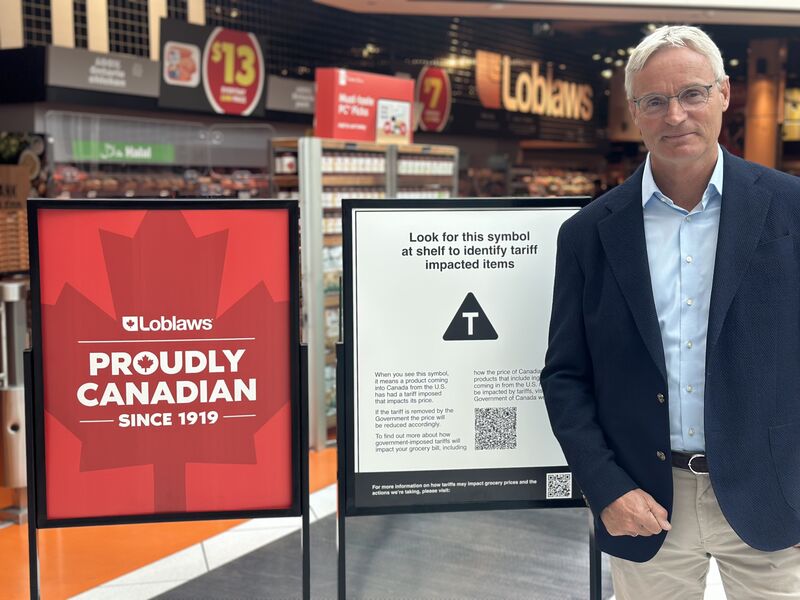
Photo- Per Bank LinkedIn

Loblaw said its performance in the fourth quarter capped a successful 2025 as it continued to invest in its future growth by opening 77 new stores across its banners, and successfully ramping the first of two automated, one million square foot distribution centres.

“The previously announced sale of PC Financial to EQ Bank will streamline the Company’s operations, and the associated long-term strategic relationship as the exclusive financial partner of the PC Optimum loyalty program is expected to result in expanded growth of high-value, loyalty-based financial services customers. 2025 also marked significant growth rates in the Company’s margin accretive logistics as a service, retail media and Lifemark businesses. Loblaw is confident that its best-in-class assets, resilient business model and investments for the future position it well to meet the evolving needs of Canadians, creating a foundation for consistent and sustainable growth,” it said.

“We are pleased to deliver another year of consistent operational and financial performance, reflecting our continuous focus on retail excellence, strategic execution, leading digital engagement and adoption of Agentic AI,” said Per Bank, President and Chief Executive Officer, Loblaw Companies Limited. “Our success reflects our commitment to being where our customers need us most, delivering unparalleled value and convenience across our many banners, combined with exceptional service from our dedicated colleagues coast-to-coast.” 

2025 FOURTH QUARTER HIGHLIGHTS

  • Retail revenue was $16,382 million, an increase of $1,657 million, or 11.3%.
    • On a 12-week comparable basis, revenue increased by 3.5%.
    • Food Retail (Loblaw) same-store sales increased by 1.5%.
    • Drug Retail (Shoppers Drug Mart) same-store sales increased by 3.9%, with pharmacy and healthcare services same-store sales growth of 5.6% and front store same-store sales growth of 2.2%.
    • E-commerce sales increased by 19.6%.
  • Retail gross profit percentage was 30.8%, a decrease of 10 basis points.
    • On a 12-week comparable basis, gross profit percentage was 31.0%, an increase of 10 basis points.
  • Retail operating income was $1,134 million, an increase of $341 million, or 43.0%.
  • Retail adjusted EBITDA was $1,775 million, an increase of $180 million, or 11.3%.
    • Selling, general and administrative expenses (“SG&A”) as a percentage of sales was 20.0%, a decrease of 10 basis points. On a 12-week comparable basis, SG&A as a percentage of sales was flat at 20.1%.
  • Net earnings available to common shareholders of the Company were $656 million, an increase of $194 million or 42.0%. Diluted net earnings per common share were $0.55, an increase of $0.17, or 44.7%.
  • Adjusted net earnings available to common shareholders of the Company were $794 million, an increase of $125 million, or 18.7%. Adjusted diluted net earnings per common share were $0.67, an increase of $0.12 or 21.8%.
    • On a 12-week comparable basis, adjusted diluted net earnings per common share increased by 10.9%.
  • Net capital investments were $677 million, which reflects gross capital investments of $722 million, net of proceeds from property disposals of $45 million.
  • Repurchased for cancellation 9.8 million common shares at a cost of $592 million. Free cash flow from Retail (continuing) operations was $1,239 million. 

2025 SELECT ANNUAL HIGHLIGHTS

  • Retail revenue was $63,903 million, an increase of $3,780 million, or 6.3%.
    • On a 52-week comparable basis, revenue increased by 4.4%.
    • Food Retail same-store sales increased by 2.3% and Drug Retail same-store sales increased by 3.9%.
    • E-commerce sales were approximately $4.6 billion, an increase of 18.1%.
  • Retail gross profit percentage was flat at 31.3%
    • On a 52-week comparable basis, gross profit percentage increased by 10 basis points.
  • Net earnings available to common shareholders of the Company were $2,667 million, an increase of $512 million or 23.8%. Diluted net earnings per common share were $2.22, an increase of $0.47, or 26.9%. The increase was primarily driven by the impact of lower costs related to certain intangible assets associated with the 2014 acquisition of Shoppers Drug Mart Corporation (“Shoppers Drug Mart”) and the favourable impact of lapping prior year charges.
  • Adjusted net earnings available to common shareholders of the Company were $2,913 million, an increase of $276 million, or 10.5%. Adjusted diluted net earnings per common share were $2.43, an increase of $0.29, or 13.6%.
    • On a 52-week comparable basis, adjusted diluted net earnings per common share increased by 10.7%.
  • Net capital investments were $1,789 million, which reflects gross capital investments of $2,062 million, net of proceeds from property disposals of $273 million.
  • Repurchased for cancellation, 34.8 million common shares at a cost of $1,875 million. Free cash flow from Retail (continuing) operations was $1,910 million.
  • In the third quarter of 2025, the Company completed a four-for-one stock split of its outstanding common shares. The stock split was implemented by way of a stock dividend, with shareholders receiving three additional common shares for each common share held. The stock split was effective at the close of business on August 18, 2025, for shareholders of record as of the close of business on August 14, 2025. All share and per share amounts presented herein have been retrospectively adjusted to reflect the stock split.

More from Retail Insider:

Amazon Launches AI-Powered Creative Agent in Canada

Amazon Creative Agent. Photo: Amazon

Amazon Ads has introduced a new AI-powered advertising tool for the Canadian market, marking a notable shift in how brands can develop creative campaigns. The launch of Creative Agent within Creative Studio gives advertisers access to a conversational, agentic AI partner capable of producing professional-quality ads in a matter of hours.

The arrival of Amazon Creative Agent in Canada signals a broader push to lower creative barriers for businesses of all sizes. By embedding the tool directly into Creative Studio, Amazon Ads enables advertisers to move from concept to finished video or display ads without relying on external production teams.

According to the company, Creative Agent supports the entire creative workflow. This includes product and audience research, brainstorming, storyboard development, scriptwriting, image generation, animation, voiceovers, music integration, and final ad delivery across multiple Amazon ad formats.

Amazon Creative Agent. Photo: Amazon

AI-Powered Creative Built on Retail Insights

Creative Agent is powered by Amazon’s retail insights, combining customer shopping signals with information drawn from an advertiser’s product pages, brand store, and website. The tool analyzes product features and brand positioning to generate concepts designed to resonate with specific target audiences.

Within Creative Studio, advertisers can access the tool through a “chat” interface. The system asks for relevant product pages, Amazon detail pages, brand guidelines, past creative assets, and intended audiences. From there, it produces multiple ad concepts and taglines, outlining how each idea was conceived and how it will appear visually to shoppers.

Advertisers can select a preferred concept or request additional variations. Once a direction is confirmed, Creative Agent generates detailed storyboards with scene-level scripts and visuals that can be edited and refined before final production.

This approach reflects Amazon’s emphasis on collaborative AI. The tool explains its reasoning at each stage, allowing advertisers to provide granular feedback and retain full creative control.

Amazon Creative Agent. Photo: Amazon

Reducing Cost and Time Barriers

Developing sophisticated advertising creative has traditionally required significant investment. Production budgets can reach tens of thousands of dollars, with timelines stretching over several weeks. Amazon positions Creative Agent as an alternative that compresses both cost and time.

The company states that advertisers can produce polished campaigns in just hours and at no additional cost. By automating elements such as scriptwriting, animation, and voiceover creation, the tool enables faster campaign launches and quicker response to market conditions.

“It’s not just about efficiency, it’s about democratizing access to premium creative capabilities that weren’t previously available to all brands,” explains Uri Gorodzinsky, Managing Director, Amazon Ads Canada and Mexico. “Creative Agent empowers businesses to test innovative concepts, work collaboratively in the moment, and produce polished advertising content, with no additional fees.”

For small and medium-sized retailers, the implications are significant. Shorter production cycles allow brands to respond quickly to seasonal shifts, emerging trends, or inventory changes. At the same time, the elimination of production costs lowers the barrier to experimentation.

Amazon Creative Agent. Photo: Amazon

Multi-Format Campaign Support

Creative Agent produces assets tailored for use across Amazon’s advertising ecosystem. These include Amazon DSP, Sponsored Display, Sponsored Brands, Sponsored Brands Video, and Streaming TV placements.

After finalizing storyboards and scripts, the tool generates complete multi-scene video ads and display creatives, including animations, music, and voiceovers. This multi-format support enables advertisers to maintain consistency across channels while optimizing for each placement type.

Amazon Ads notes that the conversational interface requires no specialized design training. Business owners or marketing teams can manage campaign development directly through the chat-based system, reducing reliance on external agencies.

Early beta testers reported that the workflow enhanced their own creative capabilities and accelerated campaign deployment.

“As a tech-focused partner, Xnurta is always seeking ways to drive more value and more easily create campaigns that scale countries,” said Kashif Zafar, CEO, Xnurta. “We are big believers in the power of GenAI creative to drive more brand engagement and sales for our clients and are excited to see Creative Agent expand to Canada – we are already mobilizing our creative team to utilize these tools on behalf of our Canadian clients,” he added.

Amazon Creative Agent. Photo: Amazon

Built on Amazon Bedrock Foundation Models

Creative Agent is built using AWS technology and foundation models available on Amazon Bedrock, including Amazon Nova and Anthropic Claude. Amazon says these models work together to support specialized AI agents while maintaining cohesive ad development.

In addition to Creative Agent, Amazon Ads offers other AI-powered creative tools such as Video Generator and Image Generator. These tools are designed to further streamline content production and enhance shopper engagement.

“AI is evolving at a remarkable rate,” notes Gorodzkinsky. “Creative Studio eliminates traditional obstacles around budget and timeline, democratizing access to the sophisticated, premium creative resources that were historically available only to major corporations. This marks just the start, the tools will evolve and improve continuously.”

Strategic Implications for Canadian Retail

The launch of Amazon Creative Agent Canada comes at a time when retailers are under growing pressure to stand out online. Digital advertising has become more complicated, and competition for consumer attention is increasing across e-commerce platforms and streaming services.

By combining AI-driven creative tools with Amazon’s retail data, the company is positioning its advertising platform as both a place to buy media and a tool to build ads. For Canadian retailers, this could help level the playing field by giving smaller brands access to creative production tools that were once limited to larger companies.

As generative AI becomes more common in retail marketing, the lines between strategy, creative work, and execution are becoming less distinct. Creative Agent moves toward a more integrated approach, allowing advertisers to create data-informed ads through a simple conversational interface.

For brands that advertise within Amazon’s ecosystem, Creative Agent adds another layer of automation to campaign development. Its long-term impact on agencies, in-house teams, and overall marketing strategies will become clearer as more Canadian advertisers begin using the tool.

More from Retail Insider:

Veg ER for Pets opens Etobicoke emergency hospital as part of North American expansion

Veg ER for Pets photo

Veg ER for Pets has opened a 5,000-square-foot, 24/7 veterinary emergency hospital in Etobicoke, marking what it says is the first location of its kind in the Toronto area and part of a broader North American network that now spans 121 hospitals.

Dr. Annie Kwok, medical director of the Etobicoke facility, said the new site reflects the company’s focus on accessibility, visibility and an open-concept model designed to differentiate it within the veterinary emergency market.

“We’re a completely open concept, so our pet parents can stay alongside their pets for every phase of treatment, including surgery and overnight hospitalization,” Kwok said in an interview.

The hospital is located next to CF Sherway Gardens, in the same plaza as Best Buy, Winners and Home Depot, with direct access from the Gardiner Expressway. Kwok said the site was chosen deliberately.

“Accessibility and visibility,” she said when asked about the location decision. “The area is definitely high traffic and our goal is to be available, 24/7, to pet parents from virtually anywhere within the GTA. So we wanted to make it where the location was easy to find, easy to see and easy to access.”

Annie Kwok
Annie Kwok

Expansion milestone

The Etobicoke hospital is part of a chain founded in 2014 by emergency veterinarian Dr. David Bessler and co-founder David Glattstein. Kwok said the company has grown to 121 hospitals, most of them in the United States.

“About 10 years ago, he looked at what we were doing in emergency medicine and thought to himself that something needed to change,” Kwok said of Bessler. “So he tried to enact that change.”

Roughly 12 years after that initial push for reform, the company has reached what Kwok described as “location number 121,” with Toronto representing its first entry into this market.

While the broader network is U.S.-based, Kwok emphasized that the Etobicoke hospital is staffed locally.

“Everyone here at this hospital is Canadian,” she said. “We want to focus on being in the community and we find community outreach really important.”

The company is currently concentrating its Canadian strategy on Toronto, with possible further expansion under consideration.

“We’re focusing on Toronto now. Hopefully in the future we can continue looking at bringing this to other areas of need in Canada,” Kwok said.

Operational model and services

The Etobicoke hospital offers emergency care, urgent care, hospitalization, surgery, blood transfusions, X-rays, ultrasounds and endoscopy. Kwok said the facility treats “anything that walks in through the front door except for venomous animals and primates.”

At approximately 5,000 square feet, the hospital is designed to be larger and more open than some traditional veterinary emergency clinics, Kwok said.

“For a veterinary emergency hospital, we’re probably pretty nice and spacious,” she said. “And that’s intentional. We want it nice and big and open so we can have comfortable arrangements for our pet parents to stay and really give that transparency to have people see everything going on.”

The open-concept layout allows pet owners to remain with their animals during treatment, including surgery and overnight stays, an approach Kwok said aligns with the company’s founding philosophy of changing how emergency veterinary medicine is delivered.

“Our hope and goal is to be that place in the community that people can feel safe going to and can trust us,” she said.

Veg ER for Pets photo

Community focus and charitable component

In addition to clinical services, the Etobicoke location participates in an initiative called Veg Cares, described by Kwok as a nonprofit donation fund used to assist pets in need.

Kwok said the Toronto operation is focused on serving what she characterized as a niche need for this type of emergency care model in the area.

Veg ER for Pets photo

While the company’s long-term Canadian footprint remains undefined, Kwok indicated that further growth would depend on identifying additional areas of demand.

“Hopefully in the future, we can continue looking at bringing this to other areas of need in Canada,” she said.

BUILD IT led the construction of the first VEG ER for Pets location in Canada. Leveraging its experience in healthcare and specialized commercial construction, the firm delivered another successful project as part of its growing veterinary and healthcare portfolio.

More from Retail Insider:

Veg ER for Pets photo

Pilgrim grows retail presence with store opening in CF Masonville Place, London

Pilgrim photo
Pilgrim photo

Pilgrim, the modern Scandinavian-Canadian jewellery brand, as it continues to expand its retail presence across the country. 

With the opening of its new boutique at CF Masonville Place in London, Ontario, Pilgrim continues to extend its presence across Canada, building on a strong foundation in Quebec and Ontario.  The company has seven stores currently in Quebec.

This milestone coincides with the brand’s 10-year journey in the Canadian market and marks the opening of Pilgrim’s 10th boutique nationwide.

“London has been part of my life for a long time because of my family, so opening a store here feels personal. The Forest City has this grounded, welcoming energy that matches what Pilgrim is all about – thoughtful, Hand & Heart Made design, sustainability, and jewellery people can truly live in, including our waterproof pieces. We’re excited to become part of the community,” said Robert P. Hayes, CEO of Pilgrim North America.

ROBERT P. HAYES
ROBERT P. HAYES

Founded in 1983 in Denmark by Annemette Markvad Pilgrim is rooted in Scandinavian design principles, with a focus on thoughtful craftsmanship, sustainability, and everyday elegance. The brand was introduced to the Canadian market under the leadership of Hayes, with collections and retail experiences adapted to Canadian sensibilities.

At the heart of Pilgrim is a simple ethos: Extraordinary Everyday. Each piece is hand and heart-made, designed for every soul with clean, simple lines and a subtle edge, bringing a touch of the extraordinary to everyday life. Sustainability is central to this approach, with 70% of the collection made from at least 75% recycled materials, reflecting Pilgrim’s commitment to mindful design and effortless everyday wearability.

“We are a Danish jewelry and sunglasses brand, and our claim to fame is that Annemette actually produced jewelry to get money to be able to go into music festivals. So she would produce outside of the festival, sell the pieces, get money, and then be able to go in. She did this all around Scandinavia. It became kind of a cult classic where people were really impressed with her jewelry. She named it Pilgrim because a music festival is like a pilgrimage. You have everybody from all over coming in together, being able to connect,” said Hayes.

“One of the things that’s really important to Annemette has always been sustainability, even before it was kind of cool, not greenwash, but something that’s always been super important to her in terms of producing things in an ethical way. She’s one of the founding members of the UN Global Compact. She’s also been really big in terms of storytelling and creating, and also working with Doctors Without Borders.

“My story kind of comes in where my cousin was working with Doctors Without Borders and she came to visit me while I was living in Denmark. That’s how I discovered the brand, because they do a necklace or an earring or a bracelet for Doctors Without Borders every season. We had to buy about 50 of them so she could bring them back to her colleagues. I discovered the brand and thought, this is so cool, and it’s ageless, and there’s nothing really like this on the Canadian market.

“I asked Annemette to bring the brand here, and she constantly said no. There were a bunch of people here that wanted it. So what I did is I asked her if I could borrow some samples, went and saw Simons, and walked out with a huge PO. The rest is kind of history. I went back with the PO and said, are we doing this or not? And that’s how the brand was established.”

Hayes said in the first year it did about $700,000 in business and opened about 100 wholesale doors, including Simons. During the pandemic, it pivoted from wholesale into retail. Within four days, it opened its first retail store. Today, 56% of its business is in retail, but it still has a huge connection with wholesale partners, selling in over 400 doors across the country, with 287 independent wholesale customers.

Pilgrim photo
Pilgrim photo

“We decided to build in London because it’s like a test town. It’s a bellwether, a little bit like Quebec City. For us, it’s a way of trying to enter into the Ontario market. We’ve opened Toronto Eaton Centre, but that’s a lot of tourists. Rideau Centre is the same thing. This would be the first real store in everyday Ontario to try to pivot the brand and expand,” explained Hayes.

“Quebec City and London have so many similarities in terms of their e-commerce presence for us, as well as a lot of our wholesale presence. So we thought this would be a really good test market to open in.

“We’re opening Oshawa in about three months from now, which we’ve signed. We’re also in the process of opening a third location this year, but I’m trying to find the right kind of deal.”

Pilgrim photo
Pilgrim photo

Hayes said the brand is also launching its demi-fine collection called xDea.

“We’re getting into the demi-fine jewelry business . . . There are two economies happening right now. There are the high-end people that are doing very well, and then there’s another portion of the economy that’s struggling.

“We’re seeing that within our wholesale customers as well. With the introduction of Dia, we’ll be able to fulfill a segment that was not currently being fulfilled within Pilgrim.”

More from Retail Insider:

Pilgrim photo
Pilgrim photo

Montreal Eaton Centre Opens Les Terrasses Food Court

Les Terrasses (CNW Group/Le Centre Eaton de Montréal) Montreal Eaton Centre

The Montreal Eaton Centre has opened Les Terrasses, Espace Restos, a new culinary destination in the heart of downtown Montréal. Located within the Tunnel level of the complex at 705 Sainte-Catherine Street West, the project pays tribute to the iconic shopping complex that once stood on the site. Positioned as a reimagined communal dining space, Les Terrasses is designed to offer an accessible, urban experience that complements the broader retail and hospitality transformation underway at the property.

The launch of Montreal Eaton Centre Les Terrasses forms part of the centre’s ongoing evolution as a mixed-use retail and lifestyle hub. In recent years, the property underwent a major transformation, including a $200 million renovation that merged the former Complexe Les Ailes with the existing centre under a unified brand. The redevelopment strengthened its position as a central node in Montréal’s Underground City network and a key gateway to McGill metro station and the REM McGill station.

A Reimagined Food Court Concept

Les Terrasses introduces a 12-vendor food hall concept that blends established quick-service brands with globally inspired offerings. The first phase includes Thai Express, Subway, A&W, Poke Monstre, Jugo Juice, Bento Sushi, and Edo Japan. A second phase, scheduled for fall 2026, will add Hurry Curry, Basha, Shanghai 360, and Grillades Torino.

“The Tunnel level, now home to Les Terrasses – Espaces Restos, has been completely reimagined and redesigned. The food hall features 12 carefully curated vendors while maintaining ample seating capacity to accommodate busy lunch-hour crowds,” said Laurence Duhamel, Senior Leasing Director, Centre Eaton de Montréal, JLL.

The food court complements existing dining destinations within the complex, including Time Out Market Montréal and the 9th floor restaurants Île de France and Le French Line. Together, these concepts broaden the centre’s food and beverage strategy, which has become an increasingly important driver of foot traffic in urban retail environments.

Design Inspired by Heritage

Les Terrasses draws inspiration from the original Les Terrasses complex, which operated between 1976 and 1987 and was known for its distinctive architectural design. The new space reinterprets that legacy through contemporary materials, improved lighting, and an emphasis on sustainability.

The design was led by LemayMichaud, which sought to create a modern gathering place while acknowledging the site’s past.

“We wanted to create a lively and welcoming destination–both an urban oasis and an animated gathering space where light and greenery interact with the vibrant energy of the Centre Eaton de Montréal and downtown Montréal. The friendly atmosphere offers a nod to the former Les Terrasses while reimagining them for today’s visitors,” said Anne-Marie Bouliane, Partner Architect, LemayMichaud.

The concept aligns with broader trends in urban retail redevelopment, where food halls and shared dining spaces serve as anchors that extend dwell time and enhance the experiential dimension of shopping centres.

The Ste-Catherine Street-facing exterior of Sephora’s store at the Montreal Eaton Centre, March 2024. Photo: Craig Patterson

Retail Expansion Alongside Culinary Growth

Coinciding with the opening of Montreal Eaton Centre Les Terrasses, Bath & Body Works has reopened near the new food hall with an expanded footprint of 5,048 square feet. The store offers a broad assortment of body care and home fragrance products, including shower gels, lotions, body mists, hand soaps, candles, and diffusers across seasonal and exclusive collections.

The adjacency of retail and food uses reflects a strategy designed to maximize cross-traffic between dining and shopping audiences. As consumer behaviour continues to evolve, landlords increasingly integrate hospitality elements directly into retail corridors to support visitation and engagement.

A Downtown Retail Anchor

Located on Sainte-Catherine Street, Montréal’s primary commercial artery, the Montreal Eaton Centre remains the largest and most visited shopping destination in the downtown core. The property welcomes nearly 22 million visitors annually and serves as a central hub within the RÉSO underground pedestrian network.

The centre is home to more than 125 stores and restaurants, including Uniqlo, Decathlon Montréal, Sephora, Samsung, Nike, Lululemon, and Aritzia. The restoration and reopening of Le 9e, one of the world’s most recognized Art Deco dining rooms, further reinforced the centre’s cultural and architectural significance in 2024.

More from Retail Insider:

How advertisers must adapt to the age of split attention: Roku 

Television viewers aren’t ignoring ads these days. They’re just ignoring advertiser’s old assumptions. 

Netflix reportedly repeats key plot points three or four times to keep distracted viewers on track, but advertisers are still clinging to 30-second spots designed for captive audiences that no longer exist. 

Brands need to stop trying to hold attention and start earning it in the two seconds they actually have. In a world of second-screen scrolling, muted TVs, and streaming fatigue, the winners won’t be the loudest but the most unmistakable. 

Platforms like CTV, Roku, and interactive streaming ads offer the ultimate leverage to reach distracted viewers with precision, measurable impact, and creativity built for multitasking. 

Ivan Pehar, Ad Sales Roku Canada, said for retailers, the opening moments of an ad need to work like a storefront window.

“Shoppers should instantly recognize the brand and understand what’s being offered—whether that’s a product, a deal, or a clear benefit. Waiting to reveal the brand or message just doesn’t work anymore. With so many distractions, the retailers seeing the strongest results are the ones that get to the point immediately and make it obvious why the ad matters,” he explained.

Ivan Pehar
Ivan Pehar

“A great example is e.l.f. Beauty, which took advantage of Roku’s Home Screen placement during the Big Game to own premium real estate in front of viewers before content even started. This boosted visibility at a key moment and connected brand exposure with buyer behaviour.”

Pehar said repetition isn’t about showing the same ad over and over; it’s about helping people remember who you are. 

“The key is to repeat the brand, not the message. The most effective retail ads keep familiar elements consistent, like colours, logos, music, or tone, while rotating the product, offer, or context. For example, a home retailer might run a CTV campaign where the logo and signature jingle appear in every ad, but one week features sofas, the next week highlights dining tables. A grocery brand could repeat its visual identity and

tagline across spots, while showcasing seasonal promotions or new product lines,” he said.

“These kinds of purposeful repetitions help the brand stick without feeling boring. Viewers don’t just remember the ad, they remember the retailer. Brands leverage the ability for storytelling with sequential messaging or extending reach against users who haven’t seen the ads on TV. Over time, this approach builds mental availability, so when someone is ready to shop, your brand is top of mind.”

As reach and frequency matter less, retailers should focus on what happens after an ad runs, added Pehar.

“Success isn’t just about views, it’s about results. Did more people visit the website, search for the brand, go to a store, or add items to their cart?

In a multitasking environment, action often happens on a second screen. To drive action we leverage multiple creative executions to further engage in the storytelling aspect, moving users down the purchase journey,” he said.

“Allowing users to get more engaged with Showroom products by consuming custom video experience and following up with action based engagements “Text / QR codes”. These tools create calls-to-action making this measurable by showing when viewers move from watching to engaging. CTV allows retailers to connect TV exposure to real-world behaviour, turning television into a measurable sales driver, not just an awareness channel.”

Pehar said watching TV with a phone in hand is now the default, not the exception and for retailers, that second screen is often where action happens.

“When viewers see something that catches their attention on TV, they’re likely to search for the product, check prices, or look up a nearby store on their phone. Roku helps advertisers understand and measure those moments, connecting CTV exposure to real behaviour across devices,” he said.

“That can look like a shoppable moment, such as a QR code or on-screen prompt that sends viewers directly to a product page, or it can be more indirect, like a measurable lift in mobile search, site visits, or store-locator use after an ad airs. In both cases, TV sparks interest, and the second screen helps finish the job.

“Rather than fighting distraction, Roku helps brands use it, turning second-screen behaviour into a measurable, high-intent opportunity that makes TV advertising more accountable and performance-driven.”

The biggest shift for legacy brands is letting go of rigid, seasonal TV buying, noted Pehar.

“For years, TV plans were locked months in advance around big moments like back to school, Black Friday, and the holidays with little flexibility once the campaign launched. But that approach doesn’t match how people shop anymore, or how CTV works. The retailers adapting best are treating CTV more like digital advertising. They are always on, test different creative messages, and adjust budgets quickly based on what’s actually driving results. If a product starts trending or inventory changes, they can respond in real time instead of waiting for the next campaign window,” he said.

“For example, a retailer might start with a broad brand message, then quickly shift spend toward ads promoting a specific product that’s seeing strong online interest. Others rotate creative weekly, either testing offers, formats, or calls to action, to see what drives site visits or store traffic, then scale what works.

“These brands are also more comfortable moving money mid-flight. If CTV is outperforming other channels, they lean in. If something isn’t delivering, they pivot. That level of flexibility can be uncomfortable for brands used to fixed TV commitments, but it’s where the momentum is.

“The advertisers winning today aren’t abandoning TV. They’re using CTV as a flexible, performance-driven tool that moves at the same pace as modern shopping behaviour.”

More from Retail Insider:

Canada Grocery Store Density Declines Despite Expansion

A woman shopping with her son in a grocery store. Photo: Unsplash

Our major grocery chains continue to open and convert discount stores across the country. Metro recently announced plans to open about a dozen new locations in 2026, focusing primarily on expanding its discount brands, including Super C and Food Basics. This week, Loblaw — the country’s largest food retailer — followed with its own announcement: a $2.4-billion investment in 2026 to open roughly 70 new stores across Canada, including Shoppers/Pharmaprix pharmacies and No Frills/Maxi discount grocery outlets, while renovating nearly 200 existing locations.

Every year, we witness the same choreography of announcements: new store openings from coast to coast. More stores to serve a market that claims to crave competition. More stores, more choice, lower prices — right?


At first glance, the news sounds encouraging. But the data tell a different story.

According to IBISWorld, Canada had 8,801 supermarkets and grocery stores at the end of 2025 — excluding specialty shops and convenience stores. That represents 21.0 stores per 100,000 residents. In 2020, the figure stood at 22.1 per 100,000. That is already a decline. Based on current projections, the ratio will fall further to 20.9 in 2026 — a 5.4% decrease since 2020.

A comparison with the United States offers some comfort — at least superficially. In 2020, the U.S. had 19.0 supermarkets per 100,000 residents. By 2025, that number had edged down to 18.8 and is expected to remain stable in 2026 — a decline of barely 1%. In other words, while Canada is experiencing a noticeable contraction in store density, the ratio south of the border has remained largely unchanged.

Comparing North America with Europe is more complex. Europe’s agri-food economy is far more regionalized, and retail there is built around proximity and walkability. In North America, our retail model still depends heavily on automobiles and long travel distances.


What is particularly frustrating about these early-year announcements is what they leave unsaid. We are told how many stores will open — but never how many will close at the same time. That missing piece of information is critical to understanding the real evolution of the market. It is, quite frankly, an optics issue. Loblaw disclosed closures several years ago, and the public reaction was far from positive.

Determining the optimal number of supermarkets in a country as vast as Canada is not straightforward. Renewal and modernization of the store network are certainly welcome. And as Canada’s population growth slows, we can reasonably expect stabilization — perhaps even rationalization — in the number of supermarkets nationwide.

That does not necessarily mean fewer choices for consumers. There is still room for smaller players and independents who quietly differentiate themselves across the country by offering something distinct. A declining store-per-capita ratio does not automatically imply a shrinking food offer. It simply means there are fewer large-format stores per Canadian than there were five or six years ago — an important nuance that triumphant press releases tend to obscure.

In food retail, as in economics, context matters far more than headlines.

More from Retail Insider:

Daily Synopsis: Feb 24, 2026

Today’s Retail Insider articles are listed below, followed by Canadian Retail News From Around the Web. Uber Eats has broadened its grocery reach by nationally launching T&T Supermarket. Foodtastic’s acquisition of Central Social Hall expands its footprint in premium casual dining, appealing to younger consumers with hybrid concepts. Meanwhile, financial pressures persist as 87% of Canadians feel trapped by rising costs, influencing spending habits across retail sectors. These developments reflect shifting consumer priorities and the increasing integration of digital and experiential retail.


🗞️ The Day’s Retail Insider Article List


🌐 Canadian Retail News From Around the Web

Ducks Unlimited Canada and Loblaw Companies Limited partner for a sustainable future for Canadian agriculture 

Loblaw Companies Limited Head Office (Image: Loblaw)

Ducks Unlimited Canada (DUC), a national leader in wetland conservation and sustainable agriculture, is partnering with Loblaw Companies Limited (Loblaw), Canada’s leading food and pharmacy retailer, building on a collaboration that began in 2025 and marks a pivotal step in advancing sustainable food systems and supporting the vital work of Canadian farmers across the country.

Loblaw will help enable DUC agronomists to work directly with grain growers and livestock producers to rehabilitate marginal cropland, establish valuable perennial cover and implement beneficial management practices that boost soil health, biodiversity and farm resilience, according to a news release. Loblaw’s vital support will enhance DUC’s capacity to deliver impactful conservation outcomes that benefit both the agricultural economy and the healthy ecosystems on which it depends.

For nearly nine decades, DUC said it has been working on the ground with producers and industry, developing innovative solutions that contribute to cleaner water, healthier soil and thriving biodiversity across millions of acres in the Prairies.

“This includes farm-gate conservation options like the Marginal Areas Program (MAP), a program that works with producers to convert low-yield acres to perennial forage while delivering ag-environmental benefits in the form of improved soil health, water absorption and beneficial insect habitat. Forage Conversion and Winter Cereals initiatives provide further crop rotation options for prairie farmers, with clear benefits to wildlife. These projects are helping to address challenges like extreme weather and soil degradation,” it said.

Nicole Chammartin
Nicole Chammartin

“This work would not be possible without the generous support of partners, and we could not be more pleased to be selected as Loblaw’s environmental partner,” said Nicole Chammartin, Chief Development Officer at Ducks Unlimited Canada. “Together with Loblaw, we are cultivating a future where productive agriculture and thriving ecosystems go hand in hand bringing regenerative agriculture to life through practical, on-farm solutions shared directly by farmers and experts.”

Emma Race
Emma Race

“We recognize the vital role that Canadian farmers play in feeding our communities and stewarding the land,” said Emma Race, Vice President of Sustainability and Community Investment at Loblaw. “Through this continued partnership with Ducks Unlimited Canada, we’re supporting programs that work together with farmers and ranchers to protect the environment, improve farm productivity and support a sustainable future for Canadian agriculture. It’s a win for farmers, a win for nature and a win for our food system.” 

This collaboration builds on Loblaw’s desire to support a more prosperous food system that benefits communities, said the company.

Learn more about the Loblaw-DUC collaboration at https://www.ducks.ca/about/our-partners/loblaw-partnership.

To learn more about Loblaw’s commitment to Canada’s prosperity, driven by its purpose of helping Canadians Live Life Well ®, visit https://www.loblaw.ca/en/responsibility/

For more information on Ducks Unlimited Canada’s sustainable agriculture programs and work with Canadian producers, visit https://ag.ducks.ca.

More from Retail Insider:

Uber Eats expands Canadian grocery selection with launch of T&T Supermarket

Source: T&T
T&T Downtown Toronto

Uber Eats announced Tuesday the national launch of T&T Supermarket, bringing a greater variety of groceries to Canadians’ front doors.

Customers can now order from T&T locations across Canada, with Quebec delivery launching at a later date. This partnership gives on demand access to fresh vegetables and fruits, fresh seafood, ready-to-eat meals, Asian snacks, and trendy Korean and Japanese beauty products every day through Uber Eats, according to a news release.

T&T Supermarket is the largest Asian supermarket chain in Canada, offering a wide variety of authentic ingredients from pantry staples to hard-to-find specialties in locations across Alberta, British Columbia, Ontario and Quebec.

Klaas Knieriem
Klaas Knieriem

“T&T Supermarket offers an incredible selection of fresh, high-quality products that are beloved by Canadians across the country,” said Klaas Knieriem, Head of Retail for Uber Eats in Canada. “We’re excited to expand the variety of groceries offered on Uber Eats, providing our customers the convenience of ordering trusted brands right to their doorstep.”

Tina Lee
Tina Lee

“Uber Eats gives customers who live or work near T&T a fast, familiar way to enjoy the freshness and value we’re known for,” said Tina Lee, CEO of T&T Supermarkets. “T&T is a destination for food discovery. You can now try exotic fruits from Asia, replenish freshly baked breads and buns, and treat yourself to our famous egg tarts all in one go. It’s an easy way to get what you need quickly from the comfort of your own home.”

How It Works

  1. Open the Uber Eats app and tap into the “Grocery” category
  2. Search for T&T Supermarket
  3. Add items to your cart, select your delivery time and place your order 
  4. Track your delivery in real time

T&T Supermarkets is the largest Asian supermarket chain in Canada, operating over 39 stores across Canada and the United States. The stores are located in British Columbia, Alberta, Ontario, Quebec, and Washington. T&T Supermarkets was founded in Vancouver in 1993 and is now led by second generation successor and CEO, Tina Lee. T&T Supermarkets is headquartered in Richmond, BC, with offices in Toronto and Los Angeles.

More from Retail Insider: