Loblaw Companies Limited has announced a new collaboration with Google that will allow Canadians to shop through conversational AI in Google Search and the Gemini app, marking another milestone in the company’s expanding Loblaw AI commerce strategy.
The announcement follows Loblaw’s recent integration of its PC Express platform into OpenAI’s ChatGPT, reinforcing the retailer’s ambition to become what it describes as an AI-native enterprise. Together, the moves position Loblaw at the forefront of agentic commerce in Canada, where AI tools move beyond search to actively assist in product discovery and purchasing.
Shopping Through Google Gemini and AI Mode
Under the new collaboration, Loblaw will make health, beauty and apparel products available for purchase directly through AI Mode in Google Search and through Google Gemini. Loblaw is the first large retailer in Canada to enable direct purchasing through Google’s AI-driven interfaces.
The integration will allow Canadians to discover and buy products through conversational prompts. For example, a shopper could ask for recommendations for a seasonal skincare routine or back-to-school apparel essentials and move directly from suggestion to transaction within the AI environment.
The system is powered by Google’s conversational AI platforms and supported by the introduction of a Universal Commerce Protocol, an open and standardized framework that enables commerce systems and AI agents to communicate securely. The protocol facilitates shopping, booking and payments across different channels, creating a more seamless path from discovery to checkout.
Per Bank, President and CEO of Loblaw Companies Limited, said the collaboration reflects the company’s ongoing focus on technology and artificial intelligence. “Our purpose is to help Canadians Live Life Well, and this most recent collaboration with Google is a clear demonstration of our commitment to leveraging technology and artificial intelligence to achieve that vision,” he said. “These integrations are making Loblaw an even better place to shop and work by fostering innovation.”

Lauren Steinberg, Chief Digital Officer at Loblaw Companies Limited, framed the move as a natural progression in how customers want to shop. “We see agentic commerce as a natural evolution of how our customers want to shop. By empowering our colleagues and making shopping simpler and more personalized for customers, we are solidifying our position as a true pioneer in Canadian AI innovation.”
Karthik Narain, Chief Product and Business Officer at Google Cloud, emphasized the broader implications for retail transformation. “We are seeing a generational shift where AI is becoming the foundational engine for business transformation. Loblaw’s commitment to scaling AI across its entire enterprise is a clear roadmap for how retailers can convert technical innovation into measurable value. By optimizing everything from merchandising to inventory management, they are proving that AI-native systems are the key to driving both operational efficiency and a superior customer experience at scale.”
Building on the ChatGPT Grocery Integration
The Google collaboration follows Loblaw’s February 2026 integration of its PC Express grocery platform into ChatGPT. That move enabled consumers to move from meal planning to checkout within a single conversational interface.
Through the ChatGPT experience, users can request meal ideas, generate ingredient lists, localize inventory by entering a postal code, and complete purchases via PC Express for pickup or delivery. The integration allows shoppers to refine preferences by dietary restrictions, budget constraints or brand choices, reducing friction in the weekly grocery planning process.
This earlier initiative marked one of the first fully integrated conversational shopping experiences offered by a major Canadian retailer within an AI platform. It also introduced the concept of Loblaw AI commerce in groceries, complementing the new Google integration that focuses on health, beauty and apparel.
Scaling Vertex AI and Enterprise Tools
Beyond customer-facing applications, Loblaw is expanding its use of Google Cloud’s Vertex AI platform across merchandising, supply chain and store operations. The retailer has leveraged Google Cloud in core retail functions for several years, and scaling Vertex AI is intended to accelerate predictive modelling and inventory optimization.
Internally, Loblaw has deployed ChatGPT Enterprise to corporate teams to assist with data analysis, coding and logistics workflows. The company also uses a proprietary AI assistant known as Robin to help store managers manage inventory, anticipate stock-outs and streamline store-floor decision making.
In collaboration with academic partners including the University of Waterloo, Loblaw has also developed Large Language Model pipelines to assess vendor price increase requests. By mapping ingredient costs to global market data, the system evaluates whether supplier price hikes align with underlying commodity trends.
AI in Healthcare and Logistics
Loblaw’s AI ambitions extend into healthcare through its PC Health app, which uses AI to personalize wellness programs and provide digital navigation tools for finding healthcare services. The system analyzes user data from wearables and other inputs to suggest tailored guidance and connect users with care providers.
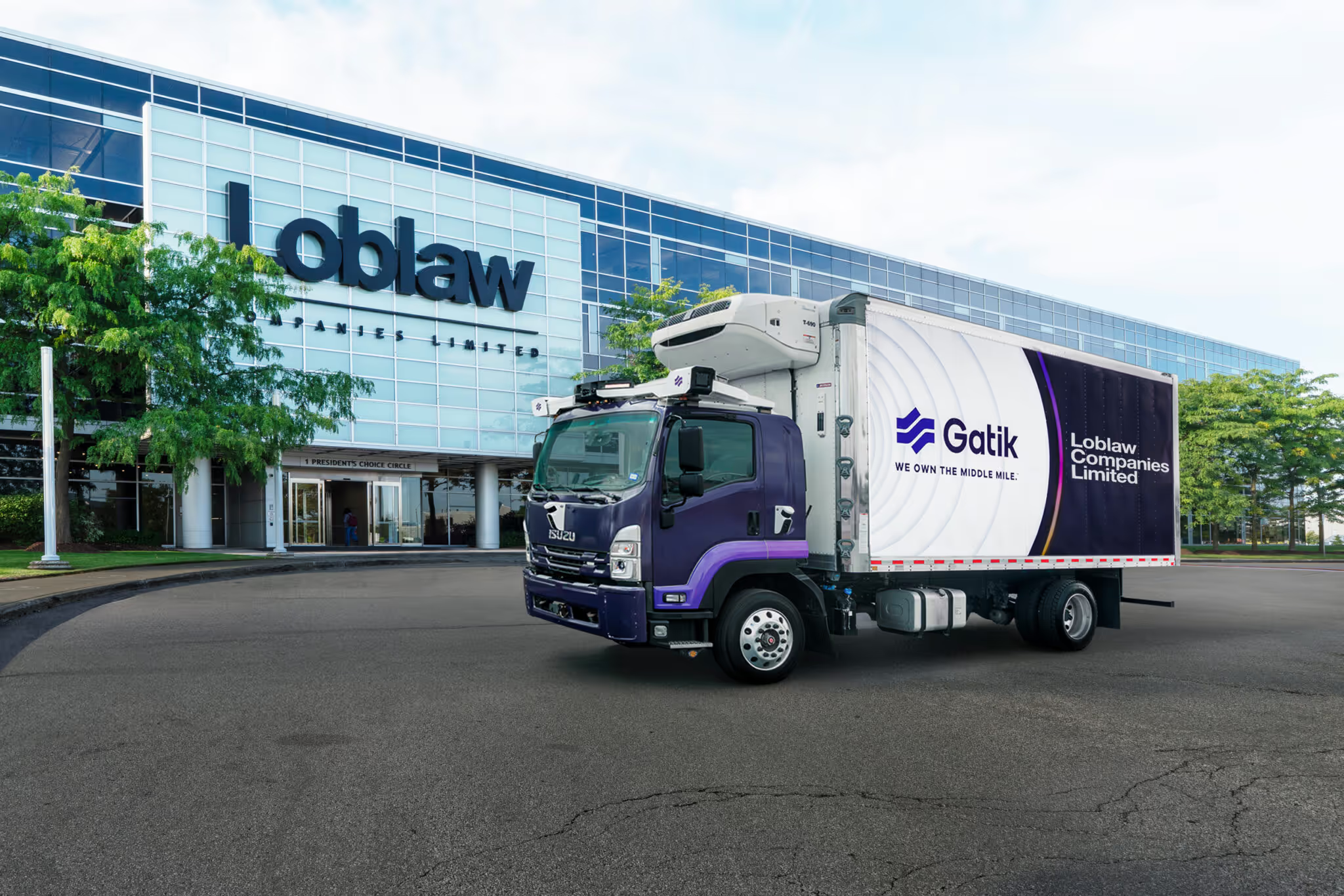
On the logistics front, Loblaw has signed a five-year agreement with Gatik to deploy 50 autonomous trucks in the Greater Toronto Area. The trucks are designed to transport temperature-controlled groceries to more than 300 stores, with a long-term objective of operating freight-only routes. The rollout represents one of the largest planned autonomous trucking deployments in North America.
The company has also opened a 1.2 million square foot automated distribution centre in East Gwillimbury, Ontario. The facility uses AI-managed robotics to increase picking and packing efficiency.
Capital Investment and Store Network Evolution
These digital initiatives coincide with a significant capital investment program. Loblaw has committed $2.2 billion in capital spending for 2025 and 2026 as part of a broader $10 billion five-year plan.
The company plans to open approximately 80 new stores over the 2025 to 2026 cycle, with roughly 50 focused on hard discount banners such as Maxi in Quebec and No Frills in the rest of Canada. Loblaw has also been converting conventional stores into discount formats to respond to consumer demand for value.
In the third quarter of 2025 alone, Loblaw opened 19 new Maxi and No Frills locations. The company is renovating more than 300 existing stores to upgrade technology, including self-checkout systems and digital shelf tags, while improving energy efficiency.
In addition, Loblaw is adding 100 new Pharmacy Care Clinics within Shoppers Drug Mart locations, deepening its role in primary healthcare services.

A Strategic Push to Gain Market Share
Taken together, these initiatives illustrate a coordinated strategy that blends physical investment with digital transformation. As Loblaw upgrades its store network and emphasizes discount banners to capture value-conscious consumers, it is simultaneously embedding AI into nearly every layer of its operations.
The expansion of Loblaw AI commerce through Google Gemini, alongside the ChatGPT grocery integration, signals a broader shift in how Canadian retailers may approach customer engagement. By meeting shoppers inside the AI platforms they increasingly use for daily planning and product research, Loblaw is positioning itself to capture incremental market share in an environment defined by both economic pressure and rapid technological change.
With more than 2,800 locations across Canada and over 220,000 employees, Loblaw remains the country’s largest retailer. Its latest AI partnerships suggest that the next phase of competition in Canadian retail may be shaped as much by algorithms and conversational interfaces as by store footprints and price promotions.