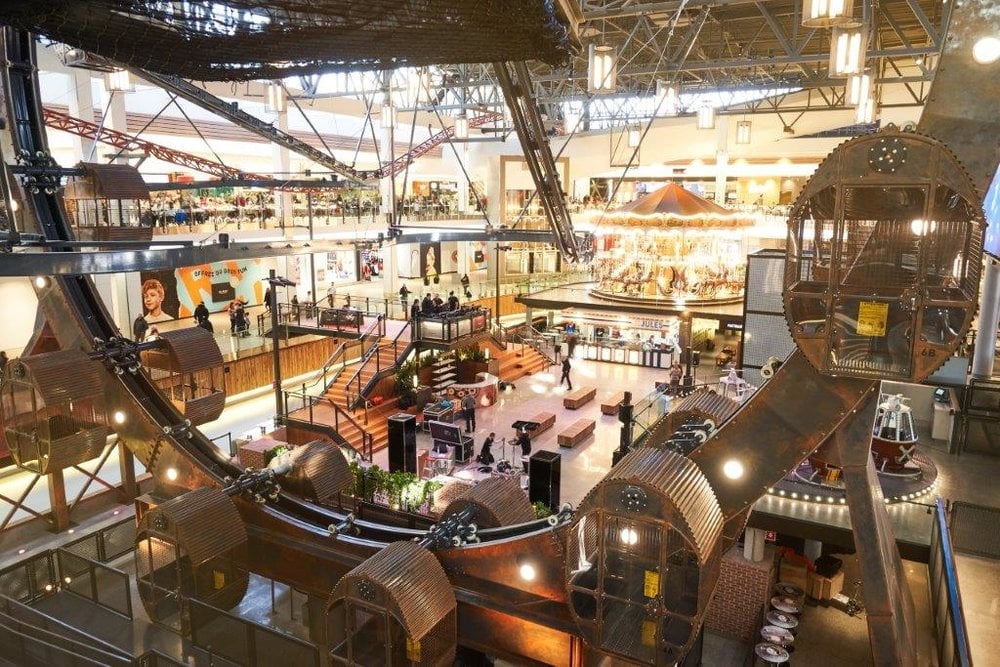
Landlord Oxford Properties has re-opened the Méga Parc amusement centre at massive Galeries de la Capitale shopping centre in Quebec City, which now includes a Steampunk theme as well as the first spokeless Ferris Wheel in North America. It’s part of a trend of mall landlords adding entertainment and other non-retail uses in order to drive foot traffic at a time when consumer tastes are shifting and many choose to shop online.
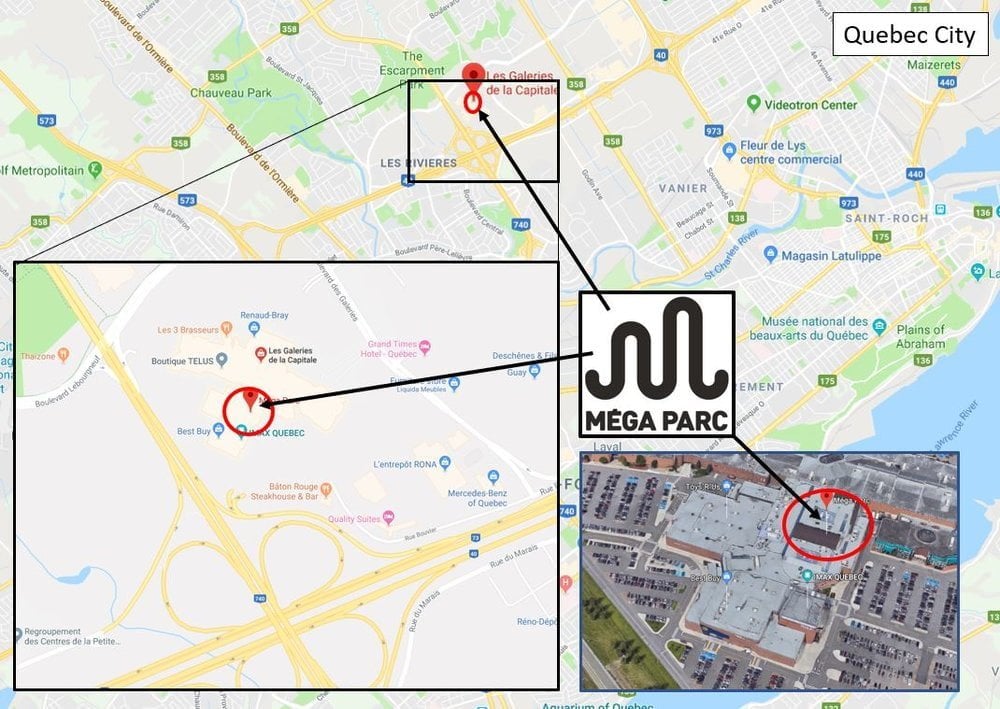
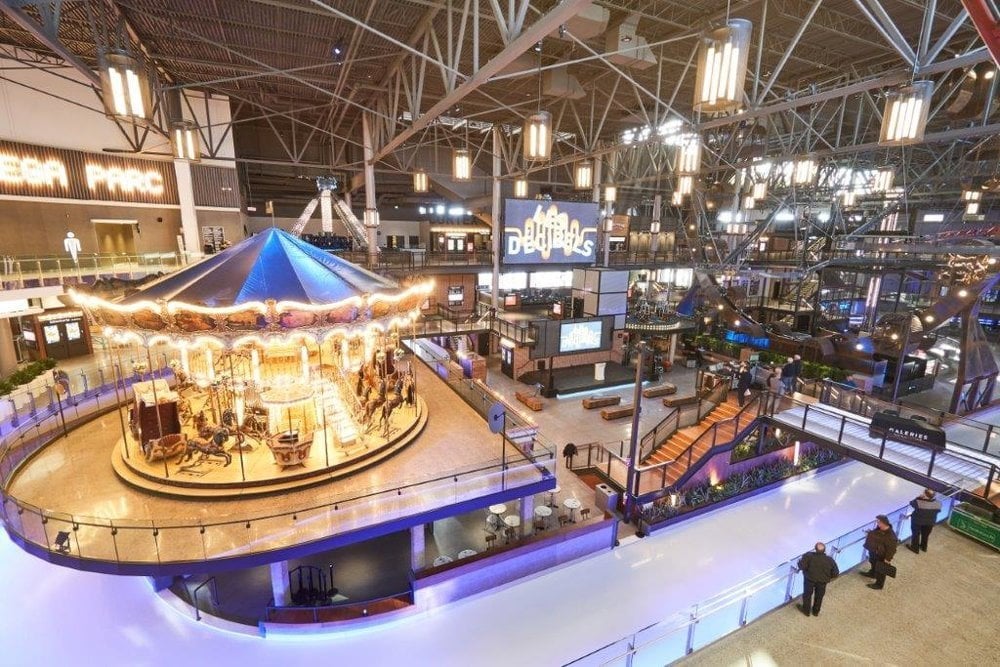
It’s the largest indoor amusement park in Quebec, and the second-largest nationwide (the largest is at West Edmonton Mall). Méga Parc was closed for over a year and after a $52-million overhaul, it now features 18 rides and experiences, 14 of which are entirely new. The four restored rides include the ‘Force G’ gravity ride, ‘Condor’ plane ride, the Carrousel, and the ‘Électro’ roller coaster.
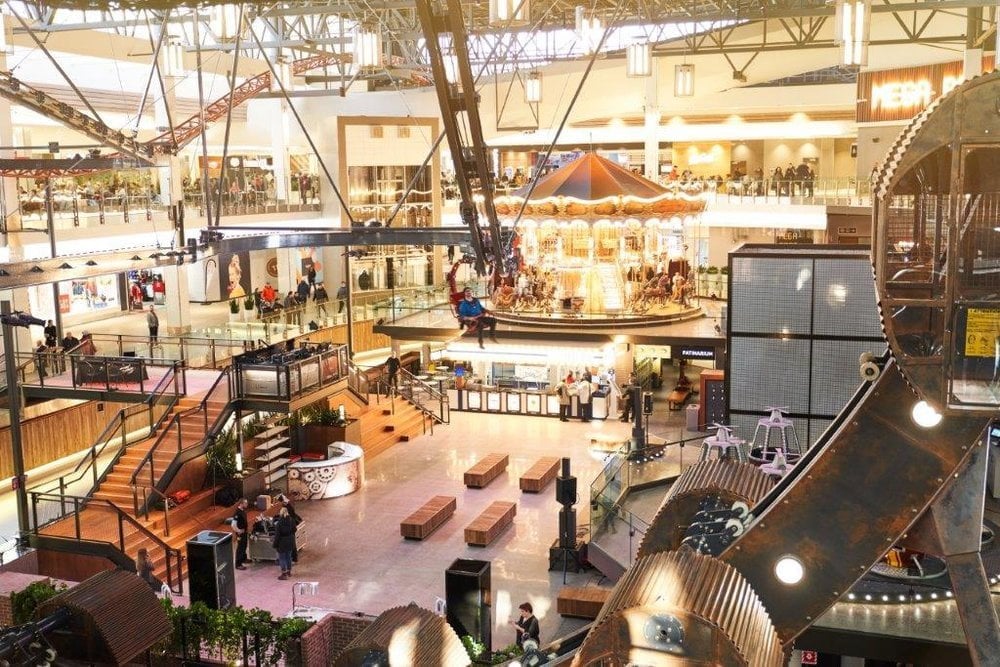
An interesting addition to the centre is Zénith, which is said to be the first spokeless Ferris Wheel in North America. Other new attractions include the Patinarium, which is a 750-foot ice skating circuit that runs through the park — it’s also is the longest indoor skating trail in Canada. The Télégraphe is described as a 40 foot high suspended glider coaster that runs right through the spokeless Ferris Wheel. The Pendule is a giant spinning pendulum that is appropriate for all ages, as is the interactive 4D Cortex theatre and the many arcade games in the ‘Salle des machines’. Other attractions include the Arsenal, the Piston, the Centrale, the Hélix, the Express, the Convoyeur, the Pare-chocs, and the Mini-mousse amusement park for toddlers — Méga Parc’s website provides further information on all of these.
Included as well are high-tech elements such as state-of-the-art lighting and sound, a giant screen, a stage for shows, and a large water fountain with lights. Oxford Properties explained how the entertainment centre is a highly functional venue for gatherings that has three rooms fully equipped for children’s parties and private events, and the entire amusement park can be rented for corporate events.
The Steampunk theme is a nod to the past as well as a point of differentiation as Méga Parc aims to be a regional tourist attraction. “The Méga Parc offers an unbeatable and unique experience you won’t find anywhere else in Canada,” said Stéphan Landry, General Manager of Galeries de la Capitale. “Locals are going to love this new entertainment offering, but it will also be a big draw for tourists and people visiting the Québec City area, especially since it’s an indoor activity families can enjoy all year-round.”
Bradley Jones, Head of Retail at Oxford Properties Group said, “The new Méga Parc is an incredible attraction that will help redefine the entire customer experience at Galeries de la Capitale. Retail is changing, and the mall is no longer simply just a place to shop but a destination to enjoy world-class experiences across fashion, food, and entertainment that can’t be recreated online.”
Shopping centre landlords such as Oxford Properties are adding entertainment components to their centres. It’s a strategy to get people into the centre and to also get them shopping. It’s something that’s more common in major shopping centres in Asia and the Middle East, and North American landlords are now recognizing the trend by adding non-retail uses, which also include expanded food and beverage offerings.
Galeries de la Capitale has seen considerable investments over the past several years in an effort to maintain its position as a dominant centre. Recent renovations have proven fruitful — the centre’s updated food court (called ‘Espace Gourmet’) is now one of the most productive in the country, and new stores are being added as retail space is reconfigured. The modernization strategy commenced about four years ago, with more than $200 million in investments having been announced for the centre’s retail and entertainment components.
Méga Parc will likely lead to further lift in visitor footfall at the centre, which saw a 7.75% increase in foot traffic in 2017 as it added new stores and others were renovated.
In March of 2018, La Maison Simons opened a first-of-its kind store in Quebec City, which uses industry leading technologies to eliminate its carbon footprint. The impressive space includes some unique features not found in other Simons stores as the company continues to refine its retail strategy. Simons moved into a former Target box from a smaller location in the mall.
Opening later this year, as well, will be a new food marketplace in the former Simons space, which is described as being a modern space inspired by European marketplaces that will showcase local food vendors and their products. A variety of artisans and merchants will offer specialties including meats, fish, seafood, cheese, spices, oils, olives, bread, pastries, juices, coffee, and various other fine products. The goal will be to offer quality and freshness at one location.
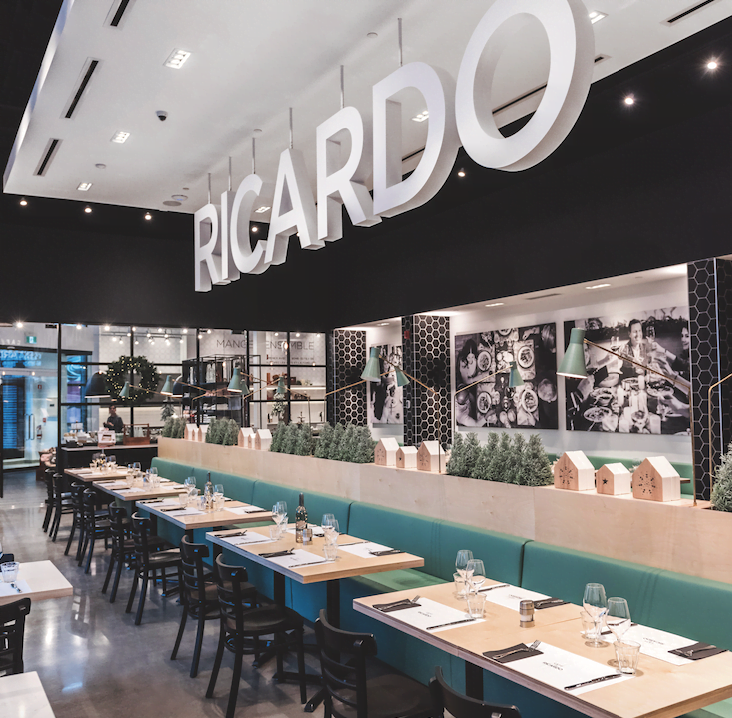
As part of the food hall redevelopment, the region’s first RICARDO Boutique + Café recently opened in the centre in a 9,000 square foot location. It includes a boutique (featuring cookware, the art de la table collections and gourmet favourites) and a café that seats about 90 people. An adjacent 745 square foot patio can accommodate more than 50 people. It is Ricardo’s third location (its second opened in Laval in November of 2017) representing an investment of nearly $2 million that led to the creation of 60 jobs.
Along with RICARDO, the new food marketplace will feature two other restaurants as well as a kitchen space reserved for fine-dining demonstrations, workshops and conferences. It’s the third such food marketplace in an Oxford Properties mall, and its first for the landlord in Quebec.

Canadian mall landlords are investing in their properties like never before, with billions of dollars being poured into centres to continue to attract shoppers. Landlords are looking beyond traditional retail models and are seeking to add new food and beverage concepts, as well as entertainment concepts, in order to attract a broader range of shoppers and keep them on-site. Given the demise of Target and Sears in Canada, landlords have more options to repurpose space in their malls beyond that of traditional fashion and anchor retailers.
Galeries de la Capitale scores high with ‘retailtainment’ with its in-mall amusement park as well as housing the only IMAX movie theatre in the area. The centre is the largest in Quebec with almost 1.5 million square feet of GLA, with about 280 stores and 10 million annual visitors.