
Advertisement
Advertisement

How the Canadian Retail Landscape will Change Post COVID-19: JLL

Date:

Share post:

The retail landscape post-COVID-19 will be vastly different than it was before the pandemic hit, and all players in the real estate industry will have to work together to move the industry forward.

Tim Sanderson, Executive Vice-President, Retail, for commercial real estate firm JLL, states that no matter how adversarial the relationship can be between landlords and tenants at times, the bottom line is that we’re all in this together and the need to find common ground is more important than ever. 

TIM SANDERSON

“Without the landlords, retailers can’t do business and vice versa. I’ve believed, for some time now, that retail is in a significant period of evolution. It will evolve in bigger and better ways because there’s a ton of smart people out there always thinking of new concepts to  bring to the marketplace. I believe that will continue to be the case post COVID-19 as well,” said Sanderson. 

“Nobody likes uncertainty. Thinking back to the Savings and Loan Crisis in 1987, we didn’t have the technology, the strength of financial markets, or this global economy that we do now. As terrible as that crisis and subsequent recessions were, we got through them. They had a beginning, and they most certainly had an end.” 

“Governments, certainly in North America, are starting to take this a lot more seriously than they did two to three weeks ago. Measures taken until April 30 could very well extend to May 31 anytime within the next four weeks. The problem right now lies in not knowing where the end is.”

Sanderson noted that an important reality is where money will be spent by consumers once the outbreak crisis is over. 

“Big-ticket items are always hurt first in recessionary times. Luxury items are hit the hardest as consumers tighten their wallets. We’re going back to shopping for essential daily needs,” said Sanderson.

Prior to the COVID-19 outbreak, Sanderson said the retail landscape within the last 18 to 24 months had been fairly robust.

“E-commerce was continuing to emerge, although it was still in the high single digits or low double digits, depending which sector of the retail economy you were talking about,” said Sanderson. “I don’t think it had deeply affected bricks and mortar retail; it was more complementary.” 

In Canada, Sanderson said the country was in a fortunate position of not being “over-retailed” compared to the United States and, from that perspective, was in an enviable position with plenty of activity in the retail real estate market.
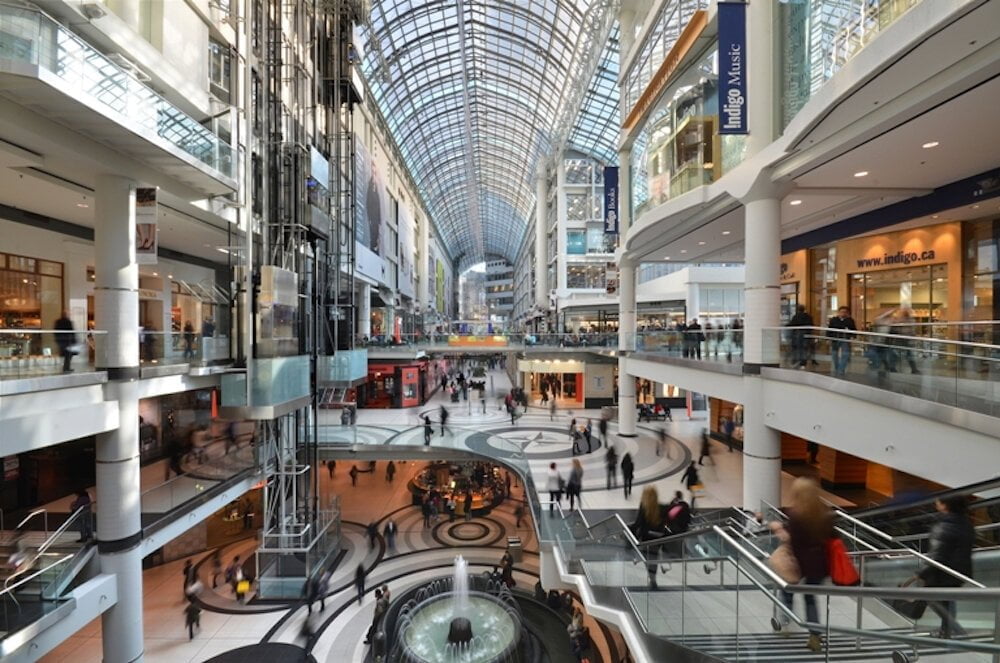
CF TORONTO EATON CENTRE
CF TORONTO EATON CENTRE. PHOTO: HOMETOWN TOURIST

Nevertheless, Sanderson said the impact of the COVID-19 pandemic is going to be huge on the retail industry.

“Liquidity in retail is a big issue, meaning how much money people have in the bank to keep their business alive. I think the sector struck the hardest is probably the food and beverage category, which was impacted early on, and is also made up to a large degree of ‘ma and pa’ retailers. The average liquidity amongst the average ‘ma and pa’ food and beverage retailers is a couple of weeks, not six months,” said Sanderson.

“What we’ve been dealing with for the last couple of weeks is what happens when rent is due. We’ve got retailers that are shut down. We waited to see what was going to happen with the malls, if different provinces across the country were going to shut them down. It’s unprecedented territory – nobody saw anything like this coming. The language that is in most leases about business interruption and force majeure is a section that people never think they’re going to have to look at. Yet, over the last two weeks, those are the clauses that are being read, re-read, and turned upside down and inside out.”

“I think we’re going to see a lot of challenges and changes for the retail industry. That said, we are already noticing significant increases in sales across grocery, drugstore, liquor stores and other essential businesses that are allowed to stay open.”

COVID-19 continues to impact our people and our economy. More details on its effects on real estate sectors can be found in JLL’s Global Real Estate Implications Report.

LEAVE A REPLY

Please enter your comment!
Please enter your name here

More From Retail Insider

RECENT RETAIL INSIDER VIDEOS

Advertisment

Subscribe to the Newsletter

Subscribe

* indicates required

RECENT articles

From The Desk: Navigating Retail’s Transformation Amid Legacy Resets and Experiential Growth

Canadian retail reshapes with Hudson’s Bay closures, experiential expansions, and evolving consumer trends emphasizing sustainability, technology and affordability.

Hudson’s Bay Stripes Return in Canadian Tire Stores

Hudson’s Bay Stripes return in Canadian Tire stores nationwide as the historic brand relaunches through a new lifestyle-focused collection.

DAVIDsTEA Returns to Profitability as Retail Strategy Gains Traction

DAVIDsTEA Returns to Profitability as Retail Strategy Gains Traction Canadian specialty retailer DAVIDsTEA has returned to profitability, marking a...

FreshCo Targets Underserved Markets with Winnipeg Opening

FreshCo will open in Winnipeg in Fall 2026, reviving a long-vacant grocery site and reflecting a broader shift in discount retail expansion across Canada.

IKEA to Open Plan and Order Point in Gatineau on May 11

IKEA Canada operates 12 Plan and order point locations in Quebec, Ontario, and British Columbia.

Happy Belly Food Group Reports $63.1M in 2025 Sales

The increase is attributed to organic baseline restaurant growth, alongside increased restaurant count, which reached 77 operating restaurants in 2025 versus 43 in the prior fiscal year, representing a 79% increase in operating restaurant count.

Square One Anchors Mississauga’s Downtown Transformation

Square One evolves into the centre of Mississauga’s new downtown, with strong retail sales and rapid mixed-use growth.

Gen Z drives rapid food trends as brands turn to AI: Tastewise

Largely fueled by TikTok and Instagram Reels, Gen Z’s tastes shift faster than brands can respond.

Three Ships challenges ‘natural’ and ‘clean’ beauty claims in Toronto campaign

The biggest issue is that there is no standardized definition across the industry at all. 

MINISO Hello Kitty Pop-Up Draws Crowds at STC

MINISO’s Hello Kitty pop-up at Scarborough Town Centre draws major crowds, highlighting demand for IP-driven retail in Canada.

Canadian Retail Sales Show Uneven Growth as Wellness Spending Surges

Canadian retail sales rose 4.0% in February, driven by health and wellness, while electronics and alcohol categories declined.

Daily Synopsis: Apr 30, 2026

Aritzia expands, Gildan reports Q1, Spin Master braces for rising costs from war, crypto ATM ban discussions, Ikea opening Gatineau Plan and Order point, Regina retail crime increases, and other news.

Casavogue Expands Offering with Furniture Warehouse in Saint-Léonard

Casavogue opens a warehouse in Saint-Léonard with up to 65% off living room, bedroom, and dining room furniture.

One Year After Hudson’s Bay’s Collapse, Retail Reshaped

A year after Hudson’s Bay collapsed, Canadian retail continues to evolve as landlords, brands, and spaces adapt to its absence.

Jobs declining in the retail sector: Statistics Canada

On a year-over-year basis, payroll employment in retail trade was down by 26,400 (-1.3%) in February 2026.

Canadian GDP rises slightly in February: Statistics Canada

Real gross domestic product (GDP) was up 0.2% in February, with goods-producing industries driving the growth for the second consecutive month.

Canadian small business sales decline, modest March rebound amid cash flow strain: Xero

Canadian small business sales fell 4.0% in the quarter to March 2026, though March posted 1.0% growth, Xero said amid cash flow pressures.

Gildan reports record first quarter revenue

Record first quarter net sales from continuing operations of $1.17 billion up 63.8% over the prior year.

La Rosée Expands in Canada Through Shoppers Deal

French clean skincare brand La Rosée expands across Canada via Shoppers Drug Mart, targeting growth in the masstige beauty segment.

Dr. Phone Fix sees revenue growth of 19% in 2025

The company operates a network of 44 corporately owned stores across five Canadian provinces.