

Canada’s first robotic cafe, RC Coffee, opened in Toronto in October 2020. The flagship location of the coffee chain revived the long-dormant retail concept of the automat: a restaurant where food and drinks are served by technology, rather than human staff.
The new coffee automat consisted of a touchscreen for placing orders, a window that allows customers to watch a robotic arm prepare their coffee, and a slot that dispenses the completed order.
Such new, digitally enabled forms of retail automation have been growing in popularity within Canada over the past decade, motivated as much by safety concerns surrounding the COVID-19 pandemic as perceived labour shortages in the service sector.
Toronto has seen the arrival of numerous autonomous business concepts, ranging from Aisle 24’s cashier-less grocery stores to PizzaForno’s 24/7 pizza vending machines.
As of the writing of this article, there are at least 10 coffee automats, six automated pizzerias and 14 unstaffed convenience stores within Toronto — and even more in the Greater Toronto Area.

These novel businesses often emphasize unparalleled convenience enabled by innovative new technologies. As RC Coffee advertises on their website: “our ground-breaking robotic coffee is available 24/7 and stays open every day of the year.”
Although the contactless convenience of these stores can be captivating, it’s important to pause and consider who benefits most from these innovations and who is left behind.
No card, no phone, no service
One concern is that automated stores generally operate on a cashless business model. Checkout is accomplished through a touchscreen interface paired with a point-of-sale device that only accepts debit, credit or smartphone payments.
This practice aligns with the general decline in cash usage for retail transactions in Canada — a trend that was already underway before 2020, but accelerated during the COVID-19 pandemic.
Although convenient for many, cashless checkout arrangements can prevent certain individuals from patronizing these businesses.
Those currently experiencing homelessness are often cited as the primary demographic that still relies on cash; however, it is estimated that about 15 per cent of Canadians are “underbanked,” meaning they have limited knowledge of or access to digital banking services.
Since these underbanked individuals often hail from low-income communities, they are already disproportionately burdened by the transaction fees associated with debit payments.
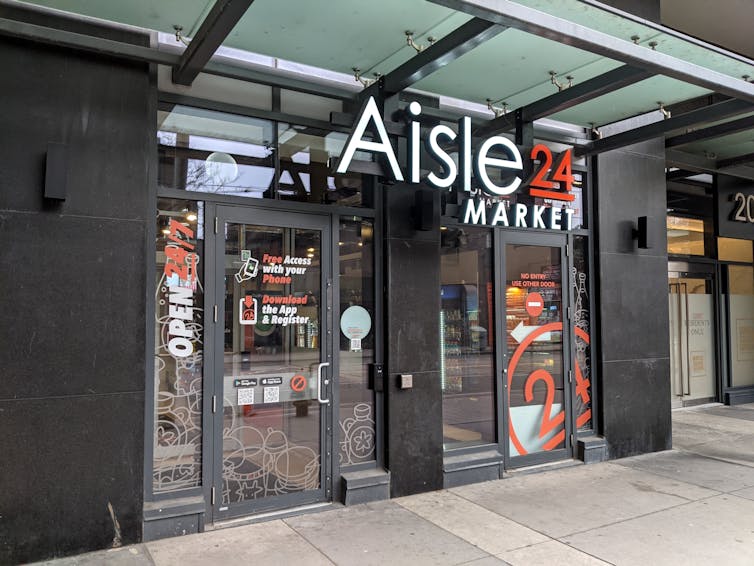
Aisle 24 goes one step further by requiring customers to download an app and create an account to enter their unstaffed convenience stores. This not only presents an obstacle for the communities mentioned above, but also impacts seniors, who still lag behind in smartphone adoption.
Automation and accessibility
Unlike the self-checkout aisles in grocery stores, which typically maintain staff to help troubleshoot technical issues, automated stores generally have no onsite employees. This poses a potential problem should a customer require immediate assistance — specifically, assistance related to a disability.
The Canadian National Institute for the Blind notes that touchscreen payment terminals often lack haptic feedback or other accessibility features, creating a barrier for Canadians with vision loss.
Similarly, instructions for navigating these autonomous experiences — which can already be physically or cognitively challenging due to their atypical interfaces and floor plans — are predominantly provided visually through electronic signage, printed instructions and floor decals.

Although these businesses generally provide a phone number or email address for remote assistance, the absence of onsite staff raises questions about the compatibility of unstaffed retail with the Accessibility for Ontarians with Disabilities Act (AODA).
The customer service standard under the AODA mandates that all customers should have equal access to services without having to accept more inconvenience. It specifically addresses concerns about businesses over-relying on visual displays instead of customer service.
Disappearing public amenities
Lastly, the automation of these retail locations often closes off taken-for-granted public amenities. In large North American cities like Toronto, spaces like public parks, shopping malls and subway stations are increasingly being designed without expected amenities like sitting areas, drinking fountains and public bathrooms.
These omissions are often intentional design choices made by business owners or municipal stakeholders to deter loitering, reduce maintenance costs and prevent vandalism.
The architecture of automats like RC Coffee are characterized by such omissions. The bathrooms, indoor seating and free Wi-Fi that we would normally expect from a cafe are notably absent from these locations.
Instead, the building façades have been converted into seamless interfaces for taking orders. And, in many cases, amenities were previously available at these sites but were removed during renovations.

Historical Google Street View data reveals that the RC Coffee on 160 Baldwin Street in Kensington Market, for example, was home to two traditional sit-in cafes prior to the opening of the automat in 2021.
This general divestment from providing public amenities slots into a broader trend within Canadian urban planning towards defensive architecture, often disproportionately targeting youths and those experiencing homelessness.
As unstaffed stores continue to displace traditional businesses, residents are being gently discouraged from spending time in public spaces outside of brief commercial transactions. Beyond simply being an issue of customer service, this move towards automation signals a significant transformation in how we interact with our cities and each other.
This article is republished from The Conversation under a Creative Commons license. Read the original article.
By Mathew Iantorno, Doctoral Candidate in Information, University of Toronto