Advertisement
Advertisement

Canadians Lead Trump Tariff Boycotts, Survey Finds

Date:

Share post:

By Shelley Boulianne

Since taking office, United States President Donald Trump has used tariffs to address perceived trade deficits with other countries. He claims that other countries have cheated and pillaged the U.S. via trade deficits.

In response, many political leaders have implemented retaliatory tariffs on American products, although Canadian Prime Minister Mark Carney recently lifted many of them in an apparent peace offering amid Canada-U.S. trade negotiations.

Citizens have also been engaged in these trade wars by avoiding the purchase of American products and services, as well as avoiding travel to the U.S.

From June 25 to July 8, 2025, Kantar, a global research and consulting company, conducted a survey through its online panels of 1,500 respondents in Canada, France and the United Kingdom, respectively.

Strict quotas were used to ensure the survey respondents would match the census profile of the adult population in each of the three countries.

Surveying consumers

As a social scientist who examines citizen engagement in civic and political life, I designed the survey questions. Respondents answered yes or no to:

Due to Trump’s recent tariffs, have you boycotted: a) American products, including grocery items; b) American services, such as Facebook, Amazon, or TV streaming services; and c) Travel to the United States.

The graph below outlines the results. Compared to the U.K. and France, Canadians were far more likely to report boycotting American products, services and travel.

Graph showing Canadians are more likely to report having boycotted US products, services and travel.
Percentage of respondents in the U.K., France and Canada who reported boycotting American products due to Trump tariffs. (Author provided)

Canadians, of course, have greater opportunities to boycott compared to other countries, given historically high levels of travel and international trade with the U.S. and Canada’s close proximity to the country. Statistics Canada reports that Canadian trips to the U.S. are down by 28.7 per cent from last year.

This case study of political consumerism reveals important distinctions compared to traditional boycotts.

Politically motivated boycotting is typically associated with those holding left-wing views.

In this case, both left-wing and right-wing people are participating in the boycott of American products. There are no ideological differences in participation in Canada and France. However, in the U.K., those on the right are more likely to boycott American products, services and travel than those on the left.

Existing research also shows well-educated people are more likely to boycott, particularly in Canada and France.

But in the Kantar survey, education did not impact participation in the boycott of American products, services and travel. All educational groups were motivated to participate.

Expressing discontent

Boycotting is a particularly attractive form of political behaviour in the case of international relations, because angry international citizens cannot simply contact Trump to express their discontent.

In fact, criticizing U.S. policies under Trump may result in being turned away at the American border by U.S. Customs and Border Protection.

Instead, consumers can express their discontent through the choices they make when grocery shopping, when making travel plans, and finally, in their choice to refrain from using American-owned social media like Facebook.

This situation is also unique because Trump actively encourages citizens to boycott companies with which he disagrees. Despite his own calls to boycott companies, Trump and American officials  have called Canadians “nasty” for boycotting U.S. alcohol and travel in retaliation of American tariffs.
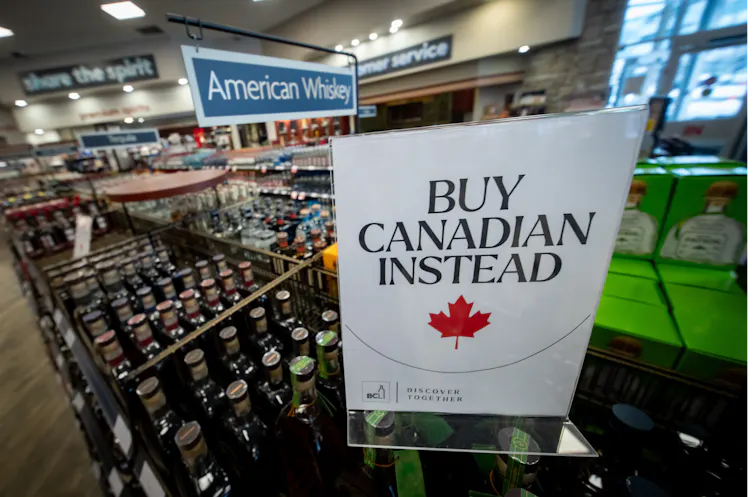
A sign in a liquor store that reads
Shoppers have been caught up in the ‘buy Canadian’ fervour since U.S. President Donald Trump announced tariffs on all Canadian goods. THE CANADIAN PRESS/Ethan Cairns

Follow the leader?

Now Canada has lifted most of the retaliatory tariffs, with Carney explaining that Canada has the “best deal with the United States right now.”

Canadians may choose to follow the direction of their prime minister or they may view this as an opportunity to take more responsibility and continue to use their purchasing choices to influence trade relations.

The responses may also differ across countries.

The U.K. says it has negotiated the lowest U.S. tariff rate so far and therefore, British citizens may choose to end their boycotting.

In contrast, political leaders in France continue to criticize the European Union’s recent trade agreement with the U.S. In this case, French citizens may follow suit and continue to use their purchasing power to influence trade relations.

About the author: Shelley Boulianne is Professor in Communication Studies at Mount Royal University.

This article originally appeared in The Conversation.

More from Retail Insider:

LEAVE A REPLY

Please enter your comment!
Please enter your name here

More From Retail Insider

RECENT RETAIL INSIDER VIDEOS

Advertisment

Subscribe to the Newsletter

Subscribe

* indicates required

RECENT articles

Changes to Temporary Foreign Worker Program applauded by business groups

Helping employers who are facing severe labour shortages.

Canada loses 84,000 jobs in February, unemployment rate increases: Statistics Canada

The largest declines were in wholesale and retail trade (-18,000; -0.6%).

Happy Belly Food Group targets up to 50 new restaurant openings as same-store sales remain strong: Sean Black interview

The company’s “core four” growth brands are Yolks, Rosie’s, Heal and iQ Food. New restaurant openings planned for this year will largely come from those concepts.

Small businesses call for stronger domestic energy supply amid global uncertainty: CFIB

An overwhelming majority (90%) of small businesses say governments should prioritize increasing Canada's energy production and capacity to better support the economy and ensure businesses have reliable access to the energy they need to operate.

The New Luxury Client in a Relationship Era

How The New Luxury Client is reshaping Canadian luxury retail through ritual, clienteling and emotional connection.

Bespoke Made Suits Opens Downtown Vancouver Showroom

Vancouver-based Bespoke Made Suits expands with an appointment-based tailoring showroom near the city’s Financial District.

Daily Synopsis: Mar 12, 2026

Cuba's fuel shortage impacts Canadian cigar stores, Manitoba asks Sobeys to scrap property restrictions, Ontario to allow shopping on 2 public holidays, alcohol in corner stores impact worker safety, redevelopment of former Sherwood Park Safeway, and other news.

73% of Canadians Now Shop Chinese Marketplaces

Survey finds 73% of Canadians shop Chinese marketplaces like Temu and Shein as monthly and weekly usage continues to grow.

Canadian hotel industry sees steady growth as leisure travel drives performance: Cushman & Wakefield

2025 ranked among the stronger years for hotel transactions over the past two decades, highlighted by several notable full-service and luxury hotel trades.

Article Expands Brick-and-Mortar Retail with Toronto Showroom

Vancouver-based furniture brand Article expands brick-and-mortar retail with a 9,600-square-foot Toronto showroom in King West, marking its second physical store.

Empire Company Limited reports Q3 financial results

Sales of $7,890 million, an increase of 2.1%.

Chatime focuses on strengthening brand leadership in Canada as expansion continues cautiously: Trinh Tham interview

Chatime currently operates about 100 locations across Canada, primarily in Ontario and British Columbia, and opened six new stores last year while preparing additional locations that are expected to come online this year.

VIDEO: 87% of Canadians feel financially trapped by rising living costs: Harris & Partners

85% report their overall monthly expenses have increased in the past 12 months

Butterly Trust Index Maps AI-Era Product Reviews

Butterly’s 2026 Trust Index shows how honest, balanced reviews influence AI-led discovery, and what Canadian brands and retailers can do next.

Abercrombie & Fitch Expands Canadian Store Network

Abercrombie & Fitch expands in Canada with new stores planned in Winnipeg, Ottawa, Calgary and London ON, and a reopened location at West Edmonton Mall.

Daily Synopsis: Mar 11, 2026

What might be next for Roots, Pokemon cards hot for theft, downtown Sudbury mall wins legal battle over 2004 Zellers exit, and other news.

Women Entrepreneurs Reshape Canada’s Franchise Industry

Women entrepreneurs are gaining momentum in Canada’s franchise sector, with leaders expanding into construction, automotive, and skilled trades.

Future of Calgary’s Hudson’s Bay Building Discussed

Experts will discuss the history, current status, and potential future of Calgary’s historic Hudson’s Bay building at a public event on March 26.

MUJI opening its newest Canadian store in British Columbia

MUJI has steadily grown as the go-to brand for millions of loyal customers in 30+ countries and 7,000+ products.

Dr. Phone Fix reports over 50% same-store growth and productivity improvements following Geebo acquisition

Dr. Phone Fix said it has begun transitioning the Geebo locations from repair-focused service centres into a broader retail platform.