

The Trump administration’s recent decision to impose a 25% tariff on Canadian and Mexican food products on March 1 is a wake-up call for Canada’s agri-food sector. As a nation that prides itself on food security and a robust agricultural trade surplus, Canada now faces a critical test of its ability to remain competitive in an increasingly protectionist global economy.
According to the new Global Agri-Food Most Influential Nations Ranking, compiled by the Agri-Food Analytics Lab at Dalhousie University and commissioned by MNP, Canada ranks thirteenth among G20 nations in terms of global agri-food influence. The United States, our neighbours, are number one. While the country has high performance in food security and political stability, its weaknesses lie in innovation, trade diversification, regulatory efficiency, and interprovincial trade barriers. These vulnerabilities are now being exploited by the latest U.S. trade policy shift.
The Economic Weight of Canada’s Agri-Food Trade Surplus
Canada’s agri-food trade surplus stands at $13.3 billion, ranking fifth among G20 nations. This surplus underscores Canada’s role as a net food exporter, supplying high-quality agricultural products to global markets, with the U.S. being the most significant trading partner. A 25% tariff on Canadian food exports will inevitably disrupt this balance, making Canadian goods less competitive in the U.S. market, leading to lower profit margins for producers, and ultimately affecting Canadian consumers.
The tariffs will also exacerbate existing challenges within the industry. The Dalhousie report highlights Canada’s struggle with high logistical costs due to its vast geography, regulatory obstacles for small businesses, and the lack of strategic investments in value-added processing. Compounding these issues are interprovincial trade barriers, which prevent efficient movement of food products within Canada itself. These barriers, ranging from differing provincial regulations to taxation inconsistencies, increase costs for producers and limit economic growth. With American tariffs cutting deep into exports, the need for Canada to build stronger trade alliances beyond the U.S. has never been more urgent.
Canada is currently classified as a Tier 2 country in global agri-food competitiveness, trailing behind Tier 1 leaders like the U.S., Japan, China, and Germany. These nations have successfully implemented policies that encourage innovation, facilitate exports, and support domestic industries through targeted investments. Canada’s fragmented regulatory framework, interprovincial trade restrictions, and inconsistent support for agri-food innovation leave it vulnerable in times of economic turbulence.

The Need for Domestic Processing Investments
The report emphasizes the importance of domestic processing investments, which would allow Canada to capture more value from its agricultural output rather than simply exporting raw materials. This is a key area where Canada lags behind top-performing nations. With the U.S. tariffs threatening Canada’s access to its largest market, the government must act decisively to enhance domestic food processing capabilities and expand export markets in Asia, Europe, and the Middle East.
The tariffs imposed by the Trump administration serve as a stark reminder that Canada cannot afford to rely too heavily on any single trade partner. Diversifying trade relationships and strengthening domestic food production and processing are now imperatives, not just aspirations.
Policy Recommendations for Strengthening Canada’s Agri-Food Sector
Policy actions must include:
- Increased R&D Investment – Canada must prioritize research in agri-food innovation, including advanced food processing, precision agriculture, and sustainable farming practices.
- Regulatory Reform – A streamlined, transparent regulatory environment would enable agri-food startups and small businesses to scale up and compete internationally.
- Trade Diversification – Expanding trade agreements beyond North America to markets like the European Union, Japan, and Southeast Asia would mitigate the risks of protectionist policies from the U.S.
- Domestic Processing Growth – More investment in food processing facilities would help retain economic value within Canada, reducing reliance on raw commodity exports.
- Strategic Infrastructure Development – Addressing high transportation costs and supply chain inefficiencies would enhance Canada’s competitiveness in global food markets.
- Interprovincial Trade Reform – Removing barriers that limit the free movement of food products between provinces would improve domestic market efficiency and competitiveness.
A Crossroads for Canada’s Agri-Food Future
Canada’s agri-food sector is at a crossroads. The Trump administration’s tariffs have exposed underlying weaknesses in Canada’s trade strategy and industry resilience. While Canada enjoys food security and a stable political environment, its ability to innovate and expand its global influence remains constrained by structural inefficiencies. By implementing forward-looking policies, Canada can turn this challenge into an opportunity—one that strengthens its agri-food industry and secures its place as a global leader in food production and export.
If Canada fails to act swiftly, the consequences will extend far beyond the farm gate. The time to secure Canada’s agri-food future is now.



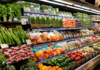












So you do a story about the Canadian Agri-food sector, post a picture and even have to caption the picture that it contains shopping carts, which is like labeling the ingredient water on a bottle of water. And the carts are from the German chain Rewe?
Sorry just seems odd/off and distracts from the story, but could just be me.
I’ll find another image — it’s sometimes a bit of a challenge to find a representative image for something, and we didn’t want to call out one retailer.