

The Hudson’s Bay Company (HBC), Canada’s oldest retailer and a storied institution in the country’s retail landscape, is now at a crossroads. After years of financial turbulence, the company has filed for creditor protection under the Companies’ Creditors Arrangement Act (CCAA), marking a significant moment in its centuries-old history.
The restructuring, announced on March 7, 2025, aims to stabilize HBC’s operations while it grapples with mounting debts, declining sales, and changing consumer habits. The move raises urgent questions about the future of Canada’s last remaining traditional department store, particularly as industry experts and insiders express skepticism about its ability to survive in its current form.

Retail strategist Carl Boutet, who has closely followed HBC’s trajectory, is blunt in his assessment. “This is a textbook example of a retailer that has failed to evolve with the times. The model that worked 50 years ago isn’t sustainable today. The writing has been on the wall for some time.”
A Financially Precarious Situation
According to court filings, Hudson’s Bay has amassed more than $1.1 billion in debt while experiencing a 30% decline in sales over the past 12 months. The company’s cash flow issues have been exacerbated by a loss of access to credit facilities earlier this year, forcing it to rely solely on daily sales revenue to cover operational costs. Industry insiders suggest that HBC’s financial troubles have left it struggling to meet payroll obligations, a common tipping point in retail bankruptcies.
Boutet points out that HBC’s missteps, including its failed attempt to revive the Zellers brand, have only further weakened its position. “Zellers was a nostalgia play that lacked substance. It had no real differentiating factor, no value proposition. It’s hard to see why anyone thought that was going to work.”
Landlords and Suppliers Lose Confidence
As HBC’s financial situation deteriorated, landlords and suppliers began taking drastic steps to protect their own interests. A recent report revealed that Cadillac Fairview, one of Canada’s largest commercial landlords, sent representatives to reclaim merchandise from Hudson’s Bay’s CF Sherway Gardens location in Toronto. In another instance, HBC’s landlords in Sydney, Nova Scotia, changed the locks on the store’s doors, effectively shutting the retailer out.
“Landlords don’t make moves like this unless things have reached a critical point,” says Boutet. “For them to take back inventory or lock out a retailer means they’ve completely lost faith in the ability of that tenant to pay what’s owed.”
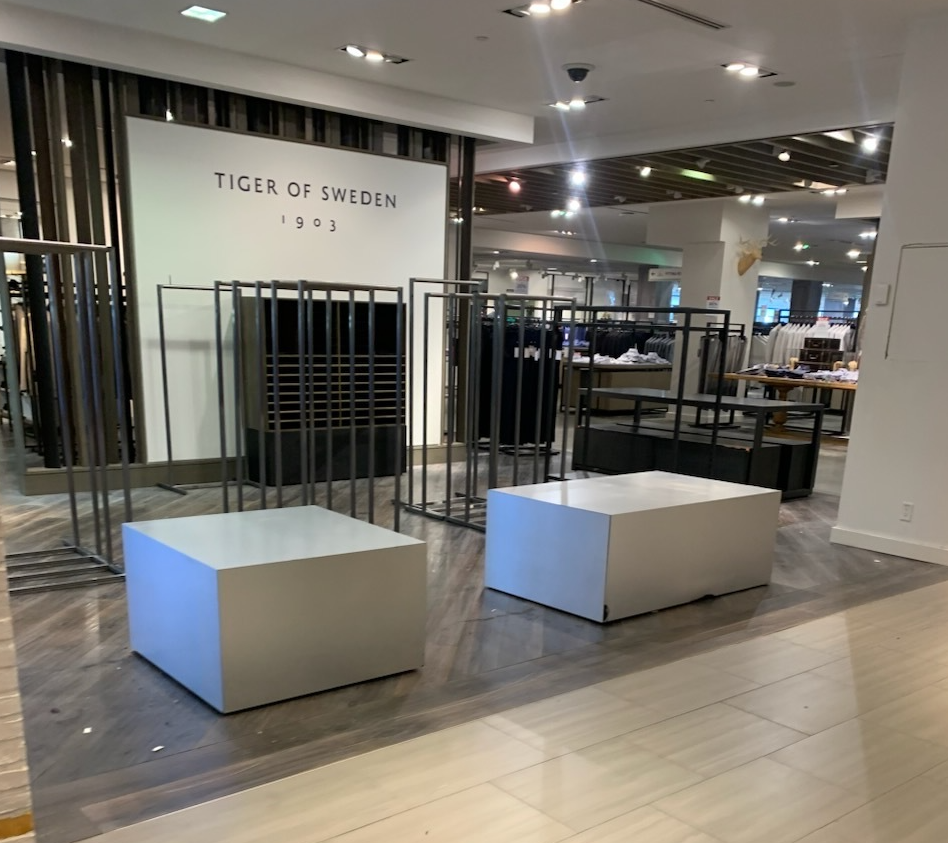
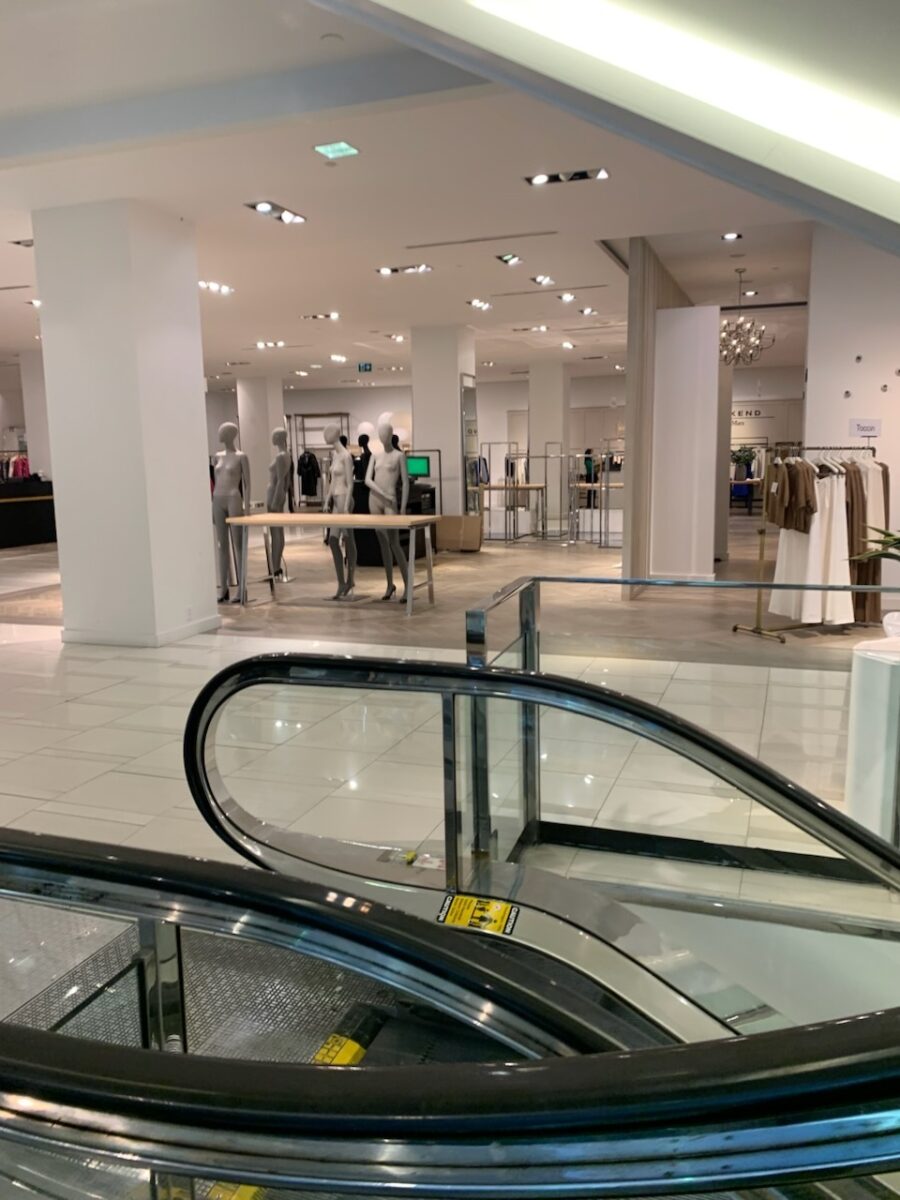
Suppliers have also pulled back, with brands like Tiger of Sweden removing inventory from Hudson’s Bay stores. Shoppers have posted images of near-empty racks at Bay locations, suggesting that many vendors had stopped replenishing stock due to non-payment.
“If suppliers aren’t getting paid, they aren’t going to keep shipping product. It’s that simple,” Boutet said. “This isn’t a new issue—it’s been building for years. The fact that we’re seeing major brands abandon ship now tells you just how dire the situation has become.”
Hudson’s Bay’s Future: A Niche Play or Total Collapse?
With the CCAA filing now in place, industry observers are speculating on what a restructured HBC might look like—if it manages to survive at all.
“The best-case scenario is that a dozen or so Bay stores remain open in key markets where landlords are willing to work with the company to keep them afloat,” says Boutet. “But beyond that, I don’t see much of a future in its current form.”
One potential strategy being floated is a reimagining of HBC as a niche Canadiana retailer, focusing on heritage-driven products in smaller-format stores.
“There’s still some equity in the brand,” says Boutet. “If someone steps in and carves out a new identity—think high-end Hudson’s Bay-branded stores in airports and tourist-heavy locations, selling blankets, outerwear, and premium Canadian-made goods—there could be something to work with. But the idea of HBC continuing as a full-line department store? That’s dead.”
Boutet also points to the shift in retail real estate trends. “The space that Hudson’s Bay occupies in these major malls is too large for what they’re offering. Mall owners will likely look to carve up those spaces and bring in a mix of smaller specialty retailers, entertainment uses, or even mixed-use developments. We’ve seen this play out already with Sears, Target, and most recently, Nordstrom.”
“Another weakness of their business model is its ability to generate enough revenue to cover even the most basic operational costs.”
A Restructuring or the End of an Era?
HBC’s restructuring is expected to involve significant store closures, likely cutting its footprint from its current 80 locations. The company also operates three Saks Fifth Avenue stores and 13 Saks Off 5th outlets in Canada under a licensing agreement, though it remains unclear how the bankruptcy will impact these operations.
Company president and CEO Liz Rodbell acknowledged the challenges ahead in a recent statement. “While very difficult, this is a necessary step to strengthen our foundation and ensure that we remain a significant part of Canada’s retail landscape,” she said. “The road ahead will not be easy, but we are committed to finding a viable path forward.”
The Canadian Retail Landscape Without Hudson’s Bay
The potential collapse of HBC would mark the end of an era for Canadian retail, following the demise of other once-iconic department stores such as Eaton’s, Simpsons, and Sears Canada. While some brands have successfully transitioned to new models—Simons, for example, has evolved into a thriving specialty retailer—HBC’s failure to adapt over the past decade has left it with few options.
“As much as we may feel nostalgic about the Bay,” says Boutet, “consumers shop differently now. Department stores were built on the idea that you could go to one place and find everything you need, but that’s what e-commerce is now. The world has changed, and Hudson’s Bay didn’t change with it.”
Final Thoughts
With a crucial court date set for March 17, the future of Hudson’s Bay remains uncertain. While there is still a slim possibility that restructuring efforts will preserve some portion of the business, the consensus among experts is that the company’s days as a national retail force are numbered.
“What we’re seeing now is the final chapter of a long decline,” says Boutet. “Whether Hudson’s Bay is able to salvage something from this or whether it simply becomes another footnote in retail history remains to be seen.”







What would be good for them is to abandon the old school department store concept and emerge with smaller locations that focus primarily on quality Canadian made goods. There is a huge demand for Canadian made product that will likely continue well into the future. It would be nice to continue their legacy as an iconic Canadian retailer and what better way to do so than to completely reinvent with a concept that Canadians will embrace. If strategically planned out, smaller stores would also equal less expense and less HR challenges, etc.
I really hope a much leaner version of HB emerges. 80 locations is far too many but culling down to approx. 15 is what I hope materializes. Canada’s major markets should have at least one Bay, ideally a flagship and one or two other high performers. In Metro Vancouver I say keep the downtown flagship and Metrotown (possibly Park Royal as well). In Toronto keep the downtown flagship, Yorkdale and Square One locations. WEM in Edmonton, Chinook in Calgary, Polo Park in MB, etc. The Bay needs more scarcity to be more of a destination retailer. Having a store in every suburb and medium sized city dilutes the experience, not to mention bloats the company’s expenses via rent, wages and inventory. Redirect the best staff from closing locations to the “keeper” locations and actually serve the public. Focusing on the best locations would help localize each location and help operations be much more nimble and responsive to trends and changes. Maybe host larger brand experiences, pop-ups, shop-in-shops, etc.? Easier said than done I admit. It would be shameful for a first world country like Canada to lose its most prominent national department store when developing countries like Mexico and the Philippines have several.
I realize shopping trends don’t favor traditional department stores like HBC — but there is a still a market for that type of store (as part of an omni-channel approach) — you can look to several retailers in the UK for example that have navigated that evolution and continued to be relevant. As a Gen X I will tell you that I still have an affinity for shopping in a nice, tidy, organized, clean, upscale-ish environment. The problem is the product selection and environment have continued to erode over the past 10+ years at HBC. My local store, in Windsor, is almost pathetically shabby. The parking lot is disintegrating, the escalators have been faulty since shortly after reopening from the pandemic and the store was the first to be hit by the HVAC nonsense last summer given our swampy summers in SW Ontario. All that aside, in the last 12 months or so the store has become essentially impossible to shop. A few months back I needed to replace a belt — they no longer carry men’s belts (or at least didn’t at the time). Today I went in looking for socks — socks are down to a single picked over rack…all of this attached to a still thriving mall at which it is the sole remaining ‘traditional’ anchor tenant. I ended up at Marshalls for the belt — not out of choice but out of necessity. I’d shop HBC over Marshalls 100 times out of 100 if it were possible — but there’s nothing to be said or done when the product isn’t even stocked any longer. It also amazes me how the entire sector gave up beauty so willingly (a category they absolutely dominated) — to in-line specialty tenants like Sephora and Ulta. Those beauty counters brought foot traffic and ‘energy’ to those sales floors which are now a shadow of their former selves. Entire situation is pathetically sad — another iconic company essentially stripped for parts. I grew up in a loyal Eaton’s household — sad to see history literally repeating itself (but as I posted elsewhere, Eaton’s at least went down fighting…).
I believe HBC has waited far too long to CCAA route. As the article states they have alienated landlords and suppliers and the state of many of their stores is abysmal. If someone wants to take a stab at salvaging this they will need deep pockets. If there is any chance of survival it will be a much smaller entity. They should get out of many categories including furniture, mattresses, major appliances and electronics. Much akin to the way Simons operates as a large format fashion retailer. Maintaining cosmetics is a question mark, again it’s a question of how much damage they have done to those business relationships. They also need to have a cohesive look and more standard merchandising. There downtown urban stores are merchandised totally different then the suburban stores. Saks should be jettisoned in Canada, licensing it doesn’t make any sense, and it they are truly serious about Zellers split some of the remaining stores one floor for Hudson’s Bay and one for Zellers. But if they have alienated Anko and other “Zellers” suppliers to such an extent then they may have effectively killed any chance of maintaining the Zellers name. Even if they survive with 30 to 40 stores I give it 2 years post reorganization before they all close. I will miss HBC. Last note, I wonder would the Weston want to take a stab at salvaging an iconic Canadian Retailer.
I’m quite curious as to what product Cadillac Fairview would be recovering from an HBC store? Was it on behalf on another retailer?
What concerns me about Hudson’s Bay leaving certain malls is the effect that it will have on the rest of the centre. While many claim the department store format is dead, it’s clear that the presence or lack thereof in a given shopping centre has a huge effect on the tenor of the rest of the centre. When a mid-to-upscale department store closes or leaves, many of the best fashion tenants do likewise and the mall begins a downward spiral from a fashion centre to a budget/value complex. Unicity in Winnipeg, Mill Woods Town Centre, Northgate and Bonnie Doon in Edmonton and Deerfoot in Calgary are just a few examples. Malls at risk of going down this road with the current HBC scenario include St. Albert Centre and Sunridge in Calgary.
I’ve been thinking a lot about this as well. Arguably Bay stores are not as critical to malls as they were in the past, but a good anchor can still ‘set the tone’ for the rest of the centre (particularly a Holt Renfrew or Simons).
Can landlords work with HBC to keep a small percentage of the stores open for this reason? For example, Polo Park in Winnipeg, Chinook and Market Mall in Calgary, Southgate and West Edmonton Mall, Metrotown, Richmond Centre and Park Royal in the Lower Mainland, etc. Other locations may not be worth salvaging but keeping a small portfoilo open would allow those shopping centres to continue positioning themselves as “premium” malls.
As an aside, I’m sure there are plenty of landlords who are thinking that an HBC liquidation would be great as it would allow property owners to reclaim many Hudson’s Bay premises and subdivide them for other tenants. Think again. There aren’t that many attractive tenants looking for retail space. Landlords can’t keep chopping up department store premises and putting Winners, HomeSense and Dollarama in every single mall in the country.