Canadian retailers spent much of 2025 trying to answer a difficult question: how do you pass along rising costs without pushing already exhausted consumers even further?
A new analysis from the Bank of Canada suggests the answer was far more strategic and selective than many Canadians may have realized.
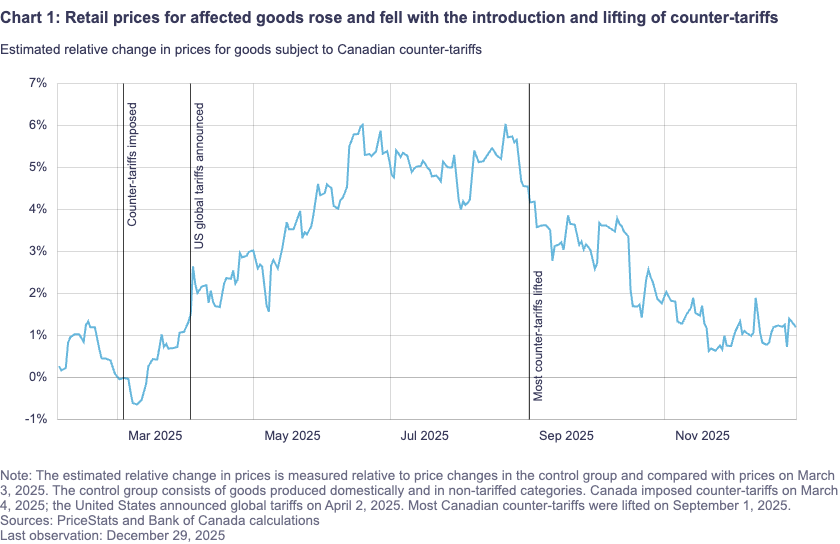
Published through the Bank of Canada’s Sparks at Bank research series, the analysis examined how Canada’s 2025 counter-tariffs on U.S. goods affected retail prices across a large sample of products sold in Canada. Researchers found that products subject to counter-tariffs rose about 6% more than comparable non-tariffed goods, representing roughly one-quarter of the 25% tariff imposed by Canada. The Bank estimated the tariffs contributed approximately 0.3 percentage points to inflation.
The results suggest retailers passed some costs along to shoppers while absorbing a meaningful portion themselves.
That mattered in an economy already shaped by inflation fatigue, cautious spending and broader uncertainty. Canadians have spent several years adjusting to higher grocery bills, rising housing costs, elevated borrowing expenses and volatile fuel prices. Consumers have become increasingly sensitive not only to price increases themselves, but also to whether those increases feel justified.
The Bank of Canada analysis suggests retailers increasingly understand that distinction.
Transparency Became Part of Pricing Strategy
One of the most revealing findings involved how retailers communicated price increases to consumers.
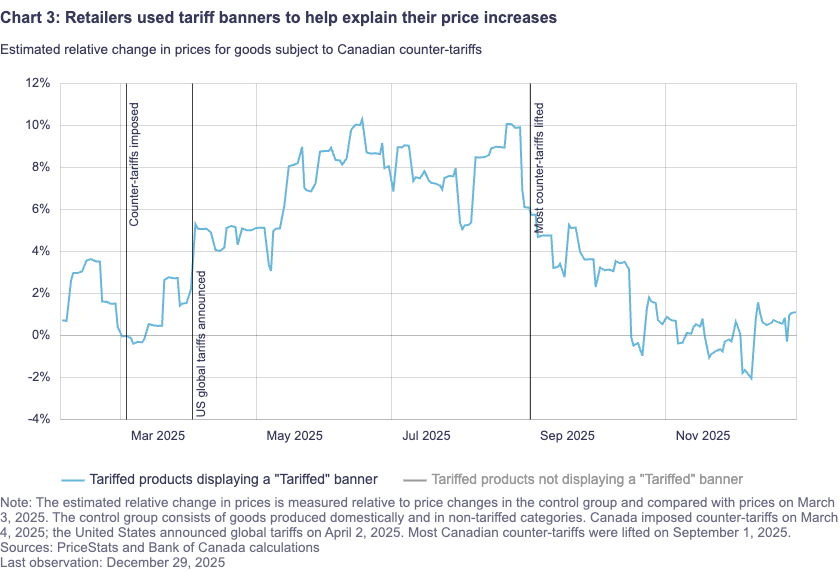
Researchers found that two retailers in the sample displayed a visible “Tariffed” label on certain affected products online. Those products experienced larger and faster price increases than tariffed goods without the label. Products without the label showed little meaningful price increase.
The implication is significant. Consumers may be more willing to accept higher prices when retailers clearly explain the source of the increase.
That insight speaks directly to how retail pricing has evolved in recent years. Consumers can now compare prices instantly across retailers and marketplaces, and many have grown increasingly skeptical of price increases after several years of inflation pressure.
In that environment, pricing has become part operational strategy and part communications strategy.
Retailers are no longer simply deciding whether to raise prices. They are also deciding how consumers will interpret those increases.
The Bank’s analysis suggests transparency may reduce resistance to higher prices by shifting blame away from retailers and toward external events such as tariffs, supply-chain disruptions or rising costs imposed elsewhere in the economy.
That may help explain why some retailers, particularly in grocery, have become more deliberate about identifying tariff-related pressures and other external cost increases for shoppers.
The broader implication is difficult to ignore: price perception may now matter almost as much as price itself.
Retail Pricing Has Become More Tactical
The analysis also offers a rare real-time look at how modern retail pricing behaves during periods of economic stress.
Researchers tracked daily online prices for more than 110,000 products sold by seven major Canadian retailers between February and December 2025. Artificial intelligence tools helped identify which products originated in the United States and were therefore subject to Canadian counter-tariffs.
The methodology itself reflects how retail pricing has changed. Retailers can now monitor competitors, pricing movements and consumer behaviour almost instantly. Consumers can do much the same.
That environment creates enormous pressure on merchants to react quickly while avoiding broad price increases that could damage trust or weaken traffic.
The data showed that prices on tariffed goods rose gradually after Canada imposed counter-tariffs on March 4, 2025. By mid-June, affected products were approximately 6% more expensive than comparable non-tariffed goods. However, researchers found little evidence of broad spillover inflation across unrelated categories. Domestic substitutes and non-tariffed products generally did not experience the same pricing effect.
That distinction mattered. The pricing behaviour suggests retailers did not broadly use tariffs as justification to raise prices across entire assortments. Instead, increases appeared targeted toward affected categories such as appliances, household goods and some grocery products. For consumers already dealing with inflation fatigue, that restraint likely made a difference.
Expectations and Uncertainty Also Influenced Prices
The research also suggests retailer expectations played a major role in pricing decisions.
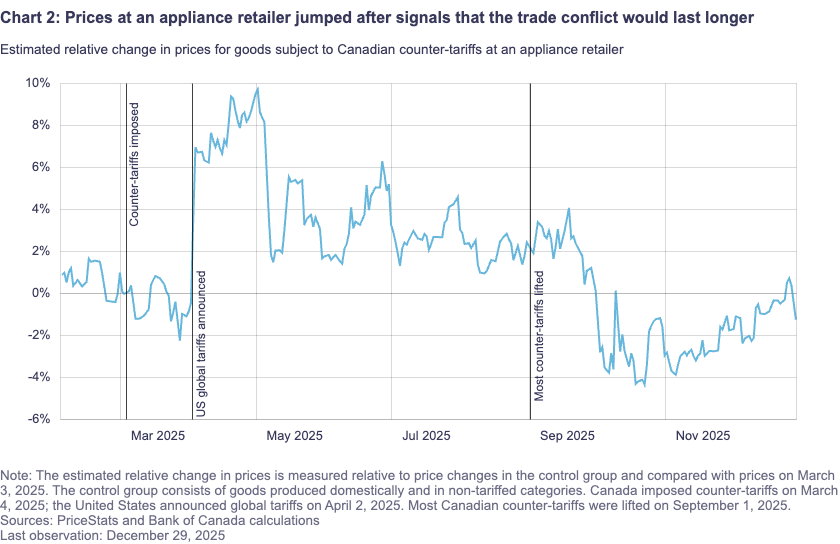
On April 2, 2025, the United States announced sweeping global tariffs. Canada did not introduce new counter-tariffs that day. Even so, prices on some tariff-affected products increased sharply following the U.S. announcement.
At one appliance retailer in the sample, prices increased 7% in just two days compared with comparable non-tariffed goods. Less than a month later, the increase peaked at roughly 10%.
According to the Bank of Canada, the escalation may have signalled to retailers that the trade conflict would last longer than originally expected. As uncertainty increased, retailers passed through a greater share of costs they had previously absorbed.
That finding feels especially relevant in today’s economic climate. Tariffs influence retail pricing not only through direct costs, but also through expectations around how long disruption may persist. If retailers believe a shock is temporary, they may absorb costs to maintain customer loyalty and protect traffic. If pressure appears longer-lasting, protecting margins becomes increasingly difficult to avoid.
In that sense, uncertainty itself can become inflationary.
Retailers Continue to Face Broader Economic Pressure
The research arrives during a period of renewed global instability and rising economic pressure.
Statistics Canada reported that the Consumer Price Index rose 2.4% year over year in March 2026, up from 1.8% in February. Higher gasoline prices tied to conflict in the Middle East were a major contributor.
Gasoline prices surged 21.2% month over month in March, which Statistics Canada described as the largest monthly increase on record.
For retailers, those pressures extend far beyond fuel purchases. Energy volatility can influence freight expenses, supplier pricing, transportation costs and household spending behaviour.
Many Canadian consumers are already exhausted by years of elevated living costs. When households spend more on gasoline, housing or borrowing, discretionary spending often weakens. That creates another challenge for retailers attempting to protect margins without triggering customer backlash.
Some merchants may absorb costs longer in traffic-driving categories. Others may rely more heavily on promotions, private label products, alternate sourcing or pack-size adjustments to maintain value perception.
The Bank of Canada analysis does not directly examine all of those tactics. However, the findings align with a broader reality across Canadian retail: pricing strategies are becoming increasingly tactical, data-driven and precise.
Prices Fell Quickly Once Tariffs Ended
The analysis also found tariff-related price increases reversed relatively quickly once most Canadian counter-tariffs were removed on September 1, 2025.
Prices on affected grocery and appliance products moved back toward comparable non-tariffed goods within several months. That suggests retailers remained highly responsive to both the underlying cost structure and competitive market pressures.
In today’s digitally transparent retail environment, maintaining elevated prices after a temporary cost shock disappears can become difficult, particularly when consumers can compare prices instantly across multiple retailers and platforms.
What the Findings Mean for Canadian Retail
The Bank of Canada analysis does not suggest tariffs were insignificant. They raised prices on affected products and contributed modestly to inflation.
However, the research also suggests Canadian retailers approached those increases carefully.
Retailers absorbed some costs, passed through others selectively, and responded differently depending on consumer-facing communication and expectations around how long economic pressure might persist.
The broader implication may be that Canadian retail pricing is becoming increasingly psychological, strategic and data-driven.
Tariffs, geopolitical instability, energy volatility and supply-chain disruptions are increasingly part of the retail operating environment. Merchants must now decide not only when to raise prices, but also how consumers are likely to interpret those increases.
In a market shaped by inflation fatigue and economic uncertainty, retailers may increasingly compete both on price and on how effectively they explain it.