

Loblaw Companies Limited announced Wednesday its unaudited financial results for the first quarter ended March 28, 2026.
Loblaw said it delivered a strong first quarter with positive sales momentum. Continued same-store sales growth in Food Retail, increased customer traffic, e-commerce sales growth, and new store openings drove topline performance.
It said the company’s discount banners outperformed again, demonstrating that Canadians are responding well to greater access to Maxi and NoFrills stores. E-commerce sales were led by growth in PC Express delivery, plus the successful integration of third-party delivery options. In Drug Retail, growth continued to reflect positive trends in prescription volumes, specialty drugs, and beauty categories. Drug Retail performance underscored the strength of the Company’s healthcare services and commitment to meeting the evolving needs of Canadians, added the company.
Loblaw said continued its focus on strategic expansion and innovation during the quarter, including opening five Hard Discount stores and eight drug stores, bringing convenient access to nutritious food and essential healthcare services to more communities.
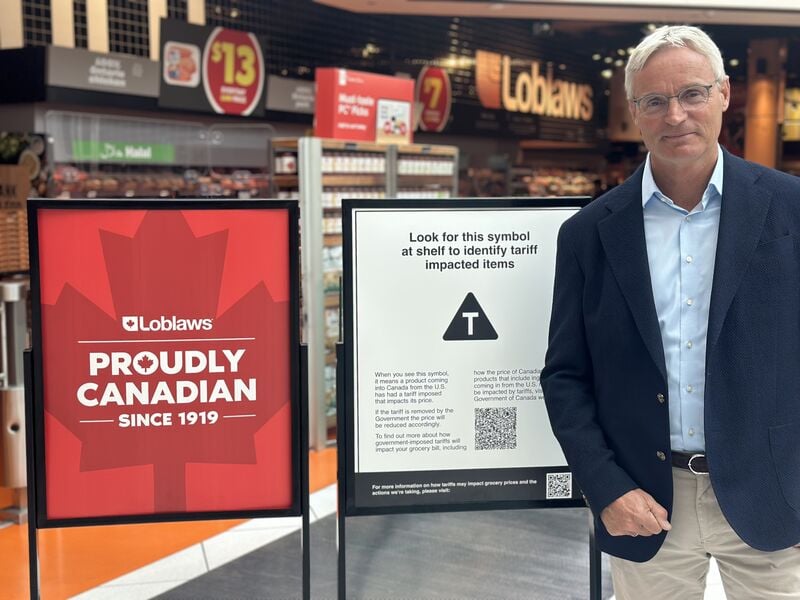
“We are very pleased that our strategic investments in opening new stores, and our focus on value, are resonating with Canadians and helping us to deliver strong financial results,” said Per Bank, President and Chief Executive Officer, Loblaw Companies Limited. “From the breadth of our banners and the continued growth of PC ExpressTM delivery, to the consistent strength of our pharmacy services, we are demonstrating our commitment to being there when and where our customers need us most.”
2026 FIRST QUARTER HIGHLIGHTS
- Retail revenue was $14,484 million, an increase of $580 million, or 4.2%. Retail revenue increased by 4.5%, excluding the impact of revenue related to Wellwise by Shoppers and the Theodore & Pringle optical business.
- Food Retail (Loblaw) same-store sales increased by 2.4%.
- Drug Retail (Shoppers Drug Mart) same-store sales increased by 4.1%, with pharmacy and healthcare services same-store sales growth of 6.7% and front store same-store sales growth of 1.0%.
- E-commerce sales increased by 20.3%.
- Revenue (including Retail and PC Financial) was $14,724 million, an increase of $589 million, or 4.2%.
- Retail gross profit percentage of 31.4% was stable, decreasing by 10 basis points, primarily driven by changes in sales mix in Drug Retail categories, partially offset by continued improvements in shrink. Food Retail gross margin was flat.
- Retail operating income was $1,010 million, an increase of $172 million, or 20.5%.
- Retail adjusted EBITDA was $1,607 million, an increase of $98 million, or 6.5%.
- Selling, general and administrative expenses as a percentage of sales was 20.3%, a decrease of 40 basis points.
- Net earnings available to common shareholders of the Company were $594 million, an increase of $91 million or 18.1%. Diluted net earnings per common share were $0.50, an increase of $0.08, or 19.0%. The increase included the impact of lower amortization related to certain intangible assets associated with the 2014 acquisition of Shoppers Drug Mart, which are now fully amortized.
- Adjusted net earnings available to common shareholders of the Company were $609 million, an increase of $39 million, or 6.8%. Adjusted diluted net earnings per common share were $0.52, an increase of $0.05, or 10.6%.
- Repurchased for cancellation 10.2 million common shares at a cost of $648 million. Gross capital investments were $312 million.
- Free cash flow from Retail was $432 million, an increase of $729 million.
- In connection with the sale of PC Financial, Loblaw expects to receive approximately $600 million in cash, representing the release of excess capital, cash consideration from EQB Inc., and collection of certain commodity tax receivables.
- Quarterly common share dividend increased by 10%, marking the fifteenth consecutive year of dividend increases.
More from Retail Insider:








record profits/revenue since they are just ripping off consumers with no other options…
It will be news to Loblaw shareholders that their company apparently now owns Sobeys, Metro, Save-on-Foods, Walmart Canada, Co-op and Costco, because Tina insists that consumers have “no other options” than a Loblaw-owned store.
“Canadian grocery retail remains more competitive than many public narratives suggest. Scale concentration exists, certainly…but consumer choice has not disappeared. The deeper issue is not merely banner ownership…it is the growing divergence between pricing perception, value accessibility, and household purchasing power across the market.”
“Scale concentration and consumer dependency are not the same phenomenon. Canada’s grocery landscape remains highly competitive across multiple national operators. The more consequential issue is the increasing pressure on consumer purchasing power…and how that pressure is reshaping value perception across every banner architecture.”
The paradox within Canadian grocery retail is becoming increasingly visible.
The stronger the financial performance becomes…the more aggressively the system is shifting toward discount architecture.
No Frills and Maxi outperforming is not merely a consumer trend…it is a structural signal. Canadians are not reducing grocery dependency…they are recalibrating where value is perceived.
What stands out operationally is the integration of three converging systems:
discount scale,
e-commerce velocity,
and healthcare adjacency.
That is not traditional grocery retail anymore. That is ecosystem retail.
Yet beneath the strength of the topline sits a more complex question:
How long can enterprise growth continue to accelerate while consumers simultaneously feel financial compression?
This is the subliminal paradox.
The business model is performing with precision…
while the customer base is operating under pressure.
And in retail, sustained growth during consumer strain requires extraordinary discipline across labour, shrink, pricing perception, inventory flow, and four-square space governance.
Because once value perception weakens…
traffic may remain….
but loyalty begins to fragment.
Strong quarter by Loblaw, particularly across discount, pharmacy, and e-commerce integration. Sustained growth at this scale reflects disciplined execution, operational reach, and structural understanding of the Canadian consumer landscape.
What stands out most to me, however, is not merely the strength of the numbers…but the discipline required to sustain them.
History has shown that the most dangerous time for a company is not when it is struggling…but when it is winning and forgetting how it won.
In retail, momentum can quietly create operational complacency beneath strong reporting periods. Labour precision, merchandising discipline, inventory governance, shrink control, and floor-level execution remain the true protectors of long-term durability.
The strongest operators understand this clearly:
success is not maintained by scale alone…it is maintained by continuously interrogating the systems that created the success in the first place.
Well executed quarter by the teams across the network.