Impact of Trump’s re-election on Canada’s agri-food Sector

Date:

Share post:

With President Donald Trump’s recent victory, headlines have been filled with warnings about the “end of democracy,” leading many Canadians to focus on what the next four years might hold. It’s true that the U.S. has just elected its first convicted felon as president, raising questions about the future. But for those of us concerned with Canada’s agri-food sector, food security, supply management, and the well-being of our farmers, the reality may be less about doom and more about data.

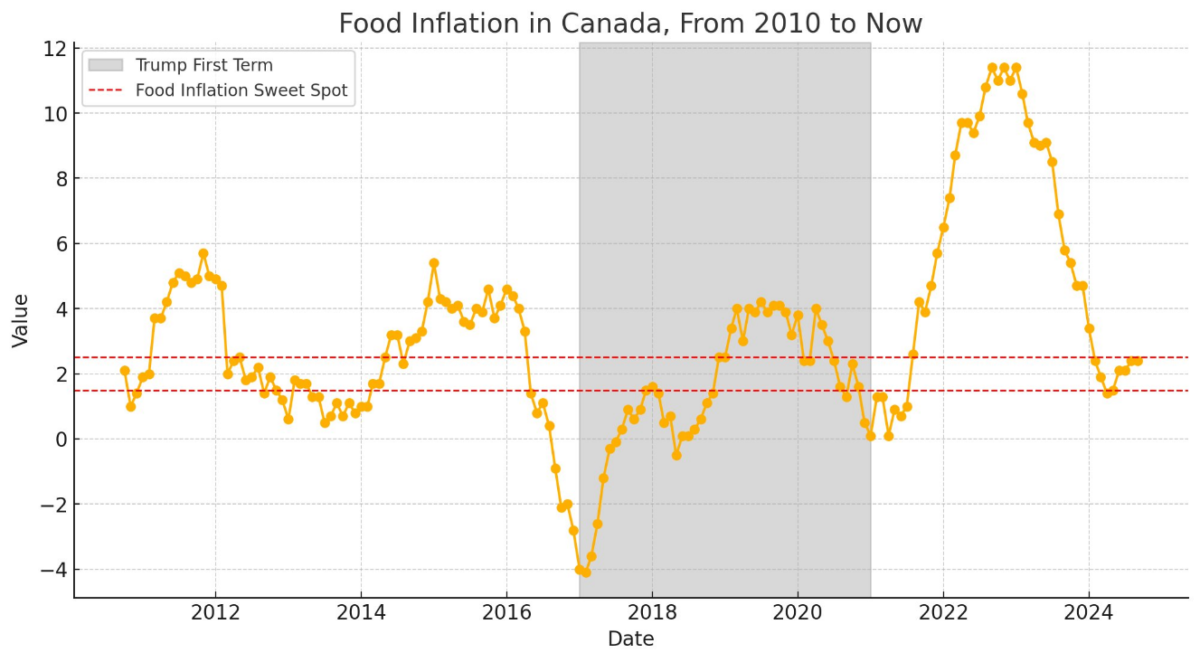
First, let’s examine food inflation during President Trump’s first term. Back in 2016, when President Trump was initially elected, the political climate was similarly intense, with talk of tariffs, renegotiated trade deals, and U.S.-centric policies. When President Trump took office, food inflation in the U.S. was at -4%—a level that may sound advantageous, but negative inflation in food prices often discourages corporate investment and stalls innovation. Though food inflation eventually hit 4% during his first term, it mostly stayed within a manageable range, averaging between 1.5% and 2.5%. Despite fears, no tariffs affecting Canada’s food supply chain were ever imposed.
USMCA and Its Impact on Canada’s Agri-Food Exports

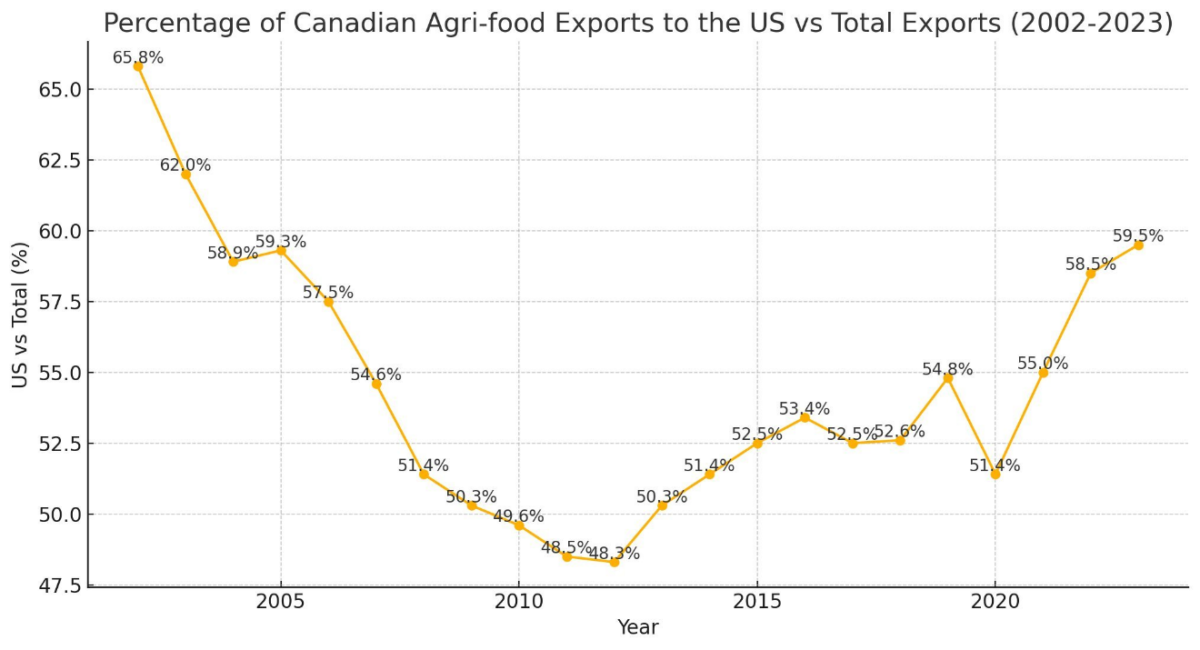
Then came the United States-Mexico-Canada Agreement (USMCA), President Trump’s flagship trade deal, which reshaped North American commerce. Ratified in 2020, President Trump’s last year in office, the agreement has led to a surge in Canada’s agri-food exports to the United States, climbing nearly 57% since 2020 to reach almost $60 billion last year.

Under the Obama administration, around 48% of our agri-food exports went to the U.S., but today, nearly 60% flow south. This dependency on the U.S. is both a blessing and a curse—while our agri-food sector benefits from access to the vast American market, it also leaves Canada’s economy more vulnerable to U.S. policy shifts. President Trump, with his America-first approach, is acutely aware of this dynamic.
Supply Management Concessions and Potential Future Changes

President Trump’s policies brought Canada closer commercially to the United States, especially in the agri-food sector. Additionally, President Trump successfully pressured Canada to concede on supply management, allowing more U.S. market access for products like dairy. Recently, Canada’s Senate criticized Bill C-282, which would have safeguarded supply-managed sectors, including eggs, poultry, and dairy, during future trade deals. If left intact, C-282 could have turned supply management into an even bigger target for President Trump.

But make no mistake—under his second term, further market access will likely be granted to American producers, and Canadian taxpayers will end up subsidizing these sectors even more. While supply management boards may frame these payouts as “compensation” for hypothetical losses, the reality is that they’re subsidies prompted by quota recalibrations, plain and simple.

Agri-food sector in Canada. Image: Canadian Chamber of Commerce

Competitiveness Challenges Facing Canada’s Agri-Food Sector

Yet the real challenge lies in our ability to keep Canada’s agri-food sector competitive. President Trump’s 2.0 agenda promises to reduce energy costs, cut red tape, lower taxes, and inject additional financial support through a colossal Farm Bill nearing $2 trillion. Since 2019, Canada’s wholesale food prices have risen almost 40% faster than those in the U.S., putting Canadian producers at a distinct disadvantage. If Ottawa doesn’t take immediate steps to address competitiveness, Canadian grocers may increasingly turn to cheaper American imports to keep prices in check.

In the end, while President Trump’s return may prompt changes, Canadians should focus on Ottawa’s actions—or inactions—in supporting our agri-food sector. President Trump’s policies may bring more American products to our grocery stores if we don’t shore up our competitive standing. Rather than fearing a distant White House, Canadians might be better off scrutinizing Parliament Hill.

The bottom line? President Trump’s re-election doesn’t signal the end of the world, and any uncertainty can be balanced by looking at the data. The real worry is not Washington but our own government’s commitment to ensuring the health of Canada’s agri-food sector.


More from Sylvain Charlebois:

RELATED ARTICLES

Subscribe to the Newsletter

Subscribe

* indicates required

RECENT articles

Scarce Retail Space Gives Canadian Landlords New Leverage

Canada’s tight retail real estate market is shifting negotiating power toward landlords as limited construction and high occupancy constrain available space. JLL, Primaris, RioCan, McDonald’s and Empire executives discuss the implications, including the temporary opportunity created by former Hudson’s Bay locations.

Canadian Holiday Shoppers Start Early, Creating New Opportunities for Retail Advertisers

Vistar Media research finds OOH advertising is influencing consumer decisions, online searches and brand consideration ahead of the holiday shopping season.

Why Grocery Pricing Rules Could Help Some Retailers and Hurt Others

Minimum advertised pricing can make it harder for discount grocers to promote lower prices. Independent retailers argue those same rules can help them compete against national chains with greater purchasing power.

Canadian Holiday Shoppers Turn to Early Deals and AI as Budgets Face Pressure: Accenture

Accenture forecasts average holiday gifting spend of $717 as consumers seek value, compare prices and use GenAI tools to find deals and products.

Tax and cost pressures holding back most small business from expanding: CFIB 

A CFIB survey finds just 7% of small businesses plan significant growth over the next year, with taxes and rising costs cited as key barriers to expansion.

Daily Synopsis: October 7, 2026

Trade war shifting consumer habits, retail crime more sophisticated say experts, Calgary's CF Chinook expands retail, Sherwood Park welcoming 7 restaurants in new plaza, T&T Supermarket opening largest Ontario store this week, and other news.

Weston Family’s Wittington to Acquire Boots in US$8.9-Billion Deal

The Weston family is making a major return to British retail with an US$8.9-billion acquisition of Boots, a pharmacy, healthcare and beauty giant with striking parallels to Shoppers Drug Mart.

Lululemon Overhauls Leadership, Taps Walmart Canada Executive as North American Sales Slide

Lululemon is restructuring its leadership team just 29 days into Heidi O’Neill’s tenure, recruiting senior executives from Walmart Canada and Athleta as the Vancouver-based retailer focuses on product, brand and operational execution.

Retail Insider Releases Q3 2026 Canadian Retail Reports

Retail Insider has released 18 Q3 2026 reports examining Canadian retail sectors, consumer behaviour and the businesses supporting the industry. The collection brings together reporting and data on store investment, real estate, technology, supply chains, marketing, security and policy.

Entertainment Becomes a New Anchor for Canadian Shopping Centres

Entertainment operators are taking larger positions in Canadian shopping centres as landlords redevelop former department stores and add attractions designed to extend visits. JLL is tracking a 16.5-million-square-foot North American pipeline as concepts including Playdium, Activate, Splitsville and Forever Young expand.

Kidfresh Expands to More Than 300 Canadian Stores as Kids’ Frozen Meal Category Grows

The brand is adding Metro Ontario and Pattison Food Group locations while making and packaging its Canadian lineup domestically.

Imaginaire Targets National Expansion with 2–3 New Stores Annually

Quebec-based hobby and collectibles retailer Imaginaire is prioritizing Ontario as it plans two to three new stores annually beginning in 2027 and builds toward a national footprint.

Canadian Travel Brand Monos Plans Retail Expansion as Tariffs Reshape U.S. Strategy

CEO Victor Tam says the Vancouver-based company is deepening its presence in existing Canadian markets while balancing growth between Canada and the U.S.

Replacement Tenants Now Identified at All Former Nordstrom Stores in Canada

More than three years after Nordstrom exited Canada, replacement tenants are now known at all six former full-line stores. From SportChek, Winners and Old Navy in Calgary to Simons, Aritzia, Eataly and Splitsville elsewhere, the former department-store boxes are taking on very different configurations.

Most Canadian Small Businesses Haven’t Felt AI’s Impact: Zensurance

Second-wave findings from Zensurance’s 2026 survey show three-in-five small business owners remain outside the AI conversation.

Calgary Retail Investment Hits $522 Million in H1 2026, Led by $154M Northland Village Sale

Investor demand in Calgary is strongest for grocery-anchored, neighbourhood and convenience-focused properties, as buyers seek resilient retail assets amid population growth and limited supply.

EB Games opening North America’s first Nintendo store-within-a-store experience in Toronto

New permanent Nintendo space coming to EB Games' flagship Toronto location October 17

Canadian Consumer Spending Tracks 2.6% Growth in Q3 as FIFA World Cup Provides Modest Boost: TD

TD data show spending on travel, groceries and home-related purchases remained resilient, while World Cup activity lifted select categories in Ontario and B.C.

Costco expands on-demand delivery across Canada through DoorDash

Costco members across Canada can now order groceries, household essentials, electronics and other products from Costco warehouses through DoorDash.

Daily Synopsis: October 6, 2026

Wild Fork retreats from Ontario after closing four stores, contrasting with Jollibee's rapid Canadian growth and MINISO's launch of a larger store format in Mississauga. Their differing strategies reflect varied approaches to scaling retail operations in competitive markets.