In recent months, the “Buy Canadian” movement has gained significant momentum, driven by a collective push to support domestic products and services, strengthen local businesses and reduce reliance on foreign imports.
Escalating trade tensions and tariff disputes with the United States and threats from U.S. President Donald Trump to annex Canada have played a pivotal role in fuelling this shift toward economic nationalism.
Though still in its early stages, the movement has already gained strong support from Canadians, with both consumers and businesses prioritizing homegrown products to strengthen the local economy.
Early results are promising
The “Buy Canadian” movement is already delivering promising results across the retail sector. Major retailers such as Loblaws Companies have reported a 10 per cent increase in sales of Canadian-made products. Sobey’s parent company Empire also noted a decline in sales of U.S.-sourced goods.
Importantly, the shift isn’t limited to big retailers or headline product categories. Smaller retailers and established brands are also seeing tangible benefits.
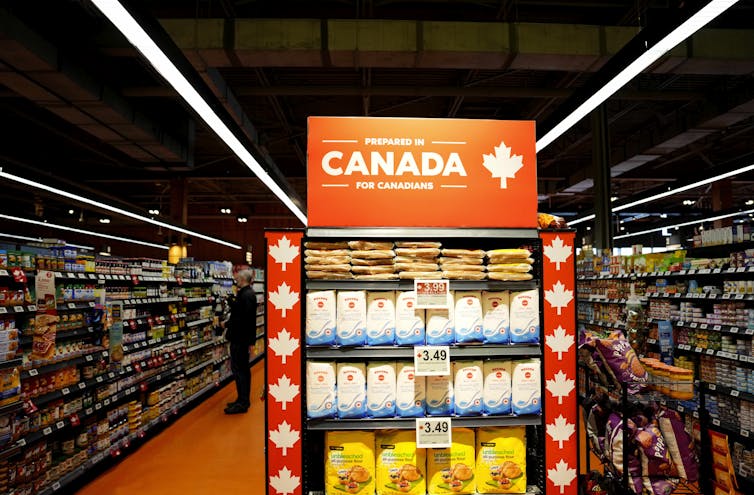
Ice cream producer Chapman’s, long known for its strong Canadian brand identity, has seen a 10 per cent increase in sales. E-commerce platform giant Shopify has reported a spike in sales for Canadian merchants across a long list of categories including mattresses, row boats, ribbons, armchairs and more.
Some provinces have pulled U.S. alcohol from store shelves to prioritize selling homegrown options, putting Canadian wineries, breweries and distillers in a position to grow substantially.
Though more data will emerge in the months ahead, early indications show that Canadians are backing the “Buy Canadian” movement not just in spirit, but with their wallets.
Helping Canadians choose Canadian
One of the most noticeable effects of the “Buy Canadian” campaign has been a nationwide effort to make it easier for consumers to identify Canadian-made products.
Demand for clear labelling has surged, prompting the Canadian Food Inspection Agency to issue a notice to industry urging producers to improve transparency.
Consumers are becoming increasingly proactive in educating themselves, with searches for “Buy Canadian” related terms skyrocketing in the past few months. Websites such as Madeinca.ca have seen a large uptick in traffic, peaking at 100,000 visits in a single day.
Retailers have been offering more in-store and online signage highlighting Canadian products. Loblaws has introduced a “Swap & Shop” tool in its Optimum app that helps users find Canadian-made alternatives for items on their shopping list. It has seen a 75 per cent week-over-week growth.
Home improvement retailer RONA has launched the “Well Made Here” campaign that provides staff training and partners with non-profits to educate consumers about Canadian-made alternatives.
Celebrity endorsements have also amplified the movement. Actor and comedian Mike Myers showcased the colloquial expression “elbows up” on Saturday Night Live, while Michael Bublé used his platform at the Juno Awards to deliver the message that “Canada is not for sale.”
Pushing the movement forward
Consumers have been turning to social media to further propel the Buy Canadian movement. Hashtags like #ShopLocalCanada and #MadeInCanada have gained significant traction, with nearly three million posts across major social media channels Facebook and Instagram.
A newly launched web browser plug-in called Support Canadian is also gaining attention. It works by bringing Canadian products to the top of search results on retailers such as Amazon. In its first week, it attracted 500 users. Although these numbers may appear small, early analytics suggest it could keep over a million dollars inside the Canadian economy.
Mobile apps designed to help consumers determine the origin of their purchases are gaining popularity. The BuyBeaver app, which crowd-sources product origins, reached 100,000 downloads in just five weeks.
Meanwhile, OScanAda, which uses AI and barcode scanning to provide detailed insights into Canadian ownership and sourcing, has been downloaded 160,000 times. MapleScan, which currently is ranked second in the shopping category on the Apple App Store, uses AI to scan products and suggest Canadian alternatives.
Brands are leveraging their Canadian roots
In response to growing national sentiment, a number of Canadian brands are using marketing strategies to underscore their national identity for consumers.
Kicking Horse Coffee, for example, has humorously rebranded the Americano as the “Canadiano” in a nod to Canadian pride. Black Diamond recently launched a campaign with the cheeky tagline “Made with 0% American Cheese.”
Meanwhile, Moosehead Brewery has launched a limited-edition “Presidential Pack” containing 1,961 beers — one for each day of the U.S. presidential term.
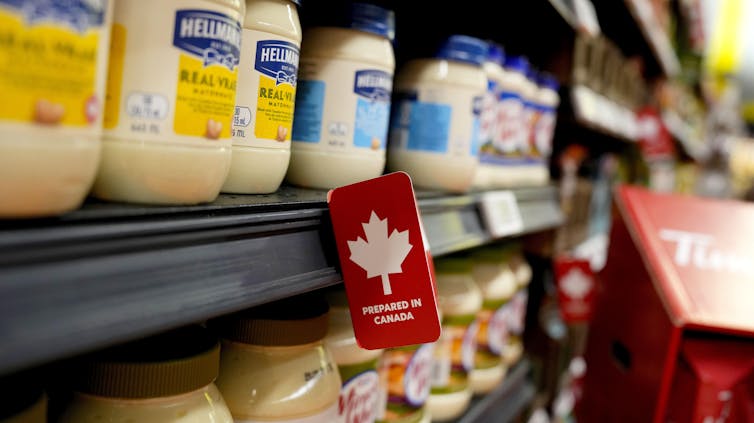
Other companies have modified existing campaigns to better align with the movement. Sobeys recently debuted a new “So Canadian” campaign, a new iteration of its long-running “So.be.it.” campaign.
Healthy Planet has expanded its #Healthyplanetswap campaign to include #HealthyCanadianSwap, which focuses on providing domestically sourced options.
Whether through packaging that clearly marks country of origin or marketing campaigns that play on national pride, Canadian brands are leveraging their national identity to resonate with consumers.
A smart choice in uncertain times
The early momentum behind the Buy Canadian movement is promising. While Canada was largely spared from Trump’s most recent tariffs under the Canada-United States-Mexico Agreement, the unpredictability of U.S. trade policy and broader global tensions make it more important than ever to build long-term economic resilience at home.
The early days of the movement show a strong desire among Canadians to support local industries, protect jobs and reinforce national self-sufficiency. Even as higher costs and global disruptions remain real challenges, buying Canadian serves as both a practical and symbolic choice, one that reduces dependency on volatile foreign markets and strengthens the domestic economy.
This is a pivotal moment. The foundations of the movement are in place, and its early success is encouraging. For the “Buy Canadian” effort to have lasting impact, it needs sustained commitment from consumers, businesses and policymakers alike.
By continuing to prioritize homegrown goods and services, Canadians can help shield their economy from future shocks and chart a more independent, stable path forward.

About the Author: Melise Panetta is a Lecturer of Marketing in the Lazaridis School of Business and Economics at Wilfrid Laurier University
More from Retail Insider:
- Canadian consumers rally behind ‘Buy Canadian’ movement
- VIDEO: How retailers are capitalizing on the Buy Canadian
*This article originally appeared in The Conversation.