Best Buy is testing a new physical retail concept exclusively in Canada, opening dedicated Business Centres within two existing stores in the Greater Toronto Area. The initiative comes as the Minnesota-based electronics retailer expects its business-to-business division to generate approximately US$1.3 billion in revenue this fiscal year, representing annual growth of about 20%.
Speaking during the company’s third-quarter earnings call on November 24, Best Buy CEO Jason Bonfig discussed the Canadian initiative in response to a question from Jefferies analyst Jonathan Matuszewski about the retailer’s decision to allocate store space to its commercial technology business. Bonfig said growth in the division during the third quarter was consistent with expectations for the full fiscal year.
“There are about six different segments that we serve underneath Best Buy for Business, and I think one of the things you are seeing in those business centers, which are only in Canada at this point in time, is an example of us moving very quickly to learn what is going to work in that particular space and doing some experimentation,” said Bonfig. The two Ontario locations will help inform the future development of the format in Canada.
Two Business Centres Open in Ontario
Best Buy Canada introduced its first Business Centre in October at its Markville store at 5000 Highway 7 East in Markham. A second location opened in November within the retailer’s Heartland store at 6075 Mavis Road in Mississauga, establishing a presence in two suburban markets on opposite sides of the Greater Toronto Area.
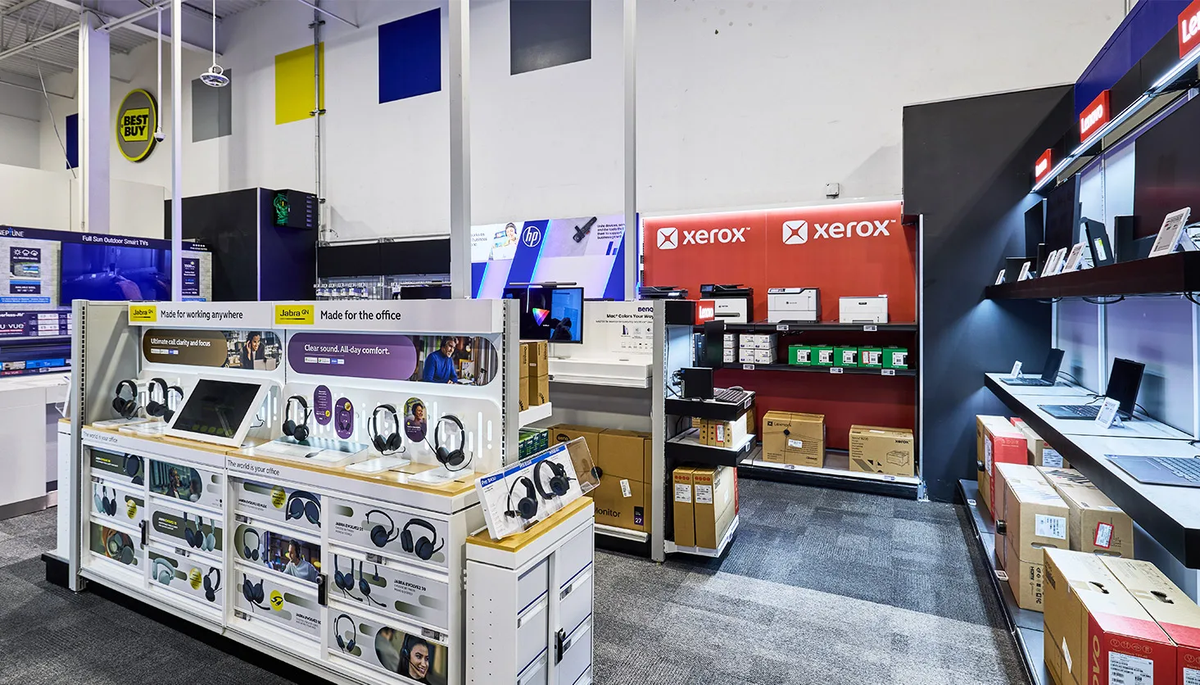
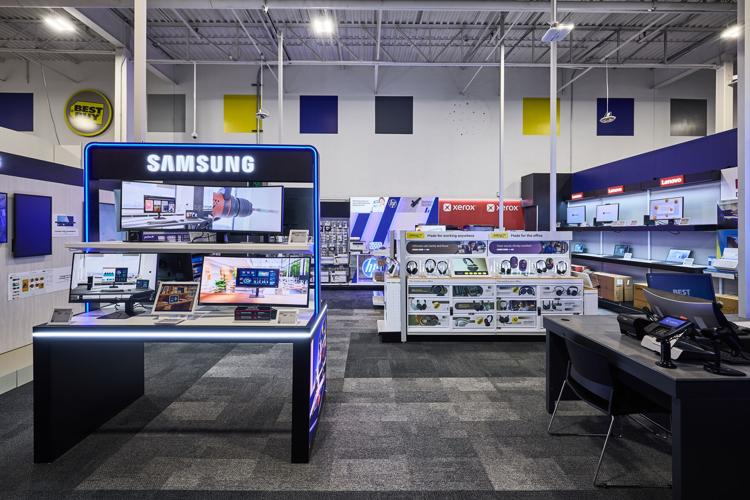
The Business Centres feature dedicated demonstration areas staffed by business advisors, with an assortment of commercial-grade technology that includes products not typically available in conventional Best Buy stores. Customers can explore computers, digital signage, point-of-sale systems, conferencing equipment and networking solutions from brands including HP, Lenovo, Apple, Samsung, Square, Jabra and Xerox.
Customers can visit without an appointment or arrange consultations in advance. The centres also provide access to Best Buy’s broader commercial procurement and professional services capabilities, ranging from audiovisual installation and device lifecycle management to technology deployment across multiple business locations.
A New Role for Existing Retail Space
Best Buy has served commercial customers in Canada for more than 20 years. Establishing dedicated showrooms within its stores provides another sales channel for the business, with opportunities to reach customers who might otherwise purchase equipment through specialized technology resellers or directly from manufacturers.
The format enables Best Buy to establish commercial showrooms without securing separate premises. The centres nevertheless require investment in displays and specialist staffing, as well as the allocation of square footage that could otherwise be used to serve conventional retail customers.
Commercial purchasing differs considerably from consumer electronics retailing in terms of order size and the potential for repeat business. A visit to evaluate computers or point-of-sale equipment could lead to an order involving dozens of devices and installation services across several locations. Subsequent orders could follow as a customer expands its operations, hires employees or replaces equipment.
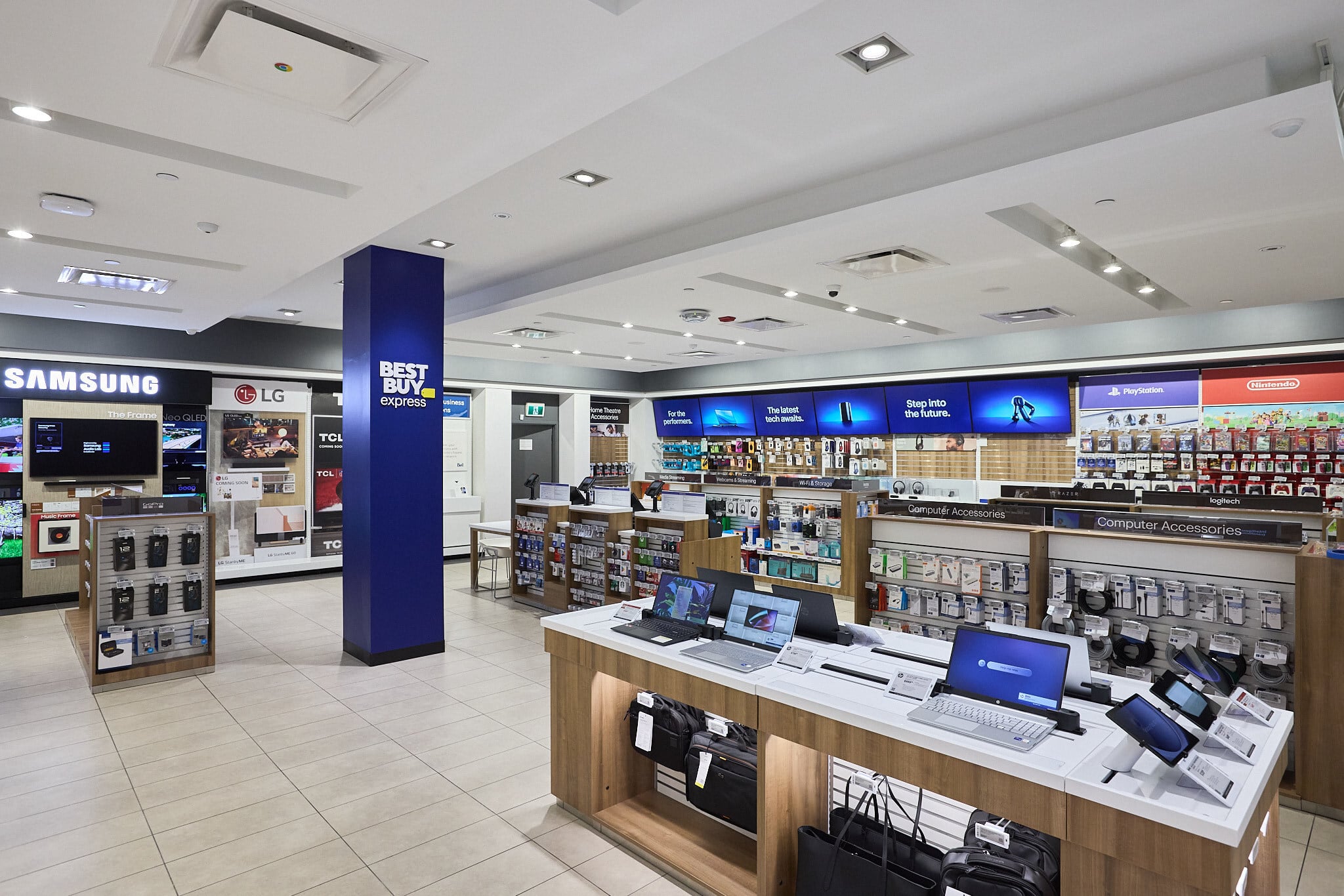
According to its fiscal 2026 annual report, Best Buy operated 130 conventional stores and 12 standalone Best Buy Mobile locations in Canada at the end of January, with those numbers unchanged as of August 1. The figures exclude its Bell-operated Best Buy Express locations, a separate format introduced in 2024 through a partnership involving 167 small-format stores.
The conventional store network provides an established platform for potential expansion of the Business Centre concept. Best Buy Canada’s October announcement characterized the Markham and Mississauga locations as pilots, with the company assessing the format before determining its future direction.
“It is very early for us to talk about the specific results of those business centers, but I think it is a great example of where the team is continuing to lean in, moving fast, testing and trying things, and then going back and figuring out how we can support the business,” Bonfig told analysts. The commercial contribution of the dedicated spaces will be an important consideration in determining where additional centres could be viable.
Targeting Canada’s Small Business Market
Christian Leadbeater, Vice President of Best Buy Business at Best Buy Canada, identified small and medium-sized businesses as an underserved market when the company announced its first centre. Smaller organizations may lack the technology procurement resources available to larger corporations, creating opportunities for Best Buy to provide professional advice alongside equipment sales.
According to Innovation, Science and Economic Development Canada, Canada had approximately 1.08 million small employer businesses as of December 2024, including 410,154 in Ontario. Businesses employing between one and nine people accounted for 77.3% of all Canadian employer businesses.
Independent retailers, restaurants and professional services firms represent potential customers, particularly those without dedicated technology procurement teams. A retailer purchasing point-of-sale equipment, for example, could also source digital signage, networking equipment and installation services through the same business advisor. Best Buy’s commercial offering also extends to educational institutions, government organizations and non-profits.
Canadian Experience Has Informed U.S. Strategy
Best Buy has previously drawn on its Canadian operations when developing new business initiatives in the United States. According to Best Buy Canada’s executive biographies, its third-party online marketplace launched in 2015 under the leadership of Thierry Hay-Sabourin, becoming available through the retailer’s mobile app in early 2016.
Best Buy operated an earlier American marketplace between 2011 and 2016 before reintroducing the model in August 2025. During the company’s March 2025 earnings call, then-CEO Corie Barry explained how the Canadian marketplace demonstrated an opportunity to capture additional demand through a broader online assortment without owning all the associated inventory. Barry also discussed how experience gained in both countries could inform their respective marketplace operations.
Bonfig, who succeeded Barry as CEO on November 1, is particularly familiar with the Canadian business. According to his corporate biography, his previous executive responsibilities included oversight of Best Buy Canada alongside merchandising, e-commerce, marketing, supply chain and retail media. He also led the development of the company’s current American marketplace and was overseeing Canada when the Business Centre initiative was introduced.
Canadian Sales Increase as Profit Margins Narrow
The Business Centre initiative comes amid continued sales growth at Best Buy Canada. According to the company’s third-quarter financial results, revenue from its International segment, which consists of its Canadian operations, increased 3.3% to US$820 million during the 13 weeks ended October 31. Comparable sales increased 4.9%, with unfavourable foreign exchange rates partially offsetting reported revenue growth.
Canadian gross margin declined to 21.6% from 22.8% a year earlier, primarily due to lower product margins. Adjusted selling, general and administrative expenses remained unchanged at US$153 million, while adjusted operating income decreased to US$24 million from US$28 million.
The economics of the Business Centre format will depend in part on the value of commercial accounts acquired through the stores, including orders subsequently fulfilled through other channels. With its business-to-business division expected to grow by approximately 20% this fiscal year, Best Buy’s Canadian experiment could help the retailer determine how much additional commercial activity its existing real estate can support and whether that contribution warrants dedicating more store space to business customers.