Will COVID-19 Have Canadians Relying On Credit More Than Ever?

Date:

Share post:

By Leo Gutierrez

During “normal” times, credit provides a means for consumers and businesses to make purchases and investments when they’re short on cash. If used responsibly, credit cards can also be a good way to accumulate travel rewards and take advantage of cashback deals. Sadly, these are anything but “normal” times.

The Effects of COVID-19 on the Credit Industry

The COVID-19 pandemic is hitting consumers and businesses all across Canada and the rest of the world. Reports estimate that Canadian unemployment stands around 7.5%, the highest rate the country has seen since the 2008 economic crisis. As a result, many consumers need to fall back on credit while they await unemployment benefits. 

The Coronavirus has forced many to live their life online, safe inside their homes. Businesses have been forced to reexamine their online platforms to successfully ride out this wave.  Since shipping services are deemed essential services, buying goods online has become the go-to outlet for much of the population. It would not be surprising to see a jump in online credit card use for the first quarter of 2020 (and throughout the year) as compared to 2019.  According to a study by Canadian Payments Insights, a company offering analysis into the payment habits of Canadians, in 2019 “credit cards were the most popular payment method for online purchases in Canada.” Canadians used credit cards for more than 66% of all transactions in 2019. 
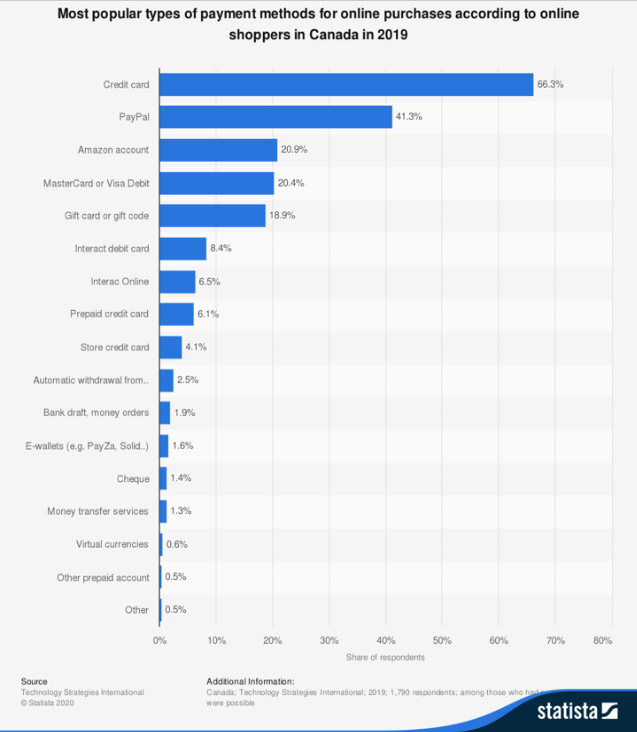
CREDIT: CANADA; TECHNOLOGY STRATEGIES INTERNATIONAL; 2019; 1,790 RESPONDENTS; AMONG THOSE WHO HAD PURCHASED ONLINE IN THE PAST 12 MONTHS; MULTIPLE ANSWERS WERE POSSIBLE © STATISTA 2020

However, the crisis is not just affecting consumers. With less cash to spend, retail stores are also taking a huge hit. Fortunately, Canadian businesses do have access to increased credit thanks to the Business Credit Availability Program (BCAP), Canada Emergency Business Account (CEBA), and other economic initiatives. That said, delays in certain government benefits could cause many retailers to close their doors for good.

Delays in Government Benefits

While Canadian citizens also have access to emergency government funds, the application process and wait times have left millions of individuals without a stable income for weeks at a time. This means that credit cards are being used in place of cash and debit cards. Consumers are turning to credit to pay for just about everything — from groceries to rent.

Right now, credit cards are a necessity for a lot of Canadians, but they also pose a financial risk. Nobody knows exactly how long the Coronavirus pandemic will continue, but many experts believe that there will not be a vaccine (or economic stability) for at least a year. Relying on credit cards and unemployment benefits for months at a time could be the only solution for many until day-to-day life returns to normal.

Tips to Stay Afloat

In this time of financial hardship and uncertainty, Canadians must remember not to overextend themselves. Acting responsibly and budgeting carefully could make the difference between weathering the storm successfully and experiencing long-term financial instability. So, here are a few tips to help Canadian consumers maintain fiscal responsibility during this crisis:

●      Don’t use all of your cash reserves immediately – If you have cash on hand, consider yourself lucky. However, you shouldn’t spend all of your cash first. Instead, try to strike a balance between cash and credit. This way, if an emergency comes up that requires cash, you will have cash on hand to deal with it.

●      Don’t overdo your debt repayment – Usually, paying more than the minimum on your credit cards is a good thing. However, in a time when your cash flow could be inconsistent, you shouldn’t spend extra cash unless it’s absolutely necessary. Pay what you can without taking away too much from your available funds.

●      Dip into your savings if necessary – COVID-19 presents the biggest crisis of our generation. If there’s ever been an emergency that required drastic measures, this is it. While you don’t want to drain all of your savings or retirement fund, you shouldn’t be afraid to take out some cash when you really need it.

●      Don’t be afraid to ask for help – The Canadian government has instituted a number of programs to help individuals get food, medicine, and money during this crisis. Research which benefits you are eligible for and apply as soon as possible.

To learn more about COVID-19 programs for individuals and businesses, consult Canada’s COVID-19 Response Page.


RELATED ARTICLES

Subscribe to the Newsletter

Subscribe

* indicates required

RECENT articles

Toronto Fashion Label Demascaré Expands Into Ready-to-Wear as Shaun Mascarenhas Eyes Retail Growth

Toronto designer Shaun Mascarenhas is expanding Demascaré into ready-to-wear, with local production, selective retail growth and broader ambitions.

Aritzia’s Stronger Store Performance Supports Continued North American Expansion

Aritzia is reporting stronger boutique productivity and customer traffic as it expands across North America. The Vancouver-based fashion retailer plans additional U.S. openings and repositionings in Quebec and California while continuing to invest in larger stores and digital commerce.

Bento launches Nashville hot chicken sushi roll across Canada

Bento’s latest sushi product combines Nashville hot chicken with traditional roll ingredients and will be sold at participating Canadian grocery, retail and post-secondary locations.

Couche-Tard to acquire Irving Oil retail assets in Quebec, Ontario

The convenience store operator has agreed to acquire retail locations, fuel supply arrangements and cardlock sites in Quebec and Ontario, subject to regulatory approvals.

Employment falls for 2nd straight month, 68,000 jobs lost in September: Statistics Canada

The unemployment rate increased 0.1 percentage points to 6.5%.

Canadians plan to spend less this holiday season but favour domestic products: PwC

A PwC Canada survey finds 54 per cent of consumers are willing to pay more for Canadian-made goods as planned holiday spending declines 11 per cent.

Maybelline expands mental health campaign to focus on support networks (Video)

Maybelline New York’s latest Brave Together campaign highlights the role of family and friends in mental health support, building on a global program launched in 2020.

Pokémon Card Thefts Push Canadian Retailers to Rethink Store Security

Pokémon card thefts across Canada are prompting retailers to rethink security, insurance, inventory storage and how valuable products are displayed and sold.

Canadians’ confidence in direction of food system weakens: report

A Canadian Centre for Food Integrity survey finds food affordability remains Canadians' top concern as uncertainty about misinformation and artificial intelligence grows.

Montreal’s Transformer Table Reaches $145 Million in Revenue as U.S. Retail Expansion Accelerates

Montreal-founded Transformer Table is expanding its U.S. retail footprint with new microstores and a Maryland flagship as CEO Chris Wantlin discusses the company's revenue growth, retail partnerships and future expansion plans.

Daily Synopsis: October 8, 2026

Holiday spending expected to be down as consumers struggle, Newmarket Walmart closing while Kingston announced, grocery store opens in Winnipeg food desert, T&T opens 1st Ontario cafe, and other news.

Aritzia reports Q2 Fiscal 2027 financial results, net revenue up 44.1% to $1.17 billion

Net revenue in Canada increased 19.8% to $390.4 million, compared to $326.0 million in Q2 2026.

Canada’s Menswear Market Is Being Rebuilt as Retailers Invest in Premium and Luxury

Canada’s premium and luxury menswear market is attracting major investment as Harry Rosen, Holt Renfrew, Simons, independent retailers and global fashion houses expand, renovate and rethink physical retail across Canada, even after the loss of major department-store capacity.

Ralph Lauren Home Joins Maison Territo in Montréal

Maison Territo adds Ralph Lauren Home to its curated catalogue, bringing the American brand’s furniture and distinctive design aesthetic to Montréal.

Casavogue Launches Buy More, Save More Promotion in Montréal

Casavogue’s Buy More, Save More promotion offers $500 in savings for every $3,000 spent on a wide selection of furniture.

Egg Club and Serruya Private Equity Announce Joint Venture to Fuel Global Growth  

New partnership will support expansion of the Toronto-born breakfast brand across North America and international markets.

Kits Eyecare report preliminary Q3 results, substantial growth in total revenue

Total Revenue grew 21.6% year-over-year to approximately $63.7 million, accelerating from 17.8% growth in Q2 2026.

Canadian Shoppers Grow More Selective as Holiday Spending Intentions Weaken

A new Stifel survey finds Canadian consumers entering the 2026 holiday season with weaker spending conviction. Holiday budget intentions fell sharply, while value retail remains resilient and higher-income shoppers show growing caution across several discretionary categories.

Selwyn Crittendon moving on to different role at IKEA

He will remain with IKEA Canada until December 31, and the company expects to announce a successor in the coming months.

Scarce Retail Space Gives Canadian Landlords New Leverage

Canada’s tight retail real estate market is shifting negotiating power toward landlords as limited construction and high occupancy constrain available space. JLL, Primaris, RioCan, McDonald’s and Empire executives discuss the implications, including the temporary opportunity created by former Hudson’s Bay locations.