Retail decision-making has always relied on a balance between data, experience, and intuition.
However, as consumer behaviour becomes more complex and market conditions shift rapidly,
the traditional pace of research is increasingly at odds with the speed required to compete. This
tension is now driving the adoption of new tools that can deliver insights faster while still
maintaining a foundation in data.
Among the most notable developments is the emergence of AI-powered personas, including platforms such as Smart Persona introduced through a partnership between Leger and Plus Company. These tools are beginning to reshape how retailers test ideas, evaluate risk, and refine strategy by turning static audience profiles into interactive, data-driven simulations that enable a more dynamic approach to understanding consumers.
From Static Personas to Interactive Insight
For years, retailers have relied on personas as a way to represent target customers. These
profiles, typically developed through segmentation studies, have provided useful guidance but
often remained underutilized once created. In many cases, they existed as static documents that
were referenced occasionally but rarely integrated into daily decision-making.
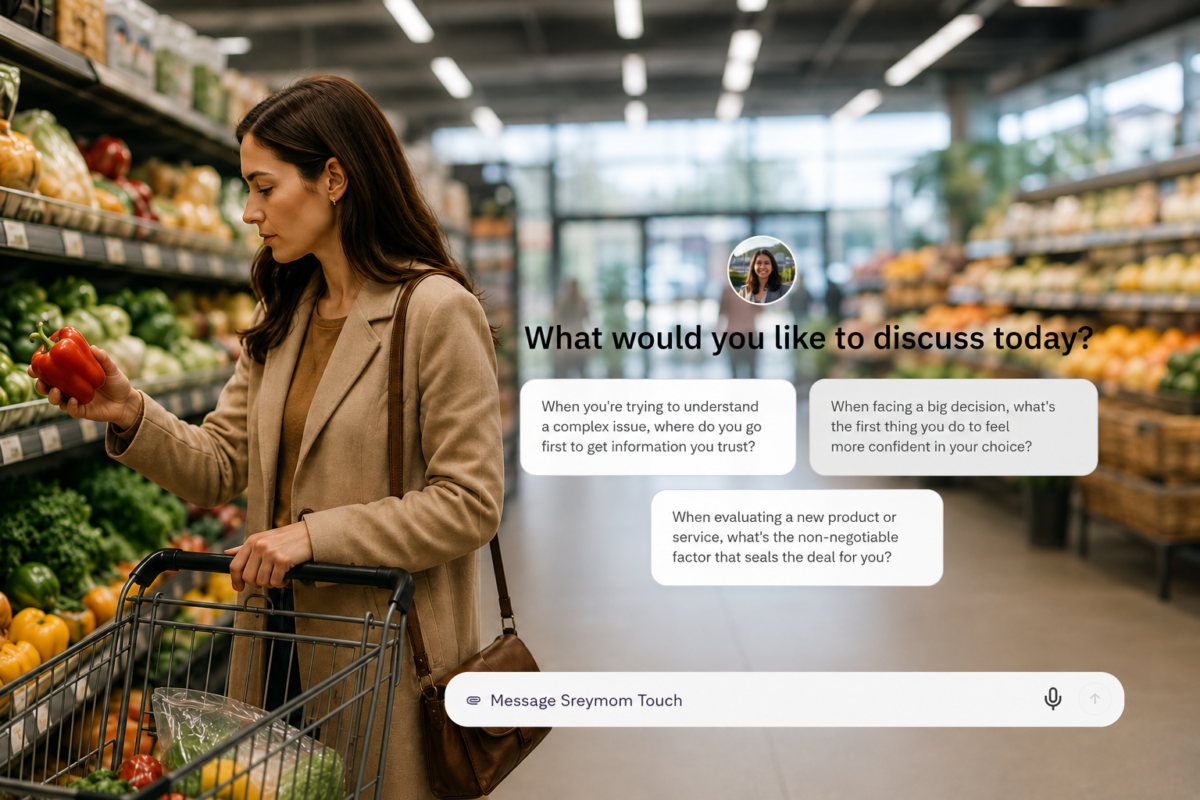
AI personas are changing that paradigm. Instead of reading about a customer segment, teams can
now interact with it. By asking questions and testing scenarios in real time, retailers gain access
to a more fluid and responsive form of insight.
This shift transforms personas from passive assets into active tools. It allows marketing teams to
explore how a target customer might respond to a campaign, while merchandising teams can
evaluate potential product offerings before committing to production. The result is a more
continuous and accessible connection to the consumer perspective.
Accelerating Decisions Across the Organization
One of the most immediate impacts of AI personas is speed. Traditional research processes can
take weeks to complete, from designing a study to recruiting participants and analyzing results.
While these methods remain essential for validation, they are not always suited to situations
where decisions must be made quickly.
AI personas provide a way to generate directional insights in minutes. This capability is
particularly valuable in retail environments, where teams often need to react to changing trends,
competitive pressures, or internal timelines.
For example, a marketing team preparing a digital campaign can test multiple creative executions
and identify which message resonates most strongly with a target audience. Similarly, a product
team can narrow down a list of potential innovations by quickly gauging consumer interest and
identifying which concepts warrant further investment.
These applications do not eliminate the need for traditional research. Instead, they allow
organizations to prioritize more effectively, focusing time and resources on the most promising
opportunities.
Enhancing Creativity While Reducing Risk
Beyond speed, AI personas are also influencing how teams approach creativity and innovation.
By providing immediate feedback on ideas, these tools create a safer environment for
experimentation.
Retailers can explore a wider range of concepts, including those that might have been considered
too risky or uncertain to test through conventional methods. Early-stage ideas can be refined or
discarded based on simulated consumer reactions, reducing the likelihood of costly missteps later
in the process.
This iterative approach aligns well with the realities of modern retail, where success often
depends on the ability to adapt quickly and respond to evolving consumer expectations. AI
personas support this by offering a way to continuously test and learn, rather than relying on a
single point-in-time study.
Grounding AI in Data and Methodology
As artificial intelligence becomes more prevalent in research, questions around accuracy, bias,
and reliability remain top of mind. The effectiveness of AI personas depends heavily on the
quality and structure of the data that underpins them.
Leading solutions in this space are built on a combination of primary research, segmentation
data, and large-scale datasets that reflect real-world behaviours. Synthetic populations, which
model individuals based on statistical relationships rather than personal information, are often
used to create detailed and privacy-compliant representations of target audiences.
In the case of Smart Persona, developed through the partnership between Leger and Plus Company, personas are informed by more than 25 data sources and can include thousands of attributes, enabling nuanced and context-aware responses. The system is designed to ground outputs in structured data, helping to limit the types of inconsistencies that can occur with more generic AI tools.
At the same time, industry experts emphasize that these tools should be viewed as
complementary to traditional methodologies. AI-generated insights are most valuable when used
to guide direction and inform early-stage thinking, with critical decisions validated through
established research techniques.
Democratizing Access to Consumer Insight
Another important implication of AI personas is their potential to broaden access to research
within organizations. Historically, consumer insight has often been concentrated within
specialized teams, with other departments relying on periodic reports or presentations.
By making insights interactive and available on demand, AI personas allow more stakeholders to
engage directly with the data. This can lead to a more consistent application of consumer
understanding across functions, from marketing and merchandising to operations and executive
leadership.
In practical terms, this means that a wider range of decisions can be informed by consumer
perspective, rather than relying solely on intuition or limited inputs. Over time, this shift could
contribute to more aligned and customer-centric strategies across the organization.

A New Layer in the Research Ecosystem
The rise of AI personas does not signal the end of traditional research. Instead, it represents the
addition of a new layer within the broader insight ecosystem.
Surveys, focus groups, and in-depth interviews will continue to play a critical role in providing
validated, statistically robust findings. AI personas, by contrast, offer a way to explore ideas
quickly, test assumptions, and identify areas that merit deeper investigation.
This complementary relationship reflects a broader trend in how organizations are integrating
artificial intelligence into their workflows. Rather than replacing existing processes, AI is being
used to enhance them, improving efficiency and expanding what is possible.
Looking Ahead
As adoption increases, AI personas are likely to become a more standard part of the retail
decision-making toolkit. Their ability to combine speed, accessibility, and data-driven insight
positions them as a valuable resource in an increasingly competitive landscape.
For retailers, the opportunity lies in using these tools thoughtfully, leveraging their strengths
while maintaining a commitment to methodological rigor. Those that succeed in striking this
balance will be better equipped to navigate uncertainty, respond to change, and deliver
experiences that resonate with today’s consumers. Leger has described this approach as a form of “augmented intelligence,” positioning AI as a complement to traditional research rather than a replacement for it.
In that sense, AI personas are not simply a technological innovation. They represent a shift in
how organizations think about research itself, moving from a periodic activity to an ongoing,
integrated part of decision-making.
For more information on Smart Persona, visit: leger360.com/smart-persona-powered-by-leger