Home Blog Page 144

How to Choose Police Footwear

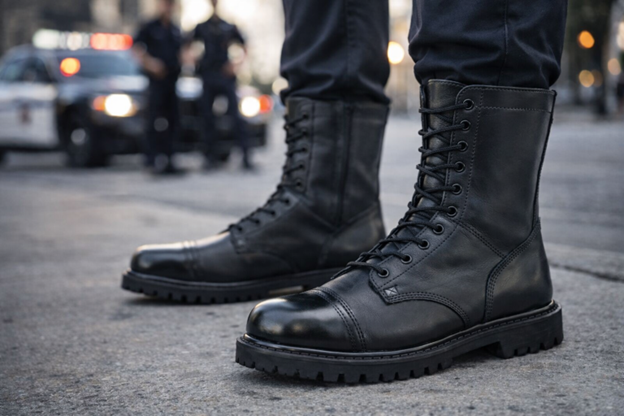
Choosing the right police boots directly impacts your safety, comfort, and performance during every shift. Your footwear affects how quickly you move, how long you can stay on your feet, and whether you end the day with sore joints or serious fatigue. 

Police boots function as essential equipment, not just uniform items. The right pair supports your stability and mobility through long patrols, foot pursuits, and unpredictable situations. 

This guide covers what matters most when selecting police shoes, trooper boots, and law enforcement boots for professional duty.

Match Footwear To Duty Environment

Your assignment determines what your boots need to handle. Patrol officers spend most of their shifts walking and standing on concrete. State troopers work along highways, with extended standing periods, exposure to vehicle traffic, and uneven road shoulders. Tactical and response units face rapid directional changes, rough terrain, and high-impact movement.

Prolonged standing and repetitive walking on hard surfaces increase your risk of foot, knee, hip, and lower back problems. Without proper cushioning and support, your police boots accelerate fatigue and raise injury risk. Consider the surfaces you walk on most, how long your shifts run, and how much sudden movement your role requires.

Prioritize Proper Fit and Ergonomic Support

Fit matters more than any other feature in police footwear. Poorly fitted boots cause blisters, nerve compression, joint strain, and reduced endurance. Your police boots should accommodate your foot width, arch height, and duty sock thickness without creating pressure points.

Lower extremity discomfort  directly reduces your performance and increase injury rates during long shifts. Look for contoured footbeds, solid arch support, and shock-absorbing midsoles that maintain alignment and fight fatigue. Police shoes should allow your toes to spread naturally while keeping your heel locked in place. For officers dealing with plantar fasciitis, metatarsalgia, or chronic heel pain, consider integrating orthotic insoles for foot pain that are custom-molded to your arches. Purpose-built orthotics maintain neutral alignment, distribute pressure, and reduce shock on concrete, helping extend on-shift endurance while minimizing hotspots, numbness, and post-shift knee or back soreness. Internal foot movement creates friction and accelerates discomfort as your shift wears on.

Evaluate Materials And Construction

Material choice affects how long your boots last, how well they breathe, and how much they weigh. Full-grain leather provides excellent abrasion resistance and structure. Ballistic nylon improves airflow and cuts overall weight. Many modern police boots combine both to balance protection and comfort.

Construction method determines service life. Goodyear-welted police boots can be resoled, extending their usable lifespan significantly. Cemented construction weighs less but typically doesn’t last as long. If you’re logging serious miles on patrol, resoleable boots reduce long-term replacement costs.

Check Traction And Outsole Performance

Slip resistance keeps you safe during pursuits and rapid response situations. our police boots must grip on wet pavement, oil-exposed surfaces, and uneven ground. Rubber outsoles with multidirectional tread patterns improvetraction during sudden stops and quick direction changes. 

Slips and falls remain a leading cause of workplace injury in law enforcement. Slip-resistant footwear significantly reduces these incidents. The outsole should balance grip with flexibility. Overly rigid soles reduce your responsiveness and excessively soft soles increase fatigue on hard surfaces.

Consider Ankle Support And Stability

State trooper boots and tactical law enforcement boots typically require increased ankle support. Higher shafts and structured collars help reduce lateral movement and lower sprain risk during pursuits or on uneven terrain. Structured ankle support improves your balance and reduces lower limb strain during physically demanding situations.

Effective stability extends beyond shaft height. Heel counters, midfoot shanks, and secure lacing systems all contribute to controlled movement without restricting mobility. Ankle padding should provide contact without pressure when you walk and run. 

A well-engineered ankle system also improves proprioception, helping you maintain awareness of foot placement during rapid movement. This balance between support and flexibility maintains your speed, control, and injury prevention during extended shifts.

Manage Footwear Weight to Reduce Fatigue

Boot weight directly affects how quickly you tire. Heavier boots increaseenergy expenditure and accelerate fatigue during prolonged walking. Lighter footwear reduces stress on your joints and muscles over long shifts.

Lightweight police shoes work well for urban patrol or administrative duties. Trooper boots and tactical boots may need added protection, but should still use modern materials such as EVA midsoles to control overall weight. The goal is finding an efficient strength-to-weight ratio rather than maximum protection at any cost.

Address Weather And Climate Conditions

You work in all weather conditions, so your police boots need appropriate protection. Look for water resistance through treated leather, sealed seams, or waterproof membranes. Moisture control prevents blistering and skin breakdown during long shifts.

Cold climate agencies need insulated police boots to protect circulation and reduce cold-related injuries. Hot environments benefit from breathable linings and moisture-wicking materials.

Improper footwear for climate conditions increases the risk of skin conditions and circulation problems.

Ensure Safety Features And Compliance

Certain roles require additional protective features. Composite or steel toe caps provide impact resistance. Electrical hazard-rated outsoles protect against live current exposure. 

Your footwear specifications should align with agency safety policies and applicable occupational standards to reduce injury risk and liability exposure.

Evaluate Durability And Lifecycle Cost

The purchase price doesn’t tell the whole story. Reinforced stitching, durable uppers, and high-quality outsoles extend service life. Tracking wear patterns helps identify failure points and improve future boot purchases.

Organizations prioritizing durability over low upfront cost reduce long-term operational expenses.

Final Considerations For Police Boot Selection

Choosing the best police boots requires evaluating your duty environment, fit needs, materials, traction, support, and safety features. Your police shoes, trooper boots, and law enforcement boots must perform as occupational equipment under demanding conditions.

Agencies that apply systematic selection criteria and incorporate officer feedback improve comfort, reduce injury risk, and enhance operational readiness. Proper footwear selection supports both immediate performance and long-term health.

Carpet Makes Surprise Comeback as UK Homeowners Reject “Cold” LVT Trend

Carpet is staging an unexpected comeback in UK homes, with new analysis showing renewed consumer interest after years of decline in favor of luxury vinyl tile (LVT) and hard flooring options.

The shift comes as 21% of UK homeowners planning to spend on new flooring, with designers increasingly specifying rich colors, bold patterns, and high-pile textures that challenge the minimalist hard-floor aesthetic that has dominated for the past decade.

“We’re seeing a real swing back to carpet, particularly in bedrooms and family spaces,” says Ben Herbert, Director at online luxury carpet store Designer-Carpet.co.uk, who carried out the analysis . “People spent years living with hard floors, but they’re now realizing they’ve been missing out on the warmth underfoot, sound absorption, and that sense of comfort that only carpet provides.”

The Comfort Factor

Carpet retains 25% of the £3.5 billion UK flooring market despite intense competition from LVT, which now holds 35% share. But the quality of carpet sales is changing. Consumers are moving away from budget options toward premium wool and natural fiber carpets priced at £25+ per square metre.

Wool carpet sales proved particularly resilient, holding 49% of the carpet segment in 2023 and growing at 4.2% annually. The natural material’s renewable, biodegradable properties appeal to sustainability-conscious consumers, while its durability justifies higher upfront costs.

Wool carpet can last 20-25 years with proper care, according to Herbert. “When you compare that to LVT replacement cycles, the economics start to make sense, especially when you factor in the comfort benefits.”

Interior designers report that 2025 trends explicitly favor carpet’s tactile qualities. Dark greys remain the top-selling color, but earthy neutrals like beige surged 22% in 2024. Natural stone and cream tones are forecast as major trends, with designers using carpet to create “grounded and calming spaces” that contrast with the clinical feel of all-hard-floor homes.

Plush, high-pile carpets in warm shades are making particular gains, helping transform interiors into “havens of comfort and relaxation” according to industry trendspotters. The move aligns with broader interior design shifts toward maximalism and color-drenching techniques.

Apple Opens New Sainte-Catherine Store in Downtown Montreal

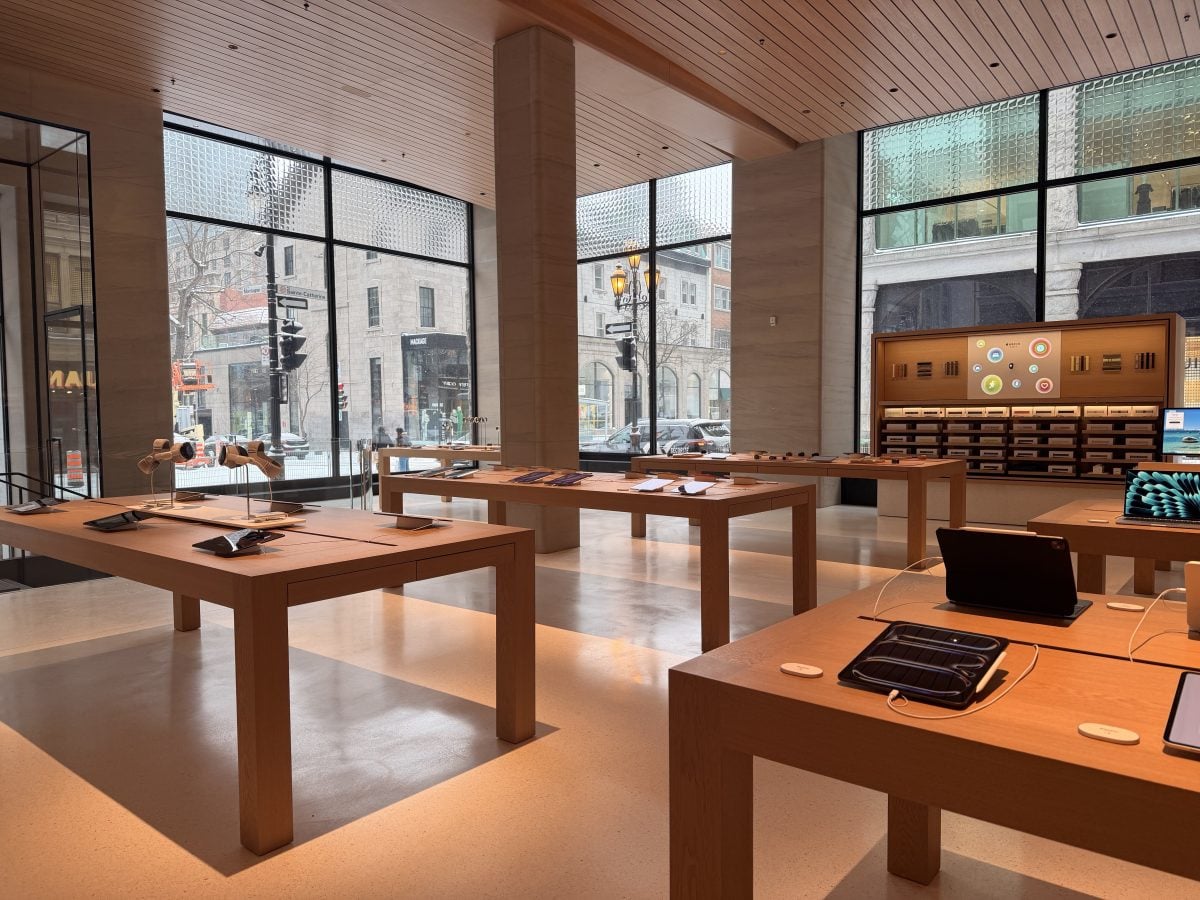
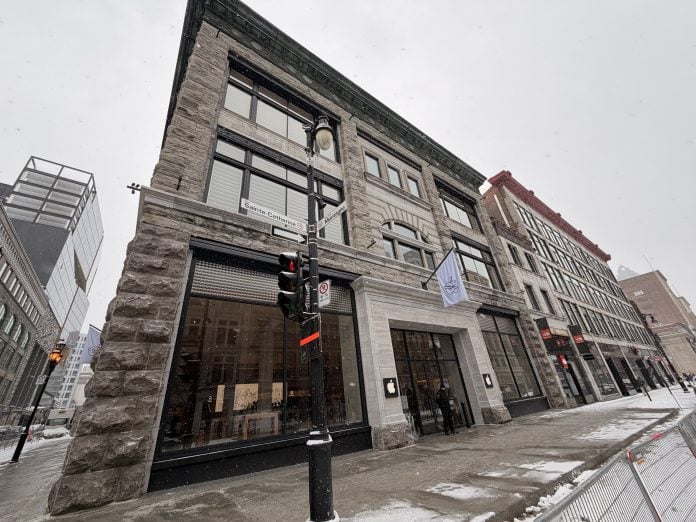
New Apple store at 1255 Ste-Catherine St. W. in Montreal. Photo: Maxime Frechette

Apple has officially opened a new retail store on Sainte-Catherine Street West in downtown Montreal, relocating from a previous space nearby. The reimagined Apple Sainte-Catherine store occupies the main floor of a restored heritage building at the prominent corner of Sainte-Catherine Street and Rue de la Montagne, reinforcing Apple’s long-term commitment to one of Canada’s most important urban retail corridors.

The new location replaces Apple’s previous Sainte-Catherine store, which first opened nearby in 2008. While the new store is not positioned as a flagship in the same sense as Apple’s highly experiential Vancouver location at CF Pacific Centre, it represents a major upgrade in scale, design, and customer experience. According to Apple, the new store more than doubles the size of its former downtown Montreal location and has been under construction since 2024, reflecting the complexity of renovating a heritage structure to meet Apple’s global retail standards.

The intersection of Sainte-Catherine Street West and Rue de la Montagne sits within Montreal’s Golden Square Mile, an area defined by high pedestrian traffic, luxury retail, hotels, and cultural destinations. The new store is located near Holt Renfrew Ogilvy and within walking distance of Sherbrooke Street West, reinforcing Apple’s position within Montreal’s most prestigious retail zone.

The original Apple Sainte-Catherine store served downtown Montreal for nearly two decades. By relocating to a larger, more prominent space, Apple maintains its visibility while significantly expanding its ability to support programming, technical services, and community engagement. This approach aligns with Apple’s broader Canadian retail strategy, which has increasingly favoured relocations and expansions of existing stores over aggressive network growth.

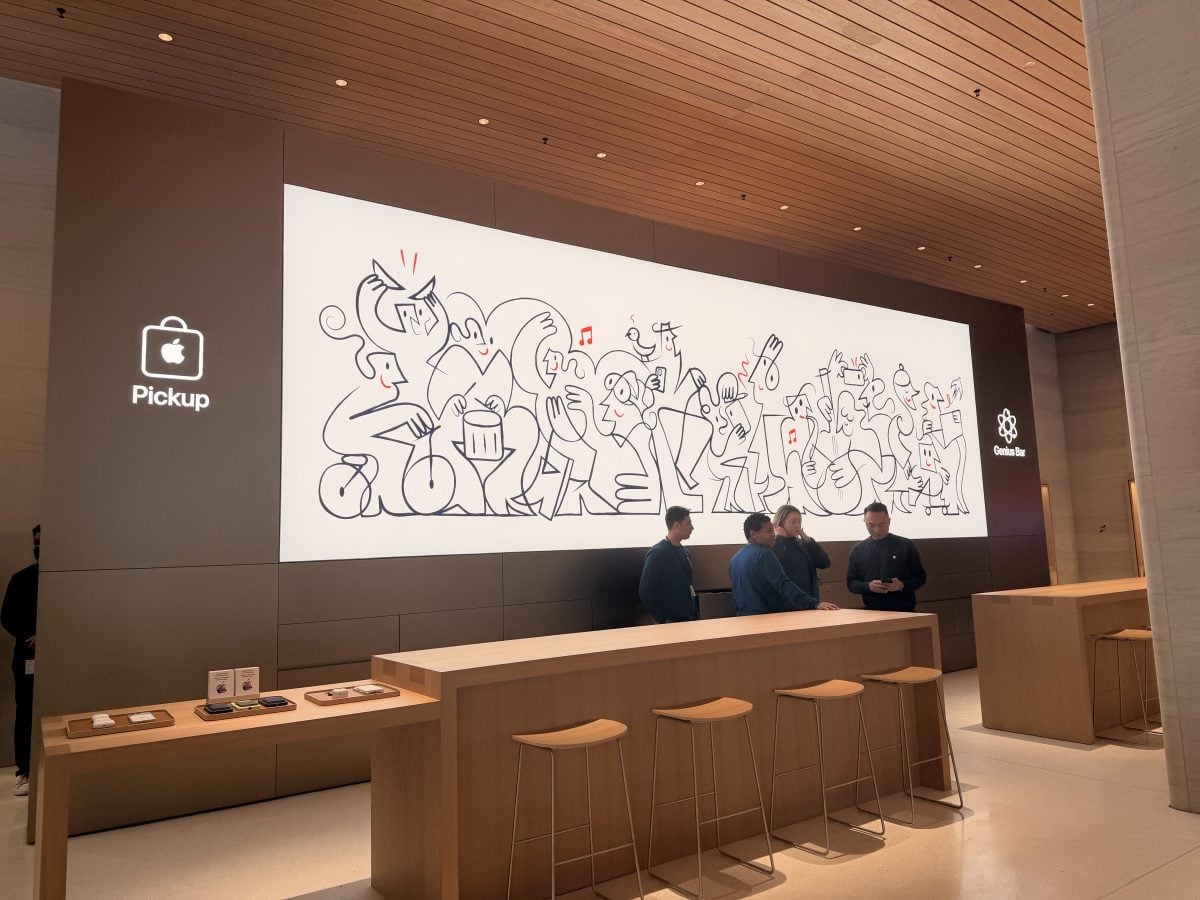
New Apple store at 1255 Ste-Catherine St. W. in Montreal. Photo: Maxime Frechette

Restoring a Historic Montreal Building

The new Apple Sainte-Catherine store occupies a heritage building that required an extensive and carefully managed restoration. Apple worked with Montreal-based construction firm SAJO, a specialist in complex retail and heritage projects, to execute the multi-year build-out. Construction began in 2024 and involved navigating the architectural constraints of a protected structure while delivering Apple’s contemporary retail standards.

The façade blends historic Saint-Marc stone sourced from Quebec with local granite, while skilled local copper artisans restored the building’s original cornice. The result is a storefront that respects the architectural legacy of downtown Montreal while presenting a modern retail presence on one of the city’s busiest commercial corners. The project highlights Apple’s approach in Canada, where global design standards are paired with local expertise to address site-specific heritage and urban challenges.

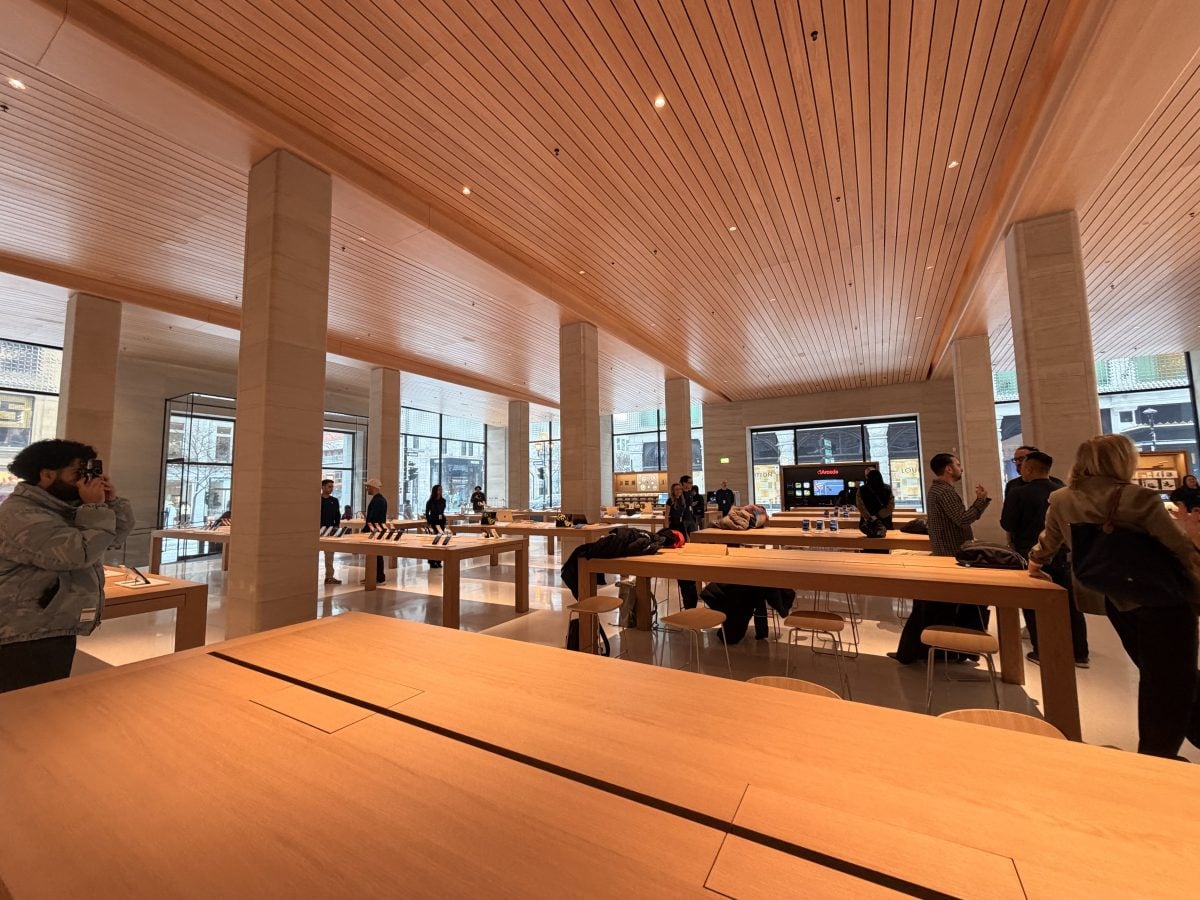
Inside, the store has been designed to create an inclusive and welcoming environment. Apple emphasized accessibility throughout the space, incorporating varied table heights, flexible seating options, and wider access routes for wheelchair users. These design choices reflect Apple’s ongoing efforts to ensure its retail spaces accommodate a broad range of customers and needs.

New Apple store at 1255 Ste-Catherine St. W. in Montreal. Photo: Maxime Frechette

Expanded Services and In-Store Experience

The larger footprint allows Apple to offer a full suite of in-store services in a more open and functional layout. Toward the back of the store, a dedicated Apple Pickup area enables customers to order products online and collect them in store at a scheduled time. The Genius Bar provides technical support from trained Apple Specialists, while customers can also access services such as personalized shopping sessions, flexible monthly financing, competitive trade-in values, and expert setup assistance.

The Apple Sainte-Catherine Montreal store also hosts free Today at Apple sessions, which focus on creativity, skills development, and accessibility. Customers can learn how to edit video, improve photography, or get started with Apple Intelligence on iPhone, iPad, and Mac. Additional sessions introduce users to assistive technologies, including VoiceOver features available on Apple devices.

New Apple store at 1255 Ste-Catherine St. W. in Montreal. Photo: Maxime Frechette

A Multilingual Team and Local Engagement

Apple stated that the nearly 200-person team at the new store collectively speaks dozens of languages, reflecting Montreal’s multicultural population. The company emphasized that its Specialists are trained to provide personalized guidance, whether customers are purchasing their first Apple device or integrating new products into an existing ecosystem.

“For nearly 20 years, we’ve been proud to be part of the downtown Montreal community, whose spirit of creativity and innovation continues to inspire us,” said Deirdre O’Brien, Apple’s senior vice president of Retail and People. “We’re incredibly excited to build on this longstanding relationship and create a destination where our customers can experience the very best of Apple, from our innovative products to the expert care and support of our amazing team.”

New Apple store at 1255 Ste-Catherine St. W. in Montreal. Photo: Maxime Frechette

Opening Celebrations Spotlight Local Creativity

To mark the opening, Apple collaborated with Montreal-based illustrator and designer Catherine Potvin, who led live art demonstrations on iPad during opening weekend. On Friday, January 16, and Saturday, January 17, customers visiting the store at select times were able to receive illustrations drawn directly onto Apple retail bags, reinforcing the company’s emphasis on creativity and local cultural engagement.

Apple also encouraged customers to explore Quebec-made content across film, television, music, books, podcasts, and apps, alongside a curated Apple Music Sainte-Catherine playlist. These initiatives reflect Apple’s ongoing effort to connect its retail environments to the communities they serve.

Apple has operated stores in Canada for 21 years and currently runs 28 locations nationwide, including five in Quebec. In recent years, the company’s Canadian retail strategy has focused on upgrading key locations in major urban markets rather than expanding store count. The relocation of the Apple Sainte-Catherine Montreal store follows similar investments, including the redevelopment of Apple Square One in Mississauga and the flagship transformation of Apple’s Vancouver CF Pacific Centre location.

New Apple store at 1255 Ste-Catherine St. W. in Montreal. Photo: Maxime Frechette
View from Chanel at Holt Renfrew Ogilvy (on de la Montagne) of the new Apple store at 1255 Ste-Catherine St. W. in Montreal. Photo: Maxime Frechette

More from Retail Insider:

Bubble Skincare targets deeper Canadian expansion as affordable skincare gains traction

Bubble Skincare, a five-year-old skincare company founded by Shai Eisenman, is pushing deeper into the Canadian market as it continues a rapid international expansion built on mass retail partnerships rather than standalone stores.

The company, which launched in Canada in late 2022 and early 2023, is now sold through Walmart Canada and Shoppers Drug Mart, with four new products set to hit shelves at both retailers starting Feb. 1. Eisenman said Canada has become a strategic focus as the brand looks to widen access while maintaining its positioning around affordability and clinical performance.

“Canada is a very high priority market for us,” Eisenman said in an interview. “We are continuing to expand and continuing to make the brand more accessible.”

Founded in 2018 and officially launched in November 2020, Bubble Skincare entered the market during a period of significant change in consumer expectations around skincare. Eisenman said she began working on the concept after identifying a gap between products positioned as clinically effective and those designed to feel engaging and emotionally resonant for consumers.

“At the more affordable side of skincare, people were really stuck with the same options in the last 30 years,” she said. “It felt like there was a real opportunity to reinvent mass skincare.”

Shai Eisenman
Shai Eisenman

Rapid retail rollout

Bubble initially launched as a direct-to-consumer brand but moved quickly into bricks-and-mortar retail. Eight months after launch, the company entered Walmart in the United States with distribution across roughly 4,000 stores. CVS followed a year later, then Ulta Beauty. The brand is now available in more than 18,000 stores across the U.S., including Walmart, CVS, Ulta and Target, as well as Amazon.

Internationally, Bubble has expanded into Canada, Australia, the United Kingdom and the Middle East. In Canada, Walmart was the company’s first retail partner, followed by Shoppers Drug Mart, where the brand launched in February of last year.

Eisenman said the decision to prioritize large retail partners reflects how consumers prefer to shop for skincare, particularly at accessible price points.

“Most consumers are looking for true accessibility and also to be able to have consolidated carts and to be able to buy multiple brands and multiple products all at once,” she said.

While customers frequently ask about the possibility of standalone Bubble stores, Eisenman said the company does not plan to pursue permanent storefronts. Instead, it will focus on pop-up experiences as a way to engage directly with consumers without moving away from its core retail strategy.

Photo: Bubble Skincate
Photo: Bubble Skincare

Industry dynamics

Eisenman attributed Bubble’s growth to broader shifts in the skincare industry, particularly among younger consumers. She said shoppers are increasingly seeking products that deliver measurable results while also offering brand personality and emotional connection.

“In the past, you had to compromise on either trust or excitement,” she said. “Today, they’re really looking for a brand that will combine everything.”

She also said consumers have become more sceptical of price as a proxy for quality, especially in skincare.

“Consumers today finally understand that prices are not necessarily a signal of quality,” Eisenman said. “You can have amazing results and super high-quality products at an affordable price.”

Bubble’s positioning centres on that belief, with products developed with dermatologists and designed to deliver what Eisenman described as clinical efficacy without harsh formulations. She said advances in skincare science have made it possible to treat acne and other skin concerns while preserving the skin barrier.

Shai Eisenman
Shai Eisenman

Founder-led strategy

Eisenman brings an entrepreneurial background that predates Bubble. She said she started her first business at age 15 and began working full time at 16. At 21, she moved to London, where she ran a subsidiary of a gaming company with about 100 employees, before relocating to New York to start an e-commerce venture.

She has since split her time between New York and Switzerland, though she said she spends most of her time in New York.

Her personal experience with acne played a role in shaping Bubble’s product philosophy. Eisenman said she struggled with acne for much of her life, including adult and hormonal acne during pregnancies, and felt existing treatments were often overly harsh.

“When I grew up and when I struggled with acne before Bubble, it felt like you could only use products that are super harsh and drying to clear your acne,” she said. “That’s no longer necessary.”

She said the brand’s goal has been to create products that improve and prevent acne over time while remaining gentle and calming.

Photo: Bubble Skincate
Photo: Bubble Skincare

Next steps in Canada

The upcoming Canadian product launches represent the next phase of Bubble’s local strategy. The products will be available through both Shoppers Drug Mart and Walmart Canada beginning Feb. 1.

While the company did not outline specific future retail partners, Eisenman said expansion in Canada remains an active priority as Bubble continues to scale its international presence.

“It felt like consumers really needed to compromise,” she said, referring to the historic trade-off between quality and affordability. “We wanted to create products that are truly accessible, but extremely high quality.”

As Bubble builds on its retail-heavy model, Eisenman said the company will continue to focus on broad distribution and product development rather than physical stores, betting that accessibility remains the strongest driver of growth in the skincare category.

More from Retail Insider:

Photo: Bubble Skincate
Photo: Bubble Skincare
Photo: Bubble Skincate

Calgary retail vacancy rate continues to fall: Barclay Street Real Estate

London Drugs at Brentwood Village Mall in Calgary. Photo by Mario Toneguzzi

After trending downward through the first three quarters of the year, Calgary’s overall retail vacancy declined further in Q4 2025 to 3.4%, representing a 90-basispoint improvement year over year, says a new report by Barclay Street Real Estate.

“At year end, available retail space remained below what we consider a balanced market threshold of 2.0 million square feet citywide. As space scarcity increased, early upward pressure on rental rates began to emerge across several retail nodes. Total retail inventory reached approximately 45.6 million square feet, reflecting an increase of nearly 700,000 square feet since the beginning of the year,” said Barclay Street.

The report said new supply was delivered this year through the completion of multiple projects, including EV606, The Mondrian, Frontier, Junction 88 & Block C, Fourth Street Lofts, and The Podium. Additional retail inventory remains in the development pipeline, with many projects anticipated for completion in 2026 or early 2027. 

“New supply continues to be dominated by smaller-format units ranging between 1,000 and 3,500 square feet, aligning with sustained demand from service-based and neighbourhood-oriented retailers. Proposed earlier this year, Vesta Properties mixed-used project – Broadway on 17th – has started taking shape in Calgary’s Beltline. The development will consist of condos, apartments and ~70,000 square feet of retail spaces: including a grocery store, shops and restaurants,” said the company.

New development activity continues

It said new development activity continued into year end. In December, the City of Calgary issued a building permit for nine commercial retail unit buildings at the Livingston Commercial Centre, totaling approximately 113,000 square feet, further contributing to the city’s near-term retail pipeline. Alongside inventory growth, overall retail occupancy increased by 130 basis points year-over-year. Net decreases in vacancy were recorded across Northeast, Northwest, Southeast and downtown quadrants. The Southwest quadrant was the sole exception, with vacancy increasing by 50 basis points. Current expansion activity remains concentrated among service-based and value-oriented retailers, particularly across the eastern split of the city. 

“Retail development is increasingly being integrated into residential communities through mixed-use formats, extending a trend observed since year-end 2024. This approach supports Calgary’s 15-minute community planning framework and reinforces the long-term resilience of neighbourhood-serving retail by embedding daily-use services closer to population growth. Notable tenant activity during the quarter reflected both portfolio rationalization and continued confidence in well-located retail,” according to the report. 

Hudson's Bay downtown Calgary. Photo by Mario Toneguzzi
Hudson’s Bay downtown Calgary. Photo by Mario Toneguzzi

Downtown retail remains in transition

The report said Starbucks closed its Britannia Plaza location as part of a broader corporate downsizing initiative. Subsequently, Good Earth Coffeehouse announced plans to acquire several recently closed Starbucks locations across Canada, highlighting continued demand for established neighbourhood retail sites. Mid-quarter, Walmart Canada confirmed its tenancy at Taza Park West, reinforcing the project’s positioning as a major retail node within Calgary’s southeast growth corridor.

“Downtown retail remains in transition. Questions persist regarding the future of Calgary’s historic Hudson’s Bay building, which was added to the National Trust for Canada’s Endangered Places list during the quarter. As office and residential conversions progress downtown, retail is shifting away from traditional department store formats toward more communitydriven environments. Construction around the revitalization of Stephen Avenue has begun, including the availability of the former Arnold Churgin shoe store space – marketed by Barclay Street Real Estate – underscoring this evolution. 

“Overall, 2025 marked a strong year for Calgary’s retail market. Citywide vacancy declined from 4.0% at the beginning of the year to 3.7% by year end, reflecting steady absorption despite continued inventory growth.” 

More from Retail Insider:

Recipe outlines next phase of Olive Garden expansion in Canada

Photo- Olive Garden
Photo- Olive Garden

Recipe Restaurant Group International says it will open its first new Olive Garden restaurants under its control in Ontario this summer, marking the next phase of the brand’s expansion in Canada after acquiring the existing locations in Western Canada.

The Vaughan, Ont.-based company said the initial openings will be at Vaughan Mills in the Greater Toronto Area and in Ottawa’s Westboro neighbourhood, with both restaurants currently in development and expected to open in summer 2026.

The planned openings follow Recipe’s recent acquisition of all eight Olive Garden restaurants operating in Western Canada and the signing of a national development agreement with U.S.-based Darden Restaurants Inc., the owner of the Olive Garden brand.

Expansion beyond Western Canada

Recipe said the Ontario locations will be the first new Olive Garden restaurants to open under its expanded national mandate, representing a shift from a regional footprint to a broader, countrywide development strategy.

“These locations represent the first new openings under Recipe’s expanded national mandate and mark an important milestone in growing Olive Garden’s presence beyond Western Canada,” the company said in its release.

Photo: Olive Garden
Photo: Olive Garden

Recipe said additional Olive Garden locations are in various stages of planning across the country as it works to establish what it described as a long-term development pipeline for the brand in Canada. No specific locations or timelines beyond the two Ontario sites were disclosed.

The company framed the expansion as part of a broader growth strategy tied to its operational control of the brand in Canada following the acquisition and development agreement.

Management commentary

Frank Hennessey
Frank Hennessey

Recipe chief executive Frank Hennessey said the upcoming openings reflect both confidence in the brand and the company’s ability to execute on a national strategy.

“With these upcoming openings, we’re taking an important step in expanding Olive Garden’s footprint into new Canadian markets,” Hennessey said. “This expansion reflects our confidence in the brand, the strength of our partnership with Darden, and our ability to execute thoughtfully and strategically across Canada.”

Yianni Fountas
Yianni Fountas

Yianni Fountas, chief operating officer for Olive Garden Canada at Recipe Restaurant Group, said the company is focused on consistency and operational execution as it introduces new locations.

“Backed by the expertise of our operational teams, these new restaurants will welcome guests like family, delivering the consistency and value that guests expect from Olive Garden, while establishing a strong foundation for the brand’s continued growth in Canada,” Fountas said.

Development timeline

Recipe said both the Vaughan Mills and Ottawa Westboro restaurants are in active development. The company did not provide details on restaurant size, investment levels or employment impacts associated with the openings.

The company also said it plans to provide further updates on future restaurant openings and development milestones in the coming months as the Canadian expansion continues.

Photo: Olive Garden
Photo: Olive Garden

Brand and company profile

Olive Garden is an Italian-inspired restaurant brand that began operating in 1982 and is known for full-service, family-oriented dining. The brand operates under Darden Restaurants Inc., which is listed on the New York Stock Exchange under the ticker DRI.

Recipe Restaurant Group International is a Canadian-based restaurant operator with a portfolio spanning full-service, quick-service and fast-casual brands. The company operates nearly 1,100 restaurants across Canada and also has an international presence in the United States and the Middle East, according to the release.

Its portfolio includes Swiss Chalet, St-Hubert, Harvey’s, Montana’s, Olive Garden, New York Fries, Kelsey’s Original Roadhouse, East Side Mario’s, Original Joe’s, State & Main, Anejo, The Burger’s Priest, The Landing Group, Elephant & Castle, Fresh Kitchen + Juice Bar, The Pickle Barrel, Blanco Cantina and Bier Markt.

Recipe said it will continue to share details about its Olive Garden development plans as they progress.

More from Retail Insider:

Booster Juice opens first drive-thru location in Ontario

Booster Juice's First Drive-Thru location is approximately 1,400 sq. ft., built for speed, quality, and convenience (CNW Group/Booster Juice)

Booster Juice has opened its first drive-thru location, marking a new operating format for the Canadian smoothie chain as it looks to add convenience for customers and expand how its stores function.

The company said the drive-thru location opened Monday, Jan. 5, at the St. Clair Shores Shopping Centre in Lakeshore, Ont. With more than 470 locations across Canada, the company described the opening as a significant step for the franchise system.

New store format targets convenience

The drive-thru is housed in a standalone building of approximately 1,400 square feet and includes a double-lane drive-thru. The location also serves walk-in customers, similar to existing Booster Juice stores.

Franchise Partner Ana Bezarevic said the format is designed to respond to changing customer habits.

“Customers seem to have less time nowadays, and this just sets us up to save our customers the need to go into our stores for a more convenient experience,” said Bezarevic.

The Lakeshore location features five digital screens displaying current promotions and campaigns, as well as the full menu, allowing customers to place orders from their vehicles. The company said the layout was designed to support speed and quality of service.

Strategy and leadership perspective

President, CEO and founder Dale Wishewan said the drive-thru reflects the company’s longer-term approach to accessibility and customer service.

Dale Wishewan, founder, President and CEO of Booster Juice

“Our goal has always been to make healthy food more accessible,” said Wishewan. “With this drive-thru location, we’re bringing our fresh, healthy products to our customers in a fast, convenient way, and with great customer service.”

The company said the drive-thru model is an extension of its existing operations rather than a replacement. The Lakeshore site continues to accommodate walk-in traffic while adding vehicle-based ordering.

Store details and operations

The drive-thru is located at 29 Amy Croft Drive in Lakeshore, Ont., within the St. Clair Shores Shopping Centre. The company said the building was designed specifically to support drive-thru traffic, with infrastructure intended to manage ordering flow and reduce wait times.

Booster Juice said the location maintains the same menu offered at traditional stores, including smoothies, wraps, paninis, Booster Balls, and freshly prepared shots and beverages. The company noted that the primary difference from existing locations is the addition of the drive-thru service.

After 26 years in operation, the company said it continues to focus on adapting its store formats while maintaining its existing menu and service model.

Development and local involvement

The project involved collaboration with the property’s landlord and developer, Steven Valente, who said the store represents a milestone for the brand.

“Congratulations to the entire Booster Juice team on the opening of this truly historic drive-thru store,” said Valente. “The result is something truly special, and it’s inspiring to see the excitement and momentum this store has already generated.”

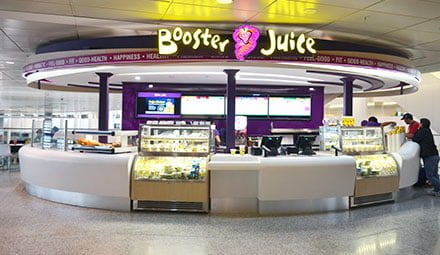
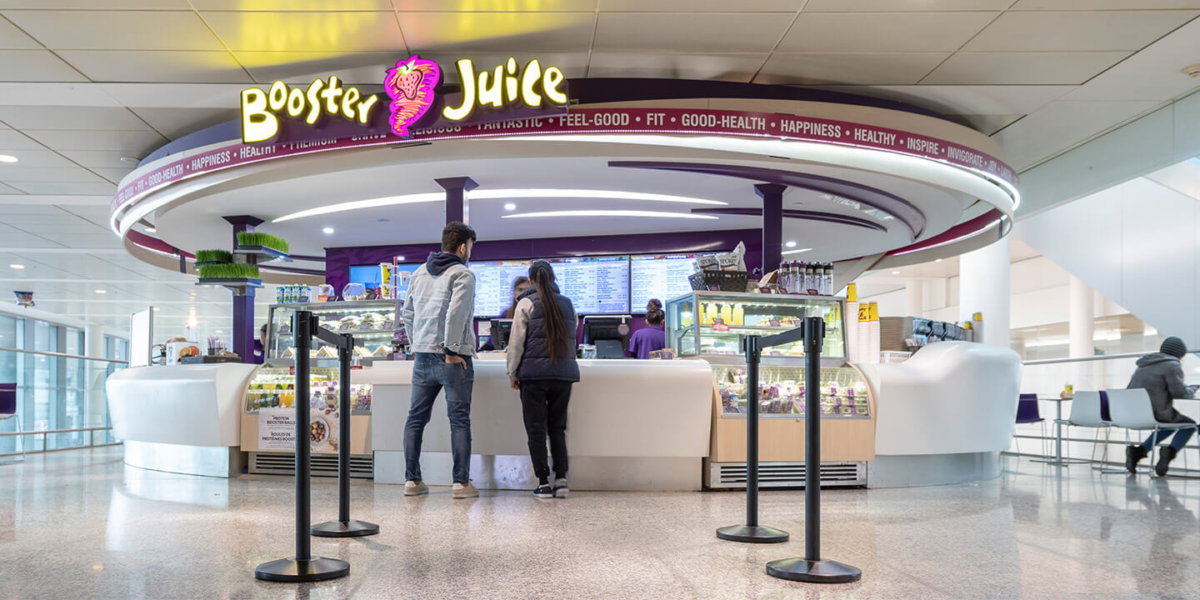
Booster Juice at Pearson International Airport in Toronto. Photo: Booster Juice

Company background

Founded in 1999, Booster Juice describes itself as Canada’s original juice and smoothie bar. The company operates in every province and territory and positions its business around providing food and beverages for customers with active lifestyles.

The company said it continues to focus on developing new products while maintaining its existing service approach as it operates within the quick-service restaurant sector.

The Lakeshore drive-thru represents the first time Booster Juice has introduced this store format within its Canadian network, as the company tests new ways to serve customers across its national footprint.

More from Retail Insider:

L’Oréal Canada appoints Laurie Bouchard as chief corporate affairs and engagement officer

Source: L'Oréal
Source: L'Oréal

L’Oréal Canada has appointed Laurie Bouchard as its chief corporate affairs and engagement officer, adding her to the company’s management committee as it strengthens its corporate affairs leadership.

The appointment took effect Monday, Jan. 12, the company said in a press release. Bouchard joins the Canadian subsidiary of the global beauty company following senior communications roles in federal politics, public affairs and the private sector.

Senior leadership appointment

Laurie Bouchard joins L’Oréal Canada (CNW Group/L’Oréal Canada Inc. (Only Use For Wire))

L’Oréal Canada said Bouchard brings experience in communications, leadership and public policy to the newly announced role, which oversees corporate affairs and engagement activities. The company positioned the appointment as part of its broader approach to managing reputation, government relations and external partnerships in Canada.

Bouchard joins L’Oréal Canada after more than a decade working in senior roles connected to Canadian politics and public affairs, including positions within the federal government and political campaigns.

Background in federal politics and public affairs

Most recently, Bouchard served as deputy director of communications in the Office of the Prime Minister of Canada under then-prime minister Justin Trudeau. She later led the communications team during the campaign of Prime Minister Mark Carney, according to the release.

Earlier in her career, Bouchard held several communications leadership roles within the federal government. These included director of communications for the minister of innovation, science and industry from March 2023 to May 2024, and senior communications manager from December 2021 to March 2023. She was also previously part of the operations team in the Office of Prime Minister Justin Trudeau.

The company said her professional experience also includes roles outside the federal government, including work in the private sector, at the Chamber of Commerce of Metropolitan Montreal, at communications agency TACT, and within the Quebec government. The release also noted that she has a legal background.

Company perspective

An Verhulst-Santos
An Verhulst-Santos

An Verhulst-Santos, president and chief executive officer of L’Oréal Canada, said the appointment reflects the company’s focus on trust, reputation and external engagement.

“Building trust and protecting our reputation is of utmost importance to L’Oréal Canada and absolutely strategic in bringing our sense of purpose, Creating The Beauty That Moves The World, to life.” said Verhulst-Santos.

She said Bouchard’s background and professional network were key considerations in the appointment.

“What Laurie brings to L’Oréal Canada is truly unparalleled. Her deep network and extensive experience within Canadian political circles provide unrivaled external relations and political acumen, which will be instrumental in navigating government relations, public affairs, and fostering strategic external partnerships, thereby significantly enhancing L’Oréal Canada’s influence and reputation, and solidifying our position as a thought leader in the market.”

Bouchard’s response

Bouchard said she is looking forward to joining the company and contributing to its work in Canada.

“It is a privilege to join L’Oréal Canada, an inspiring organization that is a pioneer in its field and that remains an industry leader thanks to its creativity, values and strong spirit of innovation. I am looking forward to contributing to our ambitious projects and especially amplify our impact in Canada within various networks,” said Bouchard.

About the company

L’Oréal Canada is a subsidiary of L’Oréal Groupe. Established in 1958, the Canadian business includes a head office, manufacturing plant and distribution centre in Montreal, as well as a sales office in Toronto.

The company employs more than 1,700 people in Canada, representing 73 nationalities, according to the release. Its portfolio includes 39 brands sold across multiple distribution channels, including hair salons, department stores, supermarkets, pharmacies, medi-spas and e-commerce platforms.

More from Retail Insider:

Canada’s retail property markets expected to remain tight as commercial real estate outlook stabilizes: Morguard

Hudson's Bay downtown Calgary. Photo by Mario Toneguzzi

Canada’s retail real estate markets are expected to remain tight in 2026, with strong demand for high-quality space supporting rents and income performance, according to a new outlook from Morguard Corporation that points to gradual stabilization across the country’s broader commercial property sectors.

The assessment comes from Morguard’s 2026 Canadian Economic Outlook and Market Fundamentals Report, which reviews conditions in 2025 and outlines investment and leasing trends expected to shape the year ahead. The report suggests that while economic growth is likely to remain modest, easing borrowing costs and improving lending conditions could support increased investment activity across retail, industrial, office and multi-suite residential real estate.

Retail sector remains supply-constrained

Morguard said high-quality retail space remained in short supply in Canada’s most productive centres and shopping nodes through the end of 2024 and into 2025. Vacancy levels held at what the company described as healthy levels nationally, particularly in community and neighbourhood formats, allowing landlords to achieve strong rents for well-located, high-quality space.

The report said supply constraints in most major markets are expected to persist, keeping conditions tight and supporting resilient rental and income performance in the retail sector.

Broader commercial markets show signs of stabilization

Beyond retail, Morguard’s outlook points to generally healthy conditions in the industrial sector, gradual stabilization in multi-suite residential rentals and an improved outlook for office markets.

Angela Sahi
Angela Sahi

“Canada’s economy shifted into a lower gear in early 2025 as U.S. tariffs and global trade tensions weighed on growth and business confidence,” said Angela Sahi, president and chief executive officer of Morguard. “Even in this slow-growth environment, high-quality real estate has continued to demonstrate resilience, supported by stable income performance and a steady flow of private capital into well-located, stabilized assets.”

The company said Canada’s economy is expected to grow at a relatively slow pace in the near term, with modest growth projected for 2026. Despite that backdrop, investment capital continued to flow into Canadian commercial real estate in 2025, particularly toward stabilized assets in the retail, industrial and multi-suite residential sectors.

Looking ahead, Morguard said the flow of capital into commercial property is expected to increase as borrowing costs ease, lender appetite improves and financing availability rises.

Industrial and office outlook improves

Industrial leasing fundamentals remained relatively healthy in 2025, even as new supply increased availability in several markets, the report said. Investment sales activity steadied, with quality logistics and warehouse assets continuing to trade at what Morguard described as a healthy rate. For 2026, the sector’s outlook is expected to remain favourable, supported by stable demand, moderating availability and income-driven performance.

The office market also showed signs of improvement, driven by return-to-office mandates from major financial institutions and the public sector. Morguard said building occupancy increased as more employees returned to physical workplaces, with demand particularly evident for high-quality, efficient space offering attractive amenities. Investors are expected to continue focusing on trophy assets, high-quality Class A buildings and value-add or conversion opportunities.

Keith Reading
Keith Reading

“We’re beginning to see the signs of renewed momentum across Canada’s major commercial property sectors,” said Keith Reading, senior director of research at Morguard. “Industrial and retail assets continue to post healthy fundamentals, and multi-suite residential demand is expected to firm as the economy stabilizes. As lending conditions improve, investors will increasingly re-engage with opportunities that offer stable and increasing income streams and long-term growth potential.”

Multi-suite residential rental market

Morguard said Canada’s multi-suite residential rental market softened in late 2024 and 2025 as weaker rental demand coincided with a notable increase in new supply. Despite that, buyers remained confident in the asset class, citing its income-driven stability and positive medium- to long-term outlook. The company said demand for multi-suite residential rental properties continues to exceed supply.

The report projects that rental fundamentals will gradually stabilize as modestly stronger economic growth and improving youth employment in the latter half of 2026 support firmer demand. As conditions improve, vacancy is expected to stabilize, landlord incentives are projected to ease and asking rents are expected to level off as the market moves toward a more balanced environment through 2027.

Economic backdrop and investment trends

Morguard said Canada’s economy slowed in 2025 as trade tensions with the United States, including tariffs on certain Canadian exports, weighed on growth, employment and confidence. While growth is expected to remain modest in 2026, the report anticipates that easing trade tensions could support improved business sentiment and investment activity.

Despite the slow-growth environment, the company said investment capital continued to flow into Canadian commercial real estate at a consistent rate in 2025, particularly toward high-quality, stabilized assets.

The report highlights the following expectations for 2026:

  • Demand for multi-suite residential investment properties is expected to gradually stabilize as fundamentals firm by the end of 2026.
  • Investor confidence in the industrial sector will remain strong, supported by healthy fundamentals and improving lending conditions.
  • Canada’s retail leasing market is expected to remain tight, with strong demand for high-quality space driving retailer expansion.
  • Canada’s economy is expected to grow modestly in 2026, given a projected easing of trade tensions while investment activity gains momentum.

Report details

The 2026 Canadian Economic Outlook and Market Fundamentals Report is Morguard’s 28th annual edition and provides an analysis of 2025 real estate market performance along with trends to watch in 2026. The report includes market analysis for Halifax, Montreal, Ottawa, Toronto, Winnipeg, Regina, Saskatoon, Calgary, Edmonton, Vancouver and Victoria.

Morguard Corporation is a Mississauga-based real estate investment company listed on the Toronto Stock Exchange under the symbol MRC. As of Sept. 30, 2025, the company’s owned and managed portfolio of assets was valued at $19.0 billion.

More from Retail Insider:

Richelieu reports higher 2025 sales, completes 10 acquisitions across North America

Photo- Richelieu
Photo- Richelieu

Richelieu Hardware Ltd. reported higher sales and cash flows in its 2025 fiscal year, driven by internal growth and a steady pace of acquisitions in Canada and the United States, including what it said was the 100th acquisition in the company’s history.

The Montreal-based hardware distributor said sales reached $1.96 billion in fiscal 2025, up 7.2 per cent from the previous year, as it completed nine acquisitions during the year and a further deal shortly after year-end.

Growth and acquisition strategy

Richard Lord
Richard Lord

“For Richelieu, 2025 was a year of sustained growth, with sales reaching $1.96 billion. Over the past thirteen months, we completed ten acquisitions in North America, representing additional annual sales of $100 million. The most recent acquisition, completed after year-end, is also Richelieu’s 100th acquisition in its history. Moreover, our 4th quarter and full-year results reflect good progress across our market segments in North America. Our operations generated cash flows of $68.7 million in the last quarter, including a $30 million reduction in inventories, and positive cash flows of $202.4 million for the full year. Benefiting from our strong balance sheet, our leadership position, and the expertise of our team, we will continue to focus on our innovation and acquisition strategies to seize opportunities, help evolve our markets, and drive growth,” said Richard Lord, president and chief executive officer.

The company said three acquisitions were completed in Canada during the fourth quarter and one in the United States after Nov. 30, 2025, marking the 10th acquisition since Dec. 1, 2024.

Those transactions included the purchase of Ideal Security, a Canadian distributor based in the Greater Montreal area, on Sept. 2, 2025; Finmac Lumber, a Winnipeg-based distributor of specialized wood products, on Oct. 1, 2025; and Klassen Bronze on Oct. 29, 2025. After year-end, on Dec. 12, 2025, Richelieu acquired three distribution centres from McKillican American in Portland, Ore., Seattle and Spokane, Wash.

Private brands and market focus

The company said the acquisitions of Ideal Security and Klassen Bronze expanded its portfolio of private brands serving hardware retailers and renovation superstores.

“We are maintaining our proactive market development strategy and will continue to invest in value creation in the short and long term. I am particularly proud of the acquisitions of Ideal Security and Klassen Bronze, which expand our private brand portfolio, bringing the total to ten brands in the retailers and renovation superstores market Segment. These additions strengthen our position in this strategic segment and fully align with our “one-stop shop” strategy, to the benefit of our partners and customers. They also support the growth of our private brands and exclusive products. It is worth noting that our private brands and exclusive products intended for manufacturers and retailers represent a significant proportion of our sales” added Lord.

Richelieu said the expansion of its private brands portfolio is supported by service centres in Calgary for Western Canada, Kitchener for Eastern Canada and Chicago for the United States.

Photo: Richelieu
Photo: Richelieu

In addition to the fourth-quarter transactions, the company said six acquisitions were completed during the first nine months of fiscal 2025. Two of those were in Canada—Mill Supply in Nova Scotia and Prince Edward Island, and Les Industries Camcoat in Quebec—while four were completed in the United States: Darant Distributing in Colorado, Midwest Specialty Products in Minnesota, Modulex Partition in New Jersey, and Rhoads & O’Hara Architectural Products, also in New Jersey.

Fourth-quarter results

For the fourth quarter ended Nov. 30, 2025, Richelieu reported:

  • Sales of $510.9 million, an increase of 7.3 per cent, including 4.1 per cent internal growth and 3.2 per cent from acquisitions.
  • EBITDA of $59.2 million, up 9.1 per cent, representing an EBITDA margin of 11.6 per cent.
  • Net earnings attributable to shareholders of $25.6 million, or $0.46 per diluted share, an increase of 4.5 per cent.
  • Cash flows from operating activities of $68.7 million.

Full-year financial performance

For fiscal 2025, the company reported:

  • Sales of $1.96 billion, an increase of 7.2 per cent.
  • EBITDA of $213.9 million, up 6.2 per cent, with an EBITDA margin of 10.9 per cent.
  • Net earnings attributable to shareholders of $85.8 million, or $1.55 per diluted share, an increase of 1.3 per cent.
  • Cash flows from operating activities of $202.4 million.
  • Working capital of $624.0 million as at Nov. 30, 2025, representing a ratio of 3.3:1.

Operations and footprint

Richelieu describes itself as a North American importer, manufacturer and distributor of specialty hardware and complementary products, serving customers in cabinetmaking, storage and closet systems, home and office furnishings, woodworking, doors and windows, and hardware retail.

The company said it offers more than 145,000 products to a customer base of over 120,000, supported by 119 centres across North America. These include 51 distribution centres in Canada, 65 in the United States and three manufacturing plants in Canada: Les Industries Cedan Inc., Menuiserie des Pins Ltée and USIMM UNIGRAV Inc.

The manufacturing operations produce veneer sheets and edge banding products, decorative moldings and components for the window and door industry, as well as custom products, including those developed through a 3D scanning centre.

Richelieu said its acquisition activity after Nov. 30, 2025, brought the total number of acquisitions since December 2024 to 10 and marked the 100th acquisition in the company’s history.

More from Retail Insider: