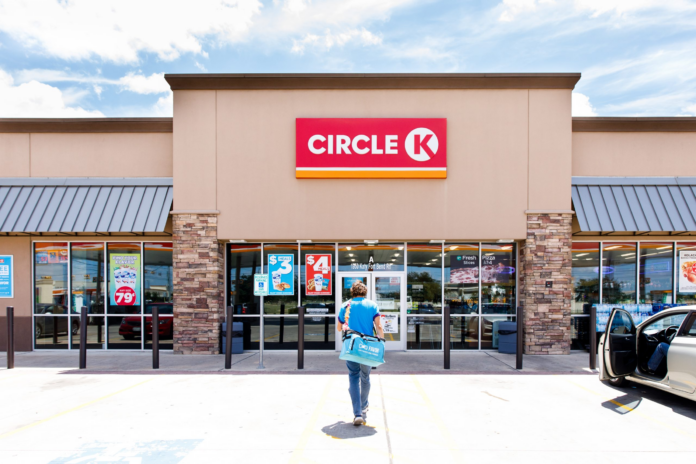
Circle K store/ Couche Tard. Photo: Yonge + St. Clair
Circle K and Couche-Tard have launched a new customer rewards campaign in Canada that links qualifying in-store purchases to visit milestones and offers customers a chance to win one of 10 $10,000 cash prizes.
The Road to Rewards promotion runs from Sept. 15 to Nov. 9, and is the company’s first app-integrated, visit-based campaign, according to Circle K Canada.
Campaign links purchases to app-based rewards
The program is designed to encourage customers to use the Circle K Canada and Couche-Tard mobile apps while making qualifying purchases at participating stores. Customers accumulate visits based on their in-store transactions and receive rewards when they reach specified milestones.
“We are delighted to launch Road to Rewards, our first app-integrated, visit-based campaign. With Road to Rewards, the more you visit, the more you get rewarded,” said Stéphane Trudel, Senior Vice President of Operations at Circle K Canada. “It’s been designed to reward our customers for the everyday visits that they’re already making and empower them to choose the rewards that mean the most to them, all through our new Circle K Canada and Couche-Tard apps.”
Stéphane TrudelPHOTO: CIRCLE K
Each in-store purchase of $5 or more counts as a visit, although in-store fuel pre-pay transactions are excluded. Customers enter their phone number at checkout and use either mobile app to monitor their progress.
Rewards are unlocked at six milestones — after the third, fifth, seventh, 10th, 13th and 15th qualifying visits. Customers can choose from rewards that include food, beverages, Circle K private-label products and region-specific offerings.
Each qualifying visit also automatically enters the customer into the campaign’s grand-prize draw. Ten $10,000 cash prizes are available, with five winners scheduled to be selected on Oct. 13 and another five on Nov. 10.
Apps become central to promotions
The campaign also expands the role of the Circle K Canada and Couche-Tard apps as platforms for contests, in-store promotions and exclusive coupons.
Customers who are of the age of majority can complete a three-step age-verification process to access additional promotions through the apps. The apps can also be used to locate nearby Circle K and Couche-Tard stores and participate in Road to Rewards.
Customers can download the Circle K Canada app by texting APP to 247253 or the Couche-Tard app by texting APPLI to 247253. They can also download the apps through an app store and create an account.
Promotion runs through November
The offer is available at participating Circle K stores from Sept. 15 through Nov. 9, subject to availability and while supplies last. Products must be purchased in a single transaction, and the offer cannot be combined with another offer or promotion.
The contest is open to legal residents of Canada, excluding Nunavut and Yukon, who are over 16. Parental or guardian consent is required for participants below the legal age of majority in their province or territory.
Participants are limited to three qualifying visits per day, with one visit permitted every three hours per mobile phone number and per person. Conditions and restrictions apply.
Alimentation Couche-Tard operates in 27 countries and territories through more than 17,200 stores, including approximately 13,100 locations that offer road transportation fuel. The company employs approximately 145,000 people throughout its network.
IKEA Canada is marking its 50th anniversary with a new campaign that uses the Swedish names of its products to highlight how those items take on personal meaning once they become part of consumers’ homes.
The campaign, called You Give It Meaning, runs to Nov. 8 and spans IKEA Canada’s official anniversary on Oct. 2, when the retailer will mark 50 years since opening its first Canadian store.
Campaign centres on IKEA’s Swedish names
The campaign is part of IKEA Canada’s anniversary platform, Celebrating 50 years of life’s moments together, and focuses on the retailer’s distinctive Swedish product names, including FJÄLLBO, SNIGLAR, STORKLINTA and MAMMUT.
The campaign contrasts the literal meanings of the names with the roles the products can take on in customers’ lives. IKEA says, for example, that a crib can become associated with a baby sleeping through the night, while a shelf can become a place for family photographs and a table can become part of dinners, homework, birthdays and other household routines.
“For 50 years, IKEA products have been showing up for Canadians in big life moments and beautifully ordinary ones,” said Jonelle Ricketts, Head of Marketing, IKEA Canada. “With You Give It Meaning, we’re having a little fun with our Swedish roots while celebrating something very true: the meaning of a product does not stop at its name. It grows with the people who live with it.”
The campaign will be supported by a series of television spots depicting everyday scenes in the home. According to IKEA, the spots use a Swedish voice named Jonas to interrupt sentimental moments and explain the actual meanings of the featured product names, adding humour to the scenes.
Anniversary marks five decades in Canada
IKEA opened its first Canadian store on Oct. 2, 1976. The retailer says the anniversary campaign is intended to recognize the role its products have played in Canadians’ homes during the five decades since that opening.
The campaign also connects IKEA’s Swedish heritage with the experiences of Canadian customers, emphasizing that the products’ significance can change after they are purchased and used in the home.
“As we celebrate 50 years of IKEA in Canada, we’re celebrating the many people who have made our products part of their homes, routines and memories,” said Selwyn Crittendon, CEO and Chief Sustainability Officer, IKEA Canada. “You Give It Meaning is a joyful reminder of what IKEA has always believed: that home matters, everyday life matters and good design should be for the many. We’re proud to keep helping Canadians create homes that feel affordable, functional, meaningful and wonderfully their own.”
IKEA Canada is part of Ingka Group, which operates 574 IKEA stores in 31 countries. In Canada, the company operates 15 stores and 13 Plan and order points.
The retailer says its Canadian operations welcomed 33.3 million visitors to its stores last year, while IKEA.ca recorded 199.9 million visitors.
Jonelle RickettsMeghan WilliskoSelwyn Crittendon
Reflecting on retailer’s success
Ricketts said the company’s 50th anniversary is an opportunity to reflect on what has made IKEA Canada successful for the past five decades while looking ahead to the next 50 years.
“At the heart of that is our relationship with Canadians and our commitment to understanding life at home. As reflected in our anniversary campaign, You Give It Meaning, we’ve been privileged to be part of countless everyday moments, milestones and memories in homes across the country,” she said.
“From a retail strategy perspective, our focus remains on making well-designed, functional home furnishing solutions accessible to the many people. That commitment to affordability is more important than ever as Canadians navigate economic uncertainty and look for ways to create homes they love on a budget without compromising on quality. Affordability has been part of our DNA since we arrived in Canada in 1976, and it will continue to be a key driver of how we innovate, invest and grow.
“More broadly, this milestone reminds us that our success has always been built on earning the trust of Canadians. While shopping habits and homes have evolved over the years, our role remains the same: to understand people’s needs, offer solutions that make everyday life better at home and create meaningful connections with our customers. That’s what we’re celebrating with this campaign, and it’s what will continue to guide us into the future.”
“Over the past 50 years, we’ve seen everything from the introduction of the personal computer and the internet to smart home technology and dedicated gaming spaces become part of everyday life. As a result, Canadians use their homes in far more flexible and multifunctional ways than ever before,” she said.
“What has allowed us to evolve alongside those changes is our deep understanding of life at home. Every year, we conduct more than 320 home visits in Canada to better understand how people live, their challenges and their dreams for their homes. Those insights help shape everything from home office and smart home solutions to newer offerings like our YXSTABY gaming collection developed in partnership with XBOX, which will be available as of October 1st.
“At the same time, some needs haven’t changed at all. Families are still looking for solutions that help them navigate life with children, stay organized and make the most of their space, whether that’s storing seasonal items, managing everyday clutter or creating a home that can adapt as life evolves.
“While our homes have changed dramatically over the decades, Canadians are still looking for the same things: affordable, functional and well-designed solutions that make everyday life better. Our job is to keep understanding those evolving needs and designing for the way people live today, and tomorrow.”
Building a campaign around Swedish product names
Ricketts said the creative was built around a tension the retailer knows exists with many consumers.
“People recognize and often have strong affection for IKEA product names, but few actually know what those names mean in Swedish. At the same time, we’ve learned that what people value most is not the product name itself, but the role that product plays in their everyday lives,” she said.
“That insight allowed us to connect two important truths about the brand: our Swedish roots and our deep understanding of life at home. By bringing those together, we could tell a story that is both uniquely IKEA and deeply relatable to Canadians.
“A shelving unit, for example, can become much more than a place to store belongings. Over the years, it fills with family photos, treasured keepsakes, children’s artwork and souvenirs from life’s biggest adventures. Yet our FJÄLLBO shelving unit literally translates to “mountain dweller.” That unexpected and humorous contrast between the name on the label and the memories it comes to hold helped inspire the creative idea behind the campaign.
“The humour in the campaign brings that unmistakable IKEA twinkle we’re always striving for, creating a lighthearted and memorable moment that we hope leaves Canadians with a smile.”
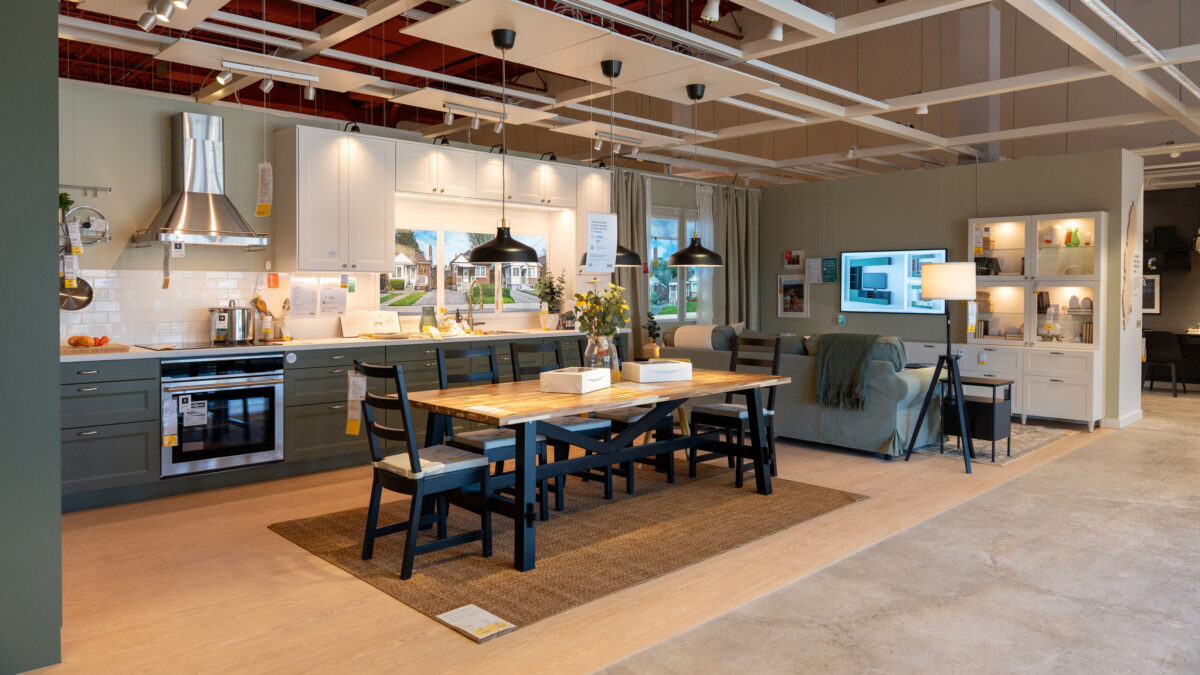
Located at 1100 boulevard Maloney Ouest, the Gatineau Plan and order point is a convenient and inspiring destination for nearby residents to get one-on-one design support from IKEA experts to plan, order, and purchase complex home furnishing solutions for any room in their home. (CNW Group/IKEA Canada Limited Partnership)
Biggest opportunities and challenges
Ricketts said the company sees its physical stores and digital channels working hand in hand, and the biggest opportunity is continuing to create a seamless experience across both.
“Our stores remain the heart of the IKEA experience. They’re where customers can touch and try products, explore room settings, find inspiration and experience the brand in a uniquely IKEA way,” she said.
“We continue to see strong engagement with our stores. This past weekend was a great example, with Canadians visiting in large numbers for our $1 breakfast and 50th anniversary STORKLINTA offer. While great deals certainly help drive traffic, it also speaks to the enduring appeal of the IKEA experience itself. Customers come for the value, but they stay to explore, gather inspiration, enjoy our food offering and experience the brand firsthand.
“At the same time, we know Canadians want convenience and flexibility. We aren’t present in every community across the country, so we’re focused on making IKEA more accessible through IKEA.ca, our app, collection points, mobile pick-up options and other evolving formats. The opportunity is to meet customers where they are and how they prefer to shop, whether that’s in-store, online or through a combination of both.”
IKEA Canada’s priorities for growing its store network
Looking ahead, the retailer’s priority is to become more accessible to more Canadians, while staying true to what has defined IKEA for the past 50 years: offering well-designed, functional home furnishings at prices as low as possible so many people can afford them, explained Ricketts.
“That means being present in more Canadians’ everyday lives and creating more opportunities for them to engage with the brand, whether that’s in-store, online, through our app or through new retail formats. Every new touchpoint is an opportunity to better understand our customers, inspire them with solutions for life at home and build even stronger relationships with them,” she said.
“We are particularly excited about our upcoming new compact store in London, Ontario, the first of its kind in Canada. It reflects how we’re evolving to meet people where they are by bringing IKEA closer to where they live, work, shop and socialize. Designed for quick visits and everyday essentials, it complements our traditional stores, digital channels, Plan and Order Points and collection points, giving customers more ways to experience and connect with IKEA.
“As we look to the future, we’ll continue to explore new formats, strengthen our omnichannel experience and invest in solutions that make IKEA more convenient and accessible across the country. But regardless of how we evolve, our focus remains the same: understanding life at home, responding to Canadians’ changing needs and ensuring that affordable, functional and inspiring home furnishings are within reach for as many people as possible. That’s how we’ll continue to earn our place in Canadian homes for the next 50 years.”
Canadian restaurants are facing mounting cost pressures, reshaping everything from menu prices to equipment investments, according to new research from EconoLease, a leading Canadian provider of equipment financing solutions to the hospitality industry.
The majority (80%) of Canadian operators have raised menu prices in the past 12 months, while nearly half (49%) plan to raise them again over the next year. Ongoing financial strain is forcing hard trade-offs, with about half (46%) of operators delaying a planned equipment upgrade in the past year because they can’t afford it, even though it’s critical to their business, said the report developed in partnership with Leger. The report surveyed 250 Canadian foodservice and hospitality operators to determine the top financial strains impacting their businesses today and their outlook for the year ahead.
Rising costs are putting more pressure on profits
EconoLease said the past year has been marked by continued economic disruption, increasing operating costs for restaurants already working with thin budgets. Compared to their U.S. peers, fewer Canadian operators saw profitability improve.
Over the past 12 months:
The typical Canadian operator reports a median overall cost increase of 7.5%, but three types of establishments — cafés or bakeries, fast-casual, and full-service or casual dining restaurants — each report a higher median increase of 15.5%†.
Operators saw the steepest cost increases in food and beverage supply (64%), labour and wages (55%) and rent and occupancy (32%).
Fewer Canadian operators saw improvement in their margins compared to their U.S. peers (42% in Canada vs. 64% in the U.S.)
Despite the pressure, 83% of Canadian operators feel optimistic about the year ahead, though the results are mixed across the different establishment types.
Fine dining operators (89%†) and full-service or casual dining operators (88%†) are most optimistic, while 27%† of franchise operators are pessimistic, roughly double the national pessimism rate of 14%.
Over the next 12 months, Canadian operators’ top business threats are rising food and beverage costs (55%), economic uncertainty or recession risk (41%), labour shortages or rising wages (37%), declining consumer spending (35%), and tariffs or supply chain disruptions (19%), it said.
Operators can’t afford to fix the equipment they need most
Every restaurant depends on working, reliable equipment to serve its communities. However, many operators can’t afford to fix their most critical equipment, increasing their risk of lost profit when that equipment breaks down during service, added the report.
Cooking equipment such as ovens, ranges and fryers is the biggest bottleneck for operators, cited by 28%, followed by refrigeration (14%).
Operators name refrigeration (60%), cooking equipment (58%), and point-of-sale and technology hardware (38%) as the most critical to their daily operations, so the categories they can’t afford to lose are also among the most failure-prone.
The typical Canadian operator spends a median of $22,500 CAD a year on equipment maintenance and repair.
With the high price tag, 29% of operators who want to upgrade their equipment said they can’t afford it, and 46% delayed a planned equipment upgrade in the past year due to costs.
The upgrades that operators want the most are energy-efficient cooking equipment (44%), smart refrigeration with monitoring and alerts (41%), and integrated POS and kitchen-display systems (37%).
The majority (80%) of Canadian operators say the ability to change or upgrade equipment at any time, without paying full price upfront, would help their operations run more smoothly.
Tyrone Ho Caio Mantovani photo
“I ran a café of my own before I ever worked in financing, so I understand the risks when a piece of equipment fails, or you’ve outgrown your current appliances, and you don’t have the cash to fix it or upgrade,” said Tyrone Ho, President of EconoLease. “As bills continue to pile up, operators need the flexibility to get the equipment when they actually need it and to adjust as their business changes. That’s the problem Rent-Try-Buy was built to solve.”
Opening a hospitality business in Canada comes with surprise costs
The financial pressure begins before operators ever open their doors, with many overshooting their budgets as they face surprise costs, said the report.
The median cost to open a hospitality business in Canada is $325,000 CAD, with café or bakery, fast-casual and full-service or casual dining operators all reporting the same median startup cost.
The most expensive types of establishments to open are hotels with food and beverage operations ($750,000 CAD†) and franchise operations ($750,000 CAD†). Meanwhile, the least expensive is a catering company at $212,500 CAD†.
Opening a café or bakery in the U.S. is cheaper than in Canada ($325,000 CAD† in Canada vs. about $139,00 CAD† in the U.S.).
More than one in four (26%) of Canadian operators said their startup costs exceeded their original budget by 10% or more, while 88% were surprised by at least one startup cost.
Commercial kitchen equipment (41%), fit-out and renovations (37%), and rent, lease and loan deposits (28%) were the expenses most likely to catch operators off guard.
Only 37% of Canadian operators turned a profit within their first year, compared to 59% of their U.S. peers.
Despite persistent cost pressures, the findings show that Canadian operators are focused on optimizing their cash flow through smarter pricing strategies and equipment investments. As they navigate higher expenses, equipment needs, and significant startup costs, access to flexible financing options can help businesses preserve cash flow while continuing to invest in the tools they need to operate and grow, said EconoLease, which is part of SilverChef Group, an Australian-founded hospitality equipment financier established in 1986 by equipment dealer Allan English.
Pressures facing restaurants
Ho said restaurants are being squeezed from several directions at once. Food and beverage costs remain the most widespread concern, while labour, rent, utilities, insurance and equipment expenses have also increased. At the same time, economic uncertainty is making it harder for restaurant operators to predict demand and plan confidently.
“These pressures are not sustainable if restaurants are expected to absorb them indefinitely. Operators have already responded by raising prices, adjusting menus, renegotiating with suppliers, and finding efficiencies wherever possible. The restaurants best positioned to manage these pressures will be those that can protect their cash flow while continuing to invest in the equipment and technology needed to operate efficiently,” he said.
Annie Hatuanh photo
How much more pricing pressure can restaurants put on consumers?
Ho said there is no single tipping point for how much restaurants can hand off to consumers because pricing power varies by restaurant, market, and customer base. However, consumers have become increasingly value-conscious, and many restaurants are approaching the limit of what they can pass along without affecting visit frequency, order size or overall traffic.
“Further increases need to be highly strategic rather than applied across the entire menu. Operators can focus on specific items, introduce different portions or price options, refine their menus, and improve back-of-house efficiency. Menu pricing can be part of the response, but it cannot be the only lever restaurants rely on,” he noted.
Financial health of the industry
Canada’s restaurant industry is feeling the pressure; delaying critical equipment upgrades is just one symptom. It shows that many otherwise viable restaurants are facing real cash-flow constraints. Delaying an upgrade may preserve capital in the short term, but it can also indicate that operators do not have enough financial flexibility to make investments that are important to their businesses, explained Ho.
“This creates a difficult cycle. Older equipment can require more maintenance, consume more energy and become less reliable, adding further costs and operational risk. Restaurants need access to financing options that allow them to obtain essential equipment without tying up the working capital they need for payroll, inventory and day-to-day operations,” he said.
Andrea Piacquadio photo
The most important equipment investments
The most important investments are those that directly improve reliability, productivity and cost efficiency. That can include refrigeration, cooking equipment, dishwashing systems, ventilation, point-of-sale technology, and equipment that reduces energy use or helps teams work more efficiently, said Ho.
“Continuing to delay these upgrades can lead to higher utility and repair costs, slower service, food waste, and unexpected downtime. A major equipment failure can be especially damaging because it may force a restaurant to reduce its menu or temporarily close. The right investment should help strengthen the operation without putting unnecessary pressure on its cash reserves,” he said.
Biggest challenges facing the industry over the next 12 months
Over the next 12 months, the biggest challenge in Canada’s restaurant industry will be protecting already-thin margins while consumers remain cautious and nearly every major operating expense stays elevated. Restaurants will also have to manage labour pressures, economic uncertainty, aging equipment, and limited access to working capital, said Ho.
“Restaurant operators cannot control the broader economy, but they can focus on the parts of the business within their reach: simplifying menus, reducing waste, improving productivity through smart equipment decisions, and making disciplined investments. Despite the challenges, our research found that 83% of operators remain optimistic about the next 12 months. That resilience is encouraging, but restaurants will need practical financial tools and the flexibility to adapt as conditions change,” he said.
Canada Goose at Oakridge Park in Vancouver. Photo supplied
By Justin Walford
A few months ago, I was shopping for a new set of kitchen knives. Like most consumers, I compared reviews, looked at materials, watched comparison videos, and eventually narrowed my decision to two nearly identical stainless steel sets.
One came from Wusthof, a heritage brand that’s been making knives for centuries. The other was a no-name manufacturer selling what appeared to be almost the same product, with the same materials and functionality, for roughly $300 less.
I bought the cheaper set, but afterwards found myself wondering if I’d made the right decision. Sure, the products were remarkably similar and their functionality appeared nearly identical. Plus, I was saving money.
Yet the premium brand’s higher price represented a layer of value that didn’t show up on a product comparison chart. More than two centuries of craftsmanship, confidence the company would stand behind its product, and the quiet satisfaction that comes from owning something built to last. None of that showed up in the specifications. Yet that’s exactly what the extra $300 was buying.
That experience got me thinking about a question retailers today are facing in almost every category. When consumers can easily find and validate lower-priced products with comparable functionality, what allows some brands to continue charging more?
I’ve spent much of my career across outdoor apparel, jewellery, retail, manufacturing and now chocolate, operating businesses in both Canada and the United States. What I’ve seen is that a premium usually can’t be defended by product quality alone. Instead, it’s validated by how much augmented value a brand can build around a strong product that also aligns with the desires of its core customer.
Here are some key lessons every retailer can learn from some of Canada’s premium brands.
The Best Brands Don’t Follow Trends. They Filter Them.
There’s no shortage of marketplaces for Canadians to access trending products at a fraction of the premium price. According to an Omnisend survey, 73% of Canadians bought from at least one Chinese marketplace such as Temu, Shein or AliExpress within the past year.
To me, the rise of this kind of consumerism is the antithesis of a brand. It’s also evidence of just how comfortable consumers have become buying a lower-priced substitute when the functionality is good enough.
Yet, some Canadian brands are still doing exceedingly well at gaining global market share at a premium price. Take Canada Goose for example. The premium outerwear and apparel company reported C$1.53 billion in revenue for fiscal 2026, up 13.3% year over year, while direct-to-consumer revenue grew 15.9%.
Canada may be a relatively small luxury market, but Canada Goose has excelled at identifying global consumer trends and interpreting them through its distinctly Arctic identity. Unlike fast-fashion competitors that chase whatever is trending, Canada Goose is intentional about finding alignment between global trends, what matters to its core customer and the Arctic heritage its products and reputation have been built upon.
That alignment creates value that goes well beyond the product itself. A Canada Goose parka still needs to perform, but consumers aren’t paying a premium for warmth alone. They’re also buying into the trust, reputation and identity the brand has built around the product. When those elements reinforce one another, they create an augmented layer of value that a lower-priced substitute can’t easily replicate.
Premium Brands Aren’t Better Everywhere. They’re Better Where It Counts.
The quality of a premium brand’s product isn’t always dramatically better than the cheaper alternative. Canada Goose’s jackets aren’t necessarily 50% warmer than say a North Face competitor. Just as the no-name knives I purchased on Amazon, weren’t 50% less sharp than the Wusthofs. What successful premium brands understand well, however, is who their customers are and where those customers expect differentiation.
Aritzia has mastered this art. Not only does the Canadian-based fashion retailer understand its core customers, it knows which nuances in product design and marketing will matter most to them. It’s no doubt part of why the company reported 35% revenue growth in fiscal 2026 and a 27% increase in comparable sales.
Take the Super Puff, one of Aritzia’s signature jackets, for example. Uniqlo and other global retailers make less expensive puffer jackets with comparable basic functionality and design. But Aritzia continues to evolve the product each year based on the trends that matter most to its customer. Depending on the season, the cut might become slightly shorter or boxier as silhouettes change. Those nuances may be meaningless to one consumer and immediately noticeable to another. Aritzia then reinforces those choices with an exceptional marketing machine that’s equally focused on the customer it’s trying to reach.
Being five per cent better doesn’t mean much if it’s in an area your customer doesn’t value, but being five per cent better in exactly the place your core customer cares about can be enough to keep a familiar product relevant and worth paying more for.
Your Customers May Be Telling You Where Your Next Premium Is
At a time when inflation and tariffs have made consumers increasingly conscious of price, some retailers have managed to continue raising prices while still gaining market share. Arc’teryx is a great example. Over the past decade, its flagship Gore-Tex jackets have tripled in price, while its sales have only accelerated. Amer Sports reported its technical apparel segment, which is led by Arc’teryx, grew 32% year over year in Q2 to $674 million.
One way Arc’teryx has been able to charge more is by expanding its relevance beyond climbers, skiers and outdoor enthusiasts without losing them. Its 2020 collaboration with Virgil Abloh’s Off-White runway at Paris fashion week famously bridged the gap between extreme outdoor gear and haute couture by featuring Arc’teryx jackets on the high-fashion runway.
That streetwear credibility has helped Arc’teryx reach new customers without sacrificing the technical performance its original customers value. For retailers, the lesson is to pay attention to where customers are already finding new value in your brand. When that opportunity aligns with what your brand already does well, expanding into it can create another layer of augmented value that customers are willing to pay for.
Going back to that no-name knife set I purchased on Amazon. In hindsight, I kind of wish I’d spent the extra $300. Not for a sharper edge, but for the certainty and social validation of a name that’s earned its reputation. A small regret, but it signifies what we’re seeing play out in every product category right now. A product alone might be good enough to win a sale, but it’s the augmented value brands create that keep customers wanting more.
Justin Walford
Justin Walford is President of Totally Chocolate and Totally Chocolate Promo. Over the past 20 years, he’s led consumer goods, retail, and manufacturing businesses through growth, operational change, and brand evolution.
Nearly two-thirds of working Albertans say they are less financially secure than they were a year ago, with financial stress also affecting workplace focus, productivity and attendance, according to a new survey commissioned by Money Mentors.
The 2026 Workplace and Wellness Report, conducted among members of the Angus Reid Forum, found 62 per cent of working Albertans feel less financially secure than they did a year ago, compared with 49 per cent nationally. Only 14 per cent said they are more financially secure.
Rising costs weigh on workers
Higher costs for groceries, utilities, transportation and other everyday necessities were identified as the biggest reason Albertans are losing financial ground. Thirty-six per cent of respondents cited higher everyday expenses, compared with 24 per cent nationally.
The survey also found that financial pressures are carrying over into the workplace. More than half, or 56 per cent, of working Albertans said financial stress has negatively affected their focus, productivity or attendance, a figure that was relatively unchanged from 58 per cent in 2025.
The impact was reported across household income levels, with 63 per cent of workers in households earning between $50,000 and less than $100,000 saying financial stress is affecting their work. Among workers in households earning $100,000 or more, 50 per cent reported an impact.
Savings also remain limited for a significant share of workers. Forty-two per cent of working Albertans said they could cover no more than two months of regular expenses with their savings if they lost their job today, compared with 44 per cent in 2025.
One in five respondents, or 20 per cent, said they had less than one month of savings or could not cover their expenses at all. Meanwhile, 32 per cent said they could cover six months or more of expenses, up from 29 per cent in 2025.
https://kaboompics.com/ photoStacy Yanchuk Oleksy
Financial cushion thinner for workers under stress
The survey found the financial safety net is particularly limited among workers who are already experiencing workplace effects from financial stress.
Among those respondents, 68 per cent said they could cover no more than two months of expenses if they lost their job. Thirty-nine per cent had less than one month of savings or no financial cushion, while just 12 per cent could cover six months or more.
The figures were similar to those reported in 2025. At that time, 71 per cent of Alberta workers who said financial stress was affecting them at work had no more than two months of expenses covered.
Workers experiencing financial stress at work were also more likely to be uncertain about where to seek help with serious debt. Twenty-two per cent of Alberta workers overall said they would not know where to turn first if they or someone they knew were struggling with serious debt, rising to 32 per cent among those whose financial stress was already affecting their work.
“Financial stress doesn’t stop when someone starts their workday,” said Stacy Yanchuk Oleksy, CEO of Money Mentors. “When people are already operating with very little financial cushion, an unexpected expense or loss of income can quickly become a much bigger problem. For employees, the takeaway is to seek support before debt becomes unmanageable. For employers, it means recognizing that financial stress can affect people at work and making sure employees know where they can turn for trusted, confidential help.”
ANTONI SHKRABA production photo
Awareness gap remains around debt assistance
Among Alberta workers who know where they would seek help with serious debt, non-profit financial counselling was the most common first choice. Twenty-six per cent said they would first turn to a non-profit financial counselling or debt-help organization, compared with 22 per cent who would choose a financial planner or financial adviser.
Ten per cent said they would first turn to a bank or credit union, while four per cent would choose a licensed insolvency trustee.
The survey found a larger awareness gap among younger workers. Nearly one-quarter, or 24 per cent, of Albertans aged 18 to 34 said they would not know where to turn for serious debt help.
Awareness was also low for Alberta’s Orderly Payment of Debts program. Seventy-nine per cent of working Albertans said they had never heard of OPD before taking the survey. Twenty per cent had heard of the program, while seven per cent said they had heard of it and knew at least something about it.
Money Mentors provides free, confidential credit counselling and financial education to Albertans dealing with debt and money management. The organization is also the exclusive provider of Alberta’s Orderly Payment of Debts program, which it manages on behalf of the Alberta government.
SHEIN pop-up at CF Toronto Eaton Centre. Image: SHEIN
SHEIN is using five digital creators and streamers to promote its Fall/Winter 2026 fashion collection, pairing six seasonal trends with creator-led content designed to bring consumers into the campaign process.
The global online fashion and lifestyle retailer has unveiled its Fall/Winter ’26 Trend Campaign, featuring trends it has identified as Dark Romance, Folk Revival, Power Dressing, Regal Maximalism, Retro Remix and Soft Glam.
SHEIN photo
Creator-led campaign
The campaign features twin sisters Wendy and Evelyn Ortiz, Brooklyn Frost, Dano Maldonado and Lani Aliza, with each creator putting an individual interpretation on the featured looks. The campaign links the creators’ existing digital audiences with content showing how the trends are incorporated into their personal styles.
SHEIN said the campaign also includes behind-the-scenes content from the creators’ photoshoots. Wendy and Evelyn focus on Retro Remix, Brooklyn Frost takes on Power Dressing, while Maldonado and Aliza interpret Soft Glam, giving their audiences a view of the campaign process as it unfolds.
“Today’s audiences don’t just want to see the final campaign, they want to be a part of how it comes together,” said Lisa Zlotnick, Head of U.S. Brand PR at SHEIN. “This collaboration is really about community, giving our creators and their audiences a front-row seat and letting them shape the conversation alongside us.”
The approach gives the creators’ followers access to content produced during the campaign rather than only the finished fashion imagery, according to the company. SHEIN said the campaign is intended to connect fashion discovery with the communities built around digital creators.
“Putting our own spin on Retro Remix and bringing our followers into the campaign shoot with us made it so much fun,” said Wendy and Evelyn Ortiz. “Fashion is how we express ourselves, so getting to share that with our community in real time meant a lot.”
Lisa ZlotnickSHEIN photo
Collection available online
The Fall/Winter ’26 Trend Collection is available through SHEIN’s website and app, with the company directing shoppers to search “FWTrends” to view the six trends.
SHEIN said the campaign is intended to reflect the role of creators and their digital communities in fashion discovery, inspiration, interpretation and conversation. The company is positioning the six trends as starting points that consumers can reinterpret through their own styles.
The campaign also encourages consumers to share their Fall/Winter ’26 looks on social media and tag SHEIN’s U.S. accounts on Instagram and TikTok.
SHEIN is headquartered in Singapore and describes itself as a global online fashion and lifestyle retailer offering SHEIN-branded apparel and products from a global network of vendors. The company said it uses an on-demand production methodology as part of its business model.
Sephora Canada First-Ever Small Store in Kitsilano (CNW Group/Sephora Canada)
American media personality Khloé Kardashian is expanding her fragrance business into Sephora, bringing her portfolio of scents to the beauty retailer’s stores and website in the United States and Canada.
The launch includes Kardashian’s XO Khloé, Almost Always and newly introduced XO BLUE fragrances. The products will be sold in 1,300 Sephora U.S. and Sephora Kohl’s locations, while Sephora will be the exclusive retailer for the fragrances in Canada.
Khloé Kardashian
North American retail expansion
The expansion, announced in partnership with LUXE Brands, gives Kardashian’s fragrance portfolio a broader physical retail presence while establishing Sephora as its Canadian retail channel. The collection is available at Sephora.com and in stores.
The companies also describe the North American launch as a foundation for potential international expansion into markets including Mexico, Brazil, India and parts of Asia. A news release says the partnership is intended to use Sephora’s retail presence and media reach in the U.S. and Canada to assess consumer demand before expanding into additional international markets.
“Sephora is such an iconic destination for beauty discovery, and I am so excited to bring my fragrance collection to their community,” said Kardashian. “Creating these scents has been a deeply personal journey for me. I wanted to build a portfolio that offers a transportive and memorable experience and Sephora is the perfect partner to help tell that story.”
“The Sephora expansion for Khloe’s fragrance portfolio will be supported with a comprehensive 360-degree media campaign across key consumer touchpoints, from paid social and digital to out-of-home and strategic media partnerships” said Dodge. The campaign will also leverage high-impact entertainment adjacencies, including video placements surrounding the new season of Hulu’s The Kardashians, reinforcing that Khloé’s fragrances are now available at SEPHORA while driving awareness, discovery, and engagement at scale.
Noreen Dodge Khloé Kardashian
Broader business portfolio
The Sephora launch adds another retail channel to Kardashian’s expanding business activities. According to the release, she recently launched Khloud Foods, a health-conscious snack brand, as part of an expansion into lifestyle and food.
Kardashian is also an executive producer of Hulu’s The Kardashians and her new series The Girls, which focuses on her inner circle. Her podcast, Khloé in Wonder Land, features conversations with a global audience.
Her fragrance business began with the solo launch of XO KHLOÉ, followed by Almost Always and XO BLUE.
LUXE Brands partnership
LUXE Brands, which is partnering with Kardashian on the fragrance portfolio, is a prestige beauty company with corporate offices in Florida and a creative hub in New York. Its portfolio includes fragrances and beauty brands associated with Ariana Grande, Nicki Minaj, Eau de Juice by Cosmopolitan and the Hummer brand through a licensing partnership with General Motors.
The company says its approach focuses on design, marketing and brand building with a digital-first strategy.
Sephora operates more than 2,700 stores across 35 countries, according to the release. The retailer’s North American footprint will provide the primary retail platform for Kardashian’s fragrance collection as the business moves into its next stage of expansion.
Welcome to the Daily Synopsis by Retail Insider. We hope you enjoy the 13 articles we published today covering key developments in Canadian retail.
Italian brands Intimissimi and Calzedonia are launching their first Canadian stores at CF Sherway Gardens in Toronto this fall, marking the start of a broader expansion led by ILT Group. Consumer prices in Canada rose 3.0% year over year in August, with gasoline price growth slowing but remaining elevated due to geopolitical tensions.
Toronto-based Liminal Assembly is expanding its LoiterFEST events to transform overlooked malls, aging retail spaces, and transitional urban environments into unique social destinations. The North West Company is experiencing rising consumer spending in Northern Canada as First Nations settlement payments are distributed to more communities, boosting sales alongside ongoing inflation driven by fuel and freight costs. RBC has relaunched its Avion Rewards Travel platform with integrated AI-powered tools that enhance fare tracking, price prediction, and personalized travel booking across flights, hotels, car rentals, and vacation packages.
Canadian small and mid-sized businesses face increasing cash-flow challenges despite profitability, driven by late payments, high inventory costs, tariffs, and rising debt levels. Empire Company is accelerating its Canadian grocery store expansion, raising its fiscal 2027 target to over 25 new locations across multiple banners including FreshCo, Sobeys, IGA, and Mayrand.
Vancouver-based furniture retailer Article has opened its largest store in Toronto, expanding its physical retail presence following strong online sales and successful testing in Vancouver. Food inflation in Canada is rising significantly faster than in the U.S. due to structural challenges such as smaller market size, limited processing capacity, reliance on imported inputs, and fragmented provincial regulations.
Maple Leaf Foods is bringing Yves Veggie Cuisine back to grocery shelves across Canada, reviving the well-known Canadian plant-based brand less than a year after its previous owner discontinued the business amid declining sales in the meat-free category.
The Mississauga-based food company announced Monday that six refrigerated Yves products have begun arriving at Canadian grocery stores, with additional retail partners expected to roll out the brand over the coming weeks. The comeback is notable because Maple Leaf is investing in Yves at a time when the broader plant-based category remains well below the growth expectations that drove heavy investment several years ago.
Yves was shut down by Hain Celestial in 2025 after more than two decades under its ownership. Maple Leaf subsequently acquired the brand and is now rebuilding it within an existing plant-protein operation that has gone through its own significant restructuring.
“Yves is one of those rare brands that people didn’t just buy — they built routines, recipes and traditions around it,” said Adam Grogan, President and Chief Operating Officer of Maple Leaf Foods. “When Yves disappeared from shelves, Canadians made it very clear how much this brand meant to them. We heard that passion.”
From Vancouver Startup to Discontinuation
Yves Veggie Cuisine traces its roots to Vancouver in 1985, decades before plant-based meat alternatives became a major consumer packaged goods category. Founder Yves Potvin built the business around vegetable-protein alternatives to conventional meat products, eventually establishing Yves as one of Canada’s most recognizable names in the category.
Hain Celestial acquired Yves in 2002 and operated it for more than two decades. By the middle of the 2020s, however, the economics of plant-based meat alternatives had changed considerably.
Hain had already consolidated Yves’ Canadian manufacturing operations as part of efforts to reduce complexity and improve capacity utilization. In June 2025, the company made the strategic decision to close the Yves business, later recording an impairment associated with its Canadian operations. When the discontinuation became public, Hain pointed to years of declining sales across the meat-free category.
Maple Leaf moved relatively quickly. Canadian trademark records show ownership of the Yves Veggie Cuisine trademark transferring from Hain Celestial Canada to Maple Leaf Foods effective December 19, 2025, with the change registered the following month. Maple Leaf has not disclosed what it paid for the brand.
Maple Leaf Brings Back Six Yves Products
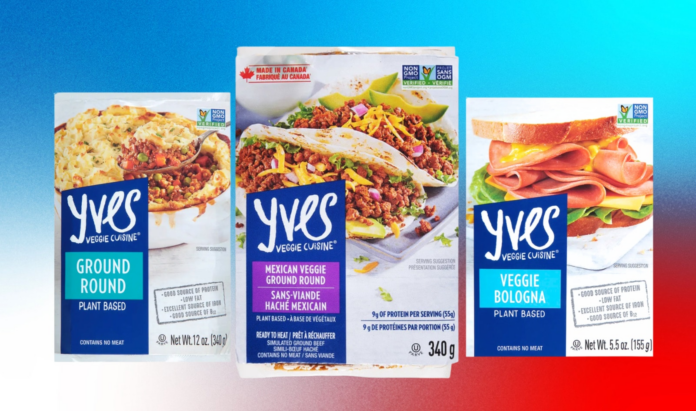
The revived Yves is starting with a smaller lineup than the brand previously carried. Maple Leaf is returning Original Veggie Ground Round, an Original Veggie Ground Round four-pack, Mexican Veggie Ground Round, Veggie Ham, Veggie Bologna and Veggie Turkey.
The company says the products were among those most requested by consumers following Yves’ disappearance. Maple Leaf has not committed to restoring the broader former assortment and says it will listen to consumer feedback as it considers what could come next.
The manufacturing structure is also different. Yves is once again under Canadian ownership and leadership and headquartered in Ontario, while the products are being made at Maple Leaf’s existing plant-based facilities in the United States.
Using existing production capacity allows Maple Leaf to add Yves to plant-protein infrastructure it already operates without recreating the brand’s former Canadian manufacturing footprint. It is one of several differences between the revived Yves business and the operation Hain decided to close.
Why Yves Fits Maple Leaf
Maple Leaf already has considerable experience with both the opportunities and difficulties of plant-based foods.
The company expanded into the category through its acquisitions of Lightlife and Field Roast in 2017 and 2018, followed by significant investment in plant-protein manufacturing, marketing and product development. Those investments came when industry forecasts anticipated rapid and sustained growth in plant-based alternatives.
The expected growth did not materialize. Maple Leaf subsequently reduced spending, restructured the operation and integrated its meat and plant-protein leadership and commercial teams.
At its 2026 Investor Day, Maple Leaf described the 2023-to-2025 period of its plant-protein strategy as a “restructure and reset.” Its current strategy includes bringing plant-protein margins toward the average of its broader portfolio, putting profitability and operational efficiency at the centre of the business.
That history provides important context for the Yves acquisition. Maple Leaf is adding an established Canadian name to a plant-protein platform that has already undergone a significant operational and financial reset, without relying on another surge in category growth to justify the investment.
Maple Leaf Sees Yves as a Growth Opportunity
The company was signalling the commercial importance of Yves before Monday’s consumer-facing announcement. During its second-quarter earnings call in August, management identified the Yves relaunch among initiatives expected to support revenue growth during the second half of 2026 and highlighted the brand’s loyal Canadian following and historical market strength.
Maple Leaf reported second-quarter sales of approximately $1.02 billion, up 1.6 per cent year over year, while adjusted EBITDA increased 4.8 per cent to $137.1 million. The company continues to focus on revenue and margin growth following several years of major capital investment and operational changes.
The earnings-call comments also make clear that the return of Yves is more than an exercise in preserving a legacy Canadian brand. Maple Leaf expects the acquisition and relaunch to contribute commercially at a time when its approach to plant protein is considerably more disciplined than during the category’s rapid expansion.
Plant-Based Market Has Changed
The Canadian market Yves is returning to has matured considerably. NielsenIQ estimates that the Canadian plant-based food categories it tracks generate approximately $1.23 billion in annual sales, with both dollar and unit sales declining by about one per cent over the latest year measured.
Household penetration has remained relatively stable, suggesting consumers have not abandoned plant-based foods altogether. Existing buyers are instead purchasing less frequently and spending less, while performance varies considerably between different parts of the category.
Products such as tofu and tempeh have performed comparatively well, while some highly processed meat alternatives have faced greater pressure. Consumers are increasingly weighing price, protein content, ingredients, convenience and value when deciding which plant-based products make it into their grocery baskets.
That environment could make Yves’ existing recognition particularly useful to Maple Leaf. Instead of introducing an unfamiliar plant-based brand, the company is returning products associated with a name that spent decades in Canadian grocery stores.
Grogan’s comments about consumers building recipes and routines around Yves point to the value Maple Leaf sees in that familiarity. In a more mature category, established consumer habits could provide a stronger starting point than relying on novelty to drive trial.
A Focused Return to Grocery Shelves
The six-product lineup keeps the initial relaunch relatively focused. Instead of immediately recreating Yves’ former assortment, Maple Leaf has concentrated on several recognizable refrigerated products while leaving open the possibility of further additions.
The returning products are intended to remain familiar to previous Yves customers, although formulations are not necessarily identical. Maple Leaf says the relaunched Veggie Bologna, for example, is its own version of the product.
Starting with a narrower assortment gives Maple Leaf an opportunity to rebuild distribution around some of Yves’ best-known products before deciding how extensively to expand the portfolio. Products have already begun appearing in grocery stores across Canada, with additional retail partners expected to join the rollout over the coming weeks.
Canadian Brand Returns Under a Different Model
Yves returns at a time when Canadian consumers are paying greater attention to domestic ownership and production. The brand was founded in Canada and is once again Canadian-owned through Maple Leaf Foods, although the relaunched products are currently manufactured at the company’s existing plant-based facilities in the United States.
That production arrangement also underscores how different the revived business is from the operation Hain Celestial decided to close. Maple Leaf already has plant-protein manufacturing, sales and distribution capabilities, while Yves brings four decades of Canadian consumer recognition to that platform.
The relaunch will now test whether those advantages are enough to make Yves work in a market that remains challenging. Hain looked at the brand and declining meat-free sales and decided to exit; months later, Maple Leaf saw enough remaining value to acquire Yves and put it back on Canadian grocery shelves.
Maple Leaf’s bet does not require plant-based foods to return to their former growth expectations. Yves can succeed on a smaller premise: that a familiar brand, focused assortment and existing operating infrastructure can create value in a plant-based market that has become considerably more disciplined.
Apple’s latest software rollout is giving consumers new ways to monitor products, retrieve information and interact with apps without navigating them in the conventional way.
With iOS 27, Safari can monitor webpages for changes such as price drops and product restocks, while Siri AI can interpret onscreen content, retrieve current information from the web and perform supported actions across applications. For Canadian retailers, the immediate significance is less about Siri becoming a shopping destination and more about Apple building another technical layer through which products and services can be discovered.
That does not mean customer behaviour has already shifted. Siri AI is limited to supported hardware, third-party functionality depends on developer integration, and adoption remains unknown. But Apple is putting infrastructure in place that could matter to retailers accustomed to optimizing digital visibility around websites, apps, search engines and marketplaces.
Retailers have traditionally designed ecommerce around a familiar sequence: a customer searches, arrives at a website or app, browses products and eventually checks out.
Apple’s newer software features make that sequence less necessary in some situations.
Safari can monitor a webpage and notify a user when something changes, including when an item returns to stock or its price falls. A shopper waiting for either event no longer needs to keep checking the retailer’s site manually.
Siri AI can also work with information already visible on screen, retrieve current information from the web and use personal context to answer questions or perform supported tasks. Apple had previously expanded Visual Intelligence so users could search services such as Google and Etsy for products related to images they were viewing.
None of these features changes ecommerce on its own. Together, however, they show Apple moving more search, monitoring and interaction into software that sits above individual retailer websites and applications.
Retail visibility may increasingly include AI visibility
The more consequential development for retailers is Apple’s developer architecture.
Through App Intents, developers can expose content and functions from their applications to Siri and Apple Intelligence. That gives Apple’s system-level software access to supported information and actions without requiring users to navigate through every step of an app interface.
For retailers, that creates a practical question: can an AI system identify a product, understand whether it is available and determine what the customer can do next?
That is a different problem from conventional website optimization.
Retailers have spent years structuring digital information for search engines, marketplaces and comparison-shopping platforms. If AI assistants become another meaningful discovery channel, product data, inventory information and app functionality may need to work for software agents as well as human shoppers.
The commercial impact remains uncertain. The technical direction is much clearer.
Safari adds another layer between merchandising and the customer
Price and inventory monitoring make the shift easier to understand.
When a retailer changes a price or replenishes inventory, Safari can detect that change and alert a consumer who has asked to be notified.
That could reduce some repeat browsing. It could also improve conversion by bringing a shopper back at the precise moment an item becomes available or reaches an acceptable price.
There is no evidence yet showing which effect will dominate.
What has changed is the communication chain. The retailer still controls the merchandise and pricing decision, but Apple can now control part of the mechanism that brings the shopper back.
For an industry already dependent on search engines, social platforms, marketplaces and app ecosystems, that is another distribution layer to account for.
Apple occupies a different position from most digital intermediaries
Retailers are accustomed to intermediaries.
Google influences product discovery through search. Amazon combines discovery with transactions. Meta and TikTok increasingly shape what consumers encounter before they begin actively shopping.
Apple’s position is different because it controls the hardware, operating system, browser, assistant and developer framework on the same device.
That does not make Apple a retail marketplace, and there is no evidence that it plans to charge retailers for Siri placement, sell product rankings or replace retailer storefronts.
But operating-system control gives Apple the ability to make AI-mediated interaction part of the device experience without asking consumers to adopt a separate shopping platform.
That distinction could become commercially important if consumers begin relying on these tools at scale.
Adoption will determine whether the capability matters commercially
There are substantial limits to the thesis.
Siri AI is not available across the entire Apple installed base. It requires relatively recent hardware, and meaningful third-party actions depend on developers implementing the necessary integrations.
Canada also has a language constraint. Siri AI is beginning its rollout in English, while Apple says additional languages, including French, will follow. Apple’s September release gives October as the timetable for French support.
Most importantly, technical availability says little about how consumers will actually use the features.
Retailers therefore have little reason to assume an immediate disruption to ecommerce traffic or app usage.
They do have reason to examine whether their product data and digital services can function in an environment where software increasingly searches, monitors and acts on behalf of customers.
Apple is not replacing the retailer’s digital storefront. It is building another interface through which consumers may reach it.
For Canadian retailers, the strategic question is increasingly straightforward: when the customer asks an AI system to find, monitor or act on a product, will the retailer’s digital infrastructure be able to answer?