DESIGNME Launches Rooting for All Women, a Campaign Celebrating Transformation, Strength, and Collective Impact (CNW Group/DESIGNME)
DESIGNME, the professional, vegan Canadian haircare brand, has unveiled Rooting for All Women, a limited-edition campaign honouring women, their evolution, and the power of transformation at every stage of life.
From artists behind the stylist chair to creators, salon owners, and consumers, women help bring DESIGNME to life every day. Rooting for All Women builds on the brand’s long-standing commitment to confidence, creativity, and self-expression – values that have been at the heart of DESIGNME since its inception in 2016, said the company.
“Rooting for All Women is about honouring the many transformations women experience – personally, professionally, and creatively,” said Cynthia Desrochers, VP Global Marketing and Digital at DESIGNME. “It’s a celebration of resilience and reinvention, while also creating meaningful impact for women who need support most.”
Cynthia Desrochers
Inspired by the idea of metamorphosis, the campaign reflects moments of growth, renewal, and empowerment, mirroring the transformations women navigate throughout their lives, said the company
As part of the initiative, DESIGNME will donate a portion of proceeds from the limited-edition collection, up to a maximum total donation of $10,000, to women’s support organizations in North America. The brand will also continue its commitment beyond the campaign, with additional initiatives planned throughout the year in support of charities, it said.
A portion of the Canadian proceeds will benefit Chez Doris in Montréal, an organization dedicated to providing safety, resources, and opportunity to women in vulnerable situations.
Diane Pilote
“This partnership reflects our mission in a meaningful way: transforming corporate commitment into concrete action,” said Diane Pilote, Executive Director of Chez Doris. “Access to essential hygiene and hair care products plays a vital role in restoring confidence and self-worth. DESIGNME’s support directly helps preserve the dignity and autonomy of the more than 1,700 women we serve each year.”
Businesses continue to anticipate a variety of obstacles over the next three months. While pressures of both cost- and labour-related obstacles continued into the first quarter of 2026, the proportion of businesses with a positive outlook has increased compared with previous quarters, according to a report released by Statistics Canada on Friday.
In the first quarter of 2026, 59.2% of businesses across Canada expect cost-related obstacles over the next three months, down from 61.2% in the fourth quarter of 2025. For the Canadian Survey on Business Conditions, cost-related obstacles consist of inflation; cost of inputs; interest rates and debt costs; cost of insurance; cost of real estate, leasing or property taxes; and transportation costs. In January 2026, prices of raw materials purchased by manufacturers operating in Canada, as measured by the Raw Materials Price Index, increased by 7.7% month over month and rose 8.0% year over year. Additionally, average hourly wages among employees were up 3.3% on a year-over-year basis in January, following growth of 3.4% in December 2025, explained Statistics Canada.
“Within this environment, in the first quarter of 2026, just over two-fifths (40.8%) of businesses expect inflation to be an obstacle over the next three months, marking it as the most commonly expected obstacle among businesses. Businesses expecting inflation to be an obstacle were most frequently found in accommodation and food services (60.7%); agriculture, forestry, fishing and hunting (50.1%); and wholesale trade (48.2%),” it said.
“Recruiting skilled employees is the second most commonly expected obstacle, anticipated by one-quarter (25.3%) of businesses, led by those in administrative and support, waste management and remediation services (39.0%); construction (37.5%); and accommodation and food services (34.2%).
“When asked to identify the most challenging expected obstacle over the next three months, 10.7% of businesses expected it to be recruiting skilled employees, 10.5% indicated inflation and 6.8% reported the cost of inputs.”
Nearly one-third (32.0%) of all businesses, whether they engaged in trade or not, reported that the imposition of tariffs by the United States on imports from Canada had a negative impact on their business over the 12 months prior to the survey. Businesses in manufacturing (51.2%); agriculture, forestry, fishing and hunting (47.1%); and wholesale trade (45.7%) were most likely to indicate this. In contrast, 1.4% of businesses reported that these tariffs had a positive impact on their business over the 12 months prior to the survey. Meanwhile, over half (51.2%) indicated that the imposition of tariffs by the United States on imports from Canada had no impact on their business over the 12 months prior to the survey. A further 15.4% of businesses were unsure what impact tariffs imposed by the United States had on their business, noted Statistics Canada.
“In the first quarter of 2026, all businesses were asked whether they had passed cost increases due to tariffs onto their customers over the 12 months prior to the survey, whether they engaged in trade or not. Over one-quarter (26.8%) of businesses reported having done so, while over one-third (34.5%) had not passed any cost increases onto their customers. Meanwhile, nearly two-fifths (38.6%) of businesses had not experienced any cost increases due to tariffs,” it said.
“At the same time, over one-third (34.1%) of businesses reported that they were either very likely or somewhat likely to pass cost increases due to tariffs onto their customers over the next 12 months. In contrast, 14.4% were either very unlikely or somewhat unlikely to do the same, and 15.0% were unsure. Over one-third (36.5%) of businesses did not expect any cost increases due to tariffs over the next 12 months.”
Andrea Piacquadio photo
In the first quarter of 2026, 16.1% of businesses indicated they had changed their marketing practices over the 12 months prior to the survey to promote Canadian products, led by those in retail trade (41.3%), accommodation and food services (30.2%) and wholesale trade (28.1%), according to the report.
“Over the 12 months prior to the survey, 12.7% of businesses experienced an increase in sales of their Canadian products, with businesses in retail trade (27.2%), manufacturing (23.0%) and wholesale trade (21.7%) being most likely to see an increase in sales. In contrast, 7 in 10 (70.5%) businesses did not experience an increase in sales of their Canadian products over the 12 months prior to the survey, and a further 16.9% were unsure,” it said.
“In the first quarter of 2026, nearly three-quarters (73.1%) of businesses are either very or somewhat optimistic about their outlook over the next 12 months, higher than the proportions of businesses that reported the same in the third (66.7%) and fourth (66.3%) quarters of 2025,” concluded Statistics Canada.
“Meanwhile, in the first quarter of 2026, nearly one-fifth (18.1%) of businesses expect their sales of goods or services to increase over the next three months, a slight increase from 16.3% in the fourth quarter of 2025. In the first quarter of 2026, 14.8% of businesses expect sales of their goods or services to decrease, while 23.2% of businesses anticipate the selling price of their goods or services to increase. Businesses most likely to expect their selling prices to increase over the next three months are those in accommodation and food services (35.1%), retail trade (29.7%) and manufacturing (29.5%).”
“While margins remained constrained in our fourth quarter results, we advanced margin improvement initiatives and saw underlying momentum improve as we exited the quarter. As we head into the important Lenten period, we are well positioned to drive profitable sales growth, supported by our ongoing focus on continuous improvement, including plant efficiencies, and disciplined execution.”
Key financial results, reported in USD, for Q4:
Adjusted EBITDA decreased by $4.5 million, or 18.9%, to $19.3 million compared to $23.8 million, and Adjusted EBITDA as a percentage of sales decreased to 7.1% compared to 10.1%;
Sales volume increased by 0.9 million pounds, or 1.5%, to 61.3 million pounds compared to 60.4 million pounds, while sales increased by $35.2 million, or 15.0%, to $270.2 million compared to $235.0 million;
Net income increased by $2.1 million, or 35.6%, to $8.0 million compared to $5.9 million, and diluted earnings per share (“EPS”) increased to $0.27 per share compared to $0.20 per share;
Adjusted Net income decreased by $9.8 million, or 78.4%, to $2.7 million compared to $12.5 million and Adjusted Diluted EPS decreased to $0.09 per share from $0.41 in 2024;
Gross profit decreased by $1.3 million, or 2.5%, to $49.7 million compared to $51.0 million, and gross profit as a percentage of sales decreased to 18.4% compared to 21.7%; and
Net Debt to Rolling fifty-two weeks Adjusted EBITDA was 3.5x at January 3, 2026 compared to 2.3x at the end of Fiscal 2024 and 2.6x at end of Fiscal 2023.
Key financial results, reported in U.S. dollars, for the year:
Adjusted EBITDA decreased by $11.6 million, or 11.2%, to $91.7 million compared to $103.3 million, and Adjusted EBITDA as a percentage of sales decreased to 8.9% compared to 10.8%;
Sales volume increased by 2.1 million pounds, or 0.9%, to 237.9 million pounds compared to 235.8 million pounds and sales increased by $67.7 million, or 7.1%, to $1,026.9 million compared to $959.2 million;
Net income decreased by $23.6 million, or 39.2%, to $36.6 million compared to $60.2 million and diluted earnings per share (“EPS”) decreased to $1.22 per share compared to $1.89 per share;
Adjusted Net income decreased by $13.2 million, or 27.5%, to $34.8 million compared to $48.0 million and Adjusted Diluted EPS decreased to $1.17 per share compared to $1.51 per share; and
Gross profit decreased by $4.5 million, or 2.1%, to $212.8 million compared to $217.3 million, while gross profit as a percentage of sales decreased to 20.7% compared to 22.7%.
Paul Jewer
“As we look ahead to 2026, we remain focused on driving sustainable margin improvement and leveraging the investments we have made in new product innovation and brands to support profitable growth,” said Jewer.
“With disciplined margin management, cost reductions, and targeted supply chain efficiency initiatives, we are confident in our ability to offset higher raw material costs and tariffs. We are seeing profitability improve and expect that to continue over the course of the year. Overall, despite continued pressures on our business from macro headwinds, we remain confident in our ability to deliver year over year adjusted EBITDA growth, starting in the first quarter of 2026.
“My conviction in the strong underlying fundamentals of our business and outlook is supported by our steady execution and the continuous innovation, which includes our newly launched fully cooked seafood line that provides customers with responsibly sourced, easy to execute, delicious mealtime solutions. These products, as well as the exciting new innovation offerings we have in the pipeline, present opportunities to expand the category and encourage greater North American seafood consumption. Our balanced approach to capital allocation, along with the recently oversubscribed incremental addition to our term loan and the extension of our ABL (asset based lending), further strengthens our financial flexibility and demonstrates strong confidence in our overall strategy.”
Real gross domestic product GDP declined 0.2% in the fourth quarter of 2025, after rising 0.6% in the third quarter. The fourth quarter decrease was due to withdrawals of business inventories following inventory accumulations in the third quarter. Offsetting some of the decline was higher exports, household spending and government capital investment. On a per capita basis,GDP was unchanged in the fourth quarter after increasing 0.5% in the previous quarter, according to a report released Friday by Statistics Canada.
Real GDP increased 1.7% in 2025, the slowest pace of annual growth since the decline in 2020. Lower exports, particularly to the United States, were the main contributor to the slower rise in GDP in 2025, explained the federal agency.
“Businesses withdrew from non-farm inventories in the fourth quarter, after adding to their stock in the previous two quarters. The largest withdrawals in the fourth quarter occurred in the manufacturing sector, followed by the wholesale trade sector. In the retail sector, motor vehicle inventories declined,” said Statistics Canada.
“On an annual basis, businesses withdrew from non-farm inventories in 2025, marking the first annual decline of inventory stock since 2020, during the COVID-19 pandemic. In contrast, the stock of farm inventories rose for the first time in three years, given strong crop production in 2025.
“Exports rose 1.5% in the fourth quarter, after increasing 0.9% in the third quarter. The growth in the fourth quarter was led by higher exports of unwrought gold and of unwrought aluminum and aluminum alloys. Despite the increases in the latter half of the year, exports fell 1.7% in 2025, as shipments to the United States did not fully recover following the drop in the second quarter.
“Imports edged up 0.3% in the fourth quarter, as higher imports of computers, clothing and footwear, and metal ores were largely offset by lower imports of pharmaceutical and medicinal products. For the year, imports were down 0.4% in 2025 due to the 2.9% decline in the third quarter.”
Household spending rose 0.4% in the fourth quarter after declining 0.2% in the third quarter. Higher expenditures on rent and financial services in the fourth quarter were partially offset by lower spending on new passenger vehicles and alcoholic beverages, as overall expenditures on goods declined for a second consecutive quarter, said Statistics Canada.
On an annual basis, household final consumption expenditure was up 2.3% in 2025, keeping pace with the 2.2% growth in each of the previous two years. The rise in 2025 was led by increased household spending on financial services and rent, it said.
Andrea Piacquadio photo
“The household saving rate was 4.4% in the fourth quarter, down from 5.2% in the previous quarter, as growth in disposable income (+0.6%) lagged that in spending (+1.2% in nominal dollars). Despite lower net saving in the fourth quarter, the household saving rate was 4.9% in 2025, about the same as in 2024,” added Statistics Canada.
“Household disposable income grew at a slower pace in the fourth quarter of 2025, as did wages and salaries and self-employment income (termed mixed income). Net property income declined 1.7% in the fourth quarter due to a reduction in investment earnings that outweighed lower interest payments. Household investment earnings (termed property income received) declined 1.7% in the fourth quarter, due mainly to lower returns on interest-bearing deposits. Household property income paid, comprised of mortgage and non-mortgage interest expenses, declined by 1.6% in the fourth quarter.”
Andrew Grantham
Andrew Grantham, Senior Economist, CIBC Capital Markets, said: “While consumer spending rose in Q4, that came despite an easing in disposable income growth and therefore was the result of a drop in the household savings rate. Real personal disposable incomes fell for the first time since Q1 2023. Because of this there is some concern regarding how sustainable the pick-up in consumer spending will be.”
Maria Solovieva, Economist, TD, said: “Canada ended the year on a weaker footing as businesses drew down inventories, weighing on headline growth. For 2025 as a whole, the economy slowed to a 1.7%, primarily due to lower exports to the United States. That said, domestic demand grew at a better 2.3% pace, supported by stronger government spending. The rebound in consumption and the return of non-residential investment in the fourth quarter provide some reassurance that underlying demand is stabilizing.
Maria Solovieva
“Still, today’s report is weaker than the Bank of Canada’s January projections for a flat reading, reinforcing their view that momentum remains limited. There is still evidence of labour market slack and inflation gradually moderating. Taken together, these dynamics suggest that the Bank of Canada will remain on the sidelines, and the policy rate at 2.25%.”
The Canadian retail landscape is entering a new phase of change. Retailers are investing in physical store expansion while also accelerating digital innovation. Recent activity shows a clear focus on growing brick-and-mortar networks and using AI tools to improve efficiency and customer engagement. At the same time, companies are adapting to shifting consumer habits and ongoing economic pressure. From large grocery chains opening new formats to premium foodservice brands entering the market and boutique fitness operators consolidating, the industry is working to balance growth with innovation and long-term relevance.
These changes are unfolding against a backdrop of uneven consumer spending and continued labour challenges. As demand slows in some categories and shoppers become more price sensitive, retailers are rethinking how they operate and how they define value. At the same time, seasonal moments such as Lunar New Year are providing targeted boosts in foot traffic and restaurant sales. This reminder of occasion-driven demand underscores the importance of staying agile. Even as broader structural shifts reshape the industry, retailers must be ready to capture opportunities when and where they emerge.
Retailer News
The grocery sector’s expansive efforts are headlined by Loblaw’s $2.4 billion commitment to open 70 new stores in 2026, from pharmacies and care clinics to discount grocery outlets, while renovating nearly 200 locations and bolstering supply chains. This initiative, part of a $10 billion five-year strategy, signals a focused push to reinforce infrastructure and scale across Canada’s market. Complementing this physical momentum, Loblaw’s pioneering expansion of AI commerce with Google Gemini integration exemplifies the melding of traditional and digital retail, advancing shopping via conversational AI.
Meanwhile, the entrance of Eggslut to Canadian urban dining scenes with new sites in Toronto and Vancouver highlights the premium fast-casual breakfast niche’s appeal among younger, quality-conscious consumers, adding diversity to core foodservice offerings within retail environments. Foodtastic further extends its portfolio by acquiring Edmonton’s Central Social Hall, drawing a blend of casual and premium dining in the social hall format that caters to contemporary consumer tastes. The intensifying leasing activity at Calgary’s CF Market Mall and CF Chinook Centre, largely driven by retail expansions such as Samsung and Wingstop, reflects robust market reactivation with retail, not entertainment, powering growth — a vital indicator for Alberta’s commercial retail outlook.
The retail sector’s financial performance conveys mixed signals shaped by consumer cost sensitivities and evolving purchasing preferences. Loblaw’s retail revenue exceeding $16 billion in 2025, propelled by nearly 20% growth in e-commerce and consistent same-store sales gains, demonstrates resilience bolstered by strategic investments in omnichannel capabilities and new store openings. Across the broader retail landscape, Leon’s Furniture reported nearly $3.1 billion in annual sales, reflecting durable demand despite weather and logistics challenges, while Canada’s restaurants and bars sector topped $100 billion in annual sales in 2025, albeit with a slight dip in December as described in the Statistics Canada report highlighting shifting dining patterns.
At the consumer behaviour level, an Omnisend survey revealed that 64% of wealthy Canadians have turned towards cheaper alternatives, including store brands and second-hand goods, evidencing a broader trend of price-consciousness transcending income groups. Correspondingly, a Harris & Partners study reported financial strain for 87% of Canadians facing rising living costs, which influences retail spending and underscores the importance for retailers to optimise pricing strategies and promotions effectively.
Small business optimism in Canada has nudged above historical averages, signalling some confidence return among entrepreneurs despite persistent concerns over taxes, regulation, and rising costs as highlighted by the CFIB survey. These economic stressors will continue to weigh on retail expansion, leasing decisions, and consumer engagement strategies.
Retailer People News
Leadership shifts signal strategic realignments within Canadian retailers. Roots appointed Rosie Pouzar as Chief Commercial Officer, entrusting her with harmonizing commercial strategy and accelerating omnichannel expansion, reinforcing the brand’s commitment to cross-border growth and customer-centric innovation. Reitmans also announced a significant board leadership transition, with Samuel Minzberg succeeding founder Stephen Reitman as Board Chairman, marking a notable moment in governance as the retailer pursues strategic renewal under CEO Andrea Limbardi’s direction.
The grocery sector’s evolving challenges are underscored in discussions about discount store proliferation and food inflation pressures, as explored in recent thought leadership content. These personnel and strategic adjustments across the sector reflect the need for agile leadership to navigate market rationalisation and consumer shifts.
Retailer Op-Eds
The sector’s overarching store footprint is being critically examined with analysis revealing a decline in grocery store density per capita in Canada despite ongoing investments by major chains. This nuanced trend, as detailed by industry expert Sylvain Charlebois in his Retail Insider op-ed, points to market rationalization amidst slower population growth, driving a shift toward fewer but larger format stores. This insight compels stakeholders to reconsider saturation assumptions and recalibrate growth strategies accordingly when evaluating real estate and competitive positioning in grocery retail.
Complementing this macro view, research into consumer ethical shopping behaviours illustrates friction points between intention and checkout actions, especially as rising costs alter household budgets. The findings stress the importance of pricing strategies and product presentation in converting ethically inclined consumers into actual purchasers, directly impacting retail assortment decisions and in-store merchandising as explored in Why Ethical Shopping Intentions Fail at Checkout.
Editor’s Take
This week’s developments show that Canadian retail is at a turning point. Retailers are balancing growth with the need to operate more efficiently in a market where shoppers are price conscious and digitally savvy. Loblaw’s investment in both new store infrastructure and AI highlights this reality. Retailers can no longer depend only on opening more stores or launching digital tools. They need to connect the two in a meaningful way to keep up with changing consumer expectations and rising competition.
At the same time, the drop in grocery store density, even as expansion plans are announced, points to an important shift. Growth does not always mean adding more locations. In many cases, it means building smarter stores in better locations, designed around specific community needs. Retailers are thinking more carefully about format, size, and long-term performance.
Financial pressure on consumers is also reshaping the market. Shoppers are looking for value, which is pushing retailers across segments to adjust pricing, formats, and product assortments. From mass-market grocers to premium fast-casual brands, companies are refining their strategies to stay relevant. Meanwhile, leadership changes and consolidation activity signal an industry that is actively repositioning itself. Agility and quick decision-making are becoming essential. Even so, areas such as fitness, foodservice, and boutique retail continue to show growth, driven by lifestyle trends and targeted demand.
Looking ahead, Canadian retail leaders will need to focus on technology that improves efficiency, including AI, while also rethinking store formats and site selection. Demographics, trade pressures, and cost challenges will all shape decision-making. Success will depend on strong leadership and disciplined execution.
Overall, the week’s developments reflect a retail sector that is adapting to change. The opportunity is there. However, retailers will need clear strategy and careful integration of physical and digital capabilities to fully capture it.
Neo Naturelle, a federally registered Canadian skincare company, is expanding its operations and retail footprint to meet growing demand for products aimed at women experiencing hormonal changes, including perimenopause and menopause. Founded in 2019 by Nila Cook, who serves as both company founder and lead formulator, the Vancouver-based business is pursuing a dual strategy of online sales and selective retail partnerships across the country.
The company launched shortly before the COVID-19 pandemic, which initially constrained its growth and limited opportunities to engage with distributors and retailers. “For the first year of our company’s life, everything was on lockdown,” Cook said. “There were no trade shows, no markets. Retailers were closed. Distributors didn’t want to talk to you. We were kind of semi-hibernating.” During that period, Neo Naturelle focused on establishing an online presence and building brand awareness through awards and competitions.
Neo Naturelle maintains two home offices: Cook operates from Vancouver while her daughter, a collaborator on product development, is based in Toronto. The federal registration of the company allows it to operate nationwide, enabling the business to distribute products across Canada.
Marketing and operational leadership are shared between Cook and co-founder Marina Mushlovina, who serves as the company’s marketing director. “I am the founder and the formulator of the company, and Marina is a co-founder and marketing manager or director,” Cook explained, highlighting the dual leadership structure that balances product development and market strategy.
The company’s focus on women navigating hormonal changes emerged from Cook’s initial efforts to develop skincare products for her pregnant daughter. Cook said that many conventional and natural skincare products either contained ingredients unsuitable for pregnant women or lacked active ingredients capable of producing noticeable results. “We realized that there were either skinceuticals-type products that used potent actives but also ingredients we were not happy with, or natural products that were very simple moisturizers without potent actives,” Cook said.
Marina Mushlovina, left, and Nila Cook
Neo Naturelle adapted this insight into a broader product strategy targeting women at multiple life stages affected by hormonal fluctuations. “Our skin brand evolved into a brand that specifically formulates for women who go through hormonal changes: perimenopause, menopause, post-menopause,” Cook said. She emphasized that the company designs products to minimize sensitivities and accommodate changes in skin biology related to hormonal shifts.
Mushlovina outlined the company’s current distribution strategy, noting that Neo Naturelle products are available across Canada through both online channels and select physical retailers. In British Columbia, the company’s products are sold in retail locations such as Pure Integrative Pharmacy, as well as independent pharmacies and MediSpa offices. In Ontario, Neo Naturelle products are available through naturopathic practices, health food stores, and independent pharmacies. The company has also established a distribution partner in Atlantic Canada but continues to expand retail access in that region and in Quebec.
“We find that independent practitioners who have their own dedicated client base and trust with their customers are excellent advocates for us,” Mushlovina said, identifying a core focus of the company’s retail strategy.
Marina Mushlovina, left, and Nila Cook
Looking ahead, Neo Naturelle plans to scale its distribution across Canada with an emphasis on health food stores, pharmacies, and independent practitioners. Mushlovina said the company seeks to expand its presence in Ontario and increase the number of pharmacy locations and practitioner partnerships.
Cook articulated a longer-term brand ambition to establish Neo Naturelle as a household name among women experiencing hormonal changes. “I want every woman in Canada and worldwide who is going through perimenopause and menopause to associate the skincare they’re using with our brand,” she said.
The company’s initial growth was constrained by pandemic-related market conditions, including closed retailers and limited trade show opportunities. Cook noted that these restrictions forced Neo Naturelle to focus on developing an online business and establishing brand credibility in alternative ways.
Neo Naturelle also faces the challenge of delivering products that meet high consumer expectations. Cook stressed that women in the company’s target demographic are highly discerning: “We do not tolerate any BS. We know if we like it or if we don’t. We don’t appreciate buzzwords or fluff. It either works for me, or it doesn’t work for me.” This emphasis on efficacy guides product development and marketing strategy, according to Cook.
Cook holds a master’s degree in chemistry and food science and previously worked as a national quality manager at Coca-Cola, overseeing 40 facilities across Canada. Mushlovina leads marketing efforts and coordinates distribution and retail partnerships, providing operational support alongside Cook’s product development focus. The company’s co-leadership model allows Neo Naturelle to balance scientific formulation with market expansion.
Nila Cook
Despite initial setbacks due to the pandemic, Neo Naturelle is pursuing steady expansion across Canada. By combining targeted product development for hormonal skincare with selective retail distribution and online sales, the company aims to reach both existing and new consumers within its niche market. Cook said the company places high importance on customer feedback as it refines products and expands its presence.
Zero Collective, a Toronto-based luxury handbag rental membership, is reimagining how Canadians engage with high-end fashion through a circular, access-based model.
Rather than purchasing items for single ownership, members gain flexible access to designer handbags from brands like Chanel, Dior, Celine, Louis Vuitton, Gucci, and Prada through a subscription model, reflecting a broader shift toward sustainability, longevity, and more intentional consumption.
From a retail industry perspective, Zero Collective offers a timely case study in how circular rental models can:
Extend the lifecycle of luxury products while preserving brand value
Keep inventory in active use longer, supporting circularity and reduced waste
Build recurring customer relationships through ongoing engagement rather than one-time transactions
Serve as a discovery and trial pathway that can lead to resale or full-price purchase
As brands and retailers continue exploring circular strategies, from resale to repair to rental, platforms like Zero Collective are showing how luxury can participate meaningfully in the circular economy while remaining aspirational, profitable, and consumer-driven.
“Zero Collective is a luxury handbag subscription company, or subscription club, I should say. Basically, our members join and have an opportunity to access hard-to-find luxury designer handbags on a monthly basis,” she said.
“The way that it works is we have two different tiers. We have our Classic tier that starts at $159, and that gets a member access to a bag that would retail up to $4,500. Then our Deluxe membership is $229 and gets a member basically any of the bags that we have. We have a lot of bags that would retail for far over $4,500.
“It’s a great option for a variety of reasons. We find most of our clients are people who appreciate luxury and designer handbags. They’re interested in it, they own them themselves, and this is a great supplement to their current collection. It’s also a great way, if you’re thinking about investing in a bag, either new or pre-owned, to try it out.
“I always give the example that when I was a Zero member, I really wanted to borrow a Christian Dior Saddle Bag because I was convinced that when I got my bonus, it was going to be the bag that I was going to buy. What I ended up finding is it is so not practical for me in my life. I’ve got an eight-year-old and a six-year-old, and I need to be able to put Goldfish crackers and stuff like that in my bag. It didn’t fit for me.
“The other thing we’ve talked a lot about is if you look at the industry and the designer landscape, prices for a lot of our high-end designer bags have gone up exponentially over the past few years. Chanel and Dior in particular have seen significant price increases. So the world is starting to make access to luxury, particularly on the new side, incredibly more difficult than it already is. This is a great alternative to have access to that world without necessarily having to spend thousands and thousands of dollars.”
Zero Collective photo
Boyce said the company sources from a variety of places around the world. All of the bags are in somewhat pre-owned condition.
“We wouldn’t really buy anything new for a variety of reasons, including the fact that a lot of what we buy is vintage. We’ve got a lot of really beautiful, hard-to-find vintage pieces,” she said.
“One thing we certainly find is bags made 20 or 30 years ago, particularly Chanel and Louis Vuitton, are actually even better quality than today. We’re talking about hardware that is 24-carat gold, versus today you don’t necessarily see that on all of the hardware. Even things like the mixed materials and the leathers they’re using, you certainly see that has changed as well.
“That’s one reason. The other is inevitably our members are going to be using these bags. You don’t necessarily want something in pristine condition because a member will wear it. It could get a scratch or a little bit dirty. We have a great repairs team and repair structure to make sure our bags stay in great condition. But that’s another reason why we don’t typically buy anything new, and we participate in the circular economy.”
Zero Collective photo
Right now, the company is Toronto-based, but it is looking to quickly expand beyond Toronto.
“Our clients discover us a couple of different ways. Most of our clients are women. They’re often highly educated, potentially working, and appreciative of this stuff,” added Boyce.
“Our members are our number one referral source, which is really interesting because I think we have two types of members. There are members who don’t necessarily want to say that the bag they’re carrying is not their own, and that’s not something they talk about. Then there are members for whom sharing what we do is such a cachet with their friends. It’s like letting someone into a secret society because we do have a wait list, and you need to be approved to be a member of Zero and part of the handbag club.
“We also see a lot come through our influencer and creator strategy because so many creators are participating in the creator economy. For them to have access to these bags is often a privilege as well.”
Boyce said she sees interest in the circular economy is growing.
“If I look at the larger circular economy, the attitude toward participation in access instead of ownership has changed drastically with the evolution of places like Airbnb or Uber. Everyone’s openness to participating in this economy has changed,” she said.
“If you look at the luxury resale market, you’re seeing that grow double digits as people participate. A hundred years ago, when Chanel first started the brand, or 200 years ago when Louis Vuitton first started the brand, the only way to access any of these goods was to buy them new. There was no pre-owned market.
“In the eighties and nineties, pre-owned or circular started to move away from being on the fringes where you go into a thrift store because the items were quirky or different to full resale companies that authenticate luxury goods as their entire business model. Even things like eBay came through acting as a large reseller in the luxury space.
Zero Collective photo
“Brands like us have come through where we aren’t necessarily buy-new or buy-pre-owned. We’re a great option to have access to something without ownership, and we’re a great supplement if you want to buy new or pre-owned, just an option for people to start participating.
“You see a willingness there in both luxury and fashion, with companies in the U.S. like Rent the Runway and Nuuly, with people recognizing that ownership and investment is not always the right thing to spend money on.
“We’ve talked a lot in our company about what return on investment means on a personal level. Your return on investment on your stock portfolio is probably to make money, but how you might measure return on investment in an expensive stereo system would be different if you really love a beautiful sound experience versus someone who’s happy listening on a Sonos.
“I think we’ve started to talk about return on investment in fashion and luxury in that way as well. Where do you want to be putting and spending money on both a personal and professional level, knowing that appearance can have such an impact on your professional perception?”
Cardinal Meats Marks 60 Years as a Canadian Protein Industry Leader (CNW Group/Cardinal Meats)
Cardinal Meats, based in Brampton, Ontario, is celebrating its 60th anniversary this year, having growing from a regional processor into a national supplier, best known for its signature beef burgers, and fully cooked products that have become staples in Canadian restaurants and households.
The company, still family owned and operated, has built its reputation on delivering consistent quality at scale–earning long-standing partnerships with major national retailers and foodservice operators.
Brent Cator
“This anniversary is about much more than a number,” said Brent Cator, President and Owner, Cardinal Meats. “It represents 60 years of building Cardinal Meats as a brand Canadians recognize for quality burgers and trusted protein products–and more than 100 years of family experience in the meat industry that continues to shape how we operate today.
“Our history gives us a strong foundation and perspective. Our future is about being trusted and proudly Canadian – while our team of wonderful talented people, continue to deliver the burgers and innovative meat product solutions, Canadians have relied on for generations.”
Cardinal Meat’s industry milestones include:
1966 – Cardinal Meats company founded by Ralph Cator in Mississauga 1986 – Developed the now, industry standard Tenderform Burgers 1988 – Launched Canada’s #1 Premium Branded Burger: Roadhouse 1990 – North America’s 1st Sous Vide processor: Kettle Cooked 1998 – Cardinal becomes Canada’s first HACCP-recognized, diverse protein solutions processor, setting a national food safety benchmark 2003 – Introduces 1st DNA lab technology for advanced meat microbiology testing 2008 – First to introduce N60 testing, setting North America’s new standards for CFIA and USDA ground beef safety policies 2010 – Developed 1st in World Natural Texture Forming (NTF) burger capabilities 2011 – Opening of current Cardinal head office at Hedgedale Rd. in Brampton 2012 – Invention & commercialization of the first stuffed burger 2018 – Cardinal purchased The Elite Meat Company 2019 – Cardinal launches world-leading new innovations with inline Safe Sous Vide capabilities 2023 – Cardinal Meat’s Stanfield Rd. location in Mississauga merges with the Hedgedale Rd. location in Brampton 2025 – Cardinal celebrates Cator-family centennial legacy in Canadian meat industry 2026 – The Cardinal Meats brand celebrates 60 years of innovation, leadership, and industry impact
To commemorate 60 years, Cardinal Meats launches Ralph’s Diner Burger (CNW Group/Cardinal Meats)
To commemorate the milestone, Cardinal Meats is launching Ralph’s Diner Burger, the original product that marked the company’s entry into foodservice.
“The same values that guided Cardinal in 1966 still guide us today,” said Cator. “Integrity, respect for people, relentless improvement, and pride in what we make.”
As Canada’s loyalty landscape undergoes rapid change, from major program relaunches to shifting reward structures, marketers are being forced to confront a critical question: Are we building real brand loyalty, or simply buying short-term transactions?
According to Rachel MacAdam, VP of Marketing at Skip, 2026 will mark a defining reset for how brands approach loyalty, performance marketing, and growth. In a tightening economic climate, she said that the brands that win won’t be the ones offering the biggest discounts, but those that invest in emotional connection, brand meaning, and faster, smarter experimentation.
Drawing from Skip’s experience operating in one of the most competitive consumer categories in Canada, MacAdam is seeing three key shifts shape marketing strategies heading into 2026:
Why loyalty programs built purely on discounts are losing power – and how brands can cultivate “irrational brand love” that goes beyond price
The return of brand storytelling as a performance multiplier, not a nice-to-have, amid over-optimization and short-term ROI pressure
How high-growth brands are adopting a more agile, test-and-learn approach to experimentation – using speed, AI, and iteration as competitive advantages
Rachel MacAdam
“I think it’s a really interesting time in loyalty right now. You see Air Miles transitioning to Blue Rewards. You see Shell moving to Scene Plus. You see all these loyalty programs restructuring. Aeroplan is restructured, and Starbucks is restructuring. So I think it’s a really interesting time,” said MacAdam.
“I think what’s coming is that the concept of value is evolving. Price is still critical. Canadians are watching their wallets. They’re looking for the best price, but that’s sort of table stakes, right? We can all play in price, but it starts to become a diminishing return exercise. It’s a race to the bottom line.
“I think the brands that are going to win, and I think you’re seeing it in many instances, are those that actually deliver on value, of which price is a component. But value also saves me time, makes me feel rewarded, knows who I am, celebrates my moments and achievements. I think those are the loyalty constructs that are actually going to be successful.
“I’ll speak about Skip Plus, obviously, but even beyond that, if you look at brands like Sephora, I think Sephora is one of the leaders in loyalty. They’ve really tapped into this idea of irrational loyalty. When you go to Sephora, you are not price-checking in store to see whether you can get that same item at Shoppers Drug Mart. You’re in the Sephora experience because you feel rewarded and recognized.
“People go there on their birthday not necessarily for the actual economic value of the gift, but because Sephora is recognizing who I am. They’re celebrating my birthday. It’s a moment. I think that’s what builds loyalty over time. You can chase a discount, but if you really want that repeat behaviour where I choose you above all else, I don’t even price shop because I know I’m getting good value, of which price is a component, those are the loyalty constructs that are going to win in the long term.”
MacAdam said one of the things that really sets Skip apart is the fact that it is a Canadian brand. Born and raised in the Prairie provinces. Head office is still in Winnipeg.
“And we’re very proud of that Canadian heritage. That has become a big part of our narrative. When Canadians have a choice, we need to make sure we are competitive on price. We need to make sure we have the same selection, that your favourite independent restaurant is on our network. But when those things are created equal, we believe it’s the power of our storytelling of who Skip is, that we are made in Canada by Canadians, our tech is Canadian technology that Canadians will choose us over international or American counterparts,” she said.
“I think brand storytelling is so important because people fundamentally want to engage with brands and organizations that reflect who they are. That has been a very big part of us.
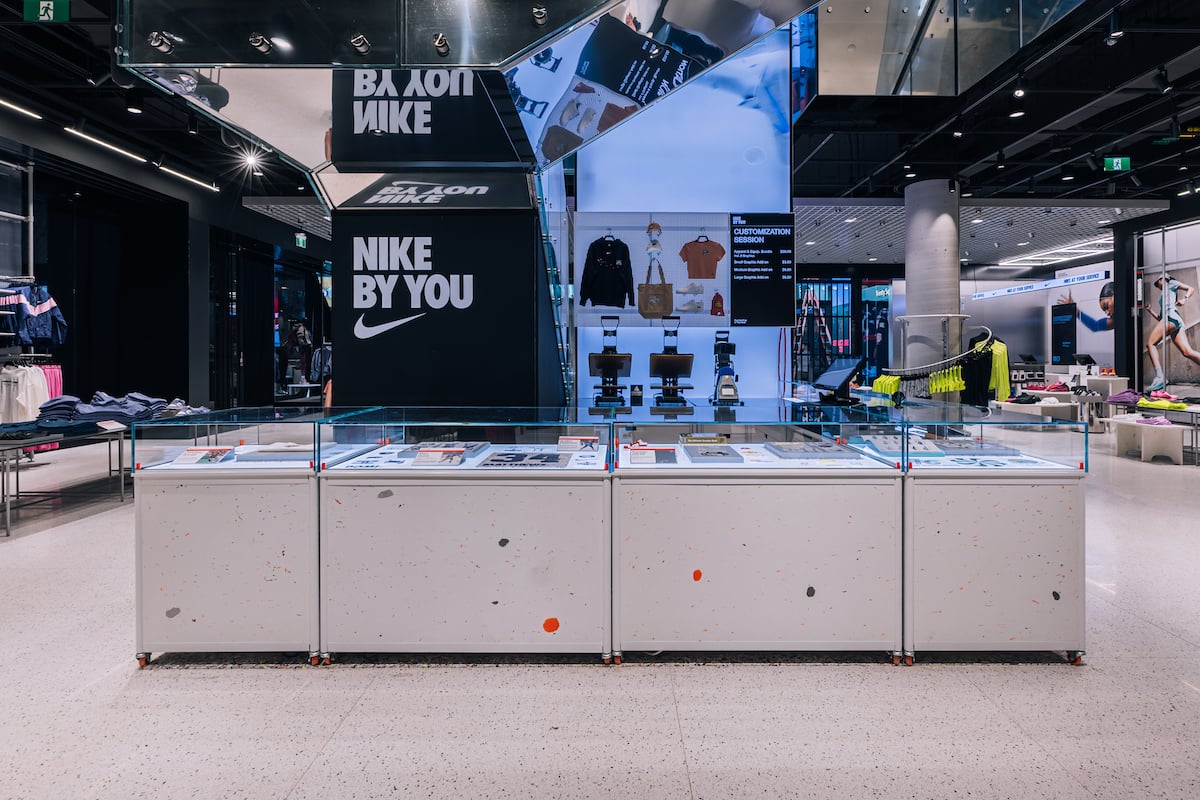
Nike by You on the main level of the Nike flagship at CF Toronto Eaton Centre. Photo supplied
“If I look outside of the Skip environment and look at Nike, that’s a great lesson for so many marketers who might be tempted to divert all of their investment into performance because it’s measurable and immediate. The reality is Nike is a great example where their brand ethos was really built on storytelling. People wanted to be part of that Nike movement. That is who I am.
“But they moved from building their brand to diverting it all to digital, and they lost market share because people no longer knew why they wanted to buy the new Nike shoe. You can get the best price, but it doesn’t reflect who I am. Especially in times where marketing budgets are scrutinized and you’re fighting for every dollar in the marketing department, it can be tempting to divert exclusively to performance. It’s measurable. Finance likes it. We can drive immediacy.
“But your performance actually becomes less efficient when you start to erode or lose the brand story. If you don’t have that overarching brand narrative, if people don’t think about you or talk about you, then when performance gets put in market, it’s actually less efficient. You have to spend more for that order.
“What we’re trying to do is balance both. Yes, we need to drive short-term metrics, but we also need to make sure we’re keeping an eye on the overarching brand narrative, how we’re showing up in market, how people think about us, talk about us, and whether we’re part of the consideration set.”
MacAdam said technology is a critical enabler.
PHOTO: SKIP VIA FACEBOOK
“When you talk about loyalty, and it’s about reward and recognition and putting the right offer to the right person so that it’s relevant to them, the underpinning of that is all technology,” she explained.
“How do I make sure that I’ve got a single view of customer so that when your best customer, he one that is your high-value customer or your top-tier loyalty customer, has an issue, your customer care group knows that they’re a best customer and differentiates the service tied to that customer?
“How do we make sure that when that customer comes into the app, we are serving out the offer we know is going to be most compelling and most relevant to them, so they don’t have to dig into the app to find the offers that are relevant to them? That’s all driven off offer engines.
“How do you make sure you’ve got a wide bank of offers, but that the intellect behind it can actually pull the offer that is most relevant to them and serve it up? I would say that is a journey we are on at Skip. We’re making significant investment in our martech capabilities so that we can actually fulfill the loyalty promise we’re making to customers. I would say it is a journey we are on. We have not fully realized that experience for our best customers yet.”
Ômage Hotel Montréal/Laval has opened, marking the debut of a brand-new boutique hotel following a 10-month transformation of the former Hilton Laval.
The property now operates under a new identity as part of Tribute Portfolio, Marriott Bonvoy’s collection of independent hotels.
Designed as a welcoming living space, Ômage Montréal/Laval features interiors inspired by the power of the elements and a distinctly local character, with the goal of bringing together both travellers and the Laval community, according to a news release.
Located at 2225 Autoroute des Laurentides, near major highways as well as key business and leisure destinations, the hotel establishes a new benchmark for boutique hospitality in the region, said the company.
This extensive transformation has resulted in an entirely new guest experience. Guest rooms, common areas, architectural details and the brand identity have all been redesigned to create a warm and distinctive destination. The hotel is positioned as a true social hub, equally suited to business and leisure travellers and local residents alike, it said.
Annie-Ève Frigon
“Seeing Ômage Montréal/Laval come to life is an incredible source of pride for our entire team. This project reflects an ambitious vision: to deliver a contemporary boutique experience with a strong sense of character, where guests feel comfortable from the moment they arrive, supported by attentive service and spaces designed for comfort, connection and meaningful moments,” said Annie-Ève Frigon, General Manager of Ômage Hotel Montréal/Laval.
Ômage Montréal/Laval said the hotel blends design, hospitality and local roots to create a vibrant and welcoming living environment. Inspired by the region’s landscapes, materials and natural resources, the concept reflects Laval’s energy and dynamism.
Spread across 10 floors, the hotel’s 190 rooms have been fully renovated in a nature-inspired palette dominated by shades of green and white. Among them, 42 extended-stay suites with fully equipped kitchens provide an ideal solution for longer stays, combining functionality, comfort and elegance.
Corporate spaces have also been redefined to meet the needs of business clientele. A privatizable library, modular meeting rooms and a bright hall create a flexible setting for meetings and events, said the company.
With this opening, Ômage Hotel Montréal/Laval becomes the fourth Tribute Portfolio hotel in Québec and the first in Laval, joining an international collection of more than 155 hotels in over 30 countries.