The global retail landscape has undergone a profound transformation. Today, cross-border e-commerce, international tourism, and multicultural urban shopping centers have turned retail into a truly boundaryless industry. Consumers no longer compare local stores only against regional competitors; they expect seamless, highly personalized shopping experiences whether purchasing online from an international vendor or visiting a brick-and-mortar flagship store abroad.
However, as retail brands expand into dynamic global markets, they encounter an enduring operational friction point: the language barrier. From frontline store associates struggling to assist international tourists to customer support centers handling cross-border orders across dozens of languages, communication mismatches lead to lost sales, frustrated shoppers, and reduced brand loyalty.
To deliver frictionless service across every touchpoint, forward-thinking retail executives, luxury brands, and e-commerce platforms are integrating low-latency voice translation architectures like Palabra directly into their customer experience ecosystems.
Elevating In-Store Experiences in International Flagships and Luxury Retail
In high-end luxury retail and international flagship stores, exceptional customer service relies on building personal rapport, explaining product craftsmanship, and delivering tailored recommendations. When international travelers or non-native speaking residents visit a store, language barriers can reduce rich storytelling to basic point-and-pay transactions.
By integrating a low-latency ai voice translator into mobile point-of-sale (mPOS) devices, associate tablets, or smart wearable audio hardware, retail brands empower sales consultants to engage in fluid, multi-lingual dialogue with shoppers.
A sales associate can explain the heritage of a time-piece, the composition of a skincare product, or dynamic sizing options in their primary language, while the customer hears natural spoken translation in their native tongue with minimal latency. This hands-free audio interaction maintains eye contact and personal connection, turning potential communication deadlocks into high-converting, memorable shopping experiences.
Scaling Cross-Border Customer Service and Contact Centers
Beyond physical storefronts, e-commerce brands face immense operational challenges managing multi-lingual customer support. Hiring native-speaking customer service representatives for every target market is notoriously costly, difficult to scale, and hard to manage during unexpected seasonal traffic spikes or promotional campaigns.
Deploying adaptive ai language translation powered by Palabra across omnichannel contact centers transforms how retail brands approach global customer care. By embedding real-time speech-to-speech translation into VoIP support lines, video chat portals, and virtual concierge platforms, support agents can assist customers around the globe in real time.
Palabra’s neural models are engineered to handle brand-specific terminology, specialized product vocabulary, size classifications, and fast conversational speech. When a customer inquires about shipping logistics, return policies, or garment specifications in Japanese, French, or Arabic, the underlying AI voice engine translates the query and response seamlessly, ensuring clarity, emotional warmth, and brand consistency.
Optimizing Global Supply Chains and Store Operations
Frictionless communication is equally critical behind the scenes. Modern retail supply chains involve constant coordination between international distribution centers, regional warehouse teams, third-party logistics providers, and store inventory managers. Miscommunication during stock receiving, order fulfillment, or inventory auditing can cause inventory discrepancies and delayed order deliveries.
Palabra provides enterprise developers with flexible SDKs and web APIs to embed real-time voice translation into internal warehouse management systems (WMS) and voice-directed picking hardware. Warehouse operators and logistics personnel can issue hands-free voice commands, confirm stock counts, and coordinate cross-border logistics in their native languages, streamlining operational efficiency across international supply networks.
Conclusion: Building the Multi-Lingual Retail Future
The future of retail belongs to brands that remove friction from every customer interaction. As global consumers demand greater convenience, personalization, and inclusivity, eliminating language barriers has become a strategic priority for retail leaders.
By pairing modern omnichannel infrastructure with Palabra’s real-time AI speech capabilities, global retailers can bridge cultural gaps, elevate frontline customer service, and unlock new growth opportunities across the worldwide marketplace.
A promising franchise candidate can still be wrong for the next opening. The person may live far from supply coverage, field support, and the strongest customer demand. Recruiting from whichever places generate inquiries can scatter a young system across difficult markets.
The franchisor therefore has 2 decisions to connect. It must identify markets with viable demand and find owners capable of operating in those markets. Geographic evidence gives recruitment a market priority instead of an inbox order.
The Next Stage of Growth
The expansion objective determines which markets deserve attention. The company may want to fill gaps around existing units or enter one new metropolitan area. Another plan may favor greater density in a state or a multi-unit operator for a wider region.
Available support places practical limits on growth. Training capacity and field visits matter, as do supply coverage, launch assistance, and local marketing resources. A distant candidate may demand more support than the team can deliver.
A planning horizon and realistic award count keep the analysis tied to near-term execution. Without those limits, a market ranking can become an oversized wish list.
Evidence From Existing Units
Each open or closed unit needs a record, along with transferred and planned locations. Useful fields include opening date, unit format, revenue, customer count, labor cost, occupancy cost, operator background, and support history.
Market effects and operator effects require separate attention. A strong owner can outperform in an average market, but a weak operator can obscure good demand. Comparisons are strongest among units with similar age, format, and operating conditions.
Healthy units may share customer traits such as household income and daytime population. Business density and family status may also matter, together with spending patterns. Each factor needs support from actual results before it becomes part of the demand model.
The Market Profile
The strongest findings form a market scorecard. Its variables need to explain performance without making the model difficult to maintain.
Market factors may include target-customer count, competitor density, and real estate availability. Labor supply and delivery access may join seasonality and distance from support staff. Any factor that can make a unit unworkable needs a minimum requirement.
Franchise mapping software can display current units, customer characteristics, candidate leads, and priority markets together. The view helps a development team distinguish attractive open areas from places that only look empty.
Cannibalization Risk
An open area beside a successful unit may already depend on customers served by the system. An estimate of transferred demand helps distinguish new opportunity from cannibalization.
Customer origins and delivery areas show where existing demand begins. Commute patterns and physical barriers refine that view, together with typical trip distance. Several proposed trade areas are usually more informative than a fixed radius around every site.
An approved threshold can define the transfer of demand the system will tolerate. Some overlap may improve convenience and brand presence, but excessive overlap can weaken existing operators and damage trust in the development process.
Market Readiness Rankings
Separate scores for demand and economics can sit beside competition and supportability, with strategic fit included as another component. Displaying each component beside the combined rank shows executives why a market rose to the top.
Uncertain inputs such as rent and wages work better as ranges, and opening sales deserve the same treatment. A market that succeeds only under optimistic assumptions deserves less priority than one that works across several scenarios.
Demographic conditions affect customers and labor. ILO analysis describes how changing demographics influence demand and workforce availability. Material changes in these inputs warrant a new market ranking.
Candidate Traits by Market
Evidence from successful owners can shape the candidate profile. Liquid capital and operating background matter, as can people leadership, local knowledge, commitment to the system, and willingness to follow standards.
Different markets may need different strengths. A new market can require local relationships and hands-on brand building. A dense group of established units may favor an experienced multi-unit operator with management depth.
Franchisor support can be evaluated through conversations with current owners and a review of onboarding and training, including continuing assistance. Recruitment pages need enough detail about the opportunity and process for prospects to assess their fit with available markets.
Geographic Recruitment Outreach
Recruitment spending can follow the highest-priority markets. Local business publications and referral partners may reach candidates with an area connection, as may professional associations, events, and existing operator networks.
The message also depends on the market. A growing suburb may support a case based on household formation and open demand. An established city may require evidence about brand awareness and unit density, along with available development zones.
Community and stakeholder relations can build awareness and trust among people in an organization’s geographic area. Specific evidence should explain why the brand is prioritizing that area.
Candidate Scores and Brand Standards
Market priority belongs on the candidate record, but candidate quality remains an independent measure. A lead in a top market still needs the required financial capacity and values, along with operating ability.
A documented screening process can cover preferred geography and capital, together with ownership role. Timeline and relevant background provide further context, as does household support. Recorded disqualification reasons help the team improve targeting.
Available funds are only one part of candidate fit. Reporting on people starting a business after retirement shows how professional background and financial goals can shape the decision. Interviews can examine initiative alongside willingness to operate a shared system.
Support Capacity Before an Award
Each candidate-market combination creates a launch burden. Real estate search and permitting need staff attention, as do financing, construction, hiring, training, opening support, and later visits.
Award timing can prevent the support team from launching too many distant units at once. Clustered growth may allow trainers and vendors to serve several openings during one trip with field staff.
Checkpoints belong before any award of a larger development area. The first unit’s opening and staffing can inform the pace of later commitments, together with standards and early performance.
Recruitment Outcomes and Model Updates
Market-level results include leads and qualified candidates, followed by discovery meetings. Awards and openings can then be considered with launch costs and early unit results. Predicted demand should be compared with actual customer behavior.
Lost candidates also contain useful evidence. A priority area may produce few qualified leads because the message or investment level is poorly matched to local prospects. The recruitment channel may be another cause.
A fixed scorecard schedule preserves enough history to judge changed rankings. Geographic analysis supports decisions made before recruitment spending and franchise awards.
The promising candidate from the opening scene may deserve an award later, in a market the system can serve. For the next opening, recruitment belongs where demand, owner fit, and support capacity meet.
Hong Kong rewards travelers who plan around its transit system rather than against it. The MTR is fast, clean, and covers nearly every part of the city worth visiting, which means the single biggest decision affecting how smoothly your trip runs isn’t which attractions to see, it’s how close your hotel sits to a station. Get that right, and Hong Kong’s famously vertical, densely packed neighborhoods become remarkably easy to navigate.
Why MTR Proximity Matters More Here Than Elsewhere
Hong Kong’s geography makes walking between districts impractical in a way many first-time visitors underestimate. Hills, harbor crossings, and long blocks mean that a destination which looks close on a map can involve a genuinely inconvenient walk. The MTR solves this almost entirely, connecting Hong Kong Island, Kowloon, and the New Territories with trains that run frequently and rarely feel delayed.
Staying within a five-to-ten-minute walk of a station effectively puts the entire city within easy reach, which is why so many seasoned travelers treat MTR proximity as a higher priority than neighborhood reputation alone.
Causeway Bay: Shopping and Convenience Combined
Causeway Bay station sits in one of Hong Kong Island’s busiest shopping and dining districts, making it a strong base for travelers who want retail therapy and food options within a short walk of their hotel. The area can feel crowded, especially on weekends, but that same energy is part of what draws people to stay here.
Hotels around Causeway Bay range from reliable mid-range chains to a few higher-end options, and the station itself connects directly to both the Island Line and easy transfers toward other parts of the city.
Central: Business Efficiency and Harbor Views
Central is Hong Kong’s financial heart, and the area’s hotels reflect that with a strong lineup of business-oriented properties, many offering skyline or harbor views given the district’s waterfront location. Central station is one of the busiest interchange points on the entire network, connecting multiple lines and making it possible to reach almost anywhere on the island or across the harbor without a single transfer headache.
This area suits business travelers well, but it’s equally practical for sightseers, given its proximity to the Star Ferry, Hong Kong Park, and the tram lines heading up to Victoria Peak.
Tsim Sha Tsui: Kowloon’s Tourist Hub
On the Kowloon side, Tsim Sha Tsui remains one of the most popular areas for visitors, largely thanks to its waterfront promenade offering some of the best skyline views of Hong Kong Island across the harbor. The station here connects to both the Tsuen Wan Line and the cross-harbor tunnel routes, making day trips to either side of the water straightforward.
Hotels in this district span a wide price range, from budget-friendly guesthouses to well-known luxury properties along the harbor, giving travelers flexibility depending on budget without sacrificing the convenience of a central Kowloon location.
Mong Kok: Local Energy and Value
Mong Kok tends to appeal to travelers wanting a more local, less polished experience than Causeway Bay or Central offer. Known for its street markets, including the well-known ladies’ market and several electronics districts, the area has a distinctly different energy, busier, louder, and generally better value for money.
The station connects to multiple lines, and hotel prices here are often noticeably lower than equivalent properties closer to the harbor, making it a solid option for budget-conscious travelers who still want strong transit access.
What to Check Before Booking
Beyond simply confirming a station is nearby, it’s worth checking exactly how far the walk is, since some hotels advertise “MTR access” despite being a longer walk than expected, particularly through connected shopping malls that can add several minutes without feeling like much distance on a map. Reading recent reviews that specifically mention walking time to the station tends to be more reliable than a hotel’s own marketing description.
It’s also worth considering which line a station serves, since staying on a line with direct access to the airport express or cross-harbor routes can save meaningful time on both ends of the trip.
Comparing Hotels Before You Commit
With several strong MTR-adjacent districts to choose from, comparing hotels across islands and neighborhoods before booking makes it easier to balance price, location, and proximity to the station that best suits your itinerary. Rather than booking based on district reputation alone, it’s worth looking specifically at walking distance and line connections for each property under consideration.
Planning the Rest of the Trip
Once the hotel and neighborhood are settled, the remaining logistics tend to fall into place quickly. Travelers whobook Hong Kong hotels with Gother often use the same platform to compare flights alongside accommodation, which simplifies coordinating the entire trip rather than managing separate bookings across multiple sites.
Final Thoughts
Hong Kong’s transit system is genuinely one of the best in the world, and building a trip around it rather than against it makes an enormous difference in how smooth the experience feels. Whether it’s Causeway Bay’s shopping energy, Central’s efficiency, Tsim Sha Tsui’s harbor views, or Mong Kok’s local character, choosing a hotel near the right MTR station is what turns a good Hong Kong trip into an effortless one. For travelers planning their stay, using a platform likeGother makes comparing these options considerably easier before locking anything in.
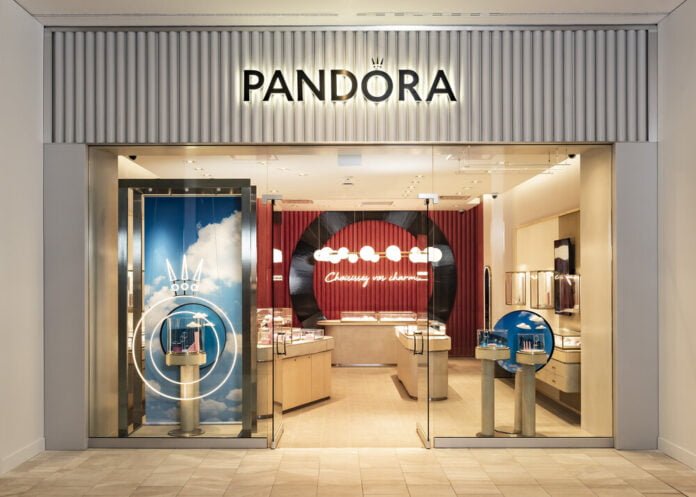
NEW PANDORA FACADE IN MONTREAL EATON CENTRE. PHOTO: PANDORA
Pandora is changing how it sells, markets and makes its jewellery as the global brand enters a new phase of growth, including in Canada, where its footprint has expanded considerably over the past several years.
The Copenhagen-based company now operates 96 stores across Canada and describes the country as one of its fastest-growing markets. Canadian revenue has increased by more than 50 per cent since 2019 and surpassed DKK 1 billion in 2025, giving Pandora a substantially larger base from which to introduce changes to its merchandise, store experience and promotional strategy.
The shift comes as Pandora works through what CEO Berta de Pablos-Barbier has described as a deliberate year of change. The company reported global like-for-like sales growth of one per cent in the second quarter of 2026 and organic growth of three per cent, with newer designs and continued network expansion helping offset pressure in some established markets.
Pandora is simultaneously reducing its reliance on promotions, investing in its physical stores and broadening the materials and jewellery categories associated with the brand. One of the biggest changes involves platinum-plated jewellery, which the company is developing as an alternative to some of the sterling silver merchandise that has long been central to Pandora.
Pandora Pulls Back on Promotions
Pandora has been deliberately reducing promotional activity as part of an effort to strengthen its positioning and become less dependent on discount-driven sales. De Pablos-Barbier told analysts that the company is substantially reducing promotions and heavy discounting in its core markets, accepting some near-term pressure on sales in exchange for stronger brand positioning over time.
The effort will continue during the second half of the year, with management describing the strategy as a “promotional detox.” Pandora is particularly focused on mature markets where promotional activity increased in recent years, while also cutting back on offers outside major commercial periods such as Black Friday.
The change is having an impact online as well. Management said e-commerce historically responds more strongly to promotions than physical stores, meaning fewer discount events can weigh disproportionately on digital sales.
Pandora ultimately wants to give customers more reasons to buy based on the product itself rather than encouraging them to wait for the next promotion. That is particularly important as the company seeks to strengthen its position in accessible jewellery, where frequent discounting can influence how shoppers perceive a brand and its pricing.
Stores Remain a Growth Engine
North America recorded approximately one per cent negative like-for-like growth during the quarter, while Pandora’s U.S. business was flat. Management attributed the U.S. performance partly to weak consumer sentiment and lower store traffic, particularly among middle- and lower-income consumers, although conversion and average basket size were improving both in stores and online.
Pandora did not provide a separate Canadian comparable-sales figure during the earnings call, and its discussion of particularly weak consumer sentiment centred on the United States. The distinction is important given the growth Pandora has reported in Canada over a longer period.
Physical retail continues to play a significant role in the company’s wider growth strategy. Pandora increased its expected full-year contribution from network expansion to approximately three per cent organic growth after new stores opened somewhat earlier and generated slightly more revenue than initially assumed.
The company is also investing in existing stores through updated facades, digital screens, visual merchandising and new ways of presenting collections as coordinated looks. The changes are designed to encourage discovery and expose customers to more of Pandora’s assortment beyond the products that initially brought them into a store.
That strategy has a growing platform in Canada. Retail Insider reported in 2022 that Pandora operated 74 Canadian stores, with company executives identifying opportunities for further expansion, particularly in underpenetrated parts of the country. Its current 96-store footprint is roughly 30 per cent larger than the store count reported at the time.
Pandora had also indicated in 2022 that it wanted to build a more dedicated organization around Canada rather than simply treating the country as an extension of its larger U.S. business.
That investment has since extended beyond physical stores. In March, Pandora opened a dedicated e-commerce distribution centre in Mississauga after previously fulfilling Canadian online orders through facilities in the United States.
More than 20 per cent of Pandora’s Canadian sales are generated online. The Mississauga facility can process as many as 12,500 orders per day and was designed to reduce typical Canadian delivery times from five-to-seven days to two-to-four days while simplifying returns.
Pandora employs more than 1,400 people in Canada. Together with the 96-store network and Canadian revenue exceeding DKK 1 billion last year, the distribution investment reflects the growing scale of the company’s Canadian operations.
Image: Pandora
Pandora Prepares for a Major Material Shift
Pandora’s changing retail strategy is being accompanied by a potentially significant change to the jewellery itself. The company is introducing platinum-plated jewellery on its proprietary Evershine alloy as it works to reduce its exposure to volatile silver prices.
Sterling silver has historically been closely associated with Pandora, particularly through the charm bracelets that helped build the company into the world’s largest jewellery brand. Rising silver costs have complicated that model and increased the importance of diversifying the materials used across Pandora’s assortment.
Pandora announced the platinum-plated initiative in February after conducting a study involving 23,000 consumers in July 2025. The company said 78 per cent of participants recognized platinum as a precious metal, compared with 69 per cent for sterling silver.
An initial Northern European pilot involved a curated selection of best-selling bracelets across 30 stores and e-commerce. During the second-quarter earnings call, management said it was also testing five key products in the Netherlands — four bracelets and one necklace — as it gathered more information about consumer response and pricing.
The test is examining more than consumer acceptance of the material. In physical stores, Pandora is pricing the platinum-plated products at the same level as their silver counterparts, while online it is experimenting with different pricing approaches.
Management said the early response has been encouraging, although the tests remain at an early stage. Pandora has said the initial pilot will inform a broader global launch in the second half of 2026, including additional platinum-plated bracelets and selected charms.
The economics behind the transition are significant. Pandora said during the earnings call that its sensitivity to movements in silver prices should decline substantially as more of its assortment moves toward platinum plating, helping protect margins from sharp movements in the commodity.
Management is also making a broader argument about why consumers buy Pandora.
De Pablos-Barbier told analysts that shoppers choose the brand for its design, craftsmanship, quality and meaning across different materials, pointing to the growth of Pandora’s gold-plated jewellery as evidence that its appeal is no longer dependent on sterling silver alone.
The platinum transition will test that proposition. Pandora is asking consumers to place more of the value of a piece of jewellery in its design, brand and presentation rather than primarily in the underlying metal.
If consumers accept platinum-plated merchandise at scale alongside traditional silver pieces, Pandora would gain considerably more flexibility over its material mix while reducing exposure to silver prices. Platinum also gives the company a precious-metal proposition that can be offered within the accessible pricing structure that has supported Pandora’s global reach.
Moving Beyond the Charm Bracelet
The material shift is part of a broader effort to diversify the reasons consumers shop Pandora. The company’s core segment recorded negative one per cent like-for-like growth during the second quarter, while the business Pandora categorizes as “Fuel with More” grew three per cent. The latter includes areas where Pandora has been introducing more distinctive designs and seeking additional business in categories such as necklaces and rings.
Pandora highlighted Timeless, its Garden of Dreams collection and Pandora Essence among the stronger-performing parts of the assortment. Management said the performance shows the potential for new product design supported by more concentrated marketing.
The company is also putting greater emphasis on fashion and cultural relevance. Its Pandora Wonders creative platform launched during Paris Couture Week with stylist Harry Lambert, following other recent initiatives including its Bridgerton collaboration.
De Pablos-Barbier said recent activations have attracted proportionally more Gen Z consumers while Pandora continues to maintain a cross-generational customer base. The company is looking to broaden its relevance without abandoning the charm and personalization business that remains central to the brand.
Stores, marketing and merchandise are increasingly being developed around that broader positioning. Pandora wants customers to encounter more of its assortment in stores and to associate the brand with a wider range of jewellery rather than primarily sterling silver charms.
A Larger Platform in Canada
Pandora’s Canadian operation enters this transition from a considerably larger position than it occupied only a few years ago. Its 96-store network, rising revenue and dedicated e-commerce infrastructure give the company a sizeable platform for the next phase of its strategy. Pandora has not detailed the timing or scope of its platinum-plated expansion specifically for Canada, while its quarterly results do not separate Canadian comparable performance from the larger North American region.
The company’s Canadian expansion to date has largely been about building scale and infrastructure. The next phase will increasingly be about what Pandora sells through that network and how it presents the brand to consumers, as it relies less on promotions, broadens its jewellery assortment and reduces its dependence on the sterling silver that helped build the business.
Coach is increasing investment in stores, marketing and brand-building after another year of strong growth, with younger consumers, higher handbag prices and reduced promotional activity reshaping the Tapestry-owned brand.
The strategy has direct relevance in Canada, where Coach operates 29 locations across Ontario, British Columbia, Alberta, Quebec and Manitoba, spanning major shopping centres and outlet malls. Its network includes Yorkdale Shopping Centre and CF Toronto Eaton Centre in Toronto, CF Pacific Centre and Oakridge Park in Vancouver, CF Chinook Centre in Calgary and West Edmonton Mall.
Coach reported fourth-quarter revenue growth of 14% on a constant-currency basis, including a 10% increase for the brand in North America, which includes Canada. It attracted more than two million new customers during the quarter and nearly nine million during fiscal 2026, with Gen Z leading customer acquisition.
The growth comes as Coach deliberately reduces its reliance on promotions. Handbag average unit retail increased at a mid-teens rate during the fourth quarter while unit volumes were roughly in line with the previous year, reflecting a decision to reduce promotional days rather than pursue additional sales through discounting.
For the full year, Coach generated both mid-teens growth in handbag average unit retail and low-double-digit unit growth. Management expects both average prices and units to increase again in fiscal 2027.
Younger Consumers Drive Coach Growth
Tapestry has made reaching consumers as they begin buying within the category central to Coach’s strategy. Younger customers joining the brand are spending more per purchase than its broader customer base, according to the company, while also demonstrating strong retention.
Tapestry CEO Joanne Crevoiserat said Gen Z’s influence extends beyond purchases made by younger consumers themselves, with the generation increasingly influencing buying behaviour across age groups. Sales from existing Coach customers have also continued to grow as the brand adds new shoppers.
Product development has been an important part of that strategy. Coach has concentrated investment around recognizable handbag families that can be expanded over time, including Tabby and its New York collection, which encompasses styles such as Brooklyn, Empire and Chelsea.
Footwear is another area the company sees as underdeveloped. Coach reported high-teens footwear growth in the fourth quarter, supported by demand for sneakers including the Soho family, and management believes the category provides room for further expansion.
Coach CEO and Brand President Todd Kahn said the brand remains particularly focused on the roughly US$200-to-US$500 portion of the market. That positioning gives Coach access to consumers seeking a premium or luxury purchase without moving into the substantially higher price points associated with many European luxury houses.
Marketing spending is increasing alongside that effort. Coach raised marketing investment by approximately 20% in the fourth quarter, while Tapestry said spending on marketing and related demand creation represented about 12% of sales during fiscal 2026.
Recent initiatives include the &Coach campaign, developed with input from Gen Z consumers, as well as the brand’s ongoing WNBA partnership. The company has also been directing more marketing toward broad brand awareness as it looks to sustain customer growth over time.
More Investment Goes Into Physical Stores
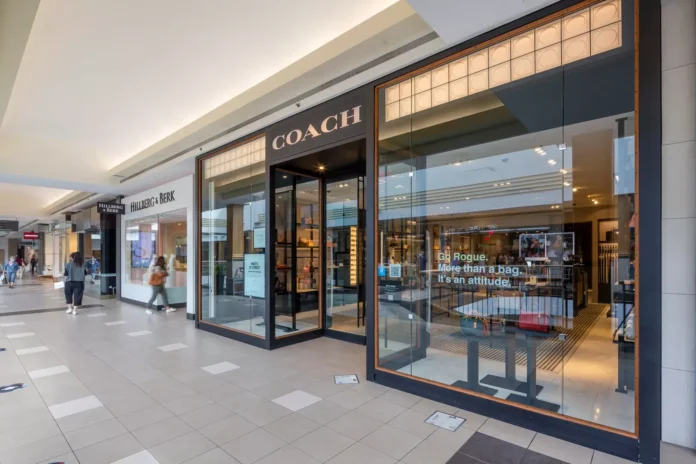
Stores are becoming an increasingly important part of Coach’s strategy. Tapestry expects to spend approximately US$300 million on capital expenditures and cloud computing in fiscal 2027, with about 70% directed toward growing and improving its store fleet. Coach expects to add approximately 40 to 50 net stores globally during the year, with roughly three-quarters of those additions outside the United States.
The expansion will take Coach beyond 1,000 stores worldwide, while significant investment is also going into existing locations.
Central to that effort is what Coach calls its “expressive luxury” store concept. The company plans to expand the format so that upgraded stores ultimately account for approximately 80% of global Coach store traffic by fiscal 2030.
Management said stores incorporating the concept have generated stronger traffic and longer visits, particularly among Gen Z consumers. Physical locations are increasingly being treated as places where customers experience the brand and its products rather than simply points of sale.
Coach is also selectively opening more experiential Coach Play locations, with recent examples in Chicago, Atlanta and the Le Marais district of Paris. Ideas tested in those stores can subsequently influence the design of the broader fleet.
Tapestry did not identify Canadian locations slated to receive its expressive luxury format during the earnings call. With 29 Coach and Coach Outlet locations already operating across Canada, however, the global fleet investment could eventually have implications for a substantial domestic network.
NEW YORKDALE STOREFRONT. PHOTO: COACH
‘One Coach’ Blurs the Line Between Full-Price and Outlet Retail
Another significant change involves the traditional division between Coach’s full-price and outlet businesses. Under its “One Coach” strategy, the company is deliberately reducing some of those distinctions. Coach has introduced collection merchandise at full price into outlet stores while working toward a more consistent presentation of the brand across physical and digital channels.
Kahn said the strategy reflects the company’s view that customers see Coach as a brand rather than viewing its full-price, outlet and digital businesses as separate channels.
The approach is particularly relevant in Canada because Coach has an extensive presence in both types of retail environments. Alongside stores at major shopping centres such as Yorkdale, CF Toronto Eaton Centre, CF Pacific Centre, Oakridge Park and CF Chinook Centre, the brand operates outlets at centres including Toronto Premium Outlets, Vaughan Mills, CrossIron Mills, McArthurGlen Designer Outlet Vancouver Airport and Tsawwassen Mills.
Coach can use the channel to introduce customers to higher-priced collection merchandise while maintaining a more consistent brand position across its network.
Management has linked the One Coach approach to customer growth and higher average unit retail, although the company has not disclosed specific results for Canadian outlet stores or identified which collection products are being carried at individual Canadian locations.
For a brand with a substantial outlet presence, the shift is notable. Coach is betting that it can preserve the reach provided by outlet distribution without allowing discounting to define the broader brand.
Coach Returns to a Transformed Oakridge Park
Coach’s return to Oakridge Park in Vancouver provides a timely Canadian example of its evolving positioning.
The retailer operated at the former Oakridge Centre before departing ahead of the property’s extensive redevelopment. Coach returned when the first phase of Oakridge Park opened on May 28, placing the brand back at the property after years of construction.
The retail environment surrounding Coach is considerably different from the former shopping centre. Oakridge Park has assembled one of Canada’s largest concentrations of luxury retailers, including Louis Vuitton, Chanel, Prada, Miu Miu, Moncler, Tiffany & Co., Bvlgari and Loro Piana.
Coach’s presence within that mix illustrates the position the brand is attempting to occupy. The company is raising average selling prices, reducing promotions and elevating its physical presentation while retaining price points and a distribution network capable of reaching a broader customer base than traditional luxury houses.
The Oakridge opening also continues a longer history of investment in Coach’s Canadian fleet. Retail Insider has previously reported on renovations and relocations at major Canadian locations as the retailer has updated its store design and merchandising.
In downtown Vancouver, Coach relocated its CF Pacific Centre store in 2022 as part of changes to the shopping centre’s retail mix. Earlier investments included renovations and upgraded merchandising concepts at other prominent Canadian stores.
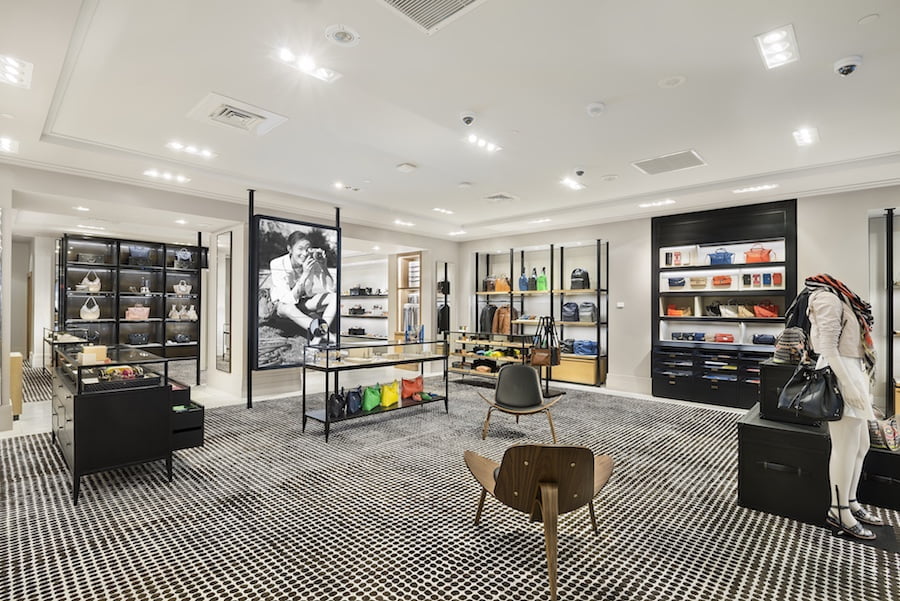
FORMER BLOOR STREET STORE. PHOTO: COACH
International Markets Take a Larger Role
Coach’s recent growth has extended well beyond North America.
Fourth-quarter revenue increased 30% for Coach in Greater China and 25% in Europe, compared with the 10% increase in North America. Those international markets are expected to contribute a growing portion of Coach’s expansion as the brand remains less penetrated in many countries than it is in North America.
The geographic split of planned store openings reflects that opportunity, with approximately 75% of Coach’s 40 to 50 expected net additions in fiscal 2027 planned outside the United States.
For the full fiscal year, Tapestry expects Coach revenue to increase at a high-single-digit rate. North American growth is expected to moderate as the company moves against strong previous-year comparisons, but management has emphasized that it does not intend to pursue additional sales through heavier promotions.
Kate Spade Remains in Rebuilding Mode
Coach’s performance stands in contrast to Tapestry’s Kate Spade brand, which remains in a multi-year effort to strengthen its positioning and return to sustainable growth.
Kate Spade attracted approximately two million new customers during fiscal 2026, including more than 450,000 in the fourth quarter, with younger consumers an important source of growth. Tapestry continues to invest in product, marketing, store improvements and creative leadership as part of the turnaround.
Progress has nevertheless been slower than anticipated. Tapestry expects Kate Spade revenue to decline at a high-single-digit rate in fiscal 2027 and projects a modest operating loss as investment in the brand continues.
The divergence underscores how central Coach has become to Tapestry’s performance. While both brands have access to the company’s consumer data, marketing capabilities and retail infrastructure, Coach is currently generating considerably stronger results. Kate Spade also recently closed a handful of stores in Canada, which is concerning.
Coach Targets Further Growth
Tapestry generated US$8 billion in revenue during fiscal 2026, and management believes Coach has a path to eventually become a US$10-billion brand on its own.
Getting there will require Coach to sustain a combination that worked particularly well during the past year: attracting millions of new consumers while increasing average selling prices, reducing promotional activity and continuing to grow unit volumes.
Physical retail will be a significant part of that effort. Dozens of new stores are planned globally, spending on the fleet is increasing and Coach intends to bring its newer store experience to locations representing the majority of its customer traffic over the next several years.
Canada is already a meaningful part of that physical network, encompassing major regional malls, luxury-oriented properties and outlet centres across five provinces. Coach’s return to Oakridge Park also puts the brand inside one of Canada’s most significant new concentrations of luxury retail as it pursues a broader strategy of higher prices, fewer promotions and more elevated stores.
Shopify is expanding its Managed Markets cross-border ecommerce offering to Canadian merchants, giving eligible retailers and brands access to infrastructure designed to simplify international selling as duties, taxes and customs requirements become more complex.
The Canadian expansion is being supported by Global-e Online, the cross-border ecommerce technology company behind the merchant-of-record infrastructure used by Shopify Managed Markets. Global-e executives said during the company’s second-quarter earnings call this week that opening Managed Markets to merchants in Canada and the United Kingdom is contributing to increased interest outside the United States.
Canada remains an early-access market, with Managed Markets currently available to certain eligible Shopify stores rather than the company’s entire Canadian merchant base. Global-e had already identified Canada as an early-access market in its first-quarter results in May, with the company now reporting increased adoption of the upgraded platform.
For international transactions processed through the Canadian version of Managed Markets, Global-e Canada E-Commerce Ltd. acts as the merchant of record and exporter of record. The Canadian retailer continues to operate its Shopify store, manage inventory and fulfil orders, while Global-e handles much of the infrastructure surrounding the international transaction, including duties and import taxes, international tax registration and remittance, customs requirements, localized currencies and payment methods, and elements of international shipping.
The model gives eligible Canadian merchants access to capabilities that larger retailers have traditionally had to build internally or assemble through multiple outside providers.
Managed Markets V2 Expands into Canada
Global-e said the rollout into Canada and the U.K. is part of a broader effort with Shopify to increase adoption of Managed Markets following the launch of version 2.
“We are seeing an increase in adoption following the rollout of V2,” Global-e co-founder and president Nir Debbi told analysts, adding that availability in Canada and the U.K. was increasing interest outside the U.S.
The company completed the migration of existing Managed Markets merchants from version 1 to version 2 during the second quarter and said early feedback has been positive. Management has characterized the newer version as an improvement over the original offering, which encountered friction that limited broader adoption.
One of the changes is a significantly streamlined onboarding process. Earlier versions required merchants to submit an application for review, with that process later shortened to approximately 24 hours. Global-e CEO and co-founder Amir Schlachet said the vast majority of eligible merchants can now move through onboarding within the same session.
“As soon as they click that they’re interested in Managed Markets, the process is done almost instantaneously, and they can go live within a very, very short time span,” Schlachet said.
Shopify and Global-e are also developing managed pricing and other features intended to improve conversion and provide international shoppers with a more localized purchasing experience. The companies are working to apply more of the practices Global-e has developed with larger enterprise merchants to businesses using Managed Markets.
For smaller and mid-sized Canadian brands, that can reduce the amount of specialized customs, taxation and cross-border commerce expertise required internally when entering additional markets.
U.S. Trade Changes Add Complexity
The expansion into Canada comes at a time when selling into the United States has become more complicated for cross-border ecommerce merchants.
The U.S. suspended duty-free de minimis treatment for shipments from all countries effective August 29, 2025. The change increased the importance of accurately determining duties, country of origin, Harmonized System classifications and the total landed cost of goods entering the country, including for lower-value ecommerce shipments.
Canadian goods that meet applicable rules of origin can still qualify for preferential tariff treatment under the Canada-United States-Mexico Agreement, but accurate product information and documentation are important in determining eligibility.
Managed Markets automates several parts of that process, including product classification and calculations for duties and import taxes. It can also incorporate cross-border costs into international pricing, support localized currencies and payment methods, and handle international tax registration, collection and remittance for eligible transactions.
Those functions are particularly relevant to Canadian merchants looking to the U.S. for growth while navigating a more demanding import environment.
Access Remains Limited
Managed Markets is not yet available to every Canadian Shopify merchant. Shopify’s eligibility requirements include operating a Canadian business with a qualifying Canadian location and fulfilment setup, while merchants must use Shopify Payments and a supported Shopify tax configuration.
There are also restrictions involving certain store structures and business models. International subscriptions and Shopify B2B transactions are not currently supported through Managed Markets, making the offering most directly applicable to consumer-facing merchants selling physical products internationally.
Global-e sees room for the Canadian business to grow as availability expands. Schlachet told analysts that Shopify has a large and growing population of merchants in Canada and the U.K. that could ultimately be relevant to Managed Markets. The U.S., Shopify’s largest market, was the initial focus for the offering before expansion into additional countries.
Cross-Border Sales Continue to Grow
The rollout comes alongside strong growth in Global-e’s broader international commerce business. Gross merchandise value reached US$2.09 billion during the second quarter of 2026, up 44 per cent from a year earlier and marking the first time the company surpassed US$2 billion in quarterly GMV outside the peak holiday period.
Revenue rose 39 per cent to US$299 million, while adjusted EBITDA increased 62 per cent to US$62.4 million. Global-e raised its full-year outlook and now expects 2026 GMV of between US$8.81 billion and US$9.11 billion, with revenue forecast at between US$1.305 billion and US$1.355 billion, including the expected contribution from its recently acquired Passport business.
Management said same-store sales growth across its merchants was running above historical levels during the quarter, with consumer demand remaining resilient across most destination markets. Newer merchants were also ramping more quickly than expected.
At the same time, shoppers appear to be becoming increasingly responsive to promotional periods. Schlachet said some larger merchants saw the increase in volumes generated by seasonal sales events reach more than 25 per cent above the increase produced by comparable promotions in the second quarter of 2025.
Debbi said Global-e has seen stronger reactions to promotions over the past two or three years, with some consumers increasingly planning their shopping around major sales events. The pattern points to healthy international ecommerce demand across the company’s merchant base, alongside consumers becoming more deliberate about when they make purchases.
Passport Adds Logistics Capabilities
Global-e is also extending its international logistics operations following its acquisition of Passport, a U.S.-based cross-border ecommerce logistics company. The transaction closed July 1 for approximately US$350 million upfront, split roughly equally between cash and Global-e shares, with up to an additional US$75 million tied to Passport’s 2026 financial performance.
Passport operates an asset-light, multi-carrier logistics network spanning cross-border, domestic and last-mile deliveries. Global-e said the acquisition adds capabilities including direct injection and consolidated returns while allowing it to continue offering Passport’s non-merchant-of-record logistics services to a broader range of businesses.
Passport is expected to generate more than US$100 million in revenue this year. Global-e is integrating the business into its existing carrier network and expects the combination to expand the shipping and post-purchase services it can provide alongside its existing pricing, payments, duties and compliance infrastructure.
Canadian Retailers Look Beyond the Domestic Market
Canadian retailers looking internationally still need products that resonate in other markets, effective customer acquisition, inventory and the ability to fulfil growing order volumes. Managed Markets does not address those fundamental retail challenges, but it can reduce the tax, customs, payments and trade infrastructure that a merchant needs to assemble independently.
Canada remains in the early stages of the Managed Markets rollout, making adoption among Canadian merchants worth watching as Shopify expands availability. If Global-e’s early indications translate into broader uptake, international expansion for more Canadian ecommerce businesses could increasingly begin from the same Shopify environment they already use to sell domestically.
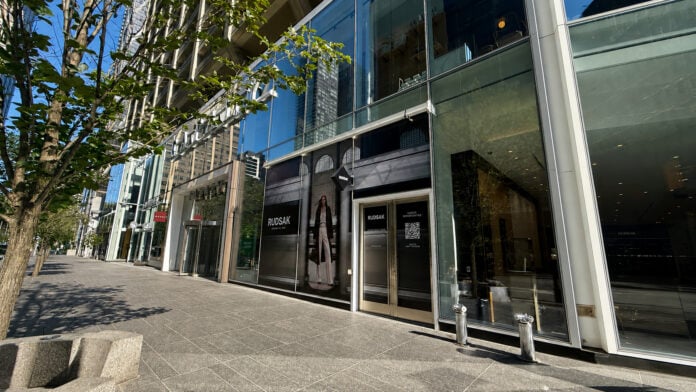
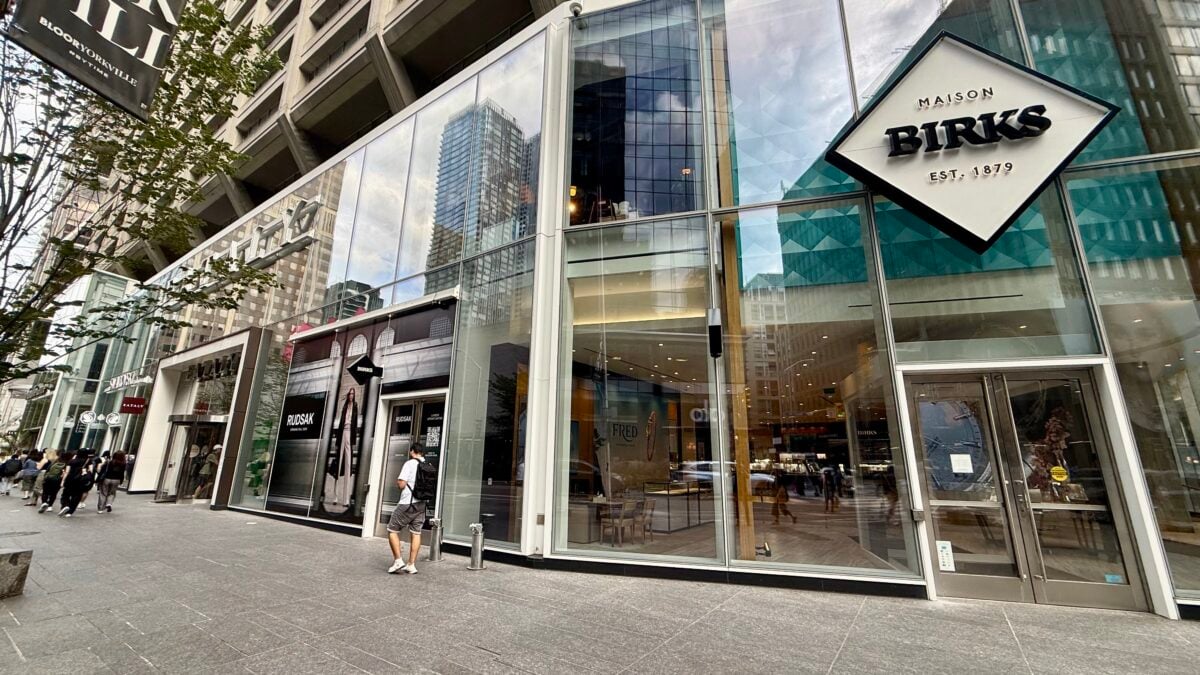
Future RUDSAK at Manulife Centre, 55 Bloor St. W. in Toronto. Photo: Craig Patterson
Montreal-based fashion brand RUDSAK is preparing to open a store on Bloor Street in Toronto, taking street-facing space at Manulife Centre that includes the former Van Cleef & Arpels boutique operated by Birks.
Construction hoarding for RUDSAK is now in place at 55 Bloor Street West, immediately beside the main Bloor Street entrance to Eataly. The opening follows the closure of RUDSAK’s store at CF Toronto Eaton Centre, shifting the brand’s downtown presence to the Bloor-Yorkville retail district.
Ben Labrecque of commercial real estate brokerage Urban Reform Realty Inc., who represents both RUDSAK and Birks, told Retail Insider that Birks continues to hold the premises and that RUDSAK is taking the space through a sublease. Labrecque said the Bloor Street location is being used as a test for RUDSAK.
Former Van Cleef & Arpels Space
Van Cleef & Arpels previously operated a licensed boutique through Birks as part of the jeweller’s Bloor Street flagship. Although connected internally to Birks, the boutique had its own entrance directly from Bloor Street, giving the French luxury jewellery brand a separate storefront.
Retail Insider reported in 2022 that Van Cleef & Arpels was preparing to establish a standalone corporate boutique farther west at 100 Bloor Street West. The new store opened in 2023, moving the brand into a larger dedicated space within the section of Bloor Street where many international luxury brands are concentrated.
The space now being prepared for RUDSAK includes the former Van Cleef frontage. While the Birks premises had previously been marketed in various configurations, RUDSAK will span over 1,000 square feet. Birks continues to control the overall premises, with RUDSAK operating under a sublease.
Birks Remains at Manulife Centre
Birks continues to operate at Manulife Centre despite earlier expectations that its Bloor Street store would eventually close. Retail Insider previously reported comments from former Birks leadership indicating that the location was expected to close, but those plans later changed following discussions with the landlord.
More recently, Retail Insider spoke with a vendor that was exploring establishing a shop-in-store within the Bloor Street Birks location, providing another indication that the jeweller expects to remain at Manulife Centre for the time being. The vendor was not authorized to speak publicly about its plans and is not being identified.
The Birks store itself has changed considerably over the past several years. Van Cleef & Arpels is no longer part of the location following its move to 100 Bloor, while other luxury brands have also departed as the jeweller has adjusted its operations on Bloor Street.
Another look at the future RUDSAK at Manlife Centre, 55 Bloor St. W. in Toronto. Photo: Craig Patterson
RUDSAK Tests Bloor-Yorkville
The move gives RUDSAK a different type of downtown Toronto presence following the closure of its CF Toronto Eaton Centre store. The new location has direct Bloor Street frontage and places the brand within the Bloor-Yorkville market, where Canadian fashion retailers operate alongside a growing concentration of international luxury brands.
Founded in Montreal by Evik Asatoorian in 1994, RUDSAK built much of its early recognition around leather goods and outerwear before expanding into apparel, footwear, bags and accessories. Its retail strategy has changed considerably over the years, including a period of aggressive expansion that took the company to 34 locations by 2019 after it had earlier contemplated a Canadian network that could eventually surpass 50 stores.
In a 2021 interview with Retail Insider, Asatoorian acknowledged that RUDSAK had opened stores in some locations where it should not have and said the company was moving toward a smaller physical network. Toronto and Montreal remained important markets, but the focus shifted from maximizing store count to operating stronger locations. Asatoorian also said physical stores remained important for customers to discover and experience the brand as e-commerce grew.
RUDSAK subsequently began updating its store fleet and refining its positioning. Executives told Retail Insider in 2023 that the company was developing what it described as a “performance luxury” identity, while renovations incorporated more open layouts, digital elements and experiential features.
That approach was reflected in RUDSAK’s boutique at Royalmount in Montreal, where the company adopted a more elevated store presentation. By RUDSAK’s 30th anniversary in 2024, Asatoorian described e-commerce as the company’s largest “store,” alongside a more selective physical retail network and expansion outside Canada.
The decision to test Bloor Street after closing at CF Toronto Eaton Centre provides another example of that more selective approach to physical retail, shifting the brand’s downtown Toronto presence from a major enclosed shopping centre to a street-facing location in Bloor-Yorkville.
Bay and Bloor Retail Mix Evolves
RUDSAK will join a notable group of retailers around Bay and Bloor. Alo Yoga occupies the northeast corner of the intersection, with Canadian footwear retailer Browns next door and Holt Renfrew immediately to the east. Aritzia and lululemon also operate nearby, creating a concentration of Canadian fashion retailers alongside international brands.
The intersection is also seeing further luxury investment. Tiffany & Co. is currently building a new flagship at Bloor and Bay, diagonally across from Birks, with an opening expected in early 2027. Farther west, the retail mix becomes increasingly concentrated with international luxury brands, including Van Cleef & Arpels, Hermès, Burberry, Saint Laurent, Gucci, Rolex, and others.
RUDSAK’s storefront immediately beside Eataly’s main Bloor Street entrance also places the brand next to one of Manulife Centre’s principal retail destinations. Eataly opened its first Canadian location at the complex in 2019. Retail Insider will report on the store opening, happening this fall.
In his role, Spear will be focused on deepening Groupe Dynamite’s customer obsession, using personalization, innovation and technology to elevate the experience at every touchpoint across GARAGE and DYNAMITE. He will focus on eliminating friction and making every interaction more seamless, intuitive and engaging, while building deeper, more lasting relationships and increasing customer lifetime value, said the retailer in a news release.
“Our customers expect shopping with GARAGE and DYNAMITE to feel inspiring, easy, and seamless wherever they engage with us,” said Stacie Beaver, President and Chief Operating Officer. “Creating a consistent experience across our digital and physical channels is at the core of our growth strategy. Henry’s proven ability to elevate the online customer journey and optimize digital operations will help us continue to raise the bar for our customers as our brands scale.”
Henry SpearStacie Beaver
The retailer said Spear brings more than two decades of experience across digital, E-commerce, customer experience, and omni-channel retail. Most recently, he served as Senior Vice-President of Digital & Customer Care at JD Sports, overseeing the digital P&L across multiple banners and advancing the company’s direct-to-consumer experience. He previously held senior leadership roles at Gymshark, including President of North America, and at Faherty Brand, following earlier experience with J.Crew, Gap Inc., and Boston Consulting Group.
Newcomers are playing a significant role in Canada’s entrepreneurial landscape, accounting for 32% of all business owners with paid staff.
As Canada continues to welcome newcomers from around the world, a growing number are choosing entrepreneurship, not just as a career path, but as a way to build long-term financial security and contribute to their communities. Many are turning to franchising as a practical and proven route to business ownership, offering support, training, and established systems that can help reduce the challenges of starting a business in a new country, says the Canadian Franchise Association (CFA.
It says newcomers are making a significant impact on Canada’s entrepreneurial landscape:
• One in four new businesses in Canada is started by an immigrant. • There are more than 800,000 self-employed newcomers across Canada. • Over 250,000 newcomer entrepreneurs employ staff, creating jobs and supporting local economies. • Newcomer entrepreneurs are contributing across a wide range of industries, including restaurants (53%), grocery stores (52%), truck transportation (56%), and computer systems design and services (49%).
Why more newcomers are choosing franchising:
A proven business model that reduces many of the risks associated with starting a business from scratch.
Comprehensive training, operational support, marketing expertise, and ongoing mentorship.
Access to established brands with existing customer recognition and trusted business systems.
Opportunities in more than 60 industries, allowing entrepreneurs to find businesses that match their skills, experience, and investment goals.
A network of franchisors and fellow franchisees, who provide guidance, collaboration, and share best practices.
The opportunity to build wealth while creating jobs and investing back in local communities.
For many newcomers, franchising provides more than a business opportunity—it offers a pathway to economic participation, community connection, and long-term success in Canada, says the CFA.
Question: The data show that newcomers account for a growing share of business ownership in Canada. What is driving more newcomers to choose franchising over starting an independent business?
Answer: For many newcomers, franchising can provide a practical and proven pathway to business ownership, particularly when they are navigating a new country and an unfamiliar business environment.
One of the key advantages is access to an established business model and support system. Rather than having to build every aspect of a business from the ground up, franchisees benefit from training, operational support, marketing expertise, established processes, and the experience of a franchisor and broader franchise network.
An established brand can also provide customer recognition and a foundation on which to build. With franchise opportunities available across more than 60 industries, newcomers can explore businesses that align with their skills, experience, interests, and investment goals.
There is also an important community aspect to franchising. Franchisees have the opportunity to connect with franchisors and other franchise owners, share experiences and learn from people who understand the challenges and opportunities of running a business in Canada. For someone who is building both a business and a professional network in a new country, that can be particularly valuable.
Ultimately, franchising can help newcomers turn their entrepreneurial ambitions into business ownership while creating jobs in their communities, building financial independence, and contributing to the communities where they live and operate.
Q: What are the biggest misconceptions newcomers have about franchise ownership, and what realities should prospective franchisees understand before investing?
A: One common misconception is that franchisees have very little room to bring their own ideas or creativity to the business because the franchisor establishes the operating model. In reality, franchising provides a framework and proven systems, but franchisees are still responsible for running their businesses, leading their teams, engaging with customers, and marketing their products or services within the parameters of the brand.
The best franchise relationships bring together the strength of the system with the experience, energy, and entrepreneurial mindset of the franchisee.
Another misconception is that franchising is too expensive or out of reach for many aspiring business owners. There are franchise opportunities across a wide range of industries and investment levels, so prospective franchisees can explore opportunities that align with their financial resources, experience, and goals.
At the same time, prospective franchisees need to understand that franchising is not a guarantee of success, and it is not a passive investment. Choosing a franchise should be about much more than selecting a recognizable brand name.
People should take the time to understand what the day-to-day business will look like, how much time and involvement will be required, the total investment and ongoing costs, staffing requirements, hours of operation, customer acquisition, and the potential timeline for achieving a return on their investment. Most importantly, they need to determine whether the business is the right fit for their skills, lifestyle and long-term goals.
Doing that due diligence is critical. The right franchise opportunity, combined with the right franchisee, is ultimately what creates the strongest foundation for success.
Q: Where are you seeing the strongest growth opportunities for newcomer franchisees—in terms of industries, regions, or business models—and why?
A: One of the strengths of franchising is the breadth of opportunities available. Newcomer entrepreneurs are already making a significant impact across industries including restaurants, grocery, transportation, technology, and professional services. Government of Canada data reinforces this, highlighting the significant participation of newcomers across these sectors.
From a franchising perspective, we see opportunities in areas where there is strong consumer demand and a clear, scalable business model. Food and hospitality, health and wellness, home and commercial services, retail and professional services all offer a range of franchise opportunities.
We are also seeing opportunities in communities experiencing population growth, not just in Canada’s major urban centres but in emerging markets across the country. For newcomers, the opportunity is really about finding the right fit—an industry and business model that aligns with their skills, experience, interests, financial capacity and long-term goals.
Newcomers bring valuable perspectives, international experience and an entrepreneurial mindset to the Canadian business landscape. Franchising can provide the framework and support to turn those strengths into successful businesses.
Yogi Patel, Booster Juice Franchisee
Q: What barriers do newcomers still face when trying to buy or build afranchise business in Canada, and what changes would make the biggest difference?
A: While franchising can help reduce some of the challenges associated with starting a business from scratch, newcomers can still face barriers when looking to become franchise owners. Financing is one, particularly for entrepreneurs who may not yet have an established financial or credit history in Canada. Other challenges can include navigating Canadian regulations, understanding franchise agreements and financial commitments, finding the right location and becoming familiar with the business environment and requirements of a particular industry.
Access to good information and trusted resources can make a significant difference. For someone building a business in a new country, having a clear understanding of the financial commitment, legal considerations, operational requirements and expectations of the franchise relationship is essential.
Like every industry, franchising has also seen a rise in fraudulent activity. Canadian banks have reported instances of fraudsters posing as legitimate business opportunity in order to secure franchisee investments or bank loans.
This is an area where organizations like the Canadian Franchise Association can play an important role. Through education, resources, and networking, we can help prospective franchisees better understand the franchise model and make informed decisions before they invest. The CFA promotes ethical franchising and is a strong community of franchise brands as well as the banks, law firms, and other services that support the franchise industry.
It’s important to Look for the Logo—the CFA member logo, displayed on franchisors’ websites, tradeshow booths, and marketing materials, tells you a brand is a member of the CFA and has signed on to the CFA’s Code of Ethics.
Anyone who is interested in purchasing a franchise should start at the CFA’s directory site, LookforaFranchise.ca, where they can search for franchise opportunities by industry, investment level, and more. You can also visit FranchiseCanada.Online to learn more about franchising in general and read success stories from CFA member brands.
If we can make the pathway to business ownership easier to navigate, we can help more newcomers turn their entrepreneurial ambitions into sustainable businesses that create jobs, generate economic activity and contribute to communities across Canada.
Q: Can you share a specific example of a newcomer franchisee whoseexperience illustrates both the challenges and the broader economicimpact that franchising can have on local communities?
A: Yogi Patel is a great example of how franchising can help a newcomer build a successful business while making a broader contribution to the communities he serves.
Yogi moved to Canada from India at the age of 13 and began exploring entrepreneurship and franchise opportunities later in life. He opened his first Booster Juice location in Toronto in 2012. Like many entrepreneurs, he faced challenges early on, including sales that were initially below expectations. With hands-on support from the Booster Juice team, including Founder, President and CEO Dale Wishewan, he was able to work through those challenges and build a stronger business.
Today, Yogi now owns more than 20 Booster Juice locations across the Greater Toronto Area, Durham Region, and Nova Scotia. Along the way, he has created employment opportunities and helped develop team members into managers and future leaders.
What I find particularly compelling about Yogi’s story is that his impact extends beyond the growth of his business. Through his business he is deeply involved in the local communities he serves, supporting schools, sports programs, community events, and charitable initiatives. He has also been involved in food drives, blood donation campaigns, health awareness programs, and other community outreach through BAPS Charities in Canada.
His story illustrates what can happen when entrepreneurial ambition is combined with the support of a franchise system. The result isn’t just a successful business. It can mean jobs, leadership opportunities, community investment and a lasting contribution to the local economy.
That is one of the reasons franchising can be such a powerful pathway for newcomers.
It gives entrepreneurs the opportunity to build something of their own while becoming an important part of the communities they serve.
Many major retailers suddenly want their own staff behind the camera. In the space of a few weeks, Gap Inc. opened its creator programto employees across Old Navy, Gap, Athleta and Banana Republic. Starbucks moved to scale its Green Apron Creators network. And Staples turned a viral in-store associate into a genuine brand asset.
“Showing authentic and imperfect people on camera is a very good strategy for brands that want to create relationships with their audience and win their trust in the age of AI. Audiences are getting very good at smelling a transaction, so the market is swinging back to the realest asset a company owns: the people who actually work there. The danger is that the moment you script them or push them to hit quotas, you kill the exact thing that made them worth filming.”
“On another hand, those same people can create viral moments, but will they make people convert? Without a proper system and accountability on someone’s end, these initiatives will not be sustainable. And we all know how much consistency matters on social media.”
Donatas SmailysVitaly Gariev photo
In an interview with Retail Insider, Smailys discussed the trend.
Question: What is driving major retailers to increasingly turn their own employees into content creators, and why is this strategy gaining momentum now?
Answer: The honest answer is trust. Audiences have gotten very good at smelling a transaction, so the market is swinging back to the most real asset a company owns: the people who actually work there. For a decade, employee advocacy just meant “please reshare the brand’s post”, staff were a distribution channel. What’s changed is that the employee is now the origination point of the creative – not to replace hired creators, but to add a layer of authenticity alongside them. It’s gaining momentum now because anyone can create content with their phone and because in the age of AI, showing an authentic, imperfect real person on camera is one of the few things you genuinely can’t fake.
Q: What makes employee-created content more authentic or effective than content produced by professional creators, and what evidence are you seeing that it builds consumer trust or drives sales?
A: An employee works with the product or service every day, so they notice the angle marketing overlooked and brings a fresher take. But I’d push back on framing it as “more effective than professionals,” because that’s the wrong comparison. Employee content is more authentic while professional UGC (User Generated Content) is more consistent and targeted. The evidence we see is that real, human-made content earns trust that polished or AI-generated content doesn’t. But the trust converts to sales only when there’s a system tracking it. A viral employee moment builds awareness. Whether it drives conversion depends on whether someone is accountable for turning it into one.
Q: How can retailers preserve that authenticity while still giving employees enough structure, training and direction to produce consistent content at scale?
A: The line is direction versus dictation. A brief that helps set the goal and gives them the raw materials: here’s what’s legally clear, here’s the true thing about the product, here are the hooks that tend to work – now go make it in your voice. A brief that kills it says these words, hits these numbers, posts this often. The first treats the person as talent. The second treats them as a delivery mechanism.
Expecting consistency from employees as content creators is naive and that’s exactly where hired UGC creators come in. They can carry the reliable volume while your staff provides authenticity.
Alena Darmel photo
Q: What are the biggest risks retailers face when they ask employees to become creators—for example, scripting, quotas, compensation, brand safety or employee burnout?
A: The first risk is over-management – the moment you script people or push them to hit quotas, you kill the exact thing that made them worth filming.
The second is building your company’s awareness on one person. Treat employee creators the way you’d treat anyone you bring on for a UGC campaign, because people leave, and if the audience was built around one face, it leaves with them.
And there’s a risk marketing shouldn’t pretend to own: the labour side. A lot of the pushback isn’t a marketing problem, and a creator program doesn’t fix it. If people are unhappy with the job, putting a camera on it amplifies that.
Q: What does a sustainable employee-creator program need in place to move beyond viral moments and actually deliver measurable business results?
A: For a program to be sustainable it needs a named owner inside marketing who is accountable for scaling it. It also needs an agreed metric from day one, tied to attributed outcomes like tracked conversions rather than follower count. And a system that removes the fear factor, because most employees assume posting could get them fired, so only the boldest few ever try. Clear permission and clear rules (here’s what you can do, here’s what’s off-limits, here’s what you get for it) turns a lucky moment into something repeatable. Start with the people already posting, and support them instead of forcing something out of everyone else.