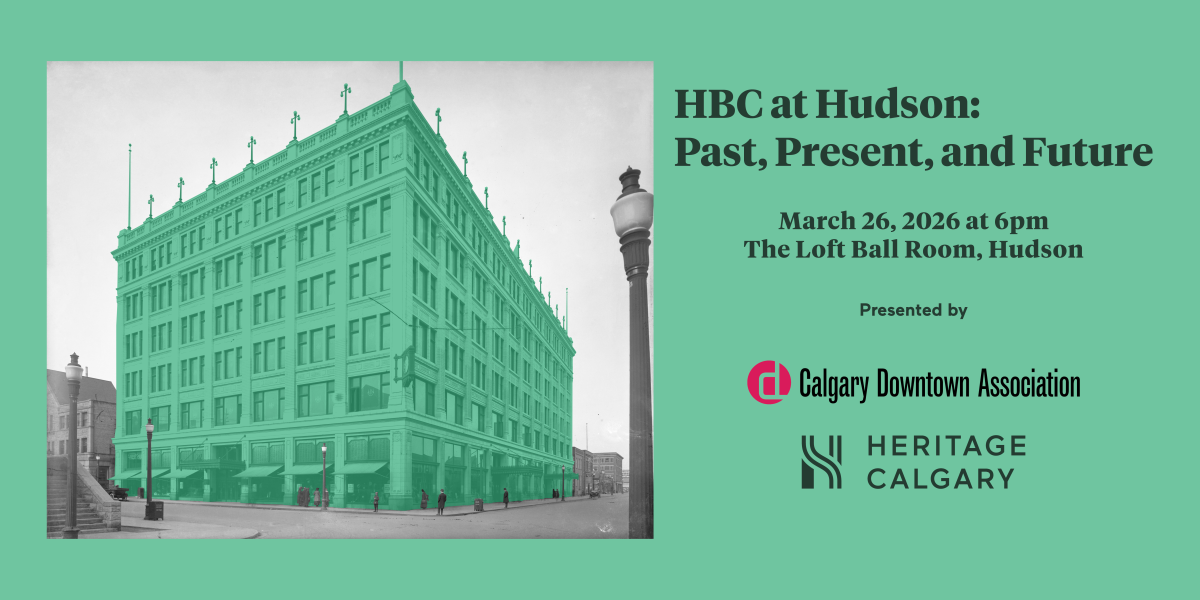
The future of one of Western Canada’s most historically significant retail landmarks will be the subject of a public discussion later this month. Heritage Calgary, in partnership with the Calgary Downtown Association, will host an information session titled “The Past, Present, and Future of the Calgary Downtown Hudson Bay Building” on March 26, 2026, bringing together experts to explore the legacy and potential next chapter of the prominent downtown property.
The evening event will take place at the Hudson event centre, located at 200 8 Avenue SW in downtown Calgary, the site of the former Hudson’s Bay Company flagship store that closed in June 2025. Doors will open at 5:30 p.m., with the panel discussion scheduled from 6:00 p.m. to 8:00 p.m. The event will include a moderated discussion, followed by audience questions and networking. [Register Here]
Calgary commercial real estate broker Michael Kehoe, broker of record at Fairfield Commercial Real Estate Inc., is helping promote the event and has compiled historical research on the building and the Hudson’s Bay Company’s longstanding presence in the city.
“People often ask what will happen to the Hudson’s Bay building downtown,” said Kehoe. “This event is meant to bring together people who can talk about the building’s past, where things stand today, and what the possibilities could be for the future.”
A Landmark at the Heart of Downtown Calgary
The Calgary flagship at 200 8 Avenue SW stands as one of the most recognizable commercial buildings in Western Canada. Completed in 1913, the structure was built as the prototype for what became known as the “Original Six” Hudson’s Bay department stores developed across the western provinces.
Constructed with a reinforced concrete and steel frame, the building was among Calgary’s first large scale commercial structures to adopt modern building techniques. Its exterior is clad in cream glazed terra cotta, a relatively rare and expensive material for the region at the time. The luminous façade helped distinguish the store within Calgary’s rapidly growing downtown core.

Architecturally, the building reflects Edwardian Classical design paired with Chicago Commercial style massing. The façade is organized into three distinct vertical sections consisting of a base with display windows, a middle section defined by pilasters spanning several floors, and a decorative cornice crowning the sixth level.
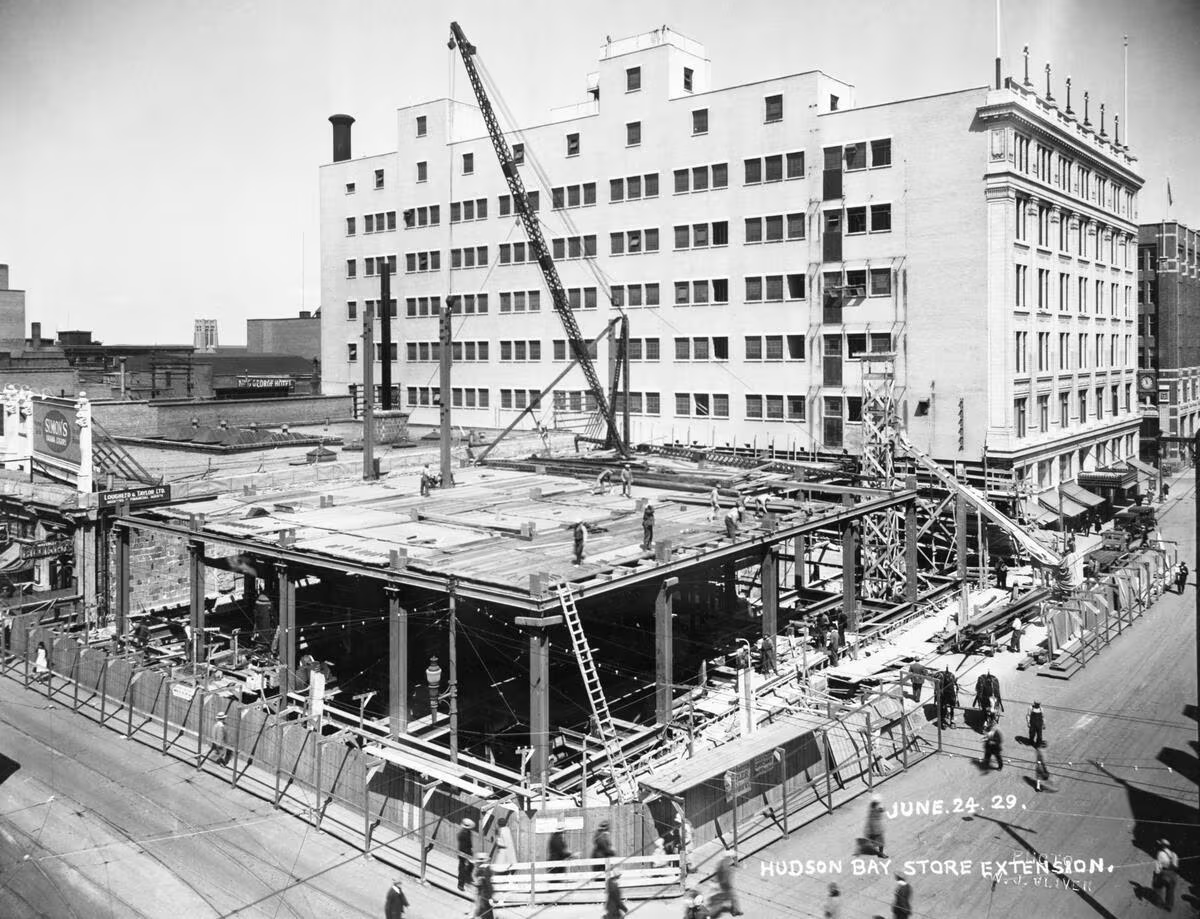
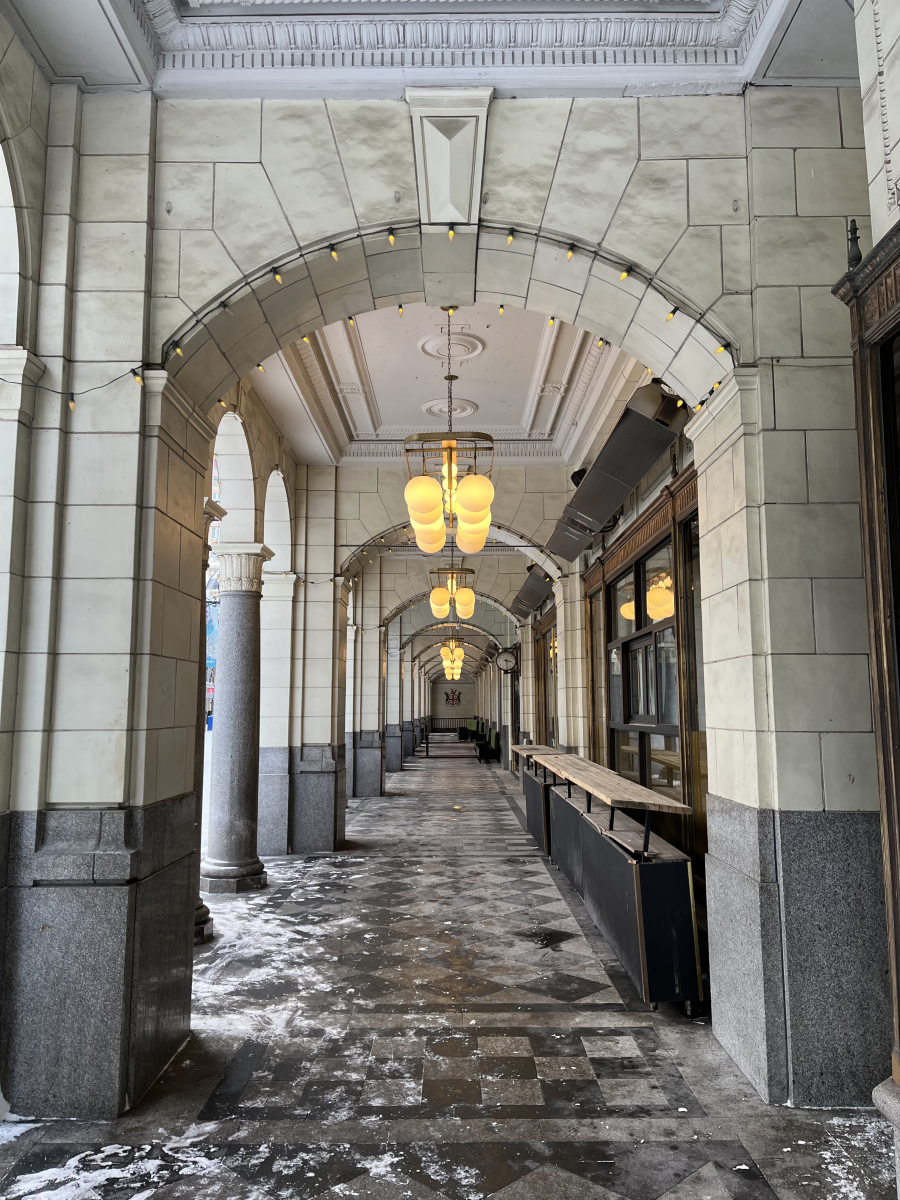
One of the structure’s most recognizable features was added in 1930 when the building underwent a major expansion. The project extended the store westward and introduced the sweeping exterior colonnade that still lines Stephen Avenue today. Inspired by Paris’s Rue de Rivoli, the colonnade features Quebec granite columns, bronze detailing, and terrazzo mosaic flooring.
The expansion further cemented the store’s role as a civic landmark within Calgary’s historic downtown retail corridor.
A Department Store That Functioned as a Social Hub
During much of the twentieth century, the Hudson’s Bay store operated as more than a retail destination. Like many grand department stores of the era, it was designed to function as a social and cultural hub for the city.
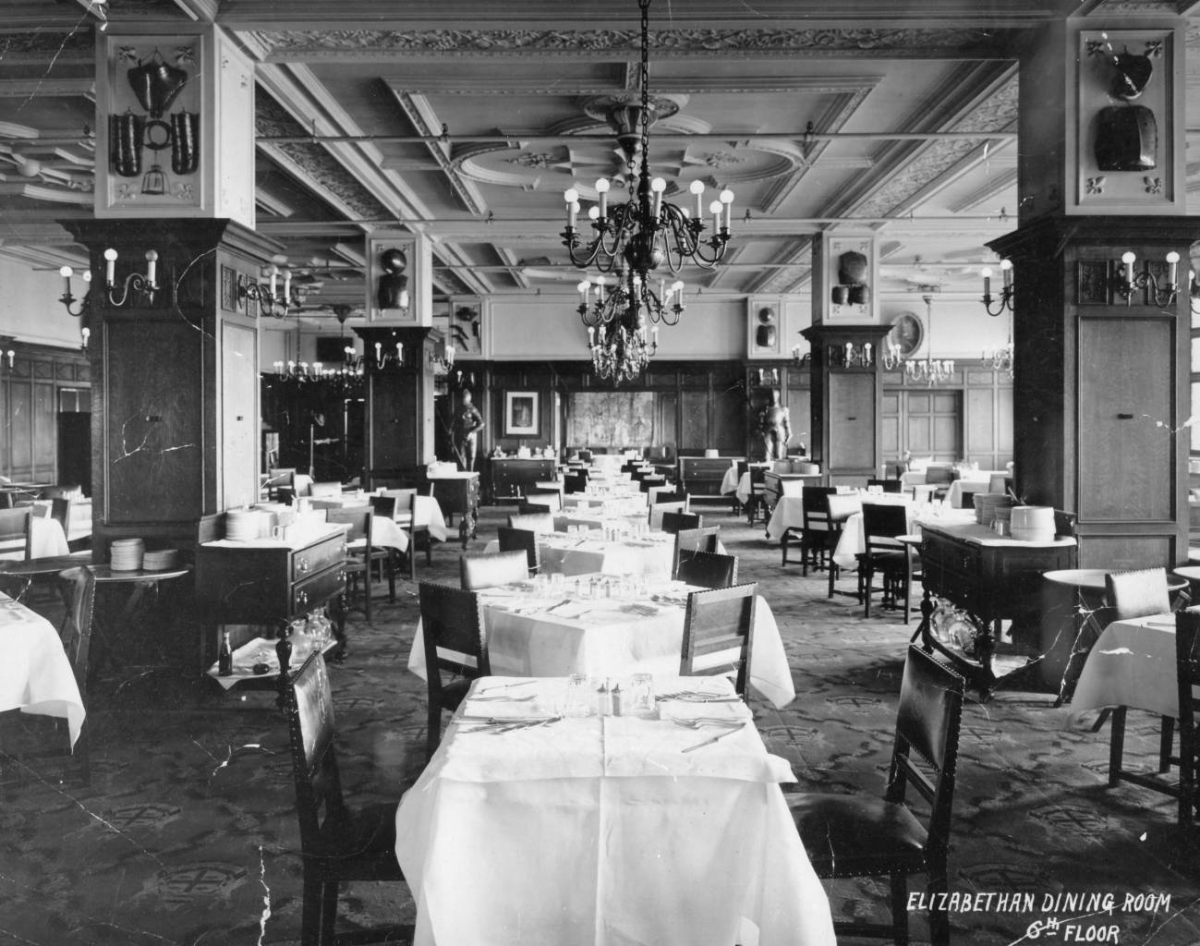
The store once included the Elizabethan Room, a 275 seat dining room on the sixth floor that featured oak paneling and elaborate furnishings. At various times the building also housed a post office, a library, banking services, and a hospital facility for customers and staff.
Technological innovations were also part of the building’s early appeal. The store featured Calgary’s first passenger elevators along with pneumatic tubes that carried messages and transactions throughout the building.
Other amenities included a men’s smoking lounge and a rooftop playground overseen by a governess, illustrating the role department stores once played as community gathering spaces rather than simply places to shop.
“These department stores were often described as palaces of consumption,” Kehoe noted. “They were designed to draw people downtown to shop as well as to socialize, dine, and spend time.”
Hudson’s Bay Company’s Long History in Calgary
The history of the building reflects the broader story of the Hudson’s Bay Company in Western Canada. The retailer traces its origins to 1670, when King Charles II of England granted the company a Royal Charter giving it trading rights across Rupert’s Land, a vast territory covering much of present day Canada.
While the company began as a fur trading enterprise, its evolution into a retail powerhouse mirrored the development of Canadian cities.
Hudson’s Bay established a presence in the Calgary region in the nineteenth century as the community began to grow following the completion of Fort Calgary in 1875 and the arrival of the Canadian Pacific Railway in 1883.
By the late nineteenth century, Calgary was emerging as an important western commercial centre. Hudson’s Bay opened early retail operations in the city before eventually developing its flagship downtown department store in the early twentieth century.
The store constructed in 1913 represented a significant investment at the time, with construction costs estimated at $1.5 million. The opening drew enormous public interest. Historical records suggest roughly 12,000 people attended the grand opening celebration in August of that year.
Subsequent expansions continued to reflect Calgary’s population growth. The building was enlarged in 1930 and again in 1958, when an additional 130,000 square feet was added to accommodate rising demand during the post war boom.
For decades, the store served as a retail anchor along Stephen Avenue, one of the city’s most historic commercial corridors.
Suburban Expansion and Changing Retail Patterns
As Calgary expanded in the latter half of the twentieth century, retail patterns began shifting away from downtown department stores toward suburban shopping centres.
Between the 1970s and 1980s, Hudson’s Bay opened additional Calgary locations at Southcentre Mall, Sunridge Mall, and Market Mall. These new suburban stores reflected the broader evolution of Canadian retail toward automobile oriented shopping centres.
In 1993, the company further expanded its presence with a store at Chinook Centre in the former Woodward’s department store location.
While the downtown flagship remained an important landmark, its role within the company’s retail network gradually changed as suburban locations attracted larger volumes of shoppers.
Like many historic department stores across North America, the Calgary location eventually faced declining foot traffic and changing consumer behaviour.
Closure Marks End of a Long Retail Era
The final chapter of retail activity in the building came in June 2025, when Hudson’s Bay closed its remaining stores across Canada following the company’s financial collapse. The closure marked the end of 355 years of retail operations for the historic Canadian company.
Prior to the closure, Hudson’s Bay had already significantly reduced its footprint within the downtown Calgary building. In 2020 the store downsized operations to just two floors, leaving much of the historic structure underutilized.
Today the building stands vacant, raising questions about its future and the potential role it could play in downtown Calgary’s revitalization.
The situation has drawn attention from heritage organizations and urban planners who see the building as both an architectural treasure and a redevelopment challenge.
Heritage Status and Preservation Concerns
In October 2025, the National Trust for Canada added the building to its Endangered Places List with a designation of “Immediate Threat.” The listing highlighted concerns about the property’s long term preservation and the absence of formal municipal or provincial heritage protection.
Despite its architectural significance and location within the Stephen Avenue National Historic District, the building currently lacks a specific heritage designation that would protect it from demolition or significant alteration.
This situation has prompted debate among local stakeholders about the importance of preserving historic structures while also enabling redevelopment that supports economic vitality.
“The building is an important part of Calgary’s architectural and commercial heritage,” said Kehoe. “But at the same time, these buildings need viable uses in order to survive.”
Major Redevelopment Challenges
Redeveloping the property presents significant financial challenges. Industry observers estimate that modernizing the structure’s mechanical systems, electrical infrastructure, and structural components could require hundreds of millions of dollars in investment.
Several major investors have explored redevelopment opportunities for the site but have ultimately stepped back due to the scale of the required capital.
RioCan, one of Canada’s largest real estate investment trusts, previously examined the property but did not proceed with a redevelopment plan.
The size of the building’s floor plates also presents design challenges when considering modern uses such as residential or office conversions.
Nonetheless, urban planners and developers have proposed a range of potential concepts for the property, including residential housing, a boutique hotel, or a mixed use cultural and commercial hub.
Similar redevelopment strategies have been explored in other Canadian cities, including Winnipeg, where historic Hudson’s Bay properties have been proposed to be converted into mixed use projects — which is proving challenging.
Expert Panel to Explore Possible Futures
The upcoming Heritage Calgary event will bring together three panelists who will examine different aspects of the building’s story. [Register Here]
Historian Darryl Cariou will discuss the history of the Hudson’s Bay Company building and its place within Calgary’s broader commercial development.
Andrew Doudican, representing the local Business Improvement Area, will outline the current state of the property and the challenges associated with its vacancy.
Jessie Andjelic and Philip Vandermay from the design firm Spectacle Bureau will present potential future scenarios for the site, exploring how the structure might be repurposed in ways that respect its heritage while enabling new economic uses.
The panel discussion is expected to provide insight into how historic commercial buildings can adapt to changing urban environments.
Community Conversation About Downtown Calgary’s Future
The event also reflects broader conversations about the future of downtown Calgary as the city works to revitalize its urban core.
In recent years, Calgary has pursued initiatives aimed at converting underused office buildings into residential developments and attracting new cultural and commercial activity to the downtown district.
Historic structures such as the Hudson’s Bay building play a unique role in that effort because they carry cultural significance while also occupying prime locations within the city.
Community discussions about the Calgary Hudson’s Bay building future therefore extend beyond a single property and touch on broader questions about how cities preserve their history while adapting to economic change.
A Historic Building Awaiting Its Next Chapter
For more than a century, the Hudson’s Bay building stood as a central gathering place for Calgary residents. Generations of shoppers visited the store for everything from fashion and home goods to dining and social events.
Although retail operations have ended, the structure continues to occupy a prominent place within Calgary’s urban landscape.
Kehoe believes that conversations about the building’s future are essential as the city considers how to balance heritage preservation with economic development.
“The Hudson’s Bay Company has been intertwined with the history of Canada,” he said. “Now we have an opportunity to think about how this iconic building can continue to contribute to Calgary’s future.”
The March 26 event will offer Calgarians a chance to learn more about the building’s past and participate in discussions about what comes next for one of the city’s most recognizable historic retail landmarks.