Edmonton-based Dr. Phone Fix, Canada’s fastest growing cell phone and electronics repair chain, recently entered the Ontario market opening three stores in the GTA as part of its national expansion plan.
It also opened two new stores in Edmonton, bringing to nine the number of Dr. Phone Fix stores it has in the Greater Edmonton area.
The five openings bring to 29 the total number of stores the company has opened since it began in 2019. By this Christmas it expects to have 40 stores – one-fifth of the way towards its intermediate goal of 200 stores.
“It’s crazy. It’s a crazy pace,” said Warren Michaels, Director/Brand & Business Development for the company. “It’s quite challenging. Next year our goal is probably to open one every two weeks. We’re doing one every three weeks this year.”
Image: Dr. Phone Fix
Michaels said Dr. Phone Fix is the fourth largest cell phone and electronics repair company in Canada.
“We’re the second largest in terms of selling pre-owned certified phones,” he said. “Our ultimate goal is 200-plus stores. And away we go.
Warren Michaels
“One of our competitive advantages is that we have a very unique supply chain and inventory strategy only known to the CEO by the way. It’s like our recipe – a Coke or KFC kind of recipe where only he knows it . . . It’s such a unique arrangement that it gives us the decided price advantage in the marketplace. We guarantee our prices are the best.
“One of the other things is that our inventory is quite substantial. So as a result when someone comes in we’ve got the parts. Some of the other stores have to ship parts in. We have unique parts. We have parts other guys don’t have. As an example we’ve got 3,000 cases but we’ve got 300 different kinds of cases. So our inventory is quite substantial. That gives us that speed advantage. Everybody wants speed. They want speed and price. And we’ve got both.”
Image: Dr. Phone Fix
The growth in the industry is pretty obvious these days with staggering number of people with cell phones and many of them have more than one device.
“I wouldn’t say we’re recession-proof if a recession happens unfortunately but we’re pretty well protected. Everybody has cell phones and there’s certain things they would not do without and a cell phone is one of them,” said Michaels.
“People are now keeping their phones slightly over three years as opposed to model changes almost yearly. And so if a recession was to hit, people would be buying our pre-owned phones rather than buying up.
“It’s a massive, massive growth industry. It’s hard to get solid numbers.”
Dr. Phone Fix said it is a nominee, finalist or winner of 18 local, national and international business awards. Recently, it was chosen as winner of one of Canada’s top awards for customer excellence. It is also a finalist for EY’s Entrepreneur of the Year.
Image: Dr. Phone Fix
With more than 4,000 positive customer reviews, Dr. Phone Fix swept to victory recently in a competition for Alberta Chambers of Commerce’s top ‘Customer Service’ award.
“We’re very honoured to win the Business Award of Distinction for Customer Service. This award is a reflection of our commitment to exceed customer expectations and the thousands of positive reviews posted on the web. We feel we’re on the right path,” said Dr. Phone Fix CEO Piyush Sawhney.
“We’re extremely grateful for our customer reviews and their loyalty. And to further express our gratitude, we recently partnered with AIR MILES Reward Miles to offer reward miles to customers . . . “
The Canadian retail leasing market will see increased activity for the remainder of 2022 as it recovers from the slowdown in the first quarter as Omicron disrupted business activity, especially in Ontario and Quebec, in January and February, raising business uncertainty and freezing leasing plans, says the Retail Outlook report by commercial real estate firm JLL.
The report said this follows a strong 2021 for retail leasing which fully rebounded from the initial pandemic shock. Overall retail leasing activity in 2021 surpassed 2019 by 12 per cent.
“Businesses and shoppers remain optimistic about the future. Businesses anticipate increased future sales over the coming months, and shoppers are less hesitant about enclosed spaces and reasonably confident about their future spending,” said the report.
“Retailers still consider exterior entrances an asset, but enclosed spaces are increasingly attractive again. Mall leasing activity has intensified, and mall vacancy is starting to trend down after peaking in Q4.
“Calgary and Edmonton have led the retail recovery with the most robust space-absorption. A higher oil price ‒ exacerbated by the Russia-Ukraine conflict ‒ has benefited both of these markets, driving strong economic and housing activity and employment. In addition, unlike Ontario and Quebec, Alberta experienced a more relaxed health framework that did not affect space-absorption levels last year.”
Temporary OVO at Yorkdale Shopping Centre (Image: Craig Patterson)
In Canada, total availability was 2.9 per cent in the Spring, near the pre-pandemic 2019 level of 2.8 per cent. It increased to 3.5 per cent in 2020 then dipped down to 3.0 per cent in 2021.
Total retail inventory in Canada is 753.6 million square feet. Net absorption so far this year has been 1.5 million square feet with another 6.2 million square feet under construction.
“Overall, Canada’s economic momentum should continue to drive down available space, while driving rents and space absorption up. The economy resiliently weathered the Omicron wave in Q1, with a tighter labour market, pent-up demand, and excess household savings,” said the JLL report.
“Due to rising construction costs and a labour shortage, retail construction levels have lowered a notch, and no major retail building boom is expected in the short-to-mid-term. Retail completions have consequently decreased, which reinforces the expectation of a tighter market in the following quarters.
“However, Calgary retail construction has been an outlier as the market sees a robust stream of completions fueled by population growth. Calgary is a magnet for young, skilled professionals whenever there’s an acceleration of job growth, especially positions with high wages.”
77 Edmonton Trail, Calgary, AB (Image: CDNGLOBAL Alberta)
Tim Sanderson, Executive Vice President & National Lead, Retail, JLL Canada, said availability numbers nationally are pre-COVID numbers.
Tim Sanderson
“That’s a healthy place to be quite frankly. Anything less than that and basically there’s nothing available,” said Sanderson. “We’re not overbuilt in this country. Thankfully.”
He said the amount of current construction out there is a big number.
“On the face of it, across the whole country, that’s a lot. A lot of that would be stuff that was in the pipeline pre-COVID. One of the toughest things we’re up against these days is construction costs. Transactions take a long time from beginning to end and when a landlord and a tenant try to agree on construction budgets and you’ve still got a permitting process to go through which means I’m not going pull my construction budgets for another 12 months and you say I’m going to spend $8 million building this store, well you’ve got no way of knowing if it’s going to be $8 million or $12 million,” he said.
“There were a lot of artificial tenancies through COVID. There were people who were not paying rent. There were people who still occupied space but maybe weren’t open because they couldn’t have staff or whatever. And there was a lot of temporary tenants filling the space. Pop-up stores or what have you. That 3.5 per cent (availability rate in 2020) if you really dug into it was probably more like 4.5.”
The JLL report said retail tailwinds are stronger than headwinds in the market today.
Those tailwinds include:
Healthy labour market: Job market conditions remain tight with the unemployment rate falling to a record low of 5.1 per cent in May. A tight labour market is a strong indicator that shoppers have disposable income to spend;
Favourable consumer confidence: Consumer spending as a whole is expected to remain healthy in 2022, supported by pent-up demand and elevated savings;
Excess household savings: Canadians saved a lot during the pandemic, especially in the first half of 2020 and first half of 2021. For Canada, the average household savings rate was about two per cent before pandemic and we finished Q1 with a rate of 8.1 per cent. At the current rate, there’s still fuel left to burn before it recedes to its historic average rate in one to two years; and
Pent-up demand: During the shutdowns of physical space, Canadians put a pause on store spending and only redirected a fraction of their shopping to online. With the reopening of physical retail, food services, gyms, cinemas, and bars, many Canadians are eager to go out again.
The headwinds include:
Supply chain: This year, most retailers expect facing challenges maintaining inventory levels or acquiring inputs, products, and supplies. The top obstacles should be the rising cost of inputs, shortage of labour force, and transportation costs;
Inflation: Inflation is likely approaching a peak, and forward-looking indicators point to a moderation in economic activity in the second half of this year. Goods prices will soon decline or decelerate as demand shifts back towards services with the relaxation of social distancing measures;
Labour shortage: While attracting and retaining talent remains a concern across all industries, it is especially acute in hospitality and construction. Although these temporary circumstances will fade over time, labour markets will remain employee-favourable in the long run, due to the secular aging of the workforce and the mass retirement of the Boomer generation;
Shift from goods to services: While shoppers aren’t clearly substituting goods with services, spending on travel and hospitality services have surged over the past few months. Goods sales, particularly groceries, remain elevated; and
Rising interest rates: As the cost of borrowing rises, more shoppers will rein in spending in favour of saving. Households that pay mortgages will have less free money to spend on discretionary goods. Commercial rents tend to rise as landlords pass on additional financing costs to preserve profitability.
JLL Listing on Rue Sainte-Catherine Ouest (Image: Dustin Fuhs)
The JLL report said general retail remains by far the most sought-after retail type. Retailers are still interested in neighbourhood centres, but their interest has waned. In contrast, businesses have shown signs of gradually returning to enclosed malls.
“Net effective rents continue their recovery trajectory, demonstrating a slight positive increase this past Q1 compared with Q1-19. Rent concessions and adoption of per cent rent leases continue to dwindle, accompanied by a gradual tapering of government rent subsidies,” said the report.
“Montreal, Toronto, and the Atlantic region have experienced the strongest rate rebound. Calgary still lags the other major markets, as rates in Calgary have yet to reach pre-pandemic levels. Like net effective rents, asking rents continue to trend up as retail sales and foot traffic recover. Particularly in Ontario and Quebec, as space-absorption increases we should see a strengthening of this trend.”
The report said e-commerce has receded from its highs during the pandemic, but activity remains elevated relative to pre-pandemic levels. During each lockdown, the pattern was that e-commerce would accelerate, but then reduce once physical stores reopened. True to form, e-commerce sales slid this March following the peak of the Omicron wave. However, the overall trendline continues to ascend and e-commerce as a percentage of total retail sales should continue to rise, added JLL.
“While physical stores remain the preferred shopping method, curbside pickup has captured a significant share during the pandemic. For each of the past two holiday seasons, about 18 per cent of shoppers bought online and opted to pick up at the store rather than wait for delivery. Before the pandemic, curbside pickup was hardly a viable option,” it said.
Retail Insider is streamlining its Canadian retail news from around the web to include a handful of top news stories that can be viewed quickly during the day. Here are the top stories from the past 24 hours.
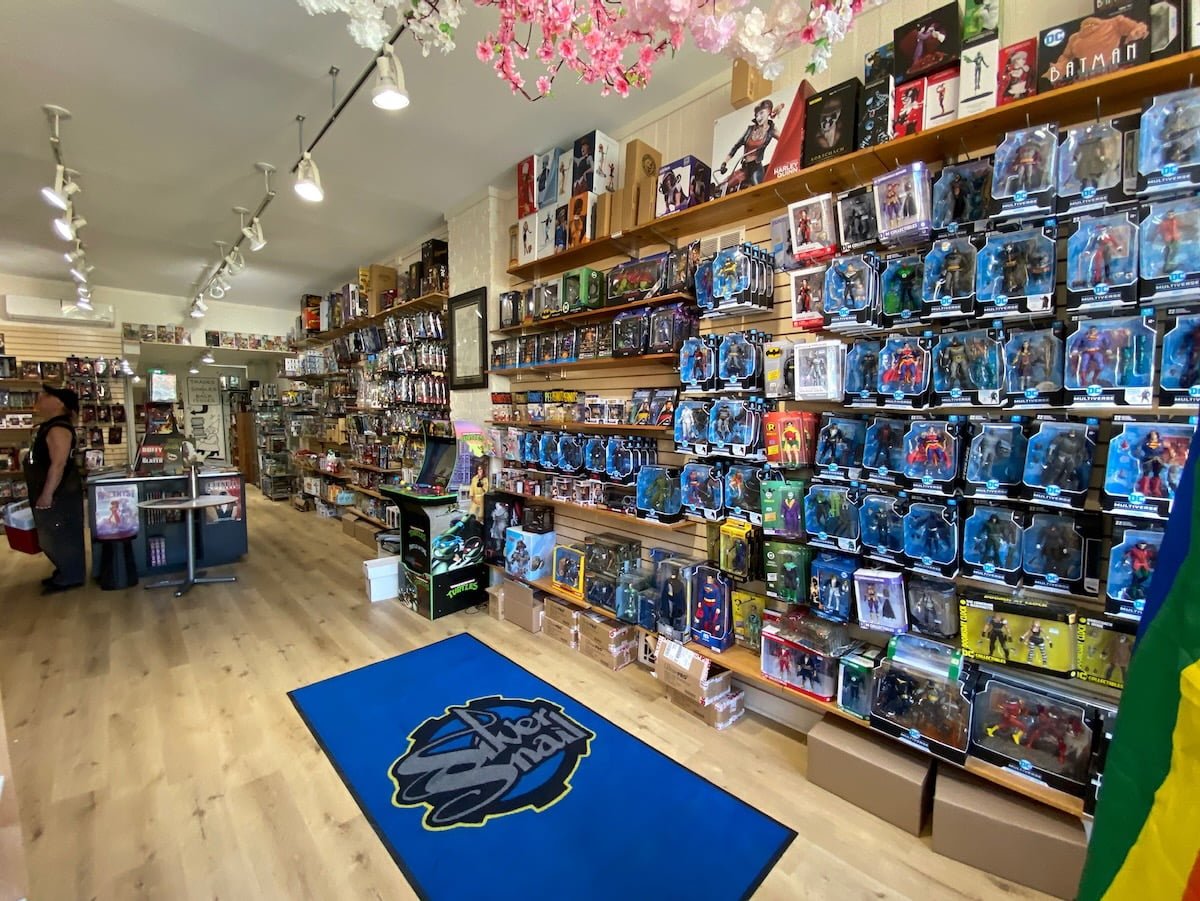
Silver Snail at 809 Queen St W in Toronto (Image: Dustin Fuhs)
It has been one year since the comic bookstore Silver Snail moved to Queen Street West in Toronto, and since the retailer has never had time to celebrate its anniversary, it is planning a celebration for this upcoming Fall as “there is lots to celebrate” says Brian Hamelin, the co-owner of Silver Snail.
Located at 809 Queen Street West in Toronto, the co-owners Brian Hamelin and Mark Gingras have around 30,000 comic books and other collectables for customers. The owners decided to move from their previous location at Dundas Square to where it all started – Queen Street West where the store originally opened in 1976 by Ron Van Leeuwen who retired in 2011 and sold the company to Hamelin and Gingras who were employees at the time.
“The original owner started this as he loved comic books, and he wanted a backup plan if it failed. So, he named the store Silver Snail as he also loved exotic animals. If his plan failed, he would turn the store into an animal store,” says Hamelin.
Customers can find all sorts of comic books and collector items including graphic novels, action figures, trading cards, collectables, giftware, and local art by Yannie Lo.
46 Years and Counting
Silver Snail at 809 Queen St W in Toronto (Image: Dustin Fuhs)Silver Snail at 809 Queen St W in Toronto (Image: Dustin Fuhs)
Last year Silver Snail turned 45 and as it did not have a celebration because of the pandemic and its move, the retailer will be having a celebration hopefully in September.
There has been a lot of challenges, especially during the pandemic, and the retailer would like to celebrate its success. As new comic books are always being released, Hamelin says they need to make sure they keep up to not disappoint their customers.
“It is stressful as I am always thinking about what new comics are coming out and how much of each do we need. We want to make sure we have enough for our customers, to fill out our stores, while also making sure that we will sell out,” says Hamelin. “We also need to make sure we keep up with all the new comic books, like the Batman that comes out every Wednesday. We need to be fully stocked while also selling out, it sounds impossible but that is our goal.”
Hamelin said during the pandemic it was slow for Silver Snail as most of its customers enjoyed browsing in person which was not possible. Customers can also purchase online; however, their main revenue is people coming into the store and picking up one or two books.
Silver Snail at 809 Queen St W in Toronto (Image: Dustin Fuhs)Silver Snail at 809 Queen St W in Toronto (Image: Dustin Fuhs)
“People like to come in and see what we have, look through the comic books, see the art, and have the experience of browsing the store,” says Hamelin.
The new location was decided on because Silver Snail wanted to connect more with families and wanted to be on street level to make the store more accessible. Hamelin said the store is close to a park and they are hoping because of that, more families will come in and kids who are just starting their comic book journey.
“We want to reinvent ourselves to be known as the friendly neighbourhood comic bookstore where families can come in. That is why we have picked our location close to a park, we want to get the younger generations into comic collections,” says Hamelin.
The next steps for Silver Snail are to be more involved in the community, expand its online store, and to hopefully serve more families.
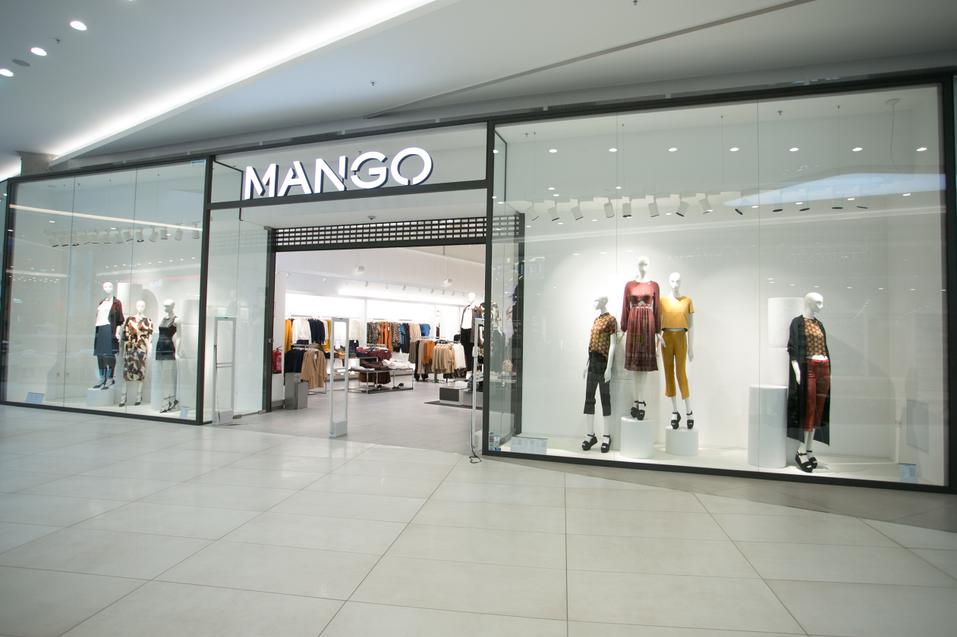
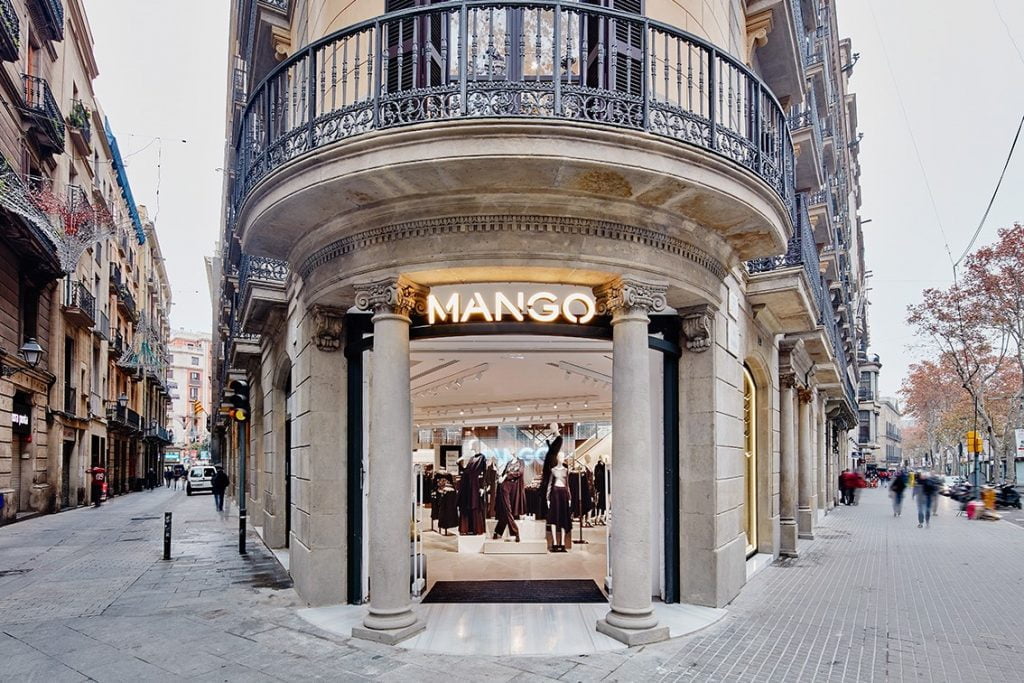
Popular Spanish fashion brand Mango has announced that it will enter the Canadian market this year in partnership with Israel-based Fox Group. About 20 stores are planned with openings as soon as this fall as well as the launch of a Canadian ecommerce site.
The Toronto market will be the entry point for Mango in Canada. A store at Toronto’s Yorkdale Shopping Centre is under construction in a space vacated during the pandemic by Victoria’s Secret. The Yorkdale Mango store will span almost 11,000 square feet in a prominent corner location facing Hudson’s Bay and Harry Rosen.
Six stores in the Toronto area are planned this year into 2023 with location announcements to follow.
Construction hoarding at Toronto’s Yorkdale Shopping Centre, July 2022. Photo: Craig Patterson Photo: Mango
Over the next decade, Fox Group plans to open at least 20 Mango stores in Canada in major markets. A mix of shopping centre and street-facing locations is expected.
In Canada, Mango secured a presence since just before the pandemic at Hudson’s Bay where it has a presence in about 50 stores.
Above and below: images from Thebay.com showing pricing of Mango fashions in Canada. Image: Mango Barcelona
For several years Mango has been looking at entering the Canadian market after ending a partnership with Montreal-based Tristan. In the summer of 2017, the company sent a real estate representative to Toronto to scout out the city’s top shopping centres with a goal of learning the market while also looking to secure a partnership with a local company to open licensed stores. A partner was not found at the time and now Fox Group has stepped up to lead the Canadian expansion.
In 2004, Mango partnered with Tristan and opened Mango stores in Quebec and Ontario that operated for several years — a location at Yorkdale was basically where Cartier and Bulgari now have stores. A local licensee also recently operated a Mango storefront in Quebec City according to a source that commented below in this article after it was published.
In the US, Mango operates almost a dozen stores and plans to open about 30 more over the next three years.
Tel Aviv-based Fox Group made headlines in Retail Insider in September of 2019 when we announced that it had partnered with Nike to open a flagship store at Toronto’s Yorkdale Shopping Centre. That Nike store opened in August of 2021 and spans over 25,000 square feet on two levels.
Fox Group operates 47 Mango stores in Israel and otherwise manages over 1,000 store locations for various brands globally.
Mango was founded in Spain in 1984 and has hundreds of stores around the world.
While Barcelona-based Mango makes its moves into Canada, a Canadian brand is moving into Spain. This week Vancouver-based lululemon announced that it will open its first stores in Madrid and Barcelona this year with plans for further expansion in the Spanish market as part of a global push for international growth to double revenue by 2026.
Video Interview: Wrestling Legend Bret Hitman Hart Talks About Branding
Wrestling legend and icon Bret Hitman Hart discusses the importance of branding.
He talks about how his brand came about, what he stands for, who he aligns with from a business perspective and why, and how the moniker Hitman came to be.
Hart was at a media event for Romero Distilling Company in Calgary which set a Guinness world record for the largest Cuba Libre cocktail.
The Video Interview Series by Retail Insider is available on YouTube.
Connect with Mario Toneguzzi, a veteran of the media industry for more than 40 years and named in 2021 a Top Ten Business Journalist in the world and the only Canadian – to learn how you can tell your story, share your message and amplify it to a wide audience. He is Senior National Business Journalist with Retail Insider and owner of Mario Toneguzzi Communications Inc. and can be reached at mdtoneguzzi@gmail.com.
Also check out the other series offered by Retail Insider, including The Weekly podcast and The Interview Series, which are both available on Apple Podcasts, Stitcher, TuneIn, Google Podcasts, or through our dedicated RSS feed for Simplecast and other podcast players.
Retail Insider is streamlining its Canadian retail news from around the web to include a handful of top news stories that can be viewed quickly during the day. Here are the top stories from the past 24 hours.
Outdoor Summer Market - Robson Experience Package in partnership with Landmark on Robson (Image: Robson Street Business Association)
There have been some interesting periods throughout the storied history of retail – moments in time, from recessions and depressions to rebuilds and renaissances, that have challenged the resolve of merchants and sparked innovation and creativity. However, it’s not likely that people have bore previous witness to such a cacophony of social, political and market turmoil as the one that exists today. It’s presenting those operating within the industry with a host of challenges to address and overcome if they have any ambition to achieve revenue and growth over the coming months and years. And, according to industry expert and Founder of Inception Retail Group Inc., George Minakakis, in order to do so, retailers and brands are going to need to draw from a number of different disciplines.
“There’s a war happening in the Ukraine,” he recognizes. “Inflation has gone through the roof. The pandemic, which is not quite under control, continues to cause problems and issues around the world. Stagflation is a definite risk. Shrinkflation is catching on, forcing consumers to pay a lot more for a lot less. When you put all of these converging issues together, it’s incredibly problematic. And so, how do retailers respond to this amalgam of challenges and difficult circumstances? They have to be artists and scientists. And they also have to be financial gurus in order to pull everything together and make it work. In short, it’s going to require smarts and ingenuity in order for retailers to compete and succeed going forward.”
Smarter marketing
One of the ways in which Minakakis suggests that retailers can be smarter is with respect to the marketing and advertising that they develop. He says that one of the greatest mistakes that any brand can make during inflationary times is to pull back and reduce advertising. It’s a tactic employed by retailers amid slower economic climates in an effort to minimize and streamline costs for the business, with marketing and advertising often being evaluated as less of a priority investment. However, according to Minakakis, it’s a function that may in fact serve a greater strategic purpose during challenging economic times.
“It’s often a bit of a knee-jerk reaction by companies amid inflationary periods to cut back on their marketing and advertising,” he explains. “But in many cases, it’s one of the absolute worst things that they can do. In fact, what they should be doing instead is becoming smarter with their advertising and increasing their focus locally. During economic downturns, brands need to develop better, stronger offers and incentives that will bring traffic through their doors, whether that’s physical or digital, in order to attract more revenue. They need to rethink their offers and reengineer how they’re structured to compete at the highest level. Success going forward will require a lot of smarts and savvy and a real compelling reason for customers to visit their stores.”
Planning for the worst
Minakakis goes on to explain, however, that not even the smartest and savviest of retailers can know more than they know, meaning the industry can’t be completely sure of the nature of challenges that lie ahead. He believes that the inflationary issues and supply chain challenges that are being faced by retailers and brands all over the world will linger for some time longer, adding that prices are not likely to ever come back down again. It’s a set of circumstances that poses considerable challenges for retailers vying for a piece of the consumer’s spend and compete in such a turbulent and uncertain market. However, in order to effectively and efficiently comprehend today’s market dynamics and respond to them, the seasoned industry expert suggests that the development and maintenance of a scenario planning toolkit will become more valuable than ever to organizations that employ them.
“I learned very early on in my retail life that any great corporate and brand strategy is supported by solid scenario planning that can help the organization identify risks and plan appropriately for them. The idea is to protect the company’s assets and health, preventing negative happenings and events from impacting it too severely or avoiding them altogether. And, the very best, most effective scenario planning will help brands recognize the opportunities that almost always come along with risk and adverse situations. And it’s up to the brand then to seize the opportunities that they’ve dedicated planning and resources toward seizing. It’s perhaps going to serve as the most important and effective tool for retailers and brands going forward, allowing them to look at their businesses just a little differently, preparing and enabling their operations to withstand future disruptions in order to maintain success and growth despite the circumstances.”
KITS Announces over 31,000 pairs of Eyeglasses Manufactured and Delivered in May 2022 (CNW Group/KITS)
Vancouver-based eyewear manufacturer KITS recently hit a new monthly record producing more than 31,000 pairs of eyeglasses in May which was more than double the 15,000 pairs it manufactured and delivered in May 2021.
Since its launch, KITS has manufactured and delivered over 350,000 pairs of eyeglasses.
Joseph Thompson
“We are thrilled to achieve these results without requiring hundreds of brick-and-mortar retail locations,” said Joseph Thompson, KITS co-founder and COO. “The KITS online-focused business model allows us to pass on these savings to our customers.”
The company was founded in 2018 by Thompson, Roger Hardy and Sabrina Liak.
KITS is primarily an online business but it does have one retail location in Vancouver that is more of a community flagship store on Kits Beach in Kitsilano.
Thompson’s background was with Amazon.com in Seattle running a couple of the retail groups there. The company was always intrigued with optical because it felt that glasses and contact lenses were an underserved market. After some investigation, it found that what Roger Hardy had started previously with Coastal Contacts, which is known as Clearly in Canada, was really the most Amazon-like optical retailer in the world. It sold in 2014 to Essilor.
Kits at Yew and Cornwall in Vancouver, BC (Image: Kits.ca)
Kits at Yew and Cornwall in Vancouver, BC (Image: Kits.ca)
Kits at Yew and Cornwall in Vancouver, BC (Image: Kits.ca)
“And so Roger and I stayed in touch and thought it would be great to start up a business together. We continued to look at the optical industry and thought there was a lot of good that we could do in the industry, a lot of work to be done,” said Thompson.
“About eight out of 10 adults require glasses or contact lenses just to get through the day and that number is growing. But the price of glasses just keeps going up. So we set out to build an optical company with more selection, unbeatable value, and the best convenience in the industry. And to do that we built an optical lab right here in Vancouver. Whereas most retailers over the last 10 years have been offshoring the manufacturing, we knew that if we had our manufacturing lab right here in Vancouver we could control the quality, we could control the cost, vertically integrated all the way through and pass that savings and convenience on to customers. That’s how we got started.”
The company said about 30 per cent of revenue from frames delivered in May 2022 came from returning customers.
“We are excited to reach the 1,000 pairs of glasses per day milestone in May” said Hardy, KITS co-founder and CEO. “To reach this level while reducing marketing spend on eyeglasses month-over-month is a further testament to the power of word of mouth, and customer satisfaction with our offering. Net Promoter Scores in the optical category are consistently below 30. Achieving an NPS of over 80 on our KITS eyeglasses continues to validate that our direct channel delivers the most efficient and satisfying experience for customers and inspires them to rave about the experience to others. This is evident in the thousands of comments we see from customers online and through social sharing, a key driver of our success.”
Thompson said KITS makes a pair of single-vision, prescription glasses in about 10 to 15 minutes in its vertically-integrated lab.
Image: Kits.ca
Image: Kits.ca
“And we get that into the carrier network right away so it’s in the customer’s hands within a day or two,” he said.
The company has customers coast to coast in Canada as well as a business in the US.
“But we’re growing most rapidly in Canada for sure. We serve customers in every province or territory over the last year and they’re all growing. The benefit of a digital footprint is we can reach customers across the country whether it’s through their insurance or whether they find us on site. We can get a pair of custom-made prescription glasses to them anywhere within a few days – or contact lenses.”
Yesterday’s mall was a place that acted as a shopping destination for consumers.
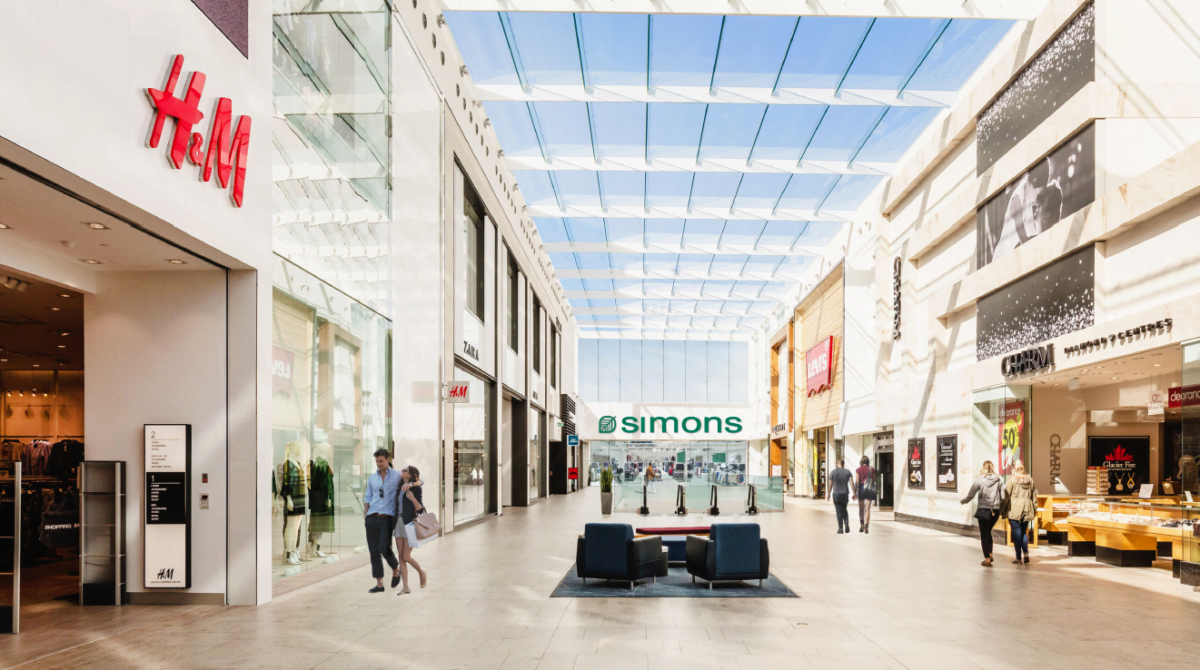
But the mall concept has evolved over the years and the mall of tomorrow will become more of a hub of daily life consisting of a social gathering place, food and entertainment, fulfillment and logistics, discovery and recreation – and of course shopping.
John Crombie, Executive Managing Director, Retail Services, Canada, Cushman & Wakefield, who gave a presentation on the topic at the recent Land & Development Conference in Toronto, said in his report that In 2015, 72.7 per cent of a mall was retail. By 2020, that had shifted with retail decreasing to 65.8 per cent.
Rendering: Simons at Halifax Shopping Centre
John Crombie
“You’ve got to look at it historically where the mall originally was. The landlord owned it, rented the space to a tenant, a retailer, and then the retailer dealt with the customer. It was very linear in terms of its arrangement,” he said.
“I think now, and this is where technology has certainly come into play, and how landlords need to look at the business differently, the landlords now need to be and have been more involved with understanding the customer base in as much as the retailer understands the customer base. A lot of it has to do with marketing their properties. If you’re going to be attracting retailers, you have to understand who your demographics are, the customer profiles and then you want to ensure getting the right tenant mix. That there’s complementary retailers and there’s a lot of cross sales opportunities.
“Landlords need to get more engaged that they’re as much in the customer service as the retailers and it’s creating this environment that’s appealing to them. It’s as simple as having events which is obviously a great draw of business from Mother’s Day to Christmas events and Santa Claus, to having areas where people can enjoy times together and realizing that food is becoming a huge component of that.”
Lined with publicly accessible, diverse open space and a bosque of trees, the pedestrian promenade is a unique landscape feature which creates a connection between Etobicoke Creek and the new urban centre. (Image Courtesy of BDP Quadrangle / SvN Architects + Planners)
Crombie said landlords also have to pay more attention to the food mix in their properties.
Crombie’s presentation, What Lies Ahead For Retail Real Estate In Canada: A Look at the Current Market & Future Predictions, outlined the following predictions for the future of retail:
Tenant mix will shift to more non-retail uses and food;
Omni-Channel is the future for physical stores;
Upbeat on revenue growth for Canadian retailers in 2022;
Better efficiencies and technology in stores;
Long live the automobile in a post COVID world;
Shoppers will shift more spend to secondhand products;
More retailers will sell into the metaverse world; and
Revival of experiential retail.
Also, Crombie said that by default we’ve seen the shift in malls. While many retailers are all right sizing, they can be as productive in a smaller footprint. We’ve also had the demise in Canada and the United States of department stores with Hudson’s Bay being the sole remaining Canadian traditional retailer.
“And so as landlords, you have to look at that old dumbbell. A department store anchor on each side and shops in between. Well, without department stores what do you do? So you’re forced to look at smaller boxes or to eliminate that and move towards things that will drive people to your shopping malls to create that (foot traffic),” said Crombie.
“Unfortunately with e-commerce nipping at retailers’ and landlords’ sales, and that’s a big concern for them, how do they drive more traffic into the malls. They have to be much more understanding that they’ve got to be as much of a traffic driver as the retailers are a traffic driver.
“The best thing about retailers and landlords is that they have an ability to be innovative and try new things. Some things don’t work and some things do work. The pandemic as we all know has been the big accelerator for a lot of these changes. I still think the idea of a shopping mall to cater more to the last mile delivery, we need to do more of that in what’s happening in the malls. I think you’ll continue to see a huge growth in that area. The buzz word is omnichannel. From a landlord’s perspective, they also need to think more omnichannel.”
Crombie said the industry has missed out on the excitement of shopping in the last couple of years during the pandemic. That needs to be reinvented.
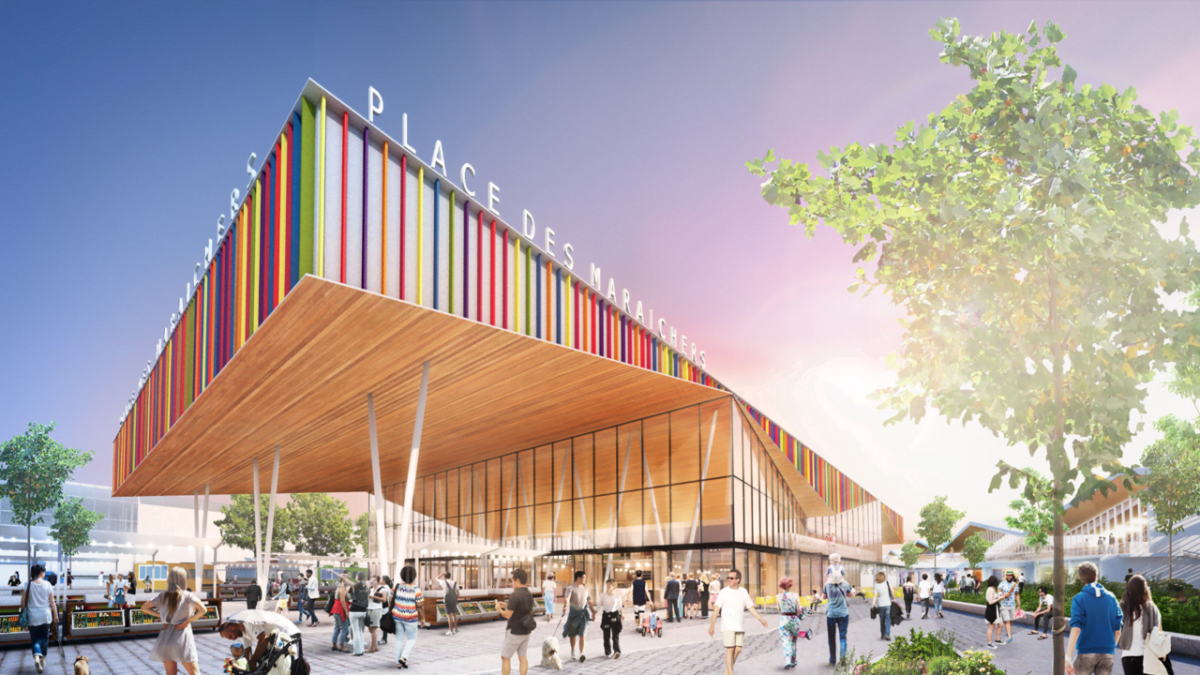
Marché Central (Rendering: QuadReal)
Also, one of the trends is mixed-use for shopping malls by adding multi-residential homes. And that will increase the asset value of those properties. The malls of the future could also have senior housing on their properties.
There will be more fitness centres as well as more drive-thru food and coffee establishments.
“About a year ago people weren’t talking about the metaverse and it was something that really wasn’t addressed and never really thought of. I can tell you that in the last six months everybody seems to be talking about it,” said Crombie. “In the metaverse world there’s people actually buying virtual real estate. There’s a lot of people in the gaming world and living virtual worlds in the metaverse and 2.7 billion playing it. This plays into the omnichannel. The metaverse is really just another extension of the omnichannel.
“It is hitting everybody’s radar screens.”
Crombie said experiential retail is very, very important.
Forever 21 Metaverse Shop City (Image: Forever 21)
“This is where back to being lifestyle architects as owners of retail properties we need draws to bring in (foot traffic) and there’s things you just can’t do online,” he said. “Experiential retail is the way to do it. It is definitely not going away and it’s nice to see.” He cited the Friends immersive exhibit at the Yorkdale Shopping Centre as an example of that.
Crombie also said short-term spaces will also be a trend. There were a record number of retail closures in 2020. That created vacant retail space, particularly in secondary and tertiary malls. Direct to consumer brands have been filling up the space as well as independents.
And Crombie said there’s a growing trend in high-end second-hand goods being sold through consignment.
“We see a huge growth area in that over the next couple of years,” he said. “There are issues that a lot of malls don’t allow second-hand products coming in there but I think retailers have got to realize that there’s an advantage to having some of these in there and the landlords are going to see some real growth in that,” he said.