Retail Insider is announcing an exclusive partnership with Toronto-based digital logistics startup Swyft which facilitates same-day delivery for Retailers. Swyft is poised to be a game changer in the package shipping industry as it grows rapidly and innovates through data and technology. The company’s overall goal is to make the price of same-day delivery comparable to one or two-day delivery, levelling the playing field for smaller businesses against major players.
“Retail Insider is thrilled to bring Swyft on as our exclusive partner in the space, as we believe what they are building will transform shipping in Canada. We believe that Swyft will be a huge benefit to large and small retailers looking to offer same-day shipping to consumers as retail continues to shift online,” said Craig Patterson, Editor-in-Chief of Retail Insider.
The company has been securing significant funding including a recent Series A raising $22 million led by Inovia Capital, Forerunner Ventures and Shopify. Now Swyft is expanding geographically over the next 12 months in a big way after recently launching operations in Los Angeles. Swyft’s software application integrates with merchant shopping carts on e-commerce platforms including Shopify, WooCommerce, and Magento to offer same-day delivery. Swyft grants courier companies free access to its software as they join Swyft’s marketplace, thus creating a network of warehouses and delivery drivers.
“Now everyone can offer affordable last mile delivery to their customers that automatically scales with seasonal activity,” said Aadil Kazmi, Swyft’s co-founder and CEO, “Same day delivery is no longer only for Amazon sellers.”
Retailers and brands already using Swyft’s marketplace include Lush Cosmetics, Station Cold Brew coffee, luxury retailer Holt Renfrew, and jewellery brand Jenny Bird. More retailers are coming on board daily as part of their accelerated growth.
Since launching in March of 2020, Swyft has delivered over 200,000 packages to date and has expanded its gross margin rapidly due to its zero-asset business model. In December, Swyft says that it drove an additional $10,000 per day for a jewellery retailer by offering quick delivery when the holidays were resulting in delivery delays from other providers.
Swyft says that its rapid delivery platform helps drive consumer retention and loyalty which in turn leads to higher profitability for retailers. Swyft also enables independent brands to offer affordable same-day delivery which is critical in helping them grow their businesses and meet increasing customer expectations. In theory, utilizing Swyft can help smaller retailers level the playing field with Amazon by in some cases offering even faster delivery.
Retail Insider will continue to work with Swyft as it grows and will provide updates on the company as it helps retailers in this country succeed. For more information on Swyft, visit: https://www.useswyft.com
Montreal-based commerce platform Lightspeed announced Monday that it has acquired two global leaders in digital commerce for about USD $925 million in total. The acquisitions will provide Lightspeed customers new further digital capabilities, enhanced supply chain management, and enhanced online customer experiences.
Lightspeed will acquire US-based eCommerce platform Ecwid which allows customers to create standalone businesses in a short time. Once integrated, the combination of Lightspeed and Ecwid will allow for selling flexibility and omnichannel experiences. Lightspeed acquired Ecwid for about USD $500 million including payment on closing of approximately USD $175 million in cash and issuance of subordinate voting shares in the capital of Lightspeed valued at approximately USD $325 million. The deal is expected to close during the quarter ended September 30, 2021.
Lightspeed also announced a definitive agreement to acquire digital platform NuORDER which connects businesses and suppliers. The partnership’s aim is to create an industry-leading bridge between the merchant and supplier experience by simplifying product ordering for retailers and offering brands insight into how their products move. Lightspeed will acquire NuORDER for about USD $425 million by way of payment on closing of USD $212.5 million in cash and the issuance of subordinate voting shares in the capital of Lightspeed valued at approximately USD $212.5 million. The deal is expected to close during the quarter ended September 30, 2021 as well.
The acquisition of NuORDER capitalizes on the Lightspeed Supplier Network to accelerate the growth of Lightspeed’s financial services offerings including Lightspeed Payments and Lightspeed Capital while establishing the company as a distribution network for leading brands such as Canada Goose, Converse and Arc’teryx.
“By joining forces with Ecwid and NuORDER, Lightspeed becomes the common thread uniting merchants, suppliers and consumers, a transformation we believe will enable innovative retailers to adapt to the new world of commerce,” said Dax Dasilva, Founder and CEO of Lightspeed. “As economies reopen and business creation accelerates, we hope to embolden entrepreneurs with the tools they need to simplify their operations and scale their ambitions.”
Ecwid currently serves over 130,000 customers in over 100 countries globally and had revenue of over USD $20 million last year with 50% growth year-over-year. NuORDER serves over 3,000 brands with about 100,000 partner retailers seeing more than USD $11.5 billion in orders through its platform over the course of the year, generating over USD $20 million in annual revenue with a year-over-year growth rate exceeding 30%.
Lightspeed was founded in Montréal in 2005 and is dual-listed on the New York Stock Exchange and Toronto Stock Exchange (NYSE: LSPD) (TSX: LSPD). The rapidly growing company has teams across North America, Europe and Asia Pacific and serves retail, hospitality and golf businesses in over 100 countries.
*Lightspeed is a partner of Retail Insider Media Ltd. To work with Retail Insider, email: craig@retail-insider.com
Retail Insider will periodically provide updates on things happening in the Canadian retail industry in a multi-topic essay forum. This format will provide us the opportunity to put out a lot more information in a timely manner and with less effort. It may be a good idea for readers to follow these posts regularly, and we encourage industry professionals to submit information that we may be interested in publishing. Here’s our first segment.
COVID-19 has ravaged many retailers in Canada, and despite some of the good news coming out of Statistics Canada, many chains are feeling the pain of reduced sales and other challenges. Leasing has been challenging in some markets while some food and beverage chains have been bullish with plans to take over vacated locations from current and former competitors. Grocers and pharmacies are doing well and surprisingly, luxury brands are doing better than expected even if only via online sales and curbside pickup.
Industry insiders are forecasting a rocky road over the next few months as retailers assess finances and look to the future. Vaccinations will help with consumer confidence but we may continue to see government shutdowns amid the potential spread of variants. Positive economic numbers do not necessarily indicate that the failure of some retail chains is inevitable from a revenue and cost/debt perspective. We’ll do our best to report on this either in full editorial articles or in a more brief format such as this.
There is certainly good news out there and we’ll endeavour to report on that. Our report regarding Vancouver retail this week provides some optimism and we’ll be profiling other markets as well.
As part of our business, Retail Insider is ramping up its guest podcasts. Last week we spoke with the former CEO of the Downtown Vancouver Business Improvement Area Charles Gauthier, and our new segment this week is with Melissa Austria of upscale Toronto-based retailer Gotstyle. Watch for more of these in the weeks to come. Craig Patterson will also be hosting a free event for Telus on Wednesday June 16 at 2pm Eastern/11am Pacific time discussing the importance of loss prevention systems to retailers including intelligent security systems [sign up here].
The following is an overview of a few things we’re watching right now in terms of openings, closings and announcements.
Retail Openings
1 of 4
CF Richmond Centre. Photo: Richard Hui
Renovated Drake Hotel & General Store - Photo by Dustin Fuhs
Former Drake General Store - Photo by Dustin Fuhs
The Chesterfield Shop at 275 King Street E - Photo by Dustin Fuhs
Despite the pandemic situation, retailers continue to open and expand. We’ll be reporting on quite a few new store openings over the summer which signals confidence in brick-and-mortar retail.
Calgary-based swimwear retailer Swimco, which went bankrupt in October of 2020 and shut all stores, has opened a pop-up store in Calgary which is an encouraging sign for the brand. Owner Lori Bacon declined to comment on what’s happening with the company at this time and we’ll follow up if there are any further developments.
UK-based luxury fragrance brand Jo Malone will open a fourth Canadian storefront this year at CF Richmond Centre near Vancouver, spanning 630 square feet. It will replace Canada’s only standalone Clinique location that opened in the mall in the spring of 2018. We were initially informed that Jo Malone would be opening three Canadian storefronts with two of those in Toronto at CF Toronto Eaton Centre and Yorkdale, as well as a Vancouver location at CF Pacific Centre. The stores are part of a growth strategy for the brand, which for years has been carried in Canada at Holt Renfrew, as well as Nordstrom, Saks Fifth Avenue, and Sephora. Jane Baldwin, Senior Vice President at Lennard Commercial Realty negotiated the lease deals on behalf of Jo Malone.
Montreal-based Bikini Village announced four new stores in Western Canada at Bower Place in Red Deer, Midtown Plaza in Saskatoon, Metropolis in Vancouver and St. Vital Centre in Winnipeg. All locations will be open by June 11. We recently featured the brand’s expansion in Retail Insider.
Toronto-based Drake General Store is reopening its flagship store back into the hotel property itself at 1150 Queen Street West this summer. The store moved across the street in July of 2016 temporarily while the hotel property was overhauled, and the temporary location recently closed. Drake General Store also has a concession space on the concourse level of the Hudson’s Bay flagship store in downtown Toronto and last year it shut its storefront at CF Sherway Gardens in Toronto.
PAUL Bakery at 1164 Robson St
1 of 3
PAUL Bakery at 1164 Robson St. - Photo by Lee Rivett
French retail bakery concept PAUL recently opened its first Canadian location at 1164 Robson Street in Vancouver. Paul is part of Holder Group which also owns Ladurée which has a franchised storefront across the street. The menu at Paul includes bread, sandwiches, pastries, macarons, and other goods served in an attractive retail space. Marcus & Millichap brokers Mario Negris and Martin Moriarty negotiated the deal when they were with CBRE.
Electric bicycle retailer Pedego has opened a 750-square-foot electric bike sales and rental shop in the Southlands area of Tsawwassen near Vancouver. The store also offers local tours, information and repairs in the 530-acre master-planned residential and farming community. Pedego was founded in California in 2008 and Canada launched two years later — now has a chain of more than a dozen stores across Canada and 140 privately-owned shops in North America, offering sales, service and rentals of North America’s favourite electric bicycle. Murray Pratt, a long-time South Delta resident and active leader in the local sports community, opened the store with friend and business partner Gord Sarkissian.
Photo: Pedago
Beauty behemoth Sephora has opened a storefront at The Amazing Brentwood in Burnaby and marks the retailer’s continued expansion into the Canadian market. Retail Insider’s Lee Rivett toured the shopping centre on Thursday of last week and we’ll be profiling the centre in a photo report. Construction specialists Amachris built the new Brentwood Sephora store and is part of Sephora’s expansion that will see nearly 50 more stores open in Canada over the next two to three years.
Dustin Fuhs on our team noted that furniture retailer the Chesterfield Shop is opening a new downtown Toronto store at 275 King Street East. We’ll follow up on this when we have more details.
Over the summer we’ll be announcing at least two more high-end/luxury stores that will be opening on Toronto’s Bloor Street West when permitted. We’re also following leasing activity in other markets. In future Briefs we’ll include many more store opening updates to share.
Retail Closings
We reported on Friday that iconic menswear retailer Boys’Co in Vancouver is shutting down operations after 37 years. The full article can be found here.
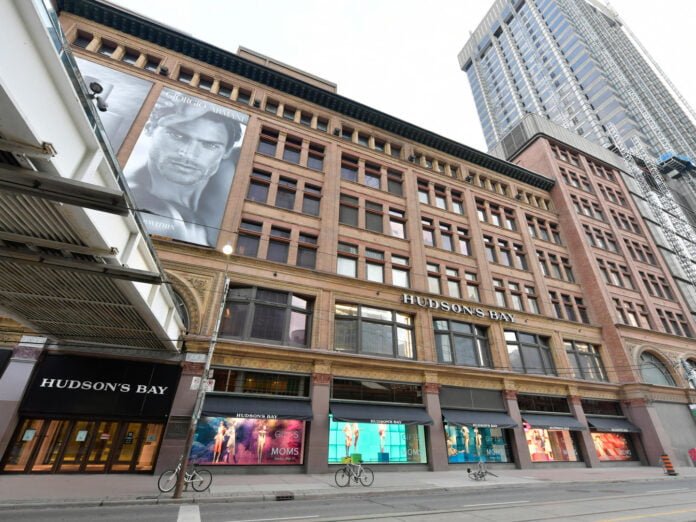
Hudson’s Bay finally shut its downtown Edmonton store late last week. The 168,000 square foot store opened in 2002 after Eaton’s went bankrupt and shut all stores. Hudson’s Bay has a long history in downtown Edmonton and we wrote a feature article last year when HBC made the announcement.
Inditex-owend fashion brand Massimo Dutti recently shut its store at CF Rideau Centre in Ottawa. The retail concept is a sister brand to Zara which has been shutting selected stores globally. Dutti still has stores in the Montreal, Toronto and Vancouver markets. A Yorkdale location in Toronto closed in 2019 to make way for a massive Nike flagship store that could open as soon as this summer in the mall.
Upscale Austrian hosiery brand Wolford exited Holt Renfrew Ogilvy in Montreal last month according to our Montreal correspondent Maxime Frechette. The boutique space was located on the third floor of the beautiful Holt Renfrew Ogilvy store which is a luxury showpiece for the Montreal market. Wolford still has stores in the Vancouver and Toronto markets, and the downtown Vancouver store is expected to close at some point to make way for a Cartier flagship store that will be moving into the adjacent space once occupied by Hermes which relocated nearby in 2019.
Casual fashion chain American Eagle recently shut its massive store on Ste-Catherine Street in downtown Montreal. It was the second-largest location globally for the brand. A rumour was recently circulating that Apple had leased the space to open a flagship store, and some are saying that a deal never concluded for that particular space. Apple currently has a store nearby at 1231 Ste-Catherine Street.
The Structube furniture store at 140 West Hastings Street shut forever last month. Peter Meiszner of Vancouver-based news publication UrbanYVR spoke to store staff who told him that the move was due in part to customers not feeling safe in the area, particularly as pickups happen in the alley behind the store. Other retailers and foodservice businesses have indicated similar opinions and have shut as well. Structube has a store in Vancouver located at 2401 Granville Street, a wealthier part of town lacking the social issues seen in the Downtown Eastside.
Danier Leather shut its store in Toronto’s PATH network at the TD Centre, and it’s unclear what the future is for some other locations. The store opened in the summer of 2017. An employee at the Vancouver area store at Tsawwassen Mills says the company is an ongoing concern.
Happenings Etc.
The second edition of the Lavazza Drive-In Film Festival will take place at Ontario Place in Toronto from June 27 to July 17. On July 1 (Canada Day), the showcase film will be Peace By Chocolate, the story of a Syrian Refugee entrepreneur in Nova Scotia who founded a successful chocolate business that is expanding with new stores. The film festival will open on Canada Multiculturalism day and will focus on diversity and expand its reach to engage a wider range of communities and minorities. Preditcmedix, an AI company based in Toronto that we reported on last year, will be deploying its Covid-screening Safe Entry Stations at the festival.
The US President recently signed legislation allowing cruise ships departing from Seattle for Alaska to bypass Canadian ports because of the pandemic. Cruise ships bring millions of dollars to Vancouver and Victoria retailers and it’s hoped that the ships return in 2022, otherwise retailers in places such as Vancouver’s Gastown may never recover. Cruise ships are said to have a $2.7 billion economic impact on the BC economy overall.
Adam Skelly, owner of Toronto-based Adamson Barbecue, is leading a constitutional challenge against the Ontario lockdowns. He has been against lockdowns noting the harm that they bring to business owners and others. The hearing will be heard in the Ontario Superior court of Justice on June 28 and 29. The final cross examination of the province’s expert will happen Monday (June 7) according to Skelly, who has legal counsel and has received funding from donations. We’ll update this as we learn more about the legal challenge.
Further to last week’s article on the importance of Chinese tourists and consumers to segments of retail in Canada when we come out of the pandemic, one thing to note is the potential of Saks Fifth Avenue to court shoppers away from Holt Renfrew. A recent article in WWD notes that Saks.com president Marc Metrick predicts explosive growth in luxury e-commerce and Holt Renfrew has shown an exceptional ability to attract Asian shoppers online as well in in stores. Saks and Saks.com have the opportunity to grow sales at the high end in Canada, and it will be interesting to watch if anything happens.
Screen shot from thebay.com
Hudson’s Bay’s website could also end up giving Holt Renfrew a run for its money. Designer items from The Room are presented prominently across the women’s side of the website. Anyone from abroad unfamiliar with Hudson’s Bay might mistake it for a luxury store given the brands available. The online assortment is impressive to say the least.
This and That
Design Delish by Bayview Village
Every day we’re inundated with emails from PR firms telling us what their clients are doing. Some of these are interesting and worthy of mentioning. Here are a few things that caught our eye recently.
The Nordstrom Anniversary Sale will take place from July 28 – August 8 and ‘Nordy Club Ambassadors’ can shop Early Access starting July 25. The Nordstrom Anniversary Sale is the retailer’s biggest, most popular sale of the year featuring brand-new arrivals and prices go back up on August 9. Nordstrom has six full-priced stores in Canada in the Toronto, Ottawa, Calgary and Vancouver markets.
Bayview Village in Toronto announced the launch of Design Delish, described as a virtual ‘food styling event’ in partnership with Toronto Life where participants learn how to make food look ‘Instagram worthy’. Two sessions on June 8 and 10 will feature demonstrations featuring the most popular menu items from a number of mall restaurants and will be hosted by food stylist, Eshun Mott, décor specialist, Christine Hanlon and professional food photographer, Dan Robb. The cost of the Zoom-based sessions is $50+ tax per event with the option for curbside pick-up or delivery.
Canadian biotech company HAVN Life announced the inaugural launch of their retail division with a line of natural health products. The seven new formulations include a range of high-quality mushroom and plant extracts that the company says support brain health and immune function. They’re available online through the company’s ecommerce site yourhavnlife.com and through Amazon as well as at select Nesters Market stores in British Columbia later this month.
Hublot, De Beers, Tory Burch, Prada on Robson Street in Vancouver - Photo by Lee Rivett
The Vancouver retail market outlook overall remains positive and one of the tightest markets in the country continues to hold up well during COVID due to limited supply and relatively lighter health and safety restrictions.
A report by commercial real estate firm JLL found that total availability of retail space fell from 3.7 per cent in 2017 to 2.8 per cent in 2020.
“As Vancouver stays competitive, tenants have become more bullish on the market, poised for expansion. At the same time, current tenants in enclosed malls have actively pursued streetfront exposure, trying to exit the mall. The amount of leased square footage in 2020 remained the same as 2019, demonstrating market resilience,” said the report.
“Despite deceleration in Q2, asking rents continued their upward trajectory with a five per cent increase in Q4 year-over-year. The growing availability of premium space on Robson, Granville, and West 4th is contributing to drive up average asking rents for the market. Effective rents have partially recovered after a Q2 correction, resulting in an aggregate drop of only two per cent in Q4. Restricted by lack of available sites, construction slowed even further to one of the lowest levels in the past five years. Perhaps the only sign that Vancouver isn’t unscathed by COVID is the percentage of available space, which advanced one per cent during 2020. The trend to move in (as opposed to moving out) remains predominant but not as strong as in 2019, contributing to loosen the market.”
Robson Street Sign – Photo by Lee Rivett
JLL said 2021 expectations for Vancouver are high as the market remains heated. In Q1 2021, the amount of leased space was more than 10 per cent higher than Q1 2020. Also, limited supply tightened the market and available space dropped. Vancouver’s retail sales remained flat in 2020 ‒ the best performance across major markets while 2020 daily average pedestrian traffic along downtown retail corridors was cut almost by half compared with 2019. Robson and Alberni Streets lacked tourists and the commercial district lacked office workers. Consequently, the number of lease signs on Robson and Granville has risen, explained the report.
Martin Moriarty, Senior Vice President, Investments & Leasing, for Marcus & Millichap, said Vancouver is such a strange market and many retail experts were kind of amazed at the activity over the past 18 months – and it shows little signs of slowing up.
“We are expecting an acceleration of deals in the next while here,” he said.
“I was pretty impressed actually overall. In the world context in the past 15-18 months, I was personally surprised with the resilience of the Vancouver marketplace – pleasantly surprised. When I look back, and it was a very strange time, we actually, like the rest of the world, had challenges. The overall story and theme is pretty challenging but I don’t think we can complain too much. There was pain here like everywhere else but when I think back we were able to complete quite a few deals across a number of industry lines.
Kiehl’s and Rocky Mountain Chocolate on Robson Street – Photo by Lee Rivett
“We were able to do flagship deals on Robson Street – Peloton, Footlocker, COS and others. Those are traditional retail deals. They’re challenging to do at the best of times. But doing them during COVID shows the confidence in the marketplace. On top of that, we added a significant number of international tenancies in terms of restaurant and dining.”
Moriarty said the retail industry was very fortunate in the fact it never had a hard lockdown during the pandemic.
“The market itself in the past two to three months has really been heating up. We’ve seen a surging demand in leasing activity and in people starting to believe that the world’s getting back to some form of normal,” he said, adding the biggest challenge right now is getting big flagship deals done without having boots on the ground. That will change as the leasing activity transitions from virtual meetings to in-person tours again.
Moriarty said the expected mass exodus of retail due to the pandemic never materialized in Vancouver or elsewhere. Certainly there were some business closures but not to the extent that some had predicted.
“It doesn’t feel like there’s a huge panic in Canada. There isn’t a huge excess of retail space here relative to populations and relative to overall landscape of real estate where some major US cities are over-retailed. Certainly in Vancouver we’re not. We are actually starting to look at booking up tours again with international groups to take a look. It’s probably been about 15 months that we’ve been able to do that.”
Teri Smith, Executive Director of the Robson Street Business Association, said the past year or so has certainly been tough for the about 150 businesses the association represents.
“The downtown has been disproportionately impacted of course by the pandemic with the loss of tourism, the loss of the commercial office sector – I think it’s running at about 10 to 25 per cent on any given day – and then of course the things that would normally drive people downtown like events and sporting events, arts and culture. All that was stopped,” said Smith.
Cactus Club and Mountain Warehouse on Robson Street – Photo by Lee Rivett
“Typically Robson Street has become more of a tourist destination and yes locals still come but it wasn’t necessarily the majority of who would be walking up and down the street. So it was hard and looking at what businesses were impacted more things like clothing retailers and restaurants definitely felt the impact quite heavily.
“It’s been hard. We’ve seen a drop in our pedestrian counts. Right at the beginning obviously significantly we were in the 85 per cent range. We’ve slowly worked our way back. So we’re about 60 per cent of what we would normally be. It’s been a positive thing in the sense we are seeing our locals support the area which has been good. We’ve seen a few closures not surprisingly but we’ve also seen new businesses open up too. There has been leasing activity. There’s a lot of interest in the downtown and on Robson as well. That’s been positive.”
Smith said there have been about 10-12 COVID closures and “we’re not out of the woods yet.” There are still some potential closures to come. But the number of closures is nowhere near what many had anticipated.
“There was a lot of doom and gloom out there, especially in the beginning. There’s always been this sort of underlining discussion about this retail apocalypse going on for a few years. It’s an evolution. Retail has been going through change always and I think COVID accelerated some of that just in terms of the online shopping and those kinds of trends and people becoming more comfortable on that platform when they didn’t have another option,” said Smith.
“It’s definitely moved online shopping a bit further ahead than it probably would have but there’s still a need for bricks and mortar. Even though we did see restaurants close Vancouver wide, city wide, they were also one of the businesses that saw the highest number of openings like new openings. I would say that things are not as bad as predicted but I would also say we were in a slightly better position than some other cities across Canada or even North America. We didn’t see as strict closures and shutdowns. Our government tried to keep our businesses open as much as possible and I think that helped as well.”
Special Edition 33: Melissa Austria and Craig discuss Retail in Toronto
Craig and Melissa discuss the history of Toronto-based Gotstyle and how the retail brand that she founded in 2005 has been able to weather the pandemic, in addition to thoughts and ideas about the future of high-end fashion retail in Canada.
The Weekly podcast by Retail Insider Canada is available on Apple Podcasts, Stitcher, TuneIn, Google Play, or through our dedicated RSS feed for Overcast and other podcast players.
Drop us a line at Craig@Retail-Insider.com. You can also rate us in Apple Podcasts or recommend us in Overcast to help more people discover the show!
Background Music Credit: Hard Boiled Kevin MacLeod (incompetech.com). Licensed under Creative Commons: By Attribution 3.0 License. http://creativecommons.org/licenses/by/3.0/
Upscale Vancouver-based multi-brand menswear retailer Boys’Co has informed Retail Insider that it will be shutting its operations this year. The retailer got its start in 1984 with a store location at Vancouver’s Oakridge Centre and was an extension of the Murray Goldman menswear brand that began in 1946.
Owner David Goldman says that he has negotiated Boys’Co’s departure with its landlords for the three Vancouver-area stores at Metropolis at Metrotown, Guildford Town Centre and Coquitlam Centre which will all close towards the end of the year. The company also has an e-commerce website with an assortment of brands. Goldman said that the company has spoken to each member of his team one-on-one to discuss the news and that 35-year veteran and General Manager Michael Roley was instrumental in helping coordinate the strategy to wind down the business. Suppliers have also been contacted to let them know that there would be no fall 2021 orders according to Goldman.
David Goldman conceptualized the Boys’Co brand and opened its first store on October 18, 1984 at Vancouver’s then recently renovated Oakridge Centre. The Boys’Co store was located next to Aritzia’s first standalone store which opened the same day. Boys’Co was an offshoot of luxury multi-brand menswear retailer Murray Goldman which David’s father opened in 1946 with a store on West Hastings Street. The family holdings company, which also includes real estate and other investments, is named Murray Goldman Ltd. to this day.
MURRAY GOLDMAN MENSWEAR WAS FOUNDED IN 1946. PHOTO: WWW.THEDIGITALPANDA.COM
In a statement, David Goldman said, “75 years – we had a hell of a run – as one of British Columbia’s longest continuously running retail operations – and we’ve always been thrilled to be steeped in a major part of BC retail history.”
Over the years, the company operated stores under various banners. The Murray Goldman Men’s Stores operated from 1946 to the 1990s and carried some top-of-the-line brands such as Lanvin, Givenchy, Brioni and various other French and Italian brands. Between 1970 and 1986 a denim concept called Bus Stop Jean Shops operated several storefronts. A discount concept called The Clothing Market operated in the 1970s and 1980s and a unisex concept called Magnet Stores operated in the 1980s. A preppy concept store called The Ivy Room operated from 1962 to 1970 and was revived at Metropolis at Metrotown in the 2010s for a time. A concept called Goldman and Son operated in the 1990s and early 2000s in Vancouver.
Under the Boys’Co banner specifically was Boys’Co Sport which operated at Vancouver’s Oakridge Centre in the 1990s and The Boys’Co General Store and Café which operated in Vancouver’s Yaletown area in the 1990s. The Boys’Co chain also once had stores on Robson Street in downtown Vancouver as well as at CF Richmond Centre in years past.
“We seemingly did it all – provided employment for many long-term and loyal folks, with whom we built lifelong relationships. And we made friends of both customers, and cherished fashion suppliers alike,” said Goldman in a statement. “We succeeded, in mostly good years and a few not-so-good, but always had fun doing so – while operating a three generation, locally owned, family business.”
Boys’Co at Guildford from Lower Level – Photo by Lee Rivett
Goldman expressed gratitude to the company’s employees for their service over the years in the family business. “To say thank you to the many people who helped us succeed will never be enough. We are so grateful for the hundreds of employees who graced our sales floors over the years, who managed our shops, greeted our customers, and who ‘made the sale’.” He went on to say, “We’ve been blessed working with many extraordinary men and women in all capacities, who stayed with us for 10, 20 and over 30 years. To this day! Grateful cannot begin to describe our appreciation!”
He also expressed gratitude to suppliers that have partnered with the retailer over the years. “To the number of folks whose offices, showrooms, and trade show booths we got to visit, engage with and who provided us with professional advice and the many fashion brands to pursue our trade and continually fill our shops, you will never be forgotten. You became our respectful (and respected) suppliers, you became our friends and our confidantes – and we couldn’t have done it without you. You are what made our career fun and fulfilling – and you reminded us daily of why our industry is a noble profession! We are overwhelmed with gratitude!”
Goldman said that he will miss the buying trips and socializing that became part of running a multi-brand menswear business. “Visiting the many cities in Canada, the US and Europe will always be one of the highlights of my career as we got to know the many people on our numerous visits in Toronto, Montreal, Los Angeles, Las Vegas, New York, London, Paris, Cologne, Berlin, Milan, and Florence, but the biggest highlight by far will be the years I got to spend with both my son Sam and my dad Murray as the three generations of us ran the show for those few years we were blessed to work together!”
DAVID GOLDMAN AT THE OPENING OF HIS NEW GUILDFORD TOWN CENTRE STORE. PHOTO: JUICEGROUP.CA
Image: Boys'Co Robson Street
1 of 5
Image: Former Boys'Co Robson Street
“We always believed in a time-honoured approach to people and relationships, adding in a dash of humour, irreverence, creativity – and respect! And while we always felt we made a fashion statement, our statement for today is – Thank You!”
At 71, David Goldman is still youthful in appearance and dress. His personality translated to Boys’Co marketing with cheeky ad phrases such as “it’s a Guy Thing”. In an interview in 2018, Goldman explained to Retail Insider how Boys’Co was showcasing well-established medium to upper end designers catering to young and ‘fashion-inspired’ men.
Boys’Co became known for carrying a range of designer brands for men, as well as its own private label line which included t-shirts with the Boys’Co logo. In the 1990s these shirts were popular with young men living in the Lower Mainland and even beyond. Designer brands featured on Boys’Co’s website today include Hugo Boss, Moschino, Stone Island, Versace Jeans Couture, Y-3 Yohji Yamamoto, Boy London, C.P. Company, Kappa, Lacoste and others.
We reported in April of 2014 that Boys’Co had renovated its then flagship store at 1044 Robson Street, which relocated to the Coquitlam Centre in the summer of 2018. Drake-owned brand OVO subsequently leased the Boys’Co’s Robson Street space. In October of 2014 Retail Insider attended the 30-year anniversary celebration of the Boys’Co brand that was held at the then Robson Street location. That year, Georgia Straight’s ‘Best of Vancouver 2014 Awards” named Boys’Co as “Vancouver’s Best Men’s Independent Store”.
David Goldman started his fashion career as a teenager in the 1960s. While in high school, he worked part-time at his father’s store, Murray Goldman Men’s Wear. After college, David moved to London UK, where he worked full time at a young men’s boutique on fashionable King’s Road. He then returned to Vancouver in 1971 to work alongside his father. David’s initial responsibilities included operating and buying for the company’s Bus Stop Stores. David’s son Sam Goldman became manager of operations of Boys’Co several years ago as the third generation to operate the business.
Boys'Co T-shirts
1 of 5
Boys'Co T-shirt
Boys'Co T-shirt
Boys'Co T-shirt
Boys'Co T-shirt
Boys'Co T-shirt
Boys’Co branded t-shirt from 1992. Photo: Christa Patterson
THE RETAILER’S CHEEKY SLOGAN: “IT’S A GUY THING”.
Even prior to the pandemic, the multi-brand menswear business in Canada was challenging amid increasing competition. In the Vancouver area, competition at the upper end has been particularly fierce with the entry of Nordstrom to the market and the expansion of Holt Renfrew, while the growth in e-commerce has also resulted in more shopping happening online. Brands opening their own stores has also been a challenge for multi-brand retailers in Canada as some brands increasingly adopt direct-to-consumer models.
Knix, a direct-to-consumer intimate apparel brand, recently completed a $50-million minority Growth Equity funding run, which will help accelerate the retailer’s expansion plans.
The funding round was led by private equity firm TZP Group, with participation from existing Knix investors including Acton Capital and alongside new investor, supermodel and entrepreneur Ashley Graham.
Joanna Griffiths, Founder and CEO, who closed the round just three days before giving birth to twins, remains the largest shareholder of the company while TZP Group will take a minority stake in the business.
PHOTO: KNIX
She said the round of financing will support Knix’s continued product innovation, brand building, and virtual fit program as well as expanding its retail store fleet in North America.
“We’re in heavy growth mode at the moment,” said Griffiths. “We’ve been experiencing tremendous growth over the past few years and are just getting started.
“We’ve been very capital efficient as a brand and especially when you look at us versus some of our US counterparts in the direct to consumer space. We’ve always been very, very intentional about our growth and what this round means for us is really leaning into the great momentum that we’ve been experiencing. It means that we are able to really serve our customers better which is what it’s all about. Create more products for them. Do larger brand campaigns and more storytelling and then scale up our ability to serve customers both (virtually) as well as through our retail store footprint.
“It’s really about doing more and more and more and leaning into the growth and the momentum that we’ve been experiencing so we can better serve our community.”
Griffiths said the company sees itself getting to about 20 retail stores over the next 18 to 24 months – half in Canada and half in the US.
“We’re really following where our customers are so you can sort of expect to see us growing as stores across the major Canadian cities over the next 24 months with our next Canadian store slated for Ottawa. That will open in the fall,” she said.
Toronto-based Knix was launched in 2013. The intimate apparel brand’s mission is to reinvent what the intimate category means both from a product standpoint, being hyper-focused on innovation and design of what suits consumers today in every stage of life and activity, and redefining the role a brand can play in the community by covering taboos and community storytelling to empower customers to be “unapoletically free.”
“Tactically speaking we’re a direct to consumer brand and a vertically integrated brand. Most of our sales come from online exclusively through our own website and in 2019 we began to open Knix retail stores. We have two stores at the moment. One is in Toronto and one is in Vancouver and in the process of opening more stores,” said Griffiths.
“We also have a little sister brand called KT. That is specifically a brand that is designed for teens and Gen Z that is centered around our first product that we ever launched at Knix which is leak proof underwear.”
Griffiths said the funding round marks Knix’s first significant financing round. With over one million customers and with an average five-year annual growth rate of 150 per cent, Knix is now surpassing $100 million in revenue over the last 12 months.
Knix was founded as a wholesale brand and switched to direct-to-consumer in 2016.
“Making the decision to pull out of over 700 retail doors and shift our focus to become a DTC brand was a turning point for Knix that led to just shy of 4,000 per cent three-year growth,” said Griffiths.
“We made that choice by listening to our customers and understanding how they wanted to shop and interact with us as a brand. That same focus of listening has driven every major decision we have made as a company and ultimately the success we experienced in 2020. We’ve always focused on innovative products that make our customers feel comfortable in their skin and they want more – more products, more retail stores and more breakthrough brand campaigns that challenge the status quo. To better serve our community we decided it was the right time to take on outside capital and accelerate our growth.”
Knix sells about two million pairs of leak proof underwear each year. The brand has leveraged its patented technology to expand its leak proof offering into swimwear, sleepwear, nursing bras and other products.
“We believe Knix is an authentic and innovative brand that is disrupting the women’s intimate apparel landscape. As pioneers in inclusivity and body positivity, with an expanding portfolio of high-quality products, the brand has amassed a large and growing community of engaged and loyal consumers. As a digitally-first brand, Knix is well positioned to seize the opportunity for continued growth, and we are thrilled to be partnering with Joanna and the team,” said Erin Edwards, Partner at TZP Group.
TZP Group is a multi-strategy private equity firm managing approximately $2 billion across its family of funds including TZP Capital Partners, TZP Small Cap Partners, TZP Strategies, and TZP Strategies Acquisition Corp.
In its recent budget, the Newfoundland and Labrador government announced that it will introduce a new tax of 20 cents per litre on sugary drinks, starting April 1 2022. This would likely be a first in Canada. So far we know very little about how the tax would work, which products would be affected, and how revenues from the tax would be used by the government. However, when a government commits to taxing a food product, any product for that matter, it always needs to proceed with extreme caution.
Many countries have already taxed sugary beverages with some degree of success. Mexico has become a well-documented soda tax case in recent years since it has one of the greatest per capita consumption of soft drinks globally and high rates of obesity and diabetes. A recent report from Sánchez-Romero looked at the market three years after the tax was implemented. They noticed that the probability of becoming a medium or high consumer of soft drinks in Mexico had decreased because of the tax. Additionally during that same period, the probability of becoming a low consumer or non-consumer had also increased. Encouraging results.
The study which did receive a lot of media attention enticed many public health experts to support the concept of a sugar tax simply based on a belief that it will discourage consumption. The reality is a little more complicated than that.
We have seen cases where demand for soft drinks has gone up, even with a sugar tax. A recent study by Kurz and König on how both France and Hungary is coping with their soda tax was quite telling. For France, they found a minor decrease in sugar-sweetened beverages sales after a tax implementation while overall soft drink sales increased. For Hungary, there was only a short-term decrease in sugar-sweetened beverages sales which disappeared after 2 years, leading to an overall increase in sugar-sweetened beverages sales.
Many studies looking at the impact of a sin tax on sugar-sweetened beverages will often look at soft drinks in isolation. Studies have suggested that, once a sin tax is implemented in a country, consumers are tempted to buy other non-taxed food products to get their sugar fix. Sale diversions at retail are rarely considered. According to the Lancet, since the sugar tax was implemented in Mexico the obesity rate in the country has gone up not down. And Mexico is still the country with the highest carbonated soft drink consumption per capita in the world, more than seven years after the sugar tax was implemented in 2014.
What some studies have also noted is that price elasticity for soft drinks barely matters. Prices will fluctuate all year round due to weather, promotions, and category management practices. A tax will not necessarily make these products more expensive to buy at retail. In fact, given how margins are so high for this category, in countries where a soda tax was implemented price is a non-decision-making factor for most consumers. The sugar tax is simply just absorbed by the supply chain.
We should dread the moralistic state which for years has opted to use a sin tax to punish consumption. We have seen it with alcohol, cannabis, and cigarettes. We have come to accept that these products should be taxed for one reason or another. But these products are not food. Hard to see how this can end well for both consumers and taxpayers. If sugar can be taxed, a revenue-hungry government could eventually opt to tax sodium or even fat. Some of the most natural food products have high sugar, sodium, and fat content. Some dairy products, meats, even natural juices, for example, could be part of some government’s hit-list someday.
Another dark side of sin taxes is how funds are spent in government. Funds generated from sin taxes are often ill-directed and will support the government’s problem of the day. Funds often end up in some bureaucratic black box and are often used for other means than what was originally planned. Many countries have promised to use revenues coming from sin taxes to spend on preventive medicine programs, awareness campaigns, or even in health care generally. It either rarely happens or the accountability is just not there.
Most public health experts will desperately want to believe in the effectiveness of a sin tax on food, but the evidence is still quite weak at best. Most studies which suggest a decrease in consumption of taxed products have flawed samples, and a scope of analysis which would exclude the influence of untaxed sugared alternatives.
In the end, education may be the most powerful tool we have. Soft drink consumption per capita in Canada has in fact decreased in recent years, without a sugar tax. An increasing number of Canadians have moved away from sugar-sweetened drinks due to effective awareness campaigning. Empowering consumers with more information can only lead to altered behaviours and choices.
If Newfoundland and Labrador wants a sugar tax, it’s certainly not to get its people to lead healthier lifestyles. Based on what has happened elsewhere, the government should be honest and simply state that this is very much about paying its bills.