

By Craig Patterson
A man gasping for air while coughing falls to the ground on a street in downtown Toronto on Monday afternoon. An ambulance soon arrives and carries him away in a bag on a stretcher. Paramedics wear protective gear and suspect that the individual, of no fixed address, has contracted the coronavirus. Similar situations are expected to play out in greater frequency across Canada as the COVID-19 pandemic takes hold and confirmed infection cases escalate.
Non-essential retailers in Toronto were ordered by the government to close last week, while some restaurants remain open for takeout service. Many who typically work in office buildings downtown remain at home. Despite the lack of business downtown, some streets in the core are still surprisingly busy during the day and in this case, that’s not good news.
The Ontario government announced Saturday evening that groups of people gathering are limited to five. Earlier the same day, a group of youth were seen playing soccer at the University of Toronto, a rap music video was being filmed on Yorkville Avenue in front of the Versace store, and a group of teenagers were skateboarding in front of a building on George Street with no regard for the suggested two metres/six foot ‘social distancing’.
Despite mandates and suggestions around ‘social distancing’ in Canadian cities, many people are still gathering and going on as they might normally. As well, recent walks through downtown Toronto showed a large percentage of those who were walking around and gathering in groups included the homeless, drug users, and the mentally ill, resulting in a much different vibe in the core than just a few weeks ago.

The city’s homeless population, many who have been pushed to the streets as social services have either shut down or have been significantly limited, are at greater risk of being infected. Over the past several days, about a third of those we saw walking down the Yonge Street strip as well as along Queen Street between Yonge Street and University Avenue appeared to have housing, mental health or drug related issues. The stretch of Queen Street extending from University Avenue to Spadina Avenue wasn’t much better. If upscale condo dwellers were tempted to go downstairs for a walk, they might be surprised with what they might see in some parts of the core right now.
The result of those struggling and congregating on the streets could be an explosive infection of COVID-19. Some individuals may have compromised immune systems and may live in closed quarters, not to mention may touch various things without the opportunity for hand washing, for example. Something needs to be done to support vulnerable populations — Retail Insider is not singling out groups to blame, rather we are identifying an issue which must be addressed (with compassion) for the betterment of society.
If COVID-19 infection numbers rise dramatically, it’s unknown how long retailers in Canada will have to remain closed while people are confined to their homes amid a push for ‘self-isolation’. Perhaps a brief full shutdown of the economy last month could have helped prevent the situation, and it might be too late to stop the spread of the virus in the short-term.


Ultimately the spread of COVID-19 in Canada’s largest city, as well as other parts of Canada, could cripple the economy and have a profound effect on the retail industry. Consumers could pull back spending significantly for an extended period while choosing to remain semi-isolated to avoid either a second wave or a similar pandemic or even a future one that could be man-made. As a result of business closures and social distancing, many small and large retail chains could go bankrupt as a result.
Most restaurants in Canada could also end up closing permanently if the situation persists. As a result of mass closures, real estate landlords could suffer significant losses in value which would directly impact pension fund owners. Landlords have been hesitant to give rent breaks to tenants — a situation that has been reported extensively in Retail Insider over the past two weeks. Some landlords have offered to defer rent which would be owed at a later date. Many retailers who have contacted us explained how this was insufficient, and that it was unlikely that they will have the resources to in effect pay full rent for their stores which in many cases have been mandated to close as per legislation.

Some retailers who have contacted us were furious with landlords and asked not to be named in any articles. Several retailers suggested that while retailers were losing money from lost sales while at the same time paying staff temporarily, landlords stood to lose very little from such arrangements. If retailers and restaurants are not able to get back on their feet, mass business closures could result that would change the landscape of our communities forever. Some “B” and “C” malls, for example, could be redeveloped into other uses as retail space is deemed excessive. Some city streets could see many boarded up storefronts which could lead to an increase in vandalism and other social issues.
Before COVID-19, the Canadian retail industry was already struggling. The pandemic has in effect kicked the industry while it was already down. How the industry emerges remains to be seen, with some experts predicting that a colossal change in consumer behaviour will result in the world never being the same again.
The Canadian retail and restaurant industries represent a substantial percentage of the Canadian economy. If they collapse, so will Canada’s economy. At the same time, oil prices have dropped to the point that it costs more to transport the oil than the value of the product itself. The stock market has also plunged, eliminating vast sums of wealth from many households. Job losses, lost wealth and the loss of life from the virus will impact Canadians greatly. And as wealth declines, one may expect an increase in crime and homelessness which again will have an impact on our society.

Perhaps it’s time for the federal government to implement harsher measures in the short-term before it’s too late. Short term pain for long-term gain, as they say. Provincial and municipal governments that have implemented stringent rules are said to be helping contain the spread of COVID-19, though factors at play such as civil disobedience and the challenged homeless population could result in a continued spread.
One can only hope that the COVID-19 pandemic is contained in Canada so that retailers and restaurants, those that will survive this, will be able to open once again. The livelihoods of many depend on this, and the entire situation should be taken very seriously.
The following are photos from walks on the streets in downtown Toronto over the past four days, including a narration of what we saw. All photos are by Craig Patterson.

Above: A lineup at a liquor store on Yonge Street. Many were standing in close proximity.

Above: The Oliver Jewellery store on Yonge Street has been deemed an ‘essential service’ and thus remains open.

Above: The corner of Yonge Street and College/Carlton Street has become a challenging area as some with mental health and drug issues have gathered in the area recently. There is a concern that COVID-19 could spread rapidly amid close human contact.

Above: The boarded up facade of the Lids store on Yonge Street. There are fewer boarded up retail storefronts in Toronto when compared to Vancouver at the moment.

Above and below: The typical shit-show at Yonge and Dundas Streets (the busiest pedestrian intersection in North America outside of Manhattan) has died down, though some characters remained on the weekend. That included an unusual looking street preacher denouncing abortion and homosexuality while claiming that COVID-19 is part of “god’s wrath”. Another man tried to hand us (and others) paper flyers. He was not wearing gloves or a face mask.


Above: CF Toronto Eaton Centre has installed barricades at its entrances to stop vehicles from driving through. The threat of thefts looms large in the city as organized criminals seek to maintain livelihoods amid fewer opportunities.

Above: A message on a billboard that more in the city should consider.

Above: The Gucci store on Yonge Street, located within the Nordstrom store, has been emptied of product that is usually contained within.

Above: Another entrance to CF Toronto Eaton Centre with barricades to prevent drive-through thefts.

Above: Saks Fifth Avenue and Hudson’s Bay at CF Toronto Eaton Centre (Yonge and Queen Streets) have shuttered indefinitely. A peek through the doors shows that both stores appear to have merchandise still on display.

Above: Open drug use on Queen Street West near Toronto City Hall. Fewer ‘eyes on the street’, coupled with a lack of visible law enforcement, has created a problem downtown.

Above: A lineup to get into the Hunny Pot cannabis store at 202 Queen Street West. The store was the first cannabis retailer to open in Ontario last year.

Above: Shuttered stores on Queen Street West. The area would normally be very busy during the day.
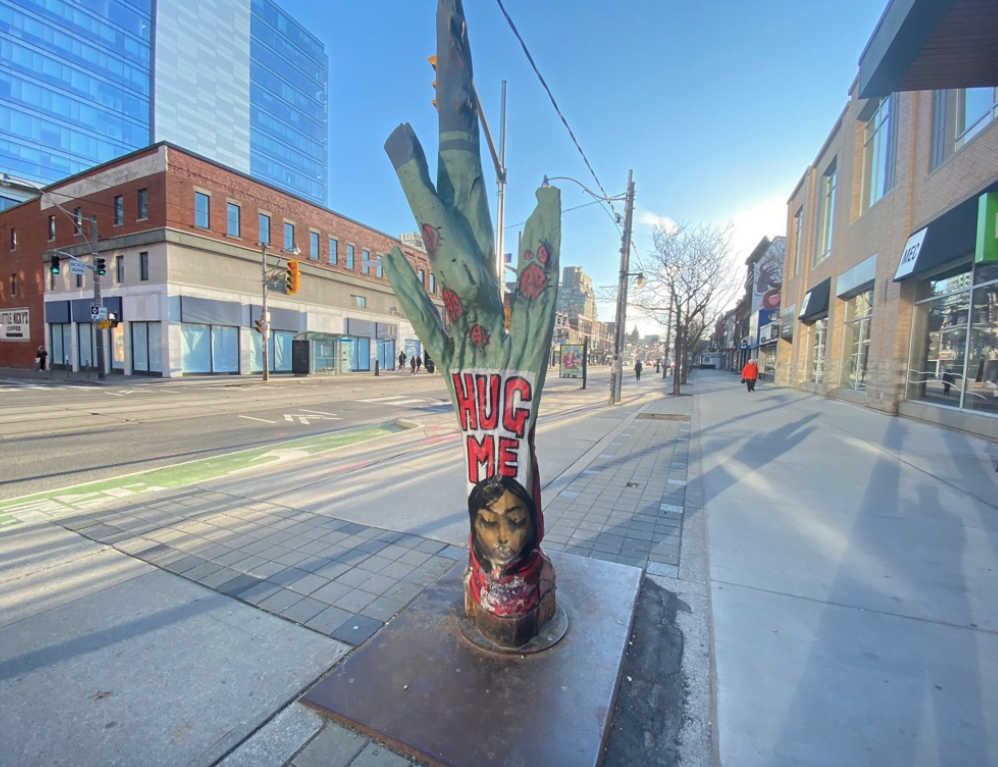
Above: Maybe hugging isn’t a good idea right now — art in front of the MEC store on Queen Street West.

Above: An exciting new retailer that some day will be able to open on Queen Street West near Spadina.

Above: The abandoned Chinatown Centre mall on Spadina Avenue with ‘caution’ tape over the doors. Chinatown was relatively quiet except for a few food markets and variety stores.

Above: A grocery market and variety store were open on Spadina Avenue in Chinatown. Otherwise, much of the neighbourhood was shut down and sidewalks were almost empty.

Above: Dragon City Mall on Spadina Avenue in Chinatown. The centre appears to have been shuttered temporarily.

Above: A busy food market on Spadina Avenue in Chinatown remains open. Grocer retail in Ontario has been deemed as essential.

Above and below: Normally busy Kensington Market was almost deserted. Some retailers remained open over the weekend, including food retail as well as a music store.


Above: We saw several buildings on and near Spadina Avenue/Collage Street with ‘Rent Freeze Now!” spray painted on the facades.

Above: The McDonald’s at 202 Bloor Street West discourages sitting in the front patio area with ‘caution’ tape.

Above: The Louis Vuitton store at 150 Bloor Street West has boarded up a side entrance. Product from within the store has been removed.

Above: Dior and Coach have boarded up the facades of their stores at 131 Bloor Street West. The adjacent Mulberry store has emptied out all merchandise, as has Prada and other retailers in the same luxury complex.

Above: The Harry Rosen flagship store at 82 Bloor Street West has made it impossible to see inside while the store is closed.

Above: Some streets are so quiet that one can get a great photo. This one was taken from Bloor Street West looking down Bay Street southward. Eataly and the Independent Loblaw City Market grocer store are among the few retailers that remain open in the immediate area.

Above: Looking towards the under-renovation Holt Renfrew flagship (under magenta tarp) at 50 Bloor Street West. At the right of the photo is the Manulife Place complex housing Maison Birks, Eataly, and other retailers.
Ultimately, it is in everyone’s best interest that the COVID-19 pandemic be contained in Canada. Lives, as well as the overall economy, depend on it. Thank you for reading, please be safe.








I’ve never heard you talk bad about Vancouver the way you just did about Yonge+Dundas square. A "shit-show"? i think not. If you have nothing good to say about certain areas in Toronto then don’t say anything about those places at all.
I’ll express my opinions where I like. I’m more than happy to classify Vancouver’s Downtown Eastside in a similar manner — and parts of Granville Street has its moments as we all know. I’m very pro-Toronto otherwise and I enjoy living here, though Yonge/Dundas is indeed a gong-show at times (maybe that’s a better terms for me to have used than ‘shit-show’).
If you are one of the "characters" who hangs out around Dundas Square and hands out pamphlets or preaches via a megaphone, then I apologize for hurting your feelings.