

Rising food costs are squeezing Canadians around the country. Nearly everyone is feeling the pinch, and it’s not just an inconvenience — high food prices are a major threat to food security for many Canadians. Understanding why food prices are so high and why they are changing is critical to the well-being of our society.
Unfortunately, consensus on why food price are so high is in short supply. Explanations given in reports like Canada’s Food Price Report and the news media range widely, from the war in Ukraine to supply chain issues to the carbon tax.
Each year it seems the key drivers change, and if the growing consumer boycott of Loblaw’s is any indication, consumers want better answers.
So, we completed a rigorous analysis of the most prominent reports that shape the narratives around food prices in Canada, including twelve years of Canada’s Food Price Reports and 39 reports from Statistics Canada. Our findings, which are peer reviewed and soon to be published in Canadian Food Studies, were both insightful and concerning.
Lacking scientific rigour
Our analysis found that most claims about food prices in these reports lack scientific rigour. Nearly two-thirds of the explanations for price changes given are not backed by evidence. Arguments about the causes of food inflation are frequently incomplete, neglecting to connect the dots between cause and effect.
For instance, reports may identify the influence of unfavourable weather, climate change or changing retail demand, but fail to elaborate how these translate into actual price increases at the till.

British philosopher Stephen E. Toulmin published a simple approach for evaluating the quality of scientific arguments in 1958. In a nutshell, for a scientific argument to be complete, it needs to have three components: a claim, verifiable observations or data that provide grounds for that claim, and an explicit theory or assumption that links the data logically to the claim.
For scientific arguments to be rigorous, they should also back up the strength of their assumptions and qualify their claims by exploring reasonable counterarguments. However, most of the arguments in these reports fall short of this, failing even to provide basic evidence in support of their claims.
These reports are not scientific publications, but rather qualify as “grey literature” — information produced outside traditional academic publishing channels.
Nevertheless, they are published under the logos of academic institutions and government agencies. Given their prominence in Canadian media and policy, we believe it is important for the public to know that the arguments presented in these reports do not live up to scientific standards.
Overlooking key issues
While the reports do identify potential drivers of food prices, they have some noteworthy gaps.
While extreme weather events and climate change are sometimes offered as abstract reasons for food price increases, some major environmental issues, like biodiversity loss and collapsing fish stocks, do not appear in reports, despite a widespread understanding that they will impact food price and availability.
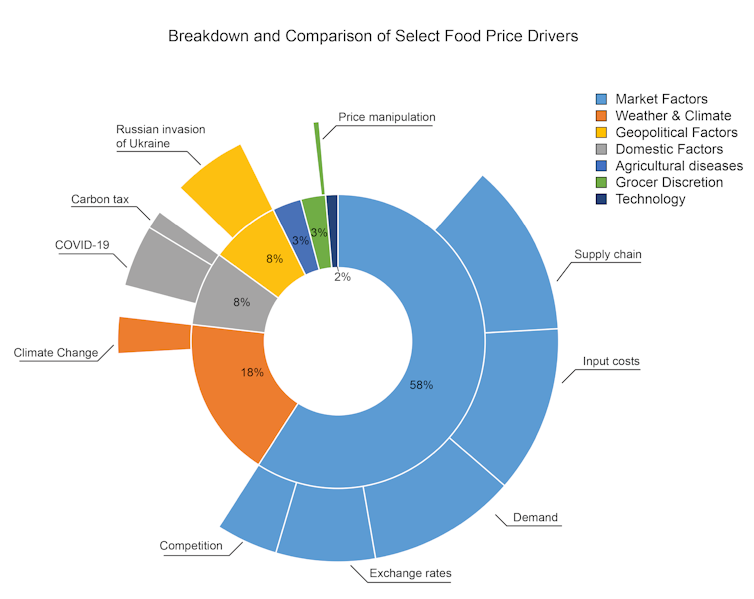
These reports also rarely consider the decisions that grocers and other private sector entities have on food prices. Increased consolidation and concentration in the grocery sector is a structural issue that deserves scrutiny.
The bread price-fixing scandal a few years ago showed how a lack of competition enables price manipulation and hurts consumers. Canada’s Competition Bureau recently announced they are launching an investigation into the owners of Loblaws and Sobeys for alleged anti-competitive conduct.
In the United States, there is also strong evidence that the private sector has been profiteering on supply chain issues and inflation. The U.S. Federal Trade Commission likewise recently found that big grocers used the pandemic as a smokescreen to pad their profits at the public’s expense.
With grocer profits expanding in Canada, too, it is fair to ask tough questions about how much grocers’ decisions are contributing to the pain at the till.
In our analysis, only three per cent of the over 200 explanations for food price changes point to grocer actions or other agency in the private sector as driving price increases. This reflects a tendency to portray food prices as erratic and overwhelmingly opaque.
Other issues — such as the over-reliance on fossil fuels across the supply chain — also go unmentioned.
A new approach is needed
Without rigorous and transparent analysis, we’re left with an incomplete picture of why food is so expensive and what we can do about it.
What we need is a new approach. Food is a human right, but a unique one in that we rely on the private sector to provision it. We should expect a higher standard than with other consumer goods, and the private sector has arguably not earned the benefit of the doubt given their history of price fixing.
One positive step towards generating trustworthy evidence about food prices would be to incorporate transparency measures into the code of conduct the Canadian government is developing with grocers. This could include third-party audits, open data-sharing and a clear breakdown of what’s driving price changes — from the farm to the shelf.
Peer review of research is a critical aspect of responsible science. In our paper, we highlight the process that the Canadian Science Advisory Secretariat provides for federal fisheries science, as one possible model for government-based food price reports.
For something as essential as food, Canadians deserve the full story. For decades, policy and markets have been designed to keep food cheap, but at the expense of workers and the environment.
If food prices are rising because they are starting to reflect the true social and ecological costs of production, we will need to enter a broader conversation about economic and livelihood reform to ensure that everyone can afford food. But without a clear picture of the actual drivers, we lack the necessary information for developing policies that protect the rights and well-being of Canadians.
This article is republished from The Conversation under a Creative Commons license. Read the original article.
Dr. Brian Pentz, now post-doctoral researcher at The Nature Conservancy, was lead author on the study and contributed to the writing of this article.
By Philip A Loring, Adjunct Associate Professor, University of Guelph and Ryan M. Katz-Rosene, Associate Professor, School of Political Studies, L’Université d’Ottawa/University of Ottawa.








Of course, the point has to be made that profit padding may not have been as critical as other supply-sde factors but they are painful. Because sales react less than proportionately to price change, grocers were able to ride the wave at the expense of consumers.
No Frills is a joke. Same high rip off pricing as Superstore. They should be charged with outright fraud and lying.
This article is all over the place. On the one hand they are saying the prices are high because retailers are fleecing the consumer, but on the other hand they are saying prices could be high because they are starting to reflect the true social and ecological costs of production and if so then thats ok.
Blame is being placed on the exclusively on the retailers for some reason (e.g Loblaws boycott), but most people must be smart enough to realize that some of those prices directly reflect the higher wholesale costs charged by the manufacturers. The manufacturers are the ones responsible for shrinking the packaging after all. Not to mention, higher supply-chain costs due to fuel, etc.
There should be a review of the impact of a system where large food suppliers’ business models are structured around shareholder investment and ROI for the shareholders. All Canadians should be able to afford basic food – the impact on reducing health care costs given better nutrition will be extremely positive.
I’ve been in the food industry as an importer and experienced the global issues of manufacturing costs…there is a factor of retailers not giving on their profit margins. Often it is the supplier that gives way to make sure a product is still accessible to the consumer from a price perspective. This article appears to be carefully written reviewing diverse factors and coming to the conclusion that there is another one not well openly discussed!