

The Ontario government has announced it’s expediting its plan to get beer into thousands of convenience stores.
The announcement received immediate backlash, primarily against the $225 million given to the Beer Store to subsidize its adjustment to a new competitive environment and avoid sudden closures of store locations.
Further criticism of the “boozedoggle” focused on the potential losses to provincial revenue and the other subsidies to corporations.
The decentralization of liquor sales, however, is nothing new in Ontario. It’s a process that has been ongoing over the past few decades and part of a strategy to erode good jobs in the alcohol retail sector. It can be viewed as union-busting by stealth and the public has played its part along the way.
Casualization of work
Once considered to be good jobs, workers at the Beer Store and Liquor Control Board of Ontario (LCBO) retail outlets have been pressured for years. Employers have forced tiered agreements with unions, where part-time and casual workers earn much less than full-time workers.
The United Food and Commercial Workers (UFCW) union representing more than 6,000 beer store workers and the Ontario Public Service Employees Union (OPSEU) representing 8,000 LCBO workers both have agreements that have full-time workers earning almost double part-time and seasonal workers. Today, unionized full-time Beer Store workers earn more than $30 per hour while a part-time workers with four years’ experience earn approximately $17 per hour.
Retailers have turned to part-time workers to reduce their labour costs and meet public demand to keep stores open during evenings and weekends. This process is known as the casualization of work.
In the most recent census, full-time workers — including management — in Ontario’s beer, wine and liquor stores made up less than half of the 16,645 workers employed in the sector, but had an average annual income two to three times higher than part-time workers. In the current round of bargaining, OPSEU is demanding protection for permanent jobs in the face of “marketplace change.”
Geographic shift of retail distribution
Beyond the casualization of work, the geographic shift of retail distribution is also threatening wages in the sector.
LCBO convenience outlets, also known as liquor agency stores, are small, non-union, owner-operated businesses attached to corner stores and gas stations. A few agents were established in the 1960s to get alcohol to rural areas, but the program rapidly expanded in the 2000s. Over the last decade, the number of agency stores has doubled to almost 400 locations across the province.
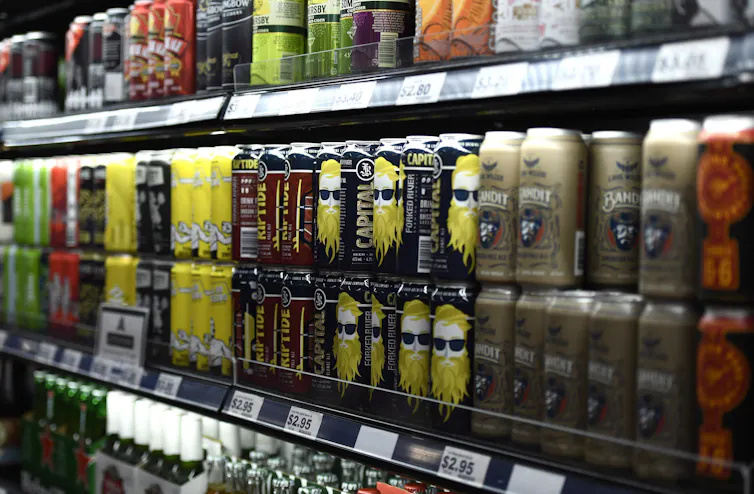
More recently, Ontario grocery stores have been allowed to sell beer and wine. In August, more than 450 grocery stores will add ready-to-drink alcohol products to shelves. During the pandemic, grocery and convenience outlet sales exploded.
According to recent annual reports, Ontarians purchase 10 to 15 per cent of their beer, wine and spirits from these agency outlets and grocery stores. The potential addition of more than 8,500 corner stores selling booze is the next big step in decentralizing liquor distribution away from unionized retail locations.
The potential loss of government revenue via decentralized distribution may be overstated. After all, wholesale distribution will still be controlled by the Beer Store and the LCBO, and the government is not going to stop taxing.
Real losses will be in the pocketbooks of beer and liquor workers as work shifts to small, lower wage, non-unionized workplaces. Unions are unlikely to organize chains or small, independent family-run operations, which will lead to further downward pressure on wages across the sector.
Convenience stores rely upon low-wage work and have lobbied the Ontario government to allow them to sell alcohol in order to meet the increases to the minimum wage rate.
The populist appeal
Other powerful forces driving the geographical expansion distribution are populist calls for booze in rural areas and politicians like Ford, whose “Buck-A-Beer” campaign slogan pledged to lower the minimum price of beer to $1 from $1.25.
As historian Craig Heron has noted in his book Booze, Ontario has a long history of prohibition, temperance and disciplining workers through controlling access to alcohol.
It’s not surprising that loosening government restrictions on what, where and when people drink has a populist appeal, and populist politicians like Ford know it very well. Beer has long been used as a political tool in Canada.

It is here where labour unions are trapped. Unions have argued there are economic, social and environmental benefits to having a more centralized system: larger operations are more efficient and can pay higher wages and efficiency, access to alcohol for young people can be more easily restricted, and the recycling and reuse of bottles and cans is facilitated.
As unions draw attention to these advantages to protect union jobs, they risk falling into the trap of echoing the moral panics around out-of-control access or stand accused of limiting rural communities’ access to alcohol.
What can unions do?
Unions do have strategic options. They will continue push back against increased decentralization and casualization, but with the addition of thousands of low-wage alcohol outlets, this is perhaps a lost battle.
Unions may choose a fortress strategy and protect remaining jobs and wages in distribution centres and remaining stores. A more aggressive strategy will be for unions to focus less on workplaces and organize workers in the sector as an occupation or trade.
In order to first reach these workers, unions could demand a role in the certification and training of all new workers who sell alcohol to the public. From here workers could be mobilized to demand minimum standards for all licensed workers.
If good jobs are to remain in the sector, unions will have to be creative and extend their power beyond their stronghold in the retail system to ensure present and future workers in the alcohol sales sector receive fair treatment and compensation.
By Steven Tufts, Associate Professor, Faculty of Environmental and Urban Change, York University, Canada
*
*
This article is republished from The Conversation under a Creative Commons license. Read the original article.








$30 a hour ! wow…. I have 6 options to purchase Cannabis on my street. 1 for wine.
It’s truly a disgrace that defending workers rights to earn a decent wage in this province is continually under attack. Minimum wage just simply isn’t cutting it for people to live, especially in places like Toronto.
Half of our retail sectors are suffering massive wage suppression, leaving thousands of Canadians with tenured experience out of the job for lower wages.
A robust and healthy economy usually is a byproduct of workers who have the confidence and money to spend on things. Constantly looking for the lowest paid wage in all these jobs is only lining shareholders pocket books.
Progress baby. Talk to taxi drivers. No one defended them. The inevitable pain of innovation.