The Hudson’s Bay Company is expected to decide on a buyer—or group of buyers—for its assets and leases by early to mid-June, marking a significant milestone in one of the most high-profile retail restructurings in Canadian history. The announcement was made during a court appearance on Tuesday by Ashley Taylor of Stikeman Elliott LLP, legal counsel for the department store chain.
Taylor confirmed that Hudson’s Bay will return to court within two to three weeks to seek approval of one or more transactions related to its intellectual property, retail leases, and other business assets. The timeline sets the stage for a potential transformation or partial resurrection of Canada’s oldest retailer, which filed for protection under the Companies’ Creditors Arrangement Act (CCAA) on March 7, 2025.
According to court documents, Hudson’s Bay has received 17 formal bids for various components of its operations. These include offers for its well-known intellectual property—such as the Hudson’s Bay name, its signature multicoloured stripes, and private label brands like GlucksteinHome and Hudson North—as well as its customer databases and historic artifacts.
In a parallel bidding process, 12 parties have submitted offers for 39 of the company’s 96 store leases, which span the Hudson’s Bay, Saks OFF 5TH, and Saks Fifth Avenue banners in Canada. Many of the lease bids overlap, suggesting competition for prime retail locations. Several bidders also submitted joint offers for both assets and leases, hinting at interest in restarting retail operations using select components of the company.
Ontario Court Approves Extension to July 31 Amid Restructuring Efforts
Ontario Superior Court Justice Peter Osborne has granted Hudson’s Bay an extension of court protection under the CCAA until July 31, 2025. The previous deadline had been set for May 15. The extension will provide additional time to complete liquidation sales, select buyers, and finalize asset transfers.
“We are asking for an extension so we can have some breathing room to see what can be done,” Taylor told the court, emphasizing the need to complete the complex sale process and asset monetization.
The extension comes at a time when Hudson’s Bay is nearing the end of its liquidation process, with most stores expected to be vacated by the end of June. Liquidation sales began in late March at 74 Hudson’s Bay stores, two Saks Fifth Avenue stores, and 13 Saks OFF 5TH locations. By April 25, the company added six final Bay stores and a Saks to the liquidation list after a last-ditch effort to revive a scaled-down version of the chain fell through.

Liquidation Sales Generate Higher-Than-Expected Cashflow
Court filings show that the company’s liquidation strategy has yielded significantly more cash than anticipated. According to an affidavit sworn by Hudson’s Bay Chief Financial Officer Jennifer Bewley on May 7, sales from April 19 to May 2 totaled $129.5 million—approximately 40% higher than earlier forecasts. As of May 2, the company held $194 million in cash, or $70.3 million more than it had projected.
Hudson’s Bay is now preparing to use this surplus cash to begin paying off portions of its senior debt. Justice Osborne approved a motion that allows the company to repay up to $165 million under two credit facilities.
Initial payments include $25 million to retire a revolving credit facility managed by Bank of America and $40 to $46 million to Restore Capital LLC, a lender involved in recent emergency financing. The motion also permits further repayments as cashflow allows.
Pushback from Landlord Stakeholders Over Debt Repayments
The motion to repay senior debt was not without controversy. Lawyers representing key landlords, including RioCan REIT, opposed the move. Joseph Pasquariello of Goodmans LLP, counsel for RioCan, argued that repaying lenders before determining the future of the leases and assets could be premature.
“There has not been one sale, one transfer of a lease put before this court for an approval,” said Pasquariello, calling the debt repayment process “very hurried.” He also raised concerns about transparency around how much debt remains with the Canadian entity after a separate $2.65 billion U.S. transaction involving the acquisition of Neiman Marcus by Hudson’s Bay’s parent company.
That transaction, completed in December 2024, resulted in the formation of Saks Global, which now holds all U.S. retail operations and real estate assets formerly under HBC. The Canadian operations were separated from those U.S. assets as part of that deal.
Taylor responded in court that the Neiman Marcus acquisition reduced Canadian indebtedness by approximately $1.36 billion and that the current repayments apply only to debt secured after the split. The U.S. entity, he noted, is no longer a guarantor of Canadian debt.
Despite the objections, Justice Osborne ruled in favour of Hudson’s Bay, stating that “distribution is appropriate” given the liquidity generated through asset sales.
Bidding Landscape: Known Buyers and Strategic Intentions
Of the 17 bids received, a few parties have made their intentions public. Notably, Weihong Liu, the entrepreneur behind Central Walk, has submitted a proposal to acquire approximately 25 Hudson’s Bay store locations across British Columbia, Alberta, and Ontario. Liu’s vision includes transforming stores into experience-driven retail hubs.
Liu’s bid is believed to include Hudson’s Bay trademarks, 25 stores, and potentially its customer database. Her real estate firm, Central Walk, already owns several major malls in Canada, including Mayfair Shopping Centre in Victoria, Woodgrove Centre in Nanaimo and Tssawwassen Mills near Vancouver.
Another confirmed bidder is Toronto-based Urbana Corporation, which is seeking to acquire Hudson’s Bay’s intellectual property portfolio. This includes historic brand assets such as Zellers, GlucksteinHome, and the company’s 1670 Royal Charter.
Canadian Tire Corporation has also expressed interest in select brand assets but has publicly ruled out acquiring the entire chain. The company’s bid is expected to focus on individual brands that could complement its existing product and private label strategy.
No bids were received from insiders, including Executive Chairman Richard Baker, according to court documents.
Background: Canada’s Oldest Retailer Faces a Pivotal Moment
Founded in 1670, Hudson’s Bay Company is the oldest corporation in North America and an enduring symbol of Canadian retail history. However, decades of shifting consumer habits, growing e-commerce competition, and an overbuilt store network gradually eroded its market position.
The situation reached a breaking point earlier this year. On March 7, 2025, Hudson’s Bay filed for creditor protection under the CCAA, citing over $1.1 billion in debt. The company owed money to approximately 400 stakeholders, including landlords, vendors, suppliers, and tax authorities.
Alvarez & Marsal Canada Inc. was appointed as the court monitor, overseeing the restructuring process and coordinating the asset sale. Initially, Hudson’s Bay aimed to restructure around a smaller core of stores, but by late April, the company pivoted to full liquidation after failing to secure necessary financing.
Store Closures, Asset Sales, and the Road Ahead
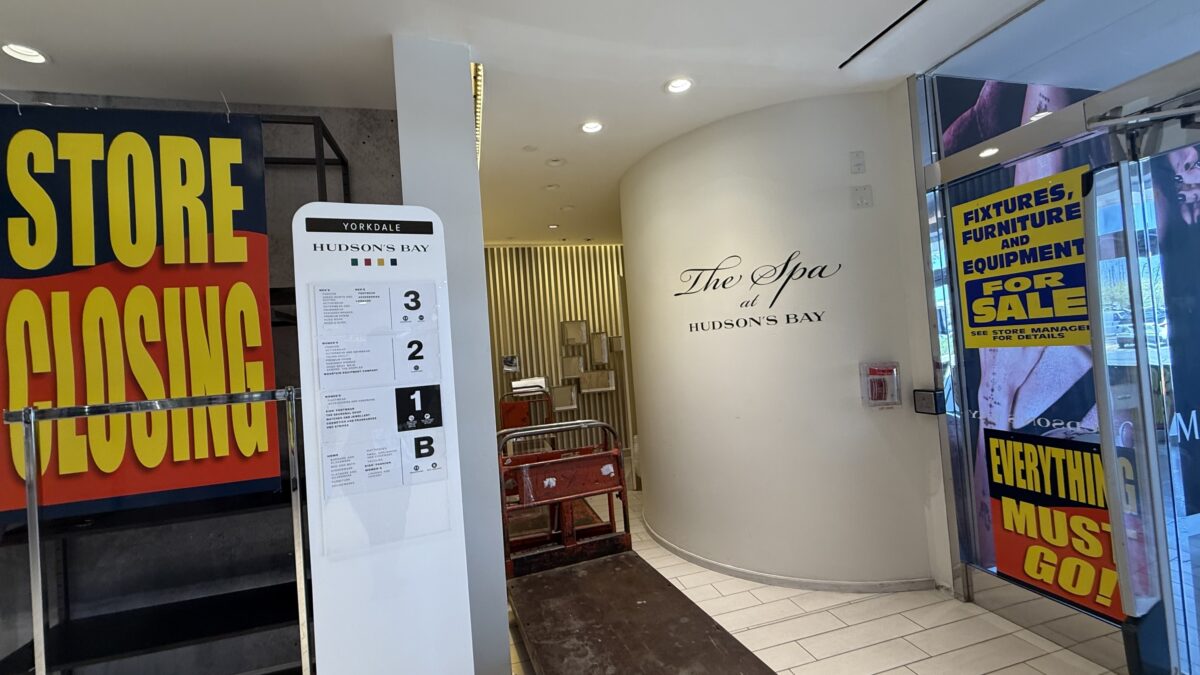
All Hudson’s Bay, Saks Fifth Avenue, and Saks OFF 5TH stores in Canada are set to close by June 15. After June 1, furniture and fixtures will be cleared out, and the company will vacate all properties by month’s end. The lease disposal process includes a mix of direct transfers and auctions where bids overlap.
The company is also preparing to auction a collection of 4,400 historical artifacts, pending court approval. These include items of national significance tied to the company’s 355-year history.
The Ontario court is expected to reconvene in late May or early June to approve selected bids and provide direction on next steps. The outcome could see parts of the Hudson’s Bay brand continue under new ownership, either as retail operations or as licensed intellectual property.
Impact on Employees and Canadian Retail
The closure of Hudson’s Bay has far-reaching implications. Roughly 9,400 employees will be affected by the store closures, alongside thousands of retirees. Legal and financial advisors are actively working to ensure their interests are considered as the process unfolds.
The disappearance of Hudson’s Bay from Canadian shopping centres also raises questions about the future of department store retail in the country. As landlords weigh their next moves, interest from global and domestic players—like Central Walk and Canadian Tire—suggests the story of Hudson’s Bay may not end entirely.
For now, the fate of this storied brand rests with the Ontario courts, competing bidders, and the court-appointed monitor overseeing the process. A clearer picture of Hudson’s Bay’s future is expected to emerge by mid-June.