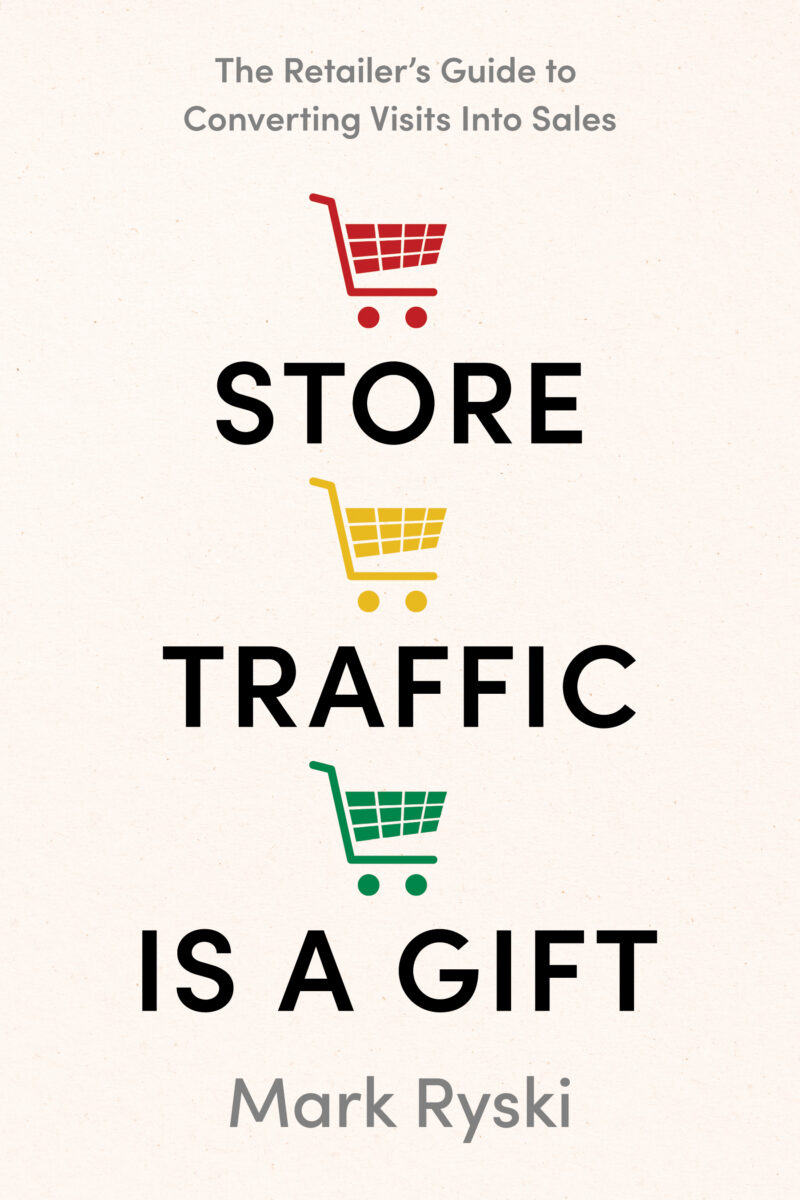
Mark Ryski, founder and CEO of Edmonton-based HeadCount Corporation, has built a career around one deceptively simple concept: foot traffic matters. Now, with his third book Store Traffic is a Gift: The Retailer’s Guide to Converting Visits into Sales launching on September 30, 2025, Ryski is sounding the alarm once again for retailers who might be taking their store visitors for granted.
“This is my third book, and the other two were on the same topic,” Ryski said in an interview. “I wrote the first one, When Retail Customers Count, in 2005, and at that time it was the first book ever written on the subject.

The second one, Conversion: The Last Great Retail Metric, followed in 2011. But retail changed a lot during and after the pandemic. I felt it was time to update these ideas for a new era.”
A Post-Pandemic Wake-Up Call
In the aftermath of COVID-19, retailers were hyper-focused on traffic. “Every retailer was obsessed with traffic during the pandemic,” Ryski said. “But now, five years later, we’ve drifted. There’s this idea that if you just drive more traffic into stores, things will improve—but it’s not that simple. Traffic is a gift. You need to know how to use it.”
Ryski’s central thesis is that store traffic, when accurately measured and analyzed, can illuminate virtually every operational decision a retailer makes. “Whether it’s staff planning, marketing ROI, or testing a new sales approach—everything shows up in the traffic and conversion metrics,” he explained.
Unlocking the Secrets of Super Converting Stores
One of the book’s standout ideas is the concept of “super converting stores”—locations in a retail chain that consistently convert foot traffic into sales at above-average rates. “Retailers might not even realize they have them,” said Ryski. “These stores can hold the key to unlocking conversion potential across the entire chain.”
But identifying them requires more than intuition. “You need to map where all your stores sit in terms of traffic and conversion. Only then can you isolate the outliers and start teasing out why some perform better,” he added. Sometimes it’s inherent—like being the only office supply store in Fort McMurray, Alberta. But often, the answer is replicable, especially when it comes to staffing and operational strategy.
Labor Misallocation and the Vicious Cycle of Decline
Ryski is adamant that many retailers are failing at one of their most basic tasks: allocating labour effectively. “This is the bane of my existence,” he said with a laugh. “Retailers still allocate labour based on sales. But if a store gets lots of traffic and doesn’t have the staff to convert it, sales look weak. That store gets even less labour next time, and eventually that traffic gives up.”
To break the cycle, he argues for a radical shift: compensating store teams based on sales per visitor, not total sales volume. “It’s a fairer and more precise measure of performance. Store teams can’t control how many people walk in, but they can control what happens once someone’s there.”
Making Store-Level Data Actionable
If there’s one refrain throughout the book, it’s that data is only useful if it’s understood and applied. “You’ll never convert a shopper from head office,” Ryski said. “The magic happens in the store. That’s why store managers and frontline teams need access to traffic insights they can actually use.”
Ryski describes a scenario where retailers invest in training or merchandising changes and then assess effectiveness solely through sales numbers. “But what if traffic was down that month?” he asked. “If conversion and ticket values went up, it may have been a success—even if sales didn’t. You’ll never know unless you’re measuring traffic.”
From Two Stores to Twenty Thousand
Despite his deep experience working with major retail chains, Ryski insists his message is just as important for small businesses. “Data and analytics aren’t just for big companies,” he said. “I discovered this stuff while working at a single-location computer store. It made a huge difference.”
One of the book’s most eye-opening chapters tackles the widely accepted—yet potentially misleading—“busyness charts” from Google. “I wrote a chapter called How Does Google Know My Store Traffic?,” Ryski explained. “What I found is that while geolocation data from companies like Placer.ai and others can be accurate at a national level, it breaks down fast when you zoom in.”
In one example, a provider’s state-level data was off by as much as 50% compared to actual store data. “It’s not operationally useful,” he said. “It might tell you that noon is a busy time in a general sense, but you can’t staff or plan around that.”
Shopping Centres: The Original Traffic Business
Ryski also speaks directly to shopping mall operators, calling them “in the traffic business.” He was candid: “I get dismayed when I walk into a mall and don’t see traffic counters. It’s like selling electricity without a meter.”
While some landlords have dabbled in trying to impact in-store conversion, Ryski believes malls need to go back to basics. “They should be tracking and sharing traffic data regularly with their tenants. That’s part of the value proposition.”
Retail Marketing Reboot
Marketers are another audience Ryski hopes to reach with Store Traffic is a Gift. “If you can precision target digital ads to drive store visits, why wouldn’t you focus on the stores with the best conversion rates?” he asked. “Instead of just driving traffic, drive traffic to where it counts the most.”
He sees an opportunity for marketers to measure their efforts more effectively by looking at traffic and conversion together. “If you’re investing in a local campaign, use that traffic data to assess ROI—not just sales numbers.”
Conversion Rate Optimization for the Physical World
While conversion rate optimization is a well-known concept in e-commerce, Ryski devotes an entire chapter to applying the concept in physical stores. “It’s harder, because every store is different. You’ve got 20 stores? That’s like optimizing 20 different websites,” he said.
But with a process of benchmarking, identifying high-performing locations, and replicating best practices, he says the potential gains are significant. “In one chain of 800 stores I studied, conversion rates ranged from 30% to 75%. That’s a massive gap. And it’s not random—it’s actionable.”
A Wake-Up Call to the C-Suite
Perhaps the most startling anecdote in the book involves a data science executive at a major U.S. retailer who told Ryski that store traffic and conversion data was “not on the radar” at the C-suite level. “They had counters in every store,” Ryski recalled. “But no one at the top cared. That’s a missed opportunity.”
This disconnect is precisely why Ryski wrote Store Traffic is a Gift. “I want to help retailers—from store managers to CEOs—see that this is foundational data. You wouldn’t run a website without analytics. Why would you run a store without knowing how many people come in?”
Practical and Accessible
Ryski made a point of writing the book in accessible language. “It’s not for data scientists,” he said. “A store associate could pick this up and understand it. That was by design. Frontline workers are still the heroes of retail, and they deserve tools that make sense.”
With 288 pages of insight and clear examples, Store Traffic is a Gift is positioned as both a guidebook and a call to action. It’s available for pre-order now through Amazon, Barnes & Noble, Porchlight, and other major retailers. Distribution will expand further upon its September 30 release via Greenleaf Book Group Press.
The Bottom Line: Start Measuring
Ryski’s parting advice to retailers is simple: just start. “If you’re not collecting store traffic data, you’re operating blind. This isn’t a luxury—it’s a necessity,” he said. “And if you are collecting it, but not using it to drive better outcomes, then it’s time to ask why.”
As the book’s title makes clear, store traffic isn’t just a metric—it’s a gift. But only if you know how to unwrap it.