

Food inflation has returned as a problem for Canadian households. According to Statistics Canada, food prices rose 3.3% in July, outpacing overall inflation by 1.6 percentage points. Unlike past cycles, this spike cannot be blamed on volatile global markets. The cause lies much closer to home — in our own policy decisions.
Coffee prices surged 28.6%, confectionery 11.8%, and fresh fruit 3.9%, with grapes alone up nearly 30%. Since March 2025 — when Ottawa ended the GST holiday that had distorted winter data — food inflation has exceeded the overall CPI by an average of 1.4 points. A large part of this gap stems from the counter-tariffs imposed on essential imports, many of which lack viable domestic substitutes.
Two facts reinforce this conclusion. First, the cost of major agricultural inputs — wheat, soybeans, and corn — has been stable in recent months, as has the Canadian dollar. Second, food operates on razor-thin margins. A 10% tariff can destabilize an importer; Ottawa has applied tariffs of up to 25% since March. For many firms, this is an impossible burden to absorb without passing costs directly to consumers.
In March, Canada became the only country other than China to retaliate against U.S. tariffs with counter-measures. This strategy, a holdover from the Trudeau era, was framed as a show of resolve against the “tariff tyrant” in Washington. Some still defend it, but the evidence suggests cheaper, less painful options were available.
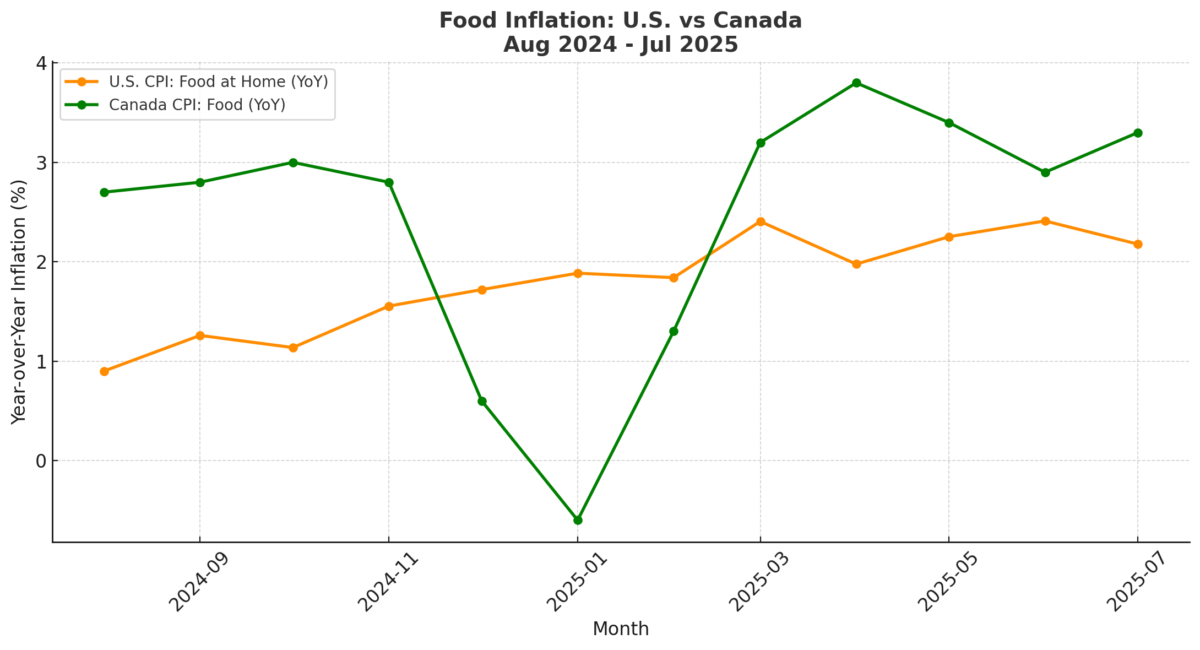
While U.S. food inflation fell to 2.9% in July — three months after America’s so-called “Liberation Day” on April 2 — Canadian food inflation rose by 0.4 points from June. Nothing suggests this trend will reverse soon. Many expected U.S. food inflation to spike once pre-tariff inventories were exhausted. It didn’t happen. America’s larger, more productive economy, supported by diversified supply chains, absorbed the shock. Canada, one-tenth the size with far less flexibility, simply cannot.
There’s a reason only China and Canada chose to respond with counter-tariffs: such policies weaponize the cost of living, but against one’s own citizens. The July data confirm this. Canadian consumers are paying the price at the checkout.
Meanwhile, Ottawa is collecting billions in tariff revenues. No information has been released about how much has been raised or how those funds will be used. Mark Carney, for his part, clearly understands how damaging grocery tariffs can be — which is why, since taking office, he has resisted adding new ones.
Yet for many consumers, grocers remain the most visible target of blame. For Prime Minister Carney and his government, this reflex is politically convenient: it distracts from the true cost of tariff policy. But the reality is far more complex.
One can only hope that the government will eventually level with Canadians and acknowledge how counter-tariffs at the grocery store hurt Canadian consumers, rather than clinging to the “elbows up” mantra.
The latest inflation numbers underscore the point.









It would be helpful if the article provided a more detailed explanation of how counter tariffs affect the price of products we buy that are not imported from the U.S. such as Canadian dairy products. I haven’t bought American food products for at least a decade yet food costs at the grocery store continue to go up.
What do counter tariffs have to do with this?
I still think our grocery monopolies have a part to play in the increasing grocery costs Canadians are experiencing. I have witnessed price differences of over 30% on products across different banners owned by the same parent company.