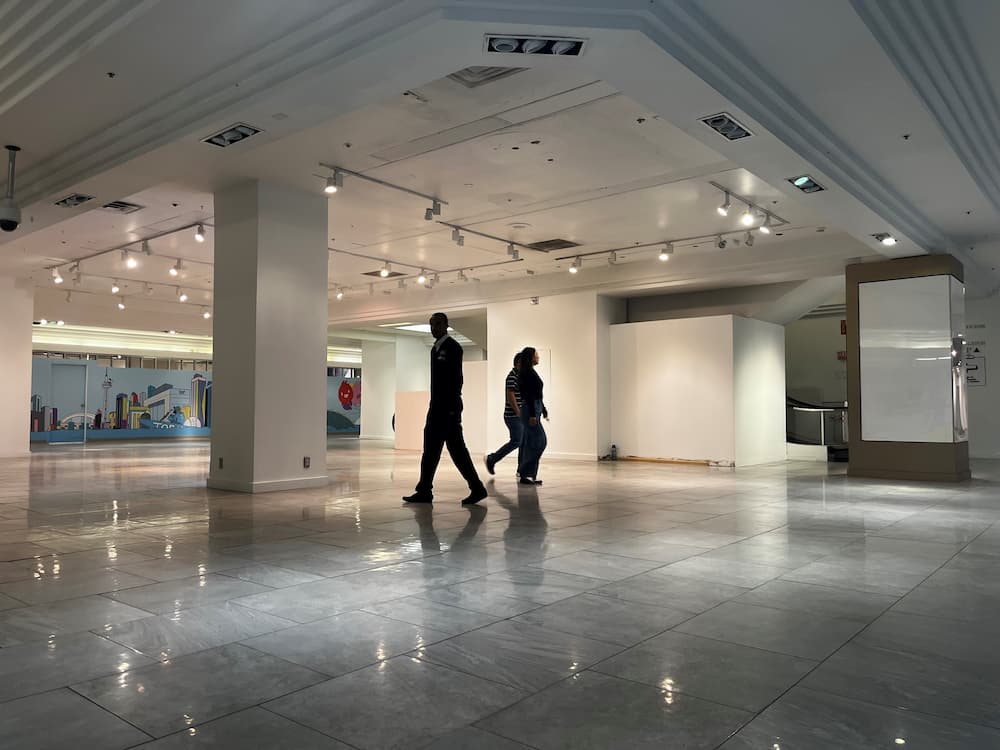
The mass closure of Hudson’s Bay stores across Canada left a daunting amount of retail space without a purpose. While there is healthy interest in most locations from a range of businesses, finding permanent tenants will take time.
“Landlords have a once in a lifetime opportunity, and I think that they will approach that opportunity appropriately,” says CBRE Vice President Kate Camenzuli.

In the meantime pop-up stores like Spirit Halloween have occupied several former Hudson’s Bay locations, a convenient short-term solution for landlords who can generate revenue from spaces that would have otherwise sat empty.
But what about the longer-term fate of empty Hudson’s Bay stores and the future of big box brick-and-mortar retail more broadly? What can consumers expect to see in major shopping districts in the years to come? Camenzuli breaks it all down.
A Short Time in Prime Time
Landlords turn to short-term tenants for two main reasons, according to Camenzuli. “To activate vacant spaces and to test the market.”
Seasonal stores and pop-ups like Spirit Halloween, Calendar Club and Cozy have always existed to fill up swing spaces in malls. Rarely, however, have they occupied huge spaces in some of the country’s most desirable malls and shopping districts.
“The difference we’re seeing now is that we have more vacancy in our shopping centres because of big box availability than we’ve seen in a very long time,” says Camenzuli. “They’re good pieces of real estate but they’re huge.”
Hudson’s Bay is just the latest in a long list of department stores that have shuttered in Canada over the past decade. Nordstrom, Zellers, Sears and Target followed similar patterns after years of operation, leaving behind hundreds of thousands of square feet the average retailer doesn’t need.
Department Stores Have Departed
Replacing Hudson’s Bay with a Costco or Walmart might at first seem like a practical solution to take up large amounts of empty space.
But Camenzuli says backfilling department stores with other department stores is a thing of the past. “200,000 sq. ft. to 300,000 sq. ft. department stores are not a vibe anymore.”
“Understanding your appropriate size and format is more crucial than it’s ever been, and that’s due to the pricing of real estate. Retailers have evolved into figuring out what they’re best at.”
The average retail project or phase is 35,000 sq. ft., nearly 50% smaller than three years ago, according to CBRE’s 2025 Real Estate Market Outlook. Domestically, an increasing number of brands are modifying the scale of their typical store, and smaller-format offerings are redefining what the typical store looks like.
“It’s harder than ever for stores to be everything to everyone,” says Camenzuli, adding that while longstanding players like Walmart and Costco aren’t leaving anytime soon, she believes empty Hudson’s Bay locations are better left for businesses that can introduce new and exciting concepts.
Right Mix, Right Partners
While it’s going to take a while for landlords to find long-term tenants that match their vision, there are seemingly endless possibilities for what’s to come.
“I think you’ll see landlords invest a lot of money into these former big box spaces in order to get the right mix with the right partners,” says Camenzuli.
Health and wellness hubs, pickleball courts, educational facilities and residential developments are just a few ideas for what might succeed in former Hudson’s Bay locations.
There are also opportunities for community hubs that can further activate the space. Look no further than Fairgrounds, a free-to-join public racquet club that boasts its own restaurant and bar, as an example.
“Take the risk, figure out a cool concept and try to roll it out as fast as you can,” says Camenzuli. “The loss of Hudson’s Bay has created so much opportunity for Canadian retailers.
“It’s time to build cool things to fill up these spaces and be part of making our country better and stronger than ever before.”
(Content provide by commercial real estate firm CBRE)
More from Retail Insider: