Roots has expanded its presence in Vancouver with a new store at Vancouver International Airport, adding travel retail to a growing mix of flagship, destination, shopping centre and experimental formats.
The store is located after security near Gate E88 in YVR’s U.S. Departures Terminal and was opened in partnership with Hudson, part of global travel retailer Avolta. Roots and YVR marked the opening on July 23 with an event attended by airport partners, media and invited guests.
The location gives Roots access to Canadian and international travellers at one of the country’s busiest gateways. It also follows a period of investment in the retailer’s physical network, including a significantly larger Robson Street flagship, major renovations at Vaughan Mills and Mont-Tremblant, and the launch of a smaller pilot concept in Toronto.
“Our product assortment is uniquely suited for comfort and travel, making airports a natural extension of our retail strategy,” said Meghan Roach, President and CEO of Roots Corporation. “Opening at YVR allows us to connect with both Canadian and international travellers at a key global gateway, building on our longstanding success of serving consumers in tourism and travel destinations.”
Travel-Focused Assortment at YVR
The YVR store carries a focused selection of Roots apparel, accessories and giftable merchandise. Products include the retailer’s Original Sweats, Vancouver graphic fleece and T-shirts, Made in Canada collections, Cabin socks, Beaver stuffies and keychains.
Select Vancouver graphic fleece and T-shirt styles are exclusive to the airport location, giving travellers access to products tied specifically to the city.
The assortment draws on several categories where Roots has strong brand recognition. Its sweats and casual apparel are suited to travel, while Vancouver graphics and smaller accessories provide options for visitors seeking Canadian-branded gifts.
The airport store also extends a localized merchandising strategy that Roots has used at other destination locations. Its downtown Vancouver flagship carries a dedicated Vancouver Collection, while stores in tourism markets such as Mont-Tremblant adapt their merchandise and presentation to their surroundings.
“We’re thrilled to partner with YVR and Hudson to bring Roots to the airport,” said Melinda MacDonald, Vice President of Wholesale and Business Development at Roots Corporation. “As we continue to expand our travel retail presence, this new location allows us to bring Roots heritage, signature products and spirit of adventure to millions of travellers from all around the world.”

Roots Builds Its Travel Retail Presence
Roots already has a presence at Taiwan Taoyuan International Airport and says it is exploring additional travel retail opportunities across Canada.
The partnership with Hudson gives Roots access to Avolta’s experience operating in airport environments, where retailers face different requirements than they would in conventional street or shopping centre locations. These can include security restrictions, extended hours, limited storage and a customer base making purchases within a relatively short period.
For Roots, the YVR format creates an opportunity to reach travellers without replicating the size or full assortment of a traditional store. The product mix centres on recognizable apparel, destination graphics, Canadian-made merchandise and smaller items that are easy to carry during a trip.
Roots has more than 100 corporate stores in Canada, two stores in the United States and more than 100 partner-operated stores in Asia. The company also sells internationally through its e-commerce platform and a branded storefront on Tmall in China.
A Larger Roots Presence in Vancouver
The airport opening comes about a year after Roots relocated and expanded its longstanding Robson Street flagship.
The retailer opened its new store at 929 Robson Street, at the corner of Hornby Street, in 2025. It replaced the former Roots flagship at Robson and Burrard, where the company had operated for more than 30 years. Arc’teryx subsequently expanded into the former Roots space.
The new flagship occupies a large corner location previously divided between Peloton and TWG Tea. Roach said the store is considerably larger than its predecessor and extends almost half a block along Robson and Hornby streets.
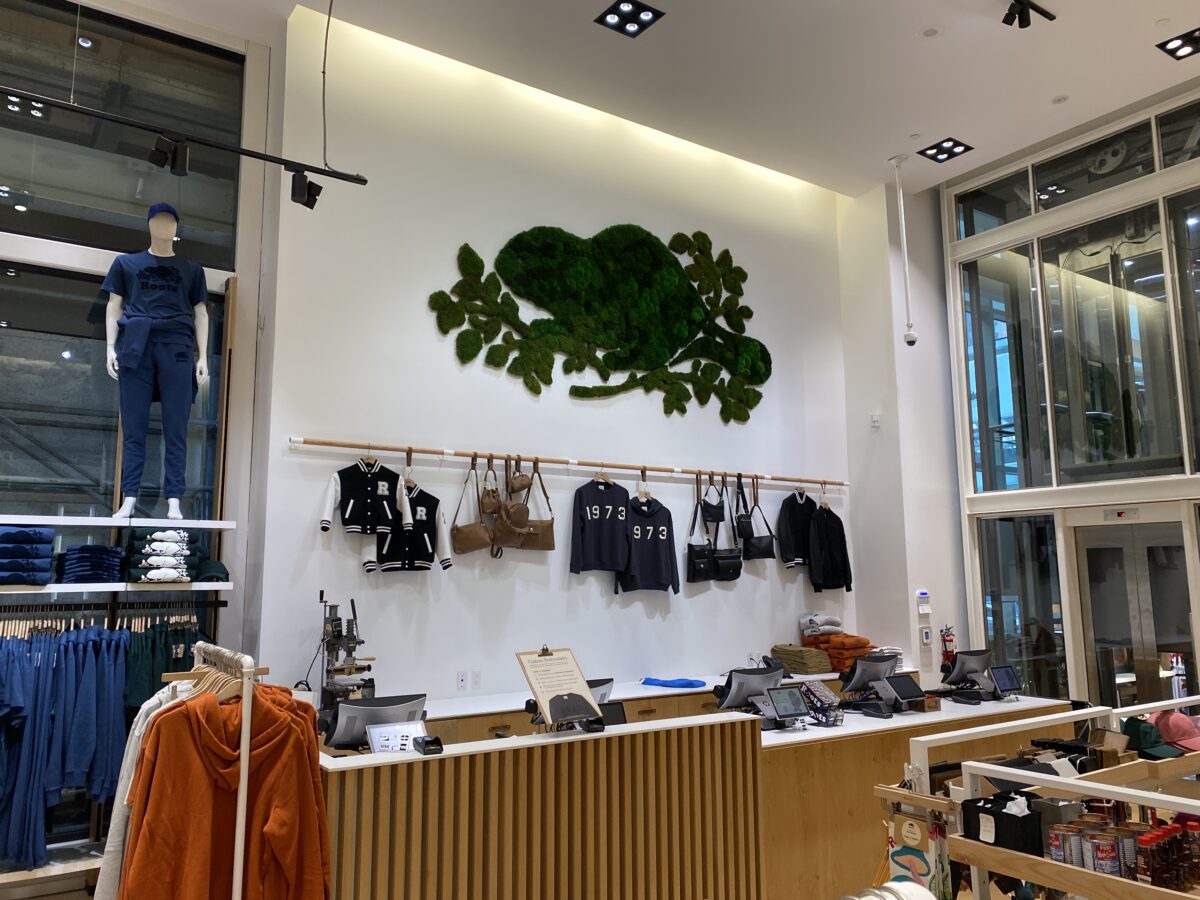
Its design incorporates natural references associated with Vancouver and the Roots brand. Features include a preserved moss wall, a moss sculpture of the company’s beaver logo, light wood finishes and a ceiling installation featuring a commissioned image of Stanley Park.
Digital screens and holographic displays are used throughout the space for campaigns and brand storytelling. Large windows along both streets give the store a prominent presence on one of Canada’s best-known shopping corridors.
The flagship also introduced a dedicated Vancouver Collection, displayed across an entire wall and available exclusively at the location.
“We dedicated an entire wall to Vancouver product because we know this store attracts a mix of locals and visitors,” Roach previously told Retail Insider. “Tourists want something that feels distinct to the city, while Vancouverites appreciate the nod to their community.”
The YVR store brings that destination-specific approach into an environment where many customers will be leaving Vancouver or Canada. Together, the two locations give Roots distinct positions in the market. Robson Street serves downtown residents, regional shoppers and tourists, while the airport store is built around departing travellers.
Renovations at Vaughan Mills and Mont-Tremblant
Roots has also been updating established stores in several markets.
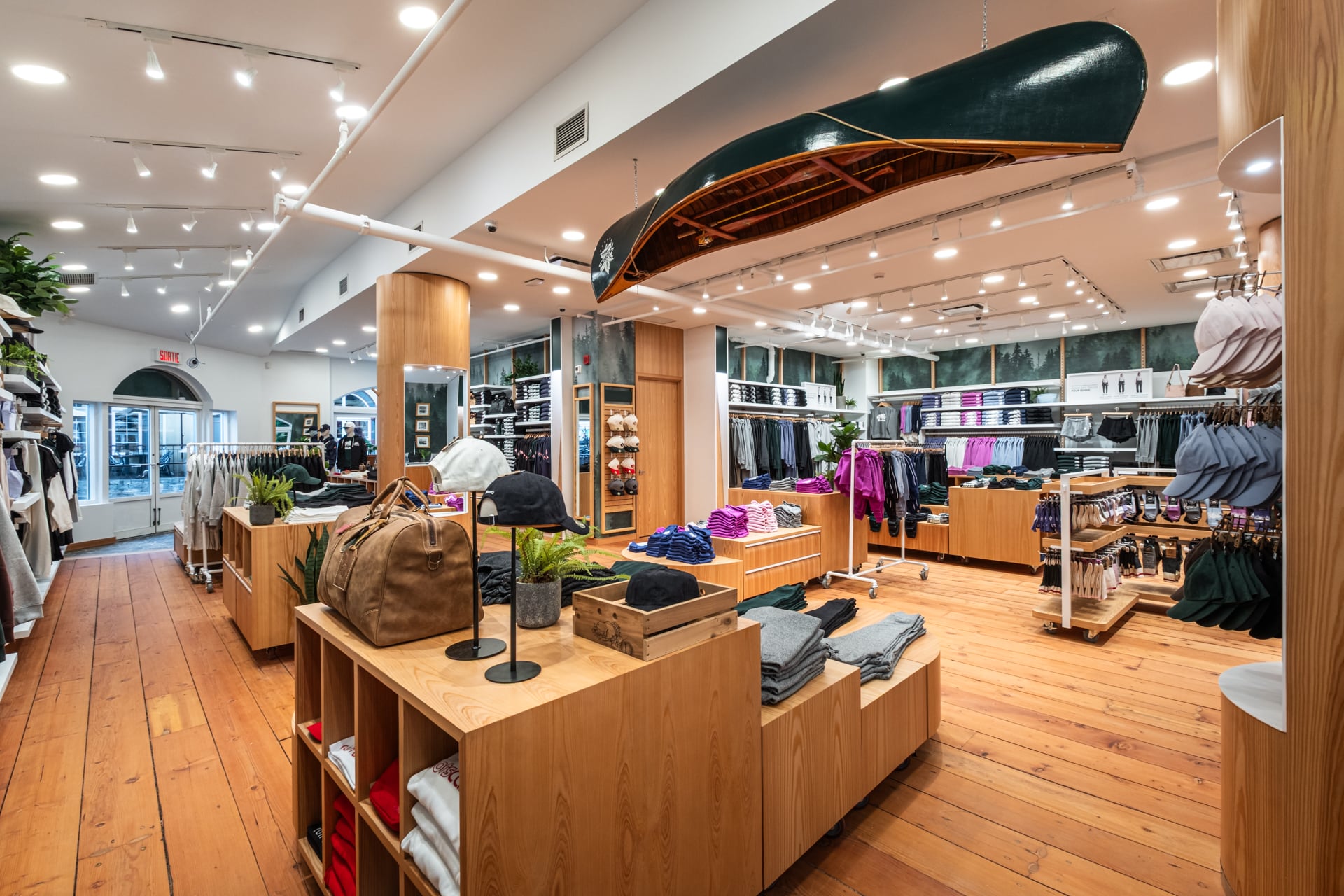
Its Vaughan Mills location completed a major transformation in April 2025, while the Mont-Tremblant store reopened following renovations in July of that year. The projects formed part of a wider effort to modernize key locations while adapting each design to its setting.
Vaughan Mills is one of Roots’ busiest shopping centre stores. Its renovation introduced lighter finishes, simplified merchandising and digital touchpoints suited to a high-traffic mall environment.
“When we were thinking about the concept and how we modernize the experience, we wanted to make sure we considered all the different types of stores we operate,” Roach told Retail Insider at the time.
The Mont-Tremblant renovation retained elements of the existing location, including its wood floors, while introducing brighter colours, digital screens and references to nature. Moss installations and other features connect the space with Roots’ Canadian identity and outdoor heritage.
Mont-Tremblant offers a useful comparison with YVR. Both locations serve customers who encounter Roots during a trip and may be particularly interested in products associated with Canada, comfort and outdoor living.
Roach has said Roots looks at its stores by category, including flagship street locations, destination stores and high-traffic shopping centre units. Each format receives a somewhat different treatment based on its setting and customer base.
Updated Store Design Spreads Across the Network
Several elements now appearing in Roots stores were introduced through the company’s updated concept at CF Toronto Eaton Centre.
The design uses brighter interiors, natural materials, clearer product organization and digital storytelling. Roots has since adapted parts of the concept for Robson Street, Vaughan Mills, Mont-Tremblant and other locations.
The company has indicated that it is identifying successful features that can be introduced more widely, including in stores that do not receive a complete renovation. That allows Roots to update parts of its network gradually while reserving larger capital investments for strategically important or high-traffic locations.
Roach previously identified Robson Street, Vaughan Mills and Champlain Mall as locations receiving investment, while also discussing plans to test a smaller retail concept.
That experimentation became more visible with the opening of Roots Outpost in Toronto.
Roots Outpost Tests a Smaller Format
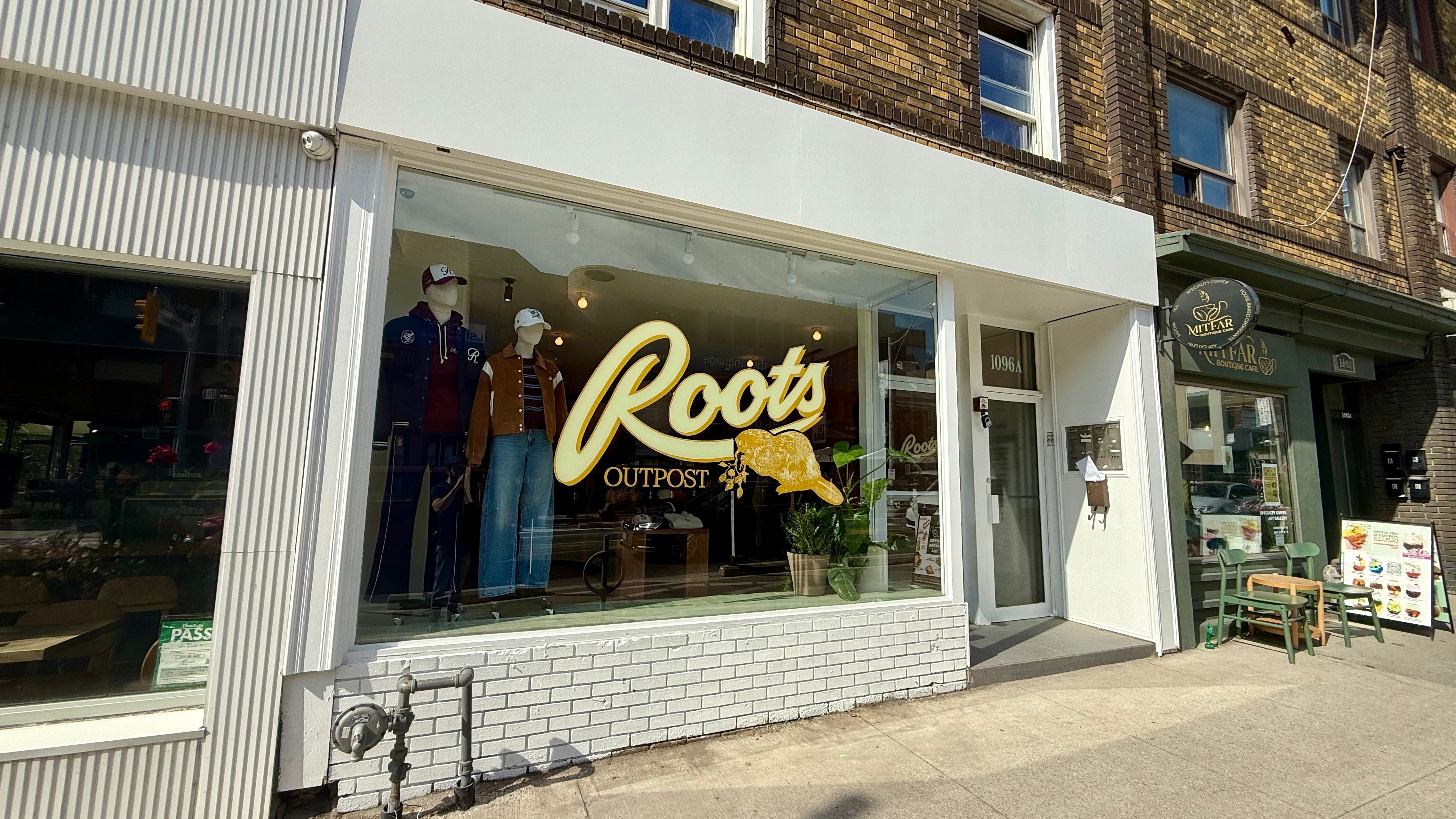
Roots opened the pilot Roots Outpost concept at 1096 Yonge Street in Toronto’s Rosedale commercial district in October 2025.
The location sits near the site of the first Roots store, which opened at 1052 Yonge Street in August 1973. The smaller-format store combines archival pieces, contemporary merchandise, Canadian art, heritage objects and products from local makers.
Its presentation is more curated than that of a conventional Roots location. Apparel and vintage items are displayed in a gallery-like setting, allowing the company to place greater emphasis on product history, materials and craftsmanship.
Roots Outpost also gives the retailer a place to test limited-run merchandise. The store has carried archival apparel, rare vintage pieces and small leather capsules produced using materials from the company’s Toronto factory.
Local pottery, soaps, candles and apothecary products have also appeared in the assortment, supporting the location’s role as a neighbourhood and community-focused concept.
The Outpost differs in size and purpose from the new YVR store, though both illustrate how Roots is developing formats around particular customers and locations. One draws on the company’s history in Rosedale, while the other presents Roots to travellers moving through Vancouver.
Selective Investment in Physical Retail
The recent projects point to a selective approach to Roots’ store network.
The company is directing investment toward prominent flagships, productive shopping centre stores, tourism destinations and smaller concepts that can be used to test new ideas. Store design, merchandise and storytelling are adjusted according to the role each location plays within the network.
Roots operates a mature Canadian store base, making renovations, relocations and format changes an important part of its growth strategy. The expanded Robson Street store increased the retailer’s presence within an established market, while the Vaughan Mills and Mont-Tremblant projects improved two productive existing locations.
YVR adds another channel without requiring the assortment or footprint of a full flagship.
Roots said in 2025 that additional renovations were being prepared, subject to discussions with landlords. Roach also indicated that recognizable design elements from recent projects could eventually be introduced across a wider portion of the chain.
Store Investments Continue During Strategic Review
The physical retail investments are continuing as Roots undergoes a broader strategic review.
In March 2026, the company announced that its board had begun examining alternatives that could include a full or partial sale, strategic partnerships, joint ventures, changes to its capital structure or other transactions. Roots retained J.P. Morgan Securities Canada as its financial advisor and Torys LLP as legal counsel.
The company said there is no assurance that the review will result in a transaction and that operations are continuing normally during the process.
The review followed a period of improved business performance. Roots reported sales of $71.5 million for the third quarter ended November 1, 2025, an increase of 6.8 per cent from the previous year. Direct-to-consumer comparable sales increased 6.3 per cent, while adjusted EBITDA rose 5.3 per cent to $7.5 million.
For the first nine months of fiscal 2025, direct-to-consumer comparable sales increased 11.5 per cent, supported by stronger online traffic and improved conversion in stores.
The recent retail projects show that Roots continues to make operational and real estate investments while the strategic review proceeds.
Additional Canadian Airport Opportunities Under Consideration
Roots has not identified which Canadian airports could follow YVR, although the company has confirmed that it is exploring further travel retail opportunities across the country.
Future locations could build on lessons from YVR, including the performance of destination graphics, Canadian-made merchandise, casual apparel and smaller accessories within an airport setting.
The partnership model could also give Roots a way to enter additional airports through operators that already understand passenger flows, terminal requirements and travel retail merchandising.