Advertisement
Advertisement

Disposable Income Spent on Food by Canadians Varies by Provincial Tax Rates [Op-Ed]

Date:

Share post:

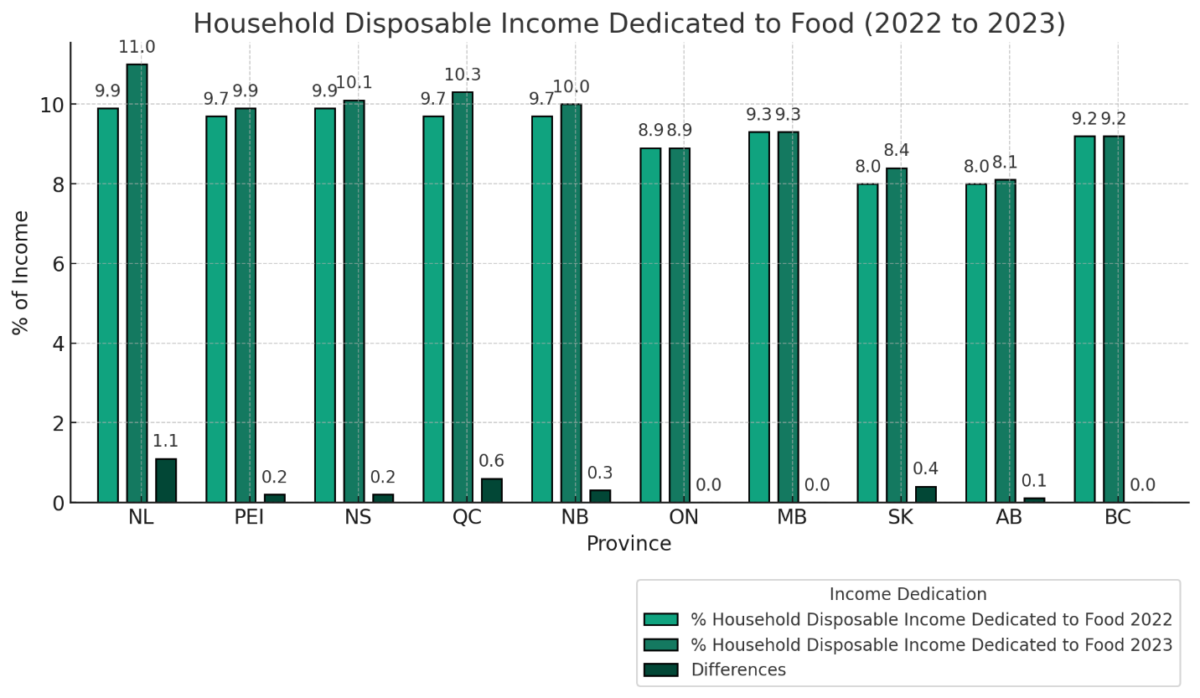
As Canadians sit down to their dining tables, the financial burden of what lies on their plates extends beyond mere calories. Recent data from Statistics Canada paints a stark picture of household disposable income being consumed by food retail across the provinces, with a noteworthy correlation to the tax rates levied upon their earnings.

The bar chart representing the percentage of disposable income spent on food retail in 2022 and 2023 shows Newfoundland and Labrador (NL) leading the charge, with 11% of household income dedicated to sustenance (up +1.1% from 2022). This is closely followed by Quebec (QC) (Up +0.6% from 2022), Nova Scotia (NS) (UP +0.2% from 2022), and New Brunswick (NB) (Up +0.3% from 2022), all hovering around the 10% mark. In stark contrast, Alberta (AB) expends only 8.1%, the lowest among the provinces.
Simultaneously, a table detailing the income tax rates reveals a story in parallel. Quebec, despite its renowned culinary culture, imposes a notable tax burden on its residents, with rates climbing to 19% on income just shy of $100,000. This is the province where citizens dedicate a significant portion of their income to food, second only to NL, which also features higher tax rates compared to the national average.
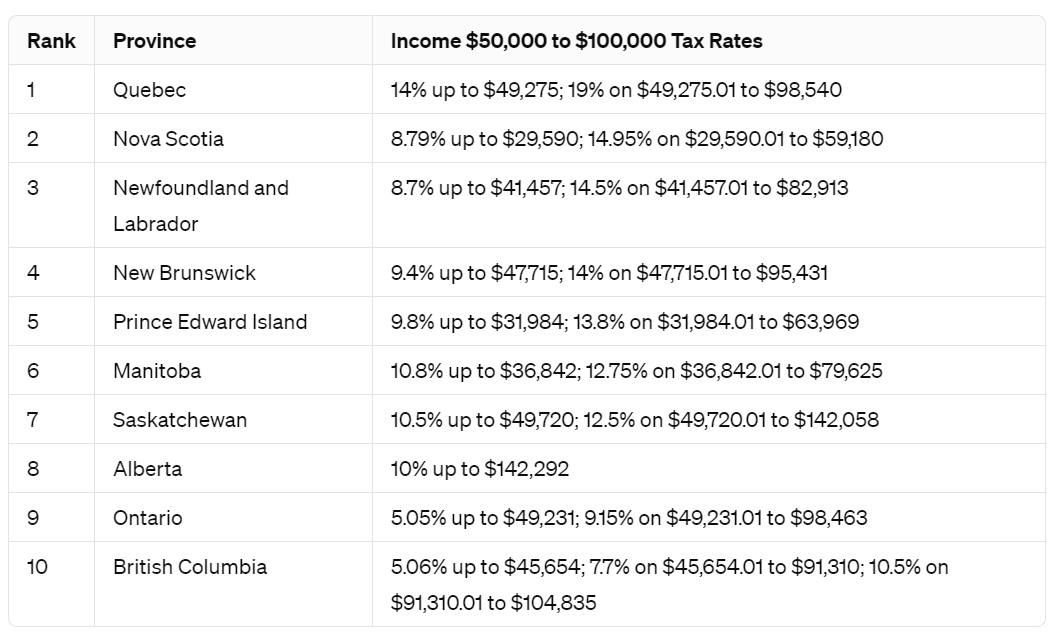
Is it a mere coincidence that provinces with higher tax rates see a greater share of income going towards food? Or is this an indicator of a larger economic narrative where the tax burden intersects with the cost of living, amplifying the impact on disposable income and, consequently, on food affordability?

Consider this: taxes affect disposable income, which in turn influences purchasing power. The interplay is especially evident in the realm of food, a necessity that consumes more of the household budget in regions with higher taxes. The situation begs a question of policy and priorities: Are we taxing our way into tighter kitchen budgets?

Provinces like Alberta, with its lower tax rates, see a lesser percentage of income spent on food. This leaves room for investment in quality, nutrition, and diversity. It might also create a wider economic space for citizens to engage in other sectors, bolster savings, and stimulate local economies beyond the grocery store aisles.

Furthermore, there’s an element that transcends the raw numbers. These figures do not only represent economic data; they reflect the lived realities of Canadian families. The percentage points translate into decisions about whether to buy fresh fruit or canned, organic or non-organic, local or imported. They influence lifestyle choices, dietary health, and, in broader terms, the wellbeing of communities.

Provinces and the Canadian government and policy makers must heed these statistics as more than fodder for fiscal debates. They are a call to action to balance the scales between taxation and affordability. With food prices continuing to escalate worldwide, there’s a pressing need to ensure that tax policies don’t inadvertently tighten the financial belts of Canadians around their dinner tables.

A policy reevaluation seems prudent, one that considers the cost of living, particularly food, in its formulation. It could be a step towards ensuring that families in Quebec, Newfoundland and Labrador, and indeed across all provinces, are not disproportionately burdened by a basic human need.

As we navigate the complex web of economic policies and their social consequences, Canada stands at a crossroads. Will the country adjust its fiscal policies to nurture not just a healthy economy, but also a healthy populace? The data is on the table, and it’s time for a national conversation about the recipe for a balanced, affordable, and nutritious food environment for all Canadians.


LEAVE A REPLY

Please enter your comment!
Please enter your name here

More From Retail Insider

RECENT RETAIL INSIDER VIDEOS

Advertisment

Subscribe to the Newsletter

Subscribe

* indicates required

RECENT articles

Daily Synopsis: Apr 16, 2026

First Capital REIT acquired as Westons expand retail empire, Skip the Dishes lays off staff and closes delivery service centres in Canada, Canada Post begins ending door-to-door delivery, Doug Ford slams city-run grocery stores, Foot Locker shuts Queen West store in Toronto, and other news.

Top Canadian Shopping Centres by Sales Per Square Foot in 2025

New data ranks the top Canadian shopping centres by sales per square foot in 2025, highlighting strong performance among leading malls.

Cyber threats hurting retail sector: EY

AI-enabled cyber threats are targeting retail, telecom and energy, says EY’s Global Cybersecurity Threat Outlook 2026.

Golf Town and Brooke Henderson cement decade-long partnership

This renewal marks more than a decade of collaboration, evolving from a landmark partnership into a lasting legacy dedicated to fueling the continued growth of golf in Canada.

First Capital REIT acquired in deal worth $9.4 billion

First Capital REIT is being acquired by KingSett Capital and Choice Properties REIT in a $9.4 billion unit and cash deal.

RONA Foundation’s 2026 Build from the Heart campaign is on

The RONA Foundation is a charity established in 1998 whose mission is to help improve the quality of life of Canadians in need by revitalizing their living environments or making it easier to access housing.

UniverCell Canada Expands Through Franchising Growth

UniverCell Canada expands with franchising and a new Mississauga store, offering transparent pricing in the growing device repair market.

Canadian Spending Holds Steady as Consumers Shift Priorities

Moneris data shows Canadians remain cautious but continue spending, with shifts toward value, essentials, and experiences.

The Ball Depot Launches E-Commerce Platform

The Ball Depot launches online with 1,000+ products, as founder Terri-lyne Gedanitz builds toward experiential retail expansion.

Adyen expands Giving program worldwide

Adyen says Canadian donations through Giving tripled from 2024 to 2025 as it expands adidas checkout donations to Europe, Brazil and Mexico.

Small Business: Elevating First Impressions Online

By Erin Shea, Senior Director of North America Marketing at VistaPrint, packaging is the first storefront for small businesses online.

Canada’s Shrinking Middle Class Is Fueling Food Inflation

As Canada’s middle class erodes, the country’s food economy is splitting, driving persistent inflation and weakening innovation.

Daily Synopsis: Apr 15, 2026

Uniqlo announces Winnipeg opening date, Winners accused of closing some store washrooms, food suppliers adding surcharges, Ontario moves to ban employees paying for uniforms, Montreal businesses await boost as Canadiens clinch playoff spot, and other news.

Iran Conflict Could Trigger New Food Price Shock in Canada

Oil and fertilizer spikes tied to Iran tensions could drive a new wave of food price increases across Canada in the months ahead.

Galion buys 5 RONA stores on Montréal’s South Shore

Marking a key strategic milestone for Galion, this initiative adds 620,000 square feet to its portfolio.

More businesses have been closing than opening in Canada: CFIB

The entrepreneurial drought, a sustained period of four or more quarters where business exits outpace new business entries, has been ongoing since early 2024.

Retail Crime Crisis Intensifies for Canadian Small Business

New CFIB and SOS data show rising retail crime is straining Canadian small businesses, increasing safety concerns and operational challenges.

How Luxury Retail Actually Works: Retail & Store Execution

Inside luxury retail execution, from flagship storytelling and pop-up strategy to operational playbooks that scale performance. Craig Patterson interviews expert Douglas Mandel.

Michael Hill Opens Vancouver Flagship at CF Pacific Centre

Michael Hill opens a new flagship at CF Pacific Centre as Canada drives growth and supports its premium retail transformation.

Canadian Milk Prices Hit Record Highs, Regional Gaps Widen

Field Agent data shows Canadian milk prices rising faster than farmgate costs, with major regional gaps and higher prices than the U.S.