Advertisement
Advertisement

Food Bank usage in Canada soars compared to US [Op-Ed]

Date:

Share post:

Last week, Feed Ontario disclosed that over a million residents in Ontario, Canada’s wealthiest province, sought assistance from food banks over the past year. A million people. That’s essentially Nova Scotia’s entire population as a province.

This revelation presents a stark contrast when juxtaposed with the situation south of the border in the United States. In 2023, while 13.5% of Americans households grappled with food insecurity—characterized by low or very low food security (USDA-ERS, 2024)—the rate in Canada was significantly higher at 22.9% (Proof Toronto, 2024). This suggests that food insecurity in Canada is a staggering 69.6% more prevalent than in the United States—a deeply unsettling statistic.

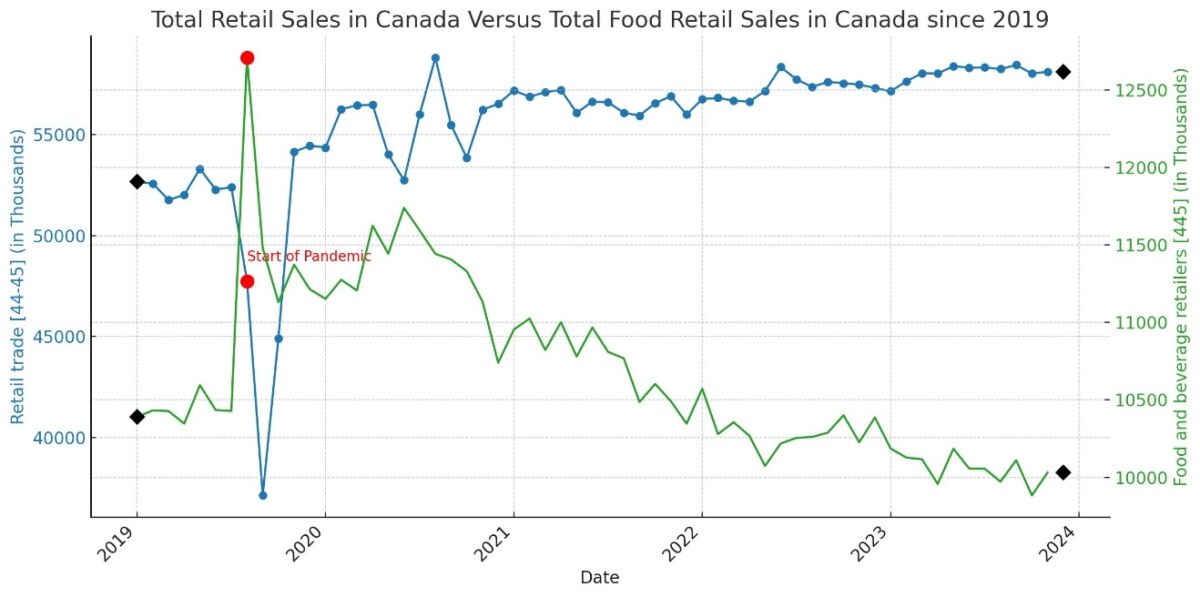
The challenge of affording food in Canada is exacerbated by anemic food sales, particularly stark when compared to the United States where grocery store sales increased by 1.8% in the last 12 months, according to the Federal Reserve Economic Data. In stark contrast, Canadian grocery store sales have plummeted by a worrying 3.2%, according to Statistics Canada (see graph on retail sales).

One plausible explanation for this disparity lies in the higher interest rates in Canada, which likely impose a heavier burden on Canadian households than on their American counterparts, given that the average debt per household is considerably higher in Canada. The Bank of Canada’s pathway to achieving a more stable inflation rate without detrimentally affecting Canadians appears much narrower than that of the U.S. Federal Reserve, evidenced by the harsh reality of ten consecutive rate hikes last year, compelling Canadians to economize particularly on food expenditures.
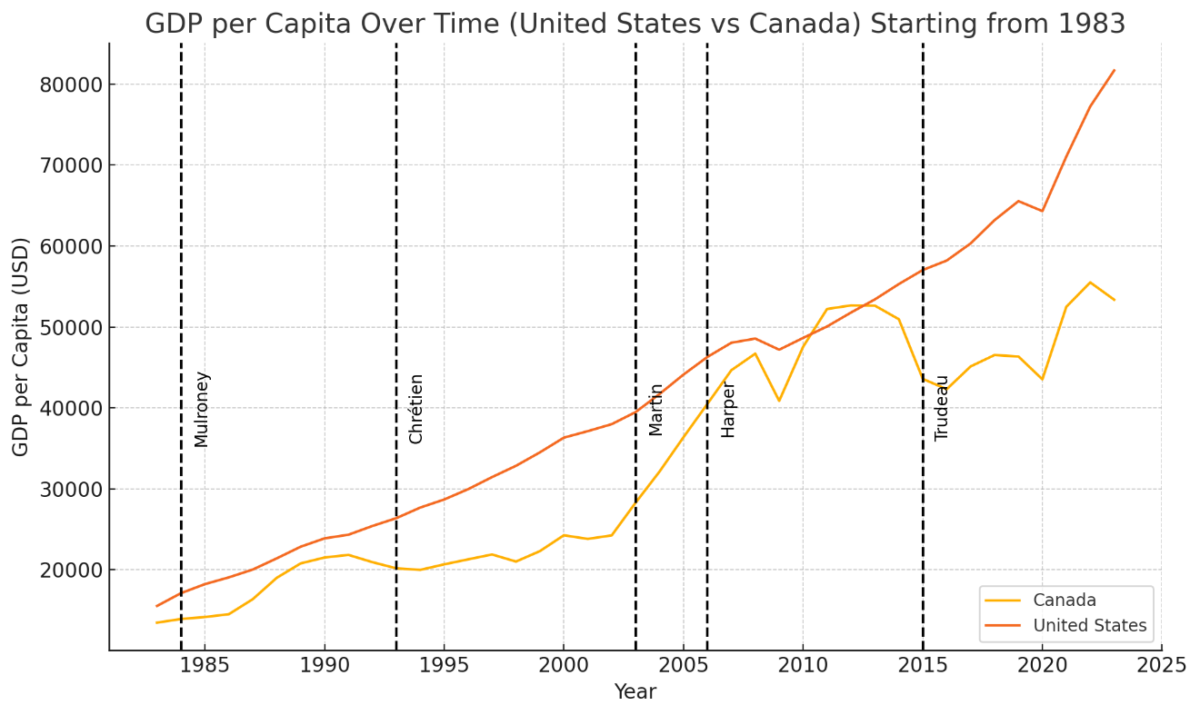
It is becoming increasingly apparent that Canada’s per capita economy is contracting, devoid of the wealth creation observed in the United States. Notably, according to World Bank Data, in 2002, the United States’ GDP per capita was 56.6% higher than Canada’s—a record high during the tenure of another Liberal Prime Minister, Jean Chrétien. The current gap, at 53.07%, is perilously close to this historical peak (see GDP Per Capita graph).
The primary drivers of GDP growth in Canada are currently immigration and public spending, with the government undertaking the bulk of economic heavy lifting. The situation is indeed dire. Moreover, the enthusiasm once held for the economic greening championed by the Trudeau administration is showing signs of significant fatigue. The carbon tax, Trudeau’s principal policy for fostering an eco-friendly economy, is increasingly losing traction due to the prevailing economic challenges. Dissenting voices from within the Federal NDP and the BC NDP government now challenge the carbon tax as the optimal path forward.

The failures of the carbon tax are emblematic of a broader trend in recent policymaking endeavours: the implementation of populist policies devoid of rigorous metrics for evaluating their success over time, all while constructing an expansive communications strategy designed to convince Canadians of the policy’s merits. The federal carbon tax is set to escalate to $95 per metric ton by April 2025, marching inexorably towards the 2030 goal of $170 per metric ton. Despite the mounting pressure, the Trudeau government has neglected to assess whether the policy meaningfully impacts our climate and emissions or to evaluate how the policy might influence the economy over time, with a particular focus on the ramifications for the agri-food sector from farmgate to plate.

The design of the rebate system ostensibly allows Canadians to overlook the real costs of this poorly-conceived policy. However, administering this massive program is not only costly but also fails to leverage the Canadian economy effectively. It is imperative to devise policies that genuinely foster both economic and environmental sustainability for the nation.

Related News:

VIDEO: Latest trends in grocery in Canada

What’s Canada’s Food Supply Looking Like These Days? Interview with Sylvain Charlebois

Where are Food Prices in Canada Headed in 2024? [Sylvain Charlebois Video Interview]

LEAVE A REPLY

Please enter your comment!
Please enter your name here

More From Retail Insider

RECENT RETAIL INSIDER VIDEOS

Advertisment

Subscribe to the Newsletter

Subscribe

* indicates required

RECENT articles

Cozey expands global footprint with Australia launch

The Australia expansion comes just six years after Cozey first launched in Canada and follows closely on the heels of its successful U.S. e-commerce debut in 2023.

Grocery Prices Stabilize, but Affordability Remains a Challenge in Canada

Grocery prices are stabilizing in Canada, but affordability challenges persist as many households continue to struggle with rising food costs.

Cadillac Fairview Dominates Canada’s Top-Performing Shopping Centres

Cadillac Fairview leads Canada’s most productive shopping centres, with seven properties in the national top 10 by sales per square foot.

Casavogue Expands Offering with Furniture Warehouse in Saint-Léonard

Casavogue opens a warehouse in Saint-Léonard with up to 65% off living room, bedroom, and dining room furniture.

Daily Synopsis: Apr 28, 2026

Lululemon appoints new leadership, surveillance pricing questioned, Alice + Olivia entering Canada, Quebec furniture manufacturing in jeopardy, mixed feelings in Winnipeg amid crime curb efforts, and other news.

Lululemon Resets Leadership Amid Rising Competition

Lululemon reshapes leadership with a new CEO and board appointments as competition intensifies and growth pressures emerge.

Self-Storage Proposed for Former Hudson’s Bay Centre in Toronto

Brookfield’s new plan for the former Hudson’s Bay Centre at Yonge and Bloor introduces self-storage above street-level retail, signaling a shift in redevelopment strategy.

adidas Canada partnering with Tim Hortons Timbits Soccer

adidas Canada has announced a multi-year partnership with Tim Hortons as the official jersey partner for the Timbits Soccer program.

La Maison Simons Announces Downtown Vancouver store at CF Pacific Centre

The location will occupy part of the mall's former Nordstrom space, and will be a welcome addition to Vancouver's downtown core which saw significant vacancies.

Alice + Olivia to Open First Canadian Store in Yorkville

Alice + Olivia will open its first Canadian store at Yorkville Village in Toronto, reinforcing the area’s strength as a luxury retail hub.

National roadshows strengthening business ties with China

The roadshow series will convene business leaders, government representatives, and industry stakeholders to explore how Canadian companies can expand into the Chinese market.

Canadian consumer still under pressure with food prices: Dalhousie report

Over 80% of Canadians identify food as the expense that has increased the most.

The Brick Chick grows with LEGO popularity

An independent parts and custom design business serving adult collectors across the U.S. and Canada.

Coast Appliances Files for CCAA After Leadership Exit

Coast Appliances enters CCAA after leadership resignations, mounting debt, and operational disruptions across Canada.

Daily Synopsis: Apr 27, 2026

DoorDash partners with Empire, Abercrombie & Fitch returning to Calgary's CF Chinook, No Frills opens in Edmonton, Michaels debuts 10-minute custom framing, Artizia opens flagship, and other news.

DoorDash Expands Grocery Reach Through Empire Partnership

DoorDash adds 1,000+ Empire grocery stores across Canada, expanding its role in on-demand grocery and retail delivery.

Aritzia Unveils Expanded Flagship at CF Toronto Eaton Centre

Aritzia unveils an expanded flagship at CF Toronto Eaton Centre, introducing a larger format store with integrated café and experiential retail features.

Michaels debuts 10-minute custom framing in Canada

The new service allows customers to upload a photo directly from their phone, choose a frame with the help of a Michaels framing expert, and leave with a printed, framed and gift-boxed memory.

Woodbine Mall CCAA Signals Shift to Redevelopment

Woodbine Mall enters CCAA as lenders move to take control, signalling a shift toward redevelopment of aging retail assets in Toronto. Craig Patterson interviews Antony Karabus about the situation.

Canada losing businesses at an alarming rate: CFIB

Business exits in Canada have outpaced new business entries since early 2024, and the problem seems to be getting worse.