Walmart has launched its Sparky artificial intelligence shopping assistant in Canada, bringing a technology associated with larger online orders among its American users into a market where retailers are increasingly competing to influence purchasing decisions.
The October 29 introduction makes Sparky available through Walmart.ca and the retailer’s mobile app, allowing Canadians to compare products, receive recommendations and build shopping lists through conversational requests. During Walmart’s February 2026 earnings call, management reported that U.S. customers using Sparky had average order values approximately 35% higher than non-users.
The figure provides a compelling commercial backdrop, although it does not establish that Sparky caused customers to spend more. Walmart has not disclosed comparable Canadian order-value, conversion or adoption figures, leaving the financial impact of the service in this market unproven.
How Sparky Works for Canadian Shoppers
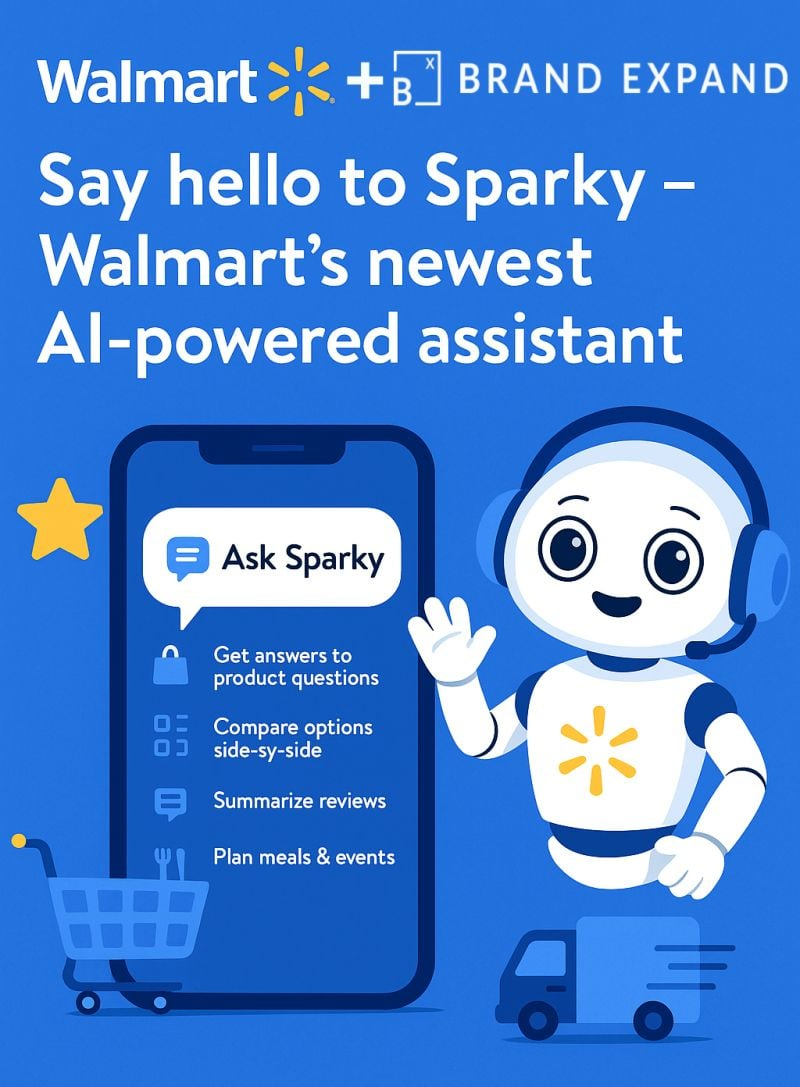
According to Walmart Canada’s launch announcement, Sparky allows customers to describe their needs in everyday language and receive product suggestions, comparisons and summaries of customer reviews.
A shopper planning a holiday dinner can ask for help assembling a list within a budget, while someone buying a gift can compare merchandise suited to a recipient’s interests. Walmart also identifies household decorating, children’s toys and family activities as occasions where the assistant can help customers find related products.
Andrew Go, vice-president of eCommerce and Marketing at Walmart Canada, explained in the company’s announcement that shopping often begins with a question, occasion or budget instead of a specific product. Sparky connects those initial needs with merchandise available through Walmart’s digital channels.
Available nationally in English and French, the assistant arrives ahead of the holiday shopping season. Walmart says additional capabilities, including image-based shopping and recipe inspiration, are planned but were not part of the initial Canadian offering.
Walmart’s U.S. Experience Points to Larger Orders
Sparky’s commercial potential is most evident in Walmart’s American business, where the assistant was introduced before its Canadian expansion.
During the company’s February 2026 earnings call, management reported that Sparky users had average order values approximately 35% higher than non-users. Walmart repeated the comparison in its May earnings commentary, when it also reported that weekly active users had increased by more than 100% during the preceding quarter.
The figures suggest growing engagement and a customer group placing relatively large orders. They do not establish how much additional spending Sparky generates, since shoppers planning substantial purchases may be more inclined to use an assistant in the first place.
Walmart acknowledged that limitation in an October 5 corporate statement, explaining that higher average order values do not prove the assistant caused customers to spend more on individual products.
The commercial opportunity is nevertheless apparent. Helping customers identify meal ingredients, compare alternatives and find complementary merchandise could reduce the effort required to assemble an order and improve conversion.
Whether that produces additional profit is another matter. Larger baskets may improve fulfillment economics, but delivery expenses, merchandise margins and the cost of operating AI services all affect the financial outcome.
Canadian Retailers Expand AI-Assisted Shopping
Walmart’s launch comes as Canadian retailers and shopping platforms introduce competing tools connecting conversational product discovery with transactions.
In February, Loblaw Companies Limited introduced a PC Express shopping experience within ChatGPT, allowing customers to explore meal ideas, select ingredients from nearby stores and move toward grocery purchases through existing fulfillment services.
Loblaw subsequently announced a collaboration with Google involving product discovery through AI Mode in Google Search and the Gemini app. Its February announcement described the shopping capability as forthcoming, rather than confirming every planned function was already available.
Retail Insider previously examined Loblaw’s Google initiative and reported in May that the company’s ChatGPT grocery integration was attracting customers ahead of expectations. Chief executive Per Bank said adoption was ahead of plan, although Loblaw did not quantify incremental sales attributable to the service.
Instacart has introduced Clementine, its conversational grocery shopping assistant. As Retail Insider reported in September, the platform uses customer preferences, shopping history and inventory information to help users plan meals, build lists and find products.
These initiatives illustrate two overlapping approaches to AI commerce. Retailers can incorporate assistants into their own websites and apps, maintaining control of the shopping environment, or make their assortments accessible through external AI platforms where consumers are already researching purchases.
Walmart is pursuing both approaches. In an October 21 announcement, the company described its broader conversational commerce strategy, including integrations with ChatGPT, Google’s Gemini and other AI services alongside Sparky.
The commercial implications extend to product visibility, transaction ownership and customer relationships. For retailers and suppliers, the question is how conversational recommendations influence which products customers consider and ultimately buy.
Pricing Transparency and Consumer Trust
As AI plays a larger role in shopping, questions about pricing and product recommendations are becoming more relevant.
In its October 5 statement, Walmart said it does not use customers’ personal information, income, shopping histories or willingness to pay to set individualized prices. The company also rejected suggestions that Sparky was being used to charge customers more for the same products.
Walmart chief executive John Furner subsequently reinforced the company’s commitments in a public letter on affordability, stating that information shared with Sparky would not be used to raise individual prices or conceal suitable lower-priced options.
Those assurances address personalized pricing, while product recommendations raise separate questions about how merchandise is selected and ranked. An assistant can suggest different products based on customer needs without changing the selling price of any individual item.
Customers may still want to understand whether recommendations reflect price, ratings, availability or other factors, particularly when shopping within a budget. For Walmart, maintaining that transparency is closely connected to its everyday-low-price positioning.
Connecting AI Shopping With Walmart’s Fulfillment Network
Sparky is also part of Walmart’s effort to connect digital shopping with physical stores and fulfillment operations.
During its February earnings call, management described how shopping baskets assembled through Sparky could be fulfilled using Walmart’s American inventory and store network, including delivery, pickup and in-store options. Executives also discussed developing technology platforms that could support consistent shopping experiences across international markets.
That connection gives the Canadian rollout a practical operating dimension. An assistant may simplify product discovery, but its value depends on whether the retailer can supply the requested merchandise accurately and at an acceptable cost.
For grocery and household purchases, inventory availability and substitutions are particularly important. An assistant recommending ingredients for a meal needs to produce an order that can actually be fulfilled, rather than a list of products that look appealing on a screen.
Walmart Canada’s stores, online assortment and fulfillment services provide infrastructure through which those purchases could be completed. The company has not disclosed whether Sparky has improved Canadian conversion rates, shopping times or pickup and delivery economics.
What Canadian Retailers Will Be Watching
Sparky’s Canadian introduction adds another competitor to a market where retailers are testing how conversational AI can influence shopping decisions. Walmart’s American experience suggests meaningful engagement among users, but the technology’s contribution to incremental sales remains uncertain.
Canadian adoption, conversion, repeat purchasing, average order values and fulfillment costs will help determine whether AI-assisted shopping creates additional profitable business or mainly changes how existing customers make purchases.
For Walmart and its competitors, the commercial test is straightforward: convert useful recommendations into completed orders while maintaining competitive prices and customer trust. The chatbot may attract attention, but the financial results will be determined by what happens at checkout and fulfillment.