Home Blog Page 1004

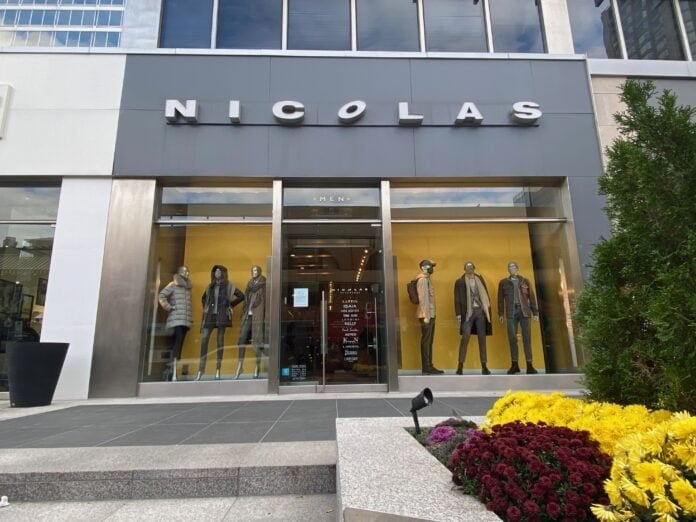
Meet the Manager: Luxury Retailer ‘Nicolas’ on Cumberland Street in Toronto

NICOLAS STORE ON CUMBERLAND STREET IN YORKVILLE, TORONTO. PHOTO: NICOLAS

By Retail Insider and Luxury Careers Canada

Luxury multi-brand retailer Nicolas, located at 153 Cumberland Street in Toronto’s Bloor-Yorkville Area, carries some of the world’s most highly respected luxury brands for both men and women. Nicolas is regularly sought out by high-profile North American tastemakers and celebrities for his unique take on fashion, always bringing in one-of-a-kind trend-setting pieces for his discerning clientele. Retail Insider recently spoke with Founder and Owner, Nicolas Kalatzis, to discuss how he got started, some of the challenges during COVID-19, and what Bloor-Yorkville could improve to attract a continuing affluent demographic following recent lockdowns.

Nicolas Kalatzis

RI: How did you first get involved in Retail? What motivated you to open your own store?

NK: My first job in retail was at the original Brick Shirt House near the corner of Yonge and Gloucester Streets next to Fenton’s restaurant in Toronto. I bought a shirt for $32.10 with tax and the owner, Alan Goouch, offered me a job. I was a student and it was a part-time job where I learned that I had a skillset for fashion. I could touch fabrics blindfolded and put together colours effortlessly, it was like I could swim the first time I jumped in the pool. On my days off as a student, I would visit Marvel Pant Company and I learned more about garments. I worked for Alan Goouch for a decade and then at the Marc Laurent store on Bloor Street which brought in brands including Claude Montana, Byblos, Cerruti 1881, and others.

I opened my first store in 1991 at the northwest corner of Bloor Street and Bellair Street, across from Harry Rosen. David Daniels of the Daniels family spearheaded financing for the store during a challenging recession. I styled my own private label clothing collection, accessories, and shoes (handmade by Fatta A Mano produced by small artisan factories), and I brought in designers no one had heard of. Names such as Giorgio Armani Black Label, Romeo Gigli, Canali and Paul Smith that all became more well-known with time. I opened the first Vestimenta (Black Label Armani) boutique in Canada featuring their own fixtures from Italy. I opened my current store on Cumberland Street in 2000 with brands such as Lardini, Aspesi and Herno, which is one of the best outerwear brands in the world, and we also carry some very strong labels such as Lanvin, Isaia, and Neil Barrett. Over the years, I have worked in excess of 70 hours weekly plus all of the European buying trips twice a year, as well as monthly trips to New York City for the store. I have been a pioneer with the brands that we have brought into Toronto. In 2004, GQ named Nicolas as one of the best stores in world, and British Vogue in 2013 named us as one of world’s top 100 stores.

The biggest asset is my eye to measure pin and tailor garments is second to none. Life is good when you are doing something that comes naturally to you that you love and can make a living from.

RI: What was it about Yorkville that made you decide to locate here?

NK: My first job in the Yorkville area was at Marc Laurent in 1980s. The area for the past several decades has been a destination for people who desire luxury goods. Being a node for luxury brands and consumers, having a store in the area makes sense. Being on Cumberland Street for a business like mine is ideal. The street has a quaint European flair which included foot traffic. Before COVID-19, about 75% of my customers were regulars and 25% were walk-ins. Today walk-ins are limited given the pandemic and with major hotels such as the Four Seasons, Hazelton Hotel and the Windsor Arms in the area being almost empty, that tourist traffic is not there.

RI: What are some of the unique challenges of being in Yorkville that is different from being in a mall?

NK: The weather is a big one, particularly in the winter. At the same time, you get a far more personalized and customized vibe in Bloor-Yorkville that you don’t generally get in a mall. Except for Yorkdale that is, which is a phenom with some stores that aren’t even on Bloor or in Yorkville.

RI: How has Covid impacted your business and what strategies did you use to defeat it?

NK: COVID-19 has hit the fashion industry from the top down. Some fashion houses have closed, some designer showrooms in the U.S. have shuttered with the process being accelerated due to the pandemic. It’s hard to do business when people are not in the offices. There are no events for charities, weddings, and other celebrations. The clothing purchases for most, therefore, are limited, except for possibly activewear and some smart-casual items. Sales of suit and sports jackets are extremely soft. Some people are also concerned for their jobs and are not doing lavish things. One only needs so much clothing. Smart-casual is where I focused over the past eight to ten years — it’s not just a sports jacket, power-blue button-down shirt without a tie. It’s an art to dress smart-casual. Connecting with my clients has proven successful and private appointments are available.

RI: What do you think the Bloor-Yorkville community needs to do to thrive in the future?

NK: I think the area would benefit from high-end advertising and events closing streets off. Sophisticated marketing makes sense, and the BIA may wish to communicate more with local merchants to determine the best messaging. Toronto is a terrific city and the Toronto International Film Festival is world class. Similar marketing tactics would be beneficial for Bloor-Yorkville to attract the ideal target demographic.

RI: Are there any retailers that inspired your current store concept?

NK: I would say no, to be honest. The way that I have curated my stores and product it unique. It’s my own look, and Nicolas as a result is not like other stores.

Luxury Careers Canada is a new recruitment firm job board that will continue to expand with new positions. Check out the job board here.

Why Canadian Grocers Need a Code of Conduct: Sylvain Charlebois

Many Canadians are oblivious to the fact that in the food industry, suppliers need to pay grocers to conduct business. Fees were justified by merchandising costs, shelf space, things anyone would expect. Yet in recent years, things changed. Companies like Loblaw, Walmart and Metro were using infrastructure and capital projects to justify new fees. Fees were imposed quickly, unilaterally. Walmart’s latest $500 million dollar distribution center project is partially financed by suppliers.

Grocers were charging fees by mainly dictating how business should be conducted in food distribution. It was their way or the highway, plain and simple. As grocers requested, suppliers and food manufacturers complied. It was the same in the United Kingdom and in Australia where oligopolistic powers in the grocery space prevailed. That is, until a code of practice was implemented. It seems Canada is now joining that club.

Indeed, a draft code of practice exists now in Canada between food manufacturers and grocers, well, one grocer. Our country’s number two grocer Sobeys, which recently acquired two key independent grocers in Longo’s and Farm Boy, felt it was time for a change. Number one grocer Loblaw and Metro, whose number three, have always stated a code was not necessary In Canada, and it’s highly doubtful they will join.

Agriculture Ministers in the country recently agreed to create a Working Group to study this important issue. Instead of waiting for a report to be presented sometime in July, both Food Health and Consumer Products Canada and Empire/Sobeys opted to go ahead and set a standard for the industry by presenting a new code of practice. The code includes 5 guiding principles which essentially gets all parties to commit and act in good faith as they conduct regular business. No more unilateral decisions, no more last-minute ploys, just straight, honest business.

Current market conditions just made it more challenging for food processors in Canada. Food manufacturing contributed $26.5 billion to the Canadian GDP in 2020. In the U.S., it was $766 billion in 2020, which is 29 times larger. That’s right, 29 times. As it is in the U.S., a strong food processing sector can serve as a strategic anchor for the entire industry. The supply chain is not as vulnerable to macroeconomic shifts and can allow the industry to better support our farmers. The Mad Cow crisis and our latest spat with China are good examples.

Despite the last decade seeing few new food plants open while several closures were reported, food manufacturing was the second largest manufacturing sector in Canada after transportation equipment in 2020. Despite the financial heartaches, food manufacturing also still managed to grow its GDP contribution from 13.18 per cent in 2010 to 13.47 per cent in 2020. But the sector can do much better.

While food prices continue to climb in Canada, grocers’ fees, in addition to low margins, have not helped manufacturers benefit from these rising prices. In most cases, farmers did not benefit from recent food price hikes. Some may speculate that food prices may rise due to a code, forcing grocers to charge more to protect margins. The United Kingdom has had a code since 2009, and food inflation in the country has generally been lower than here in Canada over the last decade.

This code is meant to change the culture of an industry in which vertical coordination and collaboration barely exists. It is also very much about dealing with a broken supply-side economic model few people in Canada can appreciate. The code is obviously an unproven concept in Canada, and few know if it’s going to work without other major grocers participating. However, the current situation was no longer viable.

Strong supply chain collaboration could lead to more innovation and growth. When forced to work on issues, parties will need to share data and insights. As such, market gaps can be recognized more easily as the execution of developing and commercializing novel food products is more likely. The code can create opportunities if the group remains disciplined and committed as the code is not legally binding.

Independent grocers, on the other hand, will likely get some welcomed help with the code. Unlike major chains, they could not really impose anything on suppliers. The relationship Sobeys has now with suppliers can be used as a useful benchmark.

Only time will tell us if the code works. But this effort is a valiant one. The concept is no longer just academic. Instead of letting politics dictate the industry’s faith, suppliers and Sobeys are giving themselves some hope that, perhaps, things can be different. Going ahead now with a code, not having everyone involved, also implies that the creation of a code of practice would have never happened with both Loblaw and Metro participating. Plain and simple.

BRIEF: Tudor Opens 1st Store in North America, Zara Home Exits Canada

Luxury Watch Brand Tudor Opens 1st North American Store at Toronto’s Yorkdale Shopping Centre

Swiss Luxury watch brand TUDOR has opened its first storefront in North America at Toronto’s Yorkdale Shopping Centre. The 450-square-foot space is a partner boutique connected to the mall’s Raffi Jewellers store which also features several other branded spaces. The boutique technically opened on November 19, 2020 and had to shut three days later due to pandemic lockdowns.

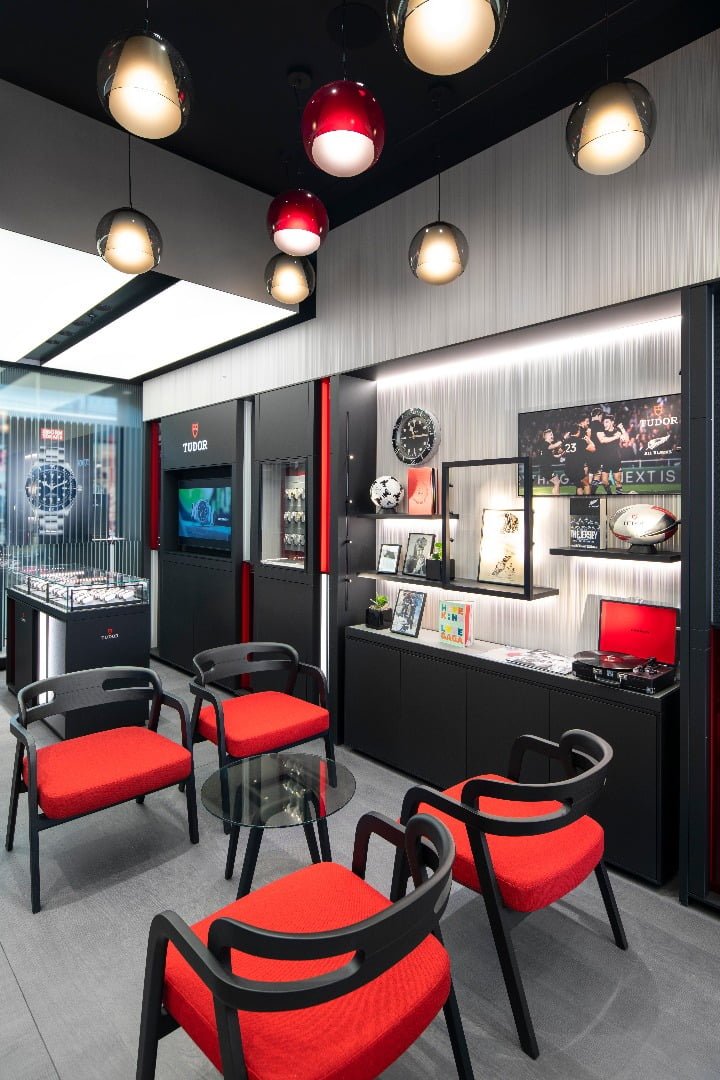
The TUDOR space features red, black, and grey colour hues combined with a mixture of high-quality finishes. The store includes a range of classic, sport, diving, and heritage inspired watches, including the newly-released TUDOR Royal line which is described as having a sport-chic range of watches with integrated bracelet, signature-notched bezel, and automatic movement.

The Yorkdale store faces directly onto the mall towards another luxury brand store, Breitling, which opened its first Canadian storefront in partnership with jeweller European Boutique in the summer of 2017.

TUDOR was founded in Geneva, Switzerland, in 1926 by Hans Wilsdorf, the founder of Rolex. Tudor continues to be the ‘sister’ company to Rolex with both companies being owned by the Hans Wilsdorf Foundation. The watches, which from afar could be mistaken for Rolex, are generally priced in the $3,000-$7,000 range depending on the style.

Interior of new Tudor boutique in Yorkdale Shopping Centre. Photo: Tudor
Interior of new TUDOR boutique in Yorkdale Shopping Centre. Photo: Tudor

Raffi Jewellers, which is the licensee for the new TUDOR boutique, operates storefronts at Yorkdale as well as at Square One in Mississauga. The Yorkdale store spans nearly 4,400 square feet. Tudor replaces a Jaeger-LeCoultre boutique that relocated down the hall into a standalone space that is now corporately owned.

Yorkdale is home to the biggest clustering of luxury brands in Canada, and sources say that more announcements are on the way for this year as well as into 2021.

We reported last month that Montreal-based jeweller Birks had partnered with Tudor for online sales.

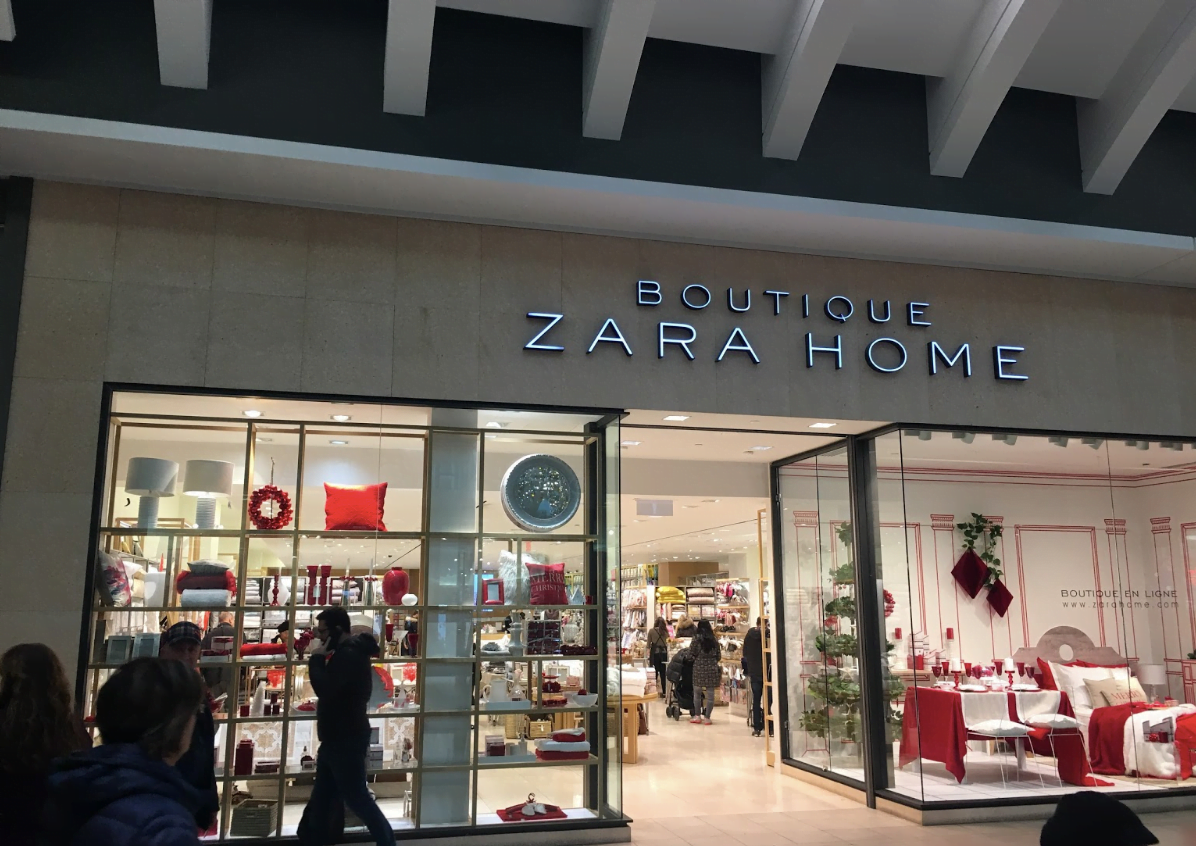
The soon-to-shutter Zara Home store at CF Carrefour Laval. Photo: Rentan TGLG

Zara Home Closes Canadian Stores

Spanish fashion brand Zara is closing its home division, Zara Home. By next month the brand’s last Canadian store — located near Montreal — will shut. Zara Home operated two storefronts in Canada for several years but the brand never expanded as broadly as had been anticipated.

The Zara Home store at CF Carrefour Laval is set to close on April 15, according to Retail Insider Montreal correspondent, Maxime Frechette. The 4,200-square-foot Zara Home store occupies a prominent location in the suburban Montreal mall near a Hudson’s Bay anchor store and across from Sephora and Aritzia.

A 4,500-square-foot Zara Home store at Toronto’s Yorkdale Shopping Centre shut permanently last year, and its space is set to be integrated into a new Nike flagship store that will be opening in the mall this year. The Yorkdale Zara Home store was the first in North America when it opened on August 22, 2013.

The Zara Home stores have struggled with merchandising and aggressive competition from other home furnishings retailers over the years. Zara Home stores operated as standalone units separate from the company’s popular Zara fashion stores. Zara Home continues to maintain a standalone Canadian e-commerce site.

Madrid-based Inditex also operates Zara and Massimo Dutti stores in Canada.

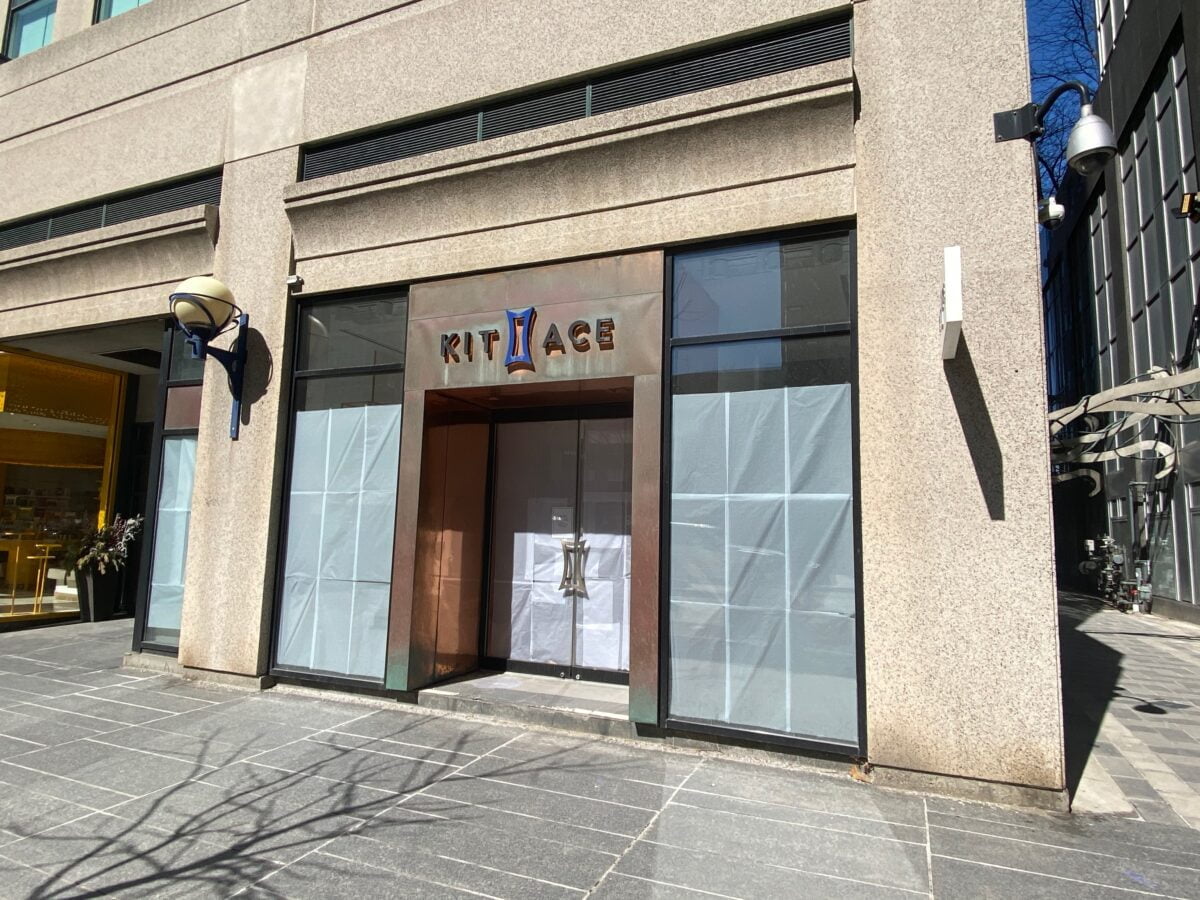
Exterior of shuttered Kit and Ace store at 102 Bloor Street West. Photo: Craig Patterson

Kit and Ace Exits Toronto’s Bloor Street Luxury Run

Vancouver-based fashion retailer Kit and Ace has shut its store at 102 Bloor Street West in Toronto. The store opened in 2015 and replaced a Benetton store that had operated there for years.

The full space spans 4,520 square feet on one level and includes a coffee component facing onto Critchley Lane called ‘Sorry Coffee’ which remains open for now. The coffee bar is also expected to shut and the space is now being offered for lease by Stan Vyriotes and David Wedemire of DSWV Realty. More information on the space can be found here.

Click for interactive Google Map of surrounding area.

Kit and Ace went on an expansion tear in 2015 and opened pop-up stores in markets across Canada. The brand was founded in 2014 by the Wilson family, including lululemon Founder, Chip Wilson, and his wife, Shannon, and son, J.J. The brand struggled financially and in 2017 all international stores were closed. In December of 2018 we reported that Kit and Ace CEO, George Tsogas, had purchased the company from Wilson’s Hold It All Inc. and that the brand was being repositioned from a ‘technical cashmere’ brand to a ‘modern commuter’ brand. With that, fashions targeting urban cyclists were added to stores.

Kit and Ace continues to operate six standalone stores in Canada. That includes two in the Vancouver area (165 Water Street in Vancouver and at Park Royal in West Vancouver), one at 171 Lakeshore Road E. in Oakville, ON, one in Mount Royal Village in Calgary, and, during the pandemic, Kit and Ace opened a store in a unique heritage building at 10324 Whyte Avenue in Edmonton.

Exterior of new Summerhill Market on Eglinton Ave West. Photo: Summerhill Market

Summerhill Market Opens 4th Location in Forest Hill

The latest addition to Summerhill Market’s expansion plan has opened on Eglinton Avenue West, in Toronto’s Forest Hill neighbourhood.

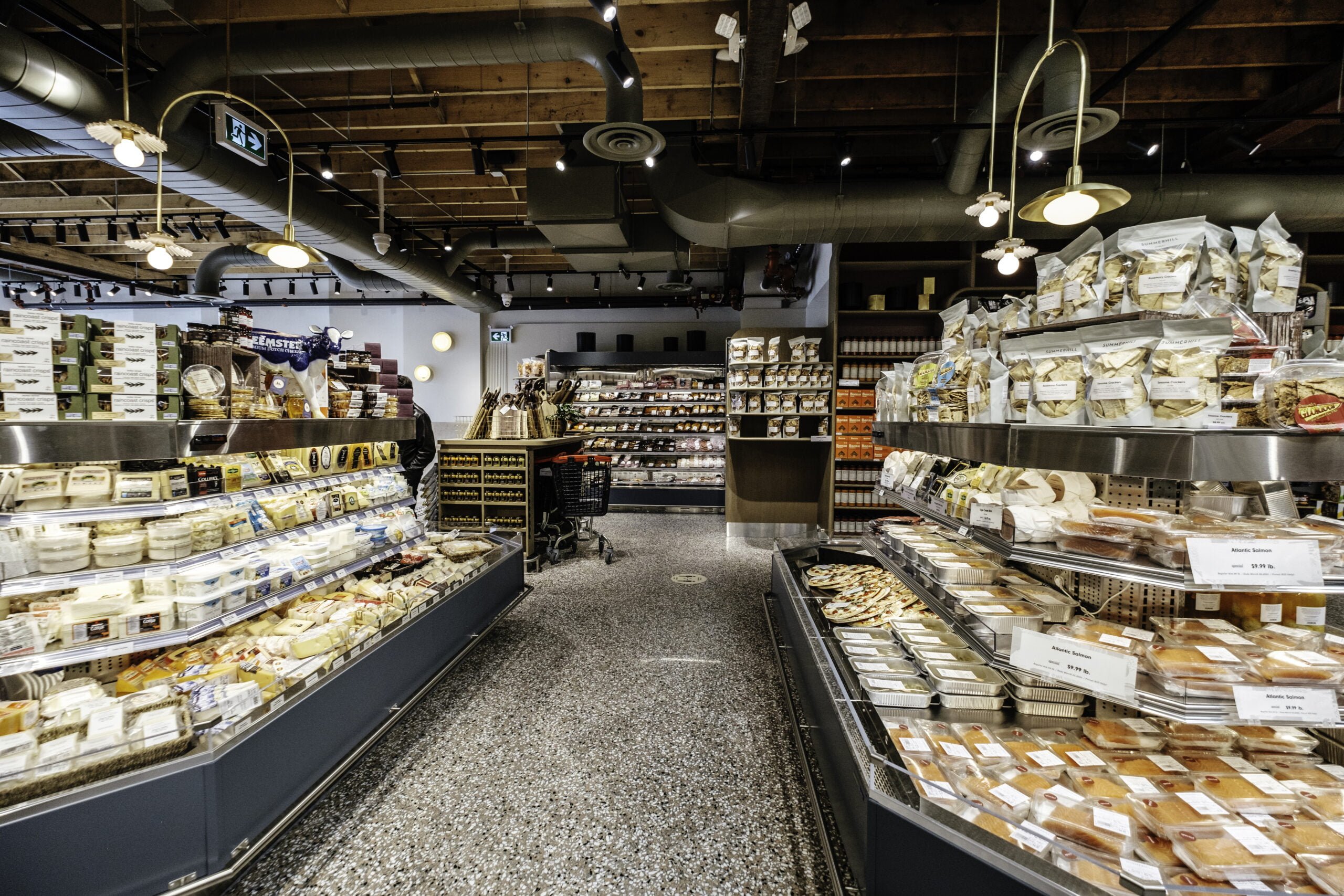
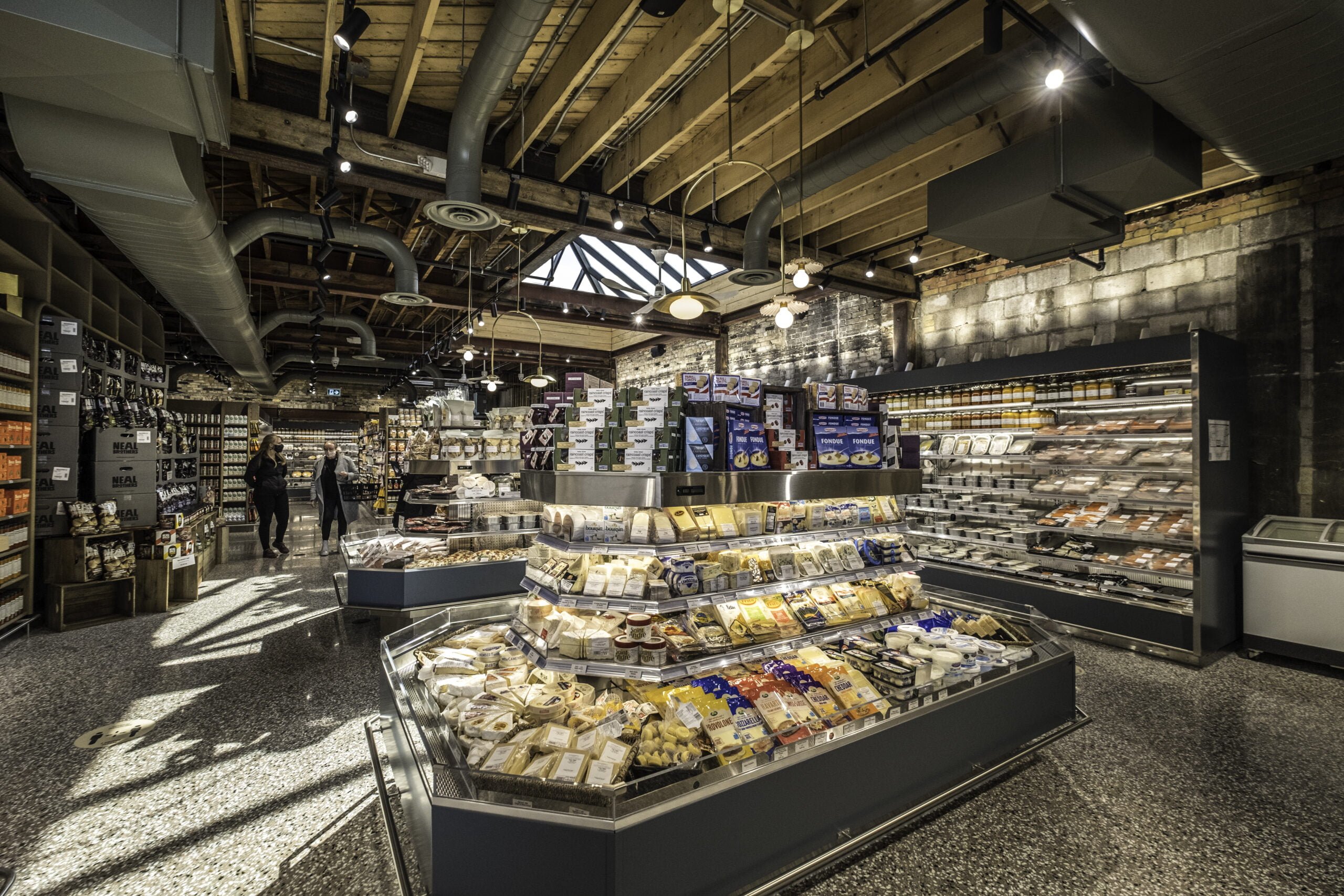
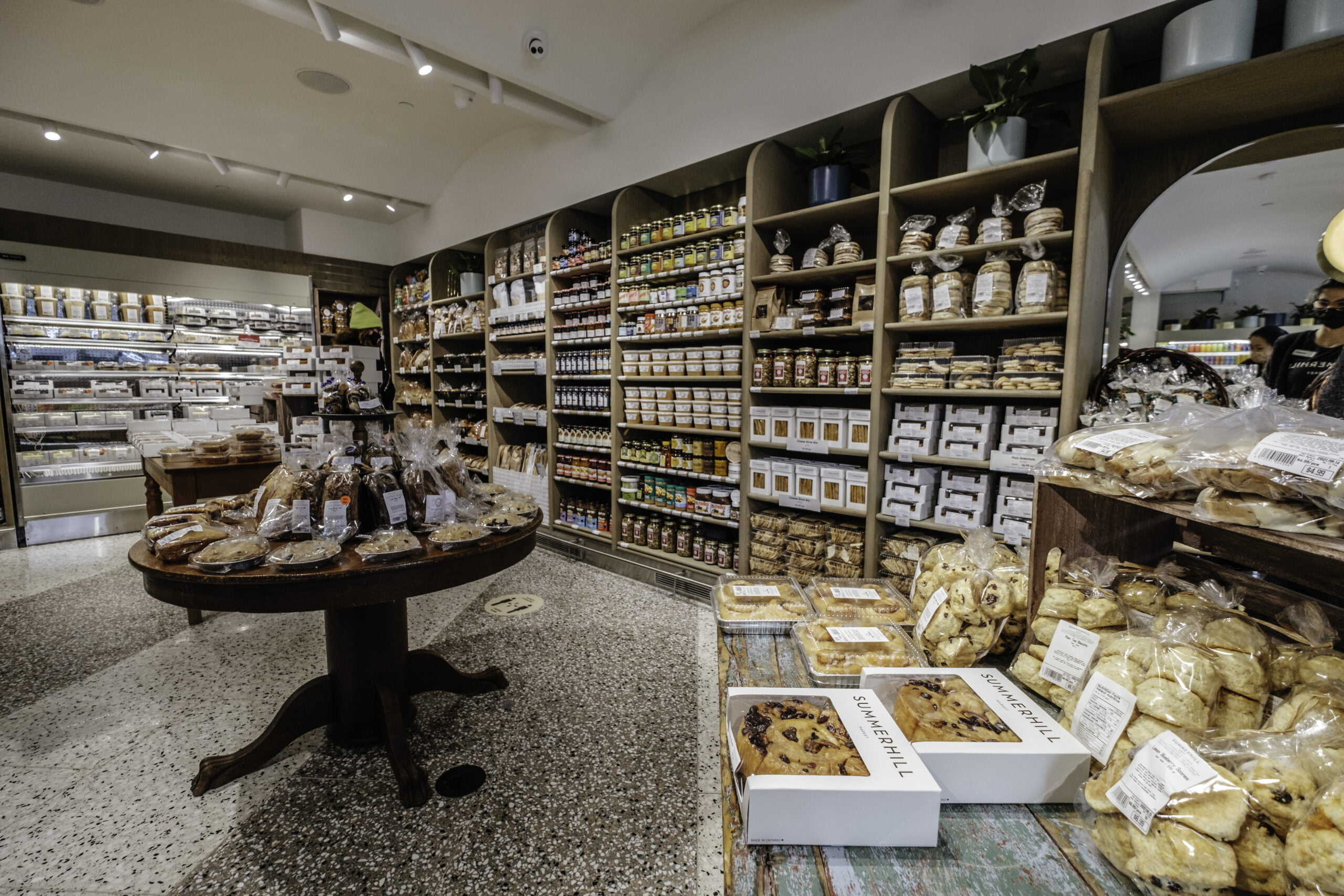
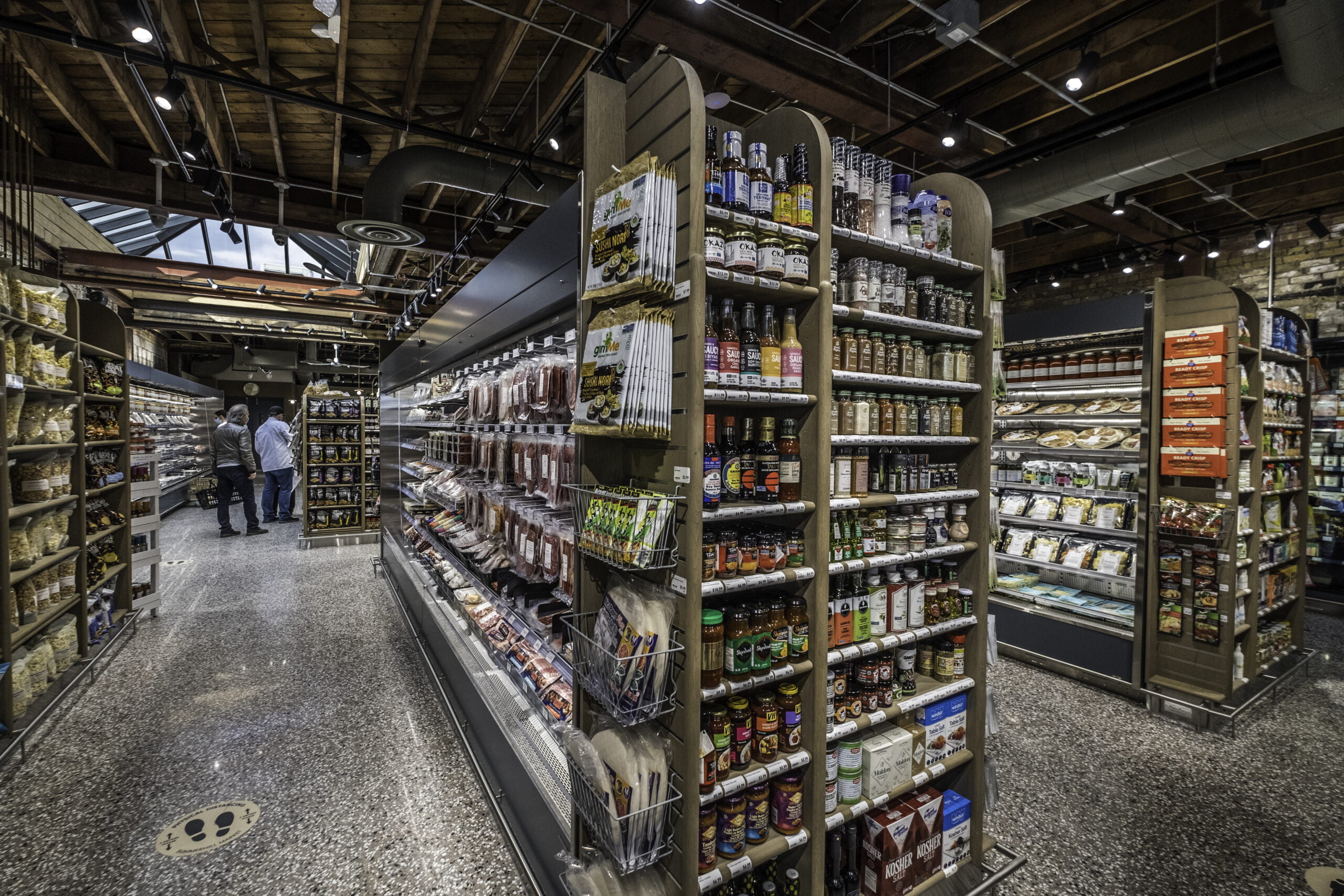
The fourth and largest location to date, Forest Hill’s Summerhill Market sits at 7,200 square feet and spans two floors. The space was previously a restaurant and has been extensively renovated to accommodate the boutique grocerant and its extensive product line up.

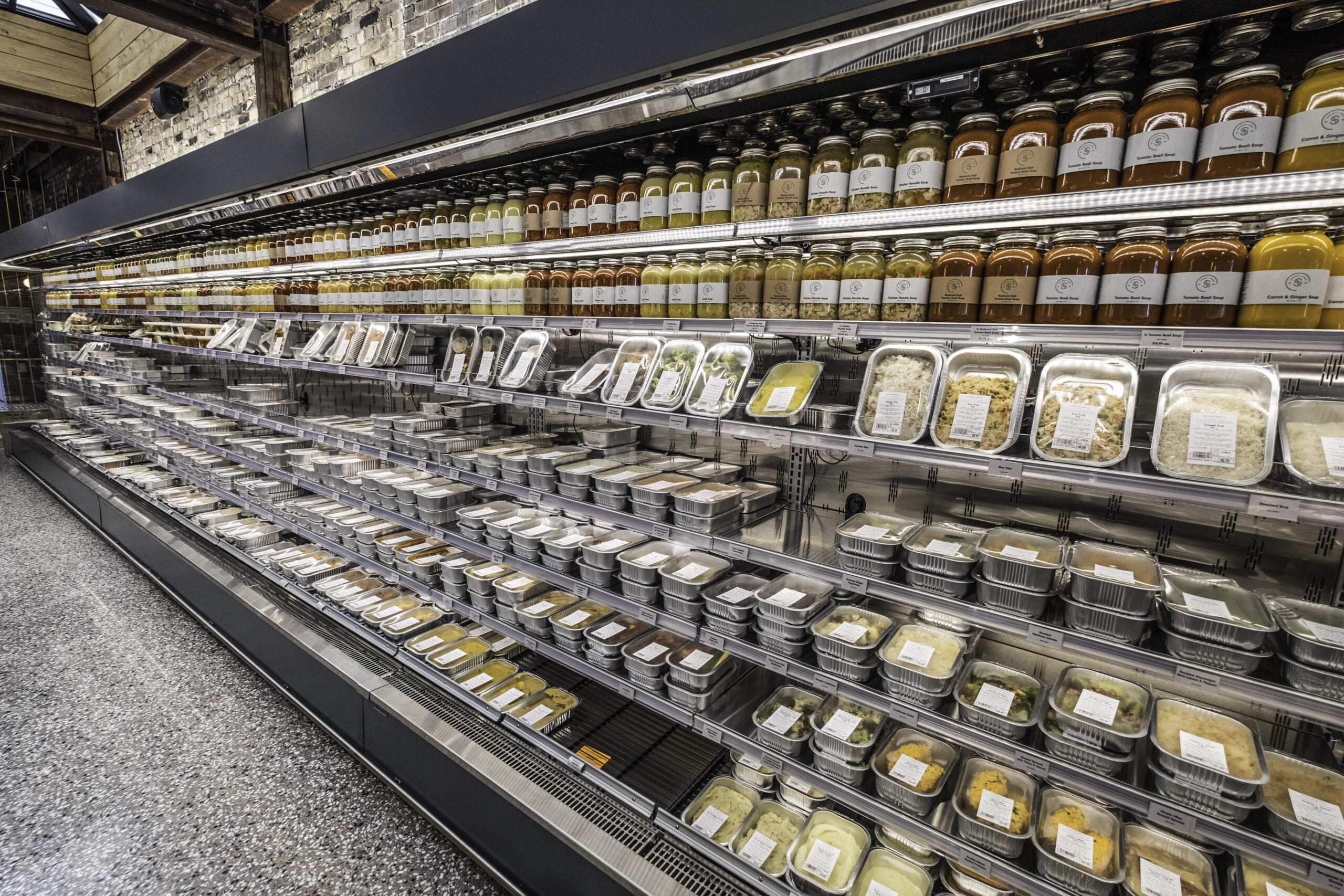
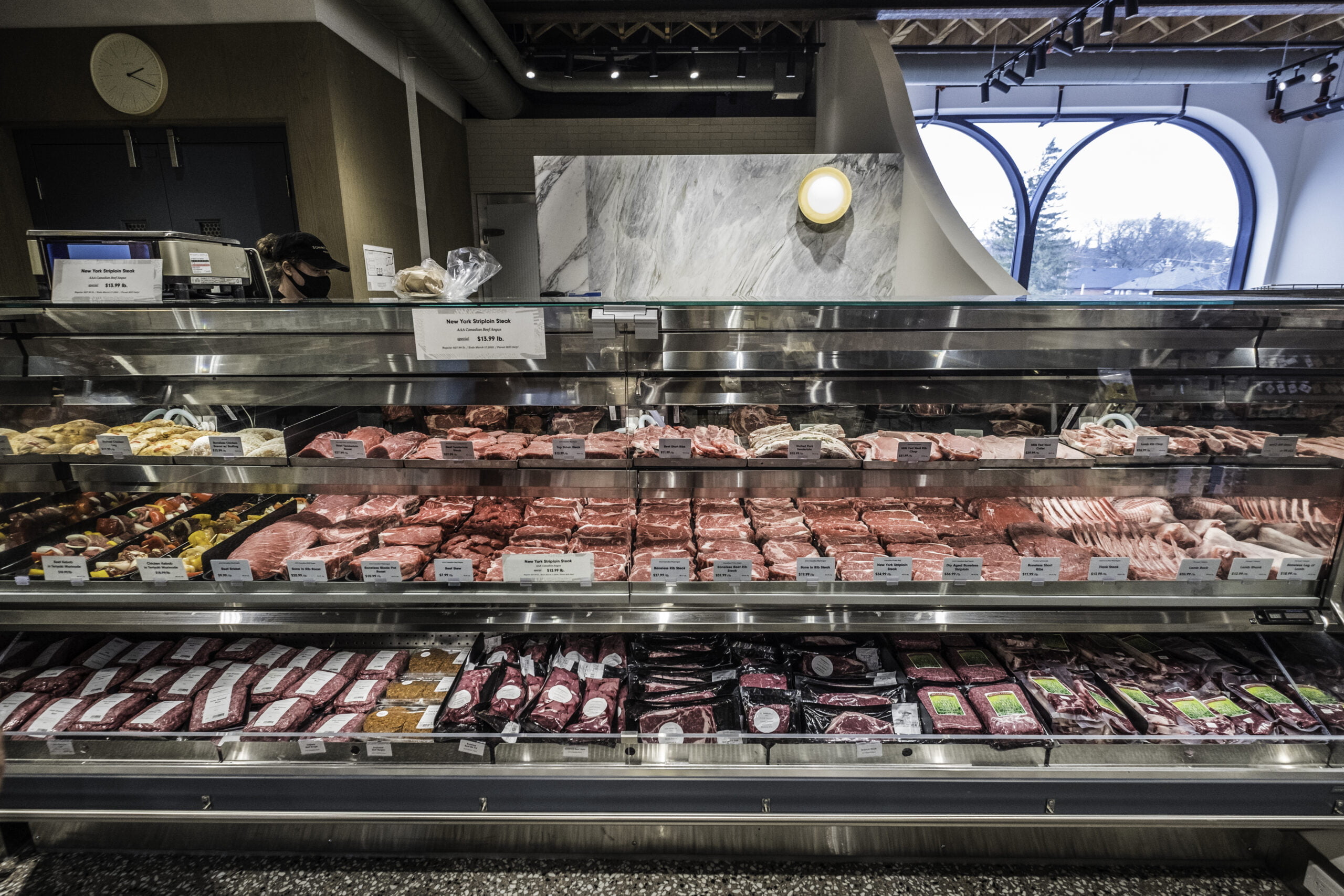
With two floors to work with, Summerhill dedicated the main floor to fresh produce, dairy and dairy alternatives, and grab-and-go meals. The second level provides customers with the retailer’s popular heat-and-eat items, a butcher, a deli and cheese counter, and various frozen food and pantry staples. Also, unique to this location and largely due to the local demographic, Summerhill Market Eglinton offers an extensive selection of kosher goods.

Retail Insider reported on Summerhill’s recent partnership with Chef Ted Corrado, who will be overseeing the market’s line of 800-plus house-made items. In addition to adding more restaurant-quality dishes and finessing Summerhill’s established recipes, Corrado is adding frozen and prepared foods from some of his industry peers, including dim sum from Patois chef Craig Wong.

Retail Insider has reported on Summerhill Market’s rapid expansion in the past. In December of 2019, we reported on the opening of Summerhill’s Annex location. In that article, we revealed that the Eglinton store would be opening shortly thereafter, with no way of knowing what kind of year 2020 would be. Now in the spring of 2021, we are pleased to watch Summerhill Market’s continued growth with it’s newest store.

Circle Craft Launches #ShopYourCircle Pop Up to Support Local

The Circle Craft market on Granville Island in Vancouver is encouraging local shopping with a pop up experience. The unique BC artist co-operative says that it wants to continue this push towards supporting smaller, local retailers through its first-ever pop up experience at its Granville Island store.

The pop up will showcase three style collaborations with local design influencers and will also highlight unique work from seven unique artists. Pieces range from glasswork to paper art to pottery.

The #ShopYourCircle pop up is taking place from March 31 to April 12, 2021. Supporting local retail is important to the future of the Canadian economy, as was laid out in a recent feature in Retail Insider.

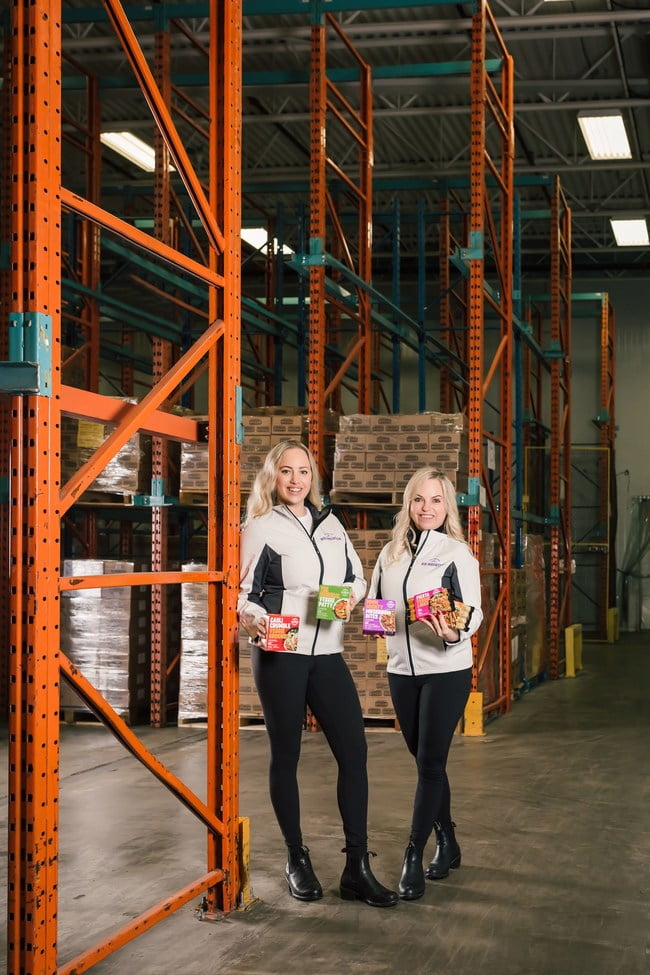
Kimberly Chamberland (right), CEO, and Jasmine Chamberland (left), President of Big Mountain Foods in their new 70,000-square-foot facility that opened in February 2021. CNW Group/Big Mountain Foods)

Big Mountain Foods Announces Major Expansion Amid Competitive Vegan Market

Mother-daughter-owned-and-operated Big Mountain Foods has announced its expansion into a 70,000-square-foot facility. The space will provide the company with the tools and international reach to make their plant-based foods more accessible than ever. Big Mountain Foods is also aiming to operate a zero-waste facility by 2025.

The natural vegan food manufacturer, owned and operated by Kimberly and Jasmine Chamberland, recently partnered with grocer giant, Kroger, to help facilitate the move into the sprawling new facility.

“I am so proud of the expansion Big Mountain Foods has undergone to get to this point and we are ready to move forward into a larger facility with the top talent in place to execute our product outreach strategy across the USA, Canada, and Asia over the next five years,” says Kimberly Chamberland, CEO of Big Mountain Foods and Orange County, California native.

“With new brands entering the plant-based space, we’re ready to expand our capacity and execute our vision to be the leader in clean eating while continuing to innovate allergen-free, clean-label products with ingredients our customers know and love,” says Jasmine Chamberland, President of Big Mountain Foods.

Founded in 1987, Big Mountain Foods has been a supermarket mainstay for years due to the quality of its plant-based products. The manufacturer also prides itself on being entirely female-owned and having a 90% female workforce.

Independent Grocers Are a Dying Breed in Canada: Sylvain Charlebois

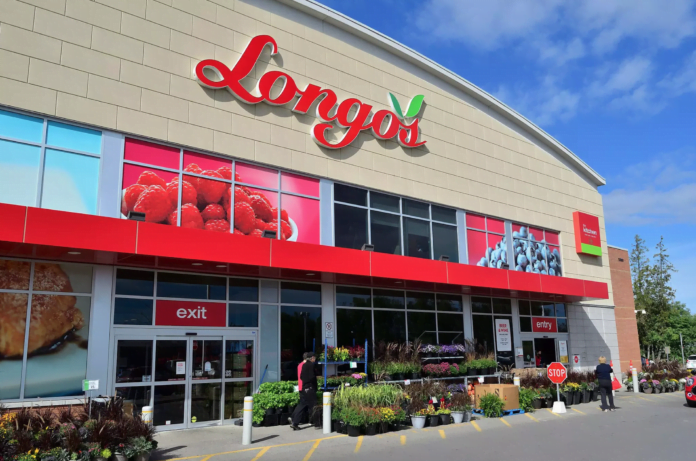
Exterior of Longo's grocery store which was recently acquired by Empire/Sobeys. Photo: Longo's

Most of us would not know if we were in an independently-owned-and-operated grocery store unless it is mentioned somewhere as you enter the store. Almost weekly these days, Canada loses an independent grocer. Last week, we learned that Empire/Sobeys would purchase one of Canada’s top premium independent grocers, Longo Brothers Fruit Markets, located in the Greater Toronto area. The $357-million deal allows Empire to acquire 51% of Longo’s and will control the entirety of the business in a few years. Longo’s is currently operating 36 stores in Southern Ontario.

Like most independent grocers, Longo’s was truly a family business. The three Longo brothers founded the company in 1956, and more than 25 family members across three generations continue to work in the company.

Canada is home to about 15,500 grocery stores. Less than 34% are independently owned and operated, and that percentage is continuously shrinking. Independent grocers are known to offer something different to customers, products you would not find elsewhere. The service is often highly personalized. Some managers know many of their customers on a first-name basis. The experience is often very different, and no duplicates exist elsewhere. Most Canadians would not know that a lot of the innovation we have seen in food retailing in Canada has come from independents. In fact, Longo’s has been in the e-commerce game since 2004, when it acquired Grocery Gateway, at a time when few believed buying food online was even a thing. New products, novel store design — they have brought so much for years. Farmboy and Longo’s are just a few examples of how independent grocers have a different way of looking at things. It’s refreshing.

Loblaws, Sobeys, and Metro are selling practically 75% of all the retailed food in Canada right now, and that percentage has continued to rise. Both Costco and Walmart are now selling a combined $32 billion dollars’ worth of food to Canadians. Pressures on independents are real.

To make matters worse, here is another pressure point for independents. It is often reported that most major grocers are charging more fees to suppliers to finance some key strategic initiative or other. Just last week, we learned that Walmart would invest $500 million to build a new distribution facility to support its e-commerce platform. Some of the funding likely came from suppliers like Kraft-Heinz Canada, PepsiCo Canada, Unilever Canada, and Lactalis. Independent grocers are slowly becoming less competitive, since they cannot bully their way through the supply chain, as major grocers are doing. They just do not have enough power and influence.

Empire/Sobeys is the only major grocer in the country which has expressed concerns about extra fees imposed on food manufacturers. It is affecting our food processing sector’s competitiveness, of course, but it is also affecting how independent grocers can keep up with the rest of the field.

This is likely why the Longo family opted to sell. But also given that they had to choose one buyer, it had to be Empire/Sobeys, due to its stance on supply chain bullying.

The good news is that major grocers are starting to value the uniqueness of some of these retailers. Years ago, while Loblaws destroyed Ontario-based Fortinos and completely changed the in-store experience, Empire alienated Safeway shoppers out West with its acquisition in 2013. It scrapped the Safeway loyalty program and many cherished products were either hard to find, or disappeared completely. All grocers have implemented such drastic changes, and massacred a brand or two in the past. At the time, it was all about consolidation and synergies, at all costs.

But in recent years, the approach appears to have changed. Loblaws’ acquisition of TNT, a unique retailer in Ontario serving the suburban market in Toronto, was executed with few hiccups. Most Farmboy shoppers in Ontario, which was acquired by Sobeys in 2018, have barely seen a difference. And as in the Farmboy deal, Longo and his executive team will remain at the helm of the company and will operate separately from the main company. Longo’s will likely become more profitable by using Sobeys’ buying power across the supply chain.

In the meantime, Canadians should be concerned about the fate of our independent grocers. A committee in Ottawa is currently looking into these outrageous fees charged by some grocers. For the sake of the independents, let’s hope the committee comes up with some good ideas when they table their report in July.

Canadian Retail Sales Bumbled Along in January: Ed Strapagiel

E-commerce is booming according to Statistics Canada.

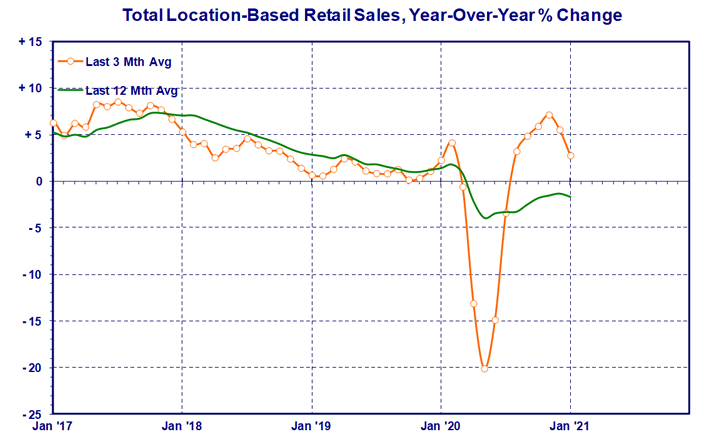
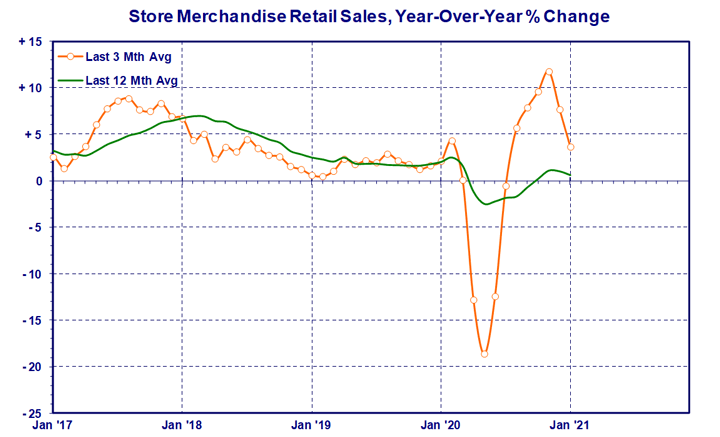
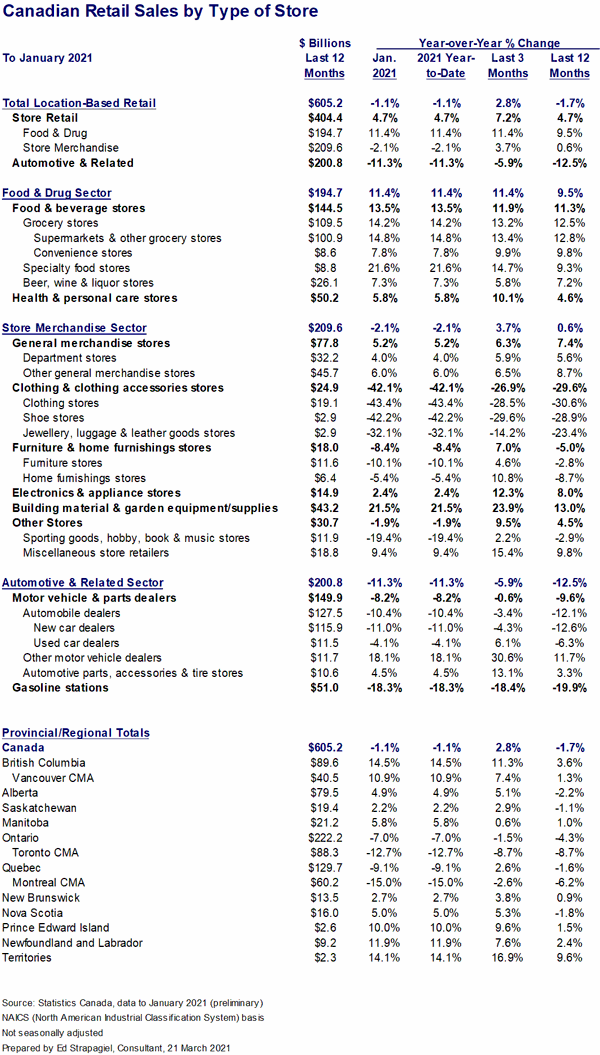
Total Canadian retail sales growth has cooled off somewhat, after hitting some high rates late last year. Nevertheless, there was still a respectable increase of 2.8% for the three months ending January 2021. In the month of January alone however, total retail sales actually declined by 1.1%, although this is on a preliminary and unadjusted basis.

The underlying 12 month trend (green line in the above chart) continues to struggle and remains in negative territory, mostly due to the extreme decline in retail sales growth in Q2 2020. We are however likely to see some positive growth trends this spring – even if only because retail sales in the coming months of 2021 will be compared to very weak 2020 year ago numbers.

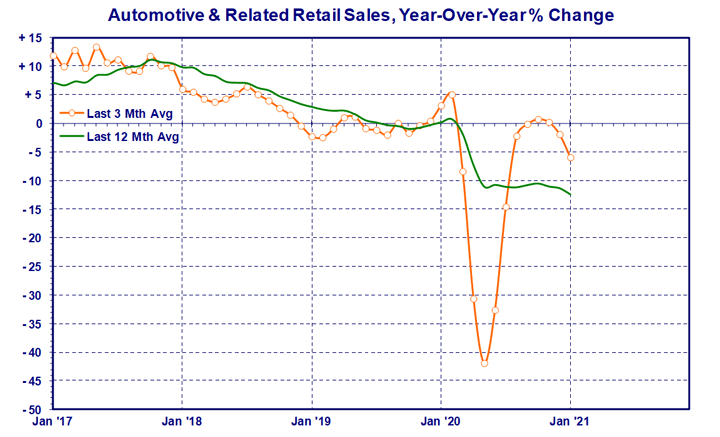
Another matter is that sales trends are very uneven among the major retail sectors. Food & Drug is doing extremely well, a recovery in Store Merchandise is now losing steam, Automotive & Related appears to be on its way down again, and E-Commerce is absolutely booming.

Food & Drug

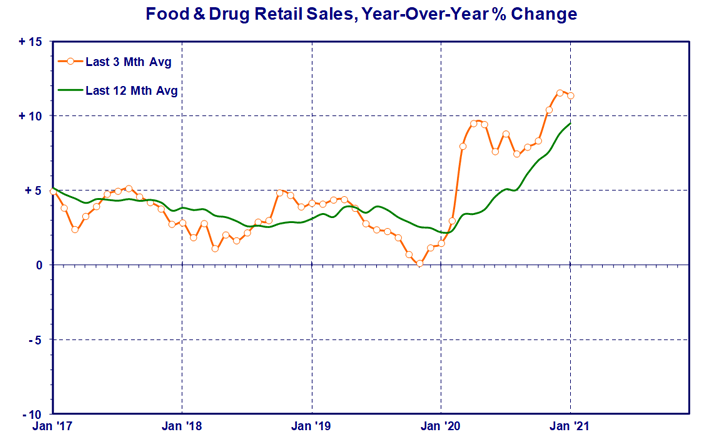
The Food & Drug sector is hitting record highs in retail sales, with growth of 11.4% year-over-year for the three months ending January 2021. The underlying 12 month trend has been on a steep upward trajectory for almost a year.

Retail sales at supermarkets and other grocery stores have been particularly strong, increasing 13.4% for the three months ending January 2021. Even so, the smaller specialty food stores group reported an even bigger gain of 14.7% in the same period.

Health & personal care stores are also contributing to the success of the Food & Drug sector. Their retail sales grew by 10.1% year-over-year for the three months ending January.

Store Merchandise

Retail sales growth in the Store Merchandise sector collapsed in the first half of 2020, but returned to positive territory in the second half of the year. And now, going into 2021, it appears to be softening again. For the three months ending January 2021, retail sales increased a modest 3.7%, but in January alone sales declined 2.1% (a preliminary and unadjusted figure).

Within Store Merchandise, retail fortunes vary greatly by store type. Sales at building material and garden equipment/supplies dealers were up a whopping 23.9% year-over-year for the three months ending January 2021, miscellaneous store retailers (which include cannabis stores) gained 15.4%, and electronics and appliance stores were up 12.3%. At the other end of the scale, retail sales at clothing and accessories stores were down a disastrous 26.9%.

Some of this may be related to retailer size and store format. Larger operations generally have deeper pockets and higher leverage for developing e-commerce capabilities, plus stand-alone locations suitable for curbside pick-up operations. Small fashion retailers however may not be as sophisticated in e-commerce and delivery services, and also to be stuck in locked down shopping malls.

Automotive & Related got run over in the first half of 2020, fought its way back to flat by the end of the year, but now seems to have hit another pothole. Retail sales declined 5.9% year-over-year for the three months ending January 2021, and by 11.3% in January alone.

Gasoline station retail sales were particularly weak, down 18.4% for the last three months. While pump prices have stabilized, people are still driving less due to anti-COVID measures.

New car dealers showed some life a few months ago but now are back to a downward trajectory. Their retail sales declined 4.3% year-over-year for the three months ending January 2021.

By The Numbers

Note that the data and analysis in this report are always based on not seasonally adjusted (or unadjusted) retail sales statistics.

For definitions of store types, see Statistics Canada NAICS.

Canadian E-Commerce Sales

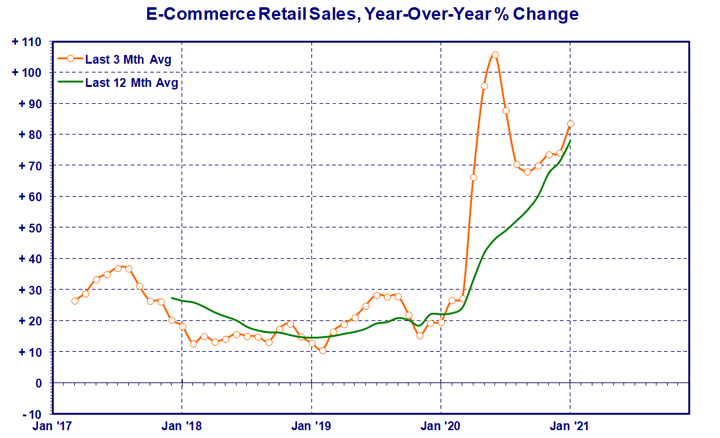
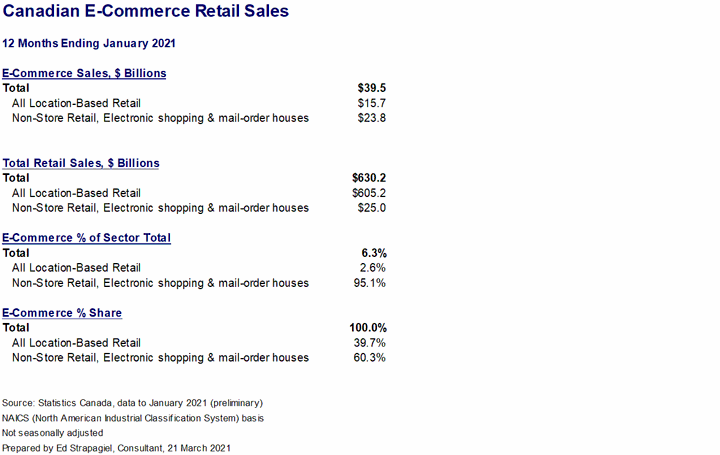
With store shutdowns and shopping mall closures, Canadian consumers turned to e-commerce in a big way in 2020. This is continuing going into 2021. E-commerce retail sales were up 83.6% year-over-year for the three months ending January 2021.

Overall, e-commerce represented about 6.3% of Canadian retail sales over the past 12 months, including both pure plays as well as bricks & clicks stores. Note that Canadian consumers may also buy online from foreign websites which is not captured in these numbers.

Location based retail is the same as that in the preceding “By The Numbers” table. It’s what’s normally reported as Canadian retail sales. Except that it isn’t. Location based retail excludes another section called Non-Store Retailers (NAICS code 454), which includes electronic shopping and mail-order houses, which in turn is where (mostly) pure play e-commerce businesses are. Over the 12 months ending January 2021, electronic shopping and mail-order houses had an estimated $23.8 billion in e-commerce sales.

But that’s not the only source of e-commerce, as (mostly) bricks & mortar location-based retailers also sell online. For the 12 months ending January 2021, this group had an estimated $15.7 billion in e-commerce sales. With electronic shopping and mail-order houses, there’s a grand total of $39.5 billion in e-commerce sales by Canadian operators. Note that this does not include foreign e-commerce purchases made by Canadian consumers, but it does include e-commerce purchases made by foreigners at Canadian operations.

For electronic shopping and mail-order houses, an estimated 95.1% of their sales are currently allocated to e-commerce. For (mostly) bricks & mortar retailers, it can be estimated that 2.6% of their total sales are attributable to e-commerce.

In the final section of the above table, (mostly) pure play operators (namely, under electronic shopping and mail-order houses) generated an estimated 60.3% of all e-commerce sales in Canada, while (mostly) bricks & mortar location-based retailers’ share of e-commerce was 39.7%.

For more explanation on the e-commerce numbers, see Statistics Canada: Retail E-commerce in Canada.

Read More Canadian Retail Analyses From Retail Insider:


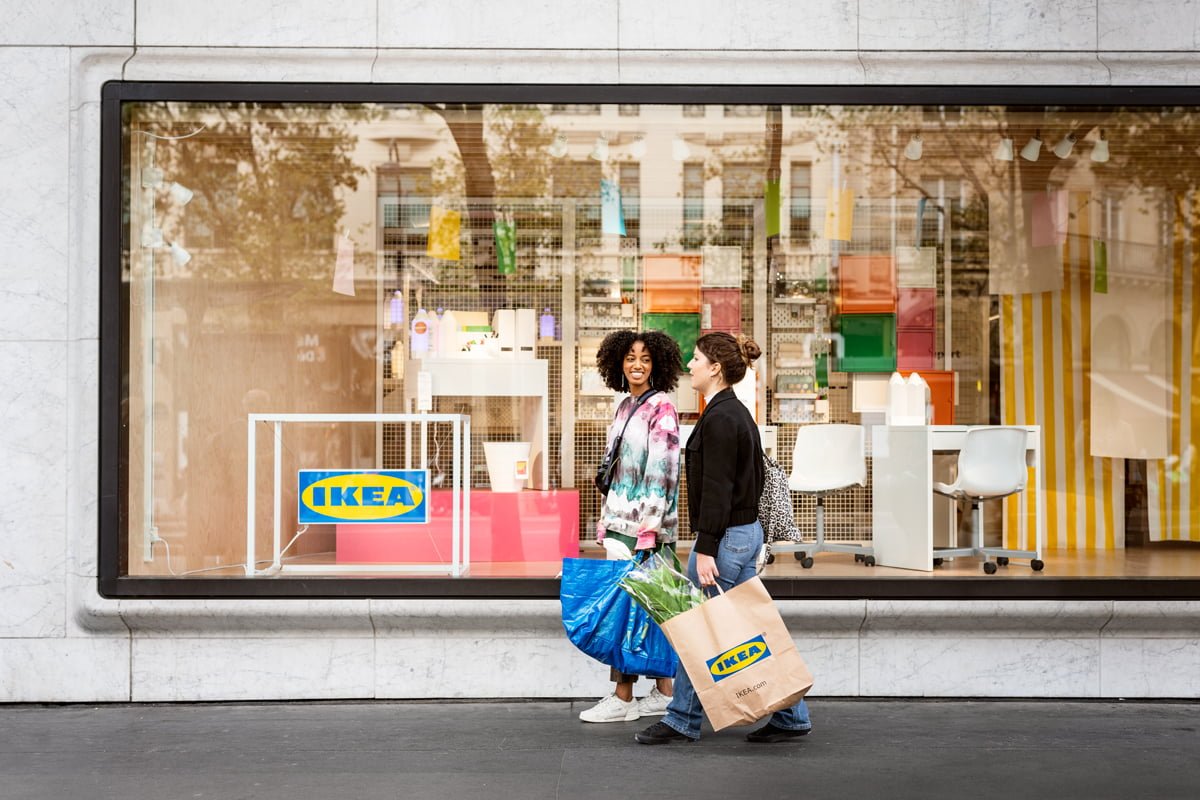
IKEA Announces Downtown Toronto Store

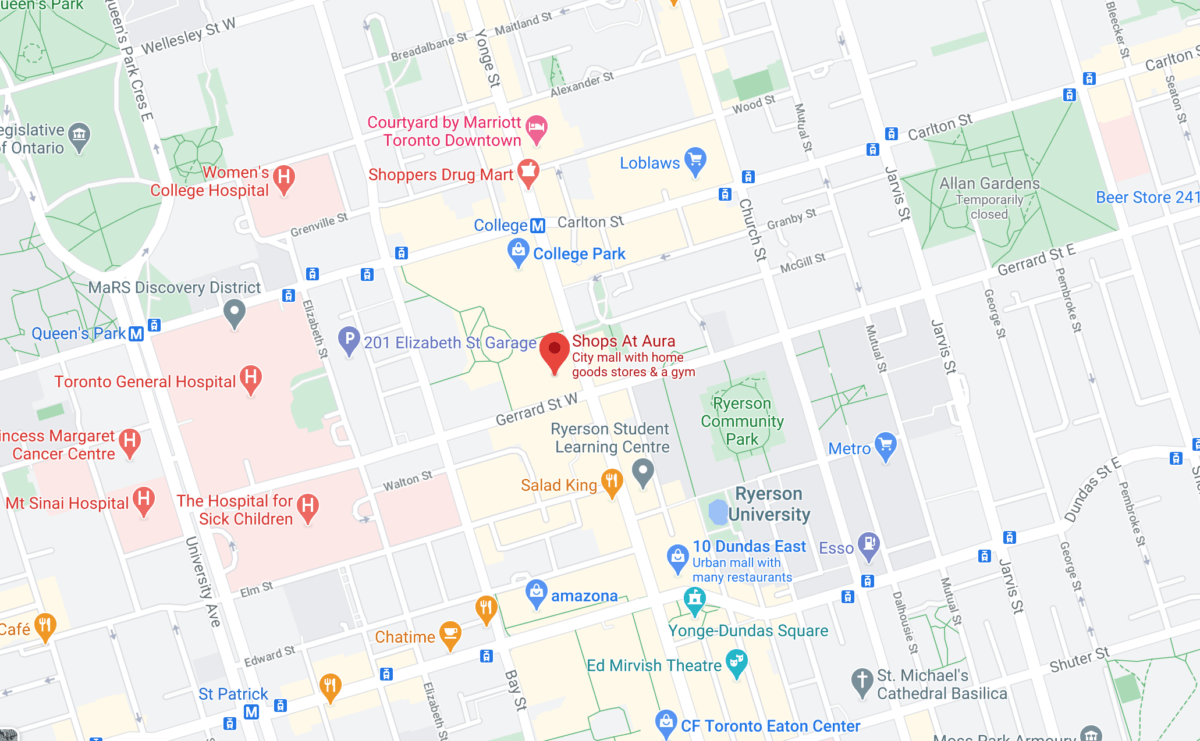
Exterior of Aura Retail Podium. Photo: Dustin Fuhs

Swedish home furnishings retailer IKEA is opening its first urban format store in Canada in downtown Toronto. The store will be located in the commercial podium of the Aura building in downtown Toronto that recently saw three restaurants vacate the main floor as well as a Bed Bath & Beyond that shut this month on the second level. The IKEA store is set to open in late 2021 or early 2022.

Ingka Centres, which also operates under IKEA’s parent company, struck a deal to acquire the commercial spaces at Aura at 382 Yonge Street following extended negotiations with the landlord. That included buying the commercial spaces as well as 110 parking spaces in the complex in anticipation of opening the urban store. For several weeks, Retail Insider was provided information on the deal while we awaited confirmation from IKEA on the new store opening. We were informed by real estate insiders that Ingka Centres was purchasing the Aura real estate in order to give IKEA a favourable lease rate while also owning the asset.

The new 66,175-square-foot Aura IKEA store will include more than 2,000 products for purchase on the sales floor that can be brought home immediately, while some larger items will be on display but will only be available for home delivery. The company says that the downtown Toronto store will not allow for “self-service furniture”.

A new food concept will be featured in the store as well as “an array of services to support a seamless shopping experience”. IKEA says more details will be released soon.

Ingka Centres acquired the Aura commercial podium from Kingsett Capital’s core strategy CREIF Fund. The podium is at the base of the Aura building — a mixed-use skyscraper co-developed by one of KingSett’s Growth Funds. It also includes a tall residential tower and a stratified basement shopping centre that some say is the worst of its kind in Canada in terms of design. The entire podium is 132,070 square feet of gross leasable area over three floors, with an operational Marshalls store occupying the third level.

“The acquisition of the Aura Retail Podium marks our entry into the Canadian market,” said Cindy Andersen, Ingka Centres Managing Director. “Downtown Toronto is a super connected and dynamic place where people live, work, study and come to meet and have fun. It is in line with our strategic vision to invest in urban locations and to be closer to our customers”.

Click for Interactive Google Map

Some are questioning the choice of location for IKEA in downtown Toronto, including questioning the success of a furniture showroom at that particular location. Ikea’s move into downtown Toronto is part of an effort to gain market share at a time when competitors are also making inroads. Vancouver-based online furniture retailer Article, for example, has seen explosive growth and is known for its design and quality products. Quebec-based Structube as also expanded its operations while offering delivery which has increased sales. Closer to Aura in downtown Toronto, retailers such as TJX’s banners Winners, Marshalls and HomeSense all offer discounted home goods that are at comparable price points and often of better quality than that offered by IKEA.

Downtown Toronto is home to about 300,000 residents and IKEA’s inexpensive furniture offerings may be attractive to budget-conscious students living downtown. That market is expected to return when post-secondary students go back to physical classroom learning. Downtown Toronto is also home to an affluent and upwardly mobile population which may look for a more elevated product than that which IKEA offers. Some also have expressed frustration with building furniture and negative experiences with IKEA partner TaskRabbit have turned some off.

Globally, IKEA has opened 10 smaller IKEA stores in major markets including Paris, Moscow, Shanghai, and most recently, in Queens, NY. The “new city” approach aims to allow customers to shop seamlessly across all channels based on their individual needs and preferences.

IKEA Canada said that it also now offers its customers the ability to pick-up online orders closer to home at eleven Penguin Pick-Up locations across Toronto.

The new IKEA Toronto Downtown store will be IKEA Canada’s fifth store location in the Greater Toronto Area, along with existing stores in Burlington, Etobicoke, North York, and Vaughan. IKEA’s first Toronto location opened in 1977.

The Importance of Customization for Canadian Retailers When Selling to Buyers

Image: Samsung

By Angelina Lawton, Founder and CEO, Sportsdigita

Retail is a constantly evolving business. Increasing margins, improving retention, and connecting with new markets are ever-present challenges. As consumers become more savvy and discover that they have more choices than ever, retailers must examine their practices to stay relevant and credible.

Leading retailers should embrace the service aspects of the industry and ask the question: How can we help you? By asking more questions about customers, learning their needs and genuinely investing in how best to meet them, you’re more likely to strike a chord that resonates in the short and long terms.

“Retail is a customer business,” says Nordstrom CEO, Erik Nordstrom. “You’re trying to take care of the customer — solve something for the customer. And there’s no way to learn that in the classroom or in the corner office, or away from the customer. You’ve got to be in front of the customer.”

Today, that translates to establishing a meaningful digital presence. The web is where consumers interact most often with brands. Being in front of the customer is only the start for retailers. Because digital marketing technology has evolved to enable brands to create curated customer experiences with relative ease and affordability, customization has become the rule rather than exception. Knowing your audience is no longer just a tactic, your audience now expects it.

In fact, 74 percent of customers feel frustrated when website content is not personalized, according to data from Instapage. A whopping 91 percent of consumers say they are more likely to shop with brands that provide offers and recommendations that are relevant to them, says Accenture. And if you’ve already adopted customization, consider this: You may not be doing enough. According to Retail Touchpoints, 36 percent of consumers say retailers need to do even more to offer personalized experiences.

To stand out in an industry with saturated marketing messaging, customization is king. According to the Journal of Business and Industrial Marketing, sellers can cut through the noise with customization curated through knowledge, adaptability, and trust. Thinking through each of these factors can help you build a stronger bond with your customers.

Knowledge: Retailers should do everything possible to make certain their salespeople not only have complete information about their products and industry, but also know how to most effectively present themselves and their expertise.

Adaptability: A salesperson’s ability to ask and answer questions, to provide insightful knowledge, and to collaborate and build a long-lasting working relationship often determines whether a customer connection is made.

Trust: Engaging with customers — both existing and prospective — in a genuine way that shows you are listening is the difference between building brand loyalty and trust and becoming just another brand in the marketplace.

Listening, providing insight, and responding to a customer’s needs are all important aspects of customization. Retailers can prepare by asking themselves a few key questions:

What challenges exist for retailers in executing a virtual selling strategy?

To meet objectives for successful sales presentations, organizations face the additional challenges of training diverse individuals in their sales teams in areas such as branding, messaging, and presentation design, all of which require costly and distracting sales meetings and the additional challenge of designing training that meets individuals’ learning styles.

What customization strategies and tactics exist to help boost sales?

Give your sales team a full menu of options for tailoring content to specific client interests. By offering key messages and digital assets (videos, music, and image files) in an easily-accessible space for your team, you can stay on-brand while delivering a personalized message to every customer and prospect interaction.

Customization can range from adding a custom logo to a presentation to personalizing brand colours and assets for each individual presentation. Obtain an internal library of assets that match your brand guidelines, and provide a simple, centralized library for your image and video files so that users always have access to the latest approved assets.

Styling individual presentations with a brand’s look and feel will show extra effort and demonstrates to prospects that they aren’t just another sale. Example: California Closets, a leader in luxury space-management known for delivering custom home solutions and premium service to clients across North America (including Canada), needed a sales solution to help with digital sales efforts. Sportsdigita responded by delivering highly-customized digital catalogs and specifically creating a “favourite” feature to determine buyer preferences. California Closets’ prospects and customers can now easily access a digital showroom or catalog of possible solutions for their home and “favourite” what is of interest to them. Giving the buyer a sense of personalization while simultaneously capturing their preferences via CRM for targeted follow-up messaging — effortless retail solutions for the digital age.

Are you leveraging data integration within your presentation platform? Today, the sales process is all about automation. CRM integration capabilities and sales analytics can automate your sales process, saving valuable time and resulting in a shortened sales cycle, giving you more time to pay attention to customizing your sales approach.

How can retailers use sales enablement technology to better communicate their brand story to prospects, open more sales channels and ultimately drive more deals?

Cloud-based presentation software and solutions offer a variety of tools to deliver responsive, current, relevant content that builds trust. These software technologies give sales teams the content they need to customize every presentation using the latest knowledge for quick adaptability while delivering a superior customer experience for their consumer. Furthermore, finding an innovative approach to meeting your customers where they want to be met and giving them the tools to guide themselves down the funnel (such as “favouriting” content) can be the difference between standing out and blending in in this new digital-first era of retail business.

Angelina Lawton

Angelina Lawton, Founder and CEO of Sportsdigita, is a respected leader in the sports industry. She was recently named by Forbes as one of “The Most Powerful Women in U.S. Sports” and was a cover story feature for Inc. Magazine. Sportsdigita has disrupted the sports industry by partnering with more than 400 clients across professional sports and enterprise with its ground-breaking interactive presentation platform, Digideck. Angelina received a Bachelor of Arts with a focus in Journalism from Arizona State University and was formerly the SVP of Corporate Communications for the NHL’s Tampa Bay Lightning.

How Social Media Is Bolstering an Online Spending Boom for Retailers in Canada [Analysis]

Social commerce boosting online sales in 2021.

We’re in the midst of a two-to-three year period in human history that has no doubt already been marked indelibly by the pandemic and its impacts. In future, textbooks within the halls of academia will denote these years with an asterisk as a time unlike most others when our traditional ways of doing things were usurped by a new normal and when uncertainty was the only absolute. For the retail industry, by and large, these years will be remembered for the turbulence and disruption caused by a global virus that forced an overturn of the industry’s status quo. However, increasingly, it seems that the early twenties may also be noted in the years and decades to come as a moment of pivot and shift that ushered in the true age of digitization.

Represented most predominantly by the abrupt and intense escalation of online spending by Canadian consumers and the simultaneous escalation of retailer e-commerce efforts, the past twelve or so months have yielded significantly altered shopping behaviour and preferences that have resulted in a revised retail landscape. And, as many pundits within and around the industry ponder whether or not these alterations will be sustained through to a post-pandemic world, their significance continues to grow, opening up new opportunities for retailers to expand their services in order to deliver and support the choice and options that today’s digital consumer is seeking. One of those opportunities for expansion is in the leveraging of social media as an influential and potentially powerful tool for commerce. It’s an area of growth that’s recognized by David Nagy, Co-Founder of eCommerce Canada, but one that he says is simply reflective of the progression of e-commerce and the continued development of retailers’ omnichannel strategies.

“Traditionally, social media has been an incredibly effective platform to build awareness for brands,” he says. “It’s most typically been used to reach and intercept users to make them aware of something that they may not have ever heard of before. It has for years now served a very important function in helping to fill the marketing funnel. However, this is a function that’s slowly been changing over the past few years. We’ve experienced the recent evolution of commerce in social media with more and more retailers employing a click-to-buy philosophy and the increasing inheritance and use of product data feeds to make product shoppable on social media. Social channels are becoming more attune to the data that they possess and the power and potential of that data. And, as people become more comfortable using these channels, and a trust is developed in them, it stands to reason that they’ll also become more comfortable with direct conversions through social media.”

Rise of Social Commerce

According to ReportLinker.com, the global social commerce market is projected to grow in excess of $762 billion by 2027, an increase of nearly 700 percent from it’s currently estimated $113 billion. And, it’s no wonder given the popularity of social media networks and the ever-expanding activity among their users. A report published by the Ryerson Social Media Lab in July of last year titled The State of Social Media in Canada 2020 indicates overwhelming use by Canadians, suggesting that 94 percent of adults in the country are active on at least one social media account. PayPal Canada revealed similar findings in its inaugural Social Commerce Trend Study. Conducted and released pre-pandemic, the study reflects the growing movement, stating that an estimated 47 percent of social media users in the country had already completed purchases via the various platforms, spending an average of $924 via social channels each year.

As a result of this undeniable activity, according to Canada Post’s 2020 Canadian E-Commerce Report, retailers in the country are responding. The report shows that 55 percent of retailers with e-commerce capabilities are actively selling product through the channel, with the majority leveraging Facebook (95%) to do so, followed by Instagram (69%), Twitter (14%), Pinterest (11%) and Snapchat (3%). The combination of these statistics goes a long way toward highlighting the momentum the trend is gaining. And, according to Nagy, the results of increased adoption of social media by retailers as a channel of commerce are likely inevitable, broadening the opportunities available to merchants online and the e-commerce ecosystem as a whole.

“E-commerce continues to become infinitely more complex than it once was,” he explains. “What’s so interesting about it is the diversity of the channel. Retailers are beginning to recognize that e-commerce is not just the checkout on their store. It’s not simply their deployment of Shopify or Magento or LemonStand. Today, it is any and all channels where revenue can be generated. So, e-commerce now becomes that checkout on Instagram, the product data feed that’s going to Google Shopping and activity on Amazon. Most good businesses today, if they have the opportunity, are promoting and selling product through their customer’s channel of choice. And at the moment, that could be five, six or even seven selling channels. Selling online is quite complex from that perspective, and I believe that social media is here to grab a larger piece of that pie. My expectation is that the platforms will continue to evolve and drive more sales, resulting in a larger percentage of overall retail revenue generated through the social channels.”

Accelerating the Trend

The rise in social commerce has been represented by a slow and somewhat steady curve in recent years. However, impacts of the COVID-19 global pandemic have resulted in a spike in activity, serving to accelerate consumer recognition of the channel and retailers’ leveraging of it. Driven primarily by lockdowns and social distancing protocols across the country and world, social media platforms have over the past number of months helped retailers everywhere bolster their e-commerce initiatives and offering and compensate significantly for the lack of physical retail footfall and decrease in overall revenue. In short, social media has quickly become an extremely viable channel for retail growth. And, according to Garrick Tiplady, VP & Country Director, Facebook & Instagram Canada, the need for retailers to intensify their online efforts has never been greater.

“There is and should be a strong correlation between retail businesses and social media tools,” he asserts. “People are spending more and more time online, so businesses need to be online, too. This was true before the COVID-19 pandemic, but it’s become even more important now. We’ve jumped forward by a decade. People all over the world are shopping online more than ever. And it seems as though this rapid rate of e-commerce adoption will likely be sustained even after the pandemic. Now, every business needs to be an e-commerce business. With the right tools, adopting a digital-first approach can open up a world of opportunity.”

Facebook Shop

To help retailers realize the opportunities available to them, Facebook recently launched Facebook Shop — a new tab on the Facebook app for daily shopping inspiration from sellers with shops on the platform, providing every merchant, from global brands to small independent businesses, the ability to set up a virtual storefront for free. The Shop browse feed helps surface multiple products, content and shops from a multitude of merchants. And, through its Commerce Manager, businesses can curate their own collections of featured products, allowing Facebook and Instagram users to discover their wares within a new, more engaging experience.

“We want to make shopping seamless and empower anyone, from a small business owner to a global company, to use our apps to connect with customers and establish their brand,” says Tiplady. “With Facebook Shop, for example, we’ve accelerated our work in commerce to build new solutions given the challenges businesses of all sizes are facing with the pandemic. We launched Facebook Shops to make it easy to set up a single online store for customers to access on Facebook and Instagram. It’s free and simple to create a Facebook Shop. Businesses choose the products they want to feature from their catalogue and brand the shop with customized colours and fonts. Shop makes it easier for businesses to set up their storefront to sell things online and creates a seamless experience from discovery to purchase, across Facebook and Instagram, and even through incorporating Messenger and WhatsApp. Many of our existing and new commerce products will now be part of Facebook Shop to help with the discovery, consideration, and purchase experience.”

Tiplady says that the speed at which retailers adapted their offering over the past year to move more of their product and services online was impressive, citing numerous examples of Canadian businesses that have started to sell, to great effect, through Facebook’s social media platforms. Bollywood Body, a Brampton-based semi-private gym, pivoted to offer virtual workouts to their online community and expanded their reach by providing online coaching to their clients globally. Vancouver-based and Indigenous-owned, Sisters Sage, relied heavily on in-person sales prior to the pandemic to sell their hand-crafted wellness products. Shifting their business online through the development of an online storefront and utilizing personalized ads to target new customers, its sales increased by more than two-and-a-half times. Based on examples like these, there seems to be little doubt as to the size of the commerce pie that social media is carving out. And its growth is rooted to a consumer shopping trend that’s only now beginning to burgeon.

Putting a Pin in it

In addition, Pinterest, one of the fastest growing social media platforms, is also concentrating much of its focus toward consistently enhancing and improving its commerce offering and capabilities and the experience for retailers and consumers alike. The site, which gained an additional 100 million users in 2020, now boasts more than 450 million monthly active users. And, according to ComScore, 13 million of those monthly visitors are Canadians. The platform allows retailers to create Product Pins that are enriched with metadata and formatted to let people on Pinterest know that they’re shoppable, providing pricing info, availability, product title and description, enabling merchants to effectively get their products in front of people who are already looking for ideas and things to buy. And, according to Dan Lurie, Head of Growth and Shopping Product at Pinterest, the social media platform continuously strives to create a unique experience for users in order to elevate brands and the products they sell.

“We are living through unprecedented times,” he exclaims. “Retailers have experienced a lot of change in their businesses over the course of the past year. As a result, e-commerce has become more important than ever to their omnichannel strategies. It’s a critical part of the reason why Pinterest is working hard to replicate the offline shopping experience for our online users. Some of the most significant pieces of the customer journey are found within moments of inspiration. Right now, online shopping seems very transactional. We want to help retailers create those same moments of inspiration on our platform, providing them with the opportunity to increase their exposure and interest in their products and services.”

Considering those moments of inspiration, more than 4.5 million ideas in the form of Pins are saved on Pinterest every day by Canadian users. And, through its unique combined use of machine learning and computer vision, the platform supports those inspirations and the shopping experience for its users while providing retailers with the opportunity to capture their attention through organic search as well as prominently placed advertisements. In addition, the social platform is also busy innovating, developing tools like its augmented reality technology which allows users to try on makeup through its app, as well as others that are currently in development, in order to enhance Shoppable Pins even further. The innovations are impressive and, as Lurie points out, are all part of Pinterest’s intention to continue developing and improving its commerce experience.

“People are generally coming to Pinterest with the same or similar mindset,” he explains. “They’re visiting to be inspired or to help inspire. And, they aren’t often visiting with branded intentions. In fact, 97 percent of searches on Pinterest are unbranded, providing incredible opportunities for businesses to acquire customers that they didn’t currently have. To help support their social commerce efforts, we have a set of features that make it really easy to set up shop on Pinterest. We recently launched our integration with Shopify, a new merchant storefront to help merchants create their social commerce presence, as well as a number of tools to help scale sales. It’s becoming increasingly imperative for retailers to make sure that their omnichannel offering is as robust as their customer’s preferences. And Pinterest’s goal is to provide a seamless way for them to incorporate social media into their e-commerce strategies.”

Another Omnichannel Option

The growth of social media over the past twelve months as a channel of commerce for retailers has been remarkable. And, although it may not reach the loftiness of predictions and projections, it seems likely at some point to transcend its traditional role as the builder of awareness at the top of the retail marketing funnel to serve a greater purpose with respect to the generation of revenue and growth. It’s also serving to an extent to shorten the online customer journey in some cases and could potentially aid in increasing notoriously low e-commerce conversion rates. In some ways, it seems as though the true value of social commerce has yet to be tapped, presenting multitudes of opportunities for brands to realize going forward. However, when it comes to the social commerce payoff for retailers and the effectiveness of their efforts, E-commerce Canada’s Nagy suggests that it will be about aligning perspectives with that of the Canadian consumer.

“Industry types come up with nomenclature for everything in order to differentiate them from one another. Digital. E-commerce. Social media. They try to parcel and package in order to design customer journeys and experiences around all of these things. And the customer is unaware of any of it. They’re agnostic to it and really couldn’t care any less. They have a need, a point of pain, a desire. And they hope to have those things fulfilled. The process of discovery can come in a lot of different ways. And depending on the day, the conversion can also come in a lot of different ways. Consumers can choose to order online from their favourite local retailer. Or, they can hop on their bike or get in their car and pick it up. So, what it comes down to for retailers is the fact that they are obligated to provide their customers with as much choice as possible in order to service them wherever they are. Social media is increasingly becoming one of those destinations for consumers, and could start to provide a more substantial stream of revenue and growth for retailers going forward. As a result, merchants will need to be active on those platforms, combining that activity with strong content and messaging to realize the full potential of the channel.”