“But to really see that reception in Canada with eBay Live as a really trusted source for live shopping is a relatively new one, and I think people are really excited about it,” he said.
Karthik Rajendran
“But we’re still seeing it develop. We’re seeing Canadians still get used to the idea of shopping eBay Live, a whole new dynamic way to shop. So it’s exciting to see that evolve.”
Rajendran described eBay Live as a whole new interactive livestream shopping experience, a whole new way to shop.
“We’re trying to create these experiences where shoppers can really engage in real time,” he said.
“Both buyers and sellers can engage in real time, ask questions, get answers. What we really want to try and do is evolve with the community, with the Canadian collectibles community. So you’re going to see us expand into new categories, bring in new features that the buyers and sellers are asking for, and hopefully diversify into other new categories as well.”
Rajendran said eBay Live launched with collectibles. eBay Live is the home of collectibles, so it was the logical place to start.
“One of the big things is case breaks, for example. Being able to bring that shopping format to Canadians and collectors was a big thing for us here and something we got really excited about,” he noted.
“But then also, we are often at live events. We were most recently at the Calgary Fan Expo and the Toronto Sports Card Expo, where we get to really be in the thick of things with the passion and the fandom and the community.
“But now it’s a way for us to really bridge those experiences on the show floor and bring it to Canadians en masse through these livestream experiences where we get to connect celebrities and talent that we have at these shows and provide that access to livestream shoppers across Canada.”
Rajendran said the concept has been going well. The fact that they’re seeing more and more adoption week over week is very, very reassuring.
“But we’re seeing adoption grow week over week. We’re seeing new people, new users, discover Live,” he said.
“Right now, the best way to access it is through ebay.ca. There’s a little Live pill that goes lime green that people can access right away and be brought into this totally immersive experience where they can see live shows that are scheduled and set reminders so that they can be notified when their favourite sellers are going live.
eBay photo
“So right now, it’s great. Adoption is great. We’re going see this continue over the next foreseeable future, where we’re going see people just discover Live, get more used to live shopping, and see that development.
“We’ve got some great activations coming up. Right now, we’ve got Pokémon Nights on Fridays, which are really great. Some of our sellers rally around putting together some great events with tons of giveaways, tons of surprises, so make sure to tune into that.
“And then we’ve also got Road to the Finals right now, which is tied to hockey and obviously with the Stanley Cup, where we’re going to be sending two lucky winners to the Stanley Cup.
“These are just great ways for us to, again, give back to the community, give them exactly what they’re asking for, to be part of the collecting community and be relevant to what’s actually happening in the fandom and in sports.”
TD describes this summer’s top trend as splurging is out and saving is in.
A new survey shows Canadians are rethinking summer spending in 2026 as ongoing cost-of-living pressures, including rising fuel prices, continue to shape household budgets and travel plans.
Key findings from the TD survey:
35% of Canadians plan to spend less this summer
44% say higher fuel costs are influencing travel decisions
24% of Gen Z Canadians – the highest among all generations – plan to increase their summer spending, driven largely by social pressure
79% of Canadians plan to support local or Canadian businesses, with 48% saying it’s a stronger priority than last summer.
How Canadians are adjusting their summer budgets
TD said the survey highlights how persistent cost pressures are pushing Canadians to make more deliberate financial trade-offs. Among those cutting back this summer, 40% cite higher transportation costs as a key factor, while 62% are redirecting spending towards everyday needs, such as groceries, fuel and housing.
Canadians are also adapting in creative ways by:
Redeeming loyalty points (44%)
Choosing lower-cost alternatives such as DIY options or purchasing second-hand items (36%)
Sumaiya Bhula
“Summer comes with a lot of expectations and spending can add up quickly,” said Sumaiya Bhula, Senior Manager, Saving and Investing Journey at TD. “Simple steps like setting a realistic budget, tracking expenses and prioritizing what matters most can help Canadians stay in control while still enjoying the season.”
Sky-high fuel prices reshape summer travel plans
Travel is one of the most prominent areas where Canadians are feeling squeezed, said TD.
Amid crude oil supply constraints, 44% of Canadians polled say fuel and aviation costs are affecting their summer travel decisions. Among those planning to travel, 61% say they are actively reducing travel costs, signaling a shift in how some Canadians are approaching their summer trips, it said.
The survey also reveals a gap in financial preparedness:
46% of Canadian travellers don’t intend to purchase travel insurance this summer
29% say they can only cover up to $300 in emergency travel costs without insurance
Patricia Foley
“When travel budgets are already stretched, skipping travel insurance might feel like an easy place to save, but disruptions like a trip cancellation or unexpected medical emergency can quickly become costly,” said Patricia Foley, Associate Vice President, Life, Health & Credit Protection at TD. “Having the right travel insurance coverage could help protect your finances and your trip, allowing you to travel with greater confidence.”
Buy Canadian sentiment remains strong
As Canadians shift their summer travel plans, findings indicate that many are becoming more intentional with their vacation destinations and buying habits:
76% of Canadians planning to travel intend to stay within Canada, with 55% exploring their own province and 41% travelling elsewhere domestically
79% plan to support local or Canadian businesses this summer
48% say their desire to support local businesses is stronger than last year
Canadians are also supporting local by buying Canadian‑made products (48%), dining locally (41%) and shopping at independent retailers (32%).
Julia Kelly
“Local businesses are the heartbeat of our communities and it’s encouraging to see Canadians choosing to explore their own backyards,” said Julia Kelly, Vice President, Small Business Banking at TD. “Shifting even a portion of summer spending to local businesses helps sustain communities, while also creating meaningful experiences close to home and supporting the entrepreneurs who drive our local economies.”
Why Gen Z is spending differently this summer
Younger Canadians are taking a distinctly different approach to their summer budgeting. Gen Z Canadians are the most likely generation to increase spending this summer, with nearly one-in-four (24%) planning to spend more, said TD
Meanwhile, 32% of Gen Z say social pressure is influencing their summer spending decisions, more than double the national average (14%), it said.
Among this group, the top spending categories include:
FOMO-driven experiences (30%)
Dining out at trendy restaurants (29%)
Shareable or photo-worthy activities (28%)
Travel (24%)
Events like concerts, festivals or sporting events (22%)
Jeet Dhillon
At the same time, Gen Z is also drawing clearer boundaries. Among those invited to summer weddings, nearly two-thirds (64%) say they’ve already declined or are being more selective, far exceeding the general population (48%), added TD.
“Social media can sometimes make it feel like you have to say yes to every experience,” said Jeet Dhillon, Senior Portfolio Manager, TD Wealth. “Having a clear sense of what you value – and what fits your budget – can make it easier to enjoy summer without letting impulse or pressure derail your financial plans.”
Kraft Dinner is entering the dessert category with the launch of a limited-time cheesecake product that incorporates the brand’s signature cheese flavour into a sweet offering sold through select bakeries across Canada.
The product, called KD Mac & Cheesecake, marks the first time the Kraft Heinz Canada brand has moved beyond its traditional meal positioning and into desserts. The company said the cheesecake is available through bakery partners in Toronto, Montréal, Winnipeg and Calgary.
The launch comes as food companies continue experimenting with nostalgic flavours and unconventional combinations aimed at younger consumers, particularly Gen Z and millennials, according to the company.
KD Mac & Cheesecake incorporates KD cheese into both the graham cracker crust and cheesecake filling, creating what the company describes as a sweet-and-savoury dessert inspired by the flavour profile of the boxed macaroni and cheese product.
“As Canada’s unofficial dish, KD has long been associated with dinner,” said Brian Neumann, head of brand and creativity at Kraft Heinz. “This led us to ask ourselves, ‘why should the unmistakable KD flavour be limited to dinner time?’ Today, we’re excited to give Canadians a brand new way to enjoy KD’s one-of-a-kind cheese flavour. KD Mac & Cheesecake is a playful way for us to remind Canadians that when it comes to delicious cheese – no matter the meal – it’s Gotta be KD.”
The company said the cheesecake is intended to encourage consumers to reconsider how and when they consume the brand, which has long been positioned as a staple meal product in Canada.
Kraft Heinz Canada said KD is made in Canada using real cheddar cheese and has been part of Canadian food culture for generations. The company said the dessert offering builds on that familiarity by adapting the brand’s flavour into a new category.
The limited-time release is being offered exclusively through independent bakery partners rather than through grocery retail channels.
Consumers seeking information about availability and participating bakery locations are being directed to the brand’s website and social media accounts.
Kraft Heinz Canada traces its roots to 1903, when James Lewis Kraft began selling cheese in Ontario from a horse-drawn wagon. Heinz Canada was established in Leamington, Ont., in 1909.
The Canadian division became part of the Kraft Heinz Company following the 2015 merger between Kraft Foods Group and H.J. Heinz Company. The company says its products are found in more than 97 per cent of Canadian households.
In addition to brands including Kraft Peanut Butter, Heinz Ketchup, Philadelphia Cream Cheese and Maxwell House, KD remains one of the company’s most widely recognized products in Canada.
A shopper does not always meet a product on a product page anymore. They may first see it in a 12-second video while scrolling through Instagram, TikTok, YouTube Shorts or a creator’s feed. Before they read a description or compare reviews, they may already be asking themselves: Does this look useful? Would it fit my space? Does the fabric move well? Is the texture real? Would I actually use this?
That first judgement used to happen mainly on the digital shelf: product images, titles, price, reviews and specifications. Now, it often happens earlier, inside short-form video.
For retailers, this changes the role of video. It is no longer just campaign material or social media filler. Short-form video is becoming part of how products are discovered, understood and trusted. It sits between inspiration and purchase, answering questions that static product pages often cannot answer quickly enough.
For retailers building this new layer of product content, a video marketing tool such as NemoVideo can help turn product links, raw clips, customer questions and short-form references into video assets that support real buying decisions. The point is not simply to make more videos. It is to make the product easier to understand before the shopper loses interest.
The Product Page Is No Longer the First Product Experience
The product page is still important. Shoppers still need accurate descriptions, clear pricing, delivery details, reviews and return information. But the product page is no longer always where the product experience begins.
In social commerce, the first product experience may be a creator showing how a bag fits under an airline seat. It may be a staff member demonstrating how a kitchen tool folds away. It may be a customer showing a beauty product in natural light. It may be a short clip showing the difference between two sizes of the same item.
These moments are not just awareness. They shape the shopper’s first impression of usefulness, quality and fit.
That means retailers need to think beyond the product page as the only place where product information lives. The digital shelf is spreading across social feeds, video ads, creator posts, product explainers, live shopping clips and customer-generated content.
A product is no longer only “listed.” It is demonstrated.
Shoppers Want Motion, Scale, Texture and Proof
Many purchase doubts are visual, but still images cannot always solve them.
A shopper looking at a coat may want to know how it moves when someone walks. A person buying a sofa may want to see its scale beside a coffee table. A beauty customer may want to see whether a cream absorbs quickly or sits heavily on the skin. Someone buying a travel bag may want proof that it really holds enough for a weekend.
These are not small details. They are often the difference between interest and hesitation.
Short-form video helps retailers show product proof in ways that product photography cannot. It can show movement, scale, texture, setup, use, transformation and comparison. It can also show imperfections or practical limits honestly, which can build more trust than overly polished visuals.
A strong product video does not need to explain everything. It needs to answer one important doubt clearly.
That is why short-form video is becoming a merchandising tool, not just a marketing format.
Every Category Has a Different Confidence Gap
Different retail categories create different types of hesitation. A useful video strategy starts by identifying the “confidence gap”: the thing the shopper needs to see before they feel ready to continue.
Will it work in a real home, not just a studio shot?
Setup demo, storage test, room-context clip
Consumer electronics
Is it easy to set up and use?
Unboxing, setup walkthrough, feature demo
Food and beverage
When would I use it, and how does it fit a routine?
Recipe clip, serving idea, occasion-based video
Fitness products
Is it suitable for my level or routine?
Beginner demo, form guidance, use-case clip
Travel accessories
What does it actually fit or carry?
Packing test, size comparison, real-use clip
This table shows why one generic video format is not enough. The shopper’s doubt changes by category, and the video should change with it.
Retailers often ask, “What content should we make for this product?” A better question is: “What does the shopper need to believe before they move closer to purchase?”
The Best Retail Videos Answer One Buying Doubt
A common mistake is trying to make one short video do too much. Retailers may want to show the product, explain every feature, include lifestyle footage, mention the discount and add a call to action all within a few seconds.
That usually weakens the video.
Short-form retail video works best when it answers one buying doubt at a time.
For example:
A fashion video can answer: “How does it fit when moving?” A skincare video can answer: “Is the texture actually lightweight?” A furniture video can answer: “How large does it look in a real room?” A tech accessory video can answer: “Can I set it up without help?” A travel product video can answer: “How much can it really hold?”
This approach is more useful than making a general product montage. It gives the shopper a reason to keep watching because the video is solving a specific uncertainty.
For retailers, this also makes content planning clearer. Instead of creating random videos, they can build a library of short product proofs around the most common buying doubts.
Store Associates Are Becoming Product Explainers
Retailers often look outside the business for content ideas: agencies, influencers, creators and paid production teams. Those can all be valuable. But many of the best product explanations already exist inside the business.
Store associates hear real customer questions every day. They know which products people pick up, compare, misunderstand or ask about before buying. Customer service teams know what causes confusion after purchase. Merchandising teams know which product details need to be seen in person. Buyers know why certain products were chosen.
This knowledge should not stay trapped in conversations.
A store associate can explain why one jacket fits differently from another. A customer service team member can show how to set up a product correctly. A merchandiser can demonstrate three ways to style a home item. A buyer can explain why a material, feature or size was selected.
These videos often feel useful because they are grounded in actual customer questions.
In this sense, store teams are not just sales staff. They are product educators. Short-form video gives retailers a way to scale that education beyond the store floor.
UGC Works Because It Shows Use, Not Perfection
User-generated and creator-style videos are often described as “authentic.” That is true, but authenticity is only part of the reason they work.
UGC-style content is powerful because it shows use.
A customer does not simply see a product against a white background. They see someone applying it, wearing it, carrying it, opening it, packing it, cleaning it, comparing it or fitting it into a real routine. That context helps shoppers imagine ownership.
Retailers can learn from this even when they are creating their own branded videos. The content should not only ask, “How do we make this look good?” It should also ask:
Who is using this? When would they use it? What problem does it solve? What surprised them? What would they compare it with? Who is it best for?
A polished product shot can create desire. A use-based video can create confidence.
That confidence is what moves a shopper from “interesting” to “maybe I should buy this.”
Viral Formats Should Serve Product Truth
Retailers naturally want videos that perform well. Short-form platforms reward strong hooks, quick pacing, visual contrast and satisfying moments. But retailers need to be careful: viral structure should support product truth, not distort it.
A video can use a trending format without exaggerating the product. It can open with a strong hook while still making an accurate claim. It can use a before-and-after structure without overselling the result. It can compare two products without misleading the shopper.
The strongest retail videos combine attention and honesty.
Useful short-form patterns include:
“I did not expect this feature…”
“Here is the difference between these two sizes…”
“Before you buy this, check this detail…”
“This is what it looks like in a real room…”
“Three ways to use this product…”
“One thing product photos do not show…”
These formats work because they create curiosity while staying connected to product information.
Retailers should study viral patterns, but the product must remain the centre. If the format becomes more important than the product truth, the video may win attention but lose trust.
Where AI Fits Into the New Digital Shelf
AI can help retailers build this new video layer, but its role should be understood carefully. It is not there to replace merchandising judgement or brand standards. It is there to reduce friction between product knowledge and useful product video.
Retail teams already have product pages, customer questions, reviews, staff explanations, raw clips, creator references and campaign ideas. The challenge is turning those inputs into short-form assets quickly enough for social commerce.
This is where tools like NemoVideo can support retail teams. Its viral video workflow can help users move from product material or creative reference to short-form video concepts, captions, pacing and platform-ready outputs. For retailers, that can make it easier to create videos around real buying doubts rather than generic product promotion.
The best use of AI is not to produce endless content. It is to help retailers create clearer product proof at the speed modern shoppers expect.
Retailers Should Measure Confidence, Not Just Reach
Views and likes are useful, but they do not fully show whether a product video is doing its job.
If short-form video is part of the digital shelf, retailers should measure whether it helps shoppers make decisions.
Useful questions include:
Did the video drive product page visits? Did shoppers save the video for later? Did comments show purchase intent? Did repeated questions about size, setup or texture decrease? Did add-to-cart improve after adding video to the product page? Did products with better demo videos see fewer returns? Did comparison videos help shoppers choose between similar items?
A video with fewer views but stronger buying signals may be more valuable than a viral clip that attracts casual attention.
Retailers should not measure every video only as media content. Some videos are product information. Some are buying guides. Some are objection reducers. Some are trust builders.
That distinction matters.
Short-Form Video Is Becoming Retail Infrastructure
Short-form video is often discussed as a marketing trend, but for retailers it is becoming something more structural. It is becoming part of how products are explained, compared and trusted online.
The digital shelf is no longer limited to the product detail page. It now includes social clips, creator demos, staff explanations, customer reviews, visual comparisons, captions and short product proofs that appear before the shopper reaches checkout.
Retailers that understand this will not treat video as occasional campaign material. They will build video into merchandising, product education and conversion support.
The winners will not simply be the brands producing the most videos. They will be the retailers that understand what shoppers need to see before they believe.
In social commerce, the first product experience may happen in a short video. The retailers that use that moment well will make their products easier to understand, easier to compare and easier to trust.
That is why short-form video is becoming the new digital shelf.
Furniture shoppers have become harder to win over. A good-looking product photo is no longer enough, especially for large living room pieces. Buyers want to know how a sofa will feel after two hours, whether a recliner will look too bulky in a modern space, how much room it needs, how it arrives, and whether it will still feel useful after the first few weeks.
This is one reason comfort-led furniture is becoming more important in retail. Consumers are not simply looking for softer seating. They are looking for furniture that reduces friction in daily life: easier rest, better family time, more flexible living rooms, and fewer regrets after delivery.
The shift is especially visible online. In a showroom, a customer can sit down, test the recline, touch the fabric, and judge the scale. Online, all of that has to be communicated through images, copy, dimensions, videos, reviews, and trust signals. Comfort has to be sold before it is physically experienced.
That is why categories such as Povison recliners are useful examples of where furniture retail is heading. Modern recliners are no longer only about a mechanism. They sit at the intersection of comfort, design, online confidence, delivery convenience, and everyday use.
The New Furniture Shopper Is More Practical
Today’s furniture shopper still cares about style, but style alone does not close the sale. Consumers are asking more practical questions before buying large furniture online.
Will this fit through the door? Will it overwhelm the room? Does the recline need extra clearance? Is the seat deep enough for lounging but still supportive? Will the fabric be easy to live with? Does it arrive assembled, or will it become a weekend project?
These questions matter because furniture is a high-consideration purchase. A sofa or recliner is not an impulse item. It takes up space, costs real money, and becomes part of daily life. When a customer is unsure, they delay the decision or abandon the cart.
For retailers, this means product pages need to do more than show attractive lifestyle images. They need to answer the practical objections that shoppers are already thinking about.
A modern furniture listing should help the customer imagine three things: how the piece looks, how it feels, and how it will work in their actual home.
Comfort Is Now Part of the Value Proposition
Comfort used to be treated as a subjective bonus. One customer likes firm seating; another prefers something softer. But in today’s furniture market, comfort has become part of the value proposition.
The reason is simple: living rooms are working harder. They are no longer used only for occasional guests or evening television. They support family lounging, reading, remote work breaks, movie nights, casual hosting, and recovery after long workdays.
A recliner or reclining sofa becomes valuable when it helps one room support more of these activities. It can provide upright seating for conversation, a relaxed position for watching a film, and a more supportive place to rest without moving to another room.
That does not mean every shopper wants the same kind of comfort. Some want deep cushioning. Some want firm support. Some want head and leg support. Some want a recliner that does not look like a traditional recliner. Retailers need to explain the type of comfort being offered, not simply claim that a product is comfortable.
A stronger product description might say: “Designed for relaxed evening seating with a supportive back and extended leg rest,” instead of only saying “comfortable recliner.” Specificity builds trust.
The Recliner Category Has an Image Problem to Solve
Recliners have long carried a visual stereotype. Many consumers still associate them with oversized shapes, heavy padding, dark leather, and rooms that feel more traditional than modern. That perception creates a challenge for retailers selling updated recliner designs.
The opportunity is to reposition the category.
Modern recliners should not be presented only as functional seating. They should be presented as design-compatible comfort pieces. That means showing them in rooms with contemporary rugs, low-profile coffee tables, warm woods, neutral palettes, and open layouts. It also means showing scale clearly, so buyers understand that a recliner can look refined rather than bulky.
Retailers can do a better job by answering a specific fear: “Will this make my living room look dated?”
That fear is real. A customer may want the comfort of a recliner but worry about ruining the look of the room. Strong merchandising should show that comfort furniture can belong in a modern interior.
This is where brands like Povison have an advantage when their designs combine clean lines, modern proportions, and ready-to-use convenience. The product is not just a recliner; it is a way to bring comfort into a contemporary living room without making the space feel visually heavy.
Online Furniture Retail Needs More “Comfort Proof”
The biggest challenge in online comfort retail is proof. A customer cannot sit down through a screen. Retailers need to replace that missing physical experience with better information.
For reclining sofas and chairs, strong product pages should include:
a clear seat depth and seat height;
recline clearance requirements;
photos in both upright and reclined positions;
close-ups of fabric texture;
room-scale images with other furniture;
delivery and assembly details;
customer reviews that mention comfort, firmness, and long-term use.
This kind of content does not just educate the buyer. It reduces risk.
A shopper may love the look of a recliner but hesitate because they do not know whether it will fit their living room or support their body well. The more clearly a retailer answers those doubts, the easier the purchase becomes.
Retailers often focus on visual aspiration, but comfort-led furniture also needs practical reassurance. The best product page should feel partly like a showroom, partly like a buying guide.
For large furniture, the delivery experience can influence the entire customer impression. A recliner may promise comfort, but if it arrives in multiple pieces with confusing instructions, the experience starts with frustration.
This is why fully assembled furniture matters in the comfort category. It reduces the gap between purchase and use. A buyer can move from delivery to relaxation faster, which supports the product promise.
For online furniture retailers, setup convenience should be treated as a selling point, not a footnote. Customers want to know:
How much assembly is required? How long does setup take? Will tools be needed? Will the piece feel stable immediately? Can the customer use it the same day?
Povison’s emphasis on fully assembled, ready-to-live-in furniture fits this expectation. For shoppers buying recliners or larger seating online, convenience is not just about shipping. It is about confidence that the piece will become part of the home without unnecessary hassle.
In a competitive retail market, reducing friction is part of creating value.
The Retail Opportunity Is in Use Cases
Many furniture retailers still describe products by category: sofa, recliner, sectional, accent chair. But consumers often shop by situation.
They are thinking:
I need a better place to relax after work. I want my living room to feel more comfortable for movie nights. My parents visit often and need supportive seating. My apartment is modern, but I still want a recliner. I want comfort without making the room look bulky.
Retailers should merchandise around these use cases.
Instead of only selling a “modern recliner,” the product can be framed as seating for evening recovery, compact living room comfort, stylish family lounging, or supportive seating for long conversations. This helps the shopper connect the product to a real problem.
Use-case merchandising is especially important for comfort furniture because the value is experienced through behaviour. A recliner is not valuable because it reclines. It is valuable because it helps someone rest, watch, read, recover, or gather more comfortably.
The more clearly retailers connect product features to life moments, the more persuasive the product becomes.
Reviews Should Be Used More Strategically
Customer reviews are especially powerful in comfort retail because they can answer questions that brand copy cannot.
A product description may claim softness or support, but a review can say, “The seat is deep enough for lounging but still easy to get out of,” or “It fits our apartment without feeling oversized,” or “The recline is smooth and does not need as much room as expected.”
Retailers should not bury this information. Reviews that mention comfort, scale, setup, material quality, and room fit should be surfaced near the buying decision.
This can be done through review highlights, FAQ sections, or short “what customers notice” summaries. The goal is not to over-edit customer feedback, but to make useful patterns easier to find.
For recliners, useful review themes include:
comfort over time, firmness, fabric feel, ease of reclining, assembly experience, room size, and whether the piece looks modern in person.
These details can directly reduce hesitation.
Comfort Retail Is Also About Trust
The rise of comfort retail is not only about softer furniture. It is about trust. Customers are making a decision about something they will physically live with. They need confidence that the product will match the promise.
This is where retailers can differentiate. Better measurements, better room photography, clearer delivery expectations, honest material descriptions, and useful reviews all build trust. So does avoiding exaggerated claims.
If a recliner is compact, say so. If it needs clearance, show it. If the seat is firm, explain who that firmness is good for. If the fabric is easy to clean, describe how. The more precise the communication, the more confident the shopper feels.
Comfort retail rewards transparency because comfort is personal. Not every product is right for every buyer. The retailer’s job is not to make every piece sound perfect. It is to help the right customer choose the right piece.
What Today’s Furniture Shopper Is Really Saying
The growth of comfort-led furniture suggests that shoppers are becoming more demanding in a useful way. They still want beautiful homes, but they no longer want beauty that ignores real life.
They want furniture that looks considered, feels supportive, arrives without too much friction, and serves more than one version of home life. They want product pages that answer practical questions. They want design that does not ask them to sacrifice comfort. They want retailers to understand the difference between a feature and an experience.
For furniture brands, this is a clear message. The future of comfort retail will not be won by simply adding recline functions or deeper seats. It will be won by showing how those features improve the way people live.
A good recliner is not just a chair that moves. A good sofa is not just something that fills a wall. In the eyes of today’s shopper, furniture has to earn its place through daily usefulness, visual compatibility, and trust before purchase.
That is the new standard. Comfort is no longer the opposite of style. It is becoming one of the strongest reasons shoppers choose one brand over another.
A former Highland Farms property in Mississauga is being transformed into a sprawling 176,000-square-foot international grocery and food destination complete with live seafood tanks, cafés, prepared foods, wholesale offerings, and what the company describes as “1,000 feet of chocolate.”
Food World Plus is preparing to open at 50 Matheson Boulevard East near Hurontario Street and Highway 401, taking over one of the larger grocery-oriented retail sites in the area. The concept blends elements of a supermarket, food hall, specialty retailer, and wholesale operation under one roof.
While an official opening date has not yet been announced, marketing activity surrounding the project has accelerated significantly in recent weeks, suggesting the launch is approaching quickly.
The project is being developed by JDass Corp, a Canadian company with business interests spanning retail, hospitality, imports, real estate, hotels, convention centres, and other sectors. The company also operates Food World Supermarket in Etobicoke.
Former Grocery Site Takes on a New Role
For years, the Matheson Boulevard property operated as a Highland Farms grocery store serving Mississauga-area shoppers. The large-format site occupies nearly 14 acres and includes approximately 1,100 parking spaces, giving the new concept substantial scale and visibility in a busy commercial corridor near Highway 401.
Food World Plus is taking a dramatically different approach to the space than a conventional supermarket.
Early promotional materials point to a project built around international assortments, prepared foods, specialty departments, and immersive food-focused experiences designed to encourage customers to spend extended periods inside the store.
The retailer is expected to feature products and culinary offerings representing South Asian, Caribbean, Middle Eastern, East Asian, African, European, and Latin American cuisines.
The store will reportedly include halal and kosher butcher counters, sushi stations, cafés, dessert counters, juice bars, bakery and deli departments, floral offerings, health and beauty sections, and specialty beauty products including Korean skincare and niche fragrances.
Another component of the project will function as a wholesale cash-and-carry business serving both consumers and commercial customers.
Image: Food World Plus
Grocery Retail Continues Moving Beyond Traditional Supermarkets
The project arrives at a time when grocery retailers are investing more heavily in prepared foods, specialty assortments, and experience-driven shopping environments.
Across North America, large-format grocery operators have increasingly expanded foodservice programs, live cooking stations, seating areas, and specialty food offerings as consumers seek convenience, dining, and discovery within a single shopping trip.
Food World Plus appears designed around many of those same ideas, combining grocery retail with elements more commonly associated with food halls and destination-oriented retail projects.
The concept also reflects the growing influence of international food retail within the GTA, where demographic growth and cultural diversity continue reshaping consumer demand.
International Grocery Competition Expands in Mississauga
Over the past decade, the Greater Toronto Area has seen rapid expansion among international grocery operators as retailers compete through assortment, authenticity, prepared foods, and shopping experience.
Retailers including T&T Supermarket, Nations Fresh Foods, Seafood City, Adonis, and Al Premium Food Mart have all expanded aggressively in recent years.
Many of those retailers have evolved beyond traditional grocery stores, drawing customers with prepared meals, imported specialty products, cafés, and food hall-style experiences that encourage longer visits and repeat traffic.
Food World Plus appears poised to compete directly within that increasingly crowded and fast-evolving segment of the market.
Large-Format Food Retail Still Drawing Investment
The Mississauga project is also notable because it arrives during a period when many retailers are downsizing footprints, emphasizing efficiency, or focusing on smaller-format urban concepts.
Food World Plus is taking the opposite approach by investing heavily in scale, assortment, and destination-oriented suburban retail.
Its location near Highway 401 and the future Hazel McCallion LRT corridor could further strengthen the project’s long-term positioning within Mississauga’s retail landscape.
If successful, Food World Plus may signal continued appetite for large-format food retail concepts that blend shopping, dining, and entertainment into a single suburban destination.
In the ports of Rotterdam and Singapore, data now moves faster than the ships. Logistics giants run on SAP, Snowflake, and MuleSoft, syncing everything from IoT sensors in containers to CRM entries in Microsoft Dynamics. But when a single API connection fails, an entire supply chain stalls — just like the DPD or Maersk systems hit by cyber incidents. Modern logistics no longer runs on fuel and routes alone — its core beats in data. Yet data integration itself is becoming the most fragile link in this global network.
What the Market Looks Like Right Now
Not long ago, the typical logistics platform meant an ERP in the center with EDI connectors around it. That’s changed. Carriers like Maersk and DB Schenker have been rebuilding around event-driven architectures, with Kafka or Confluent Platform as the central event bus. Amazon Logistics built most of its infrastructure from scratch to sidestep exactly the kind of integration debt everyone else is stuck managing.
A market for specialized middleware has grown around this. Across the sector, providers of transportation IT solutions such as IBM, DXC, Accenture, Capgemini offer platforms designed to connect shippers, carriers, forwarders, and customs systems. The approaches differ, but they’re all chasing the same problem: too many systems, too many formats, not enough interoperability.
Standards progress is real but slow. IATA’s ONE Record (JSON-LD-based, meant to replace the aging Cargo-XML) is gaining ground in air cargo. The DCSA consortium (Maersk, MSC, CMA CGM and others) published REST/OpenAPI Track & Trace specs for container shipping. Meanwhile, enormous volumes still move over X12 EDI and EDIFACT, both of which predate the commercial internet.
Blockchain had its moment. TradeLens, the IBM-Maersk venture, shut down in late 2022. The technology wasn’t the issue — multi-party consortium governance was. CargoX and Marco Polo Network have been trying to learn from that. Cloud providers keep shipping supply chain tooling: AWS Supply Chain, Azure IoT Hub with Dynamics 365 hooks, Google Cloud’s experimental agentic AI for demand forecasting.
Challenge 1: Fragmented Data Across Incompatible Systems
Why It’s Hard
A mid-sized forwarder might run Oracle TM for planning, Manhattan Associates for warehousing, SAP S/4HANA as the financial core, Descartes for customs, and project44 for visibility — plus every carrier’s own API on top. One physical shipment ends up represented as five or six separate objects, none of which agree on field names, status codes, or what a “delivery event” actually means.
What Actually Helps
The Canonical Data Model (CDM) — pick a central schema, write transformers from each source into it — is still the most common fix. Apache Camel and MuleSoft handle a lot of this, along with custom ETL in Python or Java.
Data mesh has been picking up traction, where domain teams publish their data as versioned products rather than pushing everything into a central hub. Blue Yonder and Kinaxis have been building toward this model, though full decentralization trades one set of problems for another.
Challenge 2: Real-Time Data Synchronization
Stale Data Has Real Costs
A 20-minute status lag isn’t just annoying in logistics — it means missed port appointments, customs brokers who can’t file on time, and warehouse labor that isn’t scheduled correctly because nobody knows the truck is two hours out. Batch ETL jobs running hourly or nightly made sense when operations moved more slowly. They don’t hold up anymore.
The Technical Shape of Real-Time
Real-time logistics integration typically breaks into distinct layers:
Ingestion — pulling events from GPS trackers, RFID readers, carrier webhooks, EDI streams, port authority feeds
Stream processing — Apache Flink and Kafka Streams handle most of this; windowing logic covers aggregation and anomaly detection
State management — maintaining current shipment state with exactly-once semantics
Serving — pushing updates downstream via REST, WebSocket, or Server-Sent Events
State management is where it gets messy. Two status updates for the same shipment, from different sources, both claiming to be current — the system needs explicit conflict resolution logic for that. Out-of-order delivery is the norm when data flows from multiple carriers across time zones. project44 has written publicly about how much of their engineering time goes into exactly this: normalizing timestamps and deciding which source wins under which conditions.
Challenge 3: Legacy System Integration
These Systems Aren’t Going Anywhere
Large rail operators and air cargo companies still run critical operations on COBOL or PL/I systems from the 1990s. Deutsche Bahn, USPS, several national postal services — mainframe infrastructure that can’t realistically be replaced on any near-term timeline. The business logic is too embedded and the risk is too high.
The challenge for developers isn’t just extracting data — it’s doing it without destabilizing the source and without forcing new teams to understand 30-year-old application internals.
Three Patterns That Work
Change Data Capture (CDC) tails the database transaction log instead of querying the application layer. Debezium — supporting Oracle, PostgreSQL, MySQL, SQL Server — has become the standard. Zalando and Otto Group both run CDC-based pipelines built on Debezium and Kafka, and have documented the implementations in detail.
Further down the pipeline, audit-safe handling of sensitive data matters just as much as the extraction mechanism. A decorator that wraps data access functions and records every read against shipment records — who accessed it, when, from which IP, against which resource — keeps compliance tracing wired directly into application code rather than depending entirely on infrastructure-level logging:
python
fromfunctoolsimport wraps
fromdatetimeimport datetime, timezone
defaudit_log(action: str):
defdecorator(func):
@wraps(func)
defwrapper(*args, **kwargs):
user = get_current_user()
resource_id = kwargs.get(“shipment_id”) or (args[1] if len(args) > 1elseNone)
Strangler Fig replaces legacy functionality piece by piece, routing certain transaction types to the new system while the old one handles the rest. In logistics the tight SLAs make this slower than the generic pattern suggests — there’s limited room to experiment when volumes are high.
Anti-Corruption Layer (ACL) isolates the new architecture from the legacy domain model. Its main value is organizational: new teams get a clean interface without needing to internalize the old system’s logic.
Challenge 4: Data Quality and Standardization
What Goes Wrong
Quality issues in logistics data tend to stay invisible until they cause something to fail in production:
Free-text addresses with no normalization (“Main St.” vs “Main Street” vs “Main Str” — three strings, one building)
Duplicate shipment records from different source systems carrying different IDs
Wrong or missing HS commodity codes that stall customs clearance
Weight and dimension fields with no unit specified — kilograms or pounds, nobody wrote it down
Timestamps with no timezone, which causes silent 8-hour errors when the source system was in Shanghai
The timezone problem is worth dwelling on. A timestamp read as UTC when it was recorded in UTC+8 is hard to catch in testing but shows up immediately in production when it’s driving automated port appointment logic.
Tooling This Layer
Great Expectations lets teams define validation rules — nullability checks, regex patterns for ISO country codes, weight range bounds — and run them inside the pipeline rather than as separate manual checks. Apache Griffin, built at eBay, handles similar work at higher scale. Teams on dbt can write quality tests directly alongside their transformation models, which keeps validation rules close to the data they apply to.
Master Data Management is a persistent problem underneath all of this. When the same carrier appears under different names and IDs in three separate systems, any carrier performance reporting is unreliable until someone builds a reconciled entity registry.
Challenge 5: Data Security and Regulatory Compliance
The Regulatory Stack Is Genuinely Complicated
Logistics data crosses borders alongside the cargo it describes. The compliance requirements pile up fast:
GDPR covers personal data of recipients, drivers, and contacts in EU shipments
CTPAT and AEO set supply chain data security and auditability requirements in the US and EU respectively
Country-specific customs APIs all work differently — China’s GACC, India’s IEC portal, Brazil’s SISCOMEX, the US ACE system each have their own schemas and auth mechanisms
SOC 2 Type II is becoming a baseline expectation from enterprise shippers evaluating SaaS logistics platforms
Architecture Implications
Data residency is one of the harder constraints. Some jurisdictions require specific data categories to stay on infrastructure within their borders. Designing for data sovereignty from the start is doable; retrofitting it onto an existing distributed platform is painful.
Encryption in transit sounds simple until the pipeline includes a legacy EDI partner still using plain FTP. Fixing that requires external cooperation that may not come quickly.
Access control in logistics isn’t a flat role hierarchy. A customs broker needs full documentation access but shouldn’t see pricing agreements. A driver needs the delivery address and nothing else. Attribute-based access control (ABAC) requires upfront data classification to work properly. Audit logging — immutable, retained for the duration local regulations require — is mandatory for any customs-regulated workflow. HashiCorp Vault and AWS Secrets Manager cover credential management; OpenLineage and Apache Atlas handle data lineage across the pipeline.
What Consistently Helps
No single tool addresses all five areas, but a few architectural choices improve the picture across the board:
Event-driven core — async event exchange over Kafka or AWS EventBridge reduces coupling and supports real-time flows without tight service dependencies
Schema registry — Confluent Schema Registry or AWS Glue Schema Registry enforce versioned contracts and prevent silent breaking changes when upstream systems change
Data contracts — machine-readable producer commitments, a pattern tools like Datacontract CLI are trying to standardize, borrowed from API design and applied to pipelines
Pipeline observability — lineage tracking and automated quality monitoring inside the pipeline, not just application metrics
These challenges aren’t new to anyone who’s worked in this space. What’s improved is the tooling available and the public documentation from companies like Zalando, Maersk, and project44 about what actually worked in production. That’s more useful than any architecture whiteboard.
By 2025, procurement in Canadian retail was changing faster than many companies expected. The new US tariffs revealed how dependent many Canadian retailers had become on cross-border trade after years of relatively stable relations. Canada hit back: 25% surtaxes on nearly CA$30 billion in US goods, a Buy Canadian Policy mandating domestic supplier priority, and now a CUSMA formal review starting July 1, 2026, adding fresh uncertainty for every procurement team in the country. Retailers are already feeling the pressure. As of March 2026, grocery prices had risen by 4.4% compared to the previous year, which is almost twice the national inflation rate. At the same time, Canada’s GDP growth is expected to reach only 1.1% this year. For retail chains already running on grocery margins of 3–5%, sourcing smarter and forecasting faster has moved from an operational goal to a board-level imperative.
The Real Problem Isn’t Data -It’s Visibility
Most retail chains aren’t short on data. Every scan at the till, every delivery note, every stock adjustment generates information. The problem is where that information ends up: scattered across POS systems, ERP databases, supplier portals, and individual spreadsheets that no one else can read.
In a stable trade environment, that fragmentation was an inconvenience. In this one, it’s a liability with a measurable cost.
When a buyer needs to decide whether to replace a US-sourced line with a domestic alternative, they need to know that supplier’s delivery reliability over the past six months, the margin impact of their short deliveries, and how their GMROI compares to others in the same category. If getting that picture takes two days of manual reconciliation across separate systems, the window for action has already passed. Competitors who can answer that question in minutes -and act on it -are pulling ahead.
Three gaps define where most physical retail operations are losing ground right now: supplier performance visibility, demand forecasting accuracy, and response speed. A category manager who can only see what a supplier delivered last quarter, using forecasting models built on historical averages that no longer reflect current consumer behavior, working from data that is already days old by the time it surfaces -that’s not a technology problem. It’s a decision-making problem that technology can fix.
For procurement and category teams looking to close these gaps, Datawiz BI offers a useful reference point: built specifically for retail chains, covering supplier analytics, demand forecasting, and real-time inventory visibility within a single decision-making layer. The difference between chains operating with that level of visibility and those still working across fragmented systems is no longer a competitive advantage; it is an operational necessity in a market that has fundamentally changed.
What is Datawiz?
Datawiz is an analytics platform for retail that helps you consolidate all your chain data in a single place. It integrates data from POS systems, ERP systems, and supplier information into a single, centralized data ecosystem. The platform is very easy to use, so all departments can interact with dashboards, charts, KPIs, and reports on a daily basis.
This is not a reporting tool that visualizes data you already understand. It is an analytical infrastructure that standardizes how data is defined, measured, and distributed across the entire organization. The practical result: no conflicting KPIs between departments, no manual reconciliation, no version control problem with spreadsheets.
What the Shift to Domestic Sourcing Actually Requires
The Buy Canadian Policy sounds straightforward on paper. In practice, onboarding a new domestic supplier while maintaining shelf availability, margin targets, and order accuracy is one of the more complex operational challenges a procurement team can face.
New suppliers come with unfamiliar lead times. Their fill rates are unproven. Their order accuracy hasn’t been stress-tested across regions. A chain that has spent years building confidence in a US supplier’s reliability now needs to rebuild that confidence quickly, with domestic partners who may be scaling up their own operations at the same time.
That’s only possible if the chain can track actual supplier performance in real time -not at quarterly review time, but continuously. Delivery stability, order accuracy, fill rates, return volumes, margin contribution: all of it, updated as it happens, for every vendor in the chainatawizwiz. Without that foundation, the shift to domestic sourcing becomes a leap of faith rather than a managed transition.
Why Store-Level Matters More Than Chain-Level
One of the most common gaps in retail analytics is the jump from chain-level reporting to actionable decisions. A chain-wide out-of-stock alert is useful. Knowing that the shortage is concentrated in three stores in a specific region, affecting a single SKU, with a predictable demand spike coming over the weekend, that’s what actually drives a procurement response.
Physical retail chains span wide geographies with very different local dynamics. A store in a price-sensitive suburban neighborhood moves through promotional lines at twice the rate of a downtown location. A region hit by an early cold snap needs seasonal replenishment weeks ahead of the national calendar. These signals don’t surface reliably from chain-level data. They require visibility down to the store and SKU level, updated in real time, so procurement teams can respond with targeted orders rather than blanket adjustments.
What to Look for in a BI System Built for Today’s Procurement Reality
For Canadian retail chains navigating a reshaped procurement landscape -one defined by tariff volatility, domestic sourcing mandates, and razor-thin margins -a modern BI platform has to do more than generate reports. It has to function as an operational decision layer. Here are the capabilities that matter most.
1. Unified data integration across the full supply chain
Procurement decisions fall apart when POS data, inventory records, ERP outputs, and supplier reports live in separate systems. A modern BI platform consolidates all of these into a single analytical model, ensuring that every decision, from reorder quantity to supplier negotiation, is made from a consistent, real-time set of metrics. For a Canadian chain managing dozens of supplier relationships across domestic and international sources, this kind of data unification is the foundation on which everything else is built.
2. Supplier reliability analytics
With the Buy Canadian Policy now reshaping sourcing priorities and many chains actively shifting away from US-dependent procurement, understanding each supplier’s true performance has become a strategic necessity. A capable BI system tracks delivery stability, order accuracy, stock return rates, and losses from short deliveries -and consolidates this into a supplier reliability profile for every vendor in the chain. This gives category managers and commercial directors the factual basis to renegotiate terms, adjust order volumes, or confidently onboard new domestic suppliers.
3. Demand forecasting and out-of-stock prediction
In an environment where grocery prices are 4.4% above last year, and consumer tolerance for empty shelves is low, accurate demand forecasting is a direct margin protection tool. A strong BI platform uses predictive modeling -drawing on sales history, seasonality, and category behavior -to anticipate out-of-stock situations at the store level before they occur. The practical impact is measurable: better-calibrated procurement orders reduce overstock by an average of 15% and cut lost sales from stock-outs by around 13%, while also eliminating the hundreds of SKUs per month that would otherwise require adjustment.
4. Real-time visibility down to store and SKU level
Canadian retail chains span wide geographies. A BI system that only surfaces performance at the chain level misses the local dynamics that drive procurement decisions. The right platform enables drill-down analysis by store, region, category, and individual SKU in real time, so procurement teams can identify precisely where supply is underperforming and respond with targeted orders rather than chain-wide adjustments.
5. Financial metrics embedded in supplier evaluation
Procurement is a financial decision, and supplier analysis should reflect that. A modern BI system incorporates post-payment terms, cost of capital, and GMROI (Gross Margin Return on Investment) directly into supplier reporting, allowing commercial teams to assess the full financial impact of each supply relationship -not just delivery performance. For Canadian chains renegotiating contracts amid new domestic sourcing requirements, this level of financial transparency is a significant advantage at the negotiating table.
6. Self-service analytics for non-technical teams
Procurement agility requires that insights reach the people making decisions -category managers, buyers, regional leads -without bottlenecks from IT or BI analysts. A platform with a drag-and-drop dashboard builder and intuitive interface allows commercial and supply chain teams to build, customize, and share reports without technical skills, reducing the time between data and decision to minutes rather than days.
How AI Is Reshaping Retail Procurement
For years, procurement in Canadian retail ran on experience, relationships, and spreadsheets. Category managers knew their suppliers, buyers trusted their instincts, and the system worked, because the environment was stable enough to forgive its gaps. But retail conditions have changed dramatically over the past few years.
Just ask
The simplest way to explain what conversational AI changes in procurement is this: instead of building a report, you ask a question.
A supply chain lead can ask which stores are running low on which SKUs, which suppliers missed their fill rate targets this month, or which products are generating the most shrinkage losses -and get a clear, structured answer in seconds, pulled from live chain data. Wizora, the AI assistant inside Datawiz BI, works exactly this way. No filters to set, no analyst required, no waiting. Just a question and an answer you can act on immediately.
From hindsight to foresight
Traditional retail reporting tells you what happened: what sold, what ran out, what came back. By the time that information reaches a category manager, teams are often too late to respond effectively.
AI changes that process significantly. Instead of discovering stock issues after they happen, a buyer receives an alert on Wednesday that flags which SKUs are likely to hit a shelf gap by the weekend, along with a suggested replenishment action. The information itself is not new, but getting it earlier gives retailers much more room to react before margins are affected.
Smarter assortment decisions
Deciding which SKUs stay on the shelf, which get cut, and where the gaps are has always been one of the most time-consuming jobs in category management. AI helps teams make those decisions faster and with more context.
Modern BI platforms automatically surface which products are slowing down category turnover, which items customers consistently buy together, and where a domestic supplier could step in for a US-sourced line without affecting sales. What used to take an analyst several days now takes a category manager a few minutes.
Supplier performance you can actually act on
With Canadian chains actively replacing US suppliers with domestic alternatives, knowing which vendors are genuinely performing and which are quietly costing money has never been more important.
Datawiz BI tracks every supplier across delivery reliability, order accuracy, fill rates, return volumes, and margin contribution, updated continuously, not just at quarterly review time. When it is time to renegotiate a contract or onboard a new domestic partner, the conversation is based on facts, not impressions.
Store-level demand signals
Forecasting demand at the chain level is useful. Forecasting it at the individual store and SKU level is what actually drives better procurement decisions.
A store in Brampton serving a price-sensitive neighborhood moves through a promotional line at twice the rate of a downtown Toronto location. A region hit by an early cold snap needs seasonal replenishment weeks ahead of the national calendar. AI automatically picks up these local signals and adjusts procurement recommendations accordingly, so no regional manager needs to flag them manually.
Canadian retail has entered a new reality where trade tariffs, domestic sourcing mandates, and razor-thin margins leave no room for decisions made in the dark. The chains that win are those with real-time visibility across every supplier, every store, and every SKU, and the ability to act in minutes, not days. That’s exactly the kind of decision-making infrastructure Datawiz BI is built to deliver: a single platform that unifies POS, ERP, and supplier data, forecasts demand before shelves run empty, and gives procurement teams the factual foundation for every negotiation. If your business is still reconciling data manually, now is the time to find out what Datawiz can do for you.
Fragmented commerce created fragmented intelligence. The autonomous commerce engine is the architecture that finally closes the gap.
Somewhere between the third platform and the fifth tool, the technology that was supposed to help became the thing that needed managing. Dashboards multiplied, AI assistants stacked up, and the seller became the connective tissue holding it all together. Somewhere in that collapse lives what this article calls the Artisan’s Paradox and the architecture that finally resolves it.
This is the story of that problem, and what it costs when the intelligence running your business only ever sees part of it.
Three Sellers, One Person
Picture the same person at three different screens.
On Shopify, they are a rational analyst. Conversion rates, A/B tests, cart abandonment sequences. They speak the language of funnels and cohorts. Decisions are data-led and methodical. They feel, briefly, in control.
On Amazon, they become someone else entirely: a ranking-chaser, a keyword tactician, a competitive intelligence operative. They read buy-box dynamics the way a poker player reads a table. They live inside Seller Central, watching ad spend curves and BSR shifts, looking for the moment to press or pull back.
On Instagram, they transform again. Now they are storytellers. Aesthetics, captions, scroll-stopping thumbnails. They know which content earns saves versus shares. They understand that trust is built in one-second impressions and that the algorithm rewards consistency they can barely maintain.
Same person. Same brand. Same ambition. Three operational identities, three sets of tools, three entirely separate digital lives, none of which are aware of each other.
A competitor slashes prices on your core Amazon SKU on a Friday afternoon. Your social promotional calendar, locked in two weeks ago, is already committed to pushing that exact product all weekend at full price. Nothing connects those two facts. You run the campaign. You lose the buy box. You paid to drive traffic to a listing you were already losing. The data existed. It just never met.
This is the shape modern commerce pressed them into. You sell where your customers are. Your customers are everywhere. So you go everywhere. And somewhere along the way, you stopped running a business and started managing a machine.
There is a name for this tension. It is the first tax the machine levies, and almost no one sees it coming. The people best at building products, the ones with the sharpest taste, the deepest customer intuition, the most original vision, are the same people most crushed by the operational complexity of selling online. Running a store in 2026 demands fluency in SEO, ad optimization, data analytics, social algorithms, pricing science, competitive intelligence, and inventory forecasting.
None of which has anything to do with the reason they started. This is the Artisan’s Paradox: the more time you spend managing the machine, the less time you have for the craft that makes your business worth buying from. Every platform you add deepens it. Every tool you stack to manage those platforms deepens it further. The paradox does not resolve by working harder. It compounds.
Multi-channel selling is still worth the complexity: sellers operating across multiple platforms still earn 190% more revenue than those who stay on a single platform. But the operational weight of managing that complexity has grown faster than any tool built to handle it. The Artisan’s Paradox scales with your ambition. The further you grow, the more of yourself the machine consumes.
Your AI Only Knows Part of You
There is a deeper problem underneath the overload. It is structural, not behavioral. And working harder will not fix it.
The AI tools that were supposed to help are just as fragmented as the platforms they serve. They do not just fail to solve the Artisan’s Paradox. They extend it into the intelligence layer.
Shopify’s AI understands your store, with its conversion patterns, its abandoned carts, and its seasonal rhythms. But it knows nothing about your Amazon competitive position and is unaware of what your TikTok audience responded to last week.
Your social AI understands engagement, reach, saves, watch time, but cannot see that you are running out of the product it just helped you go viral with, or that your Amazon listing is being undercut while your Reels are climbing. Each system is an expert in one room of a house it has never fully explored.
The industry has quietly conceded this. As one 2026 independent review noted, Shopify Sidekick’s value is entirely contingent on being deeply embedded within Shopify, a structural concession that confirms what sellers have long sensed: platform-native AI is, by design, platform-captured.
It cannot see past the walls of the ecosystem that built it. This is the Platform-Switching Tax: every time you move between systems, you pay it in the form of context lost. And every time you pay it, the Artisan’s Paradox tightens its hold.
The consumer side tells the same story in reverse. 73% of consumers touch three or more channels before making a purchase. They move fluidly across platforms, carrying a unified sense of the brand. The buyer experiences coherence. The seller operates through fragments. The irony is architectural.
“Your AI only knows part of you. And the part it doesn’t know is where most of your decisions get made.”
In 2026, the average e-commerce merchant runs six to eight separate AI tools. Consolidation has overtaken adoption as the primary barrier to ROI. The stack itself has become the burden. Unified commerce, as the industry currently defines it, addresses the operational layer by syncing inventory, logistics, and pricing. It does not fix the intelligence layer. Operations get unified. Awareness stays fragmented. That gap has not yet been clearly named.
89% of retailers are already using or testing AI, and most remain in reactive mode: they ask, it answers, nothing happens when they are not watching. The question for 2026 is not whether to use AI. It is whether to keep treating it as a suggestion engine or finally let it become an operator.
What Being Seen Whole Actually Feels Like
Imagine a different architecture entirely.
Instead of three assistants each taking notes in a separate meeting, never comparing them, never aware of what the others heard. Imagine one operational brain that was in all three rooms. One system carrying context across every platform, every channel, every decision you have made this week.
It already knows what happened on Amazon this morning when you open your Shopify dashboard at noon. When you ask about your TikTok content strategy, it already understands your inventory position, so it does not recommend promoting the SKU you are about to run out of.
When a competitor drops prices on Amazon, it cross-references your Shopify margin data and your Instagram promotional calendar before suggesting a response. It holds context the way a senior colleague holds it. Not because you briefed it every time. Because it was there.
What would it feel like if you didn’t have to do that anymore? Not switching between tools, but working with one system that already knows what you know. One AI that knows all of you.
Grow your store profits with agents that know how to sell.
“One operational brain. One system carrying context across platforms. The difference between being understood and being processed.”
The Autonomous Commerce Engine
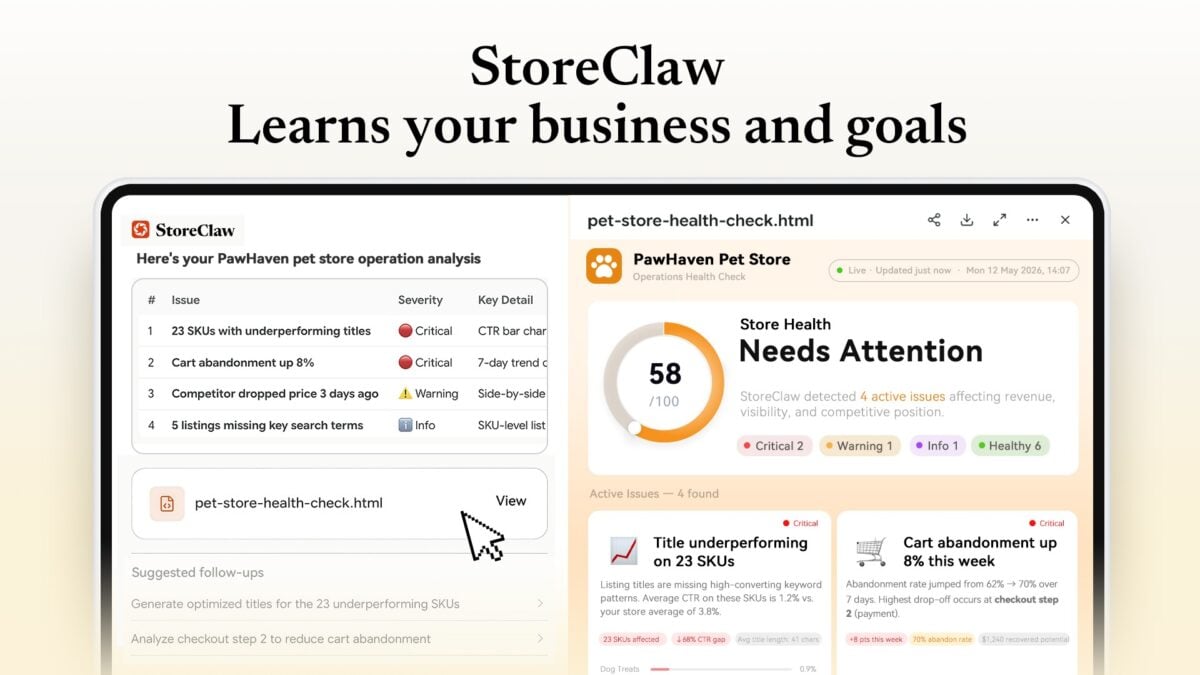
StoreClaw was built from a precise diagnosis: the fragmentation itself is the problem. Not any individual tool’s limitations. The fragmentation. The fact that intelligence is split at the seams of every platform you sell on, leaving the seller as the router between systems that were never designed to talk to each other.
StoreClaw is not a better version of those tools. It is a different category entirely. An autonomous commerce engine, a system that generates, launches, optimizes, and converts on your behalf, across every channel you operate, from a single operational layer. Not a chatbot. Not a copilot. An operator. Not another layer added to the machine. The system that finally makes the machine disappear.
The distinction is not semantic. Every other AI tool in e-commerce is built around a conversation interface: you ask, it suggests, you decide, you execute. The operational burden stays exactly where it was, with the seller, while AI becomes a smarter search engine. The work does not move. StoreClaw is built for the post-copilot era. The AI does not wait to be asked. It connects to your business, reads the data, identifies the gap, executes the action, and reports the outcome. The shift is from copilot to colleague, from AI that responds to AI that operates.
You read the brief in the morning. StoreClaw compiled it overnight.
Why Every Other Category Falls Short
The landscape in 2026 falls into three categories, and understanding where each breaks is how you understand why StoreClaw exists.
General AI agents have no pre-loaded commerce knowledge. E-commerce point solutions are competent inside their lane but blind outside it. Platform-native AI feels sufficient until you sell on more than one platform, and then its structural limits become impossible to ignore.
StoreClaw is built to solve what all three cannot: a unified intelligence layer with pre-loaded commerce expertise, native connections across every channel you sell on, and automation that runs whether you are present or not.
One System. Every Channel. Ready on Day One.
StoreClaw arrives pre-loaded with thirty-plus commerce-specific AI skills: store diagnostics, listing optimization, PPC analysis, SEO and GEO, social content generation, customer insights, competitor radar, pricing intelligence, inventory health monitoring, each a functional working system, not a prompt template.
A seller launching on Amazon gets keyword-informed listing copy based on what is actually working in the category right now. A DTC brand expanding to TikTok Shop gets content that already understands the platform’s native format and the brand’s established voice across other channels. The skill knows what you need because it has access to context that earlier tools never did.
That context comes from the underlying Connector architecture. StoreClaw connects natively to Shopify, Amazon, WooCommerce, and eBay on the store side, and to Instagram, TikTok, X, LinkedIn, Discord, and WhatsApp on the social and community side, with every channel flowing into a single operational layer.
When the competitor radar identifies a rival cutting prices on a core SKU, that signal is evaluated against your inventory position, your Amazon PPC performance, and your Shopify conversion data simultaneously.
When the social content skill drafts a LinkedIn post, it already knows what you said on Instagram this week and what your promotional calendar looks like. The intelligence is not generated in isolation. It is generated with the full picture.
“StoreClaw’s intelligence doesn’t live on one platform. It lives at the intersection of all of them, where the real decisions actually get made.”
Works While You Don’t
StoreClaw runs tasks continuously. Not because you triggered them, but because they are scheduled, configured once, and running. Competitor monitoring at 3 am. Listing quality checks before the market opens. Inventory alerts fired by sell-through velocity, not by a seller manually checking a dashboard.
Customer sentiment analysis is running across review channels while the seller is doing something else. The morning brief is a StoreClaw staple: what changed overnight, why it matters, what StoreClaw has already handled, and what it is flagging for human judgment.
AI does not replace judgment. It processes the information so judgment can be applied to what matters, not consumed by monitoring tasks that the system should handle anyway.
For cross-border sellers expanding into new markets, this layer is existential: information asymmetry is severe, and StoreClaw’s continuous automation closes it. And for every independent DTC brand, Amazon seller, or growing multi-channel operator who cannot afford a ten-person ops bench, StoreClaw produces exactly what that bench would: competitive intelligence, optimization depth, 24/7 monitoring, and strategic synthesis. Intelligence, wired in.
The Gap Closes
The Artisan’s Paradox has a resolution. The one that named itself the moment you recognized it and the one that deepened with every platform you added and every tool you stacked. Not in working harder. Not in adding another point solution to a stack that is already the problem. But in building an operating layer underneath the business that carries the intelligence load, so the founder can carry the vision. StoreClaw is not a tool added to the paradox. It is the first system built to dissolve it.
The structural infrastructure shift is already happening. Enterprise software is becoming API-native, enabling AI to run it. The outcome economy is replacing the tool economy. Autonomous systems are replacing copilots. E-commerce is not ahead of this shift. It is next in line.
StoreClaw exists because the intelligence gap is real, structural, and solvable. One AI that knows all of you. One pane of glass for the entire operation. One system is running while you are not watching. The post-copilot commerce infrastructure is not a future roadmap item. It is here.
What percentage of your business does your AI actually understand?