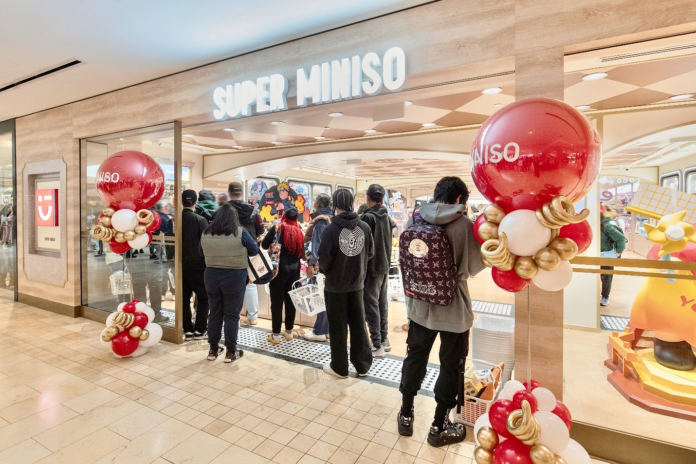
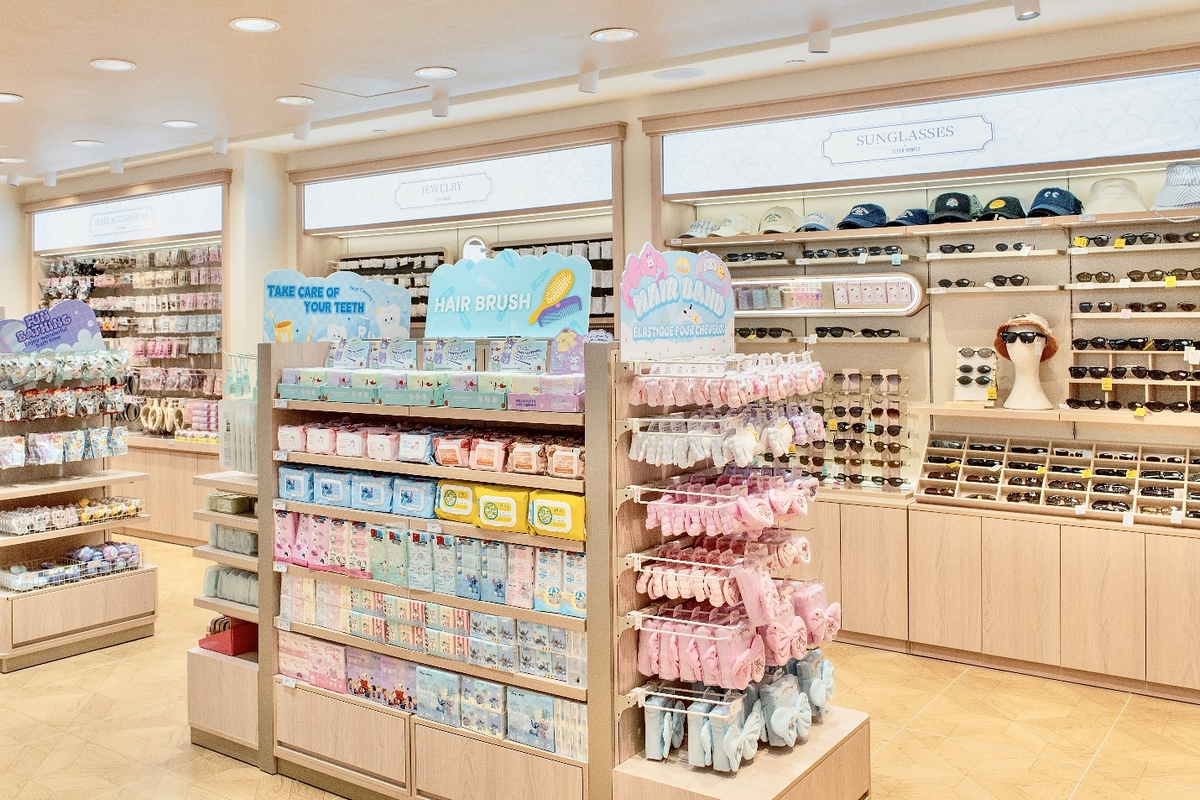
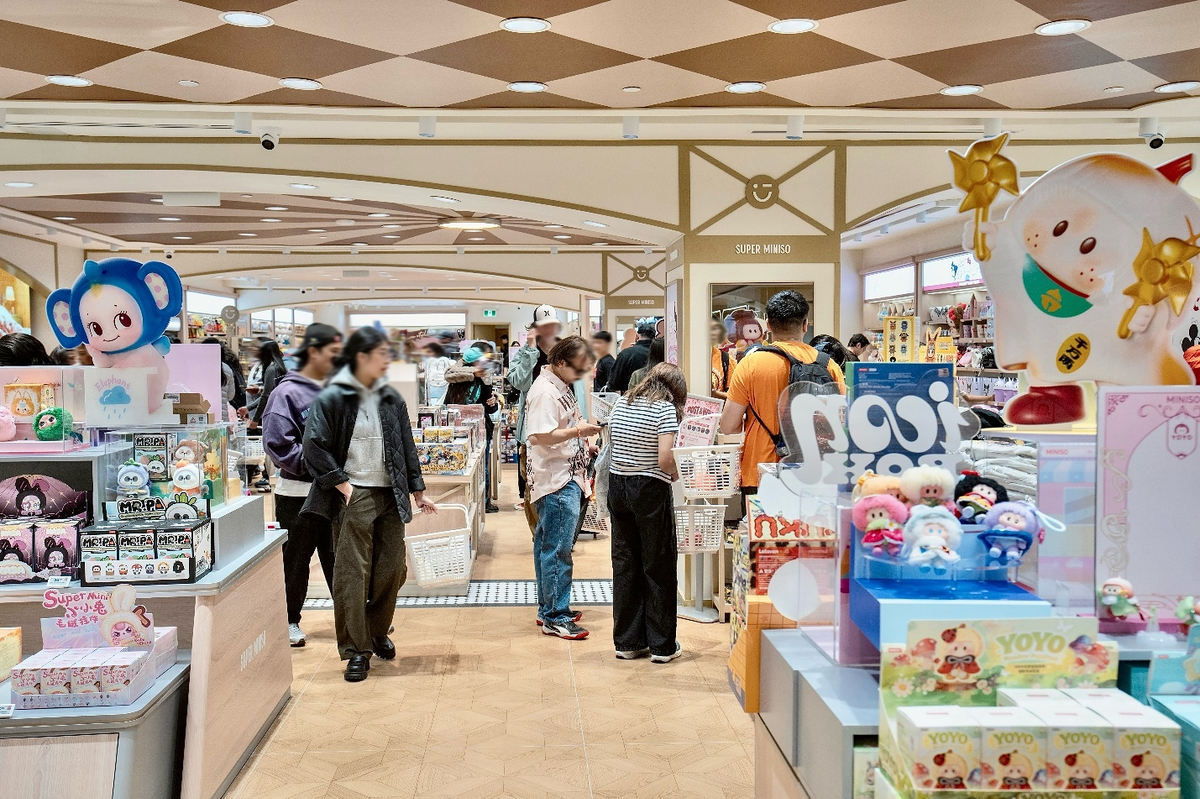
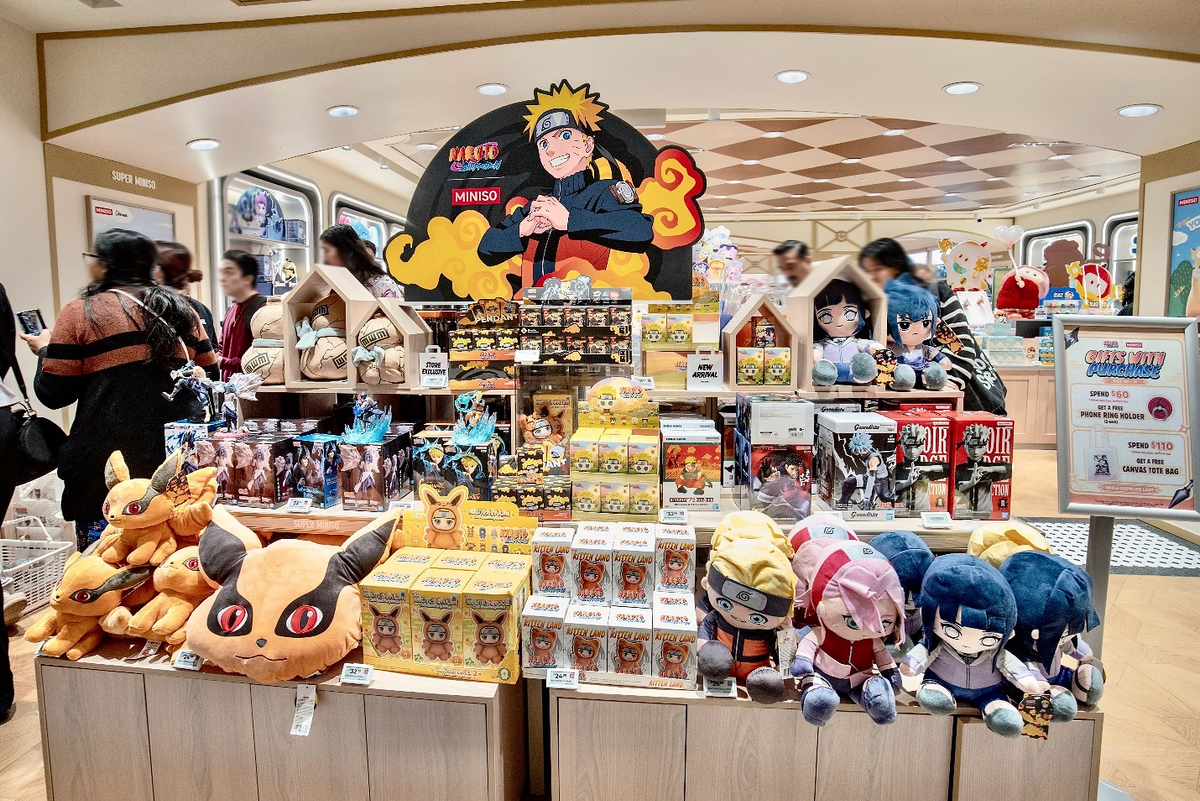
SUPER MINISO store grand opening at Square One in Mississauga, October 2026. Photo: Miniso
MINISO has officially opened its first international SUPER MINISO store at Square One Shopping Centre in Mississauga, bringing the Chinese retailer’s newest large-format concept to Canada. The opening comes as the company confirms plans for another SUPER MINISO in Montréal, part of a four-location Canadian rollout scheduled across October and November.
The Square One debut marks the first time MINISO has introduced the SUPER MINISO concept outside China. The format combines licensed character merchandise and collectibles with the retailer’s established assortment of beauty products, fashion accessories and everyday lifestyle goods, reflecting its growing emphasis on entertainment-related merchandise.
The new store places licensed entertainment properties at the centre of its merchandise presentation, with dedicated displays alongside MINISO’s conventional product categories. The opening includes the Canadian debut of the complete Naruto collection and the introduction of the Stitch Hit Snooze Series, with additional merchandise featuring Chiikawa, Hello Kitty and Friends, Mofusand, Marvel and MINISO’s proprietary character YOYO planned for release.
MINISO also organized themed promotions and fan activities during the October 10 opening weekend. The approach reflects the retailer’s effort to make character merchandise a defining feature of its larger stores, rather than simply another product category within its existing assortment.
SUPER MINISO store grand opening at Square One in Mississauga, October 2026. Photo: Miniso
Montréal Joins Canadian Expansion Plans
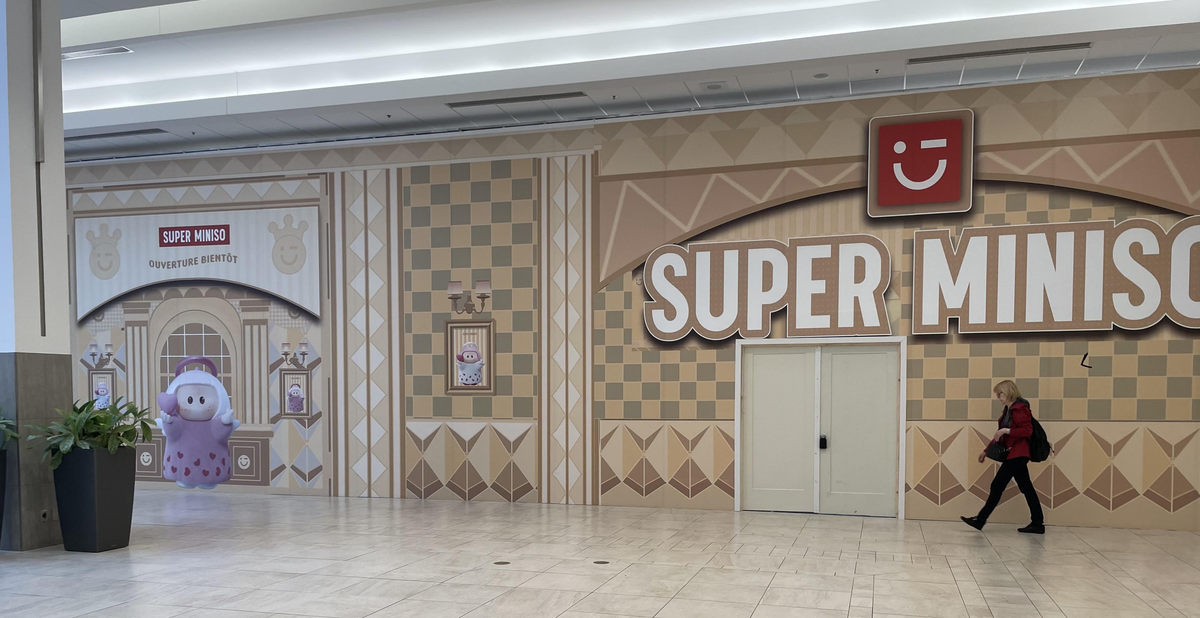
MINISO confirmed on October 12 that Montréal will receive a SUPER MINISO as part of its latest Canadian expansion. According to a reader, construction hoarding is now up at Galeries d’Anjoy in a large retail space formerly occupied by American Eagle.
Another SUPER MINISO is planned for CF Polo Park in Winnipeg, while a MINISO LAND location is expected at CF Toronto Eaton Centre. Together with Square One, the openings will introduce the retailer’s larger concepts to several major Canadian shopping centres within a relatively short period.
Although both concepts emphasize character merchandise, they serve different roles within MINISO’s store network. SUPER MINISO combines collectibles and licensed products with a broader lifestyle assortment, while MINISO LAND places greater emphasis on immersive character-themed displays and merchandise.
Future SUPER MINISO at Les Galeries d’Anjou in Montreal. Photo: Mathieu CormeraisSUPER MINISO store grand opening at Square One in Mississauga, October 2026. Photo: Miniso
Building on Canadian Expansion
The latest openings follow MINISO’s November 2025 launch of a large-format location at West Edmonton Mall, where the company says it achieved a North American single-day sales record. That opening provided an earlier Canadian example of the retailer’s investment in larger stores and entertainment-related merchandise, although the West Edmonton Mall location operates under a different concept from SUPER MINISO.
As Retail Insider previously reported, MINISO has been developing several store formats as it expands in Canada, with merchandise assortment and presentation varying by concept. The latest announcements move that strategy from planned openings to operating locations, beginning with Square One.
With the Mississauga store now open, the next developments will be the launches in Winnipeg, Montréal and Toronto. MINISO has not yet announced precise opening dates for those locations.
SUPER MINISO store grand opening at Square One in Mississauga, October 2026. Photo: Miniso
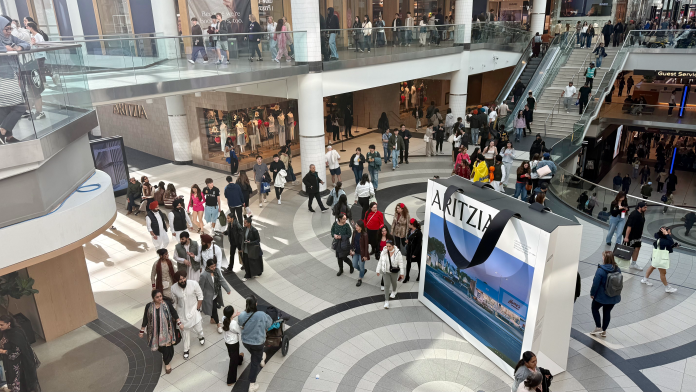
Aritzia flagship at CF Toronto Eaton Centre, April 26, 2026. Photo: Craig Patterson
Canadian retailers continue opening stores, renovating existing locations and introducing larger, more elaborate retail concepts, even as recent employment figures point to uncertainty in the labour market. The contrast is raising questions about whether continued investment in physical retail is translating into comparable growth in the industry’s workforce.
Suzanne Sears, owner of Best Retail Careers, believes the relationship between store expansion and employment deserves closer examination. In an interview with Retail Insider, she suggested that population aging, corporate restructuring and more selective hiring could help explain why visible investment in stores does not always correspond with employment growth.
Sears pointed to the development of increasingly sophisticated retail environments, including experiential stores designed to attract customers and encourage longer visits. She questioned how those investments fit with the employment picture, particularly when retailers are also facing pressure to control operating costs.
“What’s going on is what I’ve been asking all summer and started asking in the spring,” Sears said, referring to the apparent disconnect between new store investment and employment trends.
Suzanne Sears
Retail Employment Data Tells a Complicated Story
Canada lost 68,000 jobs in September 2026, following a decline of 42,000 in August, according to Statistics Canada’s Labour Force Survey. The unemployment rate increased to 6.5%, while the national employment rate fell to 60.6%, marking its second consecutive monthly decrease.
The September losses were concentrated in the public sector, where employment declined by 70,000 positions. Private-sector employment was little changed, an important distinction when considering what the national figures mean for retailers.
Employment in wholesale and retail trade declined by approximately 9,600 positions during September. However, the category includes wholesalers as well as retailers, meaning the figure does not establish how many jobs were lost specifically in storefront retail.
Separate Statistics Canada payroll figures showed that retail employment increased by approximately 25,300 positions, or 1.3%, between February and July 2026. Gains were recorded in clothing and accessories, general merchandise, food and beverage, and motor vehicle dealerships, among other categories.
Retail job vacancies nevertheless declined by approximately 5,500, or 10%, in July compared with the same month a year earlier. The figures suggest that retailers were adding employees earlier in the year even as the number of available positions was falling.
The payroll figures and Labour Force Survey use different methodologies and cover different reporting periods, so they cannot be treated as a continuous monthly comparison. Together, however, they demonstrate why the industry’s employment outlook is more complicated than a straightforward decline.
Are Retailers Operating With Fewer Employees?
Sears believes some retailers may be allowing staffing levels to decline gradually through employee departures rather than announcing large-scale layoffs. Businesses can continue investing in new locations while becoming more selective about replacing workers at existing stores.
She offered a hypothetical example of a store that previously operated with four employees but now functions with three. The reduction might not be immediately apparent to customers, she suggested, although the remaining employees would have to absorb additional responsibilities.
“If a store used to have four and now they have three, it might not be perceivable to the consumer,” Sears said. She added that employees would notice the difference because the workload previously shared among four people would now fall on three.
For retailers managing labour costs, leaving positions vacant can be less visible than closing stores or announcing restructuring. The possibility raises questions about how companies are allocating staff across existing locations while pursuing expansion elsewhere.
The broader labour market provides some context, although it does not establish how widespread the practice may be in retail. Statistics Canada reported a national layoff rate of 0.7% in September, close to historical levels, while the job-finding rate declined to 30.6%, compared with 32.8% a year earlier and a pre-pandemic average of 36.5%.
Those figures indicate that unemployed Canadians are having greater difficulty finding work even though layoffs have remained relatively low. Sears also suggested that employment reductions at larger corporations could offset some gains associated with new stores, particularly when companies reorganize head-office operations, distribution functions or existing retail networks.
The distinction matters because new store openings are highly visible, while gradual changes in replacement hiring may attract little attention. Both can influence total employment, but they are not equally apparent when assessing the industry’s expansion.
Population Aging Changes the Labour Equation
Canada’s changing demographics add another dimension to the discussion. Statistics Canada reported that the labour force participation rate declined to 64.8% in September, its lowest level since December 1997 when the pandemic year of 2020 is excluded.
The agency attributed much of the longer-term decline to population aging. Canadians aged 65 and older represented 23.2% of the population aged 15 and over in September, compared with 20.5% in 2019 and 14.8% in 2000.
Sears believes retirements could create additional challenges for retailers that depend on experienced employees, particularly those with established product knowledge, customer relationships and operational expertise. Replacing those workers involves more than filling vacant positions, especially in stores where service and specialist knowledge are central to the business model.
She sees three possible forces affecting retail employment: older workers leaving the industry, younger employees not necessarily viewing retail as a career, and larger corporations reducing positions. The combination, she suggested, could make it difficult for hiring associated with new stores to offset employment reductions elsewhere.
Younger Canadians are facing challenges of their own. Employment among people aged 15 to 24 fell by 48,000 in September, while the youth labour force declined by approximately 50,000.
Although those figures cover the entire economy, they are relevant to an industry that has traditionally provided entry-level and part-time employment. Sears questioned whether enough young people view retail as a viable long-term career, particularly when opportunities for advancement and professional development are not always apparent.
Immigration is another consideration. Statistics Canada noted that higher immigration temporarily moderated the demographic effects of population aging in 2023 and 2024, before the longer-term trend resumed in 2025 and 2026.
For retailers, changes in immigration can affect both the availability of workers and the size of the potential customer base. Sears sees those effects as interconnected, particularly for companies considering expansion into markets where population growth has supported retail demand.
Store Expansion Doesn’t Tell the Whole Employment Story
The employment discussion comes as retailers continue investing in Canadian locations. UNIQLO has been expanding its store network, MINISO is introducing larger formats in selected shopping centres, and Browns Shoes has invested in redesigned retail environments intended to improve the in-store experience.
These developments demonstrate the continuing importance of physical stores, but they do not establish whether employment across the broader industry is increasing at the same pace. A new location can create jobs in one market while the same company, or other retailers, adjust staffing elsewhere.
For commercial landlords, developers and leasing professionals, the distinction is significant. Store openings, new leases and renovations demonstrate demand for physical space, but they do not necessarily reveal how many employees will be required to operate those locations or whether overall retail employment is expanding.
Retailers must also balance labour expenses with customer expectations. More sophisticated store environments can increase the importance of knowledgeable employees and personalized service, even as businesses face pressure to manage operating costs.
Sears said economic uncertainty, including tariffs, is another factor affecting some companies’ Canadian expansion discussions. She indicated that retailers have raised concerns about proceeding with investments, although she did not identify specific companies or confirmed project cancellations.
These considerations could influence how businesses approach future hiring, particularly when evaluating the performance of existing locations alongside potential new stores. The challenge is determining whether continued investment in physical retail is being accompanied by the workforce needed to support it.
A Broader Measure of Retail Growth
Canada’s recent employment figures do not demonstrate that retailers are systematically reducing staffing or that new stores are failing to generate jobs. The increase in retail payroll employment earlier in 2026 shows that the industry continued adding workers during parts of the year, even as hiring conditions became more uncertain.
The figures nevertheless raise questions about how physical expansion, workforce availability and employment growth fit together. Sears believes retail deserves greater attention in discussions about Canadian employment because of its importance to local economies and the opportunities it provides to workers at different stages of their careers.
For retailers and property owners, the number of new locations or the amount of space leased tells only part of the story. Understanding the industry’s next phase of growth will also require examining how stores are staffed, how experienced employees are replaced and whether investment in the workforce is keeping pace with the changing demands of physical retail.
Australian-founded fitness franchise REVL Training is entering the U.S. and Canadian markets, with Florida identified as its first priority for U.S. expansion as the company pursues a target of more than 100 studios across 10 countries by 2028.
The strength and conditioning business, which launched in 2020, says it now operates more than 50 studios across six countries and has a global membership base exceeding 12,000. The North American launch forms part of a five-year growth plan that also calls for membership to surpass 20,000 by 2028.
REVL is seeking franchise partners in the United States, including experienced fitness operators, entrepreneurs and multi-unit investors. The company is also inviting prospective partners to explore opportunities in Canada as it expands beyond its existing markets in the Asia-Pacific region.
“Everyone thought we were crazy when we launched in June 2020; but what’s driven every decision since is an uncompromising belief in the product – the programming, the culture, and the standard. That belief is what’s taken us from four studios in Australia to 50+ across six countries. The gap in this market for what we do is real, and we intend to own it.”
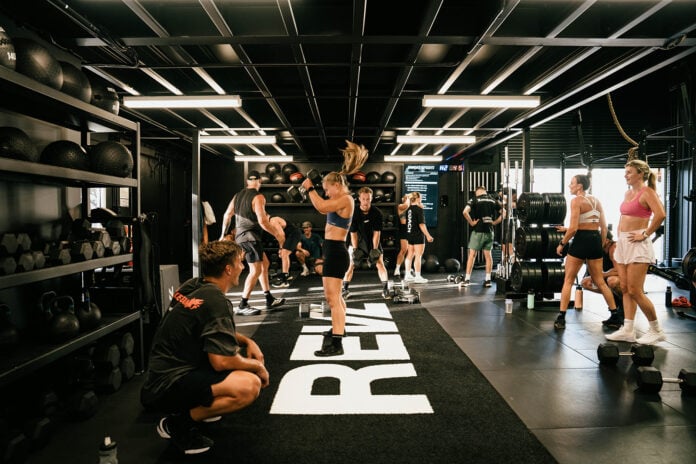
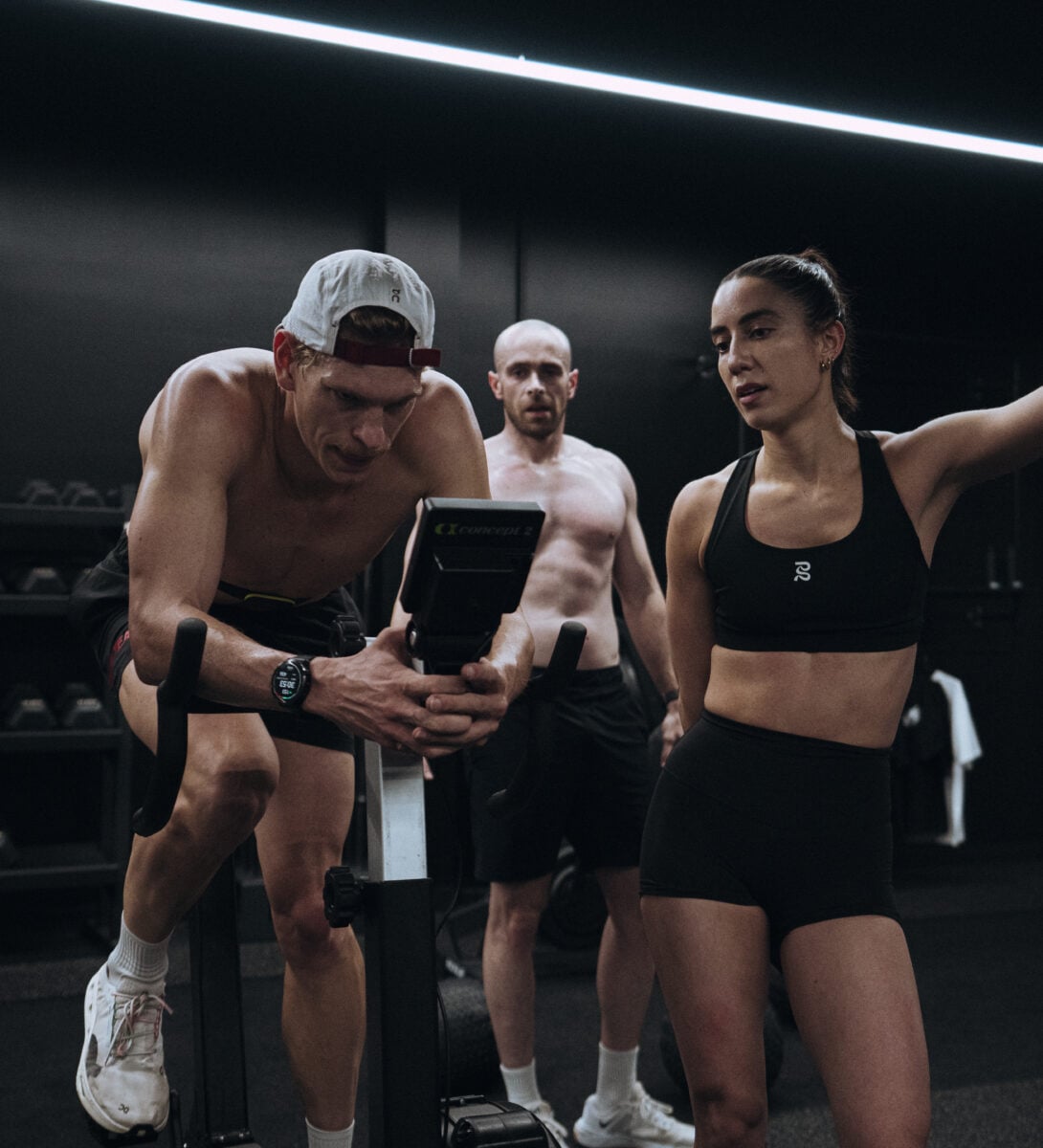
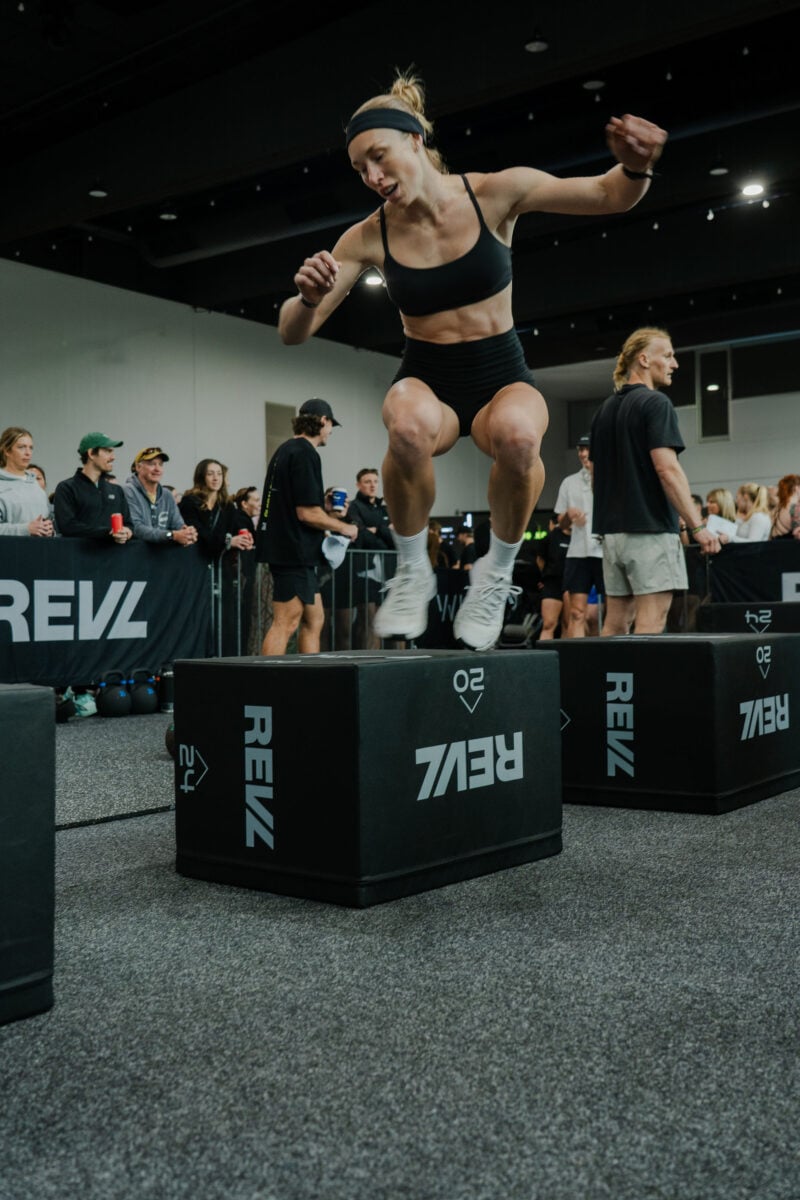
REVL Training photo
Structured training model
REVL’s business model centres on strength and conditioning programs organized into 13-week training blocks. The company says its programming uses defined sets, repetitions and percentages of one-repetition maximum or three-repetition maximum, with progressive increases in training demands built into each cycle.
The approach is intended to provide a more structured alternative to group fitness formats, combining performance-focused programming with a community studio environment. The company positions that model as a key differentiator as it enters North America.
REVL reports member attrition of less than five per cent across its global network, while average studio membership exceeds 200. Its top-performing locations in Australia have more than 350 members, according to the company.
The franchise operates in Australia, Singapore, Malaysia, South Korea, Vietnam and Taiwan. Its expansion into the U.S. and Canada would extend the business beyond those six markets and introduce its operating model to a new group of franchise investors.
Beyond its training programs, REVL’s business includes a distinct studio design, community events and franchise support systems. The company describes its studio aesthetic as featuring four black walls, supported by a creative identity intended to distinguish its locations from other fitness businesses.
Its events program includes Studio Games, REVL Pace, REVL Underground and Race The Globe, an annual flagship race event. The company says Race The Globe attracted 1,000 athletes in Singapore earlier in 2026 and is intended to draw more than 700 athletes in Brisbane in October 2026.
The franchise support offering includes Area Developer agreements, programming systems, marketing infrastructure and support from a franchisor team focused on studio profitability. These services are intended to help franchisees establish and operate studios, including entrepreneurs opening their first location and operators converting an existing fitness business.
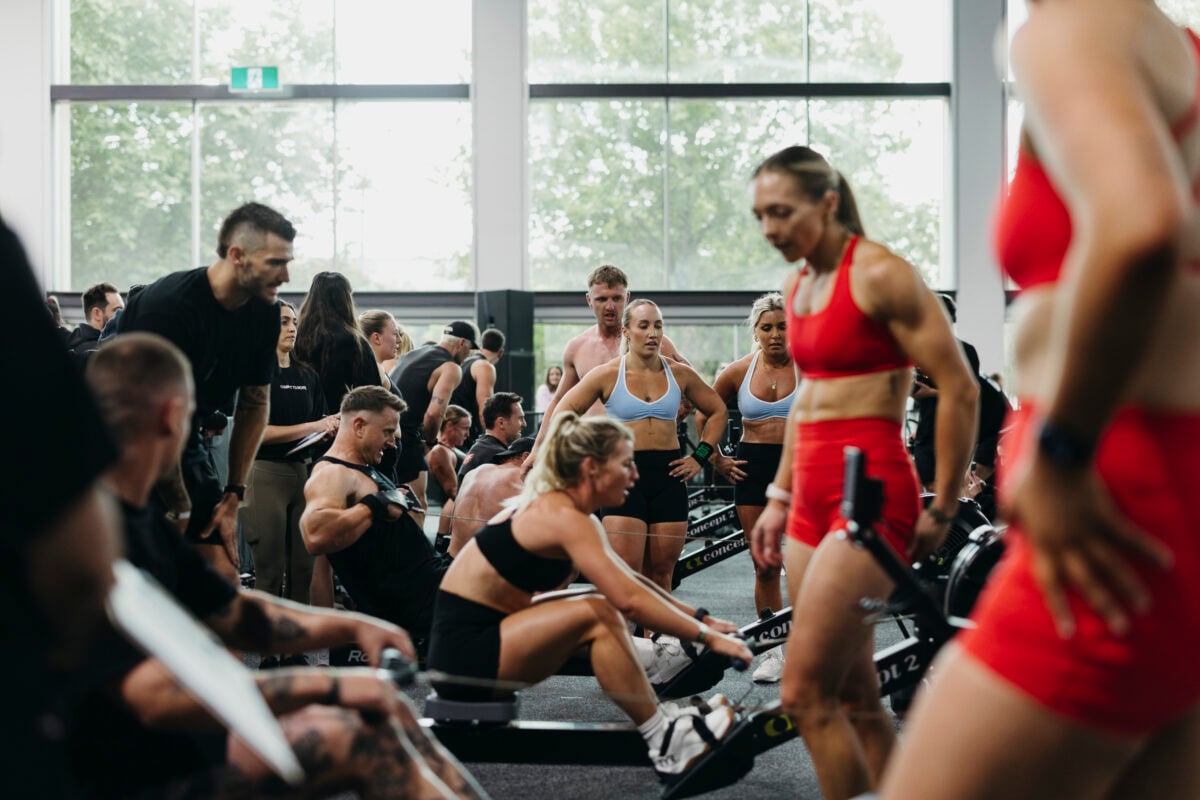
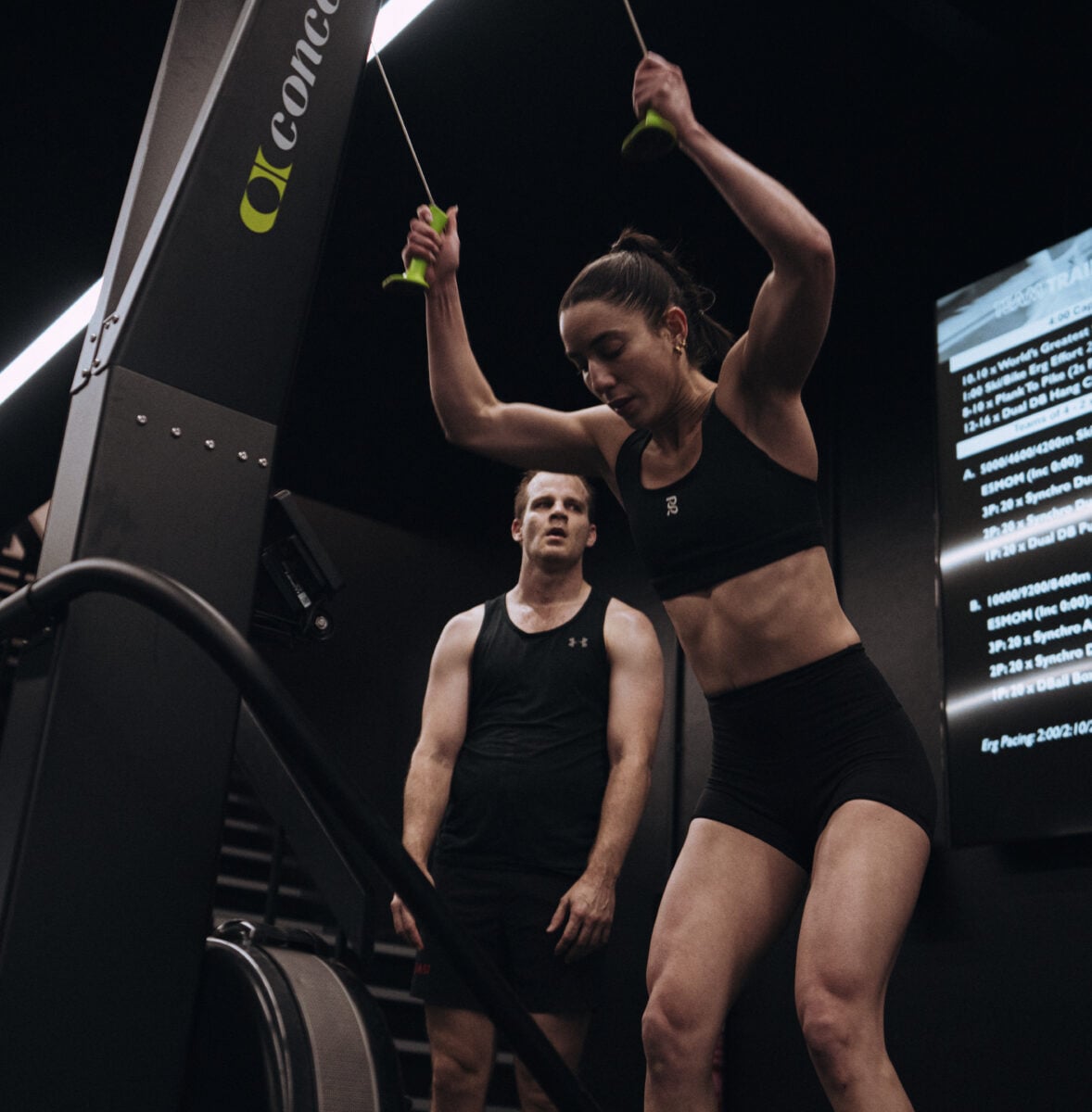
REVL Training photo
Franchise partners sought
Ben Woolford, REVL co-founder, said the company wants to attract operators looking to build businesses over the longer term, rather than simply acquire franchise territories.
“We see REVL not just as a franchise but as a platform for ambitious operators. Whether you’re launching your first studio or converting an existing brand, our goal is to give you the tools, data and community to build a long-term, profitable business in a sector that is still highly fragmented. We’ve never been more certain that the right time to bring this into the US is now.”
The company’s expansion plans will depend on attracting franchise partners as it works toward its 2028 targets. Florida is the initial priority for U.S. growth, while national franchise opportunities are available to prospective partners elsewhere in the country.
REVL is accepting franchise enquiries through its website at revltraining.com.au.
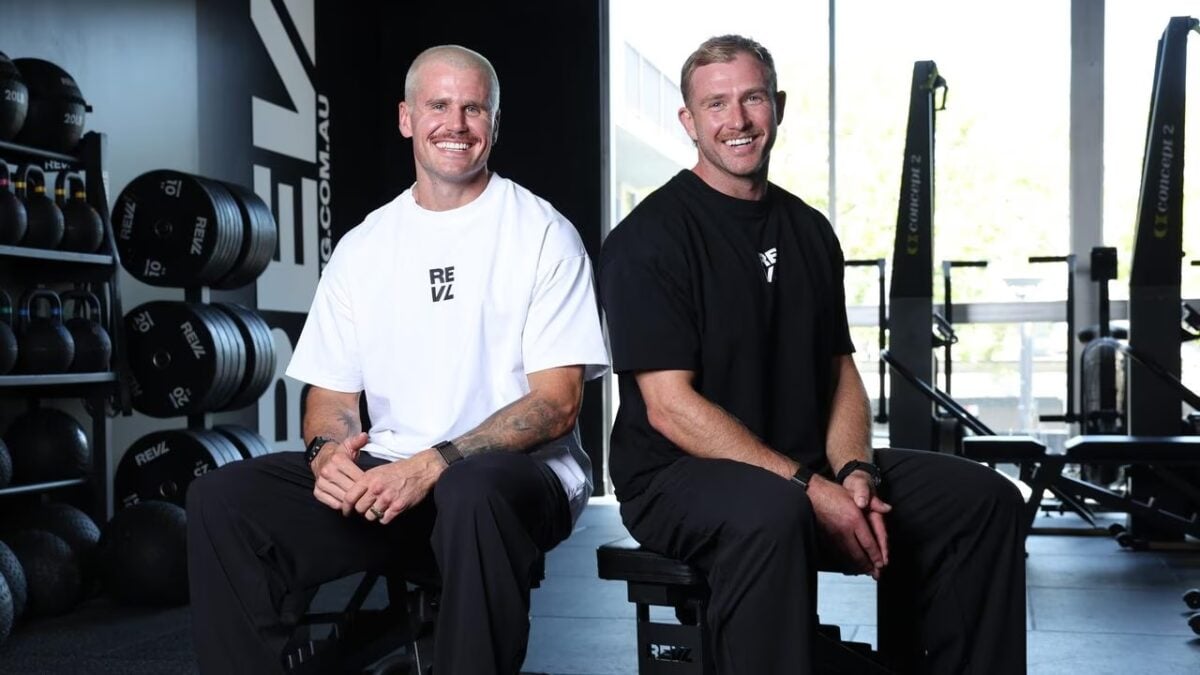
Josh Mildren (l) and Ben Woolford
In an interview with Retail Insider, Mildren and Woolford talked about the business.
Why has REVL chosen the U.S. and Canada as its next major expansion market, and why is Florida the first priority for the brand?
Woolford: North America is one of the largest boutique fitness markets in the world, and when we looked at it closely, we saw plenty of scale but very little structure. There’s no shortage of group fitness models, but very few brands deliver intensity – or properly programmed, progressive strength and conditioning inside a boutique community-centric studio.
The timing is also right. REVL has 53 studios currently operating across six countries, more than 12,000 members and a member attrition rate below 5 per cent – against an industry average of around 24 per cent. With the U.S. and Canada, that footprint now extends to eight markets.
So, a North American franchise partner isn’t being asked to bet on an unproven concept. The model was built in Australia and proven across Asia-Pacific, where REVL is now the region’s fastest-growing boutique fitness franchise.
Florida is our first priority because the conditions align: a strong year-round training culture, an active and sophisticated franchise market, and a cost of entry that gives new operators room to build properly. New York and Los Angeles are the obvious choices, but realistically they’re also the most saturated and expensive markets for a new operator. We’d rather establish the model where it has the best chance to take hold (with the right operator), then expand from there.
From a real estate perspective, REVL has three bespoke studio models:
CONCEPT 1,300–2,150 SQ FT CLASS RANGE: Sweat and Perform FRONT OF HOUSE: Self-service check-in FIT OUT: Our most compact footprint. Inner city, basement-style and multi-level spaces with the ability to run broad time slots for unit economics.
SIGNATURE 1,900 –3,250 SQ FT CLASS RANGE: Full class range FRONT OF HOUSE: Reception and waiting space FIT OUT: Our classic REVL floor plan. Warehouse, showroom or larger retail spaces. Suburban, industrial and street frontage locations.
FLAGSHIP 3,250+ SQ FT CLASS RANGE: Full class range FRONT OF HOUSE: Larger reception, luxury amenities FIT OUT: Deluxe, high-profile locations. Large retail, showroom and industrial, warehouse-style space. A1 locations as a proof point in new and major markets.
Canada is part of the same North American strategy rather than a separate project, which is why Toronto made sense as a natural trajectory in our expansion plan.
But across both markets, we lead with the right partner – rather than launching for the sake of expansion. Our franchise partners need to buy into the brand, the way we train and the standard we hold every studio to. Our model, paired with the right partner in the right location, will always outperform a fast rollout – and that’s key to long-term, sustainable growth.
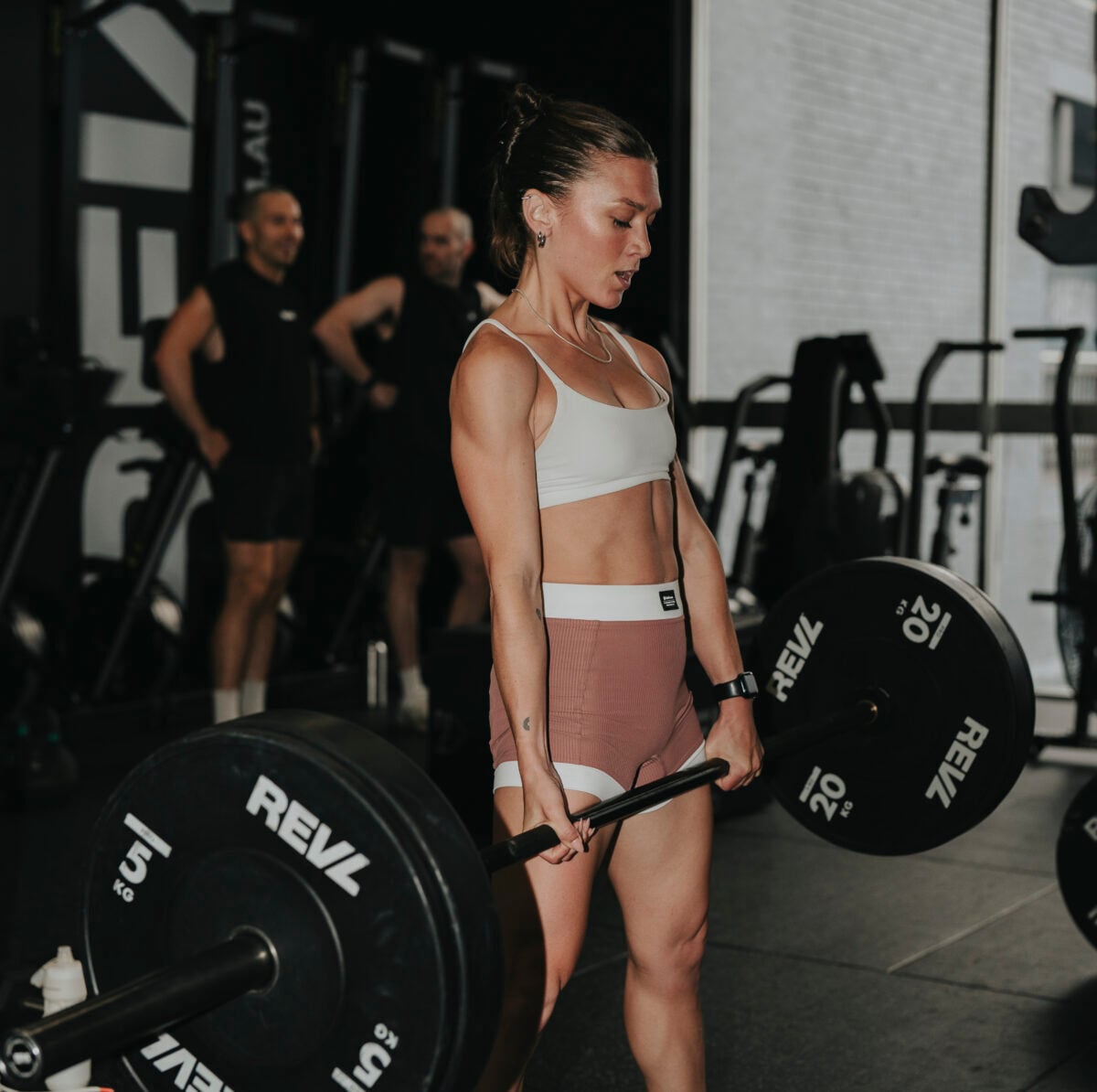
REVL Training photo
What does REVL believe is missing from the current Canadian and U.S. boutique fitness market, and how does its structured strength-and-conditioning model address that gap?
Woolford: Choice isn’t the problem in the North American boutique fitness market. What’s missing is structured, uncapped progression. Most boutique formats are built around the single session: members turn up, get a ‘hard’ workout and leave, and the following week looks much the same. That works for a while, but eventually people plateau and drift.
At REVL, members train across periodised 13-week blocks with defined sets, reps and %’s of 1RM/3RM – progressive overload built into every cycle, within a community studio format that drives results most boutique brands cannot sustain. Classes are deliberately capped so coaches know where every member is in their program and can provide a personalised experience – in real time. By the end of each cycle, members can measure exactly what they’ve gained. And that structure also makes commercial sense for franchise partners. Structure keeps members, and member retention is what makes a studio profitable.
Mildren: REVL exists to unlock human potential. Our members come from everywhere: personal training, big-box gyms, other boutique formats. What they have in common is that they want tangible progress. They come to us to get stronger and fitter, but they stay for the community. That person exists in every city in Canada and the U.S.
Over the past year, we’ve witnessed the mass shift towards social fitness and hybrid racing. People crave real, in-person experiences, and they want more reasons to train. Our program already builds the strength and conditioning that those events demand. We have a lot of our members currently participating in marathons, triathlons, HYROX and other hybrid competitions. But what we saw was a gap for REVL, as a brand, to own that space.
That’s why we built our own events ecosystem, from our PACE Run Program to local Studio Games through to REVL Underground and our flagship Race The Globe. It gives members something to train towards, a place to test what they’ve built and a club culture that extends beyond the studio walls. We never stray far from our core product. But that foundation lets us give members so much more.
REVL Training photo
REVL reports a member attrition rate of less than 5 per cent globally; what are the main factors behind that retention rate, and how confident are you that it can be replicated in North America?
Mildren: REVL’s retention comes down to three things that only work together. The first is visible progress. On a 13-week training cycle, members know what they lifted in week one and what they’re lifting in week 13, and it’s hard to walk away from something that’s clearly working. The second is the quality of our coaching. Every REVL coach goes through accreditation and ongoing development, and our coaches live and breathe the product. They’re not just running a class; they know the program, they know their members and they know how to deliver the full REVL experience.The third is culture. At REVL, you never train alone. Members work in pairs and teams, alongside people who are equally committed and driven by a shared intensity, and our events give everyone something to aim for. We have members who’ve been training with REVL for five and six years who are still progressing today.
Something else that’s worth noting, is that a lot of our franchisee’s have been existing members – and 80% of new studio openings come from existing franchisees, which is a testament to the brand and model, its results, and the benefits that our members, coaches and franchisees see.
Woolford: I’m confident REVL’s retention can be replicated in North America, but it’s not something we take for granted. We’ve seen the same retention in markets as different as Sydney, Singapore and Seoul, which tells us the model is driving the results, not the location. What we protect are the conditions behind it: the right franchise partners, coaching standards that don’t slip, and franchisor support that continues long after a studio opens. Retention is earned studio by studio, and our North American studios will be held to exactly the same standard as the rest of the network.
What is the investment required to open a REVL studio in North America, and what are the typical economics, including membership levels, revenue expectations and path to profitability, for franchisees?
Woolford: The total investment to open a REVL studio in North America typically ranges from US $371,500 – $911,500. That covers the franchise fee, studio build-out, a premium equipment and technology package, pre-opening marketing, hands-on training at REVL’s headquarters in Sydney, and initial working capital. Three flexible studio formats let partners match the model to their market: the Concept (1,300–2,150 sq ft), the Signature (1,900–3,250 sq ft) and the Flagship (3,250+ sq ft). Studios are backed by a 10-year franchise term with a renewal option, and partners get dedicated support from REVL’s real estate, design and project management teams from site selection through opening day.
For experienced multi-site operators, REVL offers Area Development Agreements that secure the rights to build a portfolio of studios across a defined development area. A single upfront development fee replaces the individual franchise fee on each studio, and the per-studio cost falls as the portfolio grows. It drops from US $50,000 for one studio to about US$40,000 per studio for three, US $34,000 for five,and under US $30,000 per studio for a 10-studio commitment (US $299,500 total). The three studio formats also give developers the flexibility to fit each site in their territory, from high-street Concept studios to destination Flagships.
Full details are set out in REVL’s franchise disclosure documents, which prospective partners receive during the franchising process.
On economics, membership is the number REVL focuses on, because it drives everything else. Across our global network, studios average more than 200 members, and our top-performing Australian locations exceed 350. Combined with attrition below 5 per cent, that creates a stable base of recurring revenue.
REVL Training photo
REVL’s franchise model is built around studio profitability rather than territory sales. Before co-founding REVL, I was a fitness franchisee myself, so I know what it’s like to invest everything and then be left to figure it out alone.
Our franchise partners are supported from before they sign a lease to long after their doors open. We start with site selection and lease negotiation, backed by financial modelling, store budgets and break-even forecasts, so partners know what their studio will cost and what it needs to achieve before they commit. From there, we handle test fits, floor planning and equipment procurement, and run a pre-sale campaign so studios open with a member base already in place. Every coach is onboarded and accredited before day one.
Once a studio is trading, partners receive the programming, marketing infrastructure, operating systems and ongoing support to reach profitability and stay there, including quarterly business planning, marketing calendars, member acquisition support and access to our global events program. Supporting our existing network isn’t a side of the business. It’s an integral part of it.
What are REVL’s specific expansion plans for Canada, including target cities, the number of studios it hopes to open and the timeline for establishing a Canadian presence?
Woolford: REVL is targeting 20 studios across Canada within the first 24 months, beginning in the Greater Toronto Area, where we already have sites locked in. Ontario is our first-to-grow market, with strong interest already coming from Mississauga and London.
We’d noticed the gap in North America long before we made any plans, but the real proof point for Toronto came when our Canadian franchise partner reached out to us three years ago.
We’ve explored the market and how the model would fit; identifying the gaps unique to Canada. Three years on, our partner’s view remains the same as ours. There was, and still is, nothing else like REVL in the Canadian market. We’re working closely with them ahead of their first studio opening in Q1 2027.
Richelieu Hardware Ltd. reported a 12.6 per cent increase in third-quarter sales to $562 million as acquisitions and internal growth lifted revenue, while the Montreal-based company continued expanding its North American distribution network.
The specialty hardware distributor said sales growth for the quarter ended Aug. 31 included 10 per cent from internal growth and 2.6 per cent from acquisitions. Net earnings attributable to shareholders rose 22.4 per cent to $29.2 million, while the company completed two acquisitions during the quarter and acquired a U.S. hardware division shortly afterward.
Richelieu has completed five acquisitions since the beginning of its 2026 fiscal year, representing about $145 million in additional annual sales. It is also investing $15 million to expand its distribution centre in Drummondville, Que., as it prepares for further growth.
“The strong growth and strategic expansion we have achieved once again demonstrate the relevance of our business model, which enables us to meet our customer needs, take advantage of excellent acquisition opportunities and continue driving the Corporation’s future growth. Our market development efforts increased sales across all market segments despite an uncertain economic environment. In the manufacturers’ market, sales increased 11.5% to $493.3 million, including 8.9% internal growth and 2.6% from acquisitions.
Photo- Richelieu
“Sales to retailers and home improvement superstores increased 20.9% to $68.7 million, reflecting, among other things, initial deliveries made to a major customer in the United States. The acquisitions of Solutions Acoustiques in the Montreal region and Winnec in the Toronto region completed during the third quarter have added expertise, specialized products, customers, and additional sales. As for Penrod’s Hardware Division, the largest acquisition we have completed to date, it contributes an additional US$70 million in annual sales, expanded market coverage through seven new centres located across seven U.S. states, and a service-oriented corporate culture fully compatible with Richelieu’s,” said Richard Lord, President and Chief Executive Officer.
“In addition, we recently announced a $15 million investment to expand the scale of our Drummondville distribution centre and support our growth. We are proud of this new development in the Centre-du-Québec region, which relies on local expertise and plays an important role in strengthening our network.”
Acquisitions expand U.S. network
Richelieu’s acquisition strategy added distribution capacity and specialized product offerings in both Canada and the United States. During the third quarter, the company acquired Solutions Acoustiques, a distributor of standard and premium acoustic products in the Montreal region, and Winnec, a specialized hardware distributor operating three distribution centres in the Toronto region.
On Sept. 1, Richelieu acquired the hardware division of The Penrod Company, adding about US$70 million in annual sales and seven distribution centres across North Carolina, Texas, Minnesota, California, Colorado, Arizona and Florida.
The acquisition expands Richelieu’s reach among door manufacturers, architects, residential and commercial contractors, and specialty distributors. The company described Penrod as its largest acquisition to date.
Earlier in the fiscal year, Richelieu acquired three distribution centres from McKillican American in Oregon and Washington state, as well as Finium, a Quebec-based distributor and manufacturer of premium wall covering panels.
Photo: Richelieu Hardware
Distribution centre expansion planned
Richelieu is also expanding its Drummondville distribution centre to support its operations. The $15-million project will increase the facility’s size from 40,000 square feet to 180,000 square feet and is expected to be completed in spring 2027.
The company reported working capital of $702.6 million as of Aug. 31, with a current ratio of 3.2 to 1.
Richelieu also declared a quarterly dividend of 15.66 cents per share, payable Nov. 5 to shareholders of record on Oct. 22.
The company imports, manufactures and distributes specialty hardware and complementary products for cabinetmakers, furniture manufacturers, woodworkers, door and window producers, and hardware retailers. It said its North American network includes 124 centres, comprising 54 distribution centres in Canada, 66 in the United States and four manufacturing plants in Canada.
Welcome to the Daily Synopsis by Retail Insider. We hope you enjoy the 11 articles we published covering key developments in Canadian retail. Here are a couple highlights with a full list of the day’s articles thereafter.
Toronto-based Demascaré is transitioning from custom couture to ready-to-wear with a focus on sustainable, local production and limited releases aimed at selective retail partners, while enhancing e-commerce options to reach discerning shoppers. Meanwhile, Aritzia is expanding its North American physical presence by increasing store traffic and productivity through larger boutique formats, particularly in the U.S., supporting its digital sales without reducing physical store performance. Both illustrate Canadian apparel brands prioritizing strategic store growth and sustainability.
Alimentation Couche-Tard is set to acquire 52 retail locations, fuel supply contracts, and 18 cardlock sites from Irving Oil in Quebec and Ontario, expanding its footprint in these markets. Rising thefts of high-value Pokémon cards across Canadian specialty retailers are forcing a reassessment of security, insurance, and inventory management practices traditionally uncommon in hobby retail.
Sketch, photograph, and idea to prototype-ready models in minutes. Quickly creating assets allows designers to experiment with shapes, proportions, and directions before diving into in-depth modeling. But even generated geometry must be checked against dimensional, structural and prototype requirements during evaluation.
Selecting Images That Translate Well Into Prototype Geometry
It is easier to obtain better visual information from images with clear silhouettes and recognizable forms for image-based model generation. A clear image enables an AI 3d model generator to recognize the contours, proportions and parts. For simple objects with limited structural complexity and straightforward references, single-view images can be used. When depth, alignment and hidden relationships are relevant for the structural interpretation, multi-view references provide information. Ambiguous images can cause hidden surfaces, proportions, openings, joints and structural features to be distorted during generation. It is also helpful to have good lighting and clear backgrounds, which can help to make the important boundaries more obvious visually.
Balancing Geometry Detail With Prototype Requirements
Polygon density should be proportional to the prototype’s purpose – not to the complexity of the geometry for each iteration. An image to 3d model process can generate detailed surfaces; complexity impacts editing. Low-poly meshes are good for fast geometry changes, visualization and for usage in applications that need efficient geometry in design. The more polygons, the more accurately curved edges, intricate contours and mechanical forms are represented. It is the optimal mesh that has been carefully balanced for the maximum amount of visible detail, editing flexibility and software requirements for most prototypes.
Steps to Prepare Prototypes Faster Using Image-to-3D Model Rapid Asset Generation
Step 1: Begin With a Reference Image
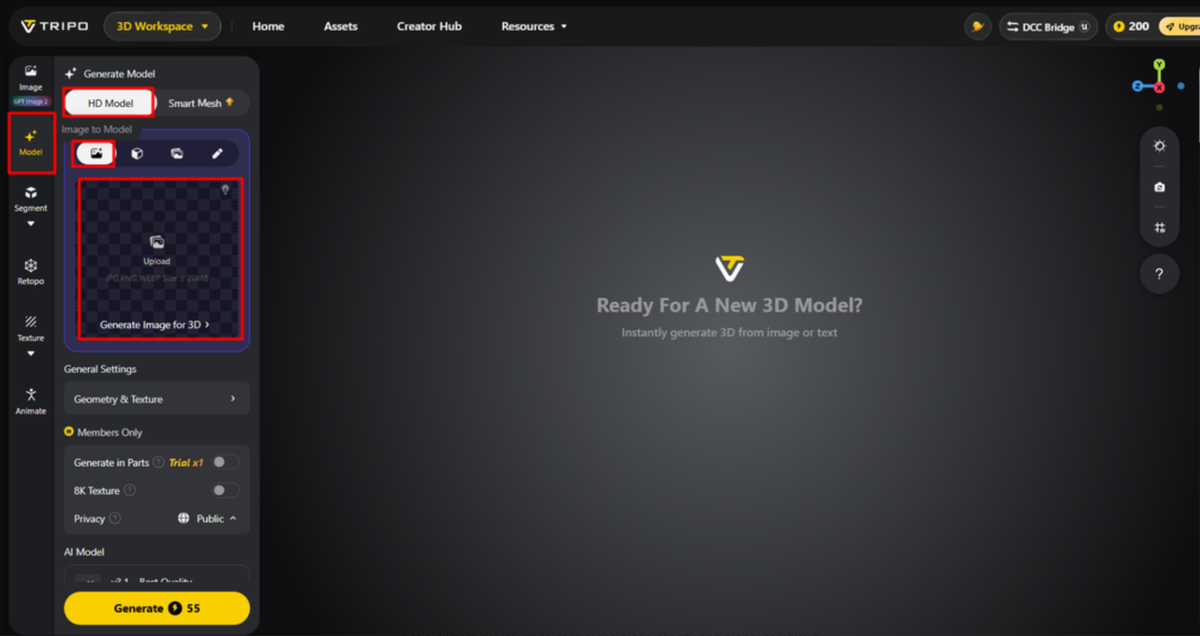
First, access Tripo 3D and sign up. Go to the “Model” tab in the vertical left menu bar.
Under “Generate Model”, choose “HD Model” to start creating your prototype asset. It will take several minutes to generate your model.
Select the “Image to Model” tab. You can drag and drop your reference image into the workspace. You can also click “Upload” and select the image from a specific location on your device.
Step 2: Configure the Prototype Before Generation
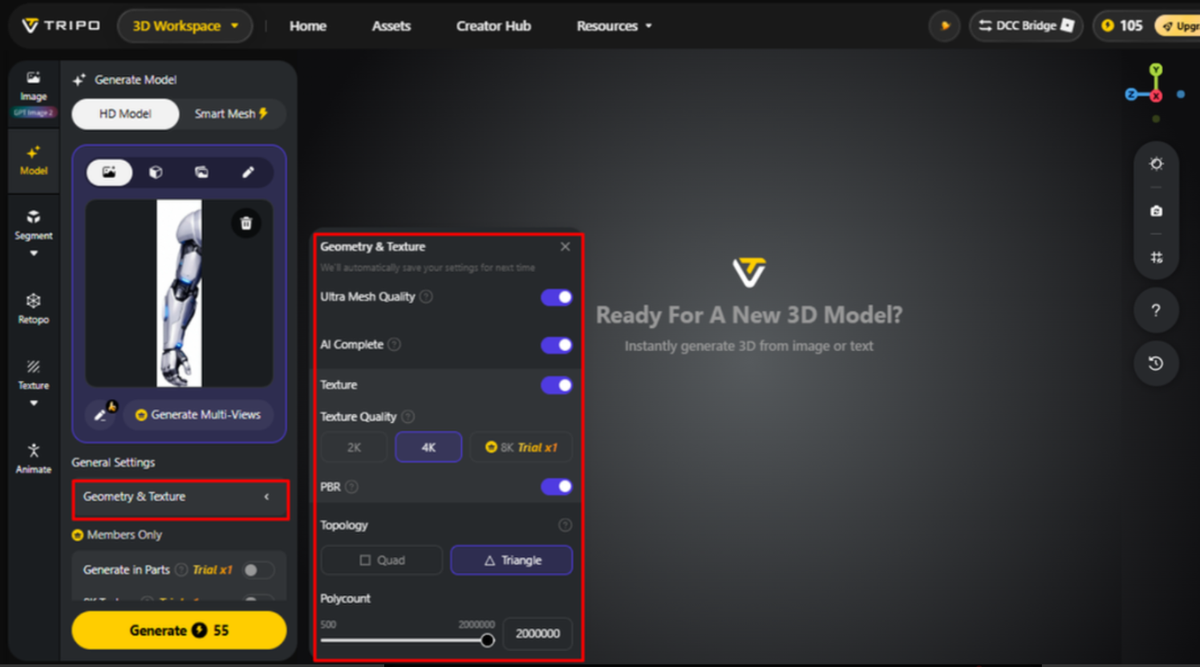
Open “General settings” and customize “Geometry and Texture” for the prototype. Turn on “Ultra Mesh Quality” when you need a detailed and realistic model.
With “AI Complete” enabled in the “Geometry & Texture panel”, AI can generate both the model’s geometry and texture for you. The option covers both tasks within that panel. Alternatively, activate texture generation and set your preferred “Texture Quality” to 2K, 4K, or 8K.
Enable “PBR” when you want accurate material and reflective properties in the generated asset.
Select “Quad” or “Triangle” topology based on the structure you want for your prototype.
Set a custom polycount to control the mesh density and model complexity.
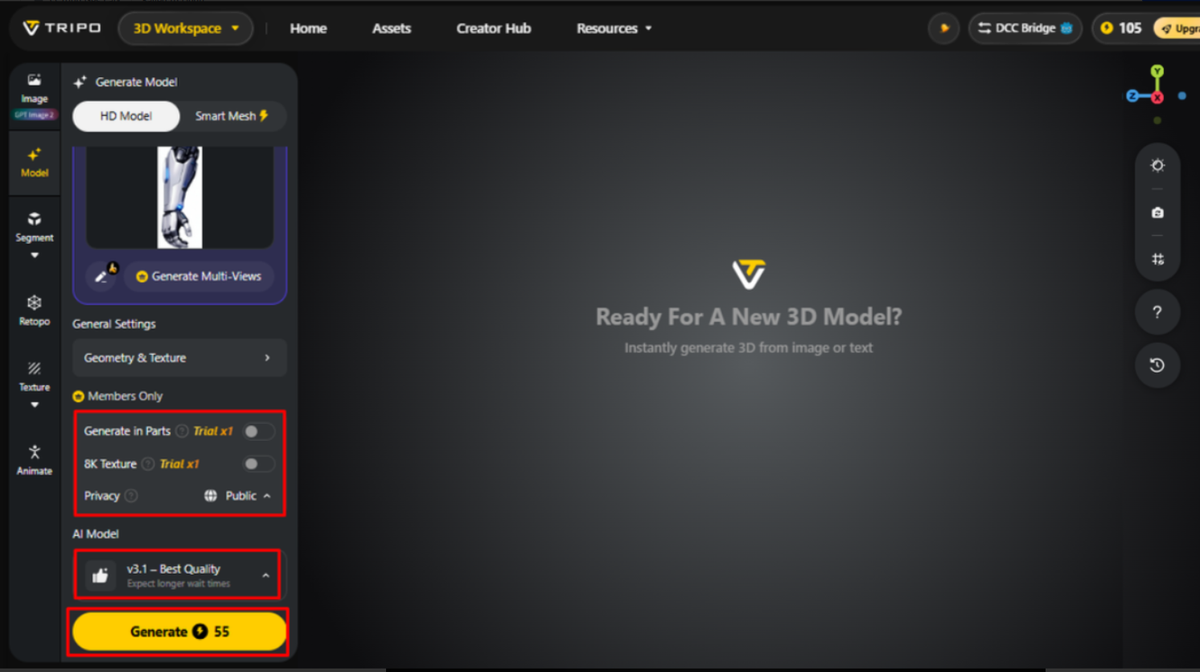
Members can test “Generate in Parts”, “8K Texture”, and “Privacy” in the Members Only section, with “Trial x1” offered per session. Note:“Generate in Parts” is charged separately using points.
Pick the model that best fits your needs. Tripo offers “V3.1”, “V3.0”, and “V2.5”, with differences in generation quality, stability, and application scenarios. Note:“V3.1” may take more time to complete.
Click “Generate Model” to start the rapid asset generation process.
Step 3: Review the Prototype and Export It
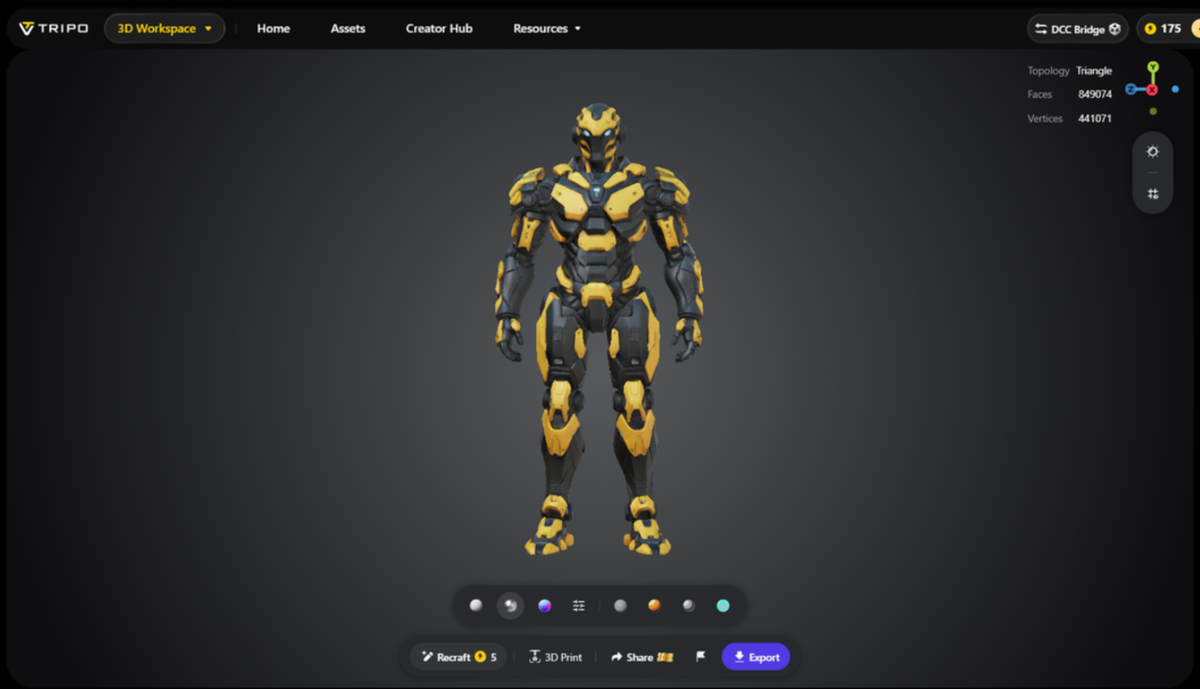
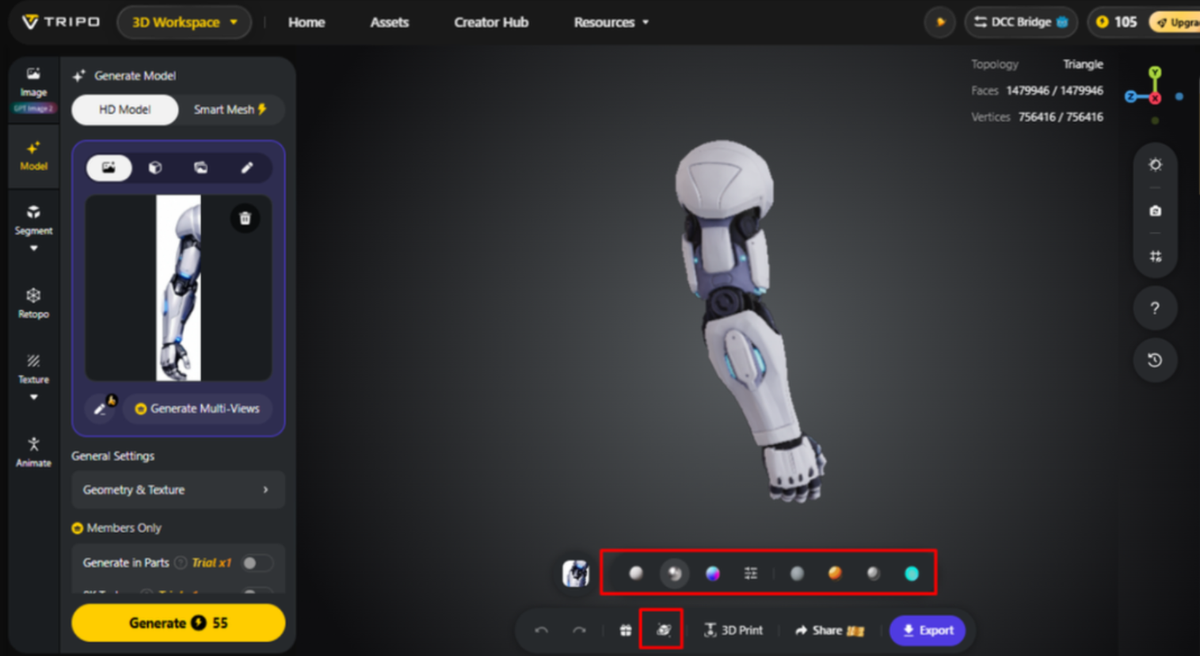
After generation, use the available display modes to inspect your model. You can choose Wireframe Mode, White Model View, Texture View, Shader, or HDRI. For additional improvements, simply click “Refine” from the bottom menu.
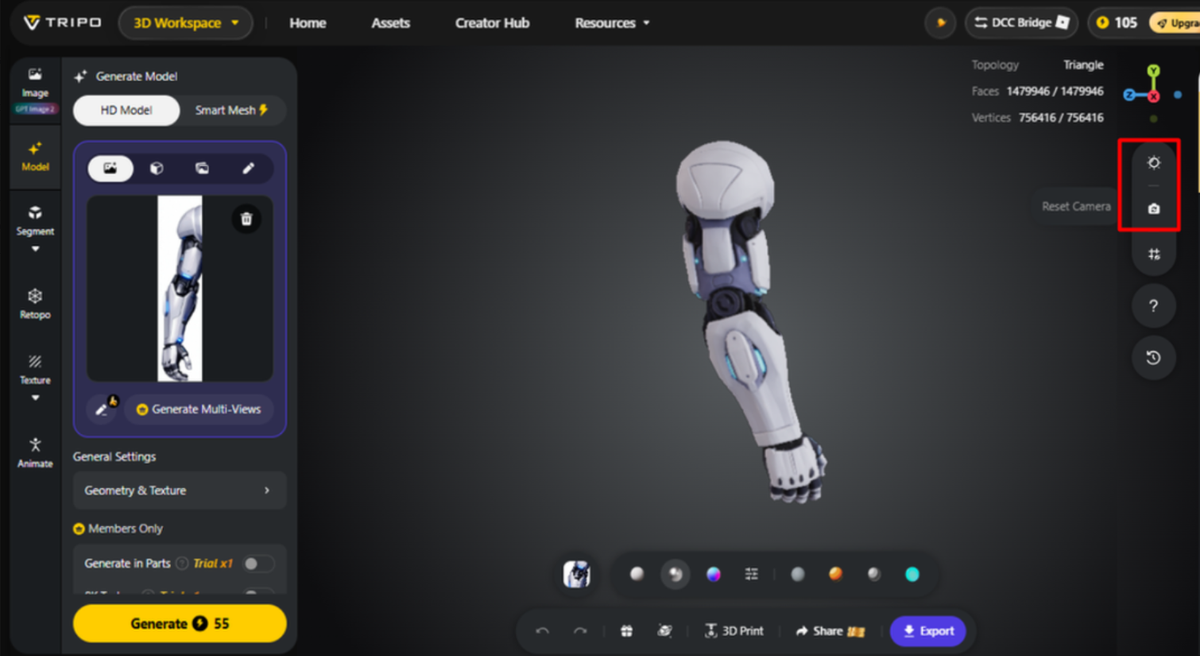
You can modify “Environment Settings” and use “Reset Camera” to review the prototype from different angles.
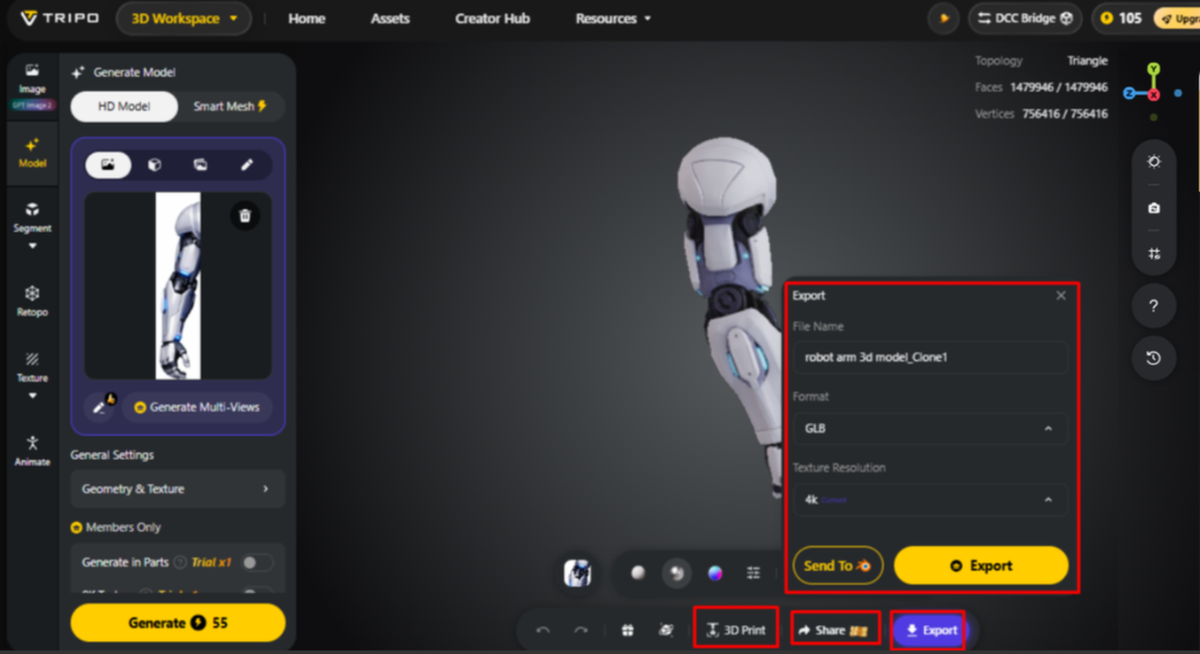
When you are satisfied with the asset, you can choose “3D Print” for physical output. You can also click “Share” to share the design directly.
Click “Export” from the bottom menu to save the prototype. Select the required resolution, format, and filename, then click “Export” again to save the design to your local device.
Six Settings That Shape Rapid Prototype Asset Generation
Detail Selection: Select detail based on visual complexity of prototype and need for structural representation. A more detailed geometry level can be used to model more complex shapes, whereas lower levels can be used for simpler shapes for easier editing later.
Polygon Count: Specify a number of polygons commensurate with the geometric detail and downstream uses. Reduced counts can enable rapid iteration when complex surfaces offer little prototype value to explore.
Texture Resolution: Choose 2K, 4K or 8K depending on the visual inspection and output requirements. Texture resolution becomes more important if it is a very important factor in the visual assessment of the prototype.
Topology Choice: Use quad or triangle topology, depending on the editing and downstream workflow needs. The topology has an effective impact on the behavior of the mesh during the refinement, deformation and subsequent modeling operations.
Part Separation: Separate parts for inspection or adjustment by using Generate in Parts. Logical separation can make components easier to change prior to an efficient combination of an editable prototype asset later.
Model Version: Choose which Tripo 3D versions are available based on workflow, speed and quality. Each version offers a unique set of generation properties; selection should be carefully based on project priorities.
Using Low-Poly Geometry For Quicker Iterations
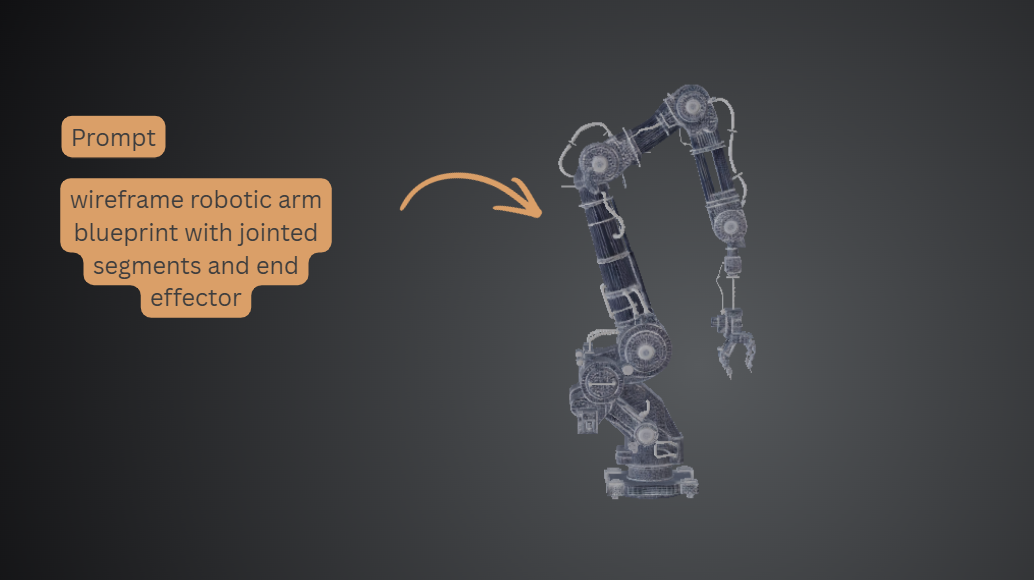
Structured low-poly geometry can enable faster edits in early prototype development and design exploration. With simplified meshes, proportion changes, component tweaks and material previews can be managed efficiently. Polygon control is important in games, visualization, printing and interactive applications where there are varying technical requirements. There is a text to 3d model workflow which allows for concept exploration and image references for guidance. Low-poly output is still valuable when the prototype is about silhouette, placement and overall proportions. When surface curvature or the structure of components is to be represented more closely, more detailed geometry can be used.
Refining Prototype Shapes Before Sharing Or Exporting
Look at important shapes before sharing or exporting, without being distracted from geometry by surface textures. Solid View can surface surprising thicknesses, proportions, missing openings and irregular component boundaries. When further enhancement is needed after detailed review, Refine can be submitted to improve geometry detail and texture quality; this typically takes 1–7 business days, and the refined model automatically replaces the original asset in your library. Different environment settings and camera controls are used to analyze surfaces under various viewing conditions during inspection. Share can be used for design review, and 3D Print can be used for physical prototype evaluation as appropriate. If external software will be used to work with the editable prototype asset after inspection, export should be used.
Moving Prototype Models Into Broader Design Workflows
The export format should be chosen based on the intended next step, since different formats are suited to different visualization and workflow needs. USD is widely used in film, VFX, and other USD-based pipelines for exchanging scene and geometry data. OBJ is a common file format that supports transferring meshes and related geometry and material data between software. FBX is an overall efficient format for workflows that include animation, scene exchange, and other digital content pipelines. GLB is a file format that efficiently stores geometry and other scene information for interactive visualization on the web. STL is used for many processes in the additive manufacturing workflow, based on surface geometry, and topology should be inspected before export. For 3D printing, 3MF can effectively carry additional manufacturing information within supported 3D manufacturing workflows. After importing, check the scale, normals, topology, materials, and component separation in the receiving software.
Conclusion
Image selection, generation, geometry control, inspection, and export form one connected prototype workflow. Each stage affects how faithfully visual references become drafts for subsequent design decisions. Start with simple references, then choose settings based on geometry, texture, and downstream needs. Review the model from multiple viewpoints, and only accept proportions and key part relationships after careful checking. If important structures come out wrong, adjust the inputs or settings and run another full prototype iteration. This is a practical cycle for turning early visual concepts into usable 3D assets without unnecessary modeling complexity.
A recent study of professional developers found that 51 percent now ask an AI tool for technical help instead of asking a teammate first. Not occasionally. As a default. The stuck-on-a-function, not-sure-how-to-structure-this kind of question that used to mean tapping a colleague on the shoulder now goes to a chat window instead.
That’s not developers avoiding their engineering team. It’s a shift in which questions reach the team at all, and which ones get resolved before anyone else needs to be involved.
The same research broke this down by scenario, and the pattern is consistent: 71 percent said they’d turn to AI first when unsure how to implement an algorithm or structure, and 60 percent said the same for breaking a task into subtasks. These are exactly the questions that used to generate a quick Slack message to whoever was online.
Why Developers Are Asking AI First
The same study found 62 percent of developers said it was easier to ask AI a question without worrying about looking unprepared. Interrupting a colleague carries a small social cost every time, even a helpful one; asking a chatbot carries none. That difference alone explains a lot of the shift.
There’s also the wait. A teammate might answer in five minutes or five hours, especially on a distributed team spanning time zones. An AI tool answers immediately, then takes a follow-up question just as fast, which matters most for the kind of small technical question that would otherwise sit unresolved for half a day.
Developers in the study described this as a real change to their focus, reporting fewer interruptions and an easier time staying in flow once routine questions stopped needing a colleague’s attention at all.
AI as a Technical Mentor, Not a Replacement
Developers in the study described AI functioning like a technical mentor for exactly this kind of question: routine, well-defined, and answerable without deep context about the specific codebase. Explaining a language feature, suggesting how to structure a function, walking through a debugging approach. That’s the category shrinking on engineering teams, not technical discussion in general.
The same research found teams weren’t losing collaboration so much as reallocating it. With routine questions handled elsewhere, the conversations that still happen with colleagues shifted toward more complex, higher-value topics instead of trivial troubleshooting. One developer in the study described it plainly: routine dependency-injection questions now go to the AI first, freeing up time with a senior colleague for the problems that actually need their judgment.
What Still Goes to a Colleague
The shift isn’t uniform across question types. In the same study, developers said they’d still rather ask a teammate than an AI tool for clarifying business logic or requirements, and for finding out how something was handled in the past on that specific project. Both call for context a general-purpose tool doesn’t have, no matter how good the tool is at everything else.
That split makes sense: implementation questions are usually about how something works in general, which AI handles well. Questions about why a particular team made a particular decision require someone who was actually there. Sixty-five percent of developers in the study still preferred a colleague for clarifying business logic.
Seventy-three percent also said human collaboration surfaces alternative perspectives AI doesn’t offer on its own, since a chatbot tends to hand back one answer rather than a range of options to weigh.
A Free AI Assistant for the Quick Stuff
Ask AI Questions works as a straightforward AI chatbot free of the friction that makes interrupting a colleague feel costly: type a question, get an answer, ask a follow-up, no account required. As a free AI assistant and a quick AI question answer tool, it fits the exact category of question the research describes moving away from teammates, the kind with a clear answer that doesn’t depend on internal context.
It won’t help with a question about why your team chose a particular architecture two years ago. It works well for everything upstream of that, the routine technical questions that used to interrupt someone for no good reason, whether that’s a quick syntax check or a general explanation of how something works.
Conclusion
The 51 percent figure isn’t a sign that engineering teams are losing something essential. It’s a sign that routine questions finally have somewhere else to go, freeing up human conversation for the parts that actually need a person: context, judgment, and the reasoning behind a decision nobody wrote down. The tool handles the “how.” Your team still owns the “why.”
Walk into any independent shop on a Saturday and watch how people browse. They don’t read. They scan. A shopper looks along a shelf for two or three seconds, picks up whatever catches the eye, and only then starts reading. For a small brand sitting next to products with national ad budgets, that first glance is the whole game.
The good news is that winning the glance doesn’t take a big budget. It takes packaging that makes a few clear decisions and sticks to them. The brands that punch above their weight on a shelf usually do three things well. They use one strong colour or material so they’re easy to spot from a distance, they put the most important words where the eye lands first, and they choose a pack shape that stands out from the boxes around it.
This piece looks at how small retailers and makers are doing that with three tools that suit short runs, which are printed boxes, product labels and paper tubes.
The Three Second Test on a Crowded Shelf
Before changing anything, it helps to stand three metres back from your own display and look at it as a stranger would. Most owners are surprised by what disappears. Fine script fonts turn into a grey smudge. Pale pastel boxes blend into a white shelf. A logo in the corner of the lid is invisible once the box is stacked.
A few questions sort out most of the problems.
Can someone tell what the product is from across the aisle, without reading the small print?
Is there one colour, shape or material that belongs to you and nobody else on that shelf?
Does the front face of the pack still work when the products are stacked or packed tightly?
Is the brand name larger than the decoration around it?
If the answer to any of those is no, the fix is usually in the packaging, not in a new logo.
Choosing a Box Finish That Earns Its Cost
For most retail products the box is the biggest branded surface you own, so the finish on it does a lot of quiet work. It also adds cost, and small brands should know roughly how much before they get attached to a mock-up.
Packaging makers price finishes as an add-on to a plain printed box. One manufacturer’s published comparison gives a useful sense of the trade-offs.
Finish
What it does on the shelf
Typical added cost
Where it suits best
Gloss coating
Makes colours look brighter under store lighting
About 15 percent
Retail displays
Matte coating
Gives a calmer, premium look with less glare
About 20 percent
Luxury and upscale brands
Spot UV
Adds shine to one area such as a logo
About 25 percent
Highlighting a mark or name
Embossing
Raises part of the design so it can be felt
About 30 percent
Premium and gift products
Foil stamping
Adds a metallic shine
About 35 percent
Awards and special editions
The practical lesson is that one finish used with purpose beats three finishes used for the sake of it. A matte box with a single spot UV logo reads as confident. A gloss box with foil, embossing and spot UV all competing tends to look busy from a distance, and it costs much more.
The board matters too. Light products such as accessories sit well in 14pt to 18pt cards, medium items need 20pt to 24pt, and heavier goods do better at 28pt to 32pt. A box that bends when picked up undoes any finish on it. Suppliers that offer custom packaging solutions for small businesses now start running from around 100 units, with production in about 4 to 6 business days after approval, which means a brand can test a new finish on one product line before committing the whole range.
Labels Do More Selling Than Most Owners Expect
Not every product needs a printed box. Candles, sauces, skincare, honey and bath products often sit on the shelf in a jar or bottle, and for those the label is the packaging. It is also the cheapest part of the pack to change, which makes it the best place to experiment.
The labels that work in retail tend to share a few traits. The product name is large and set in a plain typeface. The scent, flavour or variant has its own colour so a shopper can find their favourite again without reading. And the material survives being handled, because a scuffed or peeling label makes a good product look tired.
Candle makers have learned this the hard way. A jar gets picked up, sniffed, turned over and put back many times before it sells, and some of that handling happens with warm or damp hands. That is why custom candle jar labels are commonly made waterproof, writable with a permanent marker for batch numbers or burn dates, and removable without residue, so a customer who reuses the jar can peel the label off cleanly. They can be cut to any size or shape, which helps a small brand fit a label to an unusual jar instead of changing jars to fit a stock label.
A simple way to test a new label is to print a short run for one scent, put it on the shelf next to the old design for a month, and compare how often each is picked up and bought. Staff usually notice the difference before the sales figures do.
Paper Tubes as a Shape That Stands Apart
On a shelf full of rectangles, a cylinder gets noticed. That is the simple reason paper tubes have moved from posters and documents into tea, cosmetics, candles, socks and small gifts. The round shape catches light differently, it can stand upright or lie in a tray, and it feels more like a keepsake than a carton does. Plenty of customers keep a nice tube and reuse it, which keeps the brand on a desk or bathroom shelf long after the sale.
Tubes also make the material part of the message. Kraft tubes in a natural brown finish suit brands that want to look honest and low-waste, while black or white paper tubes give a more premium feel for candles and lipsticks. Matte and gloss finishes are both available, and the diameter and length can be set to fit the product rather than the other way round.
For small brands the useful detail is the order size. Printed paper tubes usually come with a standard minimum of 500 pieces, though smaller trial runs can be quoted on request, and typical production runs about 6 to 10 business days. That makes a tube realistic for a limited edition or a holiday gift set, not just a permanent line.
Putting the Three Together Without Overspending
The strongest small-brand displays rarely use every option at once. They pick a role for each piece of packaging and keep the look consistent across all of them. A rough plan that works for many shops looks like this.
Decide on one brand colour or material that will appear on every pack, whether that is a kraft brown, a deep green or a matte black.
Use the label to separate variants, giving each scent, flavour or size its own accent colour.
Save the printed box or tube for the products that carry the best margin or make the best gifts.
Add one finish, such as spot UV on the logo, rather than layering several.
Test on one product line for a season before rolling the change out across the range.
This approach keeps spending focused where it changes buying behaviour. A tube for the hero gift set, a clean label on the everyday range and a well-finished box for the premium product will do more for a shelf than a full rebrand.
What Retailers Notice When the Packaging Is Right
Shop owners who stock small brands say the same thing in different ways. Products with clear, consistent packaging are easier to merchandise, easier for staff to talk about and easier for customers to find again. They also hold up better, because a pack built for handling still looks fresh after a few weeks on display.
For a small brand, that matters as much as the shopper’s reaction. A buyer who sees a product that looks good on a shelf and stays looking good is more likely to reorder and to give it a better spot next time. The packaging is doing two sales jobs at once, one with the customer and one with the store.
The Short Version for a Small Brand
Shelf presence isn’t about spending more than the brand next to you. It is about being recognizable in the time it takes someone to glance along an aisle. Pick one colour or material and own it, let labels do the detailed work, use a distinctive shape like a tube where it adds something, and choose finishes one at a time. Small runs make it possible to test each change before betting the whole range on it, and the shelf will tell you quickly which ones were worth it.
Open the outerwear category on almost any mid-sized retailer’s site in late October and read five parka descriptions in a row. “Stay warm and stylish all winter long.” “Crafted for comfort and designed for adventure.” “The ultimate layer for cold-weather days.” By the third one your eyes slide off the page, and by the fifth you can’t remember which jacket had the removable hood. Nobody wrote those sentences on purpose. A tool generated them in bulk, someone skimmed them for typos, and they went live alongside 300 others the same afternoon.
I’ve spent a fair amount of time cleaning up catalogue copy for retail teams, and the pattern is very consistent. The AI didn’t fail. It did exactly what it was asked, which was “write a product description for a women’s insulated parka.” The prompt had no facts in it, so the model filled the gap with the most statistically likely words about parkas. Those words are the same ones every other retailer’s model reached for.
So the fix sits mostly upstream of the writing. It lives in what you feed the tool, how you edit the output, and who on the team gets the final say.
Start with a fact sheet, not a prompt
The single habit that changes AI product copy the most is building a short fact sheet for each SKU before anyone opens a chatbot. It doesn’t need to be fancy. A spreadsheet row works. What matters is that it contains information only your business has.
For that parka, a useful fact sheet might look like this:
Fill: 650 fill power responsibly sourced down
Shell: matte nylon with DWR finish, sheds light snow and freezing drizzle
Length: hits mid-thigh on a 5’6” model wearing size S
Hood: removable, faux fur trim detaches separately
Pockets: two hand-warmer pockets with fleece lining, one interior zip pocket that fits a large phone
Fit note from returns data: runs slightly small in the shoulders, customers layering a thick sweater size up
Store staff comment: “People like that it doesn’t look puffy from the side.”
Care: machine wash cold, tumble dry low with dryer balls
Notice the last three lines. The fit note comes from your returns system. The staff comment comes from someone on the floor at your Yorkdale or Rideau location who has watched people try it on. Those details are the ones a generic model will never invent, and they are the ones that make a shopper trust the page.
Then the prompt becomes something closer to this:
Write a 90 to 120 word product description for the parka below. Audience: commuters in Toronto and Ottawa who take transit and walk 10 to 15 minutes in winter. Use only the facts provided. Do not use the words “ultimate”, “stylish”, “perfect”, or “must-have”. Mention the sizing note plainly. Plain, warm tone, short sentences, Canadian spelling. [paste fact sheet]
The “use only the facts provided” line does a lot of work. It stops the model from claiming the jacket is rated to minus 40 when nobody tested that, which is a legal problem as well as a tone problem.
Ban list, house style, and a few sample paragraphs
Every brand has words it overuses. Every model has words it overuses too, and the two lists overlap more than you’d expect. Pull the last 50 descriptions your team wrote by hand, the ones people liked, and read them out loud in a meeting. You’ll hear your own voice in maybe ten of them. Paste two or three of those into your prompt as examples of tone, and paste a ban list of the words that make you wince.
A typical ban list for apparel and home goods includes “ultimate,” “effortless,” “timeless,” “versatile,” “must-have,” “perfect for any occasion,” “take your X to the next level,” and “look no further.” Your list will differ. A hardware retailer probably has a separate set of tired phrases (“tackle any project”) that a fashion brand never sees.
House style also covers the small mechanical stuff: whether you write “colour” or “color” (for a Canadian audience, almost always “colour”), whether you use centimetres first or inches first, whether sizes are written “S/M/L” or “Small, Medium, Large.” Models get these wrong unless told, and inconsistent units across a category page look careless.
Where an AI humanizer fits in the workflow
Even with a good fact sheet, first drafts often come back with a recognisable rhythm: three short clauses, a benefit, a call to action, repeated across every SKU. When you’re producing a few hundred descriptions for a seasonal drop, rewriting each one from scratch defeats the purpose of using AI at all. This is where a rewriting pass helps. Running the draft through an ai humanizer varies the sentence structure and loosens the stiff phrasing so the copy reads less like a template, while keeping the facts you supplied. Quillbot’s version, for example, lets you paste the draft and get back a smoother rewrite you can then edit line by line.
Treat that step as a middle pass, not a finish line. The tool can change how the sentences sound. It can’t know that your Quebec customers hate the word “puffer” or that the zip pocket is the thing everyone mentions in reviews. A person still has to read every description before it ships, and they should be checking for three things specifically:
Every factual claim matches the fact sheet. Rewriting tools occasionally soften “machine wash cold” into something vaguer, or drop a measurement.
The sizing and care notes survived intact.
The description sounds like it belongs on your site and not on a competitor’s.
A before and after
Here is a real-shaped example, built from the parka fact sheet above.
First AI draft (generic prompt, no fact sheet):
Stay warm and stylish all winter long with our Women’s Insulated Parka. Crafted with premium materials and designed for ultimate comfort, this versatile jacket is perfect for everything from city commutes to weekend adventures. Its timeless silhouette and thoughtful details make it a must-have for your cold-weather wardrobe.
Nothing in that paragraph is false, exactly. Nothing in it is useful either. A shopper learns zero about the jacket.
After fact sheet prompt, rewrite pass, and human edit:
Built for the walk from the subway to the office when the wind comes off the lake. 650 fill power down keeps the core warm without the marshmallow look from the side, and the matte shell shrugs off light snow and freezing drizzle. It falls to mid-thigh. The hood comes off, and so does the faux fur trim, separately. Two fleece-lined hand pockets, plus an inside zip pocket that fits a big phone. Sizing note: it runs a little narrow in the shoulders, so if you plan to wear a chunky sweater underneath, go up a size. Machine wash cold, tumble dry low with a couple of dryer balls.
The second version is longer, but every sentence carries something. And it reads like a person who has seen the jacket.
Bilingual copy needs its own pass
Retailers selling into Quebec already know the French requirements are not optional, and product information has to be available in French. AI translation from English has improved a lot, but direct translation of marketing copy still produces French that sounds translated. Quebec shoppers spot it immediately. The idioms come out European, or the sentence structure follows English word order a little too faithfully.
The better approach is to generate the French version from the same fact sheet rather than translating the finished English copy. Give the model the facts, tell it to write for a Montréal or Québec City shopper in Québécois French register, and have a francophone team member review it. Translating the English draft means you inherit every quirk of the English draft, plus a translation layer on top. Starting from facts means each language gets its own natural phrasing. ## Different products need different lengths
One mistake I see often is a single prompt template applied to the whole catalogue. A $14 pack of tea towels does not need 150 words. A $1,200 sectional sofa probably needs more than 150, plus dimensions, delivery notes, and fabric care.
A rough split that works for a lot of general retailers:
Product type
Typical length
What the shopper actually needs
Low-cost consumables and basics
30 to 60 words
Size, quantity, material, one use note
Apparel and footwear
80 to 130 words
Fit, fabric feel, care, sizing advice from returns
Electronics and small appliances
100 to 150 words plus spec table
Compatibility, what’s in the box, warranty
Furniture and big-ticket home
150 to 250 words plus spec table
Dimensions, assembly, delivery, materials, care
Set separate prompt templates for each tier, and you stop trimming 140-word descriptions of dish soap.
What to keep human, always
Some parts of the description should never be AI-generated without a person checking them against a source document:
Safety and compliance claims (CSA certification, flammability, age grading on toys)
Warranty terms
Allergen or ingredient lists on food, cosmetics, and supplements
Origin claims (“Made in Canada” has specific rules attached, and “Product of Canada” has stricter ones)
Sustainability claims, which the Competition Bureau has been paying closer attention to
For these, paste the exact wording from the supplier spec sheet or your compliance team, and tell the model to reproduce it verbatim. Then check that it did.
Building it into a team process
A merchandising team of four can comfortably handle a few hundred descriptions a week this way, if the steps are clear. One workable setup:
Buyers or product managers fill in the fact sheet when the SKU is set up, including the fit or use notes from samples.
A copywriter or ecommerce coordinator runs the generation prompts in batches by category.
The drafts go through a rewrite pass to break up repetitive phrasing.
A second person reads every description against the fact sheet and the brand voice examples.
Store staff feedback and early reviews get added to the fact sheet after launch, and the top-selling SKUs get their descriptions refreshed once real customer language is available.
Step five is the one most teams skip, and it’s the one that keeps the copy alive. Three weeks after launch, your reviews will tell you how customers describe the product in their own words. “Finally a jacket my arms can move in” is better copy than anything a model will produce, and it costs nothing to borrow the idea (paraphrased, with the reviewer’s words left in the review section where they belong).
Common mistakes
Generating from the product title alone. This produces the generic paragraph every time. No fact sheet, no useful copy.
Letting the model invent specs. Watch for temperature ratings, waterproof ratings, battery life figures, and thread counts that nobody gave it. These are the claims that end up in complaint emails.
Running everything through the same voice. Your kids’ department and your premium kitchen line probably shouldn’t sound identical, even if the brand voice is consistent overall.
Skipping the read-aloud. Read three descriptions in a row out loud. If you hear the same sentence shape three times, so will your customers. ## Tools and the people using them
AI does well at producing a first draft quickly and at rewriting the tenth description of a similar item so it doesn’t echo the ninth. It’s weaker at knowing which detail matters most to your customer, and it has no idea what your store staff hear at the fitting room. Feeding it those details is the job.
Using a rewriting tool on drafts that came out stiff is fine, and an ai humanizer is useful when you have a long run of near-identical products (twelve colourways of the same merino crewneck, say) and need each page to read a little differently without changing the facts. Just keep the fact sheet open beside it. The tool handles rhythm and phrasing; your team handles truth and judgment. ## FAQ
Will shoppers notice if product descriptions are AI-written? They notice generic writing, regardless of who wrote it. Descriptions built from specific facts, fit notes, and real use details rarely read as machine-made, even when a tool did the first draft.
Should we disclose that AI helped write product copy? There’s no general requirement in Canada to label AI-assisted product descriptions right now. What matters legally is that the claims are accurate. Some brands mention their process in an “about our content” page, which is a reasonable choice but not a standard one.
How often should descriptions be refreshed? Top sellers deserve a look after the first wave of reviews comes in, usually within a month or two of launch. Everything else can wait for the next seasonal update or a change in the product spec.
One small test to run this week
Pick your ten best-selling SKUs. Pull up the current descriptions and, for each one, write down a single fact a shopper would want that isn’t on the page right now: a sizing note, a care quirk, a staff observation, a common question from customer service. Then rebuild those ten descriptions from a fact sheet using the steps above and compare them side by side with the originals in a quick team review. You’ll know within an hour whether the process is worth rolling out to the rest of the catalogue, and you’ll probably find two or three of the old descriptions had a factual error nobody noticed.
A case study in how one DTC menswear brand sequenced its move from a single marketplace into Walmart, Target, and Kohl’s – and what the timeline suggests about the playbook other digitally native brands are starting to follow
Just under a year ago, COOFANDY was a menswear label most people had encountered, if they’d encountered it at all, through an Amazon search result. Today the brand sells through four major retail partners – Amazon, Walmart, Target, and Kohl’s – alongside its own direct-to-consumer site. That’s a fast, deliberate omnichannel build for a company that spent its first decade as a single-marketplace operation, and the sequencing behind it is worth more attention than the announcements themselves got individually.
COOFANDY launched in 2015 as an Amazon-first label: versatile, fairly priced menswear sold directly online, without the overhead of a traditional retail footprint. During this period, Amazon accounted for the vast majority of COOFANDY’s revenue, with annual sales exceeding $6 million in gross merchandise value. The model worked well enough to get the brand to more than 70 million customers across more than 30 countries over eleven years, but it also meant COOFANDY’s growth ceiling was tied to a single channel’s algorithm and customer base.
The 2026 retail expansion didn’t happen all at once, and the order it happened in tells its own story. Walmart came first, chosen for reach more than positioning – it’s where a broad swath of COOFANDY’s existing customer already shops for everything else. Target followed, aimed more deliberately at a design-conscious shopper, effectively testing whether COOFANDY’s growing design-award recognition would resonate outside its existing customer base. Kohl’s came third and arguably fits most naturally of the three: unlike the general-merchandise retailers ahead of it on the list, Kohl’s built its identity specifically around apparel, putting COOFANDY in front of a retailer whose core shopper already thinks about clothing the way COOFANDY’s does.
There’s a timing angle worth flagging for a trade audience too: fall is peak promotional season for men’s apparel, and this expansion is landing squarely inside that window. A new vendor showing up on a retailer’s shelves during a slower stretch of the calendar has to fight for merchandising attention on its own; one arriving as retailers are actively building out and pushing fall assortments gets folded into a push that’s already underway.
That sequencing lines up with something else that happened in 2025, just ahead of the expansion: COOFANDY picked up three separate design honors – Silver recognition from the MUSE Design Awards, the Berlin Design Awards, and the New York Product Design Awards – plus a placement on CNN Underscored’s list of editor-recommended menswear. For a brand negotiating shelf space with national retailers, that kind of third-party validation functions less as marketing copy and more as a credibility signal in the room during buyer conversations, even if it’s rarely stated that directly.
Since the 2026 retail expansion began, COOFANDY’s total omnichannel order volume has grown by approximately 34%, with brand search volume up 33% over the same period – an early signal that the new retail partnerships are generating incremental demand rather than simply redistributing existing customers across more checkout options.
“We didn’t set out to collect retailers,” said Sidney Sun, Chief Marketing Officer at COOFANDY. “Each one solved a specific distribution problem we actually had. The sequencing wasn’t random – it followed where we thought we had the strongest case to make, in the order we thought we could make it.”
Whether COOFANDY’s specific sequence becomes a template other digitally native brands follow remains to be seen, but the shape of it – build credibility first, then use that credibility to move into retail deliberately rather than opportunistically – is a more disciplined version of a jump plenty of DTC brands attempt and fewer manage cleanly. For now, COOFANDY’s footprint sits at four major retail partners plus its own site, built out in under a year. Whether that number grows further is not yet confirmed.