Home Blog Page 215

Field Agent Canada Marks 14 Years Transforming Retail Insights

Leadership & Operations - The Field Agent Canada team. Photo: Field Agent Canada

Field Agent Canada is celebrating its 14th anniversary as a trailblazer in the nation’s retail insights industry. Founded in 2011, the Calgary-based company has redefined how brands and retailers access real-time, in-store intelligence through its mobile crowdsourcing platform. Over the past 14 years, Field Agent Canada has paid out more than $13 million to its growing community of agents across the country, who provide photos, prices, and shopper feedback from stores nationwide.

“When I first heard about Field Agent I knew it would be the perfect fit for Canada, with its spread-out population and high cost of retail coverage,” said Jeff Doucette, General Manager of Field Agent Canada. “Over the past 14 years, my team and I have built a responsive national network of ‘eyes and ears’ that help our hundreds of clients from retail, CPG and foodservice get the insights they need to better manage their businesses. All at a lower cost than traditional methods and much faster as well.”

Jeff Doucette
Jeff Doucette

Since its founding, Field Agent Canada has become a trusted partner to hundreds of brands and retailers, combining technology, scale, and human insight to help businesses make informed decisions in real time.

A Growing Community of Canadian “Agents”

At the heart of Field Agent Canada’s success is its expanding community of app users who conduct microtasks in stores and online. The Field Agent mobile app recently surpassed 320,000 users, forming one of the country’s largest crowdsourced retail networks. These users, or “agents,” complete tasks such as photographing product displays, checking prices, and conducting mystery shops.

Each completed task provides actionable data that helps brands evaluate their execution, measure compliance, and understand consumer sentiment. Agents typically earn between $2 and $20 per task, which can range from simple in-store photos to “buy and try” product evaluations. This unique structure has created both an income opportunity for Canadians and a reliable, on-demand workforce for retailers seeking fast, authentic feedback.

To date, Field Agent Canada has paid out over $13 million to its users, reflecting the continued demand for crowd-powered insights in the retail, CPG, and foodservice industries.

A growing community of Canadian “Agents: – A collage of selfies taken by some of Field Agent’s agents while out in stores completing tasks. Image: Field Agent Canada

Technology-Driven Insights with the Marketplace Platform

In 2025, Field Agent Canada introduced the Field Agent Marketplace, a major milestone in the company’s evolution. The Marketplace allows businesses of all sizes to access retail insights on-demand, eliminating the traditional barriers of cost, time, and complexity often associated with market research.

Through the platform, users can launch store audits, collect shopper opinions, or generate verified product reviews in a matter of minutes. The self-serve interface is designed for speed and accessibility, enabling even small or emerging brands to gain immediate visibility into how their products are performing at retail.

This advancement shows Field Agent Canada’s ongoing commitment to democratizing access to retail intelligence. Whether for a multinational manufacturer or an independent brand, the Marketplace offers a direct line to real-world shopper data and in-store visibility.

Field Agent Marketplace homepage. Image: Field Agent

Supporting Smarter Retail Decisions

Field Agent Canada’s services also include retail audits, execution checks, shopper research, and ratings and reviews programs that connect brands with genuine consumer experiences. Each component is powered by the company’s mobile technology, ensuring speed and accuracy while reducing costs compared to conventional market research methods.

These capabilities enable clients to verify planogram compliance, confirm promotional setups, and identify execution gaps across thousands of retail locations nationwide. By turning every smartphone into a data collection tool, Field Agent Canada empowers companies to see their stores through the eyes of actual shoppers.

The company’s data-driven approach also provides a competitive advantage for brands seeking agility in an era where retail conditions change rapidly. With Field Agent Canada’s insights, decision-makers can respond to real-time challenges, optimize product placement, and enhance customer experience strategies.

Leadership and Operations

Field Agent Canada operates under the leadership of Jeff Doucette, who has overseen the company’s expansion and adaptation to the evolving retail landscape. Supporting him are Brenda Gouin, Director of Strategic Partnerships, and Ralph Chiarot, Director of Business Development; along with the rest of the Field Agent Canada team. Together, the team has built a robust infrastructure for managing nationwide operations while maintaining a human touch in client relationships.

Based in Calgary, the company leverages the powerful mobile app and back end systems developed by Field Agent Inc., which first introduced mobile crowdsourced retail audits in 2010. While Field Agent is global in reach with operations in the US, UK, Australia, Mexico, Spain, Ecuador and South Africa; the Canadian operation has since become a leader in its own right, recognized for its localized expertise and its ability to deliver scalable, cost-effective insights tailored to Canadian market realities.

A Milestone Year for Field Agent Canada

The 14th anniversary marks a year of both reflection and forward momentum for Field Agent Canada. In addition to launching its self-serve Marketplace, the company continues to expand its services into new retail channels and digital touchpoints. Its platform now supports data collection from over 320,000 smartphones, providing valuable analytics that reveal store conditions, promotional execution, and emerging shopper trends.

For many brands, this level of visibility is increasingly vital as they navigate shifting consumer behaviours, inflationary pressures, and supply chain disruptions. Field Agent Canada’s role as a bridge between brands and consumers has positioned it as an indispensable resource for understanding the retail environment in real time.


More from Retail Insider:

Small business confidence creeps down in October as demand stays low: CFIB

Photo: Vinicius Wiesehofer

Weak consumer demand continues to haunt over half (52%) of small businesses, finds the Monthly Business Barometer by the Canadian Federation of Independent Business (CFIB). This indicator has been higher than its historical average for the past 24 consecutive months.

The long-term small business confidence dropped 3.9 points to 46.3 in October. The 12-month optimism in most sectors and provinces also remains below the breakeven point of 50, said the national organization.

Measured on a scale between 0 and 100, an index below 50 means owners expecting their business’s performance to be weaker over the next three or 12 months outnumber those expecting stronger performance.  

Andreea Bourgeois
Andreea Bourgeois

“Although borrowing costs are easing for some Canadians, high cost of living and economic uncertainty continue to affect how they use their dollars. Small firms have been feeling the impacts of weak demand for their products and services for two years now,” said Andreea Bourgeois, CFIB director of economics.

“For a small business, the loss of even one customer can have a huge impact on the bottom line. As we head into the holiday shopping season, small businesses are hoping for stronger consumer demand to make up for another tough year. CFIB is also calling on the federal government to deliver meaningful cost relief in the November 4 federal budget.”

Inflation indicators are steady, with average price plans sitting unchanged at 2.7% for four consecutive months. Wage plans sat at 2.2% in October, explained the CFIB.

The labour market is slowing down even further, with 19% of small firms looking to lay off staff in the next few months, it added.

Laure-Anna Bomal
Laure-Anna Bomal

“Hiring remains weak, while layoffs stay above average. The softness that we’ve seen in the labour market since mid-2024 continues, and there are no signs of short-term improvement,” said Laure-Anna Bomal, CFIB’s economist.

The CFIB is Canada’s largest association of small and medium-sized businesses with 100,000 members across every industry and region.

More from Retail Insider:

Canadian Tire to Continue Hudson’s Bay Blanket Fund Legacy

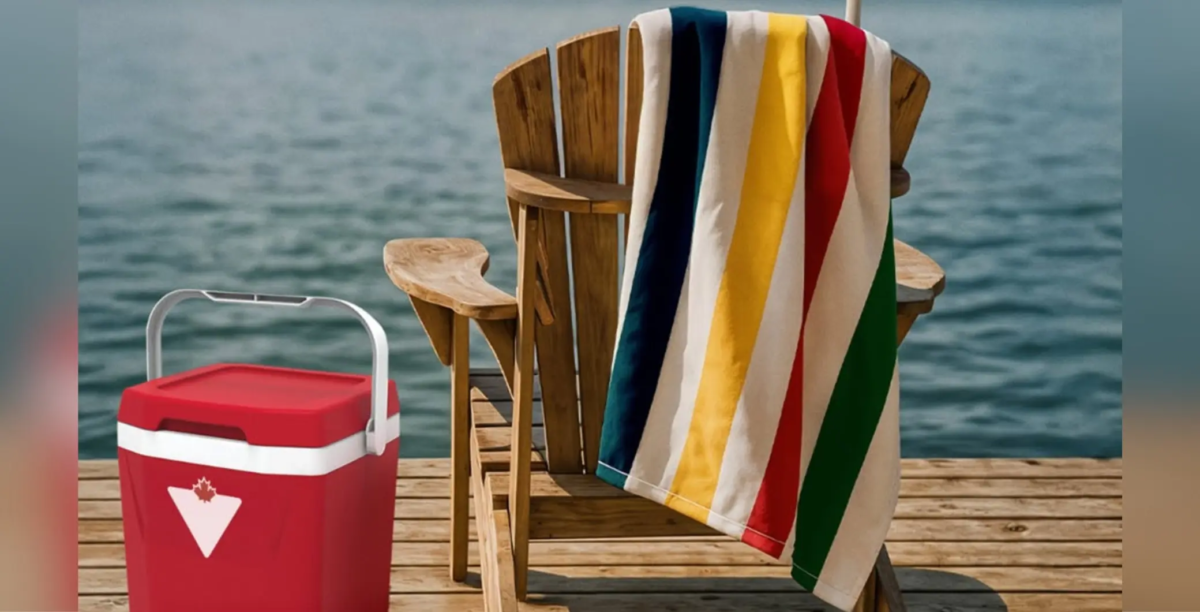
HBC stripe blanket. Photo: Canadian Tire

Canadian Tire will begin selling the iconic Hudson’s Bay point blankets and continue the program that donates proceeds to Indigenous-led initiatives, marking the first major product launch since acquiring the Hudson’s Bay intellectual property earlier this year.

The retailer announced that it will direct 100 percent of the net proceeds, and at least $1 million annually, to support Oshki Wupoowane | The Blanket Fund, a national initiative administered by the Gord Downie & Chanie Wenjack Fund (DWF). The fund provides grants that empower Indigenous communities through cultural, artistic, and educational projects.

Expanding a Legacy of Reconciliation

The partnership builds on the original initiative launched in 2022 by Hudson’s Bay Company as part of its truth and reconciliation journey. The program was created after consultation with Indigenous organizations and community leaders across Canada. Its aim was to transform the legacy of the Hudson’s Bay point blanket, an enduring national symbol tied to both cultural identity and colonial history, into a source of meaningful action.

Under the new arrangement, Canadian Tire will assume stewardship of the program and guarantee the continuation of its funding. Should annual sales of the blankets fall short of $1 million in net proceeds, the retailer will make up the difference.

“We are exceptionally proud to be the stewards of HBC’s legacy – and as one of the nation’s longest-standing companies, we don’t take the responsibility lightly,” said Greg Hicks, President and CEO of Canadian Tire Corporation, in the announcement.

Continuing the Work of The Blanket Fund

Since its launch, The Blanket Fund has distributed more than $1.1 million in capacity-building grants that help grassroots Indigenous organizations grow sustainably, and $690,000 in reconciliation action grants that support one-time projects connecting Indigenous and non-Indigenous communities through arts, education, and culture.

With the Hudson’s Bay retail operations shuttered earlier this year, the program’s future had been uncertain. The new partnership with Canadian Tire ensures continuity, with a $1 million guaranteed minimum contribution each year, significantly exceeding past annual donations from Hudson’s Bay Foundation.

In consultation with Indigenous communities, DWF developed a participatory granting model that involves applicants directly in the funding selection process, ensuring decisions reflect community priorities.

Hudson’s Bay stripes. Photo: Canadian Tire

The Iconic Hudson’s Bay Blanket Returns to Store Shelves

Canadian Tire confirmed that the Hudson’s Bay point blankets will soon be available in its stores in a limited initial run, with more to follow. For now, the blankets will be sold in-store only, not online.

The blankets will continue to be manufactured by A.W. Hainsworth, a Yorkshire-based mill established in 1783, using the same production methods and wool quality that have defined the product for centuries. The familiar multi-stripe design, introduced in the late 18th century, will return, alongside other historic colour variations.

In a conference call with analysts this summer, Hicks hinted that some Hudson’s Bay-branded products could be on shelves in time for the holidays, with a broader rollout planned for 2026.

A Complex Symbol in Canadian History

The Hudson’s Bay point blanket remains one of the country’s most recognizable consumer goods, woven deeply into the nation’s history. Its origins trace back to the early fur trade era, when the Hudson’s Bay Company used the blankets as currency to trade with Indigenous hunters, guides, and translators. The “points” stitched into the fabric indicated size and value.

While the design came to symbolize comfort and Canadiana, the blankets are also intertwined with the company’s colonial history. They evoke a period when trade and settlement expanded across Indigenous lands under the 1670 Royal Charter of King Charles II, which granted Hudson’s Bay a monopoly over vast territories encompassing much of modern Canada.

For many, the repurposing of the blanket’s profits into reconciliation efforts marks a small but symbolic act of repair.

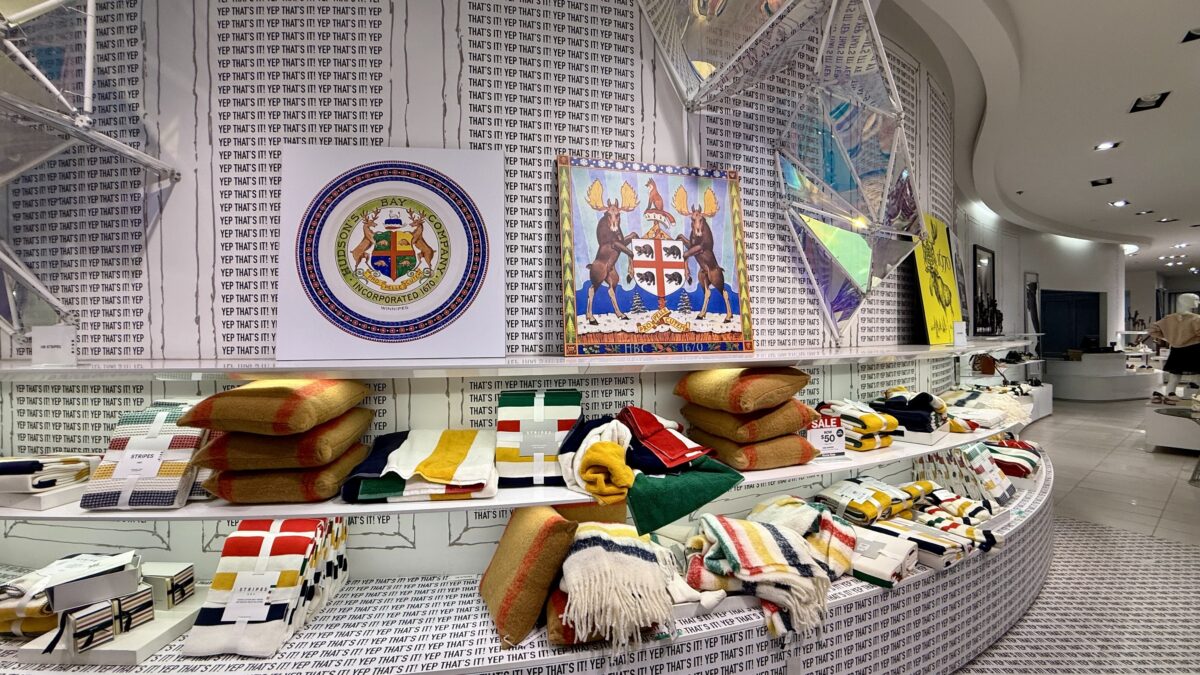
Hudson’s Bay stripe products at the Queen Street flagship store in Toronto on March 15, 2025. Photo: Craig Patterson

From Heritage to Hope: A New Chapter for the Stripes

Canadian Tire’s acquisition of Hudson’s Bay Company’s intellectual property, including the distinctive four-stripe motif, was finalized earlier this year for $30 million following the retailer’s bankruptcy proceedings. The move ensures that the Hudson’s Bay legacy will live on through select products, though under new corporate stewardship.

For Canadian Tire, this represents both a commercial and cultural responsibility. As Hicks noted, the company views itself as a caretaker of one of the country’s most storied brands, and intends to ensure that its future aligns with modern Canadian values.

By pledging sustained funding to Indigenous-led initiatives, the company is signaling an ongoing commitment to reconciliation while also preserving an artifact of Canadian retail history.

More from Retail Insider:

Nike Opens Canadian Flagship at CF Toronto Eaton Centre

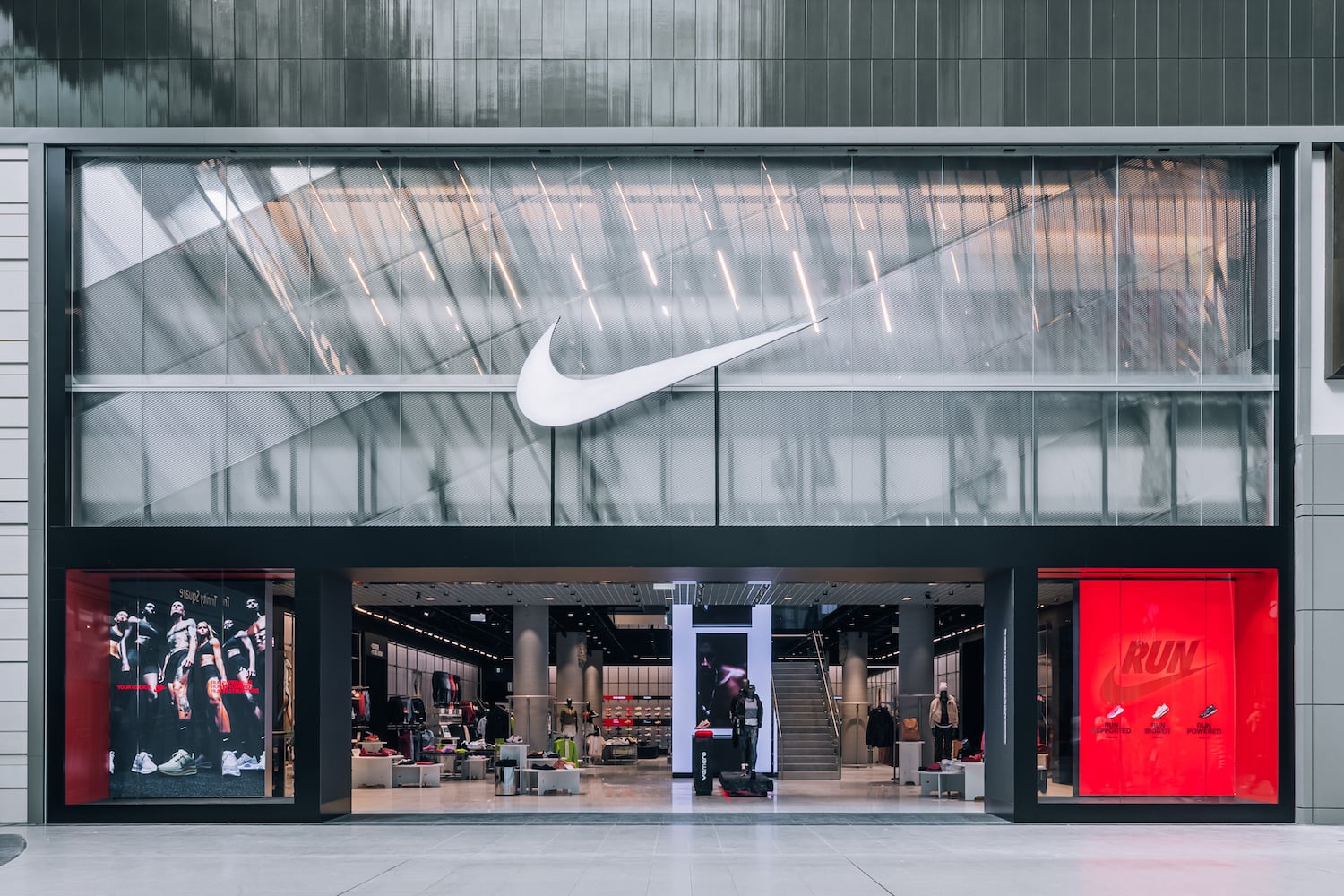
Nike flagship at CF Toronto Eaton Centre. Photo supplied

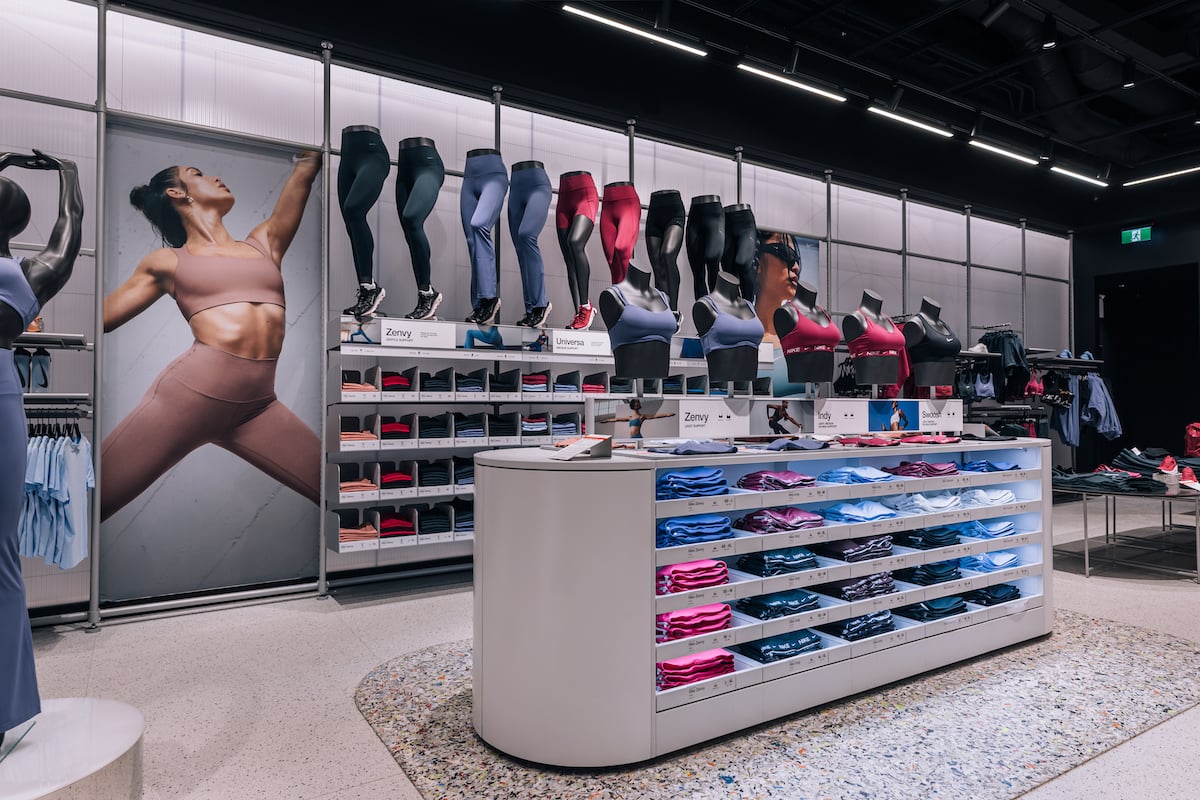
Nike has opened its new Canadian flagship at CF Toronto Eaton Centre in downtown Toronto, marking a milestone in the brand’s ongoing retail buildout across the country. The two-level store spans approximately 21,000 square feet and introduces a full expression of the brand’s sport-first merchandising, digital storytelling, and in-store services. Operated in Canada by Fox Group, Nike’s local licensee, the flagship occupies part of the former Nordstrom space within the shopping centre and arrives alongside recent and forthcoming tenants that signal a broader repositioning of the complex. The opening strengthens Nike’s visibility in the heart of Canada’s largest city and underscores a national strategy that includes multiple large-format stores and an ambitious rollout of new locations.

The new store anchors a high-traffic corridor in CF Toronto Eaton Centre with entrances that reinforce its role as a central destination. One entry fronts a main interior hallway, while another faces the new Eataly-occupied corridor that leads toward La Maison Simons. The location will help Nike capture the steady flow of local shoppers, office workers, students, and tourists that move through the centre every day. The brand’s decision to invest at this address reflects the ongoing resurgence of downtown retail and the draw of a mall that benefits from direct connections to the TTC network and the PATH system.

Inside, the flagship presents a clean, sport-driven layout with extensive digital surfaces that animate seasonal stories and guide the journey from one category to the next. A two-level digital atrium brings the height of the space to life, and the central staircase acts as an architectural anchor that connects floors and frames one of the store’s signature services. The main level is dedicated to women, while the upper level houses men and kids, with the entire offer organized around performance sport and the lifestyle moments that flow from it.

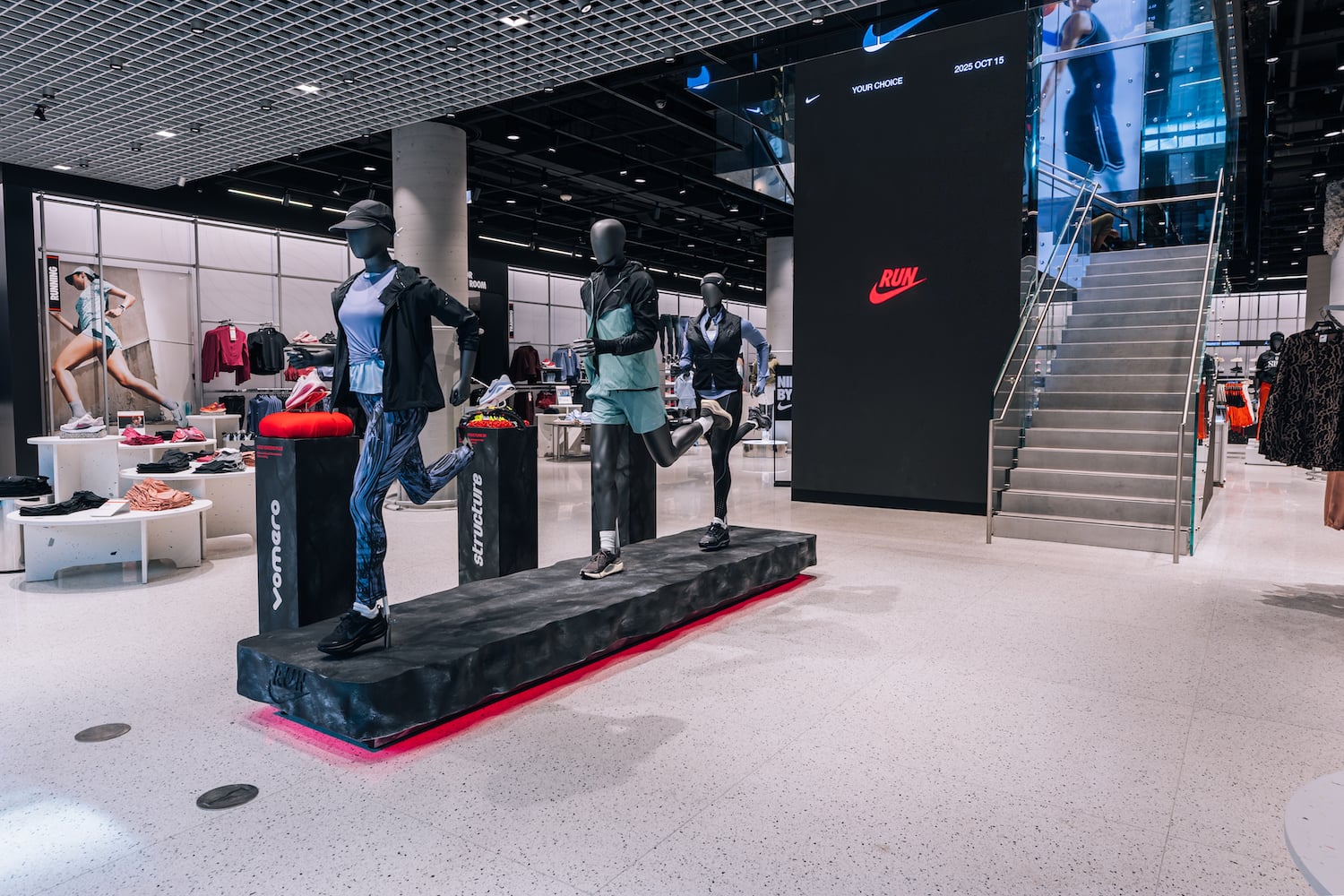
Main floor of the Nike flagship at CF Toronto Eaton Centre. Photo supplied

Women Lead on the Ground Floor, With Running at the Core

Nike has placed women at the front of the experience by dedicating the ground floor to women’s performance and lifestyle collections. A running presentation sets the tone for the store, with clear signposting that helps shoppers navigate cushioning, stability, and responsiveness across footwear families. A streamlined “power of choice” framework simplifies selection by clustering models into entry, icon, plus and premium tiers, which makes it easier to match need, fit, and budget. The approach reduces decision fatigue, gives context to step-up features, and supports self-serve shopping for customers who arrive with a goal and want to move with purpose.

Apparel assortments round out the floor with focused capsules that reflect how people actually train and live. Race Day pieces prioritize light, minimal distractions for speed work and events. The Swift running collection covers daily miles and recovery sessions with dependable staples. The 24/7 line bridges gym, commute, and casual wear, emphasizing performance fabrics that can live comfortably through an entire day. Bra and legging presentations call out support levels and technology in straightforward language, while sustainability touchpoints, including materials programs like Nike Grind, acknowledge growing consumer interest in recycled content and circularity.

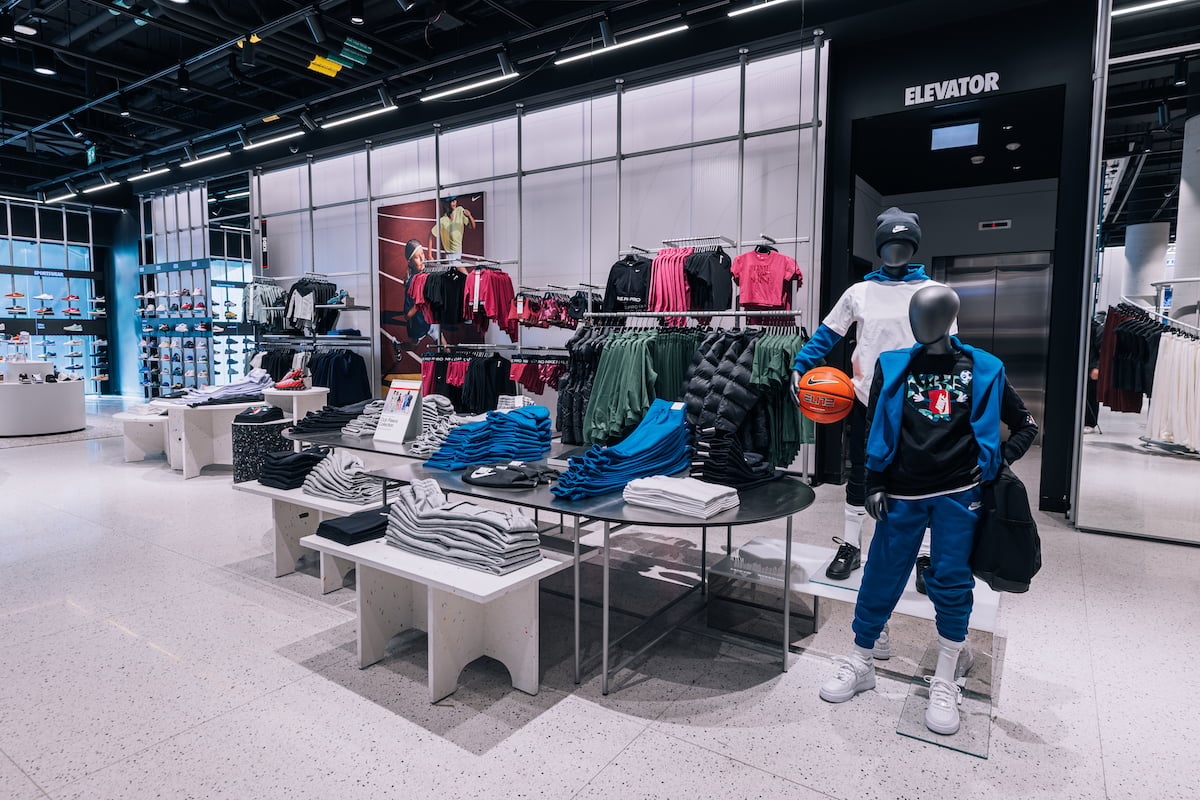
Nike flagship at CF Toronto Eaton Centre. Photo supplied

Upstairs, a Complete Men’s and Kids’ Offer, From Training to Lifestyle

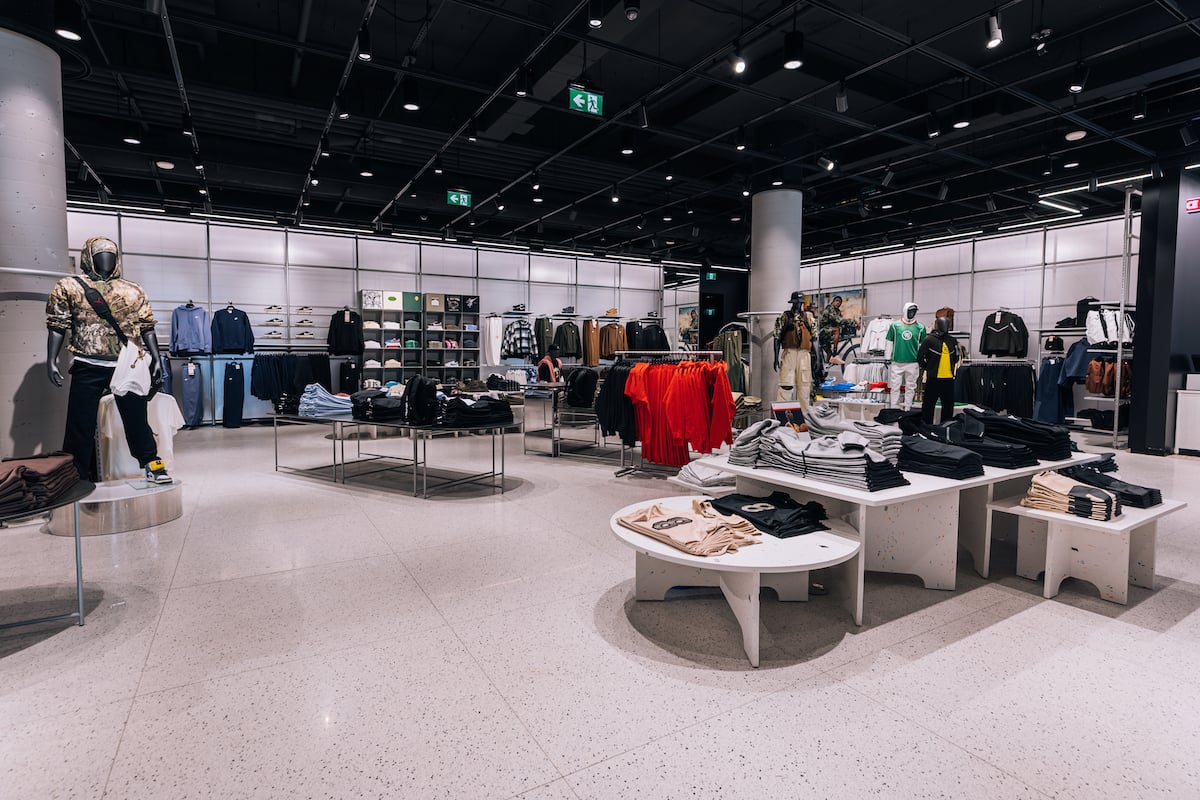
The second level expands the range with men’s and kids’ categories that mirror the store’s sport-to-style cadence. Training apparel and footwear are organized around practical performance needs, from hybrid sessions to gym-focused strength work. On-court basketball sits alongside lifestyle propositions from Michael Jordan, with colour stories and materials that nod to heritage while meeting modern fit expectations. Technical fleece and winterised layers recognize the Canadian climate, bringing warmth and versatility to collections that still look sharp in daily wear.

Kids receive a dedicated browse that scales technology, comfort, and durability down to smaller sizes while keeping the energy of the brand intact. The layout deliberately keeps families in flow, allowing parents to shop for themselves while keeping an eye on younger companions. Signage is readable at a glance, benches are placed where they are most useful, and footwear walls mix bold presentation with practical information.

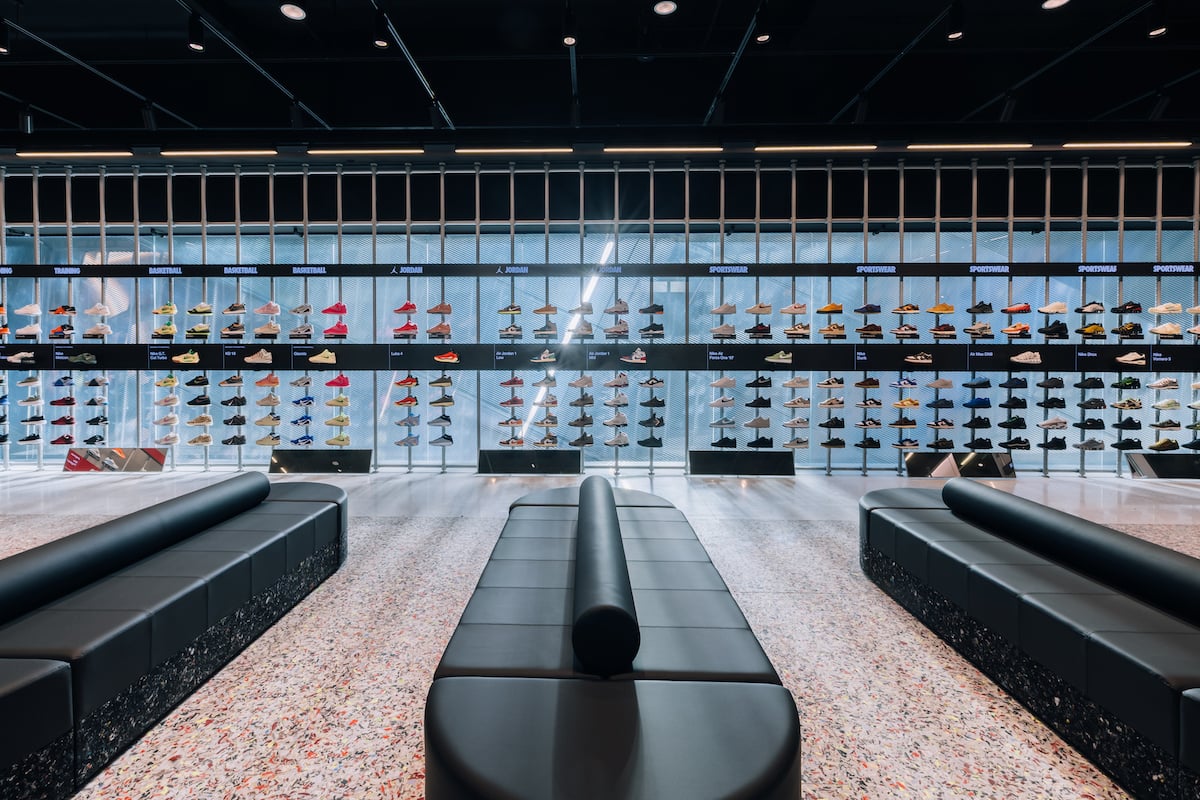
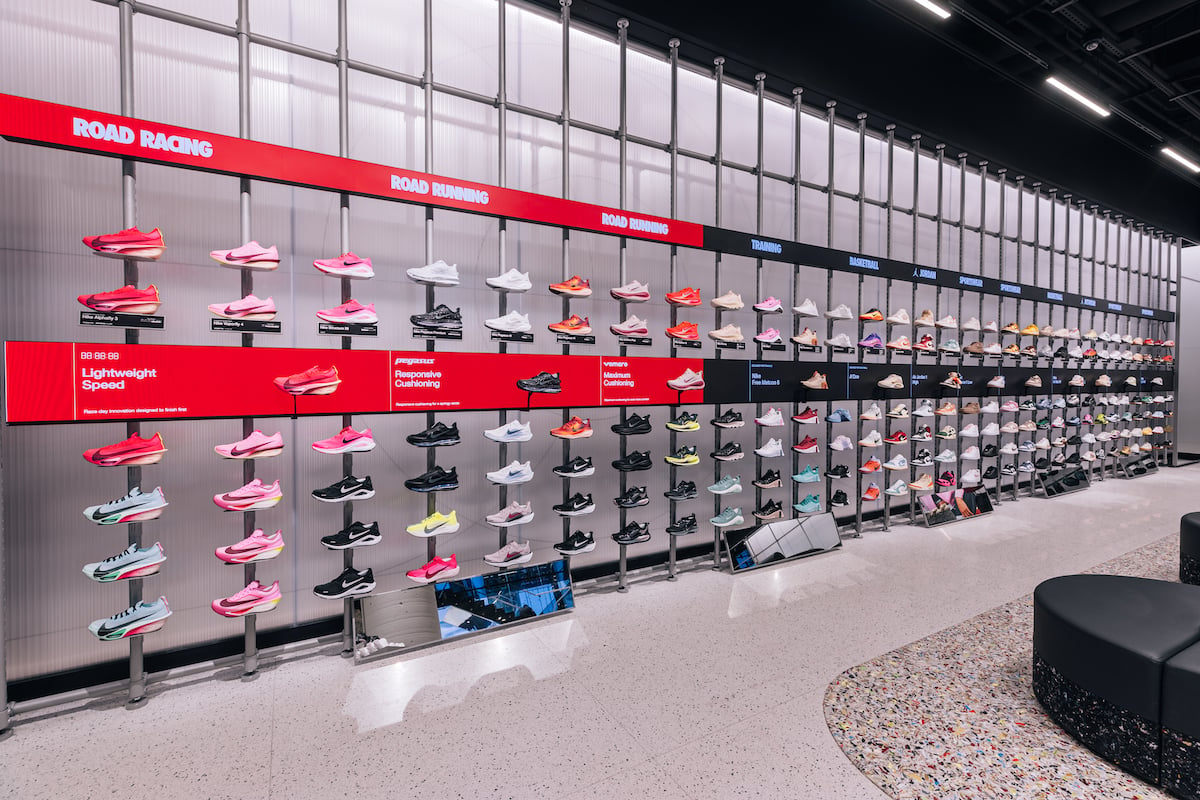
Men’s footwear wall at the Nike flagship at CF Toronto Eaton Centre. Photo supplied

Digital Storytelling and Service at the Centre of the Experience

Screens and interactive surfaces are used to explain footwear ingredients, highlight seasonal collections, and connect in-store moments with the broader brand ecosystem. The digital footwear wall upstairs is designed to be both aspirational and practical, allowing visitors to match silhouettes to functions, then learn about the cushioning systems, plates, and uppers that define ride and feel. In a busy downtown mall, that clarity matters. It helps the enthusiast compare models precisely while ensuring a casual shopper can still make a confident decision.

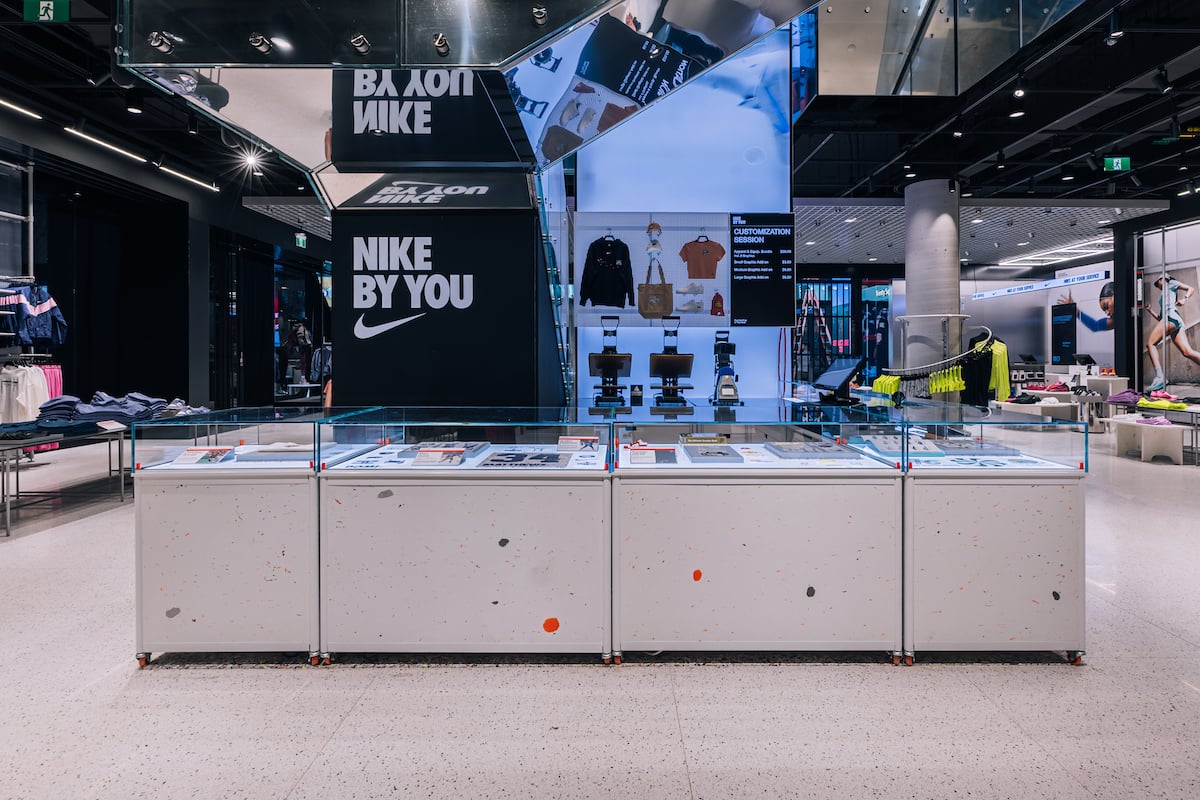
The store’s service proposition is anchored by Nike by You, introduced here as the brand’s first and only in-store customization program of its kind in Canada. Located beneath the central staircase on the main floor, Nike by You invites customers to personalize items such as T-shirts, hoodies, and select footwear with graphics, patches, and city-specific motifs. The studio is set up for speed, with a counter workflow that guides selection and pressing, and a rotating library of designs that includes Toronto references and seasonally refreshed athlete stories. The offer creates a sense of occasion for locals and visitors alike, and it gives the flagship a capability that rewards repeat trips.

Nike by You on the main level of the Nike flagship at CF Toronto Eaton Centre. Photo supplied

Performance Innovation Explained Without the Jargon

One of the challenges for any performance retailer is translating technology into benefits that matter on the run, in the gym, or on the court. The CF Toronto Eaton Centre flagship solves for this through presentation and pacing. Race-day shoes are displayed with concise notes about foam responsiveness, plate function, and upper materials, while daily trainers point out stability features and cushioning that help with long shifts on foot or urban walking in all weather. Basketball models emphasize traction and support, training shoes communicate why a stiffer platform resists torsion under load, and hybrid options make clear when limited-distance running fits into a weekly routine.

This is technology storytelling with a purpose. It respects the enthusiast who wants to compare details, and it supports the time-pressed shopper who needs a reliable everyday solution. The result is a store that takes performance seriously while acknowledging that many customers will move fluidly between sport, commute, and social settings in a single day.

Men’s apparel on the second floor in the Nike flagship at CF Toronto Eaton Centre. Photo supplied

From Nordstrom’s Exit to a New Retail Chapter

The arrival of Nike’s CF Toronto Eaton Centre flagship is part of the ongoing transformation of the space once anchored by Nordstrom, which exited Canada in 2023 and vacated all stores. The former department store floors are being reimagined by Cadillac Fairview as a series of high-profile destinations. La Maison Simons made its downtown Toronto debut in the complex last month, while Eataly is preparing to open a 25,000 square foot marketplace in November. Taken together, these additions are redefining the upper levels of the mall as a sequence of distinctive experiences that draw repeat traffic and encourage longer visits.

Nike’s decision to situate its flagship within this cluster brings a complementary sport and lifestyle proposition to the mix. The proximity to Simons and the path to Eataly creates natural cross-shopping, while the visibility of the digital atrium and entrance placements ensures the store acts as a beacon from multiple sightlines within the mall. The overall effect is a more diversified, more resilient retail ecosystem.

Unisex kid’s department on the second floor of the Nike flagship at CF Toronto Eaton Centre. Photo supplied

A National Strategy Led by Fox Group

The Fox Group operates Nike’s mono-brand stores in Canada and has been central to the brand’s rapid local expansion. The company brought a new generation of large-format Nike stores to the country beginning with the Yorkdale location in the summer of 2021, followed by additional rollouts that have broadened the brand’s reach across major markets. The West Edmonton Mall location, a single-level giant at roughly 28,000 square feet, remains the largest Nike store in Canada and demonstrates how scale can be leveraged to create immersive category depth. In Toronto, the brand added a significant anBloor Street presence at One Bloor East in late November 2024, creating a midtown address that caters to a different shopper rhythm than downtown.

The opening at CF Toronto Eaton Centre extends that strategy with a flagship that benefits from unparalleled pedestrian traffic and transit connectivity. It also signals how Fox Group and the brand are advancing a consistent visual language across stores, with digital elements and service points.

Women’s shoes on the main level of the Nike flagship at CF Toronto Eaton Centre. Photo supplied

Inside Nike’s “25 and 25” Expansion

Nike Canada’s “25 and 25” initiative was conceived as a concentrated, one-year retail buildout designed to expand access and consistency across key Canadian markets. The program set a clear target of 25 partner-operated openings in fiscal 2025 and delivered on that ambition, bringing the total store count to 56 nationwide by August 2025. It was framed internally as a defining move that would tighten the link between brand storytelling and local retail execution, with each opening positioned to serve both performance sport and day-to-day wear.

Execution was centralized through Nike’s Store Partners team. The mandate was to uphold a premium, repeatable standard in design and service while allowing stores to reflect the communities they serve. That balance is visible in category emphasis, seasonal storytelling, and the rotation of city-relevant moments that keep assortments fresh for returning customers. The approach also relied on disciplined project management so that openings landed cleanly, with trained teams in place and the in-store journey flowing from clear wayfinding to concise technology explanations.

Geographically, the rollout concentrated on Ontario, British Columbia, and Quebec, strengthening coverage in major urban centres where sport and lifestyle intersect most visibly. Those markets provided the density and commuter patterns needed for frequent visits, while also offering neighbourhoods where tailored assortments and community-oriented programming resonate. The flagship layer at CF Toronto Eaton Centre sits above that network, giving the brand a central stage for bigger stories and services while the wider fleet handles everyday demand.

By aligning a rapid cadence of openings with a tightly managed standard for in-store execution, the “25 and 25” initiative helped entrench Nike’s leadership in Canadian activewear retail. It also laid groundwork for future growth, giving the brand more places to meet customers where they are and more opportunities to connect national storytelling to local communities.

More from Retail Insider:

Calgary Retail Market Remains Stable Amid Evolving Demand, Avison Young Reports

CF Chinook Centre. Photo: Mario Toneguzzi

The Calgary retail market is maintaining stability amid shifting demand, according to a recent report by commercial real estate firm Avison Young.

Retail fundamentals in Calgary remain steady, with demand anchored by population growth, evolving consumer preferences, and strategic mixed-use development, said the report.

Key trends from the report:

  • Calgary’s economy remains resilient amid national economic headwinds, supported by a strong labour market, sustained population growth, and continued strength in the energy sector. In the retail sector, demand remains healthy, with grocery-anchored and service-based retailers performing well. New developments are limited, leading to tighter availabilities in desirable nodes, while evolving consumer preferences continue to drive demand for experiential and convenience-based retail formats;
  • The rollout of federal–provincial childcare funding has provided relief of up to $30,000 for childcare programs through federal grants; however, it has fueled quick absorption of the available commercial real estate suitable for conversion. Market dynamics have shifted: there is a growing prevalence of non-profit and preschool-only operators over traditional full-day, forprofit models—especially those requiring outdoor space. From a leasing standpoint, inquiries and leads from traditional childcare tenants have noticeably declined due to provincial grant caps;
  • Recent enforcement trends by the Competition Bureau have placed increased scrutiny on exclusivity clauses and restrictive covenants in retail leases. These provisions are now considered presumptively anticompetitive, particularly when they involve broad geographic scope, indefinite terms, or protections favoring dominant tenants—conditions that may substantially lessen competition in local markets. While grocery anchors have been the primary focus, these guidelines apply across all retail sectors, signaling a broader shift in regulatory oversight impacting property controls and leasing strategies.
CF Chinook Centre. Photo: Mario Toneguzzi

“Overall, retail remains a top asset for investment and its potential for rents and scalability. As population and markets continue to grow, the need for essential retail and leisure will follow,” said Avison Young.

“From its highest point in 2020 – due to the pandemic – vacancy has largely recovered and is steadily increasing as more retail space comes online. Inventory is expected to grow in the coming few years with several large-scale projects under development. Transportation and ease of access is expected to remain a key tenet for retail expansion.”

As of mid-2025, Calgary had 64,218 thousand square feet of retail space under construction. The total retail inventory is projected to grow by nearly 0.15% by year-end, driven by the delivery of new community retail hubs and mixed-use developments, noted the report.

“While retail rents in Calgary have been trending upward, the city has also transitioned to a premium market, above the national average. This shift reflects the market’s efforts to deliver new product over the past few years alongside steady business growth. With significant highquality inventory slated for delivery, rents are expected to continue rising in line with ongoing economic momentum and tenant demand,” it said.

More from Retail Insider:

Purdys launches No Sugar Added Salted Caramels

CF Chinook Centre. Photo: Mario Toneguzzi

Purdys Chocolatier has added a new product to its No Sugar Added line in response to growing consumer demand for lower-sugar treats.

The Vancouver-based chocolate maker announced the launch of its No Sugar Added Salted Caramels, available in a 12-piece gift box. The assortment includes six milk chocolate and six dark chocolate pieces, and will retail for $30 in Purdys shops and online.

The new offering is sweetened with maltitol, a plant-based sweetener, and contains no added sugar. Each caramel is coated in no-sugar-added chocolate and topped with flaked sea salt.

CF Chinook Centre. Photo: Mario Toneguzzi

Inspired by Purdys’ Himalayan Pink Salt Caramels, the new confections aim to deliver a similar taste and texture experience. The company says the No Sugar Added Salted Caramels offer “the perfect balance of satisfying chewiness and a silky-smooth melt.”

The release builds on what Purdys says is one of its fastest-growing product categories. According to the company, its No Sugar Added Chocolate line has seen a 70 per cent increase in growth since launch.

“Over the years, our guests have consistently asked for more no-sugar-added products, both in-store and online,” said Kriston Dean, vice-president of sales and marketing at Purdys Chocolatier. “There is a loyal and growing community seeking more high-quality treats that fit their dietary needs, so we know they’re going to be absolutely thrilled to see our fan-favourite No Sugar Added Salted Caramels in the mix.”

While many zero-sugar confections rely on artificial sweeteners, Purdys says its No Sugar Added Chocolate line uses plant-based alternatives and only small amounts of natural sugars found in ingredients such as dairy. The chocolates are designed to emphasize the natural sweetness and flavour of sustainably sourced cocoa beans.

Kriston Dean
Kriston Dean

Dean said the brand’s classic caramels are a beloved staple for many of regular customers who come into Purdy’s shops or purchase online. 

“So when we continued getting such enthusiastic demand to expand our No Sugar Added line due to a growing consumer base looking for no sugar added options for dietary preferences or health reasons, we knew we had to introduce a version of the classic caramels under this growing category,” she said.

Purdys’ No Sugar Added line has built a loyal fanbase and a unique market position. When crafting our No Sugar Added Salted Caramels, we were committed to delivering the same high-quality taste our customers expect from the entire NSA collection.

“By carefully adapting our proprietary recipes with plant-based sweeteners, we ensure our NSA products deliver a satisfying flavour comparable to their traditional counterparts.

“The magic of NSA products, maintaining a similar taste and texture, lies in our process. Our team at the Purdys Chocolatier factory has perfected specific cooking procedures and temperatures to ensure these products meet Purdys’ high-quality standards.”

She said customers loved the taste of its past No Sugar Added products, which used maltitol. 

“Because of this positive feedback, we knew we had to continue incorporating this plant-based alternative sweetener into our future recipe development. Maltitol is a popular choice and a common ingredient in the growing market for plant-based sweeteners,” explained Dean.

CF Chinook Centre. Photo: Mario Toneguzzi

Our No Sugar Added line has consistently generated strong interest and enthusiasm from our customers. Over the years, we have received ongoing feedback, both in-shops and online, asking when new NSA products will be introduced. There is a loyal and growing customer base actively looking for more indulgent, high-quality treats that align with their low-sugar dietary preferences. Since launch, our NSA category has experienced +70% growth, with sales increases of over 30% year over year.”As long as there is steady consumer interest, we’re continually exploring ways to innovate and expand our No Sugar Added product range – so we’re always open to growing our offerings.”

More from Retail Insider:

Photo: Purdys
Photo: Purdys
Photo: Purdys
Photo: Purdys

New Canadian Lingerie Brand Figiura to Serve Women with Augmentations

Photo: Figiura
Photo: Figiura

A new Canadian lingerie brand is preparing to launch with a focus on meeting the needs of women with breast augmentations, a market its founder says has long been overlooked.

Figiura, founded by Jessica Johnson, is set to go to market in early 2026. Johnson, based in Bowmanville, Ont., said the concept was born from her own experience struggling to find bras that properly fit her body after undergoing breast augmentation.

Jessica Johnson
Jessica Johnson

“For the last 15 years, I struggled to find traditional bras that fit my augmented shape,” she said in an interview. “I was really confined to sport-style bras or bralettes.”

Johnson said the idea for Figiura came after a conversation with her husband, who questioned whether other women were also having the same challenges.

“He said, ‘You can’t be the only one feeling this way and having these immense fit issues,’” she recalled.

Though Johnson came from a social work background and was running a home care agency for seniors at the time, she began reaching out to women in her community who had undergone augmentation—cosmetic, reconstructive or restorative—to gather feedback.

“I started picking the community’s brain,” she said. “What are they wearing when they get dressed in the morning?”

She said the response was overwhelming and quickly confirmed that many women shared her concerns.

“There’s wonderful brands out there focused on the mastectomy community, or on large-breasted or small-chested women,” Johnson said. “This community is being left out of the fit revolution.”

Figiura incorporated in 2022, and has since spent over two years on research and product development. The company initially began prototyping in Asia to take advantage of cost-effective manufacturing, creating custom mould presses tailored to the anatomical differences of augmented breast tissue.

“These include rounder shapes with more tissue volume in the upper quadrant, greater forward projection—even in smaller sizes—and less malleable tissue,” Johnson said.

Due to shifting tariffs, Figiura has since relocated its manufacturing to North Africa, with production now taking place in Morocco and Tunisia.

“That best aligned with our premium luxury quality,” said Johnson. “We’re going to be in select luxury retailers.”

Jessica Johnson
Jessica Johnson

Although the company will be ready by the 2025 holiday season, Johnson said they plan to officially enter the market in the first quarter of 2026 to avoid the crowded holiday rush and finalize distribution deals.

“We’re in early discussions with global licensee and distribution partners,” she said. “Capitalizing on that first-mover’s advantage and creating that community is something we’ve had our eye on right from the beginning.”

Figiura’s go-to-market strategy includes an omnichannel approach—direct-to-consumer sales through its online platform, clinical partnerships with plastic surgeons and breast reconstruction specialists, and retail expansion in select luxury stores across North America.

“We’re just about to close off our seed round raise,” Johnson said, adding that the funding will help ignite clinical partnerships and fuel growth.

Johnson emphasized that Figiura is more than a bra company—it’s aiming to establish a new category within lingerie. She said the brand seeks to move beyond traditional marketing approaches in favour of body-positive messaging.

“There was a line that tried to launch 20 years ago,” she said, referencing a failed attempt at a similar product. “It really just came down to how it was marketed. It was very ‘sex sells’ right up front.”

She said her brand’s approach will be different.

“It’s so important that conversations around body confidence and the way that women define that are more openly spoken about,” she said. “These women are demanding products that honour not only their bodies but their choices.”

Jessica Johnson
Jessica Johnson

More from Retail Insider:

Anna Olson to host brunch at Solé Uptown

Anna Olson. Photo Credit: Janis Nicolay

Solé Uptown will host Canadian chef and television personality Anna Olson for an exclusive brunch event on Nov. 1 to celebrate the release of her new cookbook, Anna Cooks.

The brunch will take place from 10:30 a.m. to 2 p.m. at the Waterloo restaurant, which is operated by the Charcoal Group of Restaurants.

Jody Palubiski. Photo credit: Charcoal Group

“Anna Olson carries a contagious passion for authentic and approachable cooking,” said Jody Palubiski, chief executive officer at the Charcoal Group. “Her recipes are thoughtful and inspiring – and bringing her to Solé allows us to combine her culinary expertise with our commitment to seasonal, locally-inspired cuisine.”

Guests attending the event can expect a seasonally inspired, chef-curated brunch menu featuring dishes such as Maple Pumpkin Pancakes with Cranberries, Crab & Corn Frittata with Simple Green Salad, and Autumn Apple Slab Pie. These items will be offered alongside Solé Uptown’s regular brunch menu.

Anna Cooks includes more than 125 recipes designed to be approachable for home cooks, with options for every meal of the day, including weekday breakfasts, quick lunches, one-pan dinners and indulgent desserts.

“Food is about connection, community and sharing moments that bring people together,” said Olson. “I can’t wait to connect with food lovers at Solé and celebrate the joy of cooking in a space that values creativity and seasonal flavours.”

Guests will have the opportunity to purchase a copy of Anna Cooks during the event. While tickets are not required, seating is limited. Solé Uptown encourages guests to reserve a table by calling 519-747-5622.

Charcoal Group is an inspired group of full-service restaurants located across Southern Ontario with over 65 years in the hospitality industry. Our restaurants include Solé Uptown, The Charcoal Steakhouse, Martini’s, Dels Italian Kitchen, Wildcraft Grill & Long Bar, The Bauer Kitchen, The Bauer Bakery & Café, Moose Winooski’s, Beertown Public House, and Sociable Kitchen & Tavern.   

More from Retail Insider:

6 Best Cost Segregation Firms For Tax Savings

Earlier this year, I reviewed a cost segregation study for a client who had just acquired a Class B office complex in Phoenix. 

The report had been delivered on time and looked professional, but when we started reconciling the numbers against the construction details, several major systems were missing from the accelerated schedules. No parking lot improvements, no specialty electrical, no HVAC zone breakdown.

The provider was a large national firm, but they’d assigned the project to a junior analyst using templated assumptions and no site visit. The client thought they had saved money. In reality, they left six figures in deductions on the table.

That situation underscored something I’ve seen repeatedly. The biggest risk isn’t hiring a bad firm, it’s hiring a good one that’s wrong for your asset type. 

When it comes to cost segregation, details matter. The best cost segregation companies in 2025 are the ones that treat every property like it’s their own.

Quick Take: Three Best Cost Segregation Companies for 2025

  1. RE Cost Seg: Best for Strategic Real Estate Portfolios
    • Portfolio-level tax planning
    • National reach with local insight
    • Engineering-grade, audit-ready studies
  2. Maven Cost Seg: Best for Investor-Owned Multifamily Properties
    • Boutique focus on multifamily assets
    • Strong feasibility modeling
    • Investor-aligned reporting style
  3. CohnReznick: Best for Institutional and Large Commercial Assets
    • National tax advisory powerhouse
    • Deep bench of CPAs and engineers
    • Ideal for REITs and complex structures

For full reviews on all the firms we analyzed, including their specialties, strengths, and selection criteria, read the full breakdown below.

5 Smart Filters for Choosing a Cost Segregation Firm

The cost segregation market is crowded, with firms that range from boutique specialists to high-volume operators. Here are the key things to look for to maximize your results.

The key is choosing one aligned with your asset type, reporting needs, and of course, risk tolerance. Here’s what I’d look for

1. Know What “Engineering-Based” Actually Means

It’s a common marketing pitch, but not all engineering-based studies are created equal. Ask who conducts the site work, whether they review blueprints, and if real engineers sign off. 

True engineering support is more than just a buzzword. It’s the backbone of audit confidence. Providers who rely solely on cost databases without property-level analysis often miss key site-specific elements that affect accelerated deductions.

2. Match Their Strength to Your Property Type

A firm specializing in industrial warehouses won’t automatically understand the depreciation potential in student housing or the medical space. Look for clear evidence and a track record in your category. Ask for sample reports and real outcomes in your vertical or similar industries. 

3. Evaluate How They Handle Multi-Asset Projects

If you’re managing a portfolio, even a small one, ask how the provider handles project coordination. Can they standardize reports across asset types? Will they track overlapping improvements across similar buildings? That level of organization often separates good from great. 

4. Don’t Overlook Report Usability

Some firms generate technically sound reports that are hard for non-accountants to navigate. Look for structured schedules, labeled asset groups, and summary-level data your CPA can plug directly into Form 4562 without needing translation. Great reporting should reduce the burden on both your CPA and your internal team.

5. Clarify What Happens If You Get Audited

Every provider promises “audit-ready” studies, but few explain what happens when an audit actually arrives. Who defends the work? What’s included in documentation packets? Is audit support built into the price or billed separately? 

Clear deliverables are non-negotiable. The best firms have internal processes, archived documentation, and a track record of representing clients successfully.

Top 6 Cost Segregation Firms Worth Considering This Year

1. RE Cost Seg: Best for Strategic Real Estate Portfolios

  • Founded: 2022
  • Headquarters: Houston, TX

Why RE Cost Seg is the best cost segregation company: RE Cost Seg brings a portfolio-minded approach to cost segregation, making them ideal for investors managing multiple property types or long-term acquisition pipelines. Their engineering-grade studies are paired with tax planning tools that show owners how reclassification impacts liquidity, refinance timing, and reinvestment capacity.

Their deliverables go beyond depreciation schedules. They include summary dashboards and pro forma integration that support real estate decision-making. RE Cost Seg also offers white-glove onboarding, with client managers who coordinate directly with CPAs and legal teams for seamless implementation. The firm’s emphasis on measurable ROI has made it a go-to for property groups serious about maximizing every aspect of their assets’ financial performance.

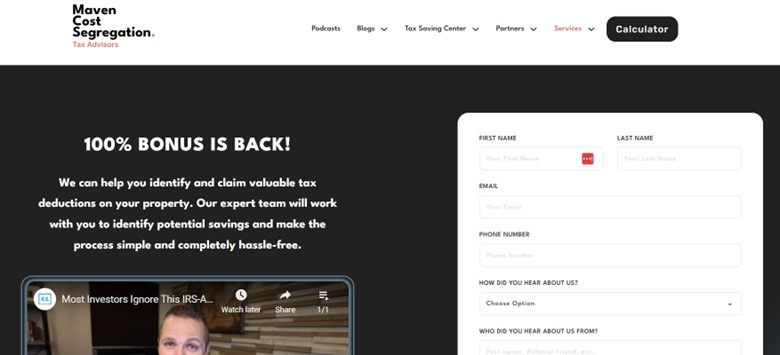
2. Maven Cost Seg: Best for Investor-Owned Multifamily Properties

  • Founded: 2023
  • Headquarters: Sterling Heights, MI

Maven Cost Seg focuses exclusively on real estate investors, with particular depth in multifamily, student housing, and small mixed-use portfolios. Their reports are structured to show impact at both property and investor levels, making them especially valuable for syndicators and passive LPs.

They also offer strong feasibility analysis up front, helping sponsors understand the projected tax benefits before closing. Clients appreciate that the team brings both engineering expertise and real estate investment fluency, helping sponsors model after-tax IRR more accurately during deal underwriting.

3. CohnReznick: Best for Institutional and Large Commercial Assets

  • Founded: 1919
  • Headquarters: New York, NY

CohnReznick is one of the few national tax advisory firms with an in-house cost segregation team. Their work spans large office campuses, healthcare facilities, and ground-up developments with layered capital stacks.

Clients benefit from multidisciplinary teams (CPAs, engineers, and tax credit specialists) who deliver tightly integrated reports designed for audit confidence and board-level scrutiny. Their institutional background also makes them an asset during financial reviews and M&A transactions, where depreciation positioning can influence deal structure.

4. Expert Cost Segregation: Best for Owner-Operators and Single-Asset Buyers

  • Founded: 1987
  • Headquarters: Houston, TX

Expert Cost Segregation or O’Connor & Associates is built for speed and accessibility. They serve small-to-midsize commercial owners with a streamlined intake process and flat-fee pricing. Their engineering reviews are site-based, but the firm stands out for making the reporting process unusually transparent and digestible, even for first-time users.

They also deliver unusually fast turnaround times for asset classes like retail strips, single-tenant NNNs, and medical condos. Ideal for business owners trying to meet filing deadlines while managing day-to-day operations.

5. Haynie & Company: Best for Tax-Integrated Advisory Services

  • Founded: 1960
  • Headquarters: Salt Lake City, UT

Haynie & Company offers full CPA services with in-house cost segregation, making them a solid fit for owners who want all tax matters handled under one roof. Their team includes engineers and tax professionals who understand how depreciation schedules interface with broader compliance obligations, including 1031 exchanges and entity restructuring.

Because they manage both preparation and implementation, Haynie is especially effective at helping clients align cost segregation with long-term tax planning strategies. Particularly for those going through ownership transitions or succession planning.

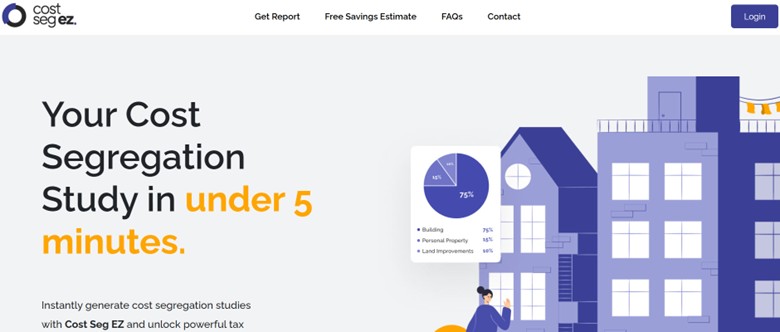
6. Cost Seg EZ: Best for Small Commercial Property Owners

  • Founded: 2015
  • Headquarters: Princeton, NJ

Cost Seg EZ offers a simplified service model designed for owners of small commercial assets (typically under $2 million). Their cloud-based intake and straightforward deliverables make them a practical choice for entrepreneurs and first-time investors.

For straightforward properties like small offices, franchises, or local retail centers, Cost Seg EZ balances speed, simplicity, and compliance. They’re not built for institutional complexity, but for many smaller owners, that’s exactly the point.

From Deduction to Strategy: Choosing With Intent

Cost segregation has matured over the last decade, but the market hasn’t. 

Too many providers still treat it as a checkbox exercise, delivering technical reports without strategic thinking. 

Whether you’re running a single asset or managing a multistate portfolio, the goal isn’t just to shorten depreciation schedules. It’s to improve cash flow, reinvestment timing, and tax positioning. That takes a provider who thinks like an operator, not just an engineer.

The firms in this list aren’t interchangeable. Each excels under specific conditions. Choosing the right one starts with clarity about your own goals, and ends with a partner who can help you reach them.

Why Brand-Led Marketing Is the Real Growth Engine for Luxury Retail

In luxury retail, the relationship between branding and marketing is being rewritten. Once treated as separate disciplines — one strategic, one tactical — they are now inseparable. The most successful brands in 2025 are those that market through the strength of their brand rather than attempt to build a brand through marketing spend.

The Performance Plateau

A decade of performance marketing promised data-driven growth. For high-street retailers, it delivered: precise targeting, measurable conversions, instant gratification. Yet when the same formulas are applied to luxury, the results flatten. Algorithms reward urgency; luxury thrives on restraint.

High-end consumers are not persuaded by repetition alone. They seek reassurance of quality, heritage, and taste — none of which can be conveyed through a fleeting ad impression. When luxury retailers chase clicks, they often find that visibility comes at the cost of desirability. Each sale secured through discounting chips away at the very exclusivity the brand is meant to protect.

The outcome is a familiar one: higher marketing budgets, lower margins, and a diluted aura of prestige.

Desire Over Discount

The lesson from enduring luxury houses is clear: sustained growth comes from desire, not discounts. Whether it is a jeweller redefining its heritage, a boutique fashion label entering global retail, or a lifestyle brand repositioning around craft, the winners have rediscovered the value of patience.

Their communications no longer shout for attention; they curate it. Photography, tone, and pacing echo editorial craft rather than advertising urgency. Instead of saturating feeds, they create anticipation — a pause between each release that allows meaning to build.

Luxury retail is, at its core, a theatre of feeling. The way a brand speaks, moves, and presents itself determines whether customers experience it as a transaction or as belonging to a world they aspire to join.

The Shift to Brand-Led Marketing

Across boardrooms and flagship stores, a quiet realignment is taking place. Marketing teams are recognising that every short-term performance spike must eventually be underpinned by a deeper brand narrative. Brand strategy is returning to the centre of decision-making — not as an aesthetic layer, but as the growth engine itself.

This shift doesn’t reject data; it reframes it. Instead of obsessing over cost per click, leaders are analysing qualitative signals: how often the brand is mentioned organically, how consistently its tone appears across markets, how it makes customers feel after purchase.

When brand leads, marketing becomes a continuum — a conversation, not a campaign.

Building From the Inside Out

Boutique agencies specialising in luxury have long practised this philosophy. The work begins not with media planning but with clarity of purpose. A strong brand identity, expressed through consistent design language and narrative, becomes the foundation for every subsequent activation.

At SUM, a London-based luxury marketing agency, projects start with strategy and end with coherence. The process aligns business objectives with creative execution so that each channel — physical, digital, or experiential — reinforces the same central idea.

This approach values precision over volume. A single brand film with emotional truth can outperform a dozen tactical ads. An editorial-style campaign that celebrates craftsmanship can generate more authentic engagement than any flash sale. The cumulative effect is a brand that grows quieter yet stronger — commanding attention without demanding it.



Lessons for Retail Leaders

  1. Rebalance investment. Dedicate equal budget to strategy, content, and brand expression as to performance media. Without that balance, acquisition costs rise while equity falls.
  2. Audit coherence. Every image, line of copy, and customer interaction should sound like the same voice. Fragmentation is the enemy of trust.
  3. Champion craft. Treat marketing assets as cultural artefacts, not disposable content. Luxury audiences notice the difference.
  4. Measure emotional resonance. Look beyond reach; track advocacy, earned mentions, and customer storytelling.
  5. Design for longevity. Each campaign should build upon the last, contributing to a lasting narrative rather than a quarterly KPI.

The Digital Layer of Desire

Luxury retail’s digital transformation was once defined by technology; now it is defined by feeling. The next evolution will see digital experiences mirror the intimacy of the in-store encounter. High-net-worth consumers expect seamless e-commerce, but also curation, discretion, and narrative depth.

Brand-led marketing provides the framework for that. A website built on strategic storytelling feels like a flagship window. A social channel guided by design principles feels editorial rather than algorithmic. Even automated CRM can feel personal when it speaks in the same refined tone as the brand itself.

Retailers investing in digital branding today — design, UX, motion, and content systems that reflect their identity — are not just modernising; they are future-proofing desirability.

Beyond Campaigns: Toward Cultural Relevance

Ultimately, luxury retailers are not competing for attention but for significance. Culture moves quickly, and brands that rely purely on visibility risk fading into noise. The alternative is to become culturally fluent — to understand design, art, and social context well enough that every campaign feels inevitable, not opportunistic.

Brand-led marketing makes that possible. It allows a retailer’s message to evolve with the world around it while maintaining the core that customers fell in love with in the first place.

The New Standard for Luxury Retail

The luxury sector’s most successful retailers share a quiet discipline: they spend less time trying to be seen and more time being remembered. They measure loyalty by repeat emotion rather than repeat purchase. In an age of instant everything, they remind us that the rarest currency is attention freely given.

Marketing that begins with brand — and ends with meaning — will define the next decade of luxury retail. The brands that embrace this shift now will not only weather algorithmic change; they will shape the culture their customers choose to buy into.