Home Blog Page 219

Loblaw Expands AI Commerce With Google Gemini

Mobile phone screenshots depicting the customer experience. Image: Loblaw

Loblaw Companies Limited has announced a new collaboration with Google that will allow Canadians to shop through conversational AI in Google Search and the Gemini app, marking another milestone in the company’s expanding Loblaw AI commerce strategy.

The announcement follows Loblaw’s recent integration of its PC Express platform into OpenAI’s ChatGPT, reinforcing the retailer’s ambition to become what it describes as an AI-native enterprise. Together, the moves position Loblaw at the forefront of agentic commerce in Canada, where AI tools move beyond search to actively assist in product discovery and purchasing.

Shopping Through Google Gemini and AI Mode

Under the new collaboration, Loblaw will make health, beauty and apparel products available for purchase directly through AI Mode in Google Search and through Google Gemini. Loblaw is the first large retailer in Canada to enable direct purchasing through Google’s AI-driven interfaces.

The integration will allow Canadians to discover and buy products through conversational prompts. For example, a shopper could ask for recommendations for a seasonal skincare routine or back-to-school apparel essentials and move directly from suggestion to transaction within the AI environment.

The system is powered by Google’s conversational AI platforms and supported by the introduction of a Universal Commerce Protocol, an open and standardized framework that enables commerce systems and AI agents to communicate securely. The protocol facilitates shopping, booking and payments across different channels, creating a more seamless path from discovery to checkout.

Per Bank, President and CEO of Loblaw Companies Limited, said the collaboration reflects the company’s ongoing focus on technology and artificial intelligence. “Our purpose is to help Canadians Live Life Well, and this most recent collaboration with Google is a clear demonstration of our commitment to leveraging technology and artificial intelligence to achieve that vision,” he said. “These integrations are making Loblaw an even better place to shop and work by fostering innovation.”

Per Bank
Per Bank

Lauren Steinberg, Chief Digital Officer at Loblaw Companies Limited, framed the move as a natural progression in how customers want to shop. “We see agentic commerce as a natural evolution of how our customers want to shop. By empowering our colleagues and making shopping simpler and more personalized for customers, we are solidifying our position as a true pioneer in Canadian AI innovation.”

Karthik Narain, Chief Product and Business Officer at Google Cloud, emphasized the broader implications for retail transformation. “We are seeing a generational shift where AI is becoming the foundational engine for business transformation. Loblaw’s commitment to scaling AI across its entire enterprise is a clear roadmap for how retailers can convert technical innovation into measurable value. By optimizing everything from merchandising to inventory management, they are proving that AI-native systems are the key to driving both operational efficiency and a superior customer experience at scale.”

Building on the ChatGPT Grocery Integration

The Google collaboration follows Loblaw’s February 2026 integration of its PC Express grocery platform into ChatGPT. That move enabled consumers to move from meal planning to checkout within a single conversational interface.

Through the ChatGPT experience, users can request meal ideas, generate ingredient lists, localize inventory by entering a postal code, and complete purchases via PC Express for pickup or delivery. The integration allows shoppers to refine preferences by dietary restrictions, budget constraints or brand choices, reducing friction in the weekly grocery planning process.

This earlier initiative marked one of the first fully integrated conversational shopping experiences offered by a major Canadian retailer within an AI platform. It also introduced the concept of Loblaw AI commerce in groceries, complementing the new Google integration that focuses on health, beauty and apparel.

Scaling Vertex AI and Enterprise Tools

Beyond customer-facing applications, Loblaw is expanding its use of Google Cloud’s Vertex AI platform across merchandising, supply chain and store operations. The retailer has leveraged Google Cloud in core retail functions for several years, and scaling Vertex AI is intended to accelerate predictive modelling and inventory optimization.

Internally, Loblaw has deployed ChatGPT Enterprise to corporate teams to assist with data analysis, coding and logistics workflows. The company also uses a proprietary AI assistant known as Robin to help store managers manage inventory, anticipate stock-outs and streamline store-floor decision making.

In collaboration with academic partners including the University of Waterloo, Loblaw has also developed Large Language Model pipelines to assess vendor price increase requests. By mapping ingredient costs to global market data, the system evaluates whether supplier price hikes align with underlying commodity trends.

AI in Healthcare and Logistics

Loblaw’s AI ambitions extend into healthcare through its PC Health app, which uses AI to personalize wellness programs and provide digital navigation tools for finding healthcare services. The system analyzes user data from wearables and other inputs to suggest tailored guidance and connect users with care providers.

On the logistics front, Loblaw has signed a five-year agreement with Gatik to deploy 50 autonomous trucks in the Greater Toronto Area. The trucks are designed to transport temperature-controlled groceries to more than 300 stores, with a long-term objective of operating freight-only routes. The rollout represents one of the largest planned autonomous trucking deployments in North America.

The company has also opened a 1.2 million square foot automated distribution centre in East Gwillimbury, Ontario. The facility uses AI-managed robotics to increase picking and packing efficiency.
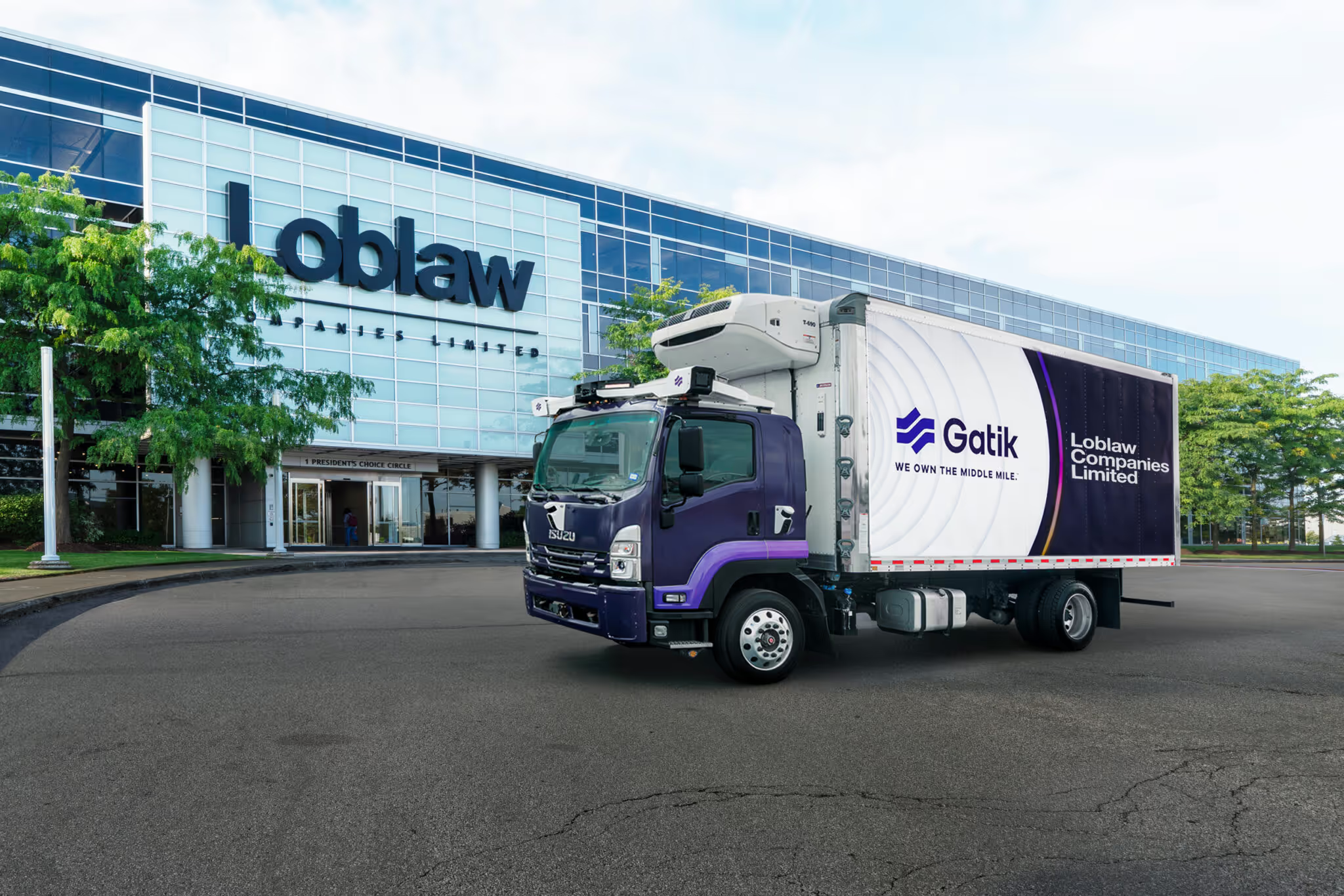
Gatik autonomous delivery truck in front of a Loblaws store. Image: Loblaw

Capital Investment and Store Network Evolution

These digital initiatives coincide with a significant capital investment program. Loblaw has committed $2.2 billion in capital spending for 2025 and 2026 as part of a broader $10 billion five-year plan.

The company plans to open approximately 80 new stores over the 2025 to 2026 cycle, with roughly 50 focused on hard discount banners such as Maxi in Quebec and No Frills in the rest of Canada. Loblaw has also been converting conventional stores into discount formats to respond to consumer demand for value.

In the third quarter of 2025 alone, Loblaw opened 19 new Maxi and No Frills locations. The company is renovating more than 300 existing stores to upgrade technology, including self-checkout systems and digital shelf tags, while improving energy efficiency.

In addition, Loblaw is adding 100 new Pharmacy Care Clinics within Shoppers Drug Mart locations, deepening its role in primary healthcare services.

No Frills in Downtown Toronto. Photo: Ritchie Po.

A Strategic Push to Gain Market Share

Taken together, these initiatives illustrate a coordinated strategy that blends physical investment with digital transformation. As Loblaw upgrades its store network and emphasizes discount banners to capture value-conscious consumers, it is simultaneously embedding AI into nearly every layer of its operations.

The expansion of Loblaw AI commerce through Google Gemini, alongside the ChatGPT grocery integration, signals a broader shift in how Canadian retailers may approach customer engagement. By meeting shoppers inside the AI platforms they increasingly use for daily planning and product research, Loblaw is positioning itself to capture incremental market share in an environment defined by both economic pressure and rapid technological change.

With more than 2,800 locations across Canada and over 220,000 employees, Loblaw remains the country’s largest retailer. Its latest AI partnerships suggest that the next phase of competition in Canadian retail may be shaped as much by algorithms and conversational interfaces as by store footprints and price promotions.


More from Retail Insider:


Vancouver dessert brand plans expansion through franchising

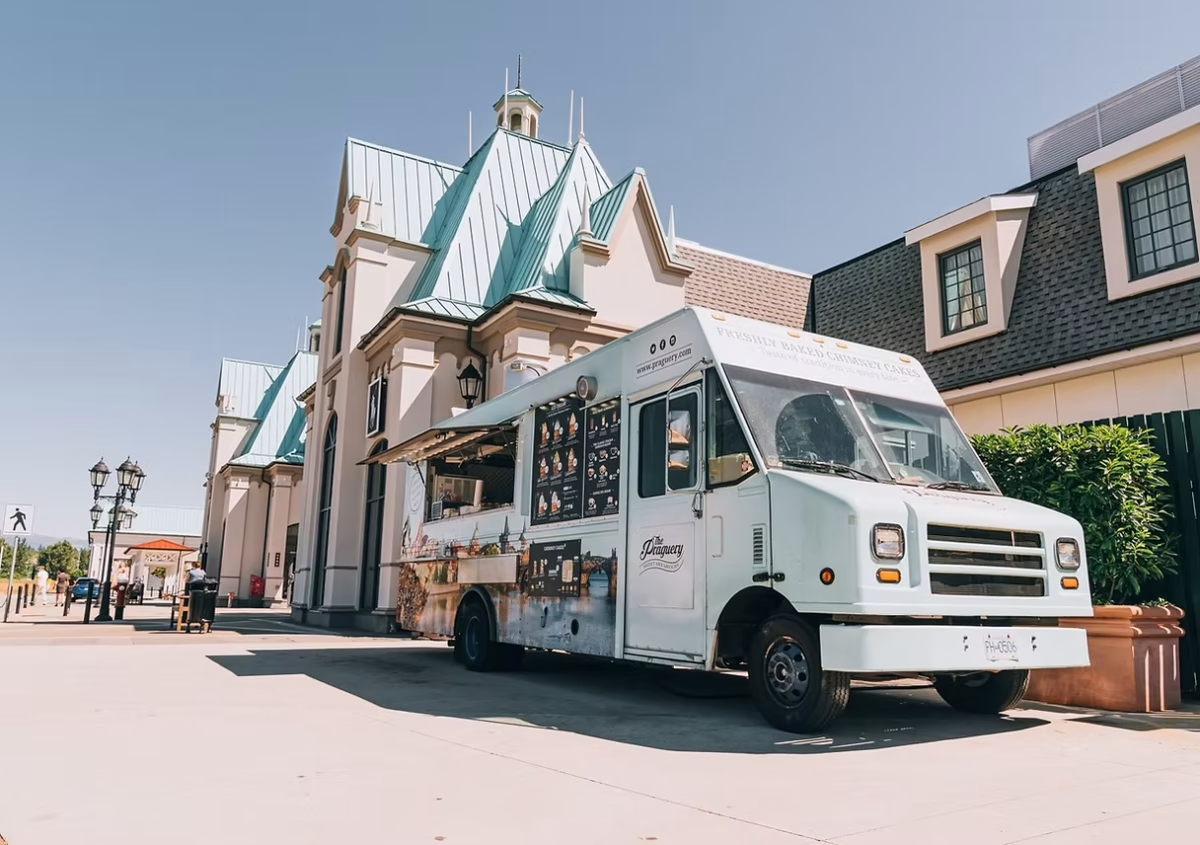
Photo: The Praguery
Photo: The Praguery

A Vancouver-based dessert and ice cream company that grew from a single market stall to four locations in six years is now preparing to expand through franchising.

The Praguery, founded in 2016 by Jaroslav Mestka, specializes in European-style chimney cakes served with ice cream. The business has established a local following in the Lower Mainland and is now formalizing operational systems in anticipation of broader growth.

Mestka said the business began modestly at the Vancouver Christmas market, where he operated a single stall selling the European desserts. 

“The first year, I started as a stall, only a stall,” he recalled. In subsequent years, the company added mobile operations, including three trucks and a trailer, before opening its first permanent retail store two years ago.

“The product is based on European tradition,” Mestka said. “We brought this from Czech, from Prague, where I’m from, and established it here in Vancouver in 2016. Since then, we have grown to four locations.” 

Jaroslav Mestka
Jaroslav Mestka

The current locations are spread across Vancouver and the surrounding Lower Mainland, including Richmond.

Mestka’s interest in dessert operations was influenced by exposure to European food stalls while living in the United Kingdom. He recalled encountering a crepe stall that left a strong impression, inspiring him to pursue a similar concept. A subsequent visit to Prague in 2015 introduced him to chimney cakes served with ice cream, which became the signature product of his business.

Mestka described a deliberate approach to scaling the business, emphasizing efficiency in small retail footprints. 

“Our concept can do really well in revenue based on small square footage,” he said. He noted that spaces between 400 and 800 square feet are sufficient when operations are optimally configured.

Through years of incremental growth, Mestka said the company has developed a “solid, repeatable operational system” that is fully proven and not speculative. 

“It’s repeatable. It doesn’t need much inside.”

The emphasis on operational efficiency underpins the company’s franchising plans. Mestka said the business has finalized its standard operating procedures and franchise disclosure documentation, making it ready to offer franchise opportunities.

Photo: The Praguery
Photo: The Praguery

Mestka indicated that The Praguery is seeking franchise partners with experience operating multi-unit quick-service restaurants. The brand plans to focus on locations with high foot traffic, including airports, malls, concession operations, and areas with significant tourist volumes.

“The concept is based on high food traffic,” he said. “We are targeting airports, concession groups, malls, food service, and high tourist volume destinations.”

The company is also exploring expansion beyond Vancouver, including opportunities in British Columbia and Ontario. 

Mestka said franchising is motivated by both demand from potential partners and his personal interest in growing the brand. “I’m still passionate about the brand and would like to grow it,” he said.

According to Mestka, the business has experienced consistent revenue growth each year since its founding. 

Photo: The Praguery
Photo: The Praguery

“There’s good demand, and it’s going really well,” he said. The company’s ability to expand from a single stall to four locations in six years reflects steady market traction.

The Praguery’s operational model leverages small, efficient retail spaces to maximize profitability. By combining a proven operational system with high-demand product offerings, Mestka said the brand is positioned for franchising growth without requiring large-scale physical locations.

Mestka anticipates that franchise expansion will allow the brand to extend its reach while maintaining operational consistency. 

More from Retail Insider:

Retail sales decrease in December: Statistics Canada

Photo: Gustavo Fring

Retail sales decreased 0.4% to $70 billion in December. Sales were down in three of nine subsectors, led by decreases at motor vehicle and parts dealers, reported Statistics Canada on Friday.

Core retail sales, which exclude gasoline stations and fuel vendors and motor vehicle and parts dealers, were down 0.3% in December. In volume terms, retail sales were unchanged in December, said the federal agency.

“Retail sales were up 0.1% in the fourth quarter of 2025, marking a seventh consecutive quarterly increase. In volume terms, retail sales decreased 0.3% in the fourth quarter. In 2025, retail sales increased 4.0%, led by gains at motor vehicle and parts dealers. In volume terms, sales were up 2.3% in 2025,” it said.

Statistics Canada said it is providing an advance estimate of retail sales, which suggests that sales increased 1.5% in January. Owing to its early nature, this figure will be revised. This unofficial estimate was calculated based on responses received from 59.8% of companies surveyed. The average final response rate for the survey over the previous 12 months was 87.7%, it explained.

Sales at motor vehicle and parts dealers fall, while sales at gasoline stations and fuel vendors rise

The largest decrease in retail sales in December was observed at motor vehicle and parts dealers (-1.6%), with all four store types within this subsector posting declines. New car dealers (-1.8%) led the decrease, falling for a second consecutive month. Lower sales were also recorded at used car dealers (-1.8%) in the month, said Statistics Canada.

The largest increase in retail sales in December came from gasoline stations and fuel vendors (+2.8%), which were up for a second consecutive month. In volume terms, sales at gasoline stations and fuel vendors rose 4.5% in December, it added.

Photo: Andrea Piacquadio

Core retail sales fall

Following an increase of 1.5% in November, core retail sales fell 0.3% in December on lower sales at building material and garden equipment and supplies dealers (-4.0%). The decline in this subsector followed two consecutive monthly gains, explained Statistics Canada.

“Lower sales were also recorded at furniture, home furnishings, electronics and appliances retailers (-1.7%) in December. This decrease marks a second consecutive monthly decline for this subsector,” it said.

“The largest increase to core retail sales in December came from sporting goods, hobby, musical instrument, book, and miscellaneous retailers (+1.0%).”

On a seasonally adjusted basis, retail e-commerce sales increased 3.6% to $4.3 billion in December, accounting for 6.1% of total retail trade, compared with 5.8% in November, added the federal agency.

Retail sales in 2025

“Canadian retailers finished 2025 with $837.2 billion in sales, up 4.0% from 2024, and increases were observed in eight of the nine subsectors. Leading the gain in retail sales in 2025 were higher sales at motor vehicle and parts dealers (+4.7%), which were driven by gains at new car dealers (+3.7%). The sole decrease in retail sales in 2025 was observed at gasoline stations and fuel vendors (-2.7%), largely the result of lower gasoline prices in 2025 compared with 2024,” said the report.

“Core retail sales increased 4.7% in 2025, led by higher sales at general merchandise retailers (+4.6%) and health and personal care retailers (+6.7%). Sales were also up at clothing, clothing accessories, shoes, jewelry, luggage and leather goods retailers (+9.6%).”

Shelly Kaushik
Shelly Kaushik

Shelly Kaushik, Senior Economist, BMO Capital Markets, said: “December retail sales was a mixed bag, as the declines were concentrated in limited sectors and volumes were unchanged. However, a solid flash estimate points to a rebound to start the new year. Ultimately, consumer spending is holding in despite ongoing economic uncertainty.”

Andrew Grantham
Andrew Grantham

Andrew Grantham, Senior Economist, CIBC Capital Markets, said: “While December was a step backwards, that followed a healthy advance in the prior month and advance figures for January suggest a strong 1.5% gain in headline sales to start the New Year. For Q4 as a whole, real retail sales posted a modest decline. Underneath the volatility in monthly figures, the trend in inflation-adjusted sales still appears to be broadly sideways since the start of last year, and it will take a few more months of data to judge if the January figure is the start of a new uptrend.”
More from Retail Insider:

Activity picking up at Calgary CF Market Mall and CF Chinook Centre

CF Market Mall. Photo by Mario Toneguzzi

Real estate activity is picking up at Calgary’s CF Market Mall and CF Chinook Centre, with a number of new leases, retailer expansions and first-to-market brands set to open in the months ahead, a senior executive with Cadillac Fairview says.

Darryl Schmidt, Vice-President, National Leasing, said demand for space at both shopping centres has strengthened to start the year, with multiple retailers under construction, major brands returning or expanding, and strong interest in former Hudson’s Bay Co. spaces. 

While some large-box negotiations remain fluid, Schmidt said leasing momentum across the portfolio has picked up, driven largely by retail rather than entertainment or non-retail uses.

Schmidt said a recent deal was made with Samsung for Market Mall.

Darryl Schmidt
Darryl Schmidt

“They’re coming back into the marketplace, and that’ll open later this spring. And then you’ll see a repositioning. La Vie en Rose is expanding. It’s going to double in size further down the fashion run,” he said.

“Ever New has a pop-up. They’re under construction across from Mark’s and will open in March. We’ve got Kit + Ace opening a new store.

“Just prior to the holidays, Arc’teryx expanded and SoftMoc relocated in position with the new prototype store, a 4,500-square-foot store. They’re really excited about the productivity that we’re seeing after the holidays. And then it allowed them to expand into a deeper and broader number of product lines.”

As for the empty former Bay space, Schmidt said “there are a lot of balls in the air.”

“The good news is we’ve got a lot of demand for all of the HBC boxes. The challenge is that there are just too many brands at the table and trying to sort through the highest and best use. They’re just fluid environments where you’re trying to negotiate highest and best uses for each of the boxes, and new brands introduce themselves. It’s challenging to stay focused and lock down what the best brands are going to be,” he said.

CF Market Mall. Photo by Mario Toneguzzi

“There are no single users in the market branding the boxes. They’re all going to get demised up. So you just have to figure out who’s going to be the best fit for each of the assets. Which brands are most on brand for our market from a price point standpoint.

“The good news is it’s virtually all retail. There might be some fitness in some of the boxes, but we’ve got such strong retail demand, which is a good fit. We’d rather have that than entertainment.”

At Chinook Centre, Wingstop and Shake Shack are expected to be open by later in the spring.

“Chipotle should go under construction in the next couple of months. And then you’re going to see, in the old Shoppers Drug Mart, Abercrombie & Fitch is coming back into the centre, and they’ll get possession in the next 60 days. So that’s exciting,” explained Schmidt.

“Shoppers relocated to the extreme south end of the shopping centre” where Old Navy used to be.

There are discussions to bring Old Navy back into the shopping centre. The Gap also relocated last year.

“And then just near The Gap and where the new Ray-Ban store opened, we concluded a deal with The North Face. That will be in the first one in the city, free-standing store. We’ve got a number of leases with some first-to-market retailers. I was hoping to get them done before the end of the holidays, but things drag. So we should be able to announce a couple more that’ll be new to the market, like The North Face, which is pretty significant.”

CF Market Mall. Photo by Mario Toneguzzi

Like Market Mall, Chinook Centre also has the empty former Bay space to deal with as well as big box space formerly occupied by Saks.

“It’s really fluid. It’s constantly changing. There’s good demand on all the boxes. Conversations have come and gone . . . It’s just that cutting deals with those bigger users takes more time. It’s more complicated, and there’s just a lot on the table. I mean, just coast to coast. A lot of the brands that we’re in discussions with are in discussions on other HBC boxes in other markets across the country. So getting everybody focused and getting to the finish line is a challenge.”

More from Retail Insider:

CFIB survey: Tax burden tops small business concerns in Canada as retailers cite costs, regulation and crime

Photo: Andrea Piacquadio

A new Members Opinion Survey by the Canadian Federation of Independent Business (CFIB), which looks at the top policy concerns of small and medium‑sized business owners across Canada, says retailers face a combination of cost, compliance, and public safety issues. 

“Tax burden (72%) leads, followed by government debt and deficit (49%), regulation (48%). Trade challenges and labour shortages (each at 47%) complete the picture. Crime and safety (39%) stands out as a more prominent concern than in most other sectors,” said the national organization.

“Hospitality businesses face heavy fiscal and regulatory burdens. Tax burden (72%) is the top issue, followed by labour shortages (53%) and government regulation (50%).”

Overall for all sectors, the CFIB said the total tax burden has been the top concern for over 25 years. After peaking at 86% in 2000, the share of entrepreneurs flagging it as an important concern dropped to 66% after the pandemic as inflation took centre stage. It’s now climbing again toward its long-term average of 78%.

“The shortage of qualified labour is a very important challenge. Only 30% of business owners indicated it in 1998, but that share peaked at over 60% in recent years. While trending down since 2024, it’s still above its historical average of 47%,” said the report.

Photo: www.kaboompics.com

“Government regulation and paper burden seriously concerned 56% of owners in the late 1990s and it climbed to 72% by 2014. To push for change, CFIB launched Red Tape Awareness Week. Today, concern is back near 1990s levels—progress made, but the issue remains.

“Other issues such as employment insurance, workers’ compensation, government debt and provincial labour laws affect fewer businesses, but they are still significant concerns. New worries like trade challenges and crime and safety have emerged and were added to the survey in recent years.”

The CFIB said its grassroots survey has been a cornerstone of its research since 1975, tracking the top policy concerns of small and medium‑sized business owners across Canada. District Managers collect responses through in‑person interviews during annual member renewals, generating about 7,500 responses per quarter. 

The survey asks one simple ‘select all that apply’ question: “Which of the following issues are the most important to your business?”. Results are compiled daily and reported quarterly since 2025. 

More from Retail Insider:

PI Fine Art celebrates 50 years with direct-to-consumer online store

Photo: PI Fine Art
Photo: PI Fine Art

PI Fine Art is making gallery-quality art accessible to everyone with the launch of its e-commerce website, www.pifineart.com, marking a major milestone as the company celebrates 50 years in business.

“We’re thrilled to launch the new PI Fine Art website and e-commerce platform in this, our 50th year in business. Our new digital strategy helps fulfill our purpose: together, we create art for the world – for the love of art – and supports our vision to become the leading art company, delivering inspiring, beautiful art anywhere people live, work, visit, and gather,” said George Jeffrey, CEO of PI Fine Art.

George Jeffrey
George Jeffrey

PI Fine Art, located in the heart of Toronto’s Design District, specializes in fine art, custom wallcoverings, mirrors, and alternative wall décor. The company manages the entire art development and supply chain process — from consulting and publishing to in-house manufacturing.

Working with both in-house and external artists, PI Fine Art holds publishing rights to more than 27,000 images.

Kristen Sanger
Kristen Sanger

Kristen Sanger, EVP Creative & Marketing, emphasized the company’s commitment to accessibility:

“Everyone deserves to enjoy high-quality art in their homes at an accessible price. Why settle for generic products from big-box stores when gallery-quality artwork is just a click away?”

For decades, PI Fine Art said it has served hospitality, licensing, and trade clients across North America and globally, earning a reputation for quality, curation, and trusted creative partnerships. 

“The new online store expands the company’s reach by making professional-quality art prints, canvases, and framed artworks directly available to consumers shopping online,” it explained.

Photo: PI Fine Art

“The company will continue to support and grow its Hospitality and Licensing divisions while now offering consumers greater access to its artwork online.

“The e-commerce launch aims to strengthen PI Fine Art’s global reach and reflects the company’s commitment to innovation, sustainability, and design excellence across both commercial and residential environments.”

More from Retail Insider:

Photo: PI Fine Art
Photo: PI Fine Art

Canada auto sales hit 6-year high in 2025, but tariffs to drive decline in 2026: TD report

Photo: Antoni Shkraba Studio

The Canadian automotive industry managed to weather the storm of elevated trade tensions with the nation’s largest trading partner relatively well in 2025, but headwinds are growing as tariffs take greater effect, according to a new report by TD Economist Andrew Foran.

“Sales notched a 6-year high last year, but are expected to retreat this year as economic growth remains subdued under the influence of tariffs. Production is also expected to decline in 2026, with shift reductions and idled plants weighing on output,” he said. 

“New agreements with existing trading partners to shore up Canadian automotive production could yield dividends, but uncertainty related to the future of CUSMA may weigh on near-term developments. Nevertheless, the need to diversify automotive trade away from its current outsized U.S. concentration will likely be necessary to ensure the long-run viability of the industry amid growing U.S. protectionism.”

Looking at the annual sales total for 2025, you might assume that it was a normal year of stable growth, with vehicle sales of roughly 2 million units – the highest level since 2019, said the report.

“Breaking it down to the monthly frequency, the magnitude of volatility last year caused by trade policies is evident. Front-loading ahead of tariffs lasted through July, averaging roughly 2 million units in seasonally adjusted annualized rate terms. In the latter half of the year, this rate fell to roughly 1.9 million as demand cooled. Still, demand remained healthier than expected given the headwinds facing the industry and the broader economy,” said TD.

“Several reasons likely led to this robustness in sales. First, domestic consumption is affected by the tariffs imposed by the government of that country. In Canada’s case, this applies to the 25% tariffs imposed by the Canadian government on imports of motor vehicles coming from the U.S. If the vehicle is compliant with CUSMA, then the tariffs only apply to the content of the vehicle not sourced from Canada or Mexico. Given that roughly 50% of the vehicles purchased in Canada come from the U.S., this would have had a notable impact on domestic sales if the government did not provide additional exemptions for the automakers which produce in Canada. This includes General Motors, Ford, Stellantis, Toyota, and Honda, which have a cumulative market share of roughly 60%. These exemptions lightened the impact of the tariffs on Canadian consumption.”

Photo: Daniel Andraski

The report said there was a modest reallocation of Canadian sourcing of motor vehicles, with Mexico seeing a modest increase in its share of Canadian imports (2-3 percentage-points), nearly equal in magnitude to the decrease in the share accounted for by the U.S. 

“This reallocation served the purpose of shifting trade away from tariff-exposed regions. To a lesser extent, we have also seen higher imports from outside of the North American region, including Japan, South Korea, and Germany. As of November 2025, the share of Canadian motor vehicles sourced from within the CUSMA region was at a record low of roughly 65%,” it explained.

“This trend began a couple years ago in 2022, as imports from overseas – mostly Japan – increased. This was likely driven by the combination of the CPTPP reduction in auto tariffs, which reached 0% in 2022, and the higher domestic content requirements of CUSMA relative to NAFTA. Now in 2025, we have seen the CUSMA share of vehicle sales dip again as tariffs raise intraregional costs.

“Looking to 2026, a number of factors are likely to pose challenges for the Canadian sales outlook. First is the unlikelihood for further easing in financial conditions, as the Bank of Canada remains in neutral. With monthly payments continuing to hover around $1,000, affordability concerns are likely to remain a partial constraint on sales activity. The industry will also be contending with slowing population growth as the federal government seeks to course correct above average growth in recent years, which will reduce the size of the consumer market. “Cumulatively we expect these factors, in addition to lingering trade uncertainty and its impact on the economy, to lead to a 4.3% decline in sales this year.”

More from Retail Insider:

Government of Canada invests in pathways to success for Black-led businesses in Alberta 

Photo: Andrea Piacquadio

The Government of Canada says black entrepreneurs play a key role in Alberta’s economy, yet many continue to face systematic barriers to capital, business networks, and opportunities to grow and scale their businesses. 

Recently, Eleanor Olszewski, Minister of Emergency Management and Community Resilience and Minister responsible for Prairies Economic Development Canada (PrairiesCan) and Rechie Valdez, Minister of Women and Gender Equality and Secretary of State (Small Business and Tourism) announced $3 million in federal funding through the Black Entrepreneurship Program (BEP) Ecosystem Fund to support Black-led businesses and entrepreneurs across Alberta.

The government said the funding will strengthen not-for-profit organizations that provide community-based support to Black-led businesses and entrepreneurs. Organizations receiving support will be able to expand services such as mentorship, networking, financial planning and business training – helping Black entrepreneurs start, scale, and sustain successful businesses, it said.

Eleanor Olszewski
Eleanor Olszewski

“Black entrepreneurs and businesses are helping build Canada strong across Alberta, including right here in Edmonton. Through the Black Entrepreneurship Program Ecosystem Fund, Canada’s new government is helping remove barriers, expand opportunities, and build a stronger, more inclusive and resilient economy for everyone. That’s because building Canada strong starts with recognizing that people are our greatest resource, and empowering them to reach their full potential,” said Olszewksi.

Rechie Valdez
Rechie Valdez

“To build the strongest economy in the G7, we need the full and equal participation of everyone. Black entrepreneurs are driving innovation, creating jobs and strengthening communities across Alberta and Canada. Through the Black Entrepreneurship Program, our government is breaking down barriers, unlocking capital, and ensuring more entrepreneurs have the tools and opportunities they need to succeed,” added Valdez.

Projects receiving support are:

  • African Canadian Civic Engagement Council (ACCEC) will expand the ANZA Entrepreneurship Ecosystem program to empower Black youth and early stage entrepreneurs to launch and scale sustainable businesses and social enterprises that create jobs and generate revenue. With $1.5 million in BEP investment, ACCEC will deliver training, mentorship, and guidance under the ANZA program.
  • Black Business Ventures Association (BBVA) will strengthen business supports available to Black entrepreneurs in Alberta that are advancing innovative technologies. $1.5 million in BEP investment will enable the BBVA to deliver personalized coaching, enhance collaboration in the Black entrepreneur ecosystem and increase visibility for Black-led technology driven businesses.
Government of Canada invests in pathways to success for Black-led businesses and entrepreneurs in Alberta (CNW Group/Prairies Economic Development Canada)

Together, these projects are expected to provide over 250 employment and skill training opportunities and will help build the capacity of Black-led not-for-profit organizations to support entrepreneurs. By investing in Black entrepreneurs and the organizations that support them, this government is strengthening local economies, supporting innovation, and building a more inclusive and competitive Canadian economy, explained the government.

Dunia Nur
Dunia Nur

“When Black youth succeed, they reinvest locally, create jobs, and advocate for a more equitable society, strengthening not only their communities but our entire economy. We are not simply teaching entrepreneurship; we are cultivating community leaders and equipping them to generate generational wealth that uplifts families and fuels long-term prosperity. This is the impact of ACCEC’s ANZA Entrepreneurship Program. I am deeply grateful to the Government of Canada for sharing this vision and investing in Black communities,” said Dunia Nur, President and CEO, African Canadian Civic Engagement Council.

Dipo Alli
Dipo Alli

“This investment from PrairiesCan strengthens Alberta’s Black entrepreneurship ecosystem by helping founders build revenue-ready, investment-ready businesses. Through BBVA’s programming, Black entrepreneurs will gain the skills, networks, and market access needed to scale, create jobs, and compete globally. We are grateful for the Government of Canada’s commitment to inclusive economic growth and resilient innovation,” said Dipo Alli, Executive Director, Black Business Ventures Association.

More information can be found here:

More from Retail Insider:

Daily Synopsis: Feb 19, 2026 – Reitmans, Walmart, Restaurant Woes

Today’s Retail Insider articles cover pivotal shifts as Canadian Tire reports strong Q4 and full-year 2025 results driven by AI and loyalty growth, Walmart Canada expands beauty offerings to fill Hudson’s Bay’s market gap, and Reitmans marks its centennial with a unique fashion activation at Toronto’s TTC Lower Bay Station. Meanwhile, Restaurants Canada highlights growing financial pressures on dining establishments. The coverage below, followed by Canadian Retail News From Around the Web, underscores how innovation and adaptation remain essential for retailers navigating evolving market realities.


🗞️ The Day’s Retail Insider Article List


🌐 Canadian Retail News From Around the Web

Ontario Court Recognizes Eddie Bauer Bankruptcy

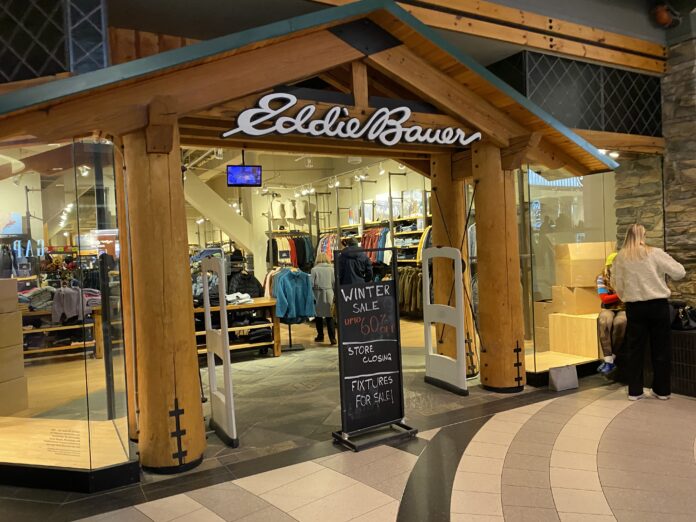
Former Eddie Bauer at CF Toronto Eaton Centre (Image: Dustin Fuhs)

On February 18, the Ontario Superior Court of Justice officially recognized the U.S. Chapter 11 bankruptcy proceedings of Eddie Bauer LLC, marking a new development in the cross-border restructuring of the heritage outdoor retailer. The ruling integrates the company’s Canadian operations into its broader American insolvency case, enabling a coordinated process to either secure a buyer or proceed with an orderly wind-down.

The decision formally places the Canadian business under the protection of U.S. court supervision, while maintaining oversight through the Ontario court. As a result, the Eddie Bauer bankruptcy Canada process now moves forward within a unified North American framework.

Founded in Seattle in 1920, Eddie Bauer has experienced recurring financial challenges over the past two decades. The 2026 filing represents the company’s third insolvency, following previous restructurings in 2003 and 2009.


According to court materials, the current crisis stems from declining sales, macroeconomic pressures, and sustained liquidity strain. Consumer preferences have shifted toward competitors such as Patagonia and The North Face, contributing to revenue erosion in core categories. At the same time, inflationary cost increases and tariff uncertainties have further pressured margins.

Financial disclosures indicate the company reported negative earnings from 2022 through 2025. According to detailed bankruptcy case documents, Eddie Bauer’s retail debtor entities reported approximately US$1.74 billion in funded debt as of the petition date, reflecting the aggregate principal and interest across secured financing facilities. This figure sits within the broader liabilities range disclosed in the Chapter 11 petition.

Ontario Court Ruling Under the CCAA

Justice Cavanagh of the Ontario Superior Court granted recognition of the U.S. proceedings under Part IV of the Companies’ Creditors Arrangement Act. This mechanism allows Canadian courts to recognize foreign insolvency proceedings involving multinational companies, thereby protecting assets and ensuring consistency across jurisdictions.

The ruling carries several immediate implications. First, the court recognized the U.S. Chapter 11 case as the “foreign main proceeding,” affirming that the company’s center of main interests is in the United States. This designation is critical in cross-border restructurings, as it establishes the primary forum for insolvency oversight.

Second, the decision provides a stay of proceedings in Canada. This stay prevents creditors from initiating independent lawsuits or seizing assets tied to the Canadian retail operations while the restructuring is underway. The protection preserves enterprise value during the sale or liquidation process.

Third, the order reinforces cross-border comity. U.S. court directives, including those related to bidding procedures and potential liquidation sales, can now be enforced in Canada. This alignment ensures that stakeholders in both countries are treated equitably and that conflicting proceedings do not undermine the restructuring strategy.

Canadian Footprint and Employment Impact

Eddie Bauer’s Canadian presence, while smaller than its U.S. network, remains significant. The company operates 24 stores across Canada. Approximately half of these locations are situated in Ontario, with others spread across major regional markets.

Roughly 379 Canadian employees are affected by the proceedings. For now, stores remain open as the restructuring unfolds. However, many locations have initiated deep-discount sales aimed at improving short-term liquidity and clearing inventory.

It is important to note that the Eddie Bauer bankruptcy Canada process applies only to the physical retail stores operated by Catalyst Brands. The brand’s e-commerce and wholesale divisions, which are managed by a separate entity known as Outdoor 5, are not included in the filing and continue to operate as usual. This distinction may prove relevant if a buyer seeks to acquire select retail assets while maintaining broader brand continuity.

Dual-Track Strategy: Sale or Wind-Down

The company is currently pursuing what court filings describe as a dual-track process. Management and court-appointed advisors are actively seeking a purchaser that could acquire the retail network as a going concern. A successful sale would preserve store operations and potentially maintain employment across both the U.S. and Canada.

If a buyer does not emerge, the court-approved framework permits an orderly wind-down and liquidation of all retail stores in both jurisdictions. The coordinated recognition between U.S. and Canadian courts is designed to facilitate either outcome without procedural delays.

For Canadian landlords and retail stakeholders, the coming weeks will be critical. The outcome will determine whether the brand’s Canadian brick-and-mortar presence can be preserved or whether another established apparel retailer will exit the market.

Real Estate Portfolio Under Review

As part of the restructuring process, RCS Real Estate Advisors has been retained as exclusive real estate consultant to Eddie Bauer LLC. The national advisory firm will oversee all real estate matters connected to the bankruptcy proceedings, subject to approval by the U.S. Bankruptcy Court.

Eddie Bauer operates more than 200 stores across 43 states and Canada, representing approximately 1.4 million square feet of leased retail space. In any Chapter 11 case, the real estate portfolio becomes central to the outcome, particularly for mall-based apparel chains.

RCS will analyze the lease portfolio and advise on strategic options as the company evaluates a sale or wind-down. If a buyer emerges, the firm may negotiate portfolio-related modifications, including lease extensions, rent relief, rent holidays and other restructuring measures required to facilitate a transaction. It will also assess opportunities to market select leases where value can be realized if certain locations close.

“When a retailer enters Chapter 11, the real estate portfolio becomes a central consideration,” said Ivan Friedman, CEO of RCS Real Estate Advisors. “Our responsibility is to analyze the leases, advise on strategic options and help manage the portfolio in a way that protects stakeholders and maximizes any available value.”

Founded in 1981, RCS Real Estate Advisors specializes in lease restructuring, occupancy cost reduction and portfolio rationalization for national retailers. The firm is frequently retained in high-profile restructurings to stabilize or monetize retail real estate assets.

Broader Retail Implications

The court’s recognition of the U.S. filing highlights how closely integrated North American retail has become. Many brands now operate seamlessly across borders, so insolvency proceedings increasingly require coordinated legal action in both countries. At the same time, retailers are navigating the same macroeconomic pressures on each side of the border.

The Eddie Bauer bankruptcy Canada process also underscores the strain facing legacy apparel chains. Competition remains intense, consumer preferences continue to shift, and operating costs have stayed elevated. As a result, established brands are confronting structural challenges that are difficult to reverse.

For now, Canadian stores remain open under court protection. The outcome of the restructuring will determine whether Eddie Bauer finds a buyer for its retail network or further reduces its physical footprint in Canada.


More from Retail Insider: