Retail has always been a cross-border business, but the staffing behind it is changing. As chains open in new markets, run buying offices near their suppliers, and build e-commerce and customer teams wherever the talent sits, they keep hitting the same wall: to employ someone in a country, you normally need a legal entity there, and setting one up is slow, costly, and hard to unwind if the market does not perform. Canadian retail is a live example of the pressure, with expansion and staffing pulling in different directions. More retailers are solving it the same way tech firms did: by employing people through an employer of record rather than building an entity for every market.
What an employer of record really does
An employer of record, or EOR, is a company already established in the target country that becomes the legal employer of your staff there. It runs local payroll, withholds the right taxes, makes statutory contributions, and issues compliant contracts, while your business directs the actual work. For a retailer testing a market with a handful of people, a buyer, a country manager, a small e-commerce team, it removes the biggest barrier to entry: you can employ someone legally in weeks, without incorporating.
The cost is mostly local, not the fee
The provider’s monthly fee is the part everyone looks at, and it is rarely the expensive part. The real cost is local employer obligations, and they swing hard by country. Hiring through an employer of record in Canada means covering CPP, Employment Insurance, and provincial rules that differ between Ontario, Quebec, and British Columbia. In Portugal, employer social security runs at 23.75 percent and staff are paid across 14 monthly instalments a year rather than 12. The lesson for any retailer budgeting an overseas hire is the same: the salary is the smallest line, and the statutory add-ons are what make or break the business case.
Some markets are almost impossible to enter any other way
For the largest consumer markets, the EOR route is not just convenient, it is often the only realistic way in for a first hire. Setting up to employ staff directly in China involves registering a local entity, navigating the mandatory social insurance system known as the five insurances and one fund, and meeting rules that vary city by city, the kind of local complexity the World Bank’s China country profile lays out in detail. A retailer that wants one merchandiser or a small marketing team in the market cannot justify that, so it employs through a provider that already carries the entity and the compliance. The same logic applies wherever the regulatory bar is high and the initial headcount is low.
What retailers should check before they sign
Not all providers are equal, and the differences matter more in retail than in most sectors, because retail hiring is seasonal, multi-site, and fast-moving. Before committing, a retailer should confirm whether the provider owns a local entity or leans on an in-country partner, how it handles seasonal ramp-ups and terminations, what the fully-loaded cost is once statutory contributions are added, and whether it can cover every market on the expansion map from one contract. The cheapest headline fee is often the most expensive arrangement once the local reality is priced in.
Retail expansion has always run ahead of the back office. The chains that scale abroad without nasty surprises are the ones that treat employment as a first-order question, not paperwork to sort out later, a discipline that matters even more as retail labour markets stay uneven and hard to read. Getting people on board compliantly, in the right markets, at a cost they modelled in advance, is what turns a promising store opening into a sustainable one. For a wider view of how the global labour market is shifting through 2030, the World Economic Forum’s latest workforce research is a useful backdrop.
Acquiring banks answer one question when they classify a retailer. How much money will they be asked to refund on that retailer’s behalf, and will the retailer still be solvent when the bill arrives? A shop paying its taxes and holding every license the state asks for can be priced as high risk on that answer alone, which is why owners read the label as an accusation when it lands.
That single question explains why a bookstore and a furniture showroom with identical revenue land in different tiers. Retail generates disputes at a rate no other category matches, and the parts of retail that generate the most of them get priced accordingly.
Delivery Lag and Prepaid Goods
The gap between payment and delivery is the second input. A grocery store closes that gap in seconds. A custom cabinetry business collects a deposit in March and delivers in August, holding five months of undelivered obligation on the books at any moment.
Card networks let cardholders dispute a purchase for months after the transaction date, and the clock in many cases starts at expected delivery rather than at payment. A retailer with long lead times therefore has a dispute window that stays open long after the money reached its bank account. Preorders and made-to-order goods both extend that window. Retailers who take deposits on furniture, custom apparel, or installed equipment often find their account reviewed after a single supplier delay, because a batch of late deliveries produces a cluster of disputes that lands in one billing cycle.
Average Ticket Size and Fraud Exposure
A $40 average ticket and a $4,000 average ticket produce very different exposure for the same monthly volume. Electronics, jewelry, and luxury goods draw stolen-card fraud because the merchandise resells easily and quickly. A single disputed $6,000 watch order wipes out the margin on a month of smaller sales, and an acquirer holding a 5% reserve against that account knows the reserve would not cover three of them in the same week.
The card-not-present share of the business matters as much as the ticket size. A jeweler with a storefront and chip terminals keeps liability with the issuer on most in-person sales. The same jeweler selling online owns the fraud loss on every disputed transaction. Underwriters ask for the split between the two channels on every application, and a retailer who cannot state the percentage tends to be assumed at the worse end of it.
Regulated and Restricted Merchandise
Retailers selling products whose legal standing varies by state face the sharpest classification. Hemp-derived products, vape hardware, kratom, firearms accessories, and adult products all fall into categories where a change in federal guidance can strand a merchant mid-year.
The kratom market shows how fast this moves. Federal regulators pushed in 2025 to restrict concentrated 7-hydroxymitragynine, the kratom-derived opioid sold in gas stations and smoke shops, and several states already ban the plant outright. A retailer stocking those products can hold a valid business license in one state and be selling a banned substance across a border.
Card networks also enforce their own brand rules, which reach further than any statute. A product can be legal in all 50 states and still fall outside what a network will allow its marks to be used for. Retailers in these categories usually reach payment processing for high risk after a mainstream processor closes their account with 30 days notice, and the second account is built with the regulatory volatility priced in from the start.
Return Volume in Underwriting
American shoppers return merchandise worth close to $850 billion a year, roughly 15.8% of everything sold. Around 9% of those returns are fraudulent, which puts about $76.5 billion of annual retail volume into a category the acquirer cannot recover through normal channels.
Underwriters read return rate as a proxy for dispute rate. Apparel is near the top because sizing drives repeat returns. Furniture, appliances, and anything shipped freight rank high for a different reason, since damaged-in-transit claims often arrive as chargebacks instead of return requests. A category where returns are rising faster than sales gets flagged before any individual merchant does anything wrong.
Store Policy and Dispute Prevention
Return policy design feeds directly into dispute volume. Some chains now make it harder for online customers to send merchandise back, using shortened windows and restocking fees, with store credit in place of cash refunds. Nearly half of retailers introduced a return fee for the first time within a single 12-month stretch.
Those policies cut reverse logistics costs and push some customers straight to their card issuer. A shopper refused a refund at the counter files a chargeback instead, and the acquirer sees the ratio climb even though the retailer was following its own posted terms. Acquirers know this pattern well, which is why a restrictive return policy invites more underwriting questions.
Seasonality and Volume Spikes
A retailer doing $30,000 a month for eleven months and $400,000 in December presents a problem no monthly average captures. Approval is typically written against a monthly volume cap, and processing above the cap triggers a review, a hold, or an account freeze during the busiest weeks of the year.
Acquirers price seasonal businesses with the January dispute wave in mind. Holiday gifts get disputed in the new year, often by cardholders who received the item as a present and never saw the receipt. A December volume spike therefore forecasts a Q1 chargeback spike, and the reserve terms are written to cover it. Merchants who warn their acquirer in October, with last year’s numbers attached, usually get the cap raised for the season. Merchants who process through the cap without notice usually get frozen at the worst possible moment.
The Cost of Ignoring the Classification
A retailer who treats the label as an insult loses the ability to plan around it. The classification determines the reserve percentage that will hold back working capital during the season when inventory needs buying, the monthly cap that decides how a strong December ends, and the dispute ratio that decides the account’s survival at the next network review. Those are operating constraints with dates and dollar figures attached. A retailer who knows their return rate, their card-not-present split, and their peak-month multiple can negotiate each of them before signing. One who does not will meet them for the first time on the day the funds stop arriving.
Peak season can bring a surge in orders and shipping volumes, creating greater exposure to lost or damaged shipments and other delivery-related challenges. For businesses, those problems can affect margins, operations and the customer experience at one of the most important times of the year.
Join Retail Insider Founder and Publisher Craig Patterson and Vishav Ranjan of UPS Capital Canada Insurance Brokers for a practical 45-minute webinar examining how businesses can prepare for peak-season shipping risks. The discussion will also explore InsureShield® shipping insurancefrom UPS Capital, including how insurance can fit into a broader strategy for protecting shipments, profits and customer relationships.
During Peak Season Risk Management: How to Safeguard Profits and Customer Loyalty When Shipping Volumes Surge, attendees will learn about:
Peak-season shipping risks: Understand some of the challenges that become particularly important as shipping volumes increase.
Protecting against loss and damage: Learn how businesses can think about managing the financial risks associated with shipments that are lost or damaged.
Customer loyalty and shipping: Explore how shipping problems can affect the customer experience and what businesses can do to prepare.
Insurance and InsureShield® shipping insurance: Learn about the role shipping insurance can play in managing risk and hear how InsureShield from UPS Capital can support businesses looking to protect their shipments.
Preparing before the holiday rush: Get practical insights that can help businesses review their shipping risk strategy before peak season is fully underway.
Attendees will also have an opportunity to submit questions in advance and participate in a live Q&A during the webinar.
Date: Wednesday, October 7, 2026 Time: 11:00 a.m. ET Duration: 45 minutes Format: Live webinar via Zoom
Shipping insurance coverage is only available in Ontario.
UPS Capital Canada Insurance Brokers, Limited (UPS Capital Insurance Brokers) is licensed as an insurance broker in Ontario only and is not yet offering any services or products in other provinces, including Québec. The complete insurance disclosure may be found here: Product Disclosure
If you would like UPS Capital Insurance Brokers to let you know when they are licensed in your province, then send them an email via insureshieldca@ups.com, and they will get back to you.
Insurance coverage is underwritten by a Canadian licensed insurance company and issued through UPS Capital Canada Insurance Brokers – an indirect wholly-owned subsidiary of UPS Capital Corporation (“UPS Capital”). The insurance company and UPS Capital Insurance Brokers reserve the right to change or cancel the program at any time.
Insurance coverage is governed by the terms and conditions, including the limitations and exclusions, set forth in the applicable insurance policy (the “Policy”). This information does not in any way alter or amend the terms or conditions, including the limitations or exclusions, of the Policy, and is intended only as a brief summary. Insurance coverage is not available in all jurisdictions. UPS Capital Insurance Brokers only issues policies of a single insurer in Canada, and receives commission on sales of insurance. An affiliate of UPS Capital Insurance Brokers reinsures a material portion of the risk insured by this insurance policy and the UPS Capital group therefore has a financial interest in the insurance program. You are not required to purchase insurance from UPS Capital Insurance Brokers and have the right to seek insurance elsewhere. In particular, your ability to ship using United Parcel Service Canada Corporation or its affiliates is not conditional on your purchase of insurance from UPS Capital Insurance Brokers.
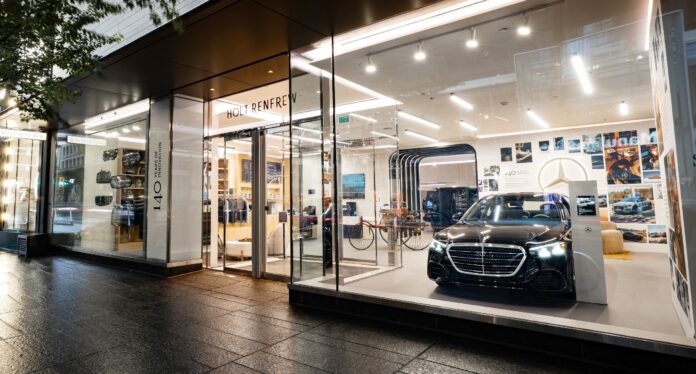
Mercedes-Benz Studio Toronto at Holt Renfrew’s Bloor Street flagship in Toronto. Image: CNW
Mercedes-Benz has reopened its Studio inside Holt Renfrew’s Bloor Street flagship following a brief renovation, unveiling the second iteration of the approximately 2,250-square-foot concept since it launched earlier this summer.
The new installation moves away from the inaugural Mercedes-AMG, Reigning Champ and tennis-focused theme and turns its attention to the automaker’s 140-year history. At the centre of the refreshed space is the Canadian debut of the 2027 Mercedes-Benz S-Class Sedan, displayed alongside a replica of the Benz Patent-Motorwagen, archival imagery, heritage displays and a virtual reality component.
Paul & Shark has also taken over as the Studio’s new fashion residency, replacing Vancouver-founded Reigning Champ. The Italian luxury clothing brand is marking its own milestone in 2026, celebrating 50 years in business with a curated Fall/Winter 2026 assortment and select pieces carrying an exclusive label developed with Mercedes-Benz and Holt Renfrew.
The September reopening provides the clearest look yet at how Mercedes-Benz intends to use the Holt Renfrew location: as an ongoing brand presence built around experiences that can be substantially reinvented throughout the year.
Mercedes-Benz Studio Toronto at Holt Renfrew’s Bloor Street flagship in Toronto. Image: CNW
A Studio Designed to Change
When Mercedes-Benz Studio Toronto opened in June, the concept was structured around two distinct areas. The front portion was designed to evolve through a series of creative installations, while the MANUFAKTUR Atelier at the rear would remain as a consistent presentation of the brand’s craftsmanship and customization capabilities.
The first major change is now complete. The original summer installation centred on performance and tennis culture, bringing together Mercedes-AMG, Reigning Champ, tennis collectibles, apparel customization, racket-stringing programming and a café component tied to the sport.
The latest version replaces much of that programming with a different narrative, new vehicles, another fashion partner and a revised food and hospitality offering. In effect, Mercedes-Benz is remerchandising the Studio in a way familiar to fashion retail, where the core brand remains while products, visual presentation, collaborations and seasonal stories change around it.
The approximately 2,250-square-foot Studio occupies a prominent main-floor location inside Holt Renfrew’s flagship at 50 Bloor Street West. The department store spans more than 150,000 square feet across multiple levels, with expansive frontage along Bloor Street in the heart of Yorkville.
Its location places Mercedes-Benz directly within one of Canada’s most concentrated luxury shopping districts. It also puts the brand in front of customers who may be visiting Holt Renfrew for fashion, beauty, accessories or other luxury purchases rather than actively seeking an automotive showroom.
140 Years of Automotive History in One Space
The latest installation is built around Mercedes-Benz’s 140 Years of Innovation anniversary, connecting the origins of the automobile with the company’s newest flagship sedan. A replica of the Benz Patent-Motorwagen represents the starting point, with Carl Benz having filed the patent for the vehicle in 1886, an event closely associated with the birth of the modern automobile.
At the other end of that history is the 2027 S-Class Sedan, which is making its Canadian debut inside the Holt Renfrew Studio. The department-store location therefore has a role in a significant national product introduction, with visitors able to step inside the S-Class and examine its materials, design and interior details as part of the broader installation.
Archival imagery and milestone displays help connect the two vehicles, while a virtual reality component adds an interactive element to the heritage presentation.
“For 140 years, Mercedes-Benz has shaped the future of mobility through a relentless commitment to innovation, design, and craftsmanship,” said Alex Matthews, Vice President, Digital, PR and Marketing, Mercedes-Benz Canada.
Matthews said the latest evolution of the Studio allows visitors to trace that history from the first automobile through to the new S-Class, which Mercedes-Benz is positioning as a showcase for its latest advances in comfort, innovation and design.
The S-Class also forms part of Mercedes-Benz’s wider global anniversary campaign. Three new S-Class sedans are travelling to 140 locations around the world during a transcontinental journey marking the anniversary, with Toronto included among the stops.
That program places the Holt Renfrew installation within a larger international initiative while allowing Mercedes-Benz to interpret the anniversary through a local retail setting. The contrast between the Patent-Motorwagen and the newest S-Class gives the Toronto installation a particularly clear way to communicate that history within a relatively compact space.
Mercedes-Benz Studio Toronto at Holt Renfrew’s Bloor Street flagship in Toronto. Image: CNW
Paul & Shark Marks 50 Years
Fashion remains an important part of the Studio’s second iteration, with Paul & Shark replacing Reigning Champ as the featured partner. The residency introduces a curated selection from the Italian brand’s Fall/Winter 2026 collection, including select pieces with an exclusive label developed in collaboration with Mercedes-Benz and Holt Renfrew.
Founded in Varese, Italy, in 1976, Paul & Shark is celebrating its 50th anniversary this year. The brand has built its identity around Italian heritage, craftsmanship, technical innovation and what it describes as a “Sense of Journey” philosophy.
“Paul & Shark has always looked to its heritage as a foundation for what comes next,” said Andrea Dini, CEO of Paul & Shark.
Dini said the Toronto residency creates a connection with Mercedes-Benz around craftsmanship, innovation and a shared sense of journey. It also provides another platform for Paul & Shark in what he described as a key market for the brand.
The fashion component is integrated into the overall Studio rather than operating as a separate shop-in-shop. Paul & Shark merchandise sits alongside the automotive and heritage elements, while Holts Café has introduced an Italian-inspired menu connected to the residency.
The approach preserves the basic structure established during the summer installation while changing its creative voice. Automotive design remains linked with apparel, hospitality and luxury products, while the brands and narrative surrounding it can shift from one iteration to the next.
MANUFAKTUR Remains the Constant
While the front portion of the Studio has undergone a substantial transformation, the MANUFAKTUR Atelier continues to serve as its consistent anchor. The Atelier focuses on vehicle personalization and material choice, allowing visitors to examine upholstery, fine leathers, steering wheels, interior finishes and exterior paint colours.
A featured G-Class demonstrates the breadth of available customization, while a floor-to-ceiling display presents interior upholstery and exterior finishes in a highly visual, tactile format. The concept is particularly suited to a luxury department-store environment, where customers are already accustomed to considering colour, fabrication, craftsmanship and personal style when purchasing fashion and accessories.
Within that setting, configuring a vehicle can be approached through a similar lens. Automotive customization becomes a luxury shopping process centred on materials, craftsmanship and individual preference.
The new S-Class provides another connection to that approach, with Mercedes-Benz expanding the personalization choices available through its MANUFAKTUR program. A live embroidery station also remains part of the Studio, carrying the customization theme into merchandise that visitors can personalize and purchase on site.
The Atelier’s continued presence provides continuity as the rest of the Studio changes. Vehicles, collaborators and creative themes can rotate around it while Mercedes-Benz’s focus on craftsmanship and personalization remains visible throughout the year.
Mercedes-Benz Studio Toronto at Holt Renfrew’s Bloor Street flagship in Toronto. Image: CNW
From Saint Laurent Concession to Rotating Retail Platform
The Studio occupies a prominent space that previously housed a Saint Laurent concession before the fashion house shifted its presence further west along Bloor Street. Saint Laurent subsequently opened a much larger standalone flagship at 110 Bloor Street West, creating a full-brand environment separate from the department store.
The transition at Holt Renfrew is notable because the former concession has not simply been replaced by another permanent fashion shop. The space is instead being used as a platform capable of taking on several identities within the same year.
The progression is already visible. Saint Laurent gave way to Mercedes-Benz Studio Toronto in June, with the first installation centred on Mercedes-AMG, Reigning Champ and tennis. The September iteration now brings the S-Class, Paul & Shark and an automotive heritage narrative into the same footprint, with another transformation planned for the holiday period.
For Holt Renfrew, the approach allows a prominent portion of its main floor to introduce new brands, products and programming without a conventional tenant turnover. Mercedes-Benz, meanwhile, maintains a continuing Yorkville presence while giving customers new reasons to revisit the space.
A Different Approach to Automotive Retail
The second iteration also makes the strategy behind Mercedes-Benz Studio Toronto easier to see. At launch, the Studio was positioned as a way for customers to engage with Mercedes-Benz outside the dealership through design, fashion and interactive programming.
With its first major turnover complete, the location is beginning to operate more like a branded retail platform on a seasonal cycle. The hero vehicle, fashion partner, food offering, visual presentation and cultural narrative have changed, while the Mercedes-Benz presence and MANUFAKTUR Atelier remain.
That continuity gives the automaker an opportunity to reach customers within a luxury shopping environment rather than waiting for them to visit a dealership. The distinction is particularly relevant in Yorkville, where automotive brands, fashion houses, restaurants, hotels and other luxury businesses increasingly cater to an overlapping customer base.
“The Mercedes-Benz Studio Toronto with Paul & Shark experience is the latest curation of the best brands for our customers,” said Jerry Wu, Senior Vice President, Marketing at Holt Renfrew.
Wu said the second iteration brings together luxury fashion and automotive heritage around legacy, craftsmanship and innovation, along with a refreshed Holts Café offering.
The Studio also gives Holt Renfrew a way to introduce visible newness on its main floor as major luxury brands continue to invest in increasingly elaborate standalone flagships along Bloor Street. Rather than filling the former Saint Laurent space with another conventional concession, the Mercedes-Benz Studio provides a format that can repeatedly change its assortment, partners and presentation while retaining a recognizable identity.
Another Transformation Still to Come
The 140 Years of Innovation installation is scheduled to run through October 2026, with a third Studio concept expected to follow in November for the holiday period. That next iteration will provide another opportunity to see how far the format can evolve while remaining recognizably Mercedes-Benz.
For now, the September reopening demonstrates the premise behind the Studio with greater clarity. Approximately 2,250 square feet inside Holt Renfrew’s flagship has become a continuing Mercedes-Benz destination capable of telling a different brand story every few months.
Of that total, 13,160 are exporters, while 45,414 are importers.
“While government has made a few important and welcome changes to the main tariff supports, the programs continue to exclude about half of the small business community,” said Corinne Pohlmann, CFIB executive vice-president, advocacy. “We have been telling government that the counter-tariffs would have a far broader impact than the U.S. tariffs. Programs that only help a few thousand businesses are unacceptable when tens of thousands need support. This week’s announcement that some Canadian goods will be outright banned from US import at the end of the month only underscores the need to get supports right ASAP.”
The CFIB it is Canada’s largest association of small and medium-sized businesses with 103,000 members across every industry and region.
Corinne PohlmannAndrea Piacquadio photo
CFIB said is proposing three important measures:
A dedicated Small Business Tariff Relief (SBTR) program, where impacted exporters and importers who can provide direct evidence they paid the tariffs directly, or adjusted prices to absorb part or all of the tariff, would be eligible to receive initial tariff relief up to $70,000 CAD.
An SME Desk for Tariff Remissions to speed up decisions on eliminating Canadian retaliatory tariffs if there are major negative impacts on the industry or if alternatives to the U.S. product are not readily available.
Immediate tax relief for all small businesses in the form of a Small Business Corporate Tax Rate cut from 9% to 6%, retroactive to January 1, 2026, and an increase to the Small Business Deduction threshold from $500,000 to $700,000 with future indexation to inflation.
“The Regional Tariff Response Initiative Programs have standardized eligibility criteria and reduced their access thresholds down to $1 million, but it doesn’t go far enough,” said Pohlmann. “A $1-million threshold will still exclude a huge number of businesses. We need a simple, direct support program to help small businesses on the U.S. and Canadian tariff lists in addition to broad-based tax relief to help all small firms that will be hurt by the trade war.”
Nearly four in 10 Canadian shoppers have used artificial intelligence to help them shop over the past year, as AI begins to play a larger role in how consumers discover, research and compare products.
Caila Schwartz
Salesforce research found that 39 per cent of Canadian shoppers have used an AI tool for shopping during the past 12 months, according to Caila Schwartz, Director of Industry Insights at Salesforce. Roughly 11 to 12 per cent now say they start their shopping journey with AI, up from single-digit levels last year.
“I would argue last year it was a niche type of behaviour, and in 2026 AI search and discovery is becoming a much more mainstream shopping behaviour for the Canadian shopper,” Schwartz told Retail Insider.
The shift is creating new questions for retailers around product visibility, data quality and marketing measurement as more of the shopping journey takes place inside AI conversations. Salesforce’s State of Commerce research found that 89 per cent of Canadian commerce professionals believe AI and large language models will be essential to product discovery within the next year.
Canadians Are Using AI to Find Value
Price comparison and deal hunting are currently the leading shopping uses for AI among Canadian consumers, according to Schwartz.
Consumers are also using the technology to conduct research quickly and receive product recommendations, reducing the need to move between multiple websites and search results.
“For the Canadian consumer, the number one reported behaviour is to compare prices and find deals,” Schwartz said. “The second is being able to do all of that research in one go very, very quickly. It does all the research for them. And then the third is that it gives them the best product recommendations.”
The way consumers use AI also varies by income. Schwartz said higher-income shoppers tend to place greater emphasis on personalization, while other consumers are leaning more heavily on AI to find deals, coupons and conduct price comparisons.
Traditional search remains important, and Schwartz cautioned against interpreting the growth of AI discovery as a direct transfer of market share away from search engines. Salesforce is seeing fewer consumers report using some traditional discovery channels and more report using emerging ones, but its research does not measure the entire discovery market as a fixed pool of traffic being redistributed between channels.
The use cases are also different. A consumer who already knows exactly what they want may still favour a conventional search, while AI can be more useful when a shopper is comparing options, seeking inspiration or working through a more complex purchase.
Retailers Face a New Visibility Challenge
The growth of AI shopping raises an increasingly important question for retailers: when a shopper asks an AI assistant what to buy, what determines which products and brands appear in the answer?
There is no settled formula yet.
“I think that is what everyone is still trying to figure out,” Schwartz said.
Salesforce believes data quality will play a central role. Schwartz pointed to clean and consistent product information, accurate inventory and pricing, and direct catalogue integrations as areas retailers should be considering as AI-driven discovery develops.
“Ultimately, it comes down to data,” she said. “Having a really sound data strategy, having clean and consistent data, trusted data across your product detail page, across your entire ecosystem.”
Direct catalogue integrations could help AI systems work with current inventory and pricing rather than recommending merchandise that is out of stock or displaying outdated information. Schwartz said Salesforce believes these tactics can also improve how retailers and their products appear within AI search results.
Retailers are consequently beginning to think about visibility beyond traditional search engine optimization. Concepts including generative engine optimization and answer engine optimization — commonly shortened to GEO and AEO — are emerging as companies consider how their information should be structured for AI-driven discovery.
Schwartz described it as, in some respects, “the new version of SEO.”
The rules remain fluid. Retailers are entering an environment where the factors influencing AI-generated recommendations are newer and less established than the practices that evolved around conventional search.
Canadian Retailers Are Moving Quickly
Canadian commerce professionals appear well aware of the change. Salesforce found that 89 per cent believe AI and large language models will be essential to product discovery within the next year. About 34 per cent are already using agentic AI, while another 33 per cent plan to use it within the next six months.
“They are seeing this already today,” Schwartz said. “They are prioritizing AI adoption.”
The larger challenge may be what sits underneath those systems.
Only 30 per cent of Canadian retailers surveyed by Salesforce said their customer data is fully unified across areas including sales, marketing, commerce and service. That fragmentation could make it harder to deliver consistent, personalized experiences as retailers increase their use of AI.
Schwartz said Canadian retailers that have successfully unified their data reported better sales outcomes, stronger AI automation for their teams and improved customer retention.
“Having a sound data strategy is really going to be important,” she said.
Smaller Retailers May Have an Opening
The transition to AI-driven product discovery does not necessarily favour the largest retailers, according to Schwartz. She described the current environment as a relatively even playing field and said smaller brands and retailers have an opportunity to establish themselves while AI commerce remains in its early stages.
Large organizations may have greater technology resources, but they can also face more complicated data environments. Multiple systems and data silos can make it difficult to create the unified information needed to support AI applications.
“Those things can be hard for larger organizations because they have more systems, more data silos that they have to unify,” Schwartz said.
She believes the technology could act as an equalizer across parts of the industry, particularly for smaller companies able to maintain clean product information and a coherent data strategy.
Whether that ultimately translates into greater visibility for smaller retailers will depend on how AI shopping tools and recommendation systems continue to develop.
Retail Marketing Has a Measurement Problem
The movement of product discovery into AI conversations is also creating a challenge for marketing attribution. A shopper can now conduct substantial research inside an AI assistant before visiting a retailer. Recommendations, comparisons and part of the purchasing decision can happen without generating the website interactions marketers have traditionally used to understand the customer journey.
Schwartz said there is not yet a clear answer for measuring that activity.
“If the discovery is staying in the conversation, we don’t have visibility into any of that,” she said. “In terms of measurement, I don’t think we have an answer for that yet.”
The issue could become increasingly important as AI takes a larger role at the beginning of the shopping journey. Search referrals, website sessions and conventional digital attribution may capture only part of the process if consumers arrive after completing much of their research elsewhere.
For retailers, Schwartz said the immediate priority is controlling what they can: the quality and structure of the data that determines how they and their products show up in these emerging channels.
Much of the Coming AI Traffic Will Be Bots
Retailers will also have to manage another consequence of AI adoption: an increasing share of website traffic may not be human.
Salesforce predicts that 20 per cent of holiday e-commerce traffic in 2026 will originate from AI agents. Schwartz clarified that the majority of the traffic represented in that prediction is expected to come from bots rather than consumers directly arriving from AI conversations.
“The majority of that is bots,” she said. “A lot of that is non-human.”
AI systems use crawlers to visit retail websites, access product pages and collect information for indexing or to bring information back into conversations with shoppers.
That creates a trade-off for retailers. They want their products accessible to AI systems because those systems may increasingly influence purchasing decisions, but large volumes of automated traffic can put additional demands on websites, particularly during peak shopping periods.
Schwartz said retailers may have to make decisions about which systems they allow to crawl their websites during periods of particularly heavy traffic. She also pointed to direct catalogue integrations as one way to reduce reliance on crawlers while providing AI systems with more structured and current product information.
The industry is already experimenting with other approaches.
“We might even see some websites that are built just for bots and not for humans,” Schwartz said.
The idea points to a potentially significant change in e-commerce infrastructure, where retailers could increasingly provide information to automated systems through channels designed specifically for machines rather than relying exclusively on the same customer-facing websites used by human shoppers.
From Discovery to Purchasing
The next question is how far consumers will allow AI to go. Using an AI assistant to research products carries relatively little risk. Allowing one to select an item and complete a transaction requires a higher level of trust.
Schwartz believes the industry may be closer to that point than it appears, although she does not think third-party AI systems have yet become significant purchasing channels.
Social commerce provides an indication of how behaviour could evolve. Schwartz said consumers, particularly Gen Z and Millennials, have become increasingly comfortable completing purchases inside social applications rather than clicking through to a retailer’s website.
“I don’t think AI is there yet as a purchasing engine,” she said. “But I think what it does tell us is that consumers will eventually be comfortable purchasing in these tools.”
Retailers’ own AI agents could reach that point sooner. A shopper interacting with an AI assistant on a retailer’s website may already have a loyalty profile and saved payment information, which Schwartz said could make consumers more willing to complete a transaction within the conversation.
For now, third-party AI tools are primarily changing product discovery. Even at this stage, retailers are having to reconsider how products are presented online, how customer and catalogue data is managed, and how marketing effectiveness is measured.
With 39 per cent of Canadian shoppers already using AI as part of shopping and 89 per cent of Canadian commerce professionals expecting AI and large language models to become essential to product discovery, the shift has moved beyond an emerging consumer experiment.
For retailers, the challenge now is ensuring their products, pricing and availability can be accurately understood by the AI systems increasingly helping consumers decide what to buy.
A fitting room may seem like a relatively small part of a retail store, but Pamela Shainhouse remembers an experience years ago that changed where she was willing to spend her money.
Shainhouse, founder of accessibility and inclusion consultancy The Shainhouse Group, had gone into a store operated by a well-known Canadian retailer and found the accessible fitting room filled with boxes and being used for storage. When she questioned why the one space intended for customers requiring an accessible fitting room had effectively been taken away, she was told the store needed the storage space.
“I never shopped there again,” Shainhouse recalled. “If you’re not going to respect me as a person with a disability, then I’m not going to give you my money.”
For Shainhouse, who walks with a walker and has spent decades in the Canadian fashion industry, the encounter illustrates a much larger issue facing retailers. Accessibility is frequently approached as a building-code requirement, compliance exercise or accommodation for a relatively small group of customers. She argues that retailers should instead regard it as a fundamental part of customer experience, one that can determine whether somebody can enter a store, navigate it, make a purchase and ultimately decide to return.
The potential customer base is substantial. Statistics Canada found that 27 per cent of Canadians aged 15 and older, representing roughly eight million people, had one or more disabilities that limited their daily activities in 2022. Among people with disabilities, 72 per cent reported encountering at least one accessibility barrier during the previous year, including barriers involving physical spaces, communication, internet use and the behaviours or assumptions of others.
“People with disabilities can be incredibly loyal customers,” Shainhouse said. “If they know they can shop there, get what they need and be treated respectfully, they’ll come back.”
For retailers, she said, that makes accessibility a significant customer-experience consideration. An inaccessible store can mean a lost sale, while a consistently accessible experience can help build long-term customer loyalty.
Accessibility Starts With Store Design
Shainhouse said newer retail environments are generally improving, with architects, engineers and developers paying greater attention to accessible entrances, automatic doors, washrooms and signage. The challenge is that meeting technical requirements does not necessarily mean a customer will be able to comfortably use the finished store. Retail merchandising decisions made after construction can create an entirely new set of barriers, with racks positioned too closely together, promotional tables narrowing circulation paths, fixtures extending unexpectedly into a customer’s route or push-button door openers being blocked by signage or merchandise.
“It comes down a hundred per cent to store design,” Shainhouse said.
She recalled visiting a smaller Indigo location at First Canadian Place several years ago and finding that she could not reach a section of the store with her walker because of the way the space was laid out. When she raised the issue, she said a manager suggested she take another route around the store. Rather than doing so, Shainhouse left.
To Shainhouse, the solution starts before fixtures are installed and merchandise is placed. Retailers developing or renovating stores should bring accessibility expertise into the design process early, allowing plans to be reviewed alongside the work of architects, engineers, store planners and merchandising teams.
“You need enough space for somebody in a wheelchair, and even more for an electric wheelchair, to comfortably get around,” she said. “You look at the space and make sure everybody can move through it safely.”
Ontario’s accessibility framework supports that broader focus. Requirements under the Accessibility for Ontarians with Disabilities Act cover areas including customer service, information and communications, employment and aspects of public-space design. Shainhouse argues that regulatory compliance should be regarded as a starting point rather than the objective.
Pamela Shainhouse
Designing for More Than One Type of Customer
One of the misconceptions surrounding accessibility, Shainhouse said, is that retailers sometimes picture a particular type of disabled customer, often somebody using a wheelchair, when assessing whether a space works. The actual customer base is considerably broader: someone may use a walker or cane, have limited vision or hearing, live with a neurological or sensory disability, or be recovering temporarily from an injury.
Many of the same design improvements can make stores easier to use for older customers, parents pushing strollers or shoppers carrying bags and packages. A small change in floor level can become a trip hazard, poor signage can make an elevator difficult to locate, and a service counter designed exclusively at standing height can create an awkward interaction for a customer using a wheelchair. Store fixtures that appear harmless to one shopper can become obstacles or hazards to another.
“You’re not only making it accessible for people with disabilities,” Shainhouse said. “You’re making it accessible for an older person walking with a cane or somebody pushing a stroller.”
That broader perspective is increasingly reflected in how retailers think about sensory environments. Accessibility is moving beyond traditional discussions about ramps, doors and washrooms to include lighting, sound and other elements that can make shopping difficult for people with sensory sensitivities or some forms of neurodiversity.
Sephora announced a global rollout of its Quiet Hours initiative in 2026 following an earlier pilot, creating designated periods when elements of the store environment are adjusted to provide a calmer shopping experience. In Canada, participating stores offer Quiet Hours during designated periods, with reduced sensory distractions intended to make the environment more comfortable for shoppers who benefit from them.
Shainhouse sees initiatives of this kind as encouraging, but said retailers need to consider the entire customer journey rather than treating accessibility as an individual program. She recalled encountering a Sephora store where a large promotional sign had been positioned in front of the button used to activate an accessible door. When Shainhouse raised the issue with the manager, the obstruction was moved. For her, the example shows how an otherwise thoughtful accessibility strategy can be undermined by something as ordinary as where a sign is placed, and why accessibility has to become part of day-to-day retail operations.
Staff Can Determine Whether a Store Is Truly Accessible
Physical design is only part of the equation. Shainhouse said one of the biggest opportunities for retailers lies in educating frontline employees about how to interact comfortably and respectfully with customers with disabilities. She has encountered sales associates who appear reluctant to approach her when she enters a store with her walker, something she believes can be particularly pronounced in commission-based environments where an employee may assume a customer requiring additional assistance will take more time.
There are also basic practices that employees may never have been taught. A wheelchair, for example, should not be moved or touched without its user’s permission.
“Never touch somebody’s wheelchair,” Shainhouse said. “That is part of them.”
When a customer enters with a white cane, she said, a sales associate does not need to make assumptions about how much the person can see or immediately take control of the interaction. An employee can simply introduce themselves and ask whether assistance would be helpful.
“You can simply say, ‘I’m happy to help if you’d like my assistance,’” Shainhouse said.
That assistance could mean explaining where a department is located, guiding someone toward an elevator or helping locate a particular product or size. Just as importantly, the customer should be able to decline the offer and shop independently. Ontario’s accessible customer-service framework includes requirements around training employees on interacting and communicating with people with different types of disabilities.
For Shainhouse, a retailer can invest significantly in an accessible physical environment and still deliver a poor experience if employees do not understand how to serve the customers those features are intended to support.
Photo: Google/Retail Insider
The Digital Store Matters Too
The same principle increasingly extends online, where a retailer’s website may be the first store environment a customer encounters. Shainhouse said retailers need to consider whether people using assistive technologies can navigate their websites, understand content and complete purchases. Elements such as alternative text for images, readable type, logical navigation and properly structured content can determine whether an ecommerce site is usable.
Ontario’s accessibility requirements apply broadly to businesses and non-profits with employees in the province, with specific obligations varying according to organization size. Businesses and non-profits with 20 or more employees must file accessibility compliance reports every three years. Businesses and non-profits with 50 or more employees, along with designated public-sector organizations, are required to make applicable public websites and web content conform to Web Content Accessibility Guidelines 2.0 Level AA, subject to specified exceptions.
The World Wide Web Consortium has since developed WCAG 2.2, a newer version of the international accessibility guidelines. Ontario’s current AODA website requirement continues to reference WCAG 2.0 Level AA.
For Shainhouse, the business question goes beyond which version of a standard a retailer is legally required to follow. If customers cannot independently use a website, the retailer has created another barrier to making a sale. Making the front door accessible accomplishes relatively little for a customer who cannot use the retailer’s website in the first place.
The distinction between physical and digital accessibility is also becoming less clear as the two channels become more closely connected. A customer might discover an item online, check inventory, visit a physical store, join a loyalty program and later place an ecommerce order. Statistics Canada found that 9 per cent of people with disabilities experienced barriers while banking or shopping online in 2022.
The Budget Question
Shainhouse readily acknowledges that making retail environments accessible requires investment. Existing stores can be more difficult to modify than new ones, while websites, training programs and physical environments all require resources. Her argument is that accessibility should have a place in the budget from the beginning rather than being addressed only after a customer complains or a problem becomes impossible to ignore.
“You can talk about it all you want, but at some point you have to bring somebody in to help you do it,” Shainhouse said. “There has to be money set aside.”
An accessibility consultant can review floor plans, work with a design team and identify potential barriers before they are built into a store. Initial training can establish expectations for employees and management, while refresher education can keep accessibility from disappearing as staffing and operations change.
“You make that initial investment, educate your board and management, and continue the training with your sales staff,” Shainhouse said. “You have to keep accessibility at the forefront.”
Shainhouse believes accessibility can still lose out when companies allocate capital because it may not receive the same attention as other competing priorities. For retailers, focusing solely on the upfront cost can overlook what happens when barriers remain.
A customer who cannot get through an aisle, reach a counter, use a fitting room or complete an online transaction is unlikely to appear as an “accessibility loss” on a sales report. That customer may simply leave, as Shainhouse did after finding the accessible fitting room being used for storage.
A Career Rooted in Fashion and Inclusion
Shainhouse’s perspective is informed by lived experience and a long connection to Canada’s apparel industry. She grew up in a manufacturing family and later founded Allistyle, an early Canadian size-inclusive fashion brand. The idea for the company emerged during an intensely personal period involving her daughter, Alli, who was undergoing cancer treatment and had gained significant weight from steroids.
During a trip to Yorkdale Shopping Centre to find jeans, Shainhouse recalled her daughter becoming upset after being directed toward a plus-size store. Her daughter felt that her changed body had suddenly determined where she was permitted to shop.
“She said, ‘They told me that I’m fat, and I have to go into the fat store,’” Shainhouse recalled. Her daughter refused to shop there, despite needing jeans.
Shainhouse remembers responding almost spontaneously: “You know what, Alli? We’re going to start a clothing brand.”
Alli did not recover, but Shainhouse went on to develop the company around many of the ideas the two had discussed. The experience reinforced her belief that people should not be unnecessarily separated or made to feel that a retail environment was intended for somebody else, a philosophy she has carried into her current accessibility work.
That perspective becomes increasingly relevant as Canada’s population ages and retailers serve customers whose needs may change throughout their lives. Statistics Canada reported that the disability rate among Canadians aged 65 and older reached 40.4 per cent in 2022, compared with 24.1 per cent among those aged 25 to 64. Accessibility measures can also benefit somebody recovering from surgery, a shopper who has broken a leg or a parent navigating a store with children.
“You don’t know what somebody is dealing with,” Shainhouse said. “They could have broken a leg, had a fall or suddenly be in a wheelchair for six weeks.”
From Accommodation to Customer Experience
For retailers opening new locations, Shainhouse recommends making accessibility part of the initial planning process, including reviews of entrances, circulation, fitting rooms, service areas, signage and other customer touchpoints. Existing retailers can conduct similar reviews of their stores while also examining websites, ecommerce platforms and staff training.
The objective, she said, should be to think about all customers from the outset rather than designing for one assumed customer and subsequently finding ways to accommodate everybody else. That can involve capital investment, but it also comes down to seemingly minor operational decisions: whether merchandise blocks a pathway, whether an accessible fitting room remains available for its intended purpose, whether staff know how to offer assistance appropriately and whether a customer can find and use an accessible entrance without having to ask someone for help.
The goal should not be to create a separate or elaborate experience for customers with disabilities.
“We don’t need extra care,” Shainhouse said. “We’re not asking to be put on a pedestal.”
Instead, she wants retailers to create an environment where customers can enter the business, use it safely, find what they need and be treated with respect.
“My wish is that people with disabilities aren’t seen any differently,” Shainhouse said. “We’re all people.”
For retailers, perhaps the most successful accessible experience is ultimately the one a customer barely notices. They arrive, shop, make their purchase and return because the business was designed for them to be there.
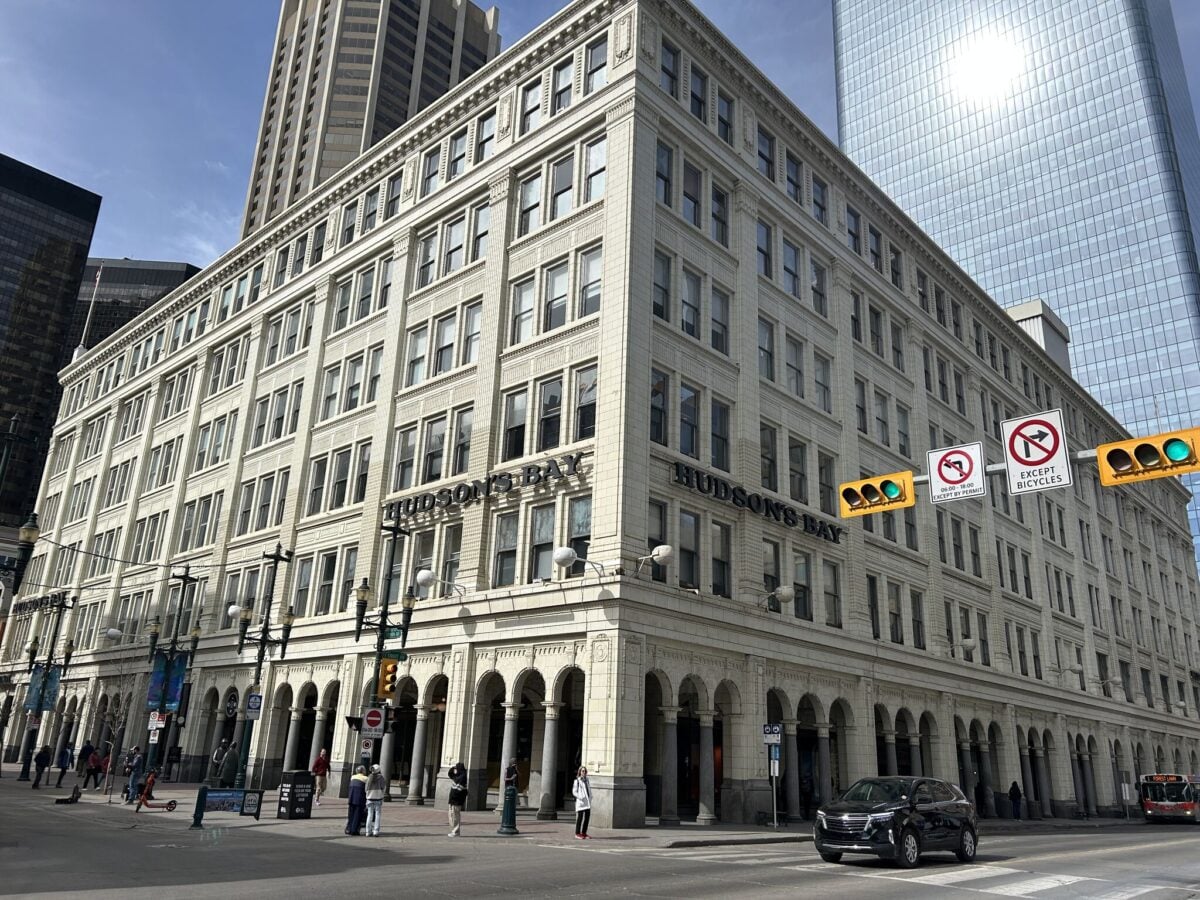
The owner of Galeries de la Capitale, Quebec City's largest shopping centre, plans to redevelop a former Hudson's Bay store left vacant by the retailer's collapse. Construction is underway and the first spaces are scheduled to open in 2027. (CoStar)
Canada’s retail vacancy rate is expected to remain near 2.5 per cent over the next year as the market continues to absorb the impact of Hudson’s Bay store closures, according to a new forecast from CoStar Group.
The commercial real estate data and analytics company says rent growth is also expected to slow further through 2027 before recovering as retail-space absorption strengthens.
The Hudson’s Bay closures had a significant impact on Canada’s retail market in 2025, with vacancy at shopping malls rising from three per cent to eight per cent in the second quarter of that year. Net absorption during the quarter was negative five million square feet, according to CoStar.
Overall retail vacancy rose from 1.8 per cent to 2.5 per cent following the closures and has remained at that level over the past year. CoStar said weaker absorption has been accompanied by similarly subdued construction activity.
Retail construction starts have remained below one million square feet per quarter since the third quarter of 2025. About five million square feet of retail space was under construction in the second quarter of 2026, the lowest level since the pandemic, the company said.
Mario LefebvreHudson’s Bay downtown Calgary. Photo by Mario Toneguzzi
“Notwithstanding a relatively tight market overall, we expect rent growth to continue decelerating over the next four quarters,” said Mario Lefebvre, chief economist for Canada at CoStar Group. “Rent growth stood at about 4% in the first quarter of 2025, before the Bay closures, and has already decelerated to just above 2% in the second quarter of 2026. We expect it to bottom out around 0% by the second quarter of 2027, before climbing back to about 3% by the end of 2028 as absorption strengthens.”
The forecast points to a period of slower rent growth for retail property owners and landlords as available space is absorbed and new construction remains limited.
Lefebvre said several economic factors could further delay the recovery.
“The balance of risks in this forecast remains tilted to the downside,” Lefebvre said. “Trade and tariff uncertainty, higher fuel costs, and a declining population could further weigh on the economy and delay the recovery in retail space absorption. Over the longer term, however, we expect demand for retail space in Canada to increase as consumer spending grows and the development pipeline remains modest.”
CoStar expects the retail market’s recovery to become more pronounced toward the end of the forecast period, with rent growth projected to reach about three per cent by the end of 2028 as absorption improves.
“Immediately upon the closures of the Bay stores, net absorption (the difference between absorbed and vacated space) was negative almost five million square feet. This is the important number, as the rise in overall retail sector vacancy does not pay justice to the impact that these closures are having. Total vacancy increased from 1.8% to 2.5. However, it rose from 3.1% to 8% for shopping malls. It will take a long time for malls to recuperate from that and, indeed, the CoStar forecast expects that malls’ vacancy rate will still be at around 7% in three years,” said Lefebvre.
“Over this year and next, retailers are likely to have some bargaining power, particularly those looking to lease shopping mall space. However, at an overall vacancy rate of 2.5%, retailers should be careful not to push their luck and ask for big long term discounts.”
Hudson’s Bay downtown Calgary. Photo by Mario Toneguzzi
At this point the big risk to the CoStar forecast is inflation, noted Lefebvre.
“These back-and-forth tariffs between Canada and the United States will undeniably lead to higher prices for a large proportion of goods and services. This has to be added to higher fuel prices. Then, you add a decline in the population, meaning a reduced number of consumers. Demand is therefore at risk. It is with that context in mind that CoStar expects very slow (down to zero in 2027 Q2) rent growth. The rising inflation risk also suggests that defensive oriented retail, including necessity retail like grocery-anchored centres, are likely to fare better than discretionary formats like enclosed malls, as people are more likely to cut discretionary spending before essentials like food and medicine,” he said.
“The roughly five million square feet of space vacated by the closures of The Bay stores means that there is space available, particularly in shopping malls. Therefore, CoStar does not believe that limited development pipeline will be an issue down the road. Indeed, it is the limited development pipeline that will help restore equilibrium in the sector over the coming years.”
CoStar Group is a global provider of commercial real estate information, analytics, online marketplaces and 3D digital twin technology. The company was founded in 1986.
Over the past few weeks, we’ve heard the growing discussion around tariffs, and this week is when the impact really starts to take effect. While much of it may feel out of our control, what can Canadians actually do as consumers to soften the blow? NerdWallet Canada’s financial expert, Clay Jarvis, breaks it all down, sharing practical tips Canadians can use now and in the months ahead.
“There’s still a vague sense of disbelief that the trade war between Canada and the U.S. has become so ugly and chaotic. But with (US President Donald) Trump failing in Iran and sinking in the polls as the mid-term elections approach, he’s in a position the world knows he can’t handle,” said Jarvis.
“Which is why the trade war is likely to grind on. If Trump can’t win, then somebody else has to lose. In this case, it’s Canada; or more specifically, (Canadian Prime Minister) Mark Carney.”
What can Canadians expect over the next few months?
Higher prices. Canada’s latest batch of counter-tariffs affect a wide range of consumer goods, including beauty supplies, milk products, clothes, home appliances and exercise equipment.
Decreased imports. Trump’s double-shot of tariffs (August 22) and import bans (September 8) will put renewed pressure on companies who rely on crossborder business.
A quiet fall housing market. Trump’s looming 50% tariffs on Canadian autos and steel, slated for January 1, 2027, could flatten home buying demand in Ontario and Quebec.
How can consumers prepare?
Get those elbows up. Many of Canada’s counter-tariffs on affected U.S. goods are 25% or 50%. Avoiding impacted goods could save you some real money. Buying Canadian supports home grown businesses when they really need it.
Do some bulk shopping ASAP. If there are impacted goods from the U.S. you can’t live without, snap them up before you have to pay tariff-boosted prices.
Re-allocate some of your paycheque. Consider funnelling a little extra money into your emergency fund rather than investments over the next few months. The liquidity could come in handy if your income is disrupted or inflation starts to bite.
Home buyers, have a long chat with a mortgage broker. The ‘fixed vs. variable’ decision is especially fraught right now. Get some professional advice around the short- and long-term impact of your rate decision.
Clay Jarvishttps://kaboompics.com/ photo
Jarvis spoke to Retail Insider about the issue.
Question: Which categories of consumer goods are most likely to see noticeable price increases as Canada’s latest counter-tariffs take effect, and how quickly could those increases reach shoppers?
Answer: I think Canadians will want to watch out for items like milk and cheese, or beauty products, which they buy regularly. A lot of household appliances are about to get dinged, too.
When shoppers actually have to pay higher prices is really up to retailers. They might try to absorb some of the higher costs for a while, or they might pass them on to customers as soon as their first tariff-impacted shipments arrive.
In a trade war as chaotic as this one, it’s really hard to predict when something is going to happen, which is partially why it’s so frustrating for consumers.
Q:For Canadians trying to reduce the impact of tariffs on their household budgets, when does buying Canadian or choosing non-U.S. alternatives make the most financial sense?
A: Buying Canadian goods only has a positive financial impact if the Canadian product is cheaper. That’s not always the case. When life is as expensive as it is today, you can’t blame someone for choosing the less expensive product, regardless of where it originates,
Q:Is bulk-buying tariff-affected U.S. products before prices rise a sound strategy for consumers, or are there risks of overspending or buying more than they need?
A: Overspending can be a legitimate risk when you’re buying bulk. You can mitigate that risk by buying non-perishable products or only stocking up on items that you know your household will make use of.
Gustavo Fring photo
Q:With the potential for higher prices and economic uncertainty, how much should Canadians prioritize building or increasing their emergency savings over investing in the coming months?
A: I think it’s a trade-off worth considering for some households. If you’re worried about a job loss or needing more cash on hand for a period of higher prices, it might make more sense to keep your cash where it’s accessible and free from risk.
Q:What specific advice would you give to Canadian consumers who are already feeling financially stretched and have little room in their budgets to absorb higher prices?
A: This is a tough one. So many Canadians are doing the right things — watching their spending, paying down their debt — and still suffering. I think it’s really important to remember that your finances don’t define who you are, and to talk about your financial stress with someone you trust.
Total revenue for Q2 2026 increased by $97.2 million or 29.8% to $423.6 million compared to Q2 2025. This growth was due to a 10.3% increase in comparable store sales (12.3% on a constant currency basis) and contributions from new stores. Online revenue for Q2 2026 was $61.4 million, representing an increase of $14.7 million or 31.5% compared to Q2 2025, it said.
Net earnings for Q2 2026 increased by $49.5 million or 77.5% compared to Q2 2025. This growth was mainly driven by higher revenue, which led to increased gross profit, partially offset by higher SG&A and increased depreciation and amortization. Net earnings also benefited from a $9.4 million recovery of tariff refund claims related to International Emergency Economic Powers Act tariff refunds under U.S. Customs and Border Protection’s refund process. Adjusted net earnings for Q2 2026, which exclude the after-tax impact of the $9.4 million recovery related to tariff refund claims, increased by $44.1 million or 68.1% compared to Q2 2025, added the company, which operates retailers DYNAMITE and GARAGE.
Andrew LutfyStacie Beaver
“Our second quarter results demonstrate the strength of our luxury-inspired operating model and our ability to continue delivering profitable growth. Comparable store sales grew 10.3%, total revenue increased 29.8%, gross margin expanded to 68.8% and adjusted EBITDA margin reached 44.3%, in all cases excluding the impact of duty refunds. The continued expansion of gross margin and adjusted EBITDA demonstrates that the economics of our model are strengthening as we scale. We have built highly coveted global brands with exceptional unit economics, disciplined inventory management and attractive returns on capital, supported by a growth engine we have engineered over decades that continues to generate profitable growth. We remain focused on creating long-term value as we scale Groupe Dynamite with discipline,” said Andrew Lutfy, Chief Executive Officer and Chair of the Board.
“Q2 demonstrated the agility of our operating model and the strength of our execution. Combined with strong brand heat across GARAGE and DYNAMITE, this helped us build momentum throughout the quarter and deliver strong sales performance. Early in the quarter, we identified an opportunity to accelerate newness within our assortments, and the speed of our luxury-inspired model allowed us to respond quickly and make targeted in-season adjustments. This enabled us to deliver products that resonated strongly with our customers and reinforced their connection with our brands. That customer response is translating into increasing productivity across our store network, with sales per square foot continuing to improve as we optimize our fleet and elevate the in-store experience. At the same time, we are strengthening the infrastructure supporting our growth, with our U.S. distribution center delivering greater efficiency as we scale. We continue to expand our presence across the United States and internationally, including the UK, and are extending our reach through shipping to nine additional countries,” added Stacie Beaver, President and Chief Operating Officer.
Groupe Dynamite photo
Fiscal 2026 Second Quarter Highlights
Revenue increased by 29.8% to $423.6 million in Q2 2026, compared to $326.4 million in Q2 2025.
Comparable store sales growth of 10.3% (12.3% on a constant currency basis(1)) in Q2 2026, compared to comparable store sales growth of 28.6% (25.7% on a constant currency basis) in Q2 2025.
Retail sales per square foot increased by 28.9% compared to Q2 2025, reaching $1,056 in Q2 2026.
Gross margin expanded by 520 basis points to 68.8% in Q2 2026 compared to 63.6% in Q2 2025.
SG&A increased to $106.8 million in Q2 2026, compared to $87.7 million in Q2 2025, and adjusted SG&A as a percentage of sales decreased by 210 basis points to 24.6% from 26.7% over the same period in Q2 2025.
Operating income increased by 60.5% to $156.2 million in Q2 2026, compared to $97.3 million in Q2 2025.
Adjusted EBITDA increased by 55.9% to $187.9 million in Q2 2026, representing an adjusted EBITDA margin of 44.3%, compared to 36.9% for the same period in Q2 2025.
Diluted net earnings per share increased to $1.00 in Q2 2026, compared to $0.56 in Q2 2025 and adjusted diluted net earnings per share increased by 68.7% to $0.96 in Q2 2026, compared to $0.57 in Q2 2025.
Real estate activity for Q2 2026 includes:
Opening of 7 new stores: 6 in the United States and 1 in the United Kingdom, both under the GARAGE banner.
Renovation or relocation of stores: 4 in Canada and 3 in the United States, both under the GARAGE banner.
7 store closures: 6 in Canada, including 4 under the GARAGE banner and 2 under the DYNAMITE banner, and 1 in the United States under the DYNAMITE banner.