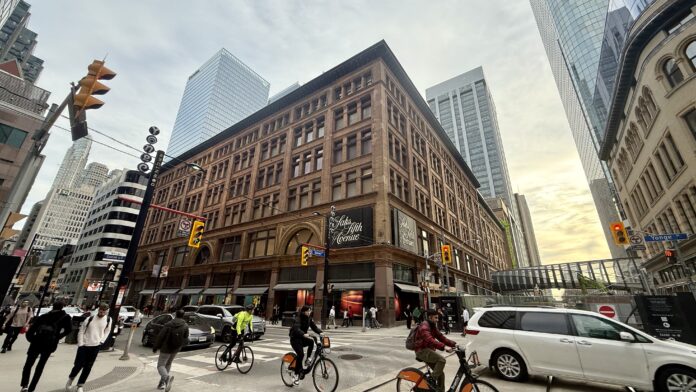
Hudson's Bay/Saks Fifth Avenue flagships in downtown Toronto. The building at 176 Yonge Street began its life in 1898 as a Simpsons store. Photo taken April 23, 2025 by Craig Patterson
The International Downtown Association Canada (IDA Canada) earlier this month officially launched Downtown Month 2025, a national campaign taking place throughout August to celebrate and highlight the essential role that downtowns play in communities across the country.
From local businesses and cultural institutions to public spaces and gathering places, downtowns remain the economic, cultural, and social engines of cities, towns, and neighbourhoods. Downtown Month provides an opportunity to showcase the strength and resilience of these spaces while underscoring the pressing need for coordinated leadership and investment to support their continued renewal, said IDA Canada.
Kate Fenske
“Downtowns across Canada are continuing to adapt and evolve in the face of economic and social challenges,” said Kate Fenske, Chair of IDA Canada.
“This month is a time to celebrate their progress while also reinforcing the need for focused federal support to help ensure their long-term success.”
IDA Canada said it continues to advocate for a national downtown strategy. Its policy priorities include investing in public spaces and infrastructure, increasing housing density, support small businesses (either supporting small businesses, addressing mental health and addictions, and ensuring downtowns remain inclusive and welcoming through improvements to the justice system and bail reform.
“Canada’s downtowns are the heartbeat of our communities. With strategic investments and a shared vision, they can thrive once again,” added Fenske. “We invite everyone to take part in Downtown Month by celebrating their local downtowns and joining the call for long-term, sustainable solutions.”
Throughout August, IDA Canada members across the country will be sharing key messages, hosting local events, and engaging their communities to shine a spotlight on the importance of downtowns and the need to support their recovery and growth.
IDA Canada is a national coalition that works on behalf of more than 500 Business Improvement Associations. Together, it represents over 250,000 business and property owners in districts that account for billions of dollars in assessments and economic activity.
As food companies race to meet evolving regulations and rising consumer demand for clean labeling, Canadian-founded, AI-powered nutrition platform MenuSano is expanding beyond North America to serve clients worldwide.
“MenuSano helps clients seamlessly meet compliance standards and create innovative, trend-driven recipes their customers love, in minutes – all at a fraction of the cost of legacy systems, making recipe development and labeling easier and scalable,” said Sonia Couto, Founder, MenuSano.
Sonia Couto
MenuSano said its accessible nutrition labeling and recipe analysis platform – starting at just $29/month – is now available across the U.K., Middle East, and Asia. The software also often eliminates the need for costly lab testing, reducing expenses by as much as 95 per cent.
Trusted by leading CPG, restaurant, and foodservice brands, including Shake Shack, Canopy Growth, Pizza Nova, Momofuku, and Healthy Planet, MenuSano now also offers modules for supplements, edibles, and cannabis-adjacent products.
“What started as a personal mission to help people eat better has grown into a global platform that empowers companies to navigate change,” added Couto, a cancer survivor who bootstrapped the company after experiencing how difficult it was to access clear, accurate nutrition information during her recovery.
MENUSANO: AN ALL-IN-ONE SOLUTION
With just a few clicks, subscribers can:
• Generate high-resolution, country-compliant nutrition labels in minutes that meet U.S., Canadian, and global standards
• Use AI-powered Smart Search that matches ingredients based on user behaviour
• Create custom ingredients and proprietary blends • Run complete nutrition analyses to meet business needs and consumer expectations
• Automate country-specific calculations, including rounding rules and cooking methods
• Access the platform 24/7 through a cloud-based, mobile-friendly interface
Sonia Couto
FOOD BRANDS FACE MOUNTING REGULATORY PRESSURE
The company said U.S. regulators are increasing scrutiny around added sugars, sodium, and artificial dyes, while demanding greater ingredient transparency.
In Canada, new front-of-package (FOP) nutrition labeling regulations take effect January 1, 2026. Meanwhile, 74 per cent of consumers prefer brands with accurate nutrition labels and 60 percent actively seek “clean label” products with simple, recognizable ingredients (Innova Market Insights, 2024), it said.
FOOD TECH PLATFORM POISED FOR GROWTH
With the global nutrition labeling market expected to grow from $25.4 billion to $36.2 billion by 2035 (CAGR 3.6%), MenuSano is positioned to capitalize on accelerating demand for faster, smarter compliance tools as a scalable, AI-powered alternative to legacy software solutions that can cost up to $30,000 per year.
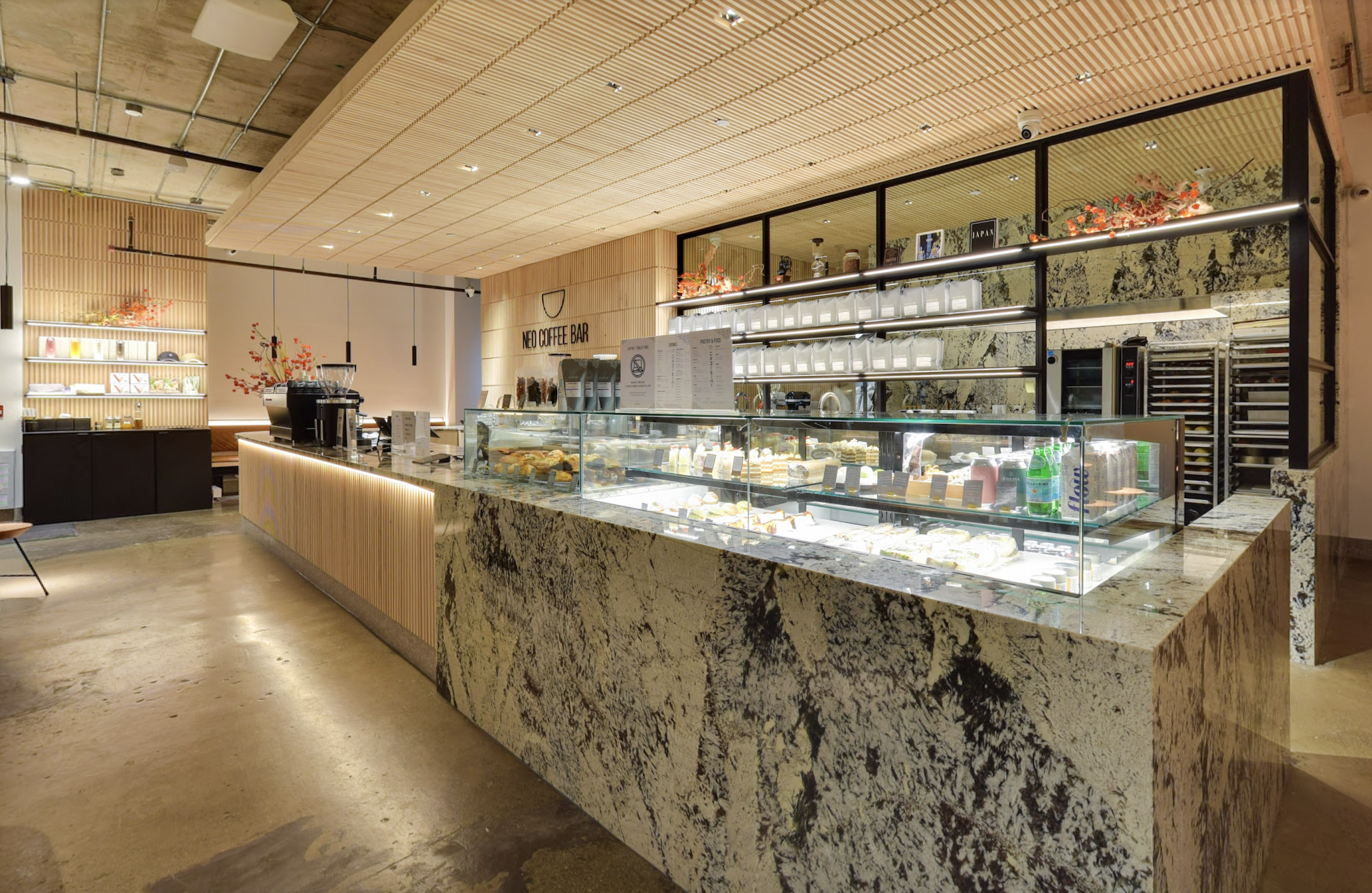
NEO Coffee Bar is celebrating 10 years of serving beverages and creating a vibrant gathering place rooted in craftmanship, care and community.
Since opening its first location in 2015, it has grown to five locations across Toronto, becoming a trusted destination for those seeking quality, intention and a moment of calm in the city. Known for its quiet design, precise preparation and thoughtful service, the brand has earned its reputation one cup at a time, said the company.
Alan De Luna
“In a fast-moving city, NEO Coffee Bar was created as a place to pause,” said Alan De Luna, Marketing Consultant at NEO Coffee Bar. “We’ve always believed in making space for intention – with our guests, our community and each other.”
Inspired by Japanese tea culture, the company said it offers drinks and desserts made with matcha, houjicha and yuzu. Each item reflects a quiet tradition – reimagined in its own way and served in a space designed to slow things down.
“We work with organic ingredients and take pride in doing things the right way – by hand, with care,” said De Luna. “Every drink and pastry reflect our commitment to craftsmanship, from how it’s made to how it’s presented.”
Its success is a testament to the dedication of its team and the loyalty of its customer. Every cup served represents a shared moment and a commitment to excellence, it added.
“As we mark this important milestone, we extend our gratitude to the team and community that made the first 10 years of NEO Coffee Bar possible,” said De Luna. “Looking ahead, we remain focused on sustainable growth and are committed to expanding our café presence across Canada with the same care and intention that have defined us since day one.”
Retail Insider is streamlining its Canadian retail news from around the web to include a handful of top news stories that can be viewed quickly during the day. Here are the top stories from the past 48 hours.
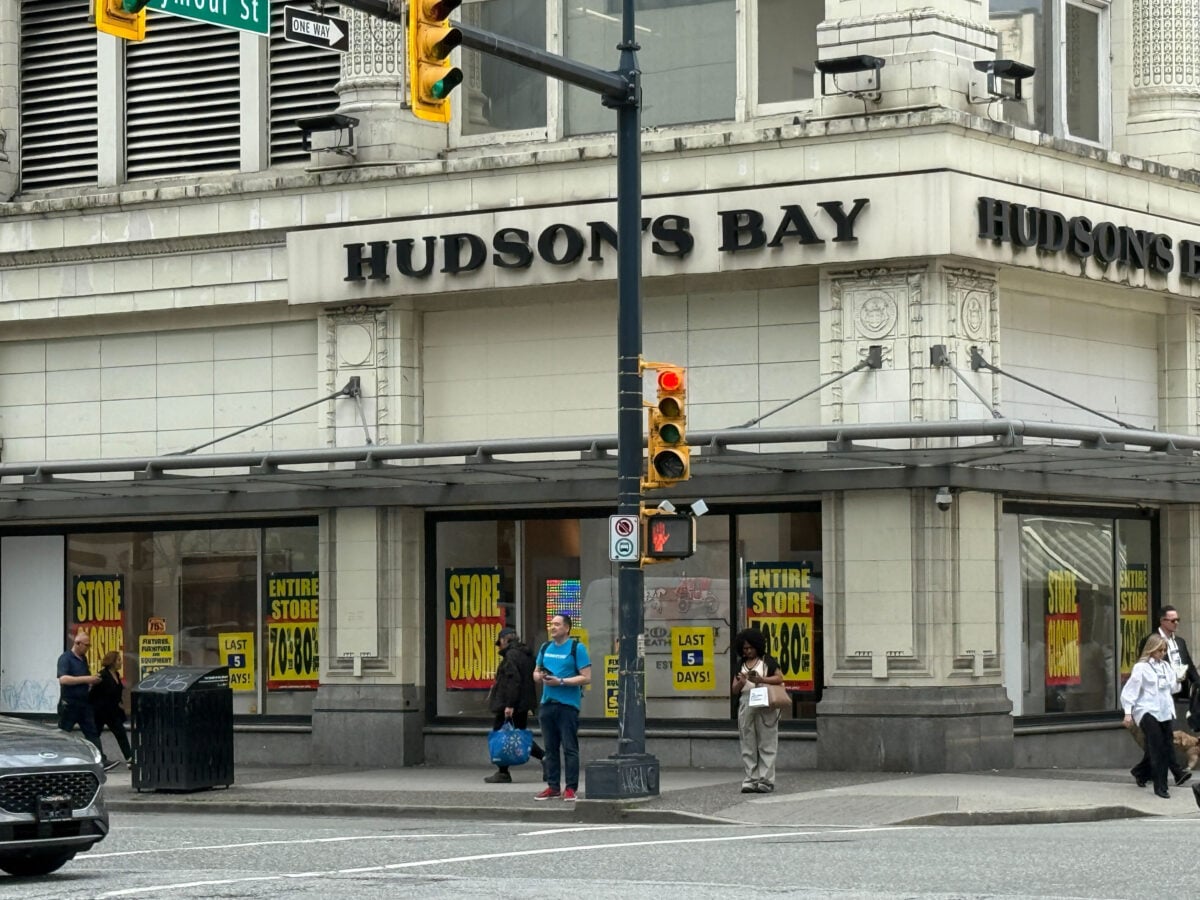
Signage outside the former Hudson's Bay flagship store in downtown Toronto, May 2025. Photo: Craig Patterson
*Update: On Wednesday, Retail Insider confirmed that ‘Rupert Legacy’ was a temporary placeholder name introduced on August 8, 2025. The former Hudson’s Bay Company and its subsidiaries are now operating under numbered company names.
Article from Tuesday:
The corporate entity that once operated the Hudson’s Bay department store chain has changed its name to Rupert Legacy, marking the latest step in the wind-down of one of Canada’s oldest retail institutions. The name references Prince Rupert, the first governor of the Hudson’s Bay Company (HBC), and Rupert’s Land, the vast northern territory over which the company once held a monopoly.
The rebrand follows the sale of the Hudson’s Bay name, trademarks, and several private-label brands to Canadian Tire Corporation for $30 million. That transaction was approved by the Ontario Superior Court earlier this year as part of HBC’s court-supervised liquidation process under the Companies’ Creditors Arrangement Act (CCAA).
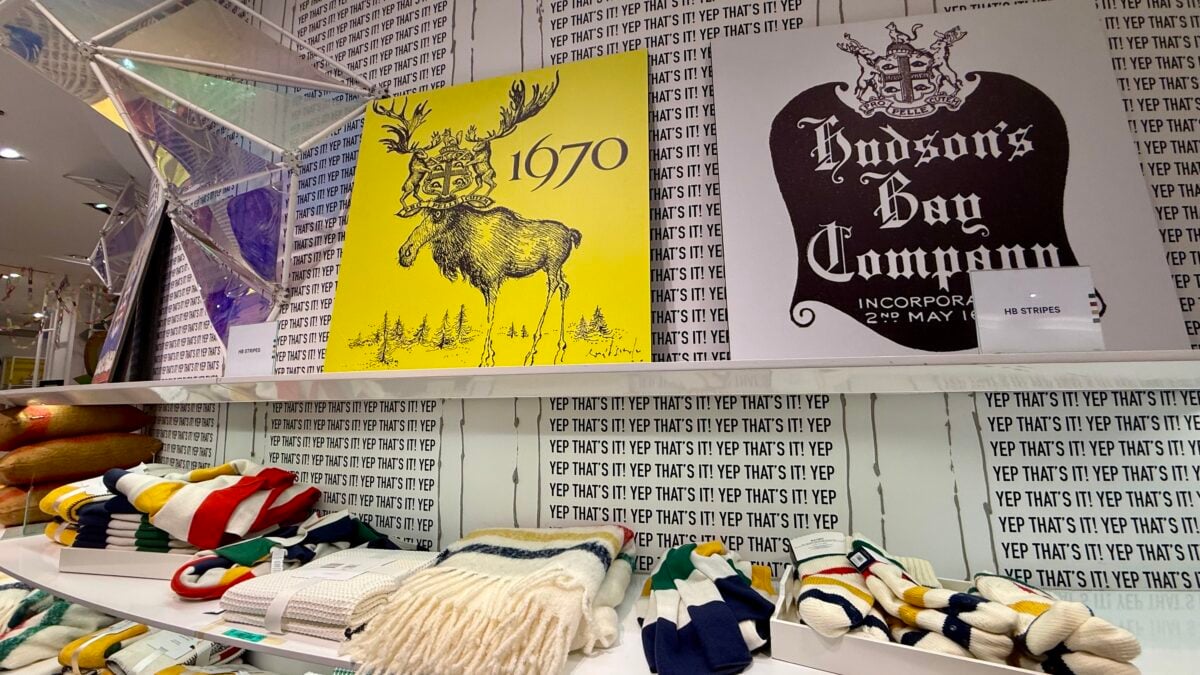
HBC, which had already shuttered all 80 Hudson’s Bay locations and its remaining Saks Fifth Avenue/OFF 5TH stores, was legally required to change its name after Canadian Tire acquired its intellectual property portfolio. The sale included the “Hudson’s Bay” and “The Bay” names, the multicoloured stripes motif, the historic coat of arms, and popular private labels such as Distinctly Home and Hudson North.
The deal also transferred ownership of well-known slogans, including “Bay Days” and the Zellers tagline “the lowest price is the law.” Canadian Tire’s acquisition gives it full control over the historic branding, while the corporate entity formerly operating the department store chain now proceeds under the Rupert Legacy banner as it sells off leases and prepares to auction its remaining art and artifacts.
Hudson’s Bay flagship store in downtown Vancouver on Wednesday, May 28, 2025. Photo: Lee Rivett
Canadian Tire’s Future Plans for the Brand
Canadian Tire has indicated it intends to preserve and potentially revive the Hudson’s Bay brand across its retail platforms. The company has described itself as a responsible steward of the historic name and will announce further plans later in 2025. While the precise format of any revival remains unclear, the acquisition provides the opportunity for Canadian Tire to integrate the brand’s heritage into its retail portfolio.
The Hudson’s Bay brand is among the most recognized in Canadian history, with roots dating back to the country’s early colonial era. Its visual identity, particularly the stripes motif, continues to hold significant nostalgic and cultural value, which Canadian Tire is expected to leverage in future merchandising and marketing strategies.
Hudson’s Bay stripe products at the Queen Street flagship store in Toronto on March 15, 2025. Photo: Craig Patterson
A Brand Steeped in History
The name Rupert Legacy recalls the 17th-century origins of HBC. In 1670, King Charles II granted a royal charter to “The Governor and Company of Adventurers of England, trading into Hudson’s Bay.” Prince Rupert of the Rhine, a cousin of the king, was named the first governor. The charter gave the company a trading monopoly over Rupert’s Land, an immense territory covering roughly one-third of modern-day Canada and parts of the northern United States.
For nearly two centuries, HBC controlled trade, governance, and exploration in Rupert’s Land, operating a network of trading posts and forts. The fur trade formed the backbone of its business, with beaver pelts serving as a unit of currency known as the “Made Beaver.”
In 1870, HBC sold Rupert’s Land to the newly formed Dominion of Canada under the Rupert’s Land Act, integrating the territory into Confederation. The company retained some trading rights and land but transitioned from governance to commercial retail operations, eventually evolving into the department store chain familiar to modern consumers.
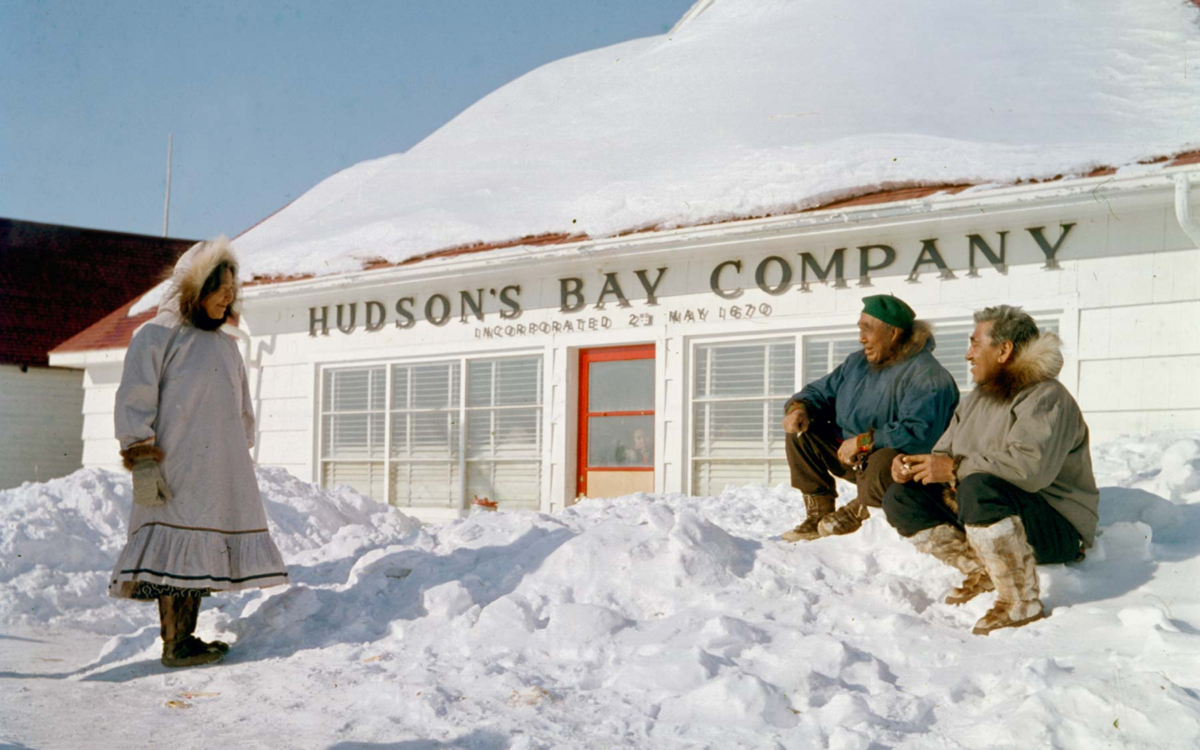
People talking outside the Hudson’s Bay Company post in Aklavik, NT, 1956.
(courtesy Library and Archives Canada/1971-271 NPC)
The End of a Retail Era
The closure of Hudson’s Bay stores this summer marked the end of an era in Canadian retail. Once considered a cornerstone of shopping in cities and towns across the country, the brand had faced years of declining sales, competition from international retailers, and the rapid growth of e-commerce. The CCAA filing in March 2025 triggered the largest department store liquidations in Canadian history, with significant impacts on employees, landlords, and suppliers.
The Rupert Legacy entity will continue to manage the remaining aspects of the wind-down, including the sale of store leases and the disposition of historical assets. These include a significant collection of art and artifacts that remain outside of the Canadian Tire transaction.
Looking Ahead
The future of the Hudson’s Bay brand now rests with Canadian Tire, which holds the rights to its name and trademarks. Industry observers will be watching closely to see whether the company chooses to launch new retail formats under the Hudson’s Bay banner or incorporate elements of the brand into its existing operations.
While the department store chain itself has vanished from Canadian streets, its legacy remains embedded in the nation’s commercial and cultural history. The adoption of the Rupert Legacy name ensures that, even in dissolution, the corporate entity reflects its origins in a business that shaped much of Canada’s early development.
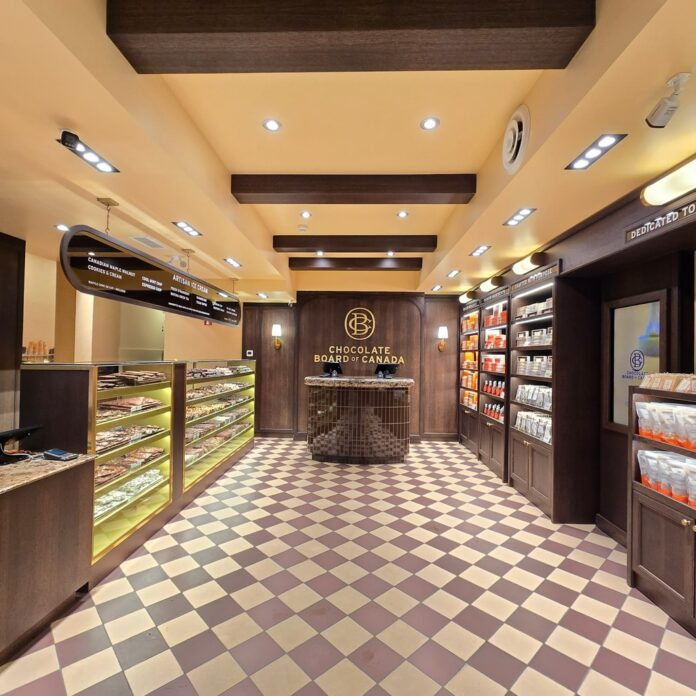
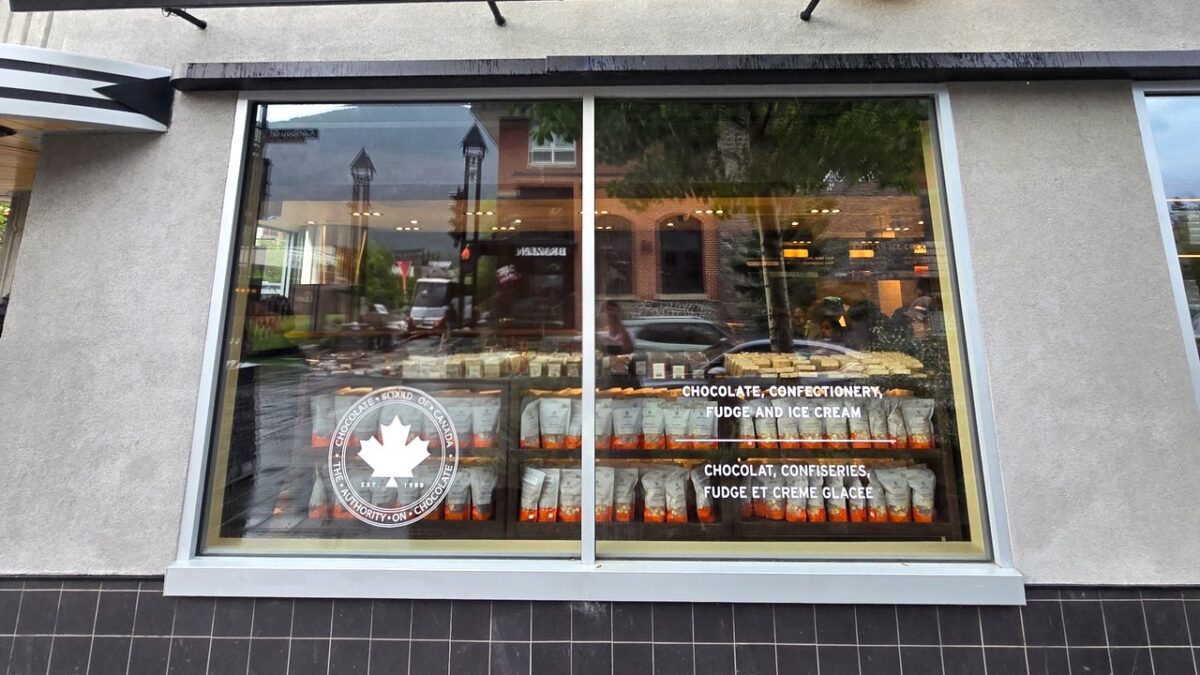
Chocolate Board of Canada storefront in Banff, Alberta. Image supplied
Rocky Mtn Chocolate, a Canadian favourite for nearly four decades, has launched an entirely new concept aimed at elevating the country’s chocolate experience. The new brand, Chocolate Board of Canada, opened its first location earlier this month in Banff, Alberta, marking a bold expansion for the family-owned company.
Located at 202 Banff Avenue in the historic Caribou Corner building, the flagship store occupies one of the most prominent retail corners in the mountain town. This same building once housed the first Hudson’s Bay Company store in Banff, which opened in 1935 and later relocated in 1947. For the Kerzner family, the symbolic location underscores the ambition behind their latest venture.
According to Ashton Kerzner, Chief Operating Officer of Rocky Mtn Chocolate Canada, the decision to introduce Chocolate Board of Canada stemmed from a desire to create something distinct from their well-known Rocky brand.
“We wanted to do something different in the chocolate space,” says Ashton. “Our history goes back to 1988 when my father Brian purchased the rights to operate in Canada, but we wanted to develop a brand completely separate from Rocky, something that speaks to our Canadian identity.”
The new brand embraces a more refined, chocolate-focused approach, moving away from the playful and sometimes quirky image associated with Rocky Mtn Chocolate. While caramel apples have long been a Rocky signature, Chocolate Board of Canada eliminates them entirely, concentrating instead on artisan chocolate creations.
Chocolate Board of Canada storefront in Banff, Alberta. Image supplied
The Name: Authority and Authenticity
The name, Chocolate Board of Canada, was not chosen lightly. “We hired several branding agencies, and when this name came up, Brian loved it right away,” recalls Tammi Kerzner, co-founder of Rocky Mtn Chocolate Canada. “With almost 40 years in the chocolate business, you learn everything about flavour, texture, and customer preferences. That expertise makes us an authority on chocolate, and that’s exactly what the name conveys.”
Tammi adds that the brand reflects distinctly Canadian tastes. “Every country has different profiles when it comes to chocolate. We wanted to stay true to Canadian flavours and create something that resonates with local consumers.”
Chocolate Board of Canada storefront in Banff, Alberta. Image supplied
A Statement Location and a Bold Design
The first Chocolate Board of Canada store makes a strong impression in Banff. Ashton explains that the team wanted a location that would turn heads. “It’s probably one of the best, if not the best, retail corner in Banff,” he says. “We wanted to make a statement with our new brand and create an experience unlike anything we’ve done before.”
To achieve that, the Kerzners hired a Vancouver-based design firm to craft a completely new visual identity. “The store looks nothing like a Rocky shop,” Ashton notes. “We designed everything from the ground up —finishes, colours, materials, so when you walk in, you immediately sense this is something different. It’s an elevated, immersive experience.”
The bold aesthetic choice extends to the packaging, where vibrant orange plays a starring role. “When orange was introduced, everyone hated it, except me,” laughs Brian Kerzner, the company’s co-founder. “Now, when you see people walking down Banff Avenue with bright orange bags, it makes a statement. It’s very different from the traditional, stoic image of chocolate retail.”
Inside the Store: A Canadian Experience in Every Detail
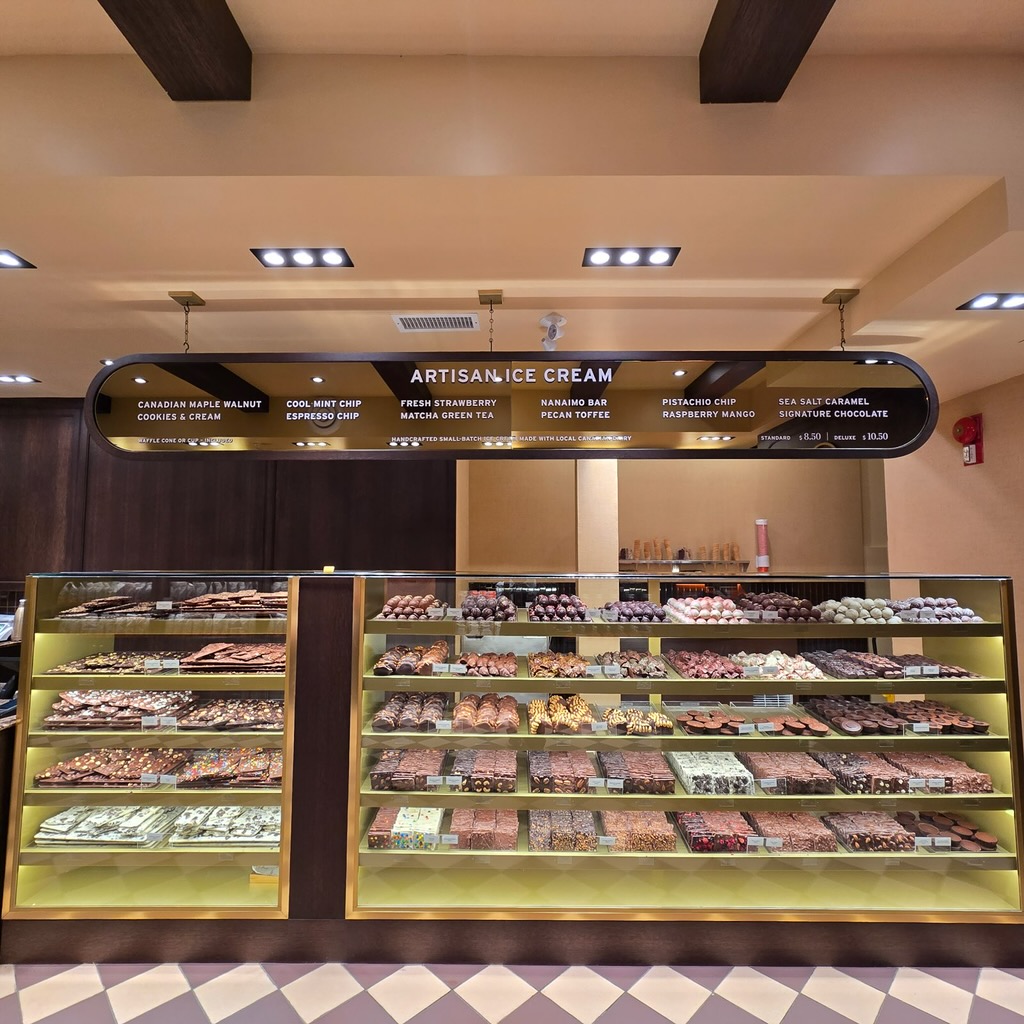
Beyond design, the Banff location reflects a deep commitment to Canadian craftsmanship. “Everything is Canadian,” says Tammi. “The aprons our staff wear are handmade in Canada, hand-riveted with leather accents. Our ice cream is made from Canadian dairy in small batches. Every detail is intentional.”
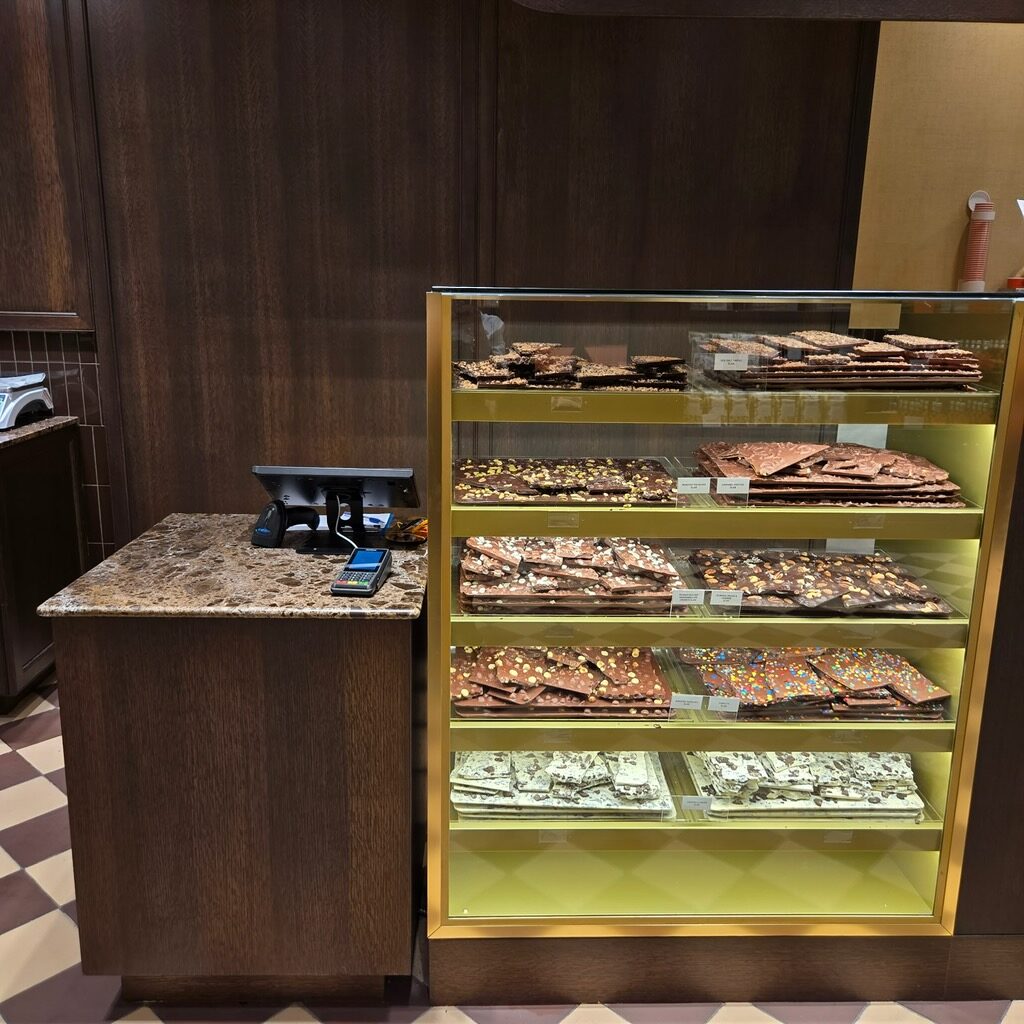
Chocolate production remains highly artisanal. “Every single chocolate is hand-dipped and hand-decorated,” explains Brian. “We have three tempering machines in the store so customers can watch our team create products in real time. Even items like fudge and caramel popcorn are made on-site.”
This emphasis on quality and transparency aligns with the brand’s ambition to offer a premium chocolate experience. “We wanted customers to feel like they’re stepping into an environment where every element is curated and authentic,” Ashton adds.
Chocolate Board of Canada storefront in Banff, Alberta. Image supplied
An Elevated Product Line
The product offering at Chocolate Board of Canada sets it apart from its sister brand. “Rocky’s personality is fun, quirky, and a little misshapen,” says Tammi. “This new line is more sophisticated. Ashton worked closely with our head chocolatier to develop unique flavour profiles that reflect Canadian preferences. It’s about giving customers something fresh, bold, and elevated.”
Gift assortments have been a major focus, with sleek packaging and premium finishes designed to appeal to travelers and gift-givers alike. “We even created a Canadian Collection gift box that highlights local flavours,” Brian says. “Every box has a soft-touch finish, custom stickers, and details that elevate the overall experience.”
Future Expansion: Airports and A-List Destinations
Although the concept is still in its infancy, early response suggests strong growth potential. “We didn’t expect it to take off this quickly,” admits Tammi. “The reception in Banff has been incredible, and it’s only been a few of weeks.”
The company has already identified its next location: Toronto Pearson International Airport. “We have a kiosk at the airport that’s scheduled for a complete redesign,” Ashton reveals. “It will become the second Chocolate Board of Canada store, likely by the end of this year.”
Beyond that, the team envisions rolling out the concept in other high-traffic, prestige environments. “We see this brand in major airports, premium urban streets like Robson in Vancouver, and A-list shopping centres,” says Ashton. “It’s not going to replicate the Rocky model in small towns. This is about select, statement locations.”
Display window at the Chocolate Board of Canada storefront in Banff, Alberta. Image supplied
Balancing Two Brands
With 47 Rocky Mtn Chocolate locations across Canada, the Kerzners have no plans to abandon their original brand. “Rocky will continue to thrive,” says Brian. “It has its own personality that is fun, approachable, and a little playful. Chocolate Board is something else entirely. It’s elegant, authoritative, and geared toward customers looking for a more elevated experience.”
This dual-brand strategy allows the company to cater to different consumer segments while leveraging decades of expertise. “Our goal isn’t to replace Rocky but to complement it,” Ashton emphasizes. “There’s room for both.”
A Canadian Brand with Global Ambitions?
When asked whether Chocolate Board of Canada could eventually go international, Brian remains focused on the immediate future. “Right now, we’re concentrating on making this concept as strong as possible in Canada,” he says. “We’ve built a brand in six months that’s resonating faster than we imagined. That’s exciting.”
For the Kerzners, the launch of Chocolate Board of Canada is more than a business move; it’s a statement about identity. “We wanted something that reflects who we are: Canadian, authentic, and passionate about chocolate,” says Tammi. “This brand does exactly that.”
With an expansive roster of brands and experiences, The Well has established itself as Toronto’s destination for discovery and connection.
The latest store openings promise to enhance its vibrant mix of tenants, infusing the property with even more unique immersive retail experiences. Whether guests seek leading fashion brands, innovative wellness concepts, or the best of Toronto’s food scene, the destination’s thoughtfully curated line-up inspires locals and visitors alike to come together to enjoy a space that unites culture, community, and commerce, according to The Well.
Anchored by the pedestrian-friendly Retail Walk, The Well blends global icons like Sephora and MUJI with Canadian favourites, including Lululemon, KIT + ACE, and Mine & Yours. The result is a shopping experience that feels fresh, inspiring, and uniquely Toronto, globally informed and locally rooted, it added.
Josh Katz
“Our focus has been on creating a thoughtfully balanced offering that resonates with Toronto’s diverse shoppers,” said Josh Katz, Assistant Vice President of Leasing at RioCan Real Estate Investment Trust. “By blending beloved international brands with top Canadian retailers, we’re offering variety and quality, ensuring visitors have a reason to return again and again.”
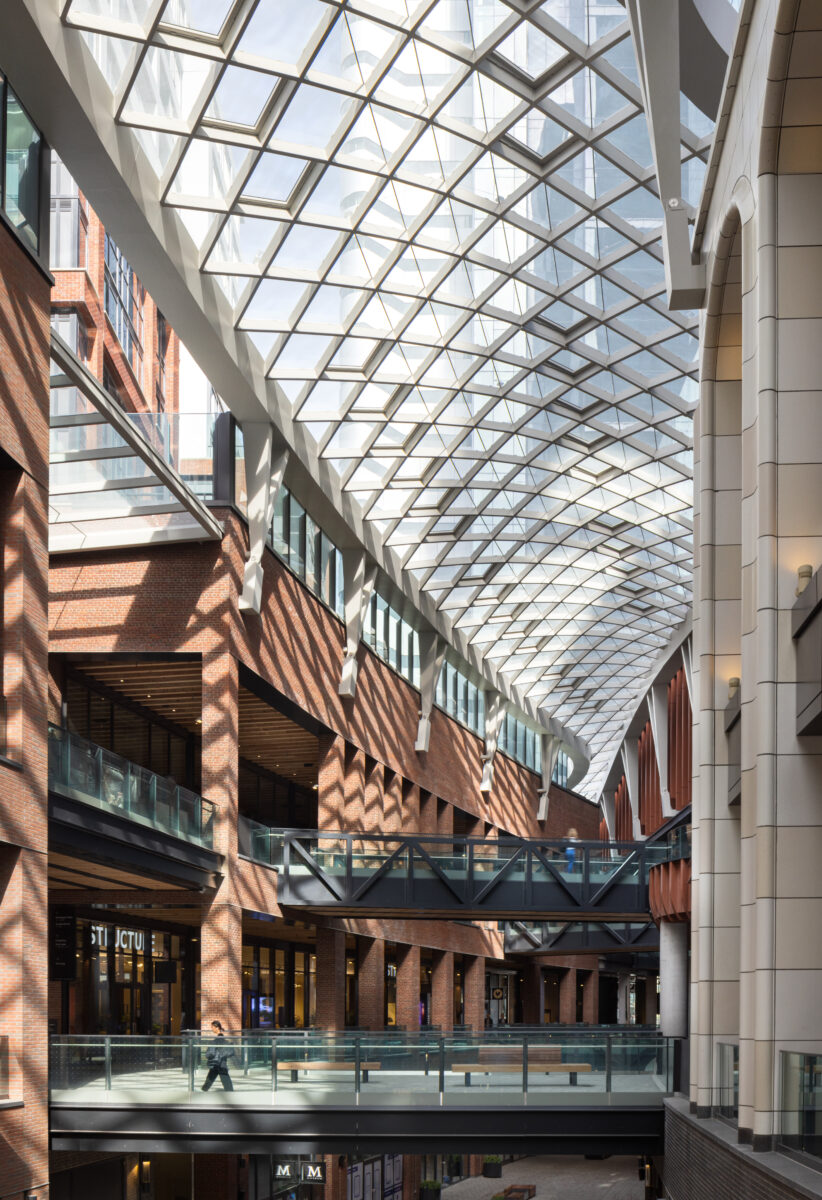
With natural light pouring through The Glass, The Well’s iconic canopy, the Retail Walk is bright, inviting, and enjoyable year-round. The experience at The Well is immersive, social, and evolving, offering something new to discover with each visit, it said.
The Well is a joint venture between RioCan and Allied, located at the gateway to Toronto’s downtown west – where the city’s top tourist attractions meet the vibrant King West neighbourhood. More than just a destination, The Well is a dynamic urban hub driven by a vision of togetherness. Located at the crossroads of Front, Spadina, and Wellington, it combines retail, commercial, and residential spaces in the heart of downtown Toronto. The Well attracts approximately 25,000 daily visitors, including around 11,000 residents and employees who live and work onsite. The property features 1.2 million square feet of office space and 320,000 square feet dedicated to retail and food service. It offers 1,700 residential units across six purpose-built rental and condominium buildings, along with one office tower connected to a three-level Retail Walk.
Recently opened retailers include:
KIT + ACE – Proudly Canadian, KIT + ACE crafts timeless technical fashion—sophisticated, versatile, and designed for comfort, empowering you to move through your day with confidence and ease.
MEN ZONE Barbershop – MEN ZONE Barbershop offers premium haircuts, precise beard grooming, and revitalizing treatments in a modern, stylish atmosphere by combining luxury and affordability.
Mine & Yours – Mine & Yours is Toronto’s go-to destination for authenticated pre-loved luxury fashion, blending sustainability with style by offering expertly curated designer pieces from brands like Celine and Louis Vuitton.
Moon Flower Reiki – Moon Flower Reiki is your spiritual sanctuary offering personal growth and well-being in a nurturing space.
REFORMD – Sweat and Tonic’s new concept studio, REFORMD, specializes in high-energy Lagree Method workouts with world-class instructors and immersive, state-of-the-art facilities.
Rodd & Gunn – Rodd & Gunn, a proud Kiwi brand from Auckland, crafts timeless, high-quality garments rooted in authentic sustainability. Celebrated globally, their classic collections combine superior craftsmanship with responsible production practices.
Source: The Well
This Fall, The Well will also welcome:
BlackToe Running (September Opening) – BlackToe Running, Toronto’s premier run specialty store, offers expert fittings, exclusive gear, and personalized service to runners of all levels. More than a retailer, Black Toe builds a vibrant running community through events, running clubs, training, and trusted expertise.
MUJI (September Opening) – Since 1980, MUJI has been a global destination for high-quality, everyday items that bring simplicity to everyday life. Spanning categories from home and fashion to wellness, all products reflect MUJI’s commitment to timeless design and affordable essentials.
Noyaa (October Opening) – High-end dining experience offering a Mediter-Asian menu put together by chefs from all over the world. Beautifully designed interior with an elevated second-level patio overlooking Wellington Street.
The new additions complement an already extensive and top-tier retail and lifestyle lineup at The Well, which includes Wellington Market, an evolved market hall offering a curated mix of restaurants, fresh market fare, and gourmet grab-and-go options.
Allied is a leading owner-operator of distinctive urban workspace in Canada’s major cities.
As of June 30, RioCan’s portfolio is comprised of 178 properties with an aggregate net leasable area of approximately 32 million square feet (at RioCan’s interest).
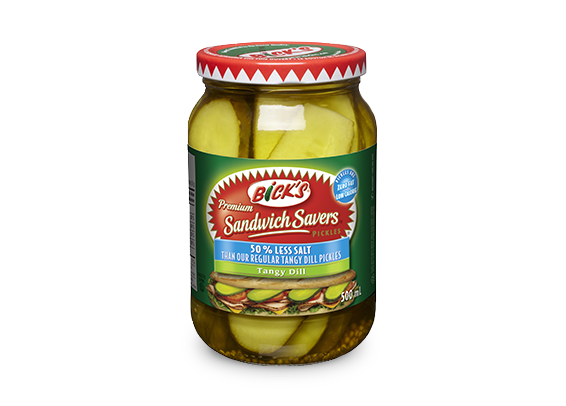
Since June, Bick’s pickles have been disappearing from some Canadian grocery shelves, caught in the crossfire of a tariff dispute that is exposing deep flaws in Ottawa’s trade strategy. The story of Bick’s is a telling case study in how well-intentioned policies can backfire, punishing consumers and domestic suppliers alike.
Bick’s was acquired by Smucker’s in 2011, and its Toronto production facility was shuttered soon after. Today, the brand is owned by TreeHouse Foods and manufactured in the United States. While the brand is no longer fully Canadian, parts of its supply chain remain here. The company still sources cucumbers from Canadian growers and lids from Canadian manufacturers. Under CUSMA, these raw cucumbers can cross into the U.S. without tariffs. Yet, once they are processed and jarred in U.S. plants, those same Canadian cucumbers return to Canada as Bick’s pickles—now subject to Canadian counter-tariffs. Other inputs sourced internationally for the U.S. facility may also be tariffed, further pushing up costs.
The economic outcome is predictable. Margins in grocery retail are razor-thin, often between two and four percent. Retailers cannot absorb steep cost increases without passing them along to consumers, and in some cases, they simply drop the product altogether. Sobeys appears to be the first major grocer to delist Bick’s, though it is unlikely to be the last. Counter-tariffs, often framed as a patriotic defense of domestic producers, can instead reduce competition, shrink consumer choice, and push retail prices higher. In practice, Sobeys has shifted shelf space to its own private-label pickles, which are often imported and carry higher profit margins. Ironically, the result is a product category that is now even less Canadian.
The policy flaw is glaring. Canada is effectively taxing products made with Canadian cucumbers and Canadian lids solely because they were processed across the border. This is not a protection strategy; it is an economic own goal. It illustrates how tariff structures can penalize integrated North American supply chains and undermine the competitiveness of Canadian companies.
Some may argue that TreeHouse should reopen a plant in Canada, but the economics of food processing make little sense for the company to shift production north. In reality, they may simply abandon the Canadian market altogether—a withdrawal that would further reduce competition and highlight Canada’s weaker position compared to the United States, a market of nearly 400 million affluent consumers.
The Bick’s case also highlights a broader reality: Canada’s food supply chains are structurally less flexible than those in the United States. When faced with tariffs or disruptions, American importers of Canadian goods can pivot quickly to alternative suppliers. Canadian importers, constrained by scale and options, have far less room to manoeuvre. The result is that even tariff-exempt Canadian products can lose shelf space and market share to foreign alternatives.
If Canada wants to avoid repeating this scenario, it needs to rethink its approach. Tariff policy should account for Canadian content and the realities of integrated cross-border supply chains. A jar of pickles made mostly from Canadian inputs should not be treated as a foreign product simply because final processing occurred in the United States. More importantly, Canada must reverse decades of decline in domestic food manufacturing. Without renewed investment in processing capacity, these vulnerabilities will only grow.
The Bick’s episode is not an isolated case; it is an early warning signal. Without a recalibration of trade and tariff policy, more products will quietly disappear from Canadian shelves, replaced by less Canadian alternatives, and consumers will pay more for the privilege. Ottawa may believe its counter-tariff strategy sends a message to Washington, but the message reaching Canadian households is far different: fewer choices, higher prices, and less Canada in the Canadian grocery cart.
Franchising in Canada is seeing steady and significant growth, with younger generations playing an increasingly vital role in the sector’s future.
“Franchising continues to grow in Canada,” said Sherry McNeil, President and CEO of the Canadian Franchise Association (CFA), in an interview with Retail Insider. “In 2019, it was an industry that generated $96 billion annually to the national GDP. And in 2025, the CFA is projecting that we will reach $133 billion. That’s quite an increase from 96 to 133 even during the time of the pandemic.”
Sherry McNeil
According to McNeil, franchising remained resilient throughout economic uncertainty. “Coming out of the pandemic, it was $120 billion to the GDP. So franchising continues to grow in this country and be a strong economic driver. Well, small business is the backbone of Canada, and franchisees are small business owners. So it’s very strong and it’s continuing to grow.”
When asked why franchising is on the rise, McNeil pointed to several trends: “Online search is up every time there’s an economic downturn. we saw online search increase fpr ‘own your own business,’ ‘own a franchise business,’ etc. during the pandemic. Every time there’s a recession or the thought of a recession or layoffs, we see people turn to wanting to change their life and have more control over their life in the future.”
That pursuit of control has driven more people to consider entrepreneurship.
“One of the opportunities that is available to them is to open a small business,” said McNeil. “So then they come to the decision, well, do I want to open my own small business or do I want to open a franchise business where I get the support of the franchisor? There’s a network of other franchisees who can support me, and then I’m in business for myself, but not by myself.”
That desire for support and structure is increasingly attractive to younger Canadians. “We are seeing that trend with Gen Z and millennials. We did a survey and they made up 52% of potential franchisees,” said McNeil. “Those groups or those categories of individuals (are) wanting to own their own business, but wanting the support of an existing system and a proven system to help them on their entrepreneurial journey.”
Community engagement is also central to the franchise model, according to McNeil. “There is a misconception often about franchisees. Franchisees are individual small business owners who live, work and contribute into their local economy. They’re not corporate employees,” she said. “They hire local people, they pay all the taxes, municipal, provincial, federal, but they also give back to their community and create those relationships.”
McNeil pointed to several examples: “M&M Meat franchisees have raised more than $450,000 to support BGC Canada, which is funding essential programs for children and youth. That’s raised at the franchisee level, in those local communities.”
Source: Ketut Subiyanto
Another standout example is Dairy Queen. “That brand has built a long-standing tradition of charitable giving, and they’ve raised over $52 million for Children’s Hospitals in Canada,” said McNeil. “They raised approximately $3 million one day every year called Miracle Treat Day. And so the proceeds from Blizzard sales actually are donated to the local Children’s Hospitals in that Children’s Miracle Network.”
Has becoming a franchisee become easier?
“I’m not sure that it’s become easier to become a franchisee, because brands all have their criteria for who they will award a franchise to,” said McNeil. “However, I would say that the profile of franchising has been raised a lot over the last number of years, and more and more people are becoming familiar with the franchise business model as an opportunity.”
That increasing awareness is supported by an expanding scope of franchise opportunities. “Franchising used to be in 50 segments or industry segments. It’s now over 60,” she said. “We’ve seen a big growth in fitness, health, and wellness. We’ve seen big growth in home services like landscaping, deck building, home inspection services, senior care services.”
When asked whether information and support are more accessible now, McNeil agreed: “Absolutely. So anybody who is looking or researching to buy a franchise, they can go on our website www.cfa.ca. They can look by investment level, by area, etc. I think there’s a greater ability to access resources than there was previously.”
She added, “More information is available to the public, also more information just in general that’s available through the internet and through AI.”
McNeil emphasized the importance of trust and ethics in franchising. “ I think it’s a great opportunity for people if they do want to open their own business. And the support system that the franchisors provide is amazing.”
Her parting advice? “Everybody should look for the logo. CFA members have signed our code of ethics and they do promise to practice ethical and best practice franchising. So that would just be something that I would mention to anybody who is looking and doing research on a franchise. Do your due diligence, make sure you like the brand, it’s a reputable brand, and that you look for the logo.”
Clutch, Canada’s fastest-growing online car retailer, has announced the opening of its first West Coast facility at 5400 Minoru Boulevard in Richmond, BC. The 30,500-square-foot location marks a significant milestone in its national expansion and will support its rapidly growing vehicle acquisition operations across British Columbia.
This move also marks a return to familiar ground as the company previously operated out of this same facility between 2021 and 2023. The reopening comes at a pivotal time as Clutch continues to experience record-breaking growth, having recently surpassed $1 billion in vehicles purchased directly from Canadians. The company now buys over $3 million worth of vehicles every day, reinforcing its position as Canada’s leading online car retailer, said the company.
The new Richmond facility will serve as Clutch’s operational headquarters for British Columbia, powering its vehicle inspection, reconditioning, and logistics capabilities throughout the province. It represents a key investment in the company’s vision to provide Canadians with a simpler, smarter way to buy and sell cars online from coast to coast, it said.
Dan Park
“Opening this new facility in Richmond represents a major step forward in our vision for Clutch and a clear sign of how far we’ve come,” said Dan Park, CEO of Clutch. “Our goal has always been to make buying and selling vehicles simpler and more transparent for all Canadians, and this expansion brings us closer to delivering that promise from coast to coast.”
Richmond facility details include:
Logistics & Operations Hub: The space will serve as Clutch’s base for transportation, storage, and operational support across the Lower Mainland and beyond.
Vehicle Evaluation & Certification: Every vehicle sold to Clutch undergoes a detailed 210-point inspection. Only the highest quality vehicles are selected for reconditioning, and those that meet Clutch’s strict national resale standards are awarded the Clutch Certified designation.
Aggressive Hiring Plans: The facility is built to support a growing team of 1,000+ employees over the next 2 years.
Currently, B.C. residents can sell their car to Clutch entirely online, receive a fair instant offer, and choose either a convenient home pickup or drop off their vehicle at our new Richmond retail hub. This expansion paves the way for Clutch to bring its full end-to-end buying and selling experience to the province in the near future, said the company.
Source: Clutch
Founded in 2016, Clutch is Canada’s leading online car retailer, transforming the way Canadians buy and sell pre-owned vehicles. Through clutch.ca, customers can browse thousands of high-quality vehicles and complete their purchase entirely online, including financing, insurance, and seamless home delivery. Every vehicle is Clutch Certified and backed by a 10-day money-back guarantee, meaning if customers don’t love it, they can return it, no questions asked. Headquartered in Toronto, the concept currently serves Ontario and Nova Scotia, with vehicle selling services also available in British Columbia, including both at-home pickup and drop-off at our Richmond retail hub.