In the fourth quarter of 2024, consumers perceived an improvement in their financial health relative to the previous quarter, mainly due to recent interest rate cuts and consumers’ expectation of further cuts ahead. This contributed to improved consumer sentiment, according to the latest Canadian Survey of Consumer Expectations – Fourth Quarter of 2024 released Monday by the Bank of Canada.
Key findings from the survey:
Fewer consumers reported that they are spending less or plan to reduce their spending; and, for the first time since 2021, people said they expect their spending to increase faster than they expect prices to rise. Still, consumers reported that the high prices of many goods and services, economic uncertainty and elevated housing costs continue to weigh on spending decisions.
Confidence in the labour market weakened in the fourth quarter and is now slightly below the survey average. Survey results show that young consumers and those with a high school diploma or less education perceived more weakness in the labour market than other respondents did. Expectations for wage growth remain unchanged from last quarter, still above where they were before the COVID‑19 pandemic.
Consumers’ inflation expectations have largely returned to historical norms. But perceptions of current inflation and the level of disagreement among consumers about where inflation is heading next year remain elevated.
Photo by Jonathan Borba
“In this survey, consumers perceived an improvement in their financial health, said the Bank in a news release. “Fewer consumers than last quarter reported that their finances had worsened over the past 12 months. In addition, more consumers said they see access to credit as easier than before, and more expect access to continue to improve.
“These positive developments, which are broad-based across both renters and homeowners, partly reflect recent interest rate cuts and consumers’ expectations of further cuts. In contrast, despite this general improvement in perceived financial health, the perceived risk of missing a debt payment increased. This is notably the case for renters, who, according to survey results, generally experience more affordability issues than homeowners. This result echoes the assessment last spring in the Bank of Canada’s Financial Stability Report—2024, when signs of increased financial stress appeared more concentrated among renters.”
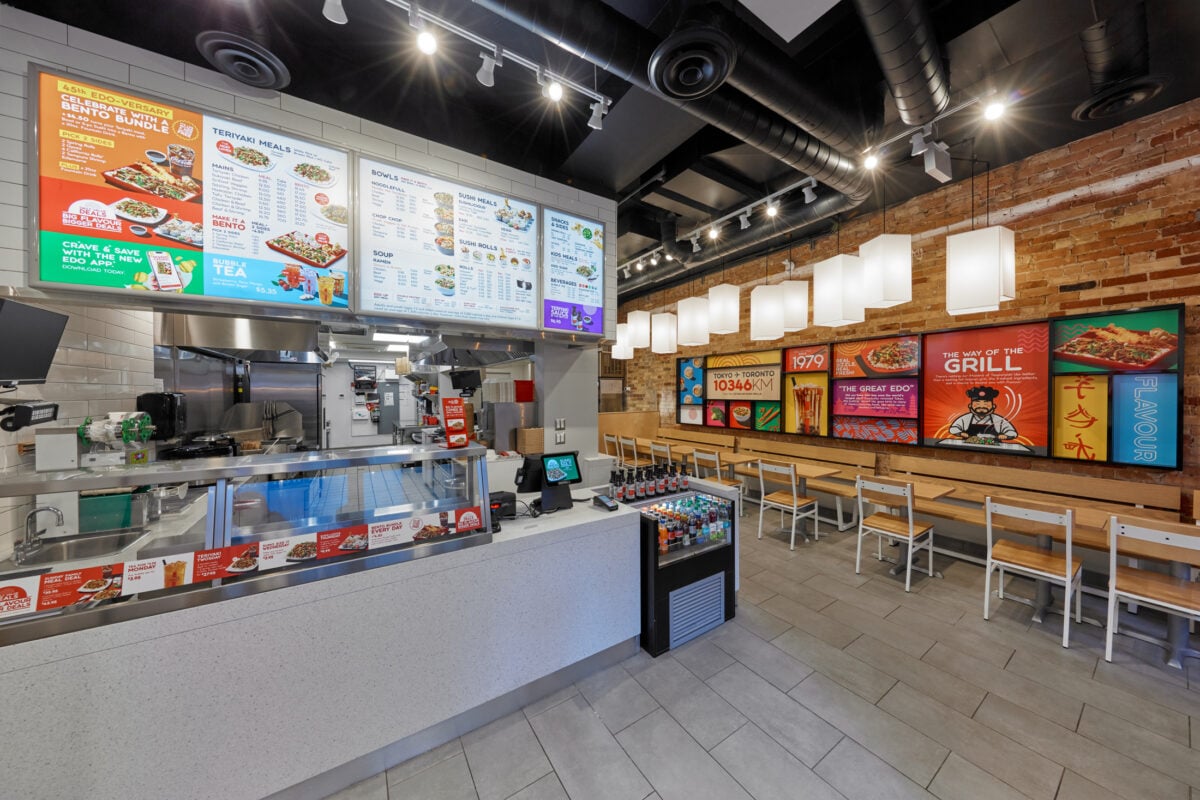
Edo Japan location on College Street in Toronto. Photo supplied
Edo Japan, one of Canada’s fastest-growing quick-service restaurant brands, is embarking on an ambitious expansion strategy aimed at reaching communities nationwide. With over 200 locations already operating and a market potential of quadrupling its current footprint, the brand is poised to redefine quick-service dining across the country.
“We are on a significant growth trajectory, particularly in parts of Canada where we’ve yet to establish a strong presence,” said Jeff Parkinson, Vice President of Real Estate Development at Edo Japan. “Historically, Edo has deep roots in Alberta, and we’ve done well in provinces like British Columbia, Saskatchewan, and Manitoba. A few years ago, we began expanding into Ontario, and now we’re looking to accelerate growth in that province, as well as enter new territories like Quebec and Atlantic Canada.”
Ontario, with its population of 13.6 million, represents a vast opportunity for Edo Japan. According to Parkinson, the company could eventually open several hundred locations in the province alone. In Atlantic Canada, Edo’s first location is under construction in Fredericton, New Brunswick, with negotiations underway for several additional sites.
“Our goal is to truly be a national brand, with a presence in every province,” Parkinson noted. “We recently celebrated the opening of our 200th store at Yonge and College in Toronto, and our vision is to exceed 300 stores nationally in the near future.”
New Opportunities for Franchisees
Edo Japan’s franchising model was initially designed to attract single-unit and small-scale franchisees, with operators typically managing one or two stores. However, the model quickly evolved as franchisees recognized its strong potential and experienced early successes. This led to a significant shift, with many franchisees expanding into multi-unit operations. The brand is now introducing a platform to attract more multi-unit franchisees, including opportunities for development agreements in defined territories.
“We’re launching a larger franchisee platform, which will allow partners to build 5, 10, or even 20 stores in designated areas,” explained Parkinson. “This initiative is targeted primarily at Quebec, Atlantic Canada, and Ontario. We’re confident it will attract growth-minded entrepreneurs who share our passion for expansion.”
The company’s support for franchisees is robust, offering turnkey solutions that include site selection, construction oversight, operational training, and ongoing marketing support. “Our franchisees are independent business owners, but they’re not alone,” Parkinson emphasized. “We provide the same level of support whether someone owns one store or ten.”
Edo has also been recognized for 14 consecutive years by the Canadian Franchise Association (CFA), an award that reflects the trust and admiration of its franchisees.
Diversified Restaurant Formats
Edo Japan is also evolving its restaurant formats to reach more diverse customer bases. While 25% of its locations are in mall food courts, 75% are now street-front stores. “We’re expanding into high-traffic downtown areas, like Yonge and College in Toronto, which represents a new frontier for us,” said Parkinson. “We’re looking to replicate this success in cities like Vancouver, Montreal, and Quebec City.”
In addition to urban centres, Edo Japan is targeting large power centres and primary shopping developments. “Our strategy is to capture high-traffic locations that drive walk-in sales, takeout, and delivery,” Parkinson said.
A Proven Business Model
Founded in Calgary in 1979 by Reverend Susumu Ikuta, Edo Japan built its reputation on freshly prepared meals made on a teppan grill. Over the decades, the brand has introduced innovations like sushi, bento boxes, ramen, and bubble tea, keeping its menu relevant to evolving consumer tastes. Its flagship teppan-style dishes, particularly the beef and chicken teriyaki remain top sellers, thanks in part to the signature teriyaki sauce that has made Edo famous.
“Our menu categories—teriyaki meals, ramen, sushi rolls, and bubble tea—are all experiencing strong growth in Canada,” Parkinson stated. “These offerings cater to multiple dayparts, making us a versatile choice for lunch, dinner, and snacks.”
Edo Japan’s small restaurant footprint (typically 1,200 to 1,300 square feet) and efficient operations make it an attractive investment opportunity. Initial capital investment ranges from $500,000 to $650,000, with franchisees benefiting from strong unit economics and manageable overhead costs.
The company’s loyalty programs, and innovative marketing strategies further enhance the customer experience. The “Edo App,” for example, offers online ordering, rewards points, and exclusive promotions.
Screenshot
Why Now?
Edo Japan’s 45th anniversary in 2024 marked a pivotal moment for the brand. “We’re a mature company with a proven track record,” Parkinson said. “We’ve learned a lot from our initial expansion into Ontario, and we’re ready to apply that knowledge as we grow into Quebec and Atlantic Canada. It’s the right time to make this leap.”
The brand’s growth is also driven by the increasing popularity of Asian cuisine in Canada. “Customers want fresh, flavorful, and globally inspired options,” Parkinson noted. “We’re perfectly positioned to meet that demand with high-quality meals prepared quickly and conveniently.”
Looking Ahead
With plans to reach over 600 locations in the coming years, Edo Japan is set to become a household name across Canada. “Our mission is to grow responsibly while seizing opportunities for both our franchisees and our customers,” Parkinson said. “We see ourselves as a truly national brand, and we’re excited about what’s to come.”
As Edo Japan continues to expand, it invites entrepreneurial franchisees to join its journey. “This is a ground-floor opportunity to be part of a brand that’s winning hearts across Canada,” Parkinson concluded. “The future is bright, and we’re just getting started.”
For those seeking franchise and real estate opportunites with Edo Japan, please visit: franchising.edojapan.com or connect with Jeff Parkinson, Vice President of Real Estate and Construction on LinkedIn.
The City of Leduc, just minutes south of Edmonton, is emerging as a premier location for retail and foodservice investment. With a rapidly growing population, strategic infrastructure investments, and a streamlined permitting process, the city offers unique advantages to businesses looking to establish a foothold in Alberta.
“We’re seeing unprecedented growth and interest from developers and investors,” says Tara de Munnik, Manager of Economic Development for the City of Leduc. “Leduc is the ideal place to bring your business dreams to life.”
Population Growth Driving Demand
Leduc’s population has seen a 9.2% increase from 2019 to 2023, and the city’s Housing Needs Assessment projects it will surpass 40,000 by 2029. The Edmonton Metropolitan Region Board estimates the population could grow to as much as 68,000 by 2044.
“This growth reflects the desirability of Leduc as a place to live and work,” says the City’s Mayor Bob Young, “With an average age of 36.8, we’re a young and vibrant community that’s attracting families and professionals.”
This influx of residents is creating new opportunities for retail and foodservice businesses to meet the needs of the growing population. “Our residents are hungry for more options, and we’re eager to work with businesses ready to fill that gap,” de Munnik adds.
Leduc sign. Photo: Explore with RKB/Youtube
Retail and Foodservice on the Rise
Leduc’s growing population and proximity to Edmonton create opportunities for retail and foodservice businesses. Local satisfaction surveys reveal that 88% of businesses rate the city as an excellent place to operate, while 43% have been established for over a decade.
“Our community supports local businesses, and the demand for new retail and dining options is clear,” de Munnik says. “Leduc is ready for fresh concepts and established brands looking to expand.”
Beyond Retail: Diverse Investment Opportunities
While retail and foodservice are key sectors, Leduc’s potential extends to industrial and commercial projects. The city’s business parks, including the new Leduc Landing, are primed for development.
“These areas offer great potential for light industrial and logistics businesses,” says de Munnik. “With our infrastructure and location, Leduc is well-suited to support a range of industries.”
Connectivity is another advantage. The city’s TELUS PureFibre network provides state-of-the-art internet services, ensuring businesses remain competitive in a digital-first world.
Leduc Business Park. Photo: City of Leduc
Fast Permitting Speeds Up Development
One of Leduc’s standout features is its commitment to an efficient and effective permitting process, which averaged just 3.2 days in 2024 for development permits. This remarkable speed is a significant advantage for developers and businesses seeking to minimize delays and costs.
“Our fast-track permitting process is one of the best in the region,” says Dennis Peck, Manager of Planning and Development for the City of Leduc. “We’ve reduced red tape without compromising quality. Developers can count on us to keep their projects on schedule.”
This efficiency ensures that both large-scale projects and smaller ventures can proceed with confidence. “When permitting delays are avoided, businesses can open their doors sooner and start generating revenue,” adds Peck. “It’s all about creating and supporting an environment where businesses can thrive.”
Strategic Location for Logistics and Distribution
Leduc’s proximity to Edmonton International Airport (YEG), Canada’s largest airport by landmass and fifth busiest by passenger traffic, gives it a competitive edge in logistics and distribution. Recent investments of over $300 million in cargo development at YEG further enhance its status as a hub for multi-modal transportation, providing seamless access to Canada, the U.S., and Mexico.
“The airport is a cornerstone of our economic strategy,” de Munnik notes. “Businesses located in Leduc benefit from year-round, uncongested operations and direct connections to international markets.”
In addition, the CANAMEX Highway offers direct access to major trade corridors, making Leduc an ideal location for businesses reliant on efficient goods transportation.
Photo: City of Leduc
Infrastructure Investments Unlock Potential
The 65th Avenue Interchange, a $112-million project co-funded by the City of Leduc and the Government of Alberta, is set to open in 2025. This transformative project will enhance connectivity to Leduc Landing, a new development area poised for residential, commercial, and light industrial growth.
“This is not just an infrastructure project—it’s an economic catalyst,” explains de Munnik. “Leduc Landing will provide exciting new opportunities for businesses to establish themselves in a prime location.”
Cost Advantages Over Edmonton
Leduc offers significant financial incentives compared to nearby Edmonton. Industrial land in Leduc is up to $300,000 cheaper per acre, and the city boasts one of the lowest non-residential tax rates in the region.
“Our affordability is a major draw,” says de Munnik. “Lower land costs and taxes mean businesses can allocate more resources to growth and operations.”
Additionally, Alberta’s corporate tax rate is the lowest in Canada, further solidifying Leduc’s status as an attractive destination for investment.
Photo: City of Leduc
A Place to Live, Work, and Prosper
Leduc offers an exceptional quality of life, combining business opportunities with vibrant community living. Residents enjoy over 80 kilometres of manicured multiway trails for walking, cycling, and outdoor activities. Year-round entertainment options include festivals, seasonal markets, and cultural events, while world-class facilities like the Leduc Recreation Centre provide sports, fitness, and theatre experiences.
Leduc’s housing market offers excellent value, making it an attractive option for employees and families. The average price of a single-detached home is $417,500—significantly more affordable than larger urban centres. Coupled with a median household income of $117,000, residents enjoy a high standard of living and financial stability.
“Leduc offers an exceptional quality of life,” says Mayor Young. “Whether you’re relocating key employees or establishing your business, this is a community where everyone can thrive.”
Photo: City of Leduc
Building Awareness for the Future
To attract more investors, Leduc’s economic development team is leveraging platforms like the International Council of Shopping Centers (ICSC) events to network with brokers, retailers, and developers.
“We’re focused on building awareness of what Leduc has to offer,” de Munnik says. “From our strategic location to our business-friendly environment, there’s a lot to share with prospective investors.”
For those seeking investment opportunities in Alberta, Leduc presents a compelling case. From its streamlined permitting process to its growing population and strategic location, Leduc is truly a city of opportunity.
For more information on the City of Leduc, visit: www.leduc.ca
For more information on economic opportunities in the city, contact Tara de Munnik, Manager of Economic Development for the City of Leduc, at: tdemunnik@leduc.ca
“Back then, our vision was simple: bring a piece of Japan’s pub culture—where friends come together over small plates and vibrant conversation—to Canada,” said De Luna. “Today, we’re proud to have nearly 54 restaurants in operation, making us the most significant Japanese restaurant group in the country. Through it all, we’ve remained dedicated to serving authentic Japanese flavours, fostering warm hospitality, and creating spaces where communities can come together.
“A significant key to our success lies in the passionate staff who power our kitchens and dining rooms. Many come from Japan, sharing the traditions and techniques that make Japanese cuisine so beloved. Working side by side with Canadian colleagues, they infuse each restaurant—be it one of our casual Izakaya, our upscale JaBistro, or one of our many KintonRamen locations—with genuine energy and expertise that guests can taste in every bite.
“Kinton Ramen is expanding faster than ever. In the near future, we’ll be opening three more restaurants in Calgary, two in Victoria, and two in Edmonton, along with four additional locations across Ontario. Each new spot reflects our commitment to introducing people to the comforting, traditional dishes of Japan and building lively neighbourhood hubs in the process.
“We also collaborate with esteemed Japanese brands like Uniqlo and Sapporo to keep our experiences fresh and engaging, though our popular BOGO (buy-one-get-one) deals are all our own—one way we show gratitude to our guests for their ongoing support.”
There are three Izakaya’s in Toronto, one JaBistro in Toronto which recently turned 12 years old and 50 Kinton Ramens.
De Luna said his personal mission statement this year is “to celebrate Japanese culture and unite local communities through vibrant, authentic flavours—making every meal feel like a thrilling step into Japan.”
He said in Japan Izakaya’s are cozy spots where people unwind to share their stories and enjoy small plates together. KINKA wanted to bring that same welcoming vibe to Canada.
“We have grown to the country’s largest Japanese restaurant group with each brand offering its own distinct taste of Japan,” explained De Luna.
For example, when a customer enters Izakaya there’s always a greeting and it specializes in sake bombs – a glass of beer with two chop sticks and on the top there’s a sake shot with servers who start singing at the table until the shot falls into the beer.
“Much of our success comes from the amazing Japanese staff members who joined our team over the years. They’re not only experts in their craft, be it in sushi preparation, ramen making, or providing a warming welcome, but also serve as cultural ambassadors,” added De Luna.
“When they work side by side with Canadian team members, it creates this special energy in the kitchen and in the dining room. You can really feel the passion they have for sharing authentic Japanese flavours and traditions.”
De Luna said something consistent throughout all the company’s brands is the quality of food.
“Kinton Ramen is our biggest star and continues to expand like crazy. We’re heading into new markets. We’re entering this year into Manitoba and Alberta.”
The company is also expected to open in Winnipeg with more expansion to come this year.
The Izakaya and JaBistro brands are in a very competitive space. He said KINKA is focused right now on how to continue to make them attractive for clients while also sustaining the growth for Kinton Ramen which for now is the company’s priority.
When Donald Trump threatened to impose a 25% tariff on Canadian imports, the reverberations across Canada’s business community were immediate. While much of the discourse focused on traditional sectors like oil, gas, and automotive, one critical group was left out of the conversation: small online retailers. These businesses, which often rely on cross-border sales to thrive, are uniquely vulnerable to such economic shocks.
“Small businesses don’t have the luxury of large cash reserves or diversified supply chains,” explained David Nagy, retail expert and founder of eCommerce Canada. “When tariffs hit, they feel the pinch much faster than big corporations, and the impacts can be devastating.”
David Nagy, founder of eCommerece Canada
Online Retailers and Cross-Border Dependence
Canada’s small online retailers are particularly susceptible to tariffs because many of them operate as “pure play” online businesses, meaning their sales channels are entirely digital. These businesses are naturally export-oriented, with the United States often accounting for a significant percentage of their revenue.
Take a Canadian online shapewear brand that has grown rapidly over the past few years. “With much of their revenue tied to U.S. customers, a tariff like this could be catastrophic,” said Nagy. Without brick-and-mortar stores to cushion the blow, businesses like this one face stark challenges.
The Digital Advantage—and Vulnerability
Unlike their brick-and-mortar counterparts, online retailers are inherently export-ready. The internet eliminates geographical boundaries, allowing small businesses to reach customers worldwide. However, this advantage comes with its vulnerabilities.
“When most of your revenue depends on shipping to the U.S., a 25% tariff doesn’t just sting—it freezes your export market altogether,” noted Nagy. “For some businesses, 20-30% of their revenue could vanish overnight.”
While large companies can weather such storms by pivoting to other markets or absorbing short-term losses, small businesses don’t have that luxury. “Big corporations have deep pockets and the ability to pause production or shift focus,” said Nagy. “Smaller businesses? They’re forced to make tough decisions like cutting jobs or scaling back operations immediately.”
Practical Solutions for Small Businesses
Despite the challenges, small online retailers can take several steps to mitigate the impact of tariffs. These strategies can help businesses adapt and build resilience in an increasingly unpredictable global market.
1. Diversify Export Markets
Expanding into new international markets can reduce dependency on the United States. While building a customer base in countries like Japan, South Korea, or the United Kingdom takes time and resources, it can provide a lifeline during trade disruptions.
“You don’t just wake up one day and decide to start exporting to Europe or Asia,” Nagy acknowledged. “Building new markets takes time, resources, and expertise. But even small steps—like researching demand in target markets or setting up localized websites—can make a difference.”
2. Invest in Digital Transformation
Technology can play a critical role in helping small businesses expand their reach and streamline operations. For instance:
Localized Websites: Creating versions of a website in multiple languages, tailored to different regions, can attract international customers.
Search Engine Optimization (SEO): Targeting keywords specific to new markets can help increase visibility in global search results.
E-commerce Platforms: Leveraging platforms like Shopify Plus or BigCommerce can make it easier to manage cross-border sales.
“The tools are there,” said Nagy. “From creating multilingual websites to using social media for global outreach, small businesses can build international customer bases more easily than ever before. But they need to act now.”
3. Build Stronger Supply Chain Relationships
Smaller businesses can mitigate risks by diversifying their suppliers or working with logistics providers that specialize in cross-border shipping. Partnering with third-party logistics (3PL) companies can also help reduce shipping costs and improve efficiency.
“Having a robust supply chain is crucial,” Nagy emphasized. “For smaller businesses, this might mean finding suppliers in tariff-free zones or negotiating better terms with existing partners.”
4. Leverage Trade Resources and Programs
Canada’s government and trade organizations offer resources to help businesses navigate international markets. Programs like the Trade Commissioner Service (TCS) and Export Development Canada (EDC) provide guidance, financing, and market intelligence.
“Many small business owners aren’t aware of the resources available to them,” Nagy noted. “Accessing these programs can make it easier to explore new markets or adapt to changing trade policies.”
Tariffs and the Broader Economic Impact
The potential ripple effects of these tariffs extend beyond individual businesses. Small businesses are Canada’s largest employers, contributing significantly to the economy. A sharp downturn in this sector could result in widespread job losses and a weakened retail landscape.
“If you consider that small businesses employ millions of Canadians, the cumulative impact could be enormous,” Nagy emphasized. “It’s not just about the businesses themselves; it’s about the livelihoods they support and the communities they serve.”
A Call to Action
The looming threat of tariffs should serve as a wake-up call for small online retailers. “This is the moment to invest in digital transformation and market diversification,” said Nagy. “If businesses wait until tariffs are implemented, it may be too late.”
Government support is also essential. Policies that provide financial aid, training programs, and trade advocacy for small businesses could help them navigate these turbulent times. “We need a proactive approach,” Nagy urged. “Negotiation should be the focus, not retaliation. The future of Canadian small businesses depends on it.”
Conclusion: Building Resilience for the Future
The potential impact of U.S. tariffs on Canadian imports is a stark reminder of the vulnerabilities faced by small online retailers. While larger companies may have the resources to weather the storm, smaller businesses must act quickly to adapt.
“Let this be a catalyst for change,” Nagy concluded. “We can’t afford to be flat-footed. By embracing digital tools and expanding their reach, small businesses can not only survive but thrive in an increasingly unpredictable global market.”
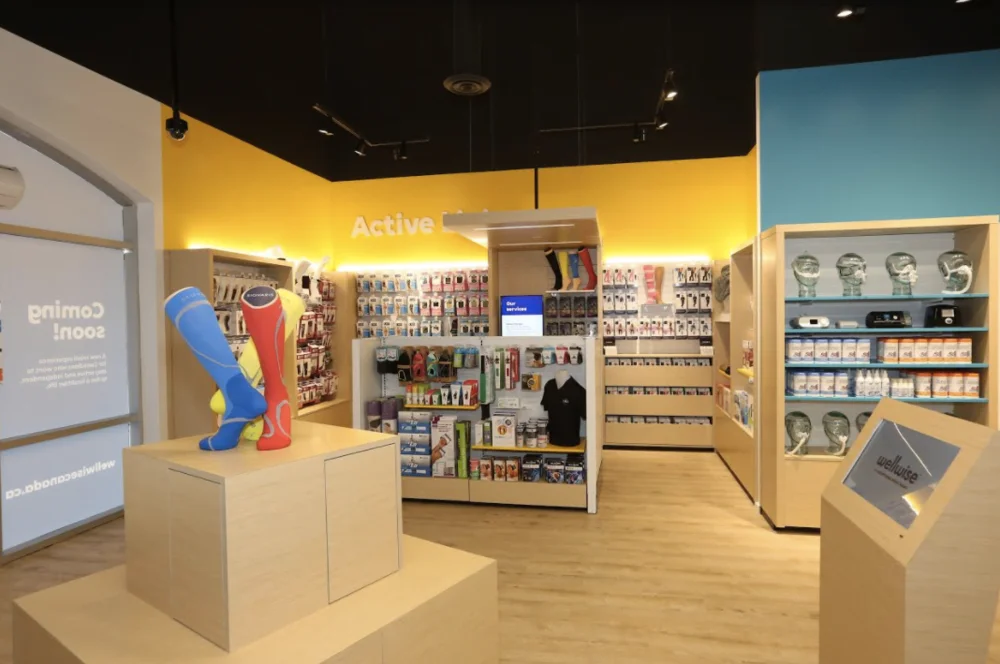
Wellwise store. Photo: Wellwise/Shoppers Drug Mart
Loblaw Companies has announced the sale of its 42 Wellwise by Shoppers stores to Verillium Health Care, a Toronto-based investment firm specializing in healthcare services. The strategic decision reflects Loblaw’s ongoing focus on its pharmacy business, including its extensive Shoppers Drug Mart network. The deal, announced Tuesday, will transfer the Wellwise brand to Verillium, which aims to expand its offerings in the active living and healthcare retail space.
Wellwise by Shoppers: A Growing Brand Since 2017
Loblaw launched Wellwise by Shoppers in 2017 as a pilot project, aiming to serve the growing needs of aging Canadians. Unlike traditional medical supply stores, Wellwise introduced a more inviting retail environment with brighter lighting, colourful signage, and an emphasis on categories like “active living” and “mobility.” Retail Insider first reported on Wellwise in September of 2017 when it launched.
The Wellwise concept was a rebranding effort that evolved from Loblaw’s earlier Home Health Care chain. While the Home Health Care stores focused on clinical needs, Wellwise provided a wider variety of products, such as aromatherapy oils, light exercise weights, puzzles, and games. This shift was designed to align with the lifestyles of active seniors who sought to maintain their independence.
A Strategic Move for Loblaw
Loblaw’s decision to sell the Wellwise brand aligns with its broader strategy to refine its focus within the healthcare sector. In recent years, Loblaw has made significant investments to expand its health-related businesses, including:
Telemedicine: In 2020, Loblaw acquired a minority stake in Maple Corp., a Toronto-based telemedicine provider, for $75 million.
Physiotherapy and Wellness Services: In 2022, Loblaw acquired Lifemark Health Group for $845 million. Lifemark operates over 300 clinics offering services such as physiotherapy, massage therapy, and mental health support.
The sale of Wellwise follows other divestitures in Loblaw’s healthcare portfolio. These include the 2022 sale of two Beauty Clinic locations and the transfer of 10 Health Clinic by Shoppers family-care practice locations to Well Health Clinic Network Inc.
Image: Wellwise by Shoppers Drug Mart/Loblaw Companies
Verillium Health Care: A New Era for Wellwise
Verillium Health Care, a private investment firm based in Toronto, specializes in acquiring and operating healthcare businesses across North America. Its portfolio includes pharmacies, senior care facilities, diagnostic imaging centres, and medical supply businesses.
Verillium targets acquisitions between $2 million and $10 million, with companies earning a minimum of $450,000 in EBITDA. The terms of the Wellwise deal were not disclosed, but the transaction is expected to close in early 2025. Until then, Shoppers Drug Mart will continue operating the stores.
Wellwise’s Impact on Aging Canadians
The Wellwise model has resonated with a growing demographic of active seniors seeking products and services that support healthy lifestyles.
With categories like mobility aids, wound care, and incontinence products reimagined for a more consumer-friendly experience, Wellwise carved out a niche in the healthcare retail market.
Loblaw’s Commitment to Pharmacy Growth
Loblaw remains Canada’s leading pharmacy retailer, with more than 1,350 Shoppers Drug Mart locations across the country. By divesting Wellwise, the company is doubling down on its pharmacy operations and related services. This includes enhancing its health ecosystem through investments in telemedicine and clinical wellness services, reflecting a strategic pivot towards healthcare innovation.
This week, Hershey quietly announced the discontinuation of Cherry Blossom, a cherished chocolate treat and, in essence, a Canadian icon. While the news has been met with a mix of nostalgia and indifference, the end of Cherry Blossom marks yet another chapter in the ongoing challenges facing food manufacturing in Canada.
Cherry Blossom’s story is deeply rooted in Canadian history. First produced in the 1890s by the Walter M. Lowney Company in Sherbrooke, Quebec, it was a proud Canadian invention. In 1989, Hershey Canada acquired the Lowney brand, moving production to its Smiths Falls, Ontario facility. Featuring a cherry in syrup surrounded by peanuts and chocolate, Cherry Blossom offered a distinctive taste that resonated with generations. However, when the Smiths Falls plant closed in 2012, production shifted to the United States. The move signaled the beginning of the end for the candy’s Canadian identity.
Declining Demand and Changing Consumer Preferences
Hershey did not provide a detailed explanation for discontinuing Cherry Blossom, but the likely culprit is declining demand. Over time, Cherry Blossom became a relic, fondly remembered but seldom purchased, particularly by younger Canadians. For many, it was the candy their grandparents enjoyed, not a treat they would buy for themselves. The brand’s inability to attract new generations of consumers sealed its fate.
This underscores a critical issue: food manufacturing in Canada is at a crossroads. The loss of iconic brands like Cherry Blossom reflects a broader trend. If Canadian food manufacturers fail to remain competitive, they risk losing not only market share but also the cultural significance that makes their products unique. Cherry Blossom’s demise is a reminder that even longstanding traditions cannot survive without innovation and adaptability.
Canada’s Resilient Confectionery Industry
The confectionery industry is fiercely competitive, yet Canada has a proud history of producing beloved chocolate bars. Coffee Crisp, Aero, Caramilk, Big Turk, Oh Henry!, and Wunderbar continue to represent the diversity and creativity of Canadian confectionery. These treats have stood the test of time, but their survival is not guaranteed. Brands today must navigate a complex landscape shaped by evolving consumer preferences, social media trends, and health-conscious demands.
Cherry Blossom’s decline was further hastened by changes to its formulation. Over the years, its size shrank to 45 grams, and the texture and flavor evolved, leaving some long-time fans disappointed. Additives like Red Dye No. 3 also made the product less appealing to health-conscious consumers. While Cherry Blossom was never marketed as a health food, indulgence treats today face increased scrutiny.
Interestingly, some global chocolate brands, such as KitKat, Aero, and Caramilk, are still manufactured in Canada. Nestlé’s Toronto plant and Cadbury’s facilities continue to produce these favorites, showcasing the potential of Canadian food manufacturing when supported by robust demand and strategic investment. However, even these products are not immune to market pressures.
Could Cherry Blossom Make a Comeback?
The question remains: could Cherry Blossom be saved? Perhaps a Canadian entrepreneur or company could revive the brand, bringing production back to Canada and reinvigorating its nostalgic appeal. Yet, without a concerted effort to prioritize food manufacturing, other iconic brands may meet the same fate. Food manufacturing in Canada must be viewed not just as an economic activity but as a cornerstone of national identity.
The end of Cherry Blossom may seem trivial—it is, after all, just a candy. But it serves as a poignant reminder of the challenges facing Canada’s food industry. If we value the cultural and economic significance of these products, we must ensure that food manufacturing remains a viable and competitive sector in Canada. Otherwise, Cherry Blossom will not be the last Canadian icon to disappear.
IKEA Canada invests an additional $50M to reduce prices on hundreds more products. Home furnishing retailer also adds playful advertising to showcase commitment to affordability. (CNW Group/IKEA Canada Limited Partnership)
While affordability concerns continue to capture the hearts and minds of Canadians, IKEA announced Monday that it continues to pass along savings to shoppers with more investment into lowering prices on even more products.
It also rolled out entertaining advertising to promote the commitment.
“This year, IKEA Canada continues its commitment to making their range more affordable by investing more than $50M to lower prices on more than 550 products. Clever advertising creative that reinforces the brand’s commitment to help Canadians find well-designed, affordable solutions that also help them to enjoy a better everyday life at home, begins to land on broadcast, out-of-home, digital and social media nationally from January to April 2025,” said the company in a news release.
“In keeping with the brand’s playful tone and manner, the new advertising creative uses tropes from high-end lifestyle brand advertising to celebrate the high quality and accessible design of IKEA products. IKEA Canada’s new “Actually, it’s IKEA” campaign initially mimics aspirational brand ads but ultimately reinforces the retailer’s commitment to making great design accessible to the many.”
Selwyn Crittendon
“Our products and home furnishing solutions bring joy to people every day and have helped millions to fulfil their dream of a beautiful and affordable home,” said Selwyn Crittendon, CEO and Chief Sustainability Officer. “As Canadians continue to be extra cautious about their spending, we remain committed to supporting them with incredible value for money across our range.”
Founded in 1943 in Sweden, the retailer is a leading home furnishing retailer. IKEA Canada is part of Ingka Group which operates 400 stores in 31 countries, including 16 in Canada.
Healthy Planet, one of Canada’s leading health and wellness retailers, is focused on empowering communities with access to quality health products. Muhammad Mohamedy, General Manager of Healthy Planet, recently shared insights into the company’s mission, its growth strategy, and the role it plays in promoting healthier lifestyles across the country.
Building a Health-Focused Brand
“Healthy Planet is all about empowering people to lead healthier lives,” Mohamedy said. “Our goal is to provide top-quality products, from supplements to natural foods, at prices that make health and wellness accessible to everyone.
“At Healthy Planet, our focus is not just on growth for growth’s sake, but on ensuring we create meaningful connections with the communities we serve. As we look toward 2025, we’re committed to making health and wellness more accessible than ever before, expanding our footprint, and continuing to innovate with solutions that empower healthier lifestyles. Whether it’s through new stores, enhanced digital tools, or Healthy Planet Kitchens, our mission is to help every customer live their healthiest life, affordably and sustainably.”
Muhammad Mohamedy
With stores across Ontario, Healthy Planet has grown steadily, but the company remains committed to its roots. “We started as a small family business, and even as we’ve expanded, we’ve kept that personal touch,” he explained. “Our customers trust us because we prioritize quality and customer care.”
Expanding Across Canada
Healthy Planet’s growth has been both strategic and community-driven. “We’ve been expanding into new markets while ensuring we meet the needs of the communities we serve,” Mohamedy said. “It’s not just about opening stores; it’s about building relationships and providing resources that make a difference.”
The company has 37 locations with five new store openings coming this year in St. Catharines, Niagara Falls, Guelph, Belleville and Toronto. The business was started in 1995 and the main Healthy Planet store first opened in 1998.
“Ontario is our main focus right now.”
According to Mohamedy, the company’s expansion strategy is based on understanding local demands. “Each community is unique, and we take the time to learn what our customers want, whether it’s a specific product line or a focus on educational workshops.”
Education and Customer Empowerment
Education is at the heart of Healthy Planet’s approach. “We believe in empowering our customers with knowledge,” Mohamedy noted. “Our staff are trained to guide people through their health journeys, and we offer workshops and online resources to support informed decision-making.”
The company’s focus on education extends beyond its stores. “Our online platform is a key part of our strategy,” he said. “It allows us to reach customers nationwide and provide them with the same quality of service they’d get in-store.”
Sustainability and Wellness
For Mohamedy, sustainability is a critical aspect of wellness. “Health and wellness go hand-in-hand with sustainability,” he said. “We’re constantly looking for ways to reduce our environmental footprint, whether it’s through sustainable packaging or sourcing products from ethical suppliers.”
This commitment aligns with Healthy Planet’s broader mission. “It’s about creating a better future for our communities and the planet,” he emphasized.
Looking Ahead
As Healthy Planet continues to grow, Mohamedy remains focused on the company’s core values. “We’re excited about what the future holds,” he said. “Our goal is to keep building on what we’ve achieved, reaching more people, and helping them live healthier, happier lives.”
Retail Insider is streamlining its Canadian retail news from around the web to include a handful of top news stories that can be viewed quickly during the day. Here are the top stories from the past several days.