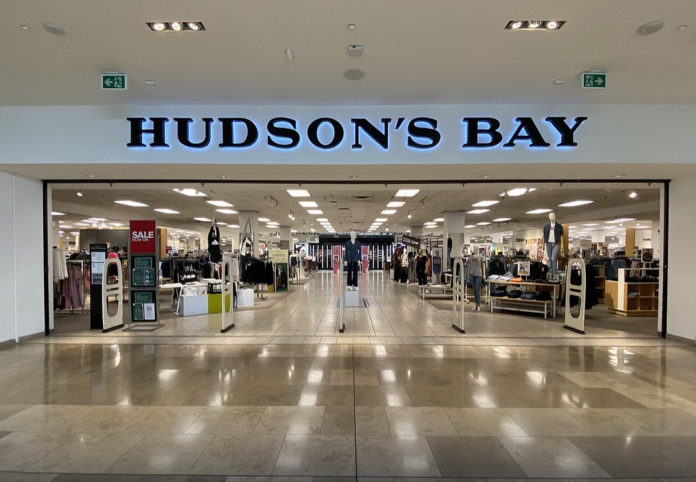
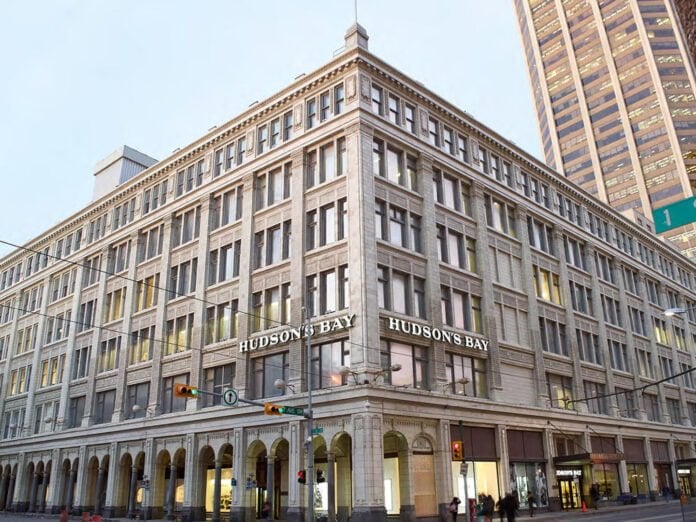
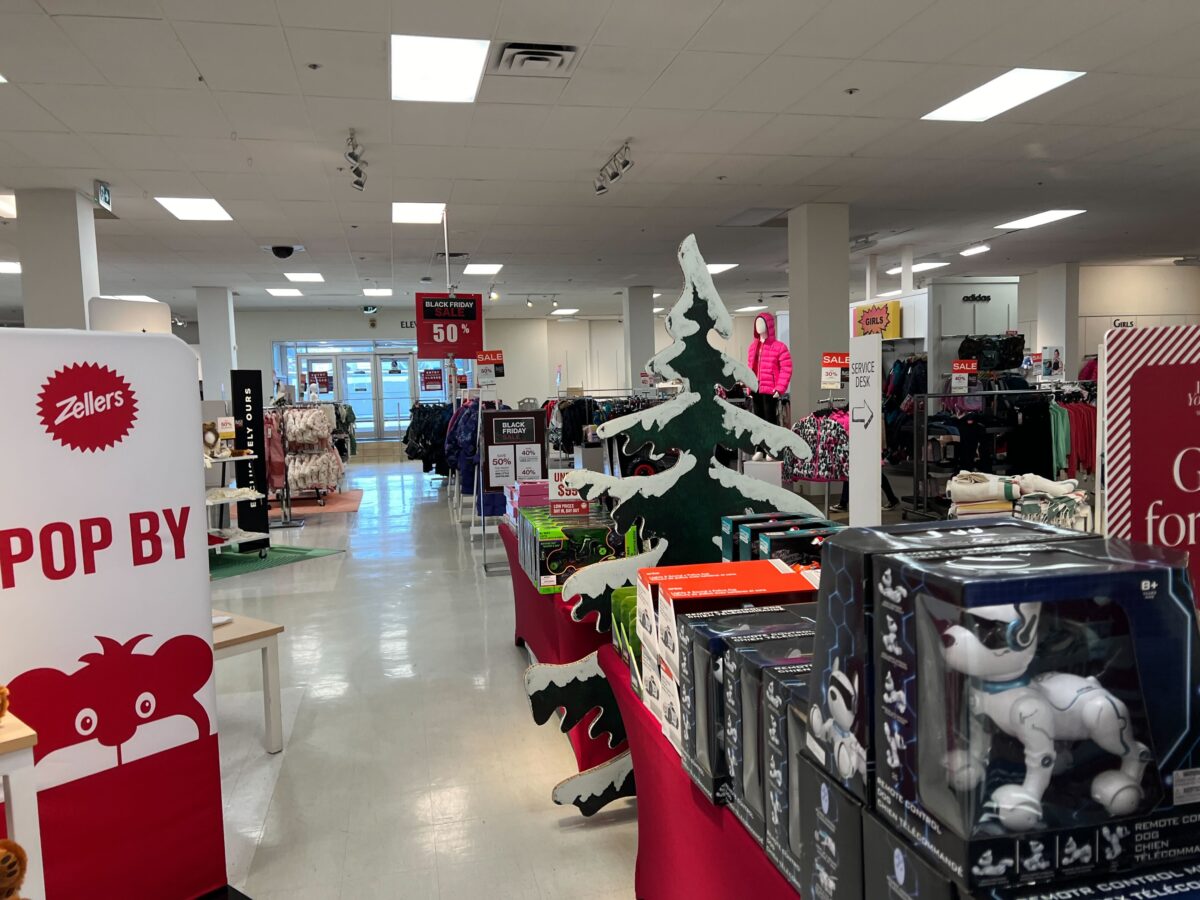
The fate of Canada’s iconic retailer, Hudson’s Bay, remains uncertain following a pivotal court hearing on Monday, March 17. Lawyers representing the struggling retailer told an Ontario Superior Court judge that unless a buyer or additional financing is secured, liquidation sales could have commence on Tuesday (March 18) across Hudson’s Bay’s 80 department stores, three Saks Fifth Avenue locations, and 13 Saks Off Fifth outlets.
“As it stands right now, the math doesn’t work,” Ashley Taylor, a lawyer for Hudson’s Bay, told the court. “We are actively seeking new capital, but as of today, liquidation remains the most viable course of action.”
At the end of Monday’s hearing, Justice Peter J. Osborne urged the retailer and its landlords to keep negotiating and to de-escalate tensions amongst parties. A ruling on Hudson’s Bay’s proposal could be issued as early as 2 p.m. on Tuesday, when Justice Osborne is set to hear from the company and other stakeholders on whether they reached an agreement on key issues discussed during Monday’s hearing.
Struggles to Secure Financing and Rescue the Business
Hudson’s Bay sought court protection under the Companies’ Creditors Arrangement Act (CCAA) on March 7 after an eleventh-hour financing deal collapsed. The company has since secured $23 million in interim financing from Restore Capital LLC, a private equity firm specializing in distressed businesses. However, this funding only facilitates an orderly liquidation rather than a restructuring plan that would allow Hudson’s Bay to remain operational.
“We are looking anywhere we can for that capital,” Taylor stated. “We need to cast the net as wide as possible, looking for solutions here.”
Justice Osborne, presiding over Monday’s hearing, expressed concerns that selling off assets too quickly could eliminate any chance of saving part of the business. “I want to make sure we haven’t sold the jewels in the crown, as it were, making a better outcome impossible,” Osborne said.
A key issue in the case is Hudson’s Bay’s request to extend the pause on its rent payments to RioCan-Hudson’s Bay JV, a joint venture with RioCan Real Estate Investment Trust. The retailer currently operates 12 stores in properties leased or subleased through the joint venture and its subsidiaries.
Additionally, the court heard objections from a group of Hudson’s Bay employees and retirees, who argued against the company’s liquidation. They urged for a one-week delay in the process to allow further negotiations with stakeholders, including landlords, in an effort to keep the business from shutting down.
Landlords, Lenders, and the Battle Over Debt
Hudson’s Bay had been in talks with landlords to keep roughly 40 stores open. However, those discussions fell apart late last week. The retailer had proposed that landlords temporarily waive rent payments and potentially invest in keeping select locations operational. Without such agreements, full liquidation is the only path forward.
Retail analyst Carl Boutet weighed in on the situation, citing financial documents submitted to the court. “Their monitor anticipates $465 million in revenue from liquidation, which after operating costs would generate around $158 million in net cash flow,” Boutet said. “But with $258 million in senior debt, a significant portion of unsecured debt—including payments owed to suppliers—will not be recovered.”
Boutet also noted disparities in financial priorities, adding, “Directors have requested to double their liability insurance to $50 million, while the key employees responsible for managing this crisis will receive only $3 million in compensation.”
Liquidation to Extend to E-Commerce
Elizabeth Pillon, another lawyer representing Hudson’s Bay, revealed that the company currently has about $315 million in inventory on its balance sheet. The proposed liquidation will extend beyond physical stores, affecting the company’s e-commerce business. The online operations will continue until the company’s Scarborough, Ont., distribution centre is emptied.
The proposed liquidation plan has faced strong opposition from employee representatives. Andrew Hatnay, a lawyer advocating for Hudson’s Bay workers, argued that the retailer’s collapse will lead to one of the largest mass terminations in Canada since Sears Canada folded.
Hatnay urged the court to delay the liquidation by one week, stating, “Once liquidation starts, it becomes a self-fulfilling prophecy. When customers rush in to buy up all the inventory, Hudson’s Bay will be left with so few options to move forward that the business will be finished.”
“Allowing this liquidation to start virtually instantly, seals the fate,” he added.
As Hudson’s Bay prepares for liquidation, it has announced plans to stop accepting gift cards after April 6. The company has already paused its loyalty program, leaving over 8.2 million Canadian customers with approximately $58.5 million in unused—now useless—points. This decision has sparked frustration among customers who relied on the rewards system.
Potential Buyers? Hope Dwindles
Despite ongoing speculation, few viable buyers have emerged for Hudson’s Bay’s assets. “At this point, we’re essentially waiting for a miracle,” said Boutet. “Maybe a group like Thailand’s Central Group, which has had success with Selfridges in the UK, might step in. But realistically, I have a better chance of being struck by lightning.”
JLL was announced to be involved in selling Hudson’s Bay leases to new tenants, though a Hudson’s Bay representative says that may no longer be the case. Landlords themselves may prefer to reclaim properties outright rather than participate in a structured sale process, Boutet said.
If the court grants approval, Hudson’s Bay will seek buyers for its leases and may also sell its operations and intellectual property, including its iconic stripes and point blanket designs. Any potential sale of the company would require repayment of its senior debt, according to an affidavit filed in court on Friday by Hudson’s Bay Co. ULC Chief Financial Officer Jennifer Bewley.
The Looming Liquidation
With liquidation sales expected to commence later this week, many questions remain. If all assets are sold, will Hudson’s Bay exist in any form beyond mid-2025? The answer likely depends on whether a financial saviour emerges in the coming weeks.
“The appetite for this much inventory hitting the Canadian market all at once is questionable,” said Boutet. “We know there’s no goodwill left among creditors and vendors. That won’t change between now and June 15.”
For now, the focus is on whether the court will approve the company’s request to move forward with liquidation sales. An outcome is expected later this week. Meanwhile, questions linger over the role of Hudson’s Bay’s leadership, including the company’s governor, Richard Baker.
“Where is Governor Baker in all of this?” Boutet asked. “He’s been awfully quiet.”
Fashion retailer SHEIN is set to return to Toronto with a new pop-up event this spring. The event, which will run from March 28 to April 6, will be hosted at the CF Toronto Eaton Centre, offering shoppers an opportunity to experience the brand’s latest collections in a vibrant, in-person setting.
This follows the success of previous SHEIN pop-up events across Canada. The 10-day event will feature a variety of the brand’s popular collections, including Maija, Dazy, SHEIN MOD, MOTF, and SHEGLAM. Visitors will have the chance to explore a curated space that highlights different styles, ranging from casual wear to trendier, fashion-forward pieces.
SHEIN’s pop-up is designed to reflect the brand’s global appeal, with an emphasis on inclusivity through its range of sizes and affordable fashion options.
Shirley Yuan
“As an online retailer with a wide range of stores under one umbrella, we are thrilled to bring this variety to life for Canadian consumers,” said Shirley Yuan, Head of Marketing at SHEIN Canada. “Our pop-up will offer a unique opportunity for them to experience firsthand the diverse assortment available.”
The design of the pop-up itself will offer a contrast of cool, muted winter tones with bright, bold spring colours, capturing the brand’s transition from winter to spring collections. The minimalistic monochrome aesthetic will gradually give way to vibrant pieces, creating an immersive shopping environment that reflects SHEIN’s blend of accessible and on-trend fashion, said the company.
In addition to showcasing its fashion collections, SHEIN is collaborating with Soles4Souls Canada, a non-profit that supports global communities through the donation of clothing and footwear. Customers who donate gently used items at the event will receive a $2 discount on their purchases.
SHEIN is also offering in-store perks for shoppers, including tiered discounts of up to 30% on select items and exclusive gifts with purchase, while supplies last. For the first time, the event will offer discounted SHEIN gift cards—available in limited quantities—allowing shoppers to save on future online purchases.
For those looking to take home a keepsake, the first 100 customers each day who share a post from the event on Instagram or TikTok will receive a limited-edition Toronto tote bag.
The SHEIN pop-up will be located on the main level of the Toronto Eaton Centre, near the Apple Store, and will be open Monday through Saturday from 10:00 AM to 9:00 PM, and Sundays from 11:00 AM to 7:00 PM.
Healthy Planet, Canada’s largest health and wellness e-commerce website and wellness store chains, is opening its first St. Catharines location.
Located at 285 Geneva Street in the Fairview Mall, this marks a milestone as Healthy Planet expands its reach across Ontario.
Set to open on April 11, the St. Catharines location will offer the community a wide range of health and wellness products, including organic foods, vitamins, supplements, natural beauty products, sports nutrition and eco-friendly household items, said the company.
“Healthy Planet has built a reputation as a trusted destination for health-conscious shoppers across Canada by providing affordable, high-quality products that support a natural and healthy lifestyle,” it said.
“Our goal has always been to make health and wellness accessible and affordable for everyone, and we look forward to serving and supporting the St. Catharines community on their wellness journey.”
The company said customers visiting the new store can expect a wide selection of dietary options, including vegan, gluten-free, and organic products.
The company said it is committed to offering a comprehensive shopping experience where customers can find their wellness needs under one roof and ask dietary professionals and naturopaths for advice onsite.
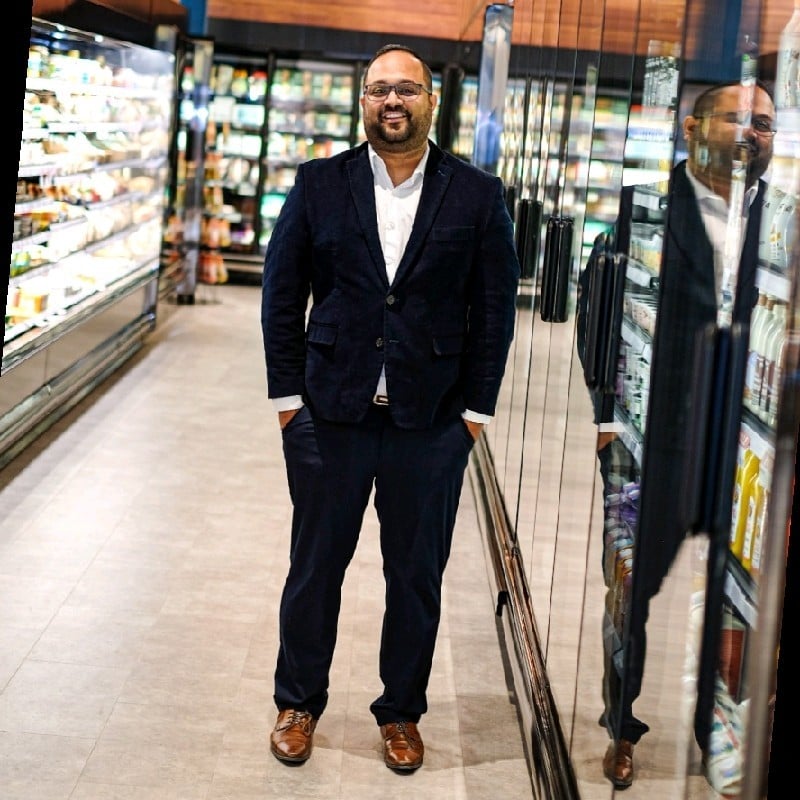
“Our goal is to make health and wellness accessible, offering a one-stop shop for high-quality products, expert advice and a commitment to supporting Canadian brands,” added Mohamedy.
Prime Minister Mark Carney is sworn in at Rideau Hall on March 14 in Ottawa, Canada [Dave Chan/AFP]
Prime Minister Mark Carney has signed an executive order eliminating the so-called “consumer carbon tax,” leading many Canadians to believe they will no longer feel its financial burden. But make no mistake—the most damaging aspect of the carbon tax for our food economy remains intact.
Carney’s plan appears to shift toward what some call a “shadow” tax system—continuing to tax major polluters in the same way as before. While this version of carbon pricing may be less visible to consumers, its economic impact is no different. Most Canadians support strong environmental policies that promote sustainability, but if those policies undermine food affordability and competitiveness, they warrant serious scrutiny.
At its core, the carbon tax accumulates costs at every stage of the food supply chain. It starts with farmers, who pay carbon taxes on fuel, fertilizers, and equipment—taxes that are further compounded by GST. Despite government rebates, production costs continue to climb. The cost burden doesn’t stop there. When wheat is transported to a mill, the trucking company pays carbon taxes on fuel, which gets passed on through shipping fees. The mill then incurs additional costs for electricity and operations. These costs continue to stack up as the flour moves through distribution, into bakeries, and onto grocery store shelves. By the time a loaf of bread reaches the consumer, multiple layers of carbon tax have been applied at different stages, increasing the final retail price.
The Real Impact of Carbon Tax on Food Prices
Consider a hypothetical scenario: If a farmer starts with a $100,000 base production cost and each intermediary pays an additional $5,000 in carbon tax, the final price could increase by as much as $89,513—of which $67,230 consists solely of carbon tax and GST on the tax itself. While politicians often focus on the direct tax that consumers see at the register, the real economic pressure accumulates throughout the supply chain. Carney’s policy shift does little to alleviate this burden.
The impact of the carbon tax on food prices is even more evident when analyzing the growing disconnect between wholesale and retail food prices. Since the carbon tax was introduced at $20 per metric ton in 2019, Canada’s agri-food sector has struggled with declining competitiveness. The narrowing gap between wholesale and retail prices suggests that grocers are increasingly forced to import food from abroad to mitigate costs.
Continued Carbon Tax Hikes and Their Long-Term Consequences
Since 2022, with annual carbon tax hikes of $15 per metric ton, the effects have become even more pronounced. Wholesale food prices temporarily outpaced retail prices, forcing grocers to absorb additional costs. This year, another $15 increase is scheduled for April 1, further amplifying cost pressures that will inevitably trickle down to consumers.
Yet despite the economic fallout, Ottawa has failed to produce any meaningful evidence that the carbon tax has improved Canada’s environmental outcomes. Since its inception, no study has been conducted to evaluate its impact on food affordability. Not one. Many academics have called it a blind-sided policy—one that weakens our economy and erodes competitiveness without measurable proof that it effectively addresses climate change.
With a new prime minister in office and potentially a new government on the horizon, it is time for Ottawa to facilitate a real, evidence-based debate on how best to tackle climate change without compromising food security and affordability. There are better solutions than the carbon tax—or its “shadow” equivalent—regardless of what Prime Minister Carney chooses to call it.
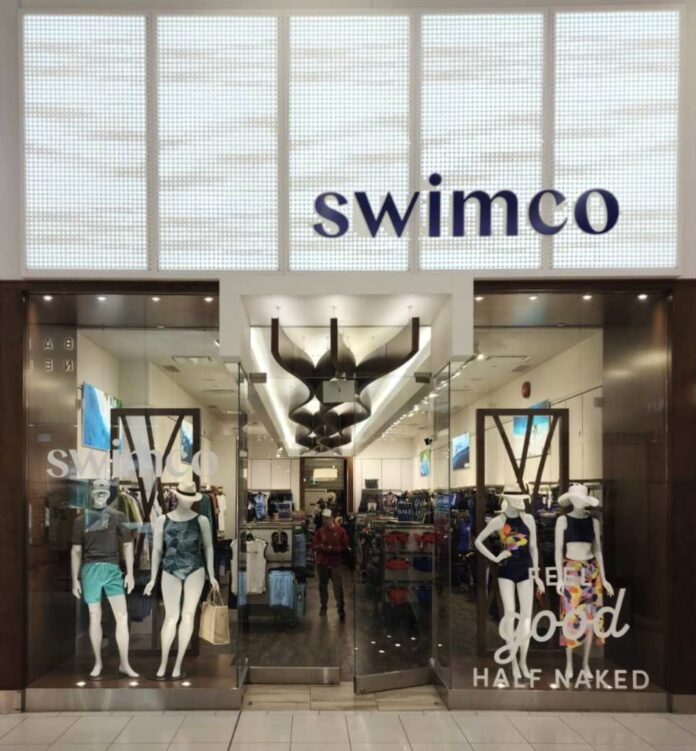
Swimco, the iconic Canadian swimwear retailer, is making a bold move with its expansion efforts as it opens its fourth store in Langley, B.C.
The new location at Willowbrook Shopping Centre marks a significant step in the company’s comeback strategy, following a period of slow, steady growth, after going into bankruptcy and closing all its retail locations in the fall of 2020 .
Despite challenges faced by smaller businesses in the ever-evolving retail landscape, Swimco’s commitment to long-term stability shines through as it celebrates its 50th anniversary this year.
With a history of successful operations and a focus on cash flow management, the brand is positioning itself for continued expansion across Canada depending on its cash flow.
Dave Bacon, president of Swimco, emphasizes the strategic importance of the Langley location, noting the region’s mix of rural charm and urban growth.
He highlights how the area, with its proximity to vacation properties and lower cost of living compared to downtown Vancouver, offers a prime opportunity for growth. The store’s comeback is also a testament to the strength of Swimco’s operations, which has seen sustained demand despite fluctuations in the marketplace. As the company prepares for its opening, Bacon remains optimistic, pointing to a healthy customer base and a business model built for scalability.
Source- Swimco
Looking ahead, Swimco is targeting strategic store openings across the country, with a focus on locations that offer favourable lease opportunities.
Bacon is cautious about high rental costs in prime markets but aims to expand at a pace that ensures sustainability.
While the retail environment continues to shift, Swimco’s steady approach—coupled with a strong leadership team—sets it apart in an increasingly competitive market. As the brand navigates its comeback, Swimco’s trajectory suggests that it remains well-positioned to thrive in Canada’s retail landscape for decades to come.
“We’ve been working on adding a store to our meager comeback. And, we had an opportunity to get into Willowbrook, which is a shopping centre in Langley that we had success with in the past, and they were happy to have us back. It’s just taken a long time. We started working with them almost a year ago. So, finally coming to fruition,” said Bacon.
Bacon said Langley is away from downtown Vancouver and residents there have more disposable income.
“We were there for 10 or 12 years and had good success compared to all the other Vancouver stores. So it’s a good market for us. I think perhaps there’s a little more disposable income and those people are able to travel. And maybe they’re closer to Kelowna. They’re closer to the lakes east of Vancouver. They have vacation property, whereas downtown Vancouver is maybe heading to Whistler.”
The retailer has stores in Park Royal in Vancouver, South Edmonton Common in Edmonton and Willow Park in Calgary.
“It’s been kind of a slow growth. We’re celebrating our 50th anniversary of our inception in May and I tell people it’s a like a 50-year-old startup. We’ve got all the history. We’ve got all the strength. We’ve got the management skills. We know how to run a big business. We’re just small,” said Bacon.
“Now we’ll have four stores going. It’s different than when you’re running a big organization with some history. We’re always watching our cash flow. We’re watching our sales. We’re watching our costs. It’s just like any other startup business. And the market is fussy, right? Every little thing affects you when you’re a small guy. When you’ve got 25 stores, you can kind of absorb the differences in the marketplaces. And you have weather issues in Edmonton that are not much different than Calgary and Vancouver. We all suffer sales for that day. We just feel like we still have a lot of optimism in the market. We’ve seen lots of customers back. And we’re seeing continued growth.”
Bacon said expansion depends on cash flow.
“I’d like to go back to the old style of a store a year sort of thing. As cash flow allows we can grow a store a year, which may not be every spring, but maybe every 18 months. And it comes down to leasing opportunities too. We want to be in locations we can thrive in,” he said.
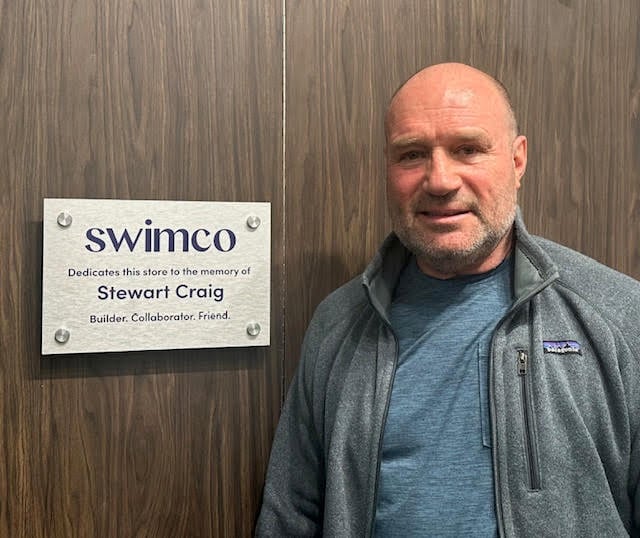
In conjunction with the opening of the new store on March 18, Swimco will be making a dedication honouring the life of Stewart Craig.
Dave Bacon
Craig was a Commercial contractor based in the Lower Mainland working with retailers like Le Chateau, Ardene’s, Bailey Nelson and Swimco.
Craig passed away in October 2024 after a battle with cancer.
Stewart Craig
“Stewart was a wonderful person who brought quiet enthusiasm, strong construction experience, and an ability to build relationships required in bringing projects together in major shopping centres across western Canada,” said Bacon.
“Stewart was instrumental in assisting Swimco develop or renovate over 20 stores over the last 14 years. We are honoured to be associated with Stewart and will remember him fondly. Personally, I will greatly miss my dear friend.
“There will be a brief ceremony at a time to be determined, when a plaque recognizing Stewart will be revealed prior to the opening of the newest Swimco location in Willowbrook Shopping Centre in Langley B.C.”
As Canadians increasingly seek homegrown alternatives, Groupe Marcelle is seizing the opportunity to strengthen its presence in the competitive beauty and personal care market.
With over 75 years of history, the family-owned business, which includes popular brands like Marcelle, Watier, Annabelle, and CW Beggs and Sons, is doubling down on its commitment to local production.
Proudly made in Quebec, the company’s extensive product line, from skincare to cosmetics, resonates strongly with a growing consumer preference for Canadian-made products. David Cape, the company’s President, highlights how Groupe Marcelle is perfectly positioned to meet this demand, emphasizing its use of Canadian ingredients and manufacturing.
David Cape
While the company maintains a modest presence in the U.S. through online platforms like Amazon, its primary focus remains in Canada, where it operates over 3,000 retail points across the country.
Cape explains that the company’s unwavering commitment to the Canadian market has contributed to its success, with a clear advantage in competing against multinational giants.
As Canada’s retail landscape shifts, Groupe Marcelle has cultivated partnerships with major retailers such as Shoppers Drug Mart and Walmart, helping it maintain a dominant presence in the local beauty sector.
In response to the growing “Buy Canadian” sentiment, Groupe Marcelle is not just relying on in-store promotions but is also engaging consumers through innovative digital marketing. Cape shared the excitement surrounding a viral TikTok video that showcased the company’s Canadian manufacturing process, which garnered over 1.7 million views. This blend of traditional retail presence and modern digital engagement is positioning Groupe Marcelle as a leader in the Canadian beauty market, capturing the attention of Canadians eager to support local businesses.
“Groupe Marcelle is a family business, started a little over 75 years ago by my grandfather, who was a pharmacist in Montreal,” said Cape. “He started distributing the Marcelle cosmetic brand in his spare time, really as a side business. We now sell four brands: Marcelle, Watier, Annabelle, and CW Beggs, which is a men’s brand. We sell these in about 3,000 retail sales points across Canada. We have over 1,200 individual SKUs and we make skincare, fragrance, and makeup products, most of which are made in Quebec. We have a manufacturing facility in Montreal where we actually manufacture the products,” he said.
“We have about 350 employees and do business with most of the large retailers—Shoppers Drug Mart, Jean Coutu, London Drugs in the West, among others. We also sell online through platforms like Amazon and Walmart, so we’re really widely distributed across Canada.
“We have a small presence in the U.S. We sell online on Amazon, on our own Amazon site, as well as a select few retailers. But the vast majority of our business is Canadian. We’ve always focused on building our business in Canada and we’ve always seen that we have more potential here. We’ve layered into it over the last many years and have grown very successfully in Canada.”
For now, Cape doesn’t see the tariff situation having a major impact on its presence in the U.S. It’s just not a large enough business that it’s causing him concern at this point.
Source- Groupe Marcelle
“We are really a Canadian-first business. We innovate here in Canada, we do our R&D here, and we’ve always been very proud of our Canadian heritage. We use and specialize in Canadian ingredients, and that makes us rather unique. We’re trying to communicate this message, and we’re really thrilled and excited to have a very receptive audience. Canadians are looking for products made in Canada. While we compete against the largest multinational companies out there, we’re one of the largest players in the industry within Canada.
“Our ability to differentiate ourselves and share the message of being made in Canada, by Canadians for Canadians, is a unique opportunity, and we’re really trying to make the most of it.”
Cape said the company does business with all the major retailers and that includes those based in the U.S. These retailers have made significant investments in Canada.
“When you’re dealing with them, you’re dealing with Canadian head offices that employ Canadians. They are, as much as other retailers, really focused on Canadians,” he said.
“There’s understandable tension right now as people look for ways to support Canadian-made products. It’s important to consider which companies have made large commitments to Canada, have invested here, and employ Canadians. We do work with these retailers, and it’s a concern. The question is, how do we channel people’s desire to purchase Canadian in the most productive way, rather than hurting people that are making real investments in Canada?
“We’re really seizing opportunities as they come. Some of our retailers, like Loblaws, which owns Shoppers Drug Mart, Jean Coutu, and London Drugs, are focused on promoting Canadian products. We’re working with them because, in the beauty category, we’re the number one go-to for Canadian products.”
He said the company is also taking initiatives to highlight for consumers that it is a Canadian brand, whether it’s on its website or at the point of purchase.
“Canadians are looking for that. We also participate in Facebook groups and other platforms where consumers are looking for Canadian products.
“One of our marketing videos recently went viral on TikTok, showing our facility and how we innovate in Canada. It got over 1.7 million views, and it was an exciting moment. We didn’t make a huge investment in it, but it really took off in that environment. We’re trying to participate and meet the needs of our Canadian consumers who are looking for Canadian-made products,” explained Cape.
Retail Insider is streamlining its Canadian retail news from around the web to include a handful of top news stories that can be viewed quickly during the day. Here are the top stories from the past 3 days.
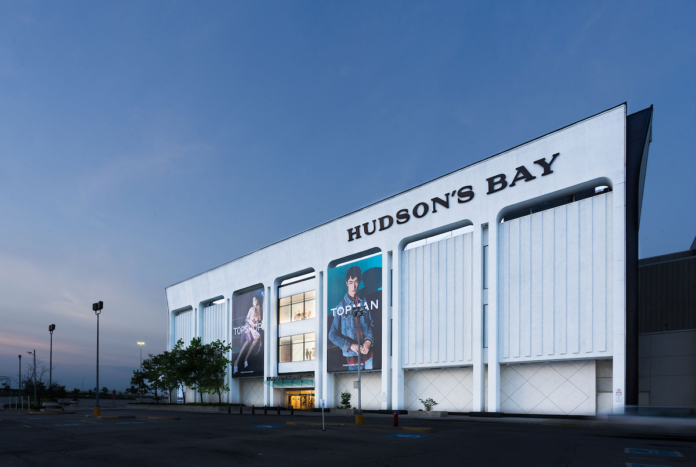
Hudson's Bay Yorkdale, part of the HBC/RioCan JV. Image: WZMH Architects.
A critical court hearing on Monday, March 17, could determine the fate of Hudson’s Bay Company (HBC) in its ongoing restructuring under the Companies’ Creditors Arrangement Act (CCAA). At the center of the legal battle is a motion filed by RioCan Real Estate Investment Trust, one of HBC’s largest landlords and a key joint venture (JV) partner, demanding that the retailer resume paying rent on a dozen properties across Canada.
RioCan, which co-owns 12 retail properties with HBC through a joint venture, has taken legal action to overturn an earlier court order that allowed HBC to suspend rent payments to these JV properties while still occupying them. The real estate giant argues that this decision is unprecedented in Canadian insolvency proceedings and puts RioCan’s financial stability at risk.
HBC, which filed for CCAA protection on March 7, 2025, is still paying rent on 84 other leased locations, but under the court-approved restructuring terms, it has exempted itself from rent obligations on the JV properties. RioCan asserts that this selective rent suspension violates CCAA principles, as companies under protection are typically required to continue paying for the use of leased properties.
RioCan’s Legal Argument
In its motion record, filed on March 14, 2025, RioCan is seeking an order from the Ontario Superior Court of Justice (Commercial List) that would:
Require HBC to resume rent payments to the JV properties immediately.
Strike down the rent suspension provision in the original CCAA order.
Prevent HBC from securing debtor-in-possession (DIP) financing if it includes restrictions on paying JV rent obligations.
RioCan CFO Dennis Blasutti, in an affidavit supporting the motion, emphasized that HBC owes approximately $10 million per month in rent to the JV entities. Roughly 70% of these payments go toward covering property-related expenses such as mortgages, operating costs, and administrative fees, while the remaining 30% is distributed to JV partners, including RioCan and HBC’s own real estate arm.
Potential Court Outcomes
Monday’s court hearing could result in several possible outcomes:
Full Victory for RioCan – The court orders HBC to resume full rent payments immediately, preventing financial strain on the JV and ensuring that all landlords are treated equally under the CCAA.
Partial Compromise – The judge may allow HBC to pay only a portion of the rent, covering operating costs while deferring landlord distributions until a later stage in the restructuring.
HBC Prevails – The court upholds the rent suspension, meaning RioCan and its JV entities would be left to cover financial shortfalls, potentially forcing loan defaults on some properties.
DIP Financing Adjustments – The judge could modify HBC’s DIP financing agreement, ensuring that funds are available for JV rent payments.
Potential Impact on Hudson’s Bay Stores
The outcome of this court hearing could significantly impact the future of the Hudson’s Bay department store chain. Depending on the court’s ruling, several scenarios could unfold:
If the Court Orders Full Rent Payments – HBC would be required to resume rent payments on the JV properties, adding approximately $10 million per month in financial obligations. This could force the company to accelerate store closures, particularly in underperforming locations, and may lead to liquidation proceedings if it cannot secure additional financing.
If the Court Grants Partial Compromise – HBC may receive temporary relief, allowing it to defer portions of its rent payments. While this would ease immediate financial strain, it could still result in selective store closures or negotiations with landlords to exit unprofitable leases.
If the Court Upholds the Rent Suspension – HBC would gain a significant financial advantage by avoiding rent payments on the JV properties while continuing operations. This scenario would extend the retailer’s runway for restructuring, potentially allowing it to focus on e-commerce expansion and store format changes. However, RioCan and other landlords could retaliate, pushing for alternative legal remedies or accelerating foreclosure actions on properties.
If DIP Financing is Modified – If the court mandates changes to the debtor-in-possession (DIP) financing, ensuring that rent is included in funding obligations, HBC could be forced to prioritize payments to landlords over other restructuring initiatives. This could impact the retailer’s ability to invest in store renovations, technology, and inventory replenishment.
The decision could determine whether HBC survives as a department store operator or faces an expedited path toward liquidation or asset sales. Store closures, layoffs, and shifts toward a smaller store footprint may all be on the horizon, depending on how the legal proceedings unfold.
How RioCan Could Push HBC Toward Liquidation
The legal action taken by RioCan has the potential to accelerate the downfall of Hudson’s Bay, depending on how the court rules. Several scenarios could force HBC into a rapid restructuring or outright liquidation:
Court Orders Full Rent Payments – If HBC is required to resume full rent payments to the JV properties, this additional $10 million per month obligation could drain its remaining cash flow. If HBC fails to secure new financing, it may be forced into store closures, mass layoffs, or even bankruptcy liquidation.
Eviction from JV Properties – If HBC does not comply with court-ordered payments, RioCan could push for eviction or foreclosure on the JV properties. Losing key downtown locations in Vancouver, Montreal, Calgary, and Ottawa would cripple operations, making it harder for HBC to sustain its brand.
JV Defaults on Mortgages – If RioCan and its JV partners cannot cover property-specific mortgages due to HBC’s non-payment, lenders could foreclose on properties or demand immediate repayment, further jeopardizing HBC’s access to key locations.
Legal Retaliation from Other Landlords – If RioCan’s case succeeds, other landlords may follow suit, pressuring HBC into negotiating rent obligations or liquidating more assets to stay afloat.
The combination of these pressures could force HBC into a more aggressive restructuring, asset sell-offs, or a complete liquidation.
Details of the 12 Properties in Dispute
The properties at the center of this legal dispute include a mix of head lease properties, wholly-owned properties, and co-owned properties between RioCan and HBC. These properties are vital to HBC’s retail operations and represent a significant portion of RioCan’s real estate holdings.
1. Head Lease Properties (Leased from Third-Party Landlords)
These properties are leased by the JV entities and subleased to HBC:
CF Carrefour Laval (Laval, QC)
Promenades St. Bruno (St. Bruno, QC)
Yorkdale Shopping Centre (North York, ON)
Scarborough Town Centre (Scarborough, ON)
Square One (Mississauga, ON)
2. Freehold Properties (Owned by the JV)
These properties are 100% owned by the JV, with HBC as a tenant:
Downtown Vancouver (Vancouver, BC)
Downtown Calgary (Calgary, AB)
Downtown Montreal (Montreal, QC)
Downtown Ottawa (Ottawa, ON – Beneficial interest held by Ottawa LP)
Devonshire Mall (Windsor, ON)
3. Co-Owned Properties (50% Ownership by RioCan and the JV)
These two mall locations are co-owned by RioCan and the JV, with HBC as the tenant:
Oakville Place (Oakville, ON)
Georgian Mall (Barrie, ON)
Broader Implications for Canadian Retail and Real Estate
The outcome of this case could have far-reaching consequences for landlords, creditors, and the broader retail sector. If the court permits rent suspension, it could set a precedent where CCAA debtors strategically avoid payments to certain landlords while maintaining control of key properties. Conversely, if the court requires full rent payments, it could place additional financial pressure on HBC, accelerating liquidation scenarios.
The March 17 hearing will provide clarity on whether HBC can continue operating under its current rent deferral strategy or if it will be forced to allocate more funds toward its landlords. RioCan has also indicated that it is open to an alternative DIP financing structure that would ensure rent payments continue.
Hudson’s Bay Company ULC, the entity behind the 355-year-old retailer Hudson’s Bay and TheBay.com, has announced that it has been unable to secure the necessary financing to restructure its business, potentially leading to the full liquidation of the retailer. Hudson’s Bay stores across Canada could begin liquidation sales as early as next week, marking the end of an era for the country’s last traditional department store chain.
The company has spent the past week in discussions with landlords to find a path forward but has struggled to reach agreements. The financial strain comes after Hudson’s Bay sought creditor protection under the Companies’ Creditors Arrangement Act (CCAA) on March 7, 2025, in a bid to restructure its operations. However, with only limited debtor-in-possession financing secured, the company now says a store-by-store liquidation process will likely be necessary.
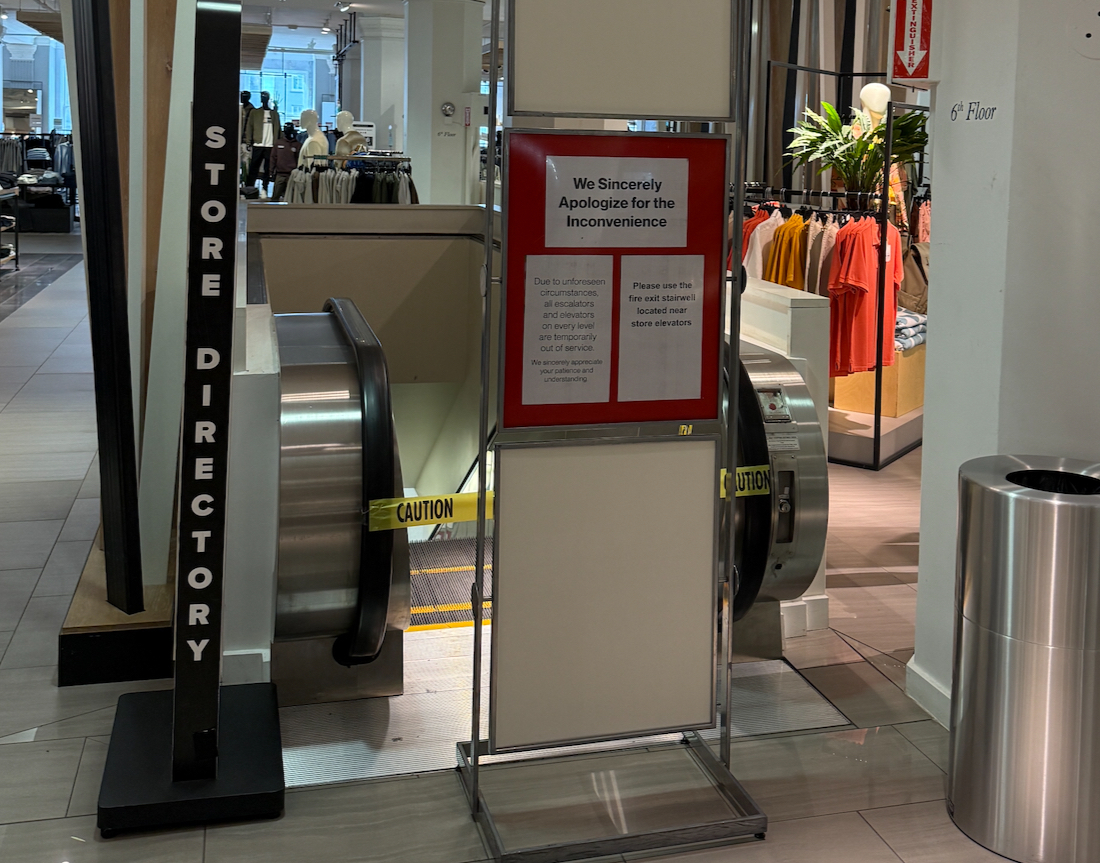
On Monday of this week, all escalators and elevators were down at the Hudson’s Bay flagship store in downtown Vancouver. Shoppers had to walk up a set of fire stairs to get to the 6th floor men’s store. Photo: Lee Rivett
A Retail Giant’s Fall
Hudson’s Bay, Canada’s oldest retailer, currently operates 80 locations across the country, as well as TheBay.com. Through a licensing agreement, the company also oversees three Saks Fifth Avenue and 13 Saks Off 5th stores in Canada. The collapse of Hudson’s Bay would be a devastating blow to the Canadian retail landscape, impacting shopping malls, employment, and consumer choice.
The closure would see the loss of approximately 9,364 jobs across the country, while major shopping centres would be left with the task to fill the large anchor spaces occupied by Hudson’s Bay. Many of these locations encompass multiple floors and represent some of the largest tenant retail square footage in malls nationwide. Ontario would be the hardest hit, with 32 stores and more than half of the company’s employees located in the province.
Maje and Sandro women’s fashion concessions were dismantled at Hudson’s Bay Queen Street, coinciding the HBC’s bankruptcy filing.
The Search for a Last-Minute Solution
Liz Rodbell, President and CEO of Hudson’s Bay, said, “Our team has worked incredibly hard to identify a viable path forward, and our resolve is strengthened by the overwhelming support from customers and associates who have shared heartfelt stories about Hudson’s Bay and what our stores have meant to them. These powerful experiences remind us why we must continue to pursue every possible opportunity to secure the necessary support from key landlords and other stakeholders to save The Bay.”
However, with court proceedings expected to approve the liquidation plan on Monday, the timeline for securing an alternative solution is rapidly closing. If no new financial support is found, the liquidation of all Hudson’s Bay stores will begin next week, with final sales events marking the end of the retailer’s storied history.
With Hudson’s Bay now entering the liquidation phase, the retailer has set a firm deadline for the use of its gift cards. Customers will have until April 6 to redeem them, after which they will no longer be accepted. Shoppers can use their gift cards during the ongoing liquidation sales, providing an opportunity to maximize their remaining balances before the deadline. As of February 1, Hudson’s Bay customers collectively held approximately $24.1 million in outstanding gift card value, adding urgency for cardholders to use their funds before they become void.
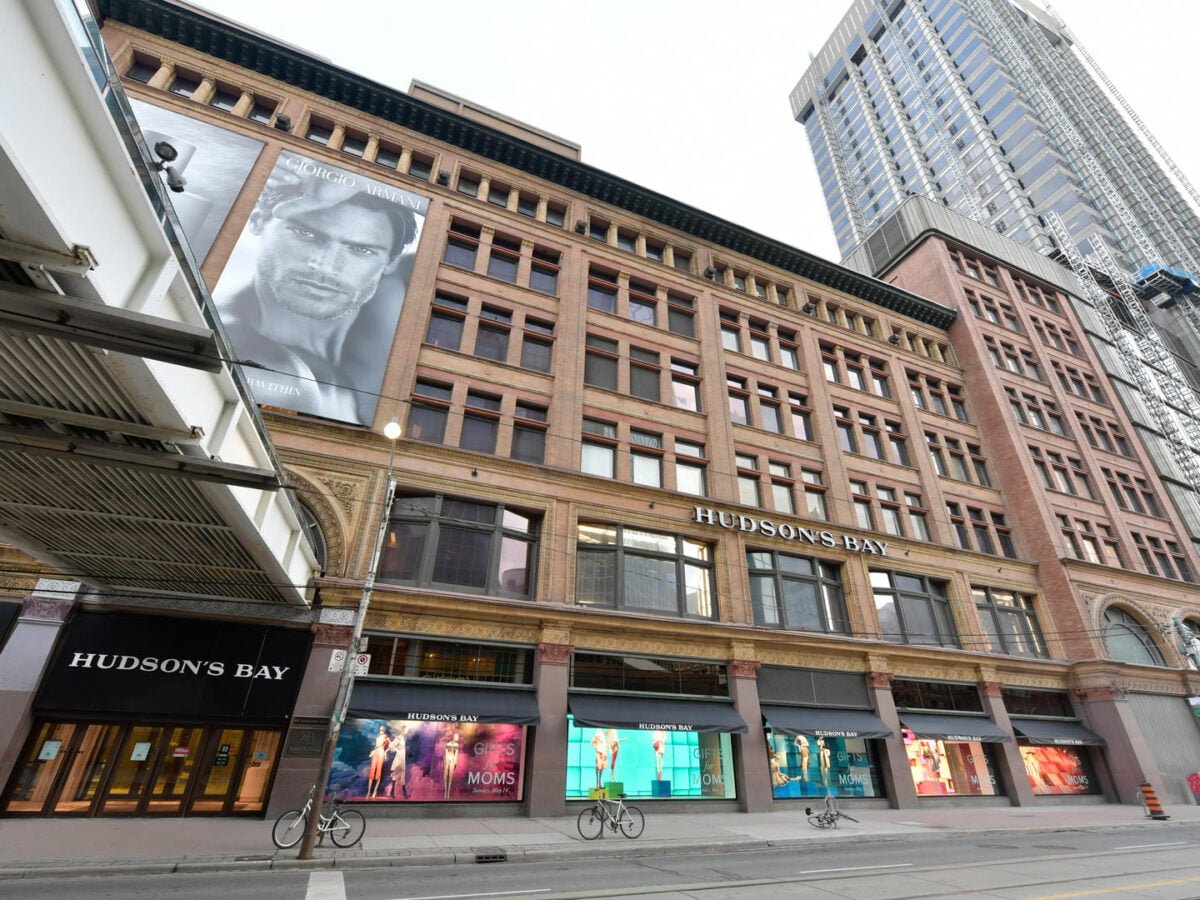
Hudson’s Bay flagship, Queen Street Toronto. Photo: HBC
Negotiations with Mall Landlords Challenging
Sources told Retail Insider this week that Hudson’s Bay, its joint-venture partner RioCan, and mall landlords were engaged in negotiations to determine which stores to keep open. Insiders said that by mid-week, only 23 Hudson’s Bay locations had been negotiated to remain open, far fewer than the initial goal of 40 stores under a restructured business model.
According to sources, Hudson’s Bay has been asking landlords to cover renovation costs and offer financial concessions to keep stores operating. However, some landlords, already frustrated by unpaid rent and financial losses tied to Hudson’s Bay, are hesitant to comply. Some are even prepared to reclaim the anchor spaces for redevelopment rather than continue leasing to the struggling retailer.
Struggles Leading to Collapse
Hudson’s Bay claims that its financial difficulties have been exacerbated by multiple factors, including subdued consumer spending, ongoing trade tensions between the U.S. and Canada, and reduced foot traffic in downtown shopping districts following the pandemic. In reality, much of the company’s struggles stem from years of underinvestment by its ownership, which failed to modernize stores, refresh product selections, and improve the overall shopping experience.
Shoppers have encountered poorly maintained locations with limited staff, broken escalators, and other unresolved maintenance issues. The company also lacked an effective marketing strategy to attract and retain customers, while alienating vendors and not paying them. Cost-cutting measures and prolonged neglect ultimately weakened the chain, leaving it vulnerable at a time when leadership appeared to have cast Hudson’s Bay aside, focusing on the shiny newly formed Saks Global.
Hudson’s Bay owes more than $950 million to an extensive list of creditors, including major fashion brands such as Ralph Lauren, Chanel, Columbia Sportswear, Diesel, and Estée Lauder. Many of these brands have gone unpaid for months, as the retailer struggled to keep up with lease and supplier payments.
The company’s financial turmoil has also led to drastic actions by landlords. According to court filings, a landlord in Sydney, Nova Scotia, forcibly locked Hudson’s Bay out of a store, while bailiffs hired by Cadillac Fairview attempted to seize merchandise from its location in CF Sherway Gardens in Toronto.
Hudson’s Bay at Woodgrove Centre in Nanaimo, BC in November 2023. Photo: Lee Rivett.
The End of Saks Fifth Avenue and Saks OFF 5TH in Canada
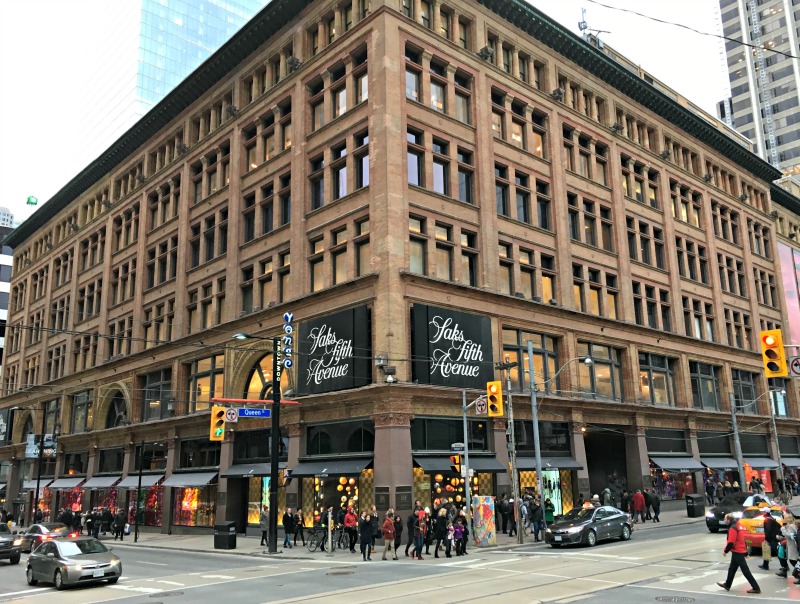
The liquidation of Hudson’s Bay would also mean the closure of all licensed Saks Fifth Avenue and Saks OFF 5TH stores in Canada. Saks Fifth Avenue currently operates three locations in the country: two in Toronto and one in Calgary. The Toronto stores, which opened in early 2016, include a downtown flagship spanning three floors of the Hudson’s Bay building and another location at CF Sherway Gardens. The Calgary store, located at CF Chinook Centre, was the last Saks Fifth Avenue to open in Canada. Originally, the retailer had planned to expand to as many as 10 stores nationwide, but growth was halted after the Calgary opening.
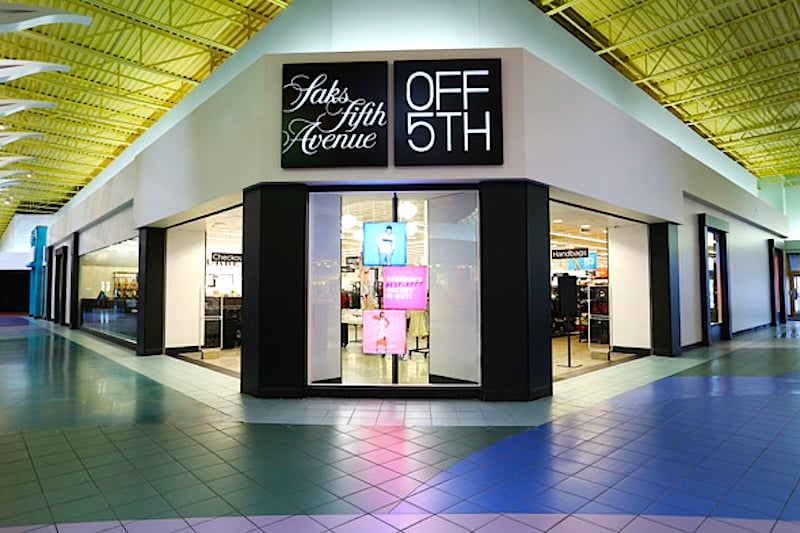
The closure will also affect Saks OFF 5TH, the off-price retailer which currently has 13 stores across Canada. The chain, which launched its Canadian expansion in 2016, once operated 18 locations at its peak. However, according to sources, Saks OFF 5TH underperformed in the Canadian market, leading to multiple store closures in recent years. With the liquidation of Hudson’s Bay, Saks OFF 5TH will now fully exit the Canadian market.
Saks Fifth Avenue Toronto
A Historic End to an Iconic Brand
Founded in 1670, Hudson’s Bay is the oldest surviving corporation in North America and has played a pivotal role in Canada’s retail and economic history. What began as a fur-trading enterprise evolved into a national department store chain that defined Canadian shopping for generations. The closure of Hudson’s Bay would represent not just the end of a business but the conclusion of a centuries-old legacy.
The retail industry in Canada is at a crossroads, with the disappearance of traditional department stores accelerating in the face of e-commerce growth and shifting consumer preferences. If Hudson’s Bay ceases operations, it will leave a significant gap in the retail landscape, affecting everything from real estate to employment and consumer habits.
As the company awaits its final court ruling and any potential lifelines, Canada watches closely to see if Hudson’s Bay will be saved at the eleventh hour or if it will join Eaton’s, Sears Canada, Woodward’s, Simpson’s, Morgan’s and others in the annals of Canadian department store history.
Saks OFF 5TH Vaughan Mills. Photos provided by Hudson’s Bay Company.
What’s Happening on Monday:
The Hudson’s Bay Company will appear before the Ontario Superior Court of Justice (Commercial List) on Monday, March 17, 2025, at 9:00 AM, seeking approval for a range of motions that will determine the future of the struggling department store chain. The company is asking for additional financial lifelines and legal protections as it navigates its Companies’ Creditors Arrangement Act (CCAA) restructuring process.
If approved, Hudson’s Bay will have a temporary reprieve to continue operations while selling off inventory, transferring leases, and seeking a potential buyer. If denied, the retailer could be forced into immediate liquidation, accelerating the shutdown of stores across Canada.
Key Requests Before the Court
1. Extension of CCAA Protection Until May 15, 2025
Hudson’s Bay will request an extension of its CCAA protection, which prevents creditors and landlords from taking legal action against the company. The extension would allow HBC to continue restructuring efforts without the immediate risk of eviction from store locations or further financial penalties.
If the court grants this request, Hudson’s Bay will have two more months to execute its turnaround plan. However, if denied, the company could face forced closures and immediate asset liquidation, making it significantly harder to negotiate with landlords and potential investors.
2. Approval of $23 Million in DIP Financing
HBC is also seeking court approval for $23 million in Debtor-in-Possession (DIP) financing, which would provide much-needed capital to keep stores operating in the short term. The funding is being provided by a consortium of lenders, including Restore Capital LLC, Tiger Asset Solutions Canada ULC, and GA Group Solutions, LLC.
This financing is essential for the company’s day-to-day operations, including:
Paying rent and supplier obligations to keep stores stocked.
Funding liquidation efforts at stores that will close.
Covering administrative costs, including legal fees for the restructuring process.
Without this financial injection, Hudson’s Bay would quickly run out of cash, forcing an accelerated shutdown of operations.
3. Approval of a Liquidation Sale Plan
The court will also decide whether Hudson’s Bay can proceed with liquidation sales at select store locations and distribution centres. The company is seeking approval to engage a liquidation consultant to oversee the process, ensuring that remaining inventory and store fixtures are sold in an orderly manner.
If approved, Hudson’s Bay could begin clearance sales as early as next week at affected locations. The sales would run until June 15, 2025, unless extended by the court. However, if the request is denied, Hudson’s Bay may struggle to monetize its inventory, further straining its financial position.
4. Lease Monetization Strategy
Hudson’s Bay is also asking for approval to market and sell its store leases. The company plans to engage a lease monetization consultant to help find businesses interested in taking over leases at various locations.
This process will unfold in two phases, with a series of ten milestones designed to maximize the recovery of value from leases. If approved, the company may be able to generate additional cash flow from lease sales.
If the request is denied, landlords could move to terminate HBC’s leases early, eliminating any chance of recovering value from lease transfers.
5. Sales & Investment Solicitation Process (SISP)
Hudson’s Bay is actively seeking a buyer or investor to rescue part or all of the business. On Monday, the company will ask the court to approve a formal sales and investment process (SISP).
Key deadlines in this process include:
April 15, 2025 – Deadline for potential buyers to submit bids.
April 29, 2025 – If multiple offers are received, an auction may be held.
If no buyer emerges, Hudson’s Bay could be forced into a complete shutdown.
6. Financial Protection for Executives & Employees
HBC is also asking the court to approve measures aimed at protecting executives and key employees during the restructuring process:
Directors’ Charge Increase: The company is seeking to increase executive financial protection from $26.3 million to $49.2 million to shield leadership from personal liability during the bankruptcy process.
Key Employee Retention Plan (KERP): Hudson’s Bay is requesting $3 million to retain critical employees needed to oversee the restructuring and liquidation process.
These measures are designed to keep leadership and key staff in place as the company navigates this difficult transition.
What Happens if the Court Denies These Requests?
If Hudson’s Bay is denied court approval on any key motions, the consequences could be devastating:
The company may run out of money without DIP financing, forcing an immediate shutdown.
Landlords could terminate leases early, pushing HBC out of key retail locations.
Liquidation sales could stall, preventing HBC from generating much-needed cash flow.
If the company is unable to find a buyer through the SISP process, Hudson’s Bay could cease operations entirely.
Update: RioCan Could Trigger Liquidation on Monday
Documents filed Friday, and uploaded publicly early Saturday, show that RioCan Real Estate Investment Trust is seeking an order from the Ontario Superior Court of Justice to force Hudson’s Bay to fulfill its rent obligations under their joint venture lease agreements. If the court grants RioCan’s motion on Monday, it could have significant financial and operational consequences for both parties.
One of the core requests in RioCan’s motion is the immediate payment of all outstanding rent owed by Hudson’s Bay to the joint venture properties. Currently, HBC is required to pay rent only to cover head leases, leaving RioCan and the joint venture entities without full rental income. If the court rules in favour of RioCan, HBC would be required to make rent payments for all 12 properties held under the joint venture, amounting to approximately $10 million per month. Given HBC’s existing financial difficulties, this could further strain the company’s cash flow, potentially accelerating store closures and liquidation efforts.
Possible Termination of Joint Venture Leases
Should the court compel HBC to pay full rent and the retailer is unable to comply, RioCan could take steps to terminate lease agreements on its co-owned properties. This would give RioCan greater control over these retail spaces, allowing it to repurpose or lease them to new tenants. However, for major flagship locations such as Yorkdale, Square One, and downtown Montreal, repurposing these massive retail footprints could take years, leaving substantial gaps in some of Canada’s most prominent shopping centres and downtowns.
Impact on HBC’s Restructuring Efforts
HBC has been attempting to restructure under the Companies’ Creditors Arrangement Act (CCAA), seeking court protection while it negotiates with creditors. If RioCan’s motion succeeds, it may limit HBC’s ability to defer rent obligations, making it harder to attract investors or find a buyer for its remaining stores. Additionally, RioCan’s request to block any debtor-in-possession (DIP) financing agreements that prevent rent payments to the joint venture could further complicate HBC’s efforts to secure funding.
Implications for Shopping Centres and Landlords
For shopping centres where RioCan and HBC jointly own properties, such as Oakville Place and Georgian Mall, the court’s decision could impact future redevelopment plans. If RioCan gains the ability to re-lease these spaces, it could look to bring in new retailers or mixed-use developments, reshaping the commercial real estate landscape in these locations.
If RioCan’s motion is denied, HBC may continue to delay rent payments while pursuing restructuring efforts, potentially keeping some stores open longer. However, if the court rules in RioCan’s favour, HBC could face an accelerated timeline for closures and liquidations, forcing landlords to seek new long-term solutions for prime retail spaces left vacant by the struggling retailer.
The outcome of RioCan’s motion will be closely watched by retail industry stakeholders, investors, and landlords across Canada, as it may set a precedent for how creditors and joint-venture partners are treated in large-scale retail insolvency cases. The court’s decision on Monday could ultimately determine whether HBC has a path forward or if it will be forced to exit the Canadian retail market entirely.
Final Thoughts: A Defining Moment for Hudson’s Bay
Monday’s court hearing will be a decisive moment for Hudson’s Bay. If all motions are approved, the company will have a temporary lifeline to continue operations while working toward a possible sale. However, if key requests are denied, HBC could face immediate liquidation, bringing an end to a 355-year-old retail legacy.
The fate of Canada’s last remaining major department store chain now rests in the hands of the court.
Toronto Designers Market, soon to be Wilkes & Bowens, at the Holt Renfrew Centre at 50 Bloor Street West in Toronto. Photo: Craig Patterson
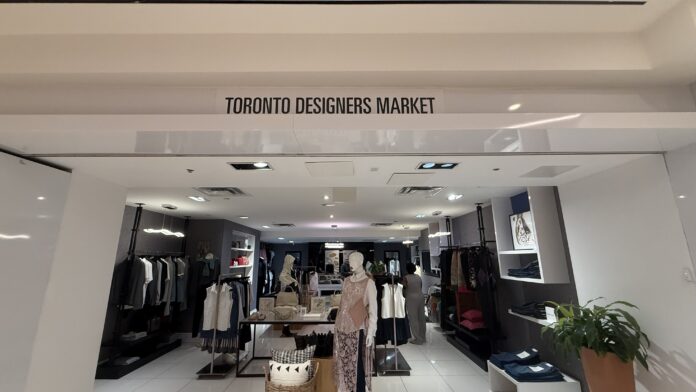
Toronto Designers Market, a retail incubator for Canadian designers, is marking its two-year anniversary at the Holt Renfrew Centre in Toronto. Located on the lower level of the shopping centre at 50 Bloor Street West, the store has become a destination for shoppers seeking unique, locally made fashion, accessories, and home decor. As part of its growth strategy, the retailer is undergoing a significant transformation, rebranding as Wilkes & Bowens within the next month.
The move signals an evolution in the retailer’s mission, with plans to expand its offerings by bringing in designers from across Canada while maintaining its commitment to local talent. Owner Karen Ferguson, who has been at the helm since acquiring the business in 2019, discussed the store’s journey, the rebrand, and the vision for the future.
Toronto Designers Market/Wilkes & Bowens owner Karen Ferguson with a Petit Futé award. Photo supplied
A Decade in the Making
Although the Toronto Designers Market has only been at its Bloor-Yorkville location for two years, the brand itself has a much longer history. Originally launched in Toronto’s Parkdale neighborhood in 2015 by Joshua James, the market has undergone several transitions in leadership and location. Ferguson, one of the original designers at the market, took ownership in 2019 and led its relocation in 2023 to the high-traffic Bloor-Yorkville area.
“We’re actually celebrating two birthdays,” Ferguson said. “Toronto Designers Market has been around for 10 years, but it’s been two years since we relocated to Holt Renfrew Centre.”
The shift to a more upscale location came with both opportunities and challenges. “This space is completely different from our previous one in Parkdale. We had to rebuild and introduce ourselves to a new audience, but it has given us access to a more affluent clientele and a prime retail environment,” she added.
Toronto Designers Market, soon to be Wilkes & Bowens, at the Holt Renfrew Centre at 50 Bloor Street West in Toronto. Photo: Craig Patterson
Rebranding to Wilkes & Bowens
Ferguson is preparing for another major change—renaming Toronto Designers Market to Wilkes & Bowens. The name holds deep personal significance for her.
“Wilkes is my mother’s maiden name, and Bowens is my maiden name—both represent my foundation,” Ferguson explained. “I want to build on that foundation and translate it into the business.”
Beyond sentimental value, the rebrand is also a strategic move to support future expansion. “With ‘Toronto Designers Market,’ the name itself is limiting if we want to expand beyond this city. You can’t really have ‘Toronto Designers Market, Vancouver Edition,’” Ferguson noted. “Wilkes & Bowens allows us to create something that isn’t confined to one city, opening the door to future locations across Canada and even internationally.”
Toronto Designers Market, soon to be Wilkes & Bowens, at the Holt Renfrew Centre at 50 Bloor Street West in Toronto. Photo: Craig Patterson
Expanding Canadian Talent
A core component of the rebrand involves bringing in more designers from across the country. “Over the last two years, I’ve been scouting brands in Montreal, Vancouver, and Calgary—there is incredible talent across Canada,” Ferguson said. “We’re expanding our reach so that it’s not just Toronto-based designers but a true reflection of Canadian creativity.”
While Toronto Designers Market has always provided emerging designers with a platform to test their products in a retail setting, the rebrand will emphasize mentorship and industry education. “We don’t just sell their products; we provide them with resources and knowledge on how to scale their business,” Ferguson said. “From understanding wholesale pricing to learning about UPC codes and fulfilling large purchase orders, we help designers prepare for the next step in their retail journey.”
Toronto Designers Market, soon to be Wilkes & Bowens, at the Holt Renfrew Centre at 50 Bloor Street West in Toronto. Photo: Craig Patterson
A Testing Ground for Emerging Brands
Several designers who launched their brands at the market have successfully expanded into their own retail spaces. One example is designer Ross Mayer, a veteran in the industry who used his time at Toronto Designers Market to re-engage with customers before opening his own store.
“Ross has been designing for over 25 years, and he spent the last two years testing the market with us,” Ferguson said. “It helped him understand his customer base in Yorkville and solidify his decision to open his own boutique.”
This process of incubation has been a defining feature of the market. “A lot of stylists and industry professionals tell new designers that they should come to us first,” Ferguson added. “It’s an opportunity to test their brand in a real retail environment before making the leap to their own store.”
Toronto Designers Market, soon to be Wilkes & Bowens, at the Holt Renfrew Centre at 50 Bloor Street West in Toronto. Photo: Craig Patterson
Evolving Consumer Behaviour and Retail Challenges
The past two years have also brought challenges, particularly in the post-pandemic retail landscape. Ferguson has observed shifts in consumer behaviour, with many shoppers still exercising caution in their spending habits.
“Retail is still recovering from the pandemic. While the government says things are back to normal, consumer mentality hasn’t fully shifted,” she explained. “People are more hesitant, cautious with their spending, and quick in their shopping visits.”
In addition to consumer hesitancy, the store has faced security challenges, including two break-ins. “Shrinkage is a reality for any retailer, but the break-ins were a tough blow,” Ferguson admitted. “Thankfully, Yorkville has a strong retail community and dedicated police presence, which helps create a supportive environment.”
Toronto Designers Market, soon to be Wilkes & Bowens, at the Holt Renfrew Centre at 50 Bloor Street West in Toronto. Photo: Craig Patterson
The Future of Wilkes & Bowens
Looking ahead, Ferguson envisions expanding beyond Toronto. “My dream has always been to take this concept to other places—whether that’s another Canadian city, the Caribbean, or even Paris and London,” she said. “We want to create a space where Canadian designers can showcase their work internationally.”
As part of the transition, the store will launch a new marketing campaign to introduce the Wilkes & Bowens name. “We’ll start with social media, our website, and possibly some in-store events and contests,” Ferguson shared.“We want to engage our customers and make them part of this journey.”
Despite the challenges of rebranding, Ferguson remains optimistic. “It’s been a wild journey, but it’s also exciting. We’re not just changing a name; we’re building something bigger—a brand that can grow and represent Canadian designers on a larger stage.”