Retail sales in December reached $71.6 billion, marking a 3.7% increase compared to the same month in 2023, according to a report from Statistics Canada. This uptick was seen across 14 of the 18 commodity classes, signaling a robust end to the year for the retail sector.
The most significant contributor to this growth was motor vehicle sales, which surged by 14.1% year-over-year in December. “The growth in motor vehicle sales was largely driven by a 15.0% increase in new motor vehicles,” said the report. New minivans, sport utility vehicles, and light trucks led this rise, with sales in these categories increasing by 16.8%. Additionally, used motor vehicle sales saw a solid increase of 12.6% compared to December 2023.
Photo by Ron Lach
Clothing sales also saw continued growth as the holiday season approached, rising by 3.9% in December. Women’s clothing led the charge with a 3.4% increase, while men’s clothing saw a slightly higher gain of 4.0%. Footwear sales, in particular, experienced a notable rise, up 7.7%, with non-athletic footwear accounting for the bulk of the growth, posting a 9.6% increase, explained Statistics Canada.
The holiday season also brought increased demand for gifts and entertainment items. Audio and video recordings, as well as game software, jumped by 12.4%, while toys and games (excluding game consoles and software) saw a smaller, but still significant, increase of 2.6%.
However, not all commodity classes saw growth in December. Food and beverage sales posted the largest dollar decline, falling by 0.5%. The decrease was primarily attributed to a drop in alcoholic beverage sales, which fell by 5.1%. Despite this decline, other categories within the food and beverage sector performed well. Sales of eggs and dairy products rose by 2.3%, while cookies, confectionery, and snack foods grew by 1.8%, and fresh meat and poultry saw a 2.0% increase, noted Statistics Canada.
Looking ahead, the Monthly Retail Trade Survey’s advance estimate for January 2025 suggests an early increase of 6.5% in unadjusted total retail sales. This figure is preliminary and will be revised in future reports.
These figures point to a resilient retail landscape, driven by strong consumer demand across multiple categories, from vehicles to apparel and entertainment.
For the 16-week period ended December 29, 2024 (Q4 2024), A&W posted system sales of $576.8 million, maintaining consistency with Q4 2023. However, the company experienced a revenue decrease of $9.7 million (9%) compared to the previous year. Despite this, income before income taxes increased significantly by $8.7 million (72%) compared to Q4 2023. Adjusted EBITDA saw a slight increase of $0.2 million (1%), reaching $27.9 million.
Operating costs decreased by $11.7 million (19%) in Q4 2024, and general and administrative expenses were reduced by $1.7 million (10%) compared to the same period last year. During Q4 2024, A&W opened 9 new restaurants, contributing to its growth, it said.
Fiscal 2024 Highlights
For the 52-week period ended December 29, 2024 (Fiscal 2024), A&W achieved record system sales of $1.87 billion, surpassing its previous high of $1.85 billion in Fiscal 2023. Revenue for the year decreased by $7.0 million (2%) year-over-year, while income before income taxes increased by $2.9 million (6%).
Adjusted EBITDA rose by $1.2 million (1%) to $93.5 million, and operating costs decreased by $6.9 million (4%). However, general administrative expenses increased by $1.5 million (3%) in Fiscal 2024. A&W also opened 28 new restaurants during the year, along with its first stand-alone Pret restaurant, reflecting its continued growth and expansion, reported the company.
Net Annual Restaurant Unit Growth
A&W said it significantly increased its pace and number of restaurant openings in Fiscal 2024. The company opened 28 new restaurants, an improvement over the 19 restaurants opened in the previous fiscal year. While 11 restaurants were closed in 2023, only 9 closures occurred in 2024, resulting in a net restaurant count increase of 19 in 2024, compared to 8 in the prior year.
This growth in restaurant openings and fewer closures led to a Net Annual Restaurant Unit Growth of 1.8% in 2024, compared to 0.8% in 2023. A&W attributes this increase to the stabilizing construction timelines following the multi-year slowdown in real estate transactions and construction timelines that resulted from the COVID-19 pandemic, which had significantly impacted the construction and real estate industries.
Strategic Developments
Susan Senecal
Reflecting on the year, A&W CEO Susan Senecal shared her thoughts on the company’s performance: “Reflecting on 2024, A&W has a lot to celebrate and be proud of. We opened 28 new A&W restaurants and opened our first stand-alone Pret restaurant.”
She also highlighted menu innovations, including the South Asian-inspired Veggie Masala Burger and the Spicy Peri Peri Buddy Burger lineup, alongside the nationwide rollout of Pret coffee at A&W locations.
Senecal emphasized the company’s response to a more challenging environment in 2024. “We have renewed our marketing strategy to reflect the growing importance of value and affordability to Canadians. With the decline in disposable income pressuring consumers and the intense price competition in the quick service restaurant industry, we recognize the need for more price activity and offers as well as doubling down on our successful innovation.”
Looking ahead, Senecal spoke about the company’s plans for 2025: “We have made solid advancements on many of our strategic areas in 2024, including a redesigned restaurant operating system which will be rolled out in 2025. We are excited to bring more efficiency and guest experience enhancements to life at our restaurants and for our franchisees.”
Image: A&W Canada
Strategic Combination with the Fund
In Q4 2024, A&W completed an important transaction that altered its corporate structure. On October 17, 2024, A&W acquired all remaining units of the A&W Revenue Royalties Income Fund (the “Fund”) that it did not already own, indirectly gaining control of the A&W Trademarks. This acquisition led to the de-listing of the Fund’s units from the Toronto Stock Exchange (TSX) and the listing of A&W’s common shares under the symbol AW.TO on October 18, 2024.
This strategic move simplifies the company’s structure and strengthens its position for future growth.
Canada has walked itself into an unnecessary trade war with the United States’ biggest geopolitical rival, China. The consequences are now clear: new retaliatory tariffs from China are directly targeting our farmers, affecting over $3 billion in agrifood commodities and products. These measures are a direct response to Canada’s decision to impose a 100% tariff on Chinese electric vehicles (EVs) back in October—a move designed to align with U.S. trade policy and shield the North American auto sector from low-cost competition. But now, the landscape has shifted: Joe Biden is no longer in office, Donald Trump is signaling hostility toward Canada, and China is retaliating against Canadian farmers. Meanwhile, the United States is also taking an aggressive stance against Canada, unprovoked, further complicating trade relations.
Canada has been in this position before. During the Huawei affair in 2018, China employed similar tactics. When Meng Wanzhou, a top Huawei executive, was arrested in Vancouver, China swiftly imposed restrictions on Canadian canola, pork, and other agricultural exports. China’s geopolitical strategy is calculated and effective, targeting industries that will generate maximum pressure on the Canadian government. By contrast, Canada’s trade policy is often reactionary, driven by optics rather than strategic long-term planning.
China’s Targeted Response to Canada’s EV Tariffs
Now, China is once again sending a clear message by targeting Canadian farmers in retaliation for an EV tariff—even though Canada has yet to import a single Chinese-made electric vehicle. This comes on the same weekend that Canada installs Mark Carney to replace Justin Trudeau, the leader who originally imposed the tariffs. The symbolism is undeniable, yet it remains unclear whether Ottawa grasps the significance.
At the heart of this issue is Canada’s flawed strategy on EVs—a policy that mirrors the protectionist nature of supply management in the dairy sector. The federal government has poured over $50 billion into the EV and battery industries, supporting domestic manufacturing, critical minerals, and supply chain development. Beneficiaries include Volkswagen, Stellantis-LG Energy Solution, Northvolt, and Honda, among others. To protect these investments, Ottawa followed the U.S. lead in imposing tariffs on Chinese EVs, effectively limiting market competition and driving up domestic EV prices over time.
This raises an important question: if the Canadian government is serious about climate action, shouldn’t it prioritize making EVs more affordable rather than blocking cheaper imports? Instead, Ottawa has chosen to prioritize jobs in the auto sector over environmental concerns. The inconsistency is staggering.
Meanwhile, the EV and battery industries Canada is trying to protect remain in their infancy. We are not importing Chinese EVs, yet our agricultural sector is bearing the cost of this policy misstep.
To put the misallocation of funds into perspective, let’s consider what else could have been achieved with the $50 billion funneled into EVs and batteries. The beef sector, a vital component of Canada’s food security, offers a compelling case study.
Missed Opportunities: Strengthening Canada’s Meatpacking Industry
With $50 billion, the meatpacking industry could be revolutionized. A mid-sized meatpacking plant costs roughly $200 million to build, meaning these funds could support the construction of approximately 250 plants, each capable of processing between 500 and 2,000 cattle per day. Alternatively, large-scale industrial plants, like those operated by Cargill and JBS, typically cost $800 million each, meaning this investment could fund around 62 massive facilities, each capable of handling 4,000 to 7,000 cattle daily.
For context, Cargill’s High River plant processes 4,000 cattle per day, while JBS’s Greeley facility in the U.S. handles about 5,000. This level of investment would decentralize the North American meat supply chain, increase competition, and improve food security by reducing reliance on a handful of dominant processors.
The lack of foresight in Ottawa’s trade and industrial policies is astonishing. If a country controls its food supply, it holds far greater economic and strategic leverage. China understands this well. The question now is whether Canada’s next government will learn the lesson before more damage is done to our farming sector.
Retail Insider is streamlining its Canadian retail news from around the web to include a handful of top news stories that can be viewed quickly during the day. Here are the top stories from the past three days.
Hudson's Bay at Queen and Yonge in Toronto (Image: Dustin Fuhs)
The Hudson’s Bay Company ULC (HBC), one of Canada’s largest and most iconic retailers, has filed for protection under the Companies’ Creditors Arrangement Act (CCAA) in a bid to restructure its business operations. This move, announced through a court order on March 7, 2025, comes as the company seeks to navigate severe financial distress and reorganize its operations while ensuring the continued operation of its stores and properties.
The CCAA application involves HBC and a number of its affiliated entities, including HBC Canada Parent Holdings Inc., HBC Bay Holdings, and other related companies. The court granted HBC an “Initial Order,” allowing it to continue operations and manage its assets under the protection of the CCAA, a legal framework often used by companies facing insolvency to protect them from creditor actions while they restructure.
Key Provisions of the Initial Order
Under the terms of the initial court order, Hudson’s Bay remains in possession and control of its assets, including its stores, properties, and business operations. The company has also been allowed to continue employing staff and using its current financial systems, ensuring business continuity throughout the restructuring process. HBC is also authorized to pay employee wages, pensions, and necessary business expenses as they arise.
One of the more critical aspects of the order is the appointment of Alvarez & Marsal Canada Inc. (A&M) as the court-appointed monitor. A&M will oversee the company’s restructuring, ensuring that the process complies with CCAA requirements. Their duties include supervising HBC’s cash flows, advising the company on financial matters, and reporting regularly to the court. Importantly, HBC is authorized to explore options for asset sales, lease negotiations, and potential liquidation if necessary.
The company has also been granted a debtor-in-possession (DIP) financing facility of up to $16 million. This financing is intended to support HBC’s ongoing operations, particularly working capital and capital expenditures, while they continue to negotiate with creditors and evaluate restructuring options.
Shuttered Hudson’s Bay store in Banff, AB. Photo: Avison Young
Impact on Operations and Stakeholders
The order includes provisions that shield HBC from creditor actions during the restructuring period, with a temporary halt on any legal proceedings against the company. This “stay of proceedings” is crucial in giving HBC time to develop a plan without the pressure of lawsuits or claims from unsecured creditors.
HBC will also continue paying landlords and vendors, ensuring that the supply chain remains intact. However, the company is protected from claims arising from any pre-filing obligations, allowing it to focus on restructuring rather than settling past debts.
The company will also have the flexibility to lay off employees or negotiate terms with creditors, potentially including real estate lease restructurings or asset sales, as it works to stabilize its operations and position itself for future growth or liquidation.
Next Steps for HBC
The court has set a hearing date for March 17, 2025, where further details regarding the company’s restructuring plan will be presented. This hearing will likely determine whether the restructuring process will result in a sale, debt restructuring, or liquidation. In the meantime, Hudson’s Bay has the protection of the CCAA to stabilize its finances and operations.
Hudson’s Bay’s path forward will depend largely on negotiations with creditors, stakeholders, and potential buyers. The retail giant, which has faced increasing competition in the Canadian market, will need to adapt its business model and operations in response to shifting market conditions and consumer preferences.
This development marks a significant chapter for Hudson’s Bay, a company that has been a staple in Canadian retail for years, and raises important questions about the future of large department stores in the country.
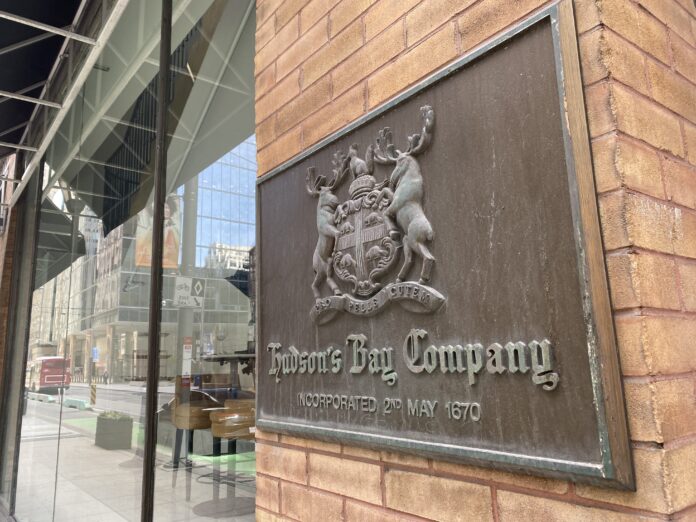
Hudson's Bay plaque on the flagship store at 176 Yonge St. in Toronto. Photo: Dustin Fuhs/6ix Retail
Hudson’s Bay Company ULC (Hudson’s Bay), the Canadian retail giant with over 80 stores across the country, filed for protection under the Companies’ Creditors Arrangement Act (CCAA) in the Ontario Superior Court of Justice on Friday. The legal move marks a critical step in the company’s ongoing battle to stabilize its operations amid a backdrop of financial struggles and significant challenges in Canada’s retail landscape. With the appointment of Alvarez & Marsal Canada Inc. as the court-appointed monitor, the company will now begin a restructuring process in hopes of charting a sustainable path forward.
The court’s Initial Order grants Hudson’s Bay relief from creditor actions for an initial period of 10 days, with the potential for extension as the restructuring process unfolds. In addition to the court’s protection, Hudson’s Bay has secured interim financing from Restore Capital, LLC, an affiliate of Hilco Global, with a CAD$16 million advance already approved. However, the company is expected to seek further financing to support its operations throughout the CCAA process.
For Hudson’s Bay, this bankruptcy filing is not an isolated event but part of a larger, years-long struggle. Despite efforts to turn around the company, it has faced numerous financial difficulties over the past several years. Hudson’s Bay said in documents that it has long been burdened by high operational costs, declining consumer foot traffic, and increasing competition from both online and discount retailers.
Several macroeconomic and industry-wide factors were blamed for the retailer’s situation. The escalating trade tensions between Canada and the United States, the ongoing uncertainty caused by tariffs, and rising costs of living all were said to have contributed to the company’s financial woes. Moreover, shifts in Canadian consumer habits, accelerated by the COVID-19 pandemic, have forced many brick-and-mortar retailers like Hudson’s Bay to adapt to a new retail reality, one that heavily relies on e-commerce.
The company’s recent efforts to refinance its credit facilities earlier in 2024 were ultimately thwarted by the external economic pressures and the risks associated with the ongoing trade war, which compounded the uncertainty in the market.
Outside the temporarily shuttered Hudson’s Bay store in downtown Vancouver, July 2024. Photo: Lee Rivett
The Economic Pressures on Retail: A Perfect Storm for Hudson’s Bay
Hudson’s Bay’s bankruptcy filing blamed a culmination of several intertwined factors, including global trade issues, shifting consumer preferences, and Canada’s broader retail challenges. These include:
Trade and Financing Uncertainty: The ongoing trade war between Canada and the U.S., compounded by retaliatory tariffs, created substantial economic uncertainty. This situation made it challenging for Hudson’s Bay to refinance and secure the necessary capital to continue its operations, it said.
Post-Pandemic Shifts in Consumer Behaviour: The COVID-19 pandemic altered the way Canadians work and shop. A permanent reduction in downtown office workers, coupled with work-from-home policies, led to decreased foot traffic in major urban stores. The prolonged closure of physical retail stores also accelerated the shift toward e-commerce, a shift that has proven difficult for many traditional department stores to fully embrace.
Economic Strain on Canadian Consumers: The rising cost of living, soaring mortgage rates, and a weakening Canadian dollar have all placed pressure on Canadian households. This economic environment has led to restrained discretionary spending, which has impacted retailers like Hudson’s Bay that rely on customer spending for profitability, it said.
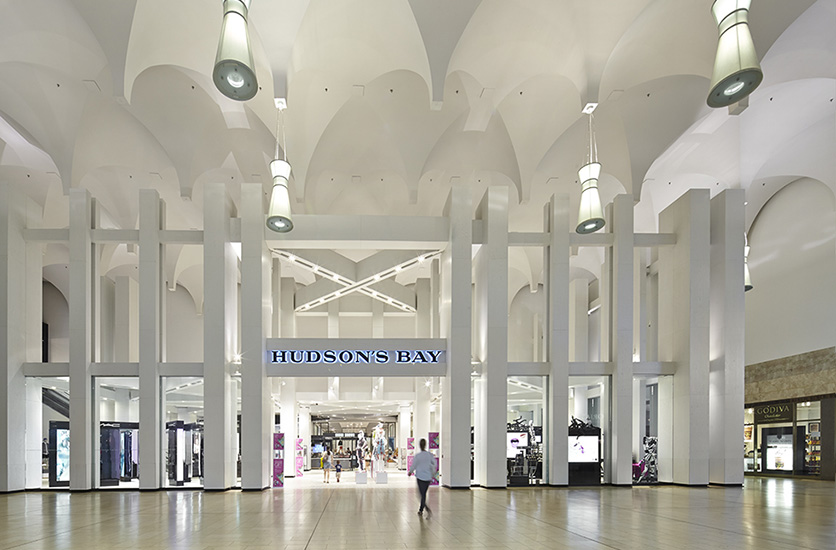
(HUDSON’S BAY, YORKDALE. PHOTO: ALEX REBANKS ARCHITECTS. INC.)
A Focus on Canadian Operations
Despite these significant challenges, Hudson’s Bay says it is committed to re-establishing its place in Canada’s retail ecosystem. The company says plans to focus on its core strengths, including its flagship Hudson’s Bay stores.
The Canadian operations of Saks Fifth Avenue and Saks OFF 5TH operate under a licensing agreement — the future of these stores have become uncertain. In Canada, and licensed Saks Fifth Avenue stores include a downtown Toronto flagship and stores at CF Sherway Gardens in Toronto and at CF Chinook Centre in Calgary. Their condition, compared to when they opened between 2016 and 2018, is shocking. Hudson’s Bay also operates 13 licensed Saks OFF 5TH off-price stores in Canada, most of which are underperforming.
As the company navigates this turbulent period, Hudson’s Bay says it remains committed to maintaining its relationships with employees, customers, and partners. Liz Rodbell, the company’s President and CEO, emphasized in a statement that the decision to seek creditor protection under CCAA was made with the best interests of all stakeholders in mind. “While very difficult, this is a necessary step to strengthen our foundation and ensure that we remain a significant part of Canada’s retail landscape,” she said.
Hudson’s Bay’s Financial Struggles: A Closer Look
The retailer’s financial struggles have been a long time coming. Hudson’s Bay was once one of the most prominent and established names in Canadian retail, with a rich history that dates back more than 300 years. However, in recent years, the company has been beset by a series of financial setbacks.
Since being acquired by private-equity investor Richard Baker in 2008, Hudson’s Bay has grappled with high debt levels and rising operational costs. Despite efforts to diversify its business, including a push into e-commerce and international markets, the company has failed to fully capitalize on these ventures. Moreover, Hudson’s Bay’s real estate holdings have been a major factor in its financial strategy, with Baker leveraging the company’s prime retail locations to raise capital. However, this strategy has proven less effective in the face of shifting consumer behaviour and a decline in demand for traditional department stores.
In addition to these financial pressures, the company has faced operational issues, such as the malfunctioning HVAC systems in stores across Canada. In the summer of 2024, multiple Hudson’s Bay locations were temporarily closed due to unsafe conditions caused by HVAC system failures during a heatwave. These incidents highlighted the company’s mounting maintenance issues and deepened concerns over its ability to maintain operations at scale. Sources said problems were mostly related to vendors not being paid.
A New Vision for Hudson’s Bay?
As Hudson’s Bay navigates this restructuring process, the key question is whether the company can reclaim its place in Canada’s retail landscape. Retail experts have pointed out that Hudson’s Bay must adapt to the evolving retail environment, where online shopping, personalization, and omni-channel experiences are becoming more important than ever.
David Ian Gray
David Ian Gray, a prominent retail expert, noted that Hudson’s Bay’s troubles reflect a broader shift in the retail industry, where traditional department stores are increasingly becoming irrelevant. “The problem is they’ve been doing it so much damage by neglect, particularly over the last year or two, with not even doing basic maintenance. How do you rebuild that?” Gray said, adding that while there is hope for the brand’s revival, the long-term future of Hudson’s Bay remains uncertain.
A major challenge for Hudson’s Bay will be rebuilding its relationships with key vendors. According to sources, the company has already alienated many brands due to outstanding debts for merchandise orders. The withdrawal of brands like Australian fashion label Ever New Melbourne, which recently removed all of its merchandise from Hudson’s Bay stores, underscores the retailer’s financial instability. If Hudson’s Bay fails to regain the trust of its suppliers, its inventory levels and store offerings could be severely impacted, making a recovery even more difficult.
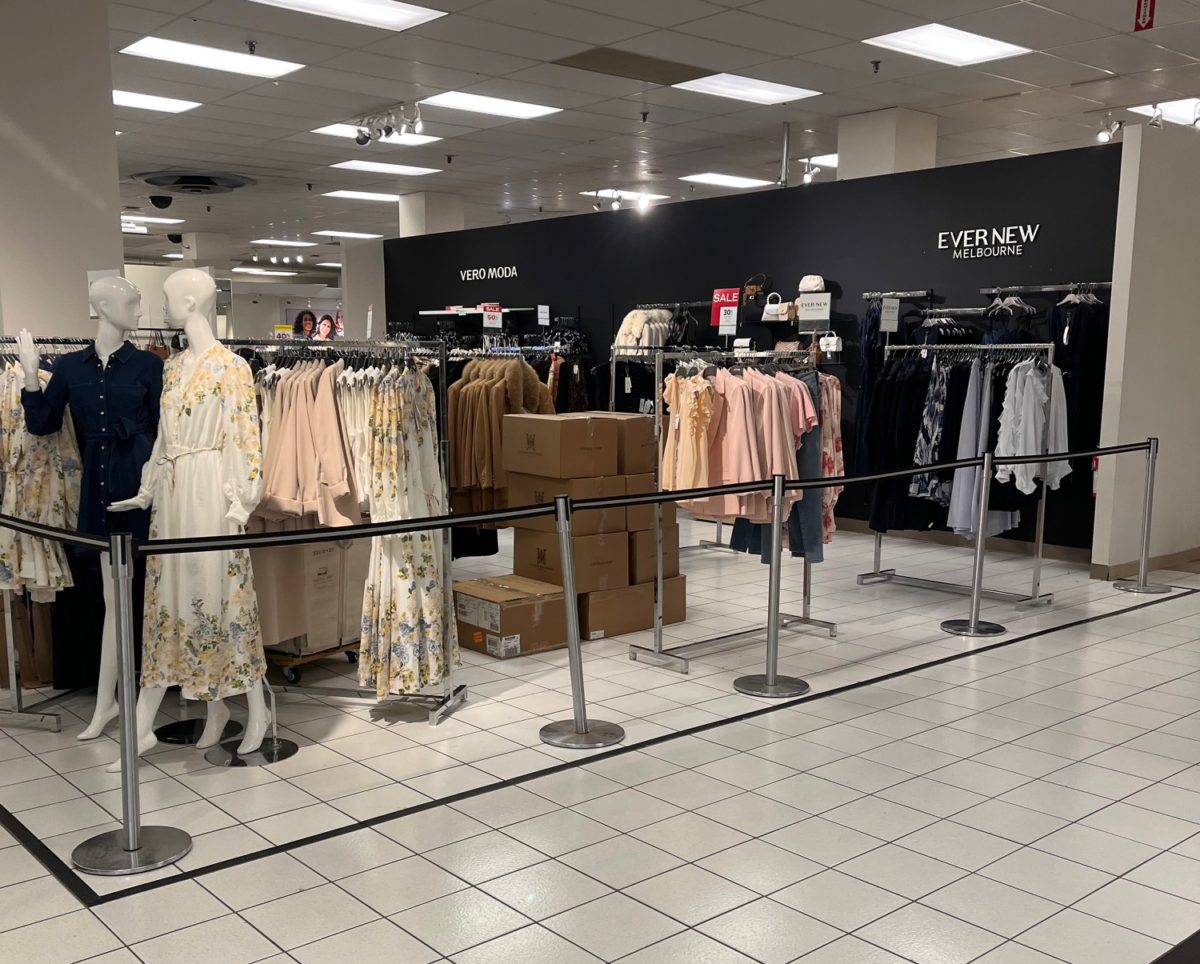
Clearing out the product – Ever New Melbourne representatives dismantle a shop-in-store at Hudson’s Bay in Coquitlam, BC. A reader, who took this photo, spoke with reps who were moving product out of Hudson’s Bay, moving it into the CF Pacific Centre and Metropolis at Metrotown Ever New stores.
Rebuilding Hudson’s Bay: Key Areas for Revitalization
For Hudson’s Bay to survive and thrive in the years to come, it must focus on several key areas, according to Gray:
Revitalizing the Brand: The Hudson’s Bay brand has long been synonymous with Canadian retail, but its relevance has waned in recent years. To remain competitive, the company must reinvent itself to meet the changing needs and expectations of modern Canadian shoppers. This includes offering a more curated product mix, enhancing its customer experience, and making the brand more digitally savvy.
Strengthening Vendor Relationships: The recent departure of key vendors signals a breakdown in trust between Hudson’s Bay and its suppliers. To ensure the success of its restructuring efforts, Hudson’s Bay will need to rebuild these relationships and offer more attractive terms to regain access to high-quality merchandise.
Omni-Channel Retailing: As the retail industry continues to evolve, an effective omni-channel strategy is essential. Hudson’s Bay must ensure that its online and offline experiences are seamless, enabling customers to shop whenever and however they prefer.
Cost Management and Operational Efficiency: With its financial difficulties, Hudson’s Bay must streamline its operations, cut unnecessary costs, and focus on improving the efficiency of its supply chain and store operations.
Reinventing Its Real Estate Strategy: The company’s extensive real estate holdings have long been a double-edged sword. While its prime locations have historically been a source of value, they now represent a significant financial burden. Hudson’s Bay may need to reconsider its approach to real estate, potentially selling off or repurposing some of its properties to reduce debt.
Larry Leung’s Perspective on Hudson’s Bay’s Path Forward
Larry Leung, a customer service expert, shared his thoughts on how Hudson’s Bay can regain traction amidst its current challenges. He emphasized the importance of going “back to basics” to address the company’s core issues.
Larry Leung
“Hudson’s Bay should get back to basics and improve sales by focusing on a consistent omni-channel experience, engaging customers with a relevant pared-down product mix, rejuvenating its loyalty program with partners, and engaging employees,” said Leung. “This is crucial to re-establishing the brand’s credibility and customer loyalty.”
Leung also noted that the key to reviving Hudson’s Bay’s fortunes lies in improving the in-store experience and aligning the company’s physical presence with the needs of modern Canadian shoppers. His suggestion to streamline the product offering, paired with a reinvigorated loyalty program, underscores a crucial strategy for the retailer to regain its relevance in a competitive market.
Gary Newbury’s Analysis: A Retail Legacy in Decline
Gary Newbury, a retail supply chain specialist, offered a sobering view of Hudson’s Bay’s financial troubles, attributing much of the retailer’s decline to strategic missteps over the years. He pointed to the company’s acquisition of Neiman Marcus in a significant $2.65 billion deal, questioning whether the leadership truly believed in the future of Hudson’s Bay Stores.
Gary Newbury
“Over the last year or so, HBC acquired Neiman Marcus for a significant outlay of $2.65 billion. One may argue if the leadership thought HBC Stores had a future, they would have invested the money in HBC Stores,” Newbury said. This move, he argues, reflected a larger shift in priorities at Hudson’s Bay, one that further distanced the company from its roots as a quintessential Canadian brand.
Newbury highlighted the amalgamation of Saks Fifth Avenue and Neiman Marcus under a separate leadership team as a pivotal moment. Hudson’s Bay Stores, on the other hand, was left “very much on the outside.” The decision to separate these operations, according to Newbury, was a clear signal of trouble for the Canadian retailer, which has been a fixture in Canada since 1670. “This definitely spelt trouble for this Canadian brand, a brand that has been present in Canada since 1670 and has deep roots in the hearts and minds of Canadians,” he said. For decades, Hudson’s Bay embodied the hardworking, enduring spirit of Canada, and the shift away from this legacy was a turning point that many saw as the beginning of its downfall.
A History of Missteps
The retailer’s troubles were compounded by a series of missteps and poor strategic decisions, Newbury explained. One of the most notable was Hudson’s Bay’s attempt to “buck the trend” by disaggregating its website, The Bay, from its store business, only to abandon the strategy within a year. “They claimed to be ‘bucking the trend’ by having a disaggregated website (TheBay.com) from the store business and said this was genius, only to abandon this a year later,” Newbury remarked. This failure to stick with a cohesive strategy added to the retailer’s struggles and confusion around its digital and physical retail presence.
Another debacle, according to Newbury, was the attempt to revive the Zellers brand. Initially launched in the Burlington Mall as a well-thought-out concept, the Zellers revival ultimately failed due to poor execution. By the time it expanded into Durham Region, it had been reduced to a “home furnishings and apparel landscape of overpriced, fairly perfunctory, and poorly visually merchandised assortments.” This, Newbury suggests, epitomized Hudson’s Bay’s broader retail strategy failures in recent years.
Operational Failures and Lack of Technological Investment
As Hudson’s Bay faced mounting pressures, operational issues also started to surface, further complicating its financial woes. The pandemic only heightened these struggles, with disputes arising between Hudson’s Bay and its landlords over the maintenance of store environments during lockdowns. The company’s failure to maintain its HVAC systems—leading to store closures due to unsafe conditions—was another sign of the operational neglect that plagued the retailer during this period. “There were troubles/disputes during the pandemic with some failed attempts to insist that landlords had not maintained a first-class operating environment during the restriction, and then the failure of HVAC systems reported on the West Coast,” Newbury said.
In addition to these operational challenges, Hudson’s Bay’s lack of investment in modern technology proved to be another critical factor in its demise. Instead of upgrading to newer systems, the retailer chose to patch up its old legacy infrastructure, which hindered its ability to compete effectively in the digital era. “Failure to invest in current technology, choosing to patch up old legacy systems spelled doom for effectiveness,” Newbury stated. This decision left the company behind its competitors in terms of efficiency and innovation.
The Leadership Struggle and the Fall of a Retail Giant
Newbury also pointed to Hudson’s Bay’s ongoing leadership struggles as a contributing factor to its decline. The company cycled through multiple Presidents in a manner reminiscent of Sears Canada’s final years, with each new leader coming and going without making a significant impact. “Presidents were wheeled in and wheeled out, much the way Sears Canada saw in its last 5-10 years,” Newbury remarked.
The constant turnover in leadership sent a clear message to both consumers and suppliers that Hudson’s Bay lacked a clear vision and stable direction. Even as the company tried to shift its strategy, including an ambitious plan to position itself as a premier retail destination, the results were underwhelming. Newbury pointed out that, early in the pandemic, retail futurist Doug Stephens suggested Hudson’s Bay reduce its store count to just 30 locations. A year later, Hudson’s Bay claimed it had developed a new strategy focused on becoming a luxury retail leader. But as Newbury observed, “perhaps this formed an inspired template for the top leadership team—how to bust a brand in five easy steps?”
Looking Ahead: Can Hudson’s Bay Bounce Back?
The road ahead for Hudson’s Bay is fraught with challenges. The company must navigate a complex restructuring process, repair its relationships with suppliers and vendors, and find ways to reinvent itself in an increasingly digital world. The retailer could also close dozens of stores. However, there is a glimmer of hope that with the right leadership, a renewed focus on customer experience, and a revitalized business model, Hudson’s Bay can once again find its place with Canadian shoppers.
As the company moves forward with its restructuring efforts, all eyes will be on the next court hearing, scheduled for March 17, 2025. The outcome of this hearing will determine the future direction of Hudson’s Bay and whether it can remain a viable player in Canada’s competitive retail landscape.
Hudson’s Bay, the iconic Canadian department store chain founded in 1670, is reportedly preparing to file for bankruptcy within days, according to sources who spoke with the Wall Street Journal. The move follows mounting financial difficulties that have plagued the retailer in recent years, exacerbated by operational challenges and shifting market conditions.
The impending bankruptcy comes just months after Hudson’s Bay was spun off as a standalone business in December 2024. That separation occurred following a major transaction in which Saks Fifth Avenue merged with Neiman Marcus Group in a $2.65 billion deal, creating Saks Global. The newly formed entity, which also owns luxury retailer Bergdorf Goodman in New York City, is not expected to be affected by Hudson’s Bay’s bankruptcy proceedings, according to individuals familiar with the matter.
Since 2008, Hudson’s Bay has been controlled by private-equity investor Richard Baker, an American real estate mogul known for acquiring struggling retailers and leveraging their real estate assets. Despite previous efforts to revitalize the brand, Hudson’s Bay has struggled to maintain financial stability.
Hudson’s Bay at Woodgrove Centre in Nanaimo, BC in November 2023. Photo: Lee Rivett.
Operational and Financial Turmoil
Hudson’s Bay currently operates more than 80 stores across Canada, making it one of the country’s most established retailers. However, it has faced increasing difficulties, including a lack of financial resources and issues with banking and credit facilities, as sources told Retail Insider in January 2024. The company has been attempting to stay afloat through strategic layoffs and asset sales, but these measures have not been enough to counteract its declining financial position.
The company’s challenges were further highlighted in July 2024, when a severe heatwave exposed infrastructure issues, leading to HVAC (Heating, Ventilation, and Air Conditioning) system failures at multiple locations. Stores in Vancouver, Victoria, Calgary, Abbotsford, Coquitlam, Winnipeg, and Windsor were temporarily closed due to unsafe conditions. Analysts suggested that the widespread HVAC failures, along with ongoing maintenance problems like malfunctioning escalators and elevators, pointed to deeper operational issues within the retailer.
Staff Layoffs and Cost-Cutting Measures
In response to growing financial pressures, Hudson’s Bay had enacted multiple rounds of layoffs in recent memory, including:
In April 2024, the company restructured its organizational framework, eliminating fewer than 100 positions, which accounted for less than 1% of its workforce. This move was intended to secure long-term sustainability amid a challenging retail landscape.
In January 2024, Hudson’s Bay laid off 41 employees, citing industry headwinds as a driving factor.
To raise capital, the company sold off real estate assets, generating approximately USD$340 million.
Despite these actions, the financial strain appears to have deepened, making bankruptcy a likely next step.
Zellers Diner at Pen Centre (Image: Pen Centre)
The Zellers Revival and Consumer Reception
Hudson’s Bay had attempted to breathe new life into its business by reviving the Zellers brand, a nostalgic discount retailer that once had a strong presence in Canada.
In August 2022, HBC announced plans to relaunch Zellers both online and through physical store-in-store locations within Hudson’s Bay stores.
The first 12 Zellers sections opened in March 2023 in Ontario and Alberta, each ranging between 8,000 and 10,000 square feet.
By April 2023, Zellers expanded to 25 locations, followed by an additional 21 pop-up shops in August 2023.
In September 2023, HBC committed to introducing Zellers pop-ups in all remaining Hudson’s Bay stores by the holiday season.
Despite initial excitement, consumer response to the Zellers comeback has been mixed. A poll conducted in April 2024 revealed that while Canadians welcomed the return of the brand, many remained hesitant to shop there, with nostalgia alone not being enough to drive consistent sales.
A key aspect of Zellers’ strategy has been its partnership with Anko, an Australian brand associated with Kmart. While the products were generally well received, some consumers noted discrepancies in pricing compared to international markets.
The Leadership of Liz Rodbell
Liz Rodbell.
Amid these challenges, Hudson’s Bay appointed seasoned retail executive Liz Rodbell as its President and CEO in December 2023. Rodbell, who had previously served as Hudson’s Bay’s President from 2013 to 2017, was brought back to help steer the company through turbulent times.
During her prior tenure, she was credited with driving a 22% sales increase for the retailer. In returning to lead the company, Rodbell emphasized her commitment to strengthening brand partnerships and improving the customer experience. However, with Hudson’s Bay now on the verge of bankruptcy, the effectiveness of her leadership efforts remains to be seen.
Growing Concerns from Suppliers
In a troubling development, Retail Insider has learned that yesterday and today, Aussie fashion brand Ever New Melbourne removed all of its merchandise from Hudson’s Bay stores. Multiple suppliers have reported outstanding debts for merchandise orders dating back to 2023.
These issues underscore the retailer’s cash flow problems, raising concerns about its ability to continue operations even in the short term. If more brands choose to sever ties with Hudson’s Bay, its inventory levels and store offerings could be significantly impacted.
Clearing out the product – Ever New Melbourne representatives dismantle a shop-in-store in Coquitlam, BC. A reader, who took this photo, spoke with reps who were moving product to the CF Pacific Centre and Metropolis at Metrotown Ever New stores.
What Lies Ahead for Hudson’s Bay?
With a bankruptcy filing looming, questions remain about what this will mean for Hudson’s Bay’s remaining stores, employees, and suppliers. While the retailer has attempted to modernize and adapt through strategic restructuring and brand revivals, it has faced continued financial headwinds that may now prove insurmountable.
Industry experts speculate that if Hudson’s Bay proceeds with bankruptcy, it could attempt to restructure its debt and continue operations in some form. However, given the company’s ongoing struggles and reliance on real estate sales to stay afloat, a more drastic reduction in store footprint—or even a full wind-down of the business—is also a possibility. One landlord told Retail Insider this week that they were hearing that about 50 of Hudson’s Bay’s stores could close with a bankruptcy filing.
As one of Canada’s most historic retailers, Hudson’s Bay’s fate will be closely watched by consumers, employees, and industry insiders alike. The coming days will determine whether the storied brand can find a way forward or if it will mark the end of an era in Canadian retail history.
Restaurants Canada is applauding Friday’s federal announcement of new support measures for workers and businesses impacted by the tariff dispute with the U.S.
The move to open the EI Work-Sharing Program to more workers for longer periods is particularly important, as it will allow affected workers to maintain their connection to their job through any disruptions, it said.
Janick Cormier
“Helping exporters find new markets, providing favourable loans to businesses facing liquidity issues and shoring up our agri-food sector are all moves in the right direction. Restaurants Canada also commends federal and provincial governments for all of the progress they have made on removing interprovincial trade barriers, in particular the move to allow the sale of alcohol products from other jurisdictions in most provinces,” said Janick Cormier, Vice-President, Atlantic Canada, Restaurants Canada.
“The last few months have thrown Canada’s economy into turmoil, at a time when many restaurants are operating at a loss or just breaking even. The foodservice industry is Canada’s fourth largest private sector employer, with nearly 1.2 million workers, and contributes $120 billion to the economy. Their success props up every community in Canada and tens of other industries, from fishing to tourism to agriculture.”
Restaurants Canada is urging the government to be prepared to do more for workers and businesses if the tariff threat continues.
“The restaurant industry stands with governments in protecting Canada’s interests, but retaliatory tariffs will add pressure to an industry that is in worse shape now than at any time during the pandemic,” said Cormier.
If the government can’t exempt those items, Restaurants Canada said it can soften the blow for the foodservice industry by:
Removing sales tax from all food, as it did during the GST/HST holiday.
Providing manufacturing credits to enable food and packaging manufacturers to expand production quickly.
Loosening regulations around packaging requirements from out of country products that may be substitutes for American-made products.
Rolling out a wage subsidy program to keep employees connected to their workplaces and prevent job losses.
Provincial governments can also help by deepening alcohol wholesale discounts.
On Friday, the federal government said “we will use every tool at our disposal so Canadian businesses and workers can weather this storm. We will defend Canadian jobs.”
“To support our businesses and ensure they have the liquidity they need through this turbulent time, we will be:
Launching the Trade Impact Program through Export Development Canada. The program will deploy $5 billion over two years, starting this year, to help exporters reach new markets for Canadian products and help companies navigate the economic challenges imposed by the tariffs, including losses from non-payment, currency fluctuations, lack of access to cash flows, and barriers to expansion.
Making $500 million in favourably priced loans available through the Business Development Bank of Canada to support impacted businesses in sectors directly targeted by tariffs, as well as companies in their supply chains. Businesses will also benefit from advisory services in areas such as financial management and market diversification.
Providing $1 billion in new financing through Farm Credit Canada to reduce financial barriers for the Canadian agriculture and food industry. This lending offer will help address cash flow challenges so that businesses can adjust to a new operating environment and continue to supply the high-quality agricultural and food products that Canadians rely on.”
Along with supporting businesses, the government said it is also introducing temporary flexibilities to theEI Work-Sharing Program to increase access and maximum agreement duration.
“The Work-Sharing Program provides EI benefits to employees who agree with their employer to work reduced hours due to a decrease in business activity beyond their employer’s control. This helps employers retain experienced workers and avoid layoffs and helps workers maintain their employment and skills while supplementing the reduced wages with EI benefits,” it said.
“In the weeks and months ahead, additional measures will be brought forward to support businesses and workers as needed. The federal government will continue to work closely with provinces and territories to ensure complementary supports are in place across all jurisdictions.”
Dominic LeBlanc
“We are deeply committed to supporting Canadian businesses and workers in the face of the unjustified and unreasonable tariffs the United States has imposed on Canadian goods. We have faced economic challenges before, and we know we will overcome this new challenge. The measures announced today as part of our Team Canada response will protect jobs, keep businesses open, and help stabilize Canada’s economy,” said Dominic LeBlanc, Minister of Finance and Intergovernmental Affairs.
“With tariffs themselves changing every five minutes, getting this right will be a challenge. Expanding the EI Work-Sharing Program is a sensible way of allowing small firms to trim payrolls without losing connection to their workers. It has been used in past emergencies and is a proven help. As for the other supports, what I can tell you is that small firms are NOT looking for more debt through loans. While the CEBA program was helpful during the pandemic, what small firms need in emergencies is help meeting payroll and keeping the lights on,” he said.
Dan Kelly
“One thing that would be very useful is help in defraying shipping costs for small firms that need to reach a new export market or a supplier of imported goods. Business subsidies are bad ideas in normal times, but an SME shipping support program may be very helpful to small firms trying to sell into/buy from other Canadian provinces or countries other than the United States. CFIB data show that shipping costs are one of the chief obstacles to Canadian small firms looking at markets outside of the US.
“Temporary help may help catalyze greater interprovincial trade and utilization of our trade agreements. I welcome thoughts from small business owners on this idea.
“Beyond that, the best thing governments can do is: 1. Recall Parliament to ensure we can respond quickly. 2. Kill the capital gains inclusion rate hike and the April 1 hike in carbon taxes & liquor taxes. 3. Immediately pass the increase in the Lifetime Capital Gains Exemption, the Canada Entrepreneur Incentive and legislation to make the December $2.5B carbon tax rebate tax free. 4. Continue with the significant progress in mutually recognizing all provincial rules to fix interprovincial trade. (good work on this one is happening) 5. Pass emergency tax cuts – like cutting the small business corporate rate to zero for the next year – both federally and provincially.”
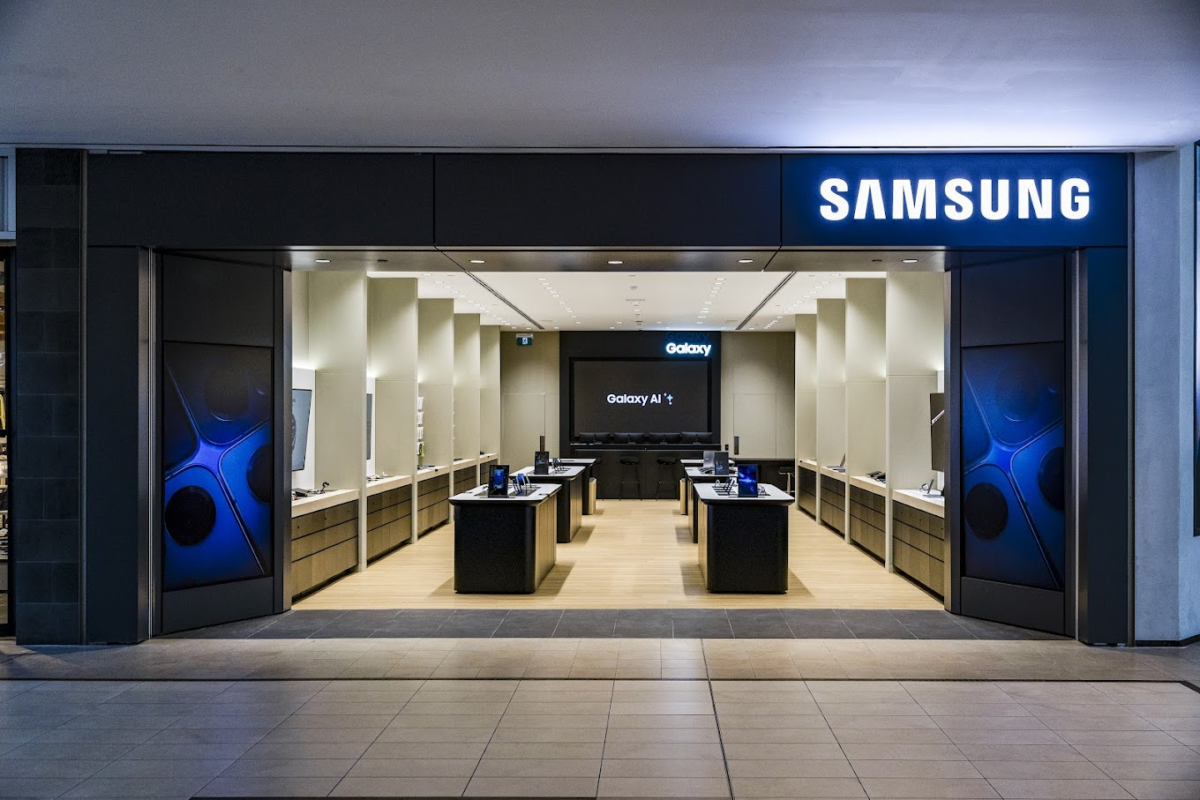
Samsung Experience Store opening at Scarborough Town Centre. Photo: Samsung Canada
Samsung Electronics Canada has unveiled its latest Samsung Experience Store at the Scarborough Town Centre in Toronto, reinforcing the brand’s commitment to expanding its retail presence in Canada. The new store aims to provide customers with an immersive, hands-on experience with Samsung’s latest products, including the Galaxy S25 series and a suite of AI-powered features.
“We’re thrilled to introduce this interactive shopping experience to Scarborough and our dedicated customers,” said Krista Collinson, Head of Direct-to-Consumer Division at Samsung Electronics Canada. “This store offers a unique chance to experience new technology, including innovations like Samsung Health, Now Brief, and Live Translate. We’re excited for the community to explore how our connected devices and new features can enhance daily life for Canadians.”
Krista Collinson, Head of Direct-to-Consumer Division at Samsung Electronics Canada
A High-Tech Retail Destination
Strategically located at Scarborough Town Centre, the new Samsung Experience Store is designed to serve as more than just a retail space. It functions as a hub for customer support, offering expert-led services such as device repairs, troubleshooting, small business support, and the ability to browse Samsung’s entire product catalog online.
“Building on the success of our Samsung kiosk at Scarborough Town Centre, we’re proud to open the Samsung Experience Store – reinforcing our ongoing commitment to enhancing the shopping experience for Canadians,” said Brian Shin, President & CEO of Samsung Electronics Canada Inc. “This store is more than just a retail space—it’s a destination where customers can discover new technology and receive expert support to make the most of Samsung’s products.”
Beyond its retail focus, the new store will feature live demonstrations, exclusive promotions, and interactive activations such as Sketch by Galaxy AI, Live Translate, and Now Brief, allowing customers to engage with the latest innovations firsthand.
Expanding Samsung’s Physical Retail Strategy
Samsung’s presence in Canada continues to grow, with its retail strategy balancing full-size stores and smaller footprint kiosks. The company currently operates several Samsung Experience Stores in high-profile malls, including the Yorkdale Shopping Centre and CF Sherway Gardens in Toronto, Metropolis at Metrotown in Burnaby, and the Eaton Centre in Montreal.
Alongside these Experience stores, Samsung also operates Express Stores—smaller retail locations in shopping centres including Bramalea City Centre in Brampton, Square One Shopping Centre in Mississauga, and Southgate Centre in Edmonton.
“Our approach allows us to strategically enter new markets, in some cases introducing an express store, which builds awareness and establishes a customer base,” explained Collinson. “Identifying strong customer demand and securing the right retail location, we can transition into a full-scale store. Scarborough Town Centre is a prime example of that strategy.”
Samsung Experience Store at Scarborough Town Centre. Photo: Samsung Canada
A Store Designed for Community Engagement
The location of the new store is particularly significant given Scarborough’s growing population and its proximity to key suburban areas such as Markham, Newmarket, Aurora, and Durham Region.
“This region has been underserved in terms of technology retail, so having a dedicated Samsung Experience Store fills an important gap,” said Collinson. “We’re not just here to sell products—we’re providing a full-service experience, including on-site device repairs with Samsung Care Plus and support for small business customers.”
Samsung’s expanded store model also caters to entrepreneurs and business owners, particularly in industries such as transportation, food service, and retail. The Scarborough store features a dedicated B2B section where businesses can explore Samsung’s enterprise solutions, including Knox security and productivity-enhancing tools.
“We’re seeing strong interest from small business owners who want to integrate Samsung products into their operations, whether it’s tablets for order processing, mobile devices for fieldwork, or secure enterprise solutions,” added Collinson.
An Omnichannel Approach to Retail
The new Samsung Experience Store is fully integrated with Samsung’s online and offline retail ecosystem, offering seamless shopping options for customers.
“We’re committed to delivering an omnichannel experience,” said Collinson. “Customers can browse online, visit the store to see products in person, and either purchase in-store or complete their transaction online with home delivery. We also allow customers to buy online and pick up in-store, as well as make in-store returns for online purchases.”
Samsung’s investment in retail extends beyond physical stores, with a strong focus on customer education and engagement. The company offers in-store learning sessions and personalized consultations to help customers maximize the potential of their devices.
“We believe retail is not just about transactions—it’s about building relationships,” said Collinson. “Customers today expect more than just a place to shop; they want a destination where they can learn about new technologies, interact with knowledgeable staff, and have a seamless experience across all channels.”
Samsung Experience Store opening at Scarborough Town Centre. Photo: Samsung Canada
The Future of Samsung’s Retail Expansion in Canada
While Samsung has established a strong retail presence in Canada, there are still key markets where the company is evaluating expansion opportunities.
“We are always exploring new locations,” said Collinson. “The challenge in Canada is finding premium retail spaces that align with our brand experience. Our partnerships with landlords like Oxford, Cadillac Fairview, Primaris REIT, Morguard Corporation, and Ivanhoé Cambridge are crucial in securing the right locations for future stores.”
A Strong Commitment to Customer Service
Samsung’s expansion comes at a time when consumers are increasingly looking for personalized, expert-led retail experiences. As competition in the Canadian tech market intensifies, Samsung is betting on a high-touch retail approach to build deeper customer relationships.
“Retail is evolving, and so are customer expectations,” said Collinson. “We are investing in our stores not just to showcase our products, but to provide an immersive experience where customers can get hands-on with technology and receive the support they need.”
Ethan Allen at Yorkville Village in Toronto. Photo: Ethan Allen
Ethan Allen, the esteemed American furniture and interior design retailer, has opened its latest Canadian location at Yorkville Village in Toronto. The expansion places the brand in one of the city’s most prestigious shopping districts, aligning with Yorkville’s reputation for high-end retail and luxury living.
The decision to establish a presence in Yorkville Village was driven by a combination of existing customer demand and the opportunity to attract new clientele. Many of Ethan Allen’s Toronto-based customers already frequent the area for shopping, dining, and entertainment. The move enhances the brand’s accessibility while positioning it among other premium retailers catering to affluent urban dwellers.
A Distinctive Retail Experience
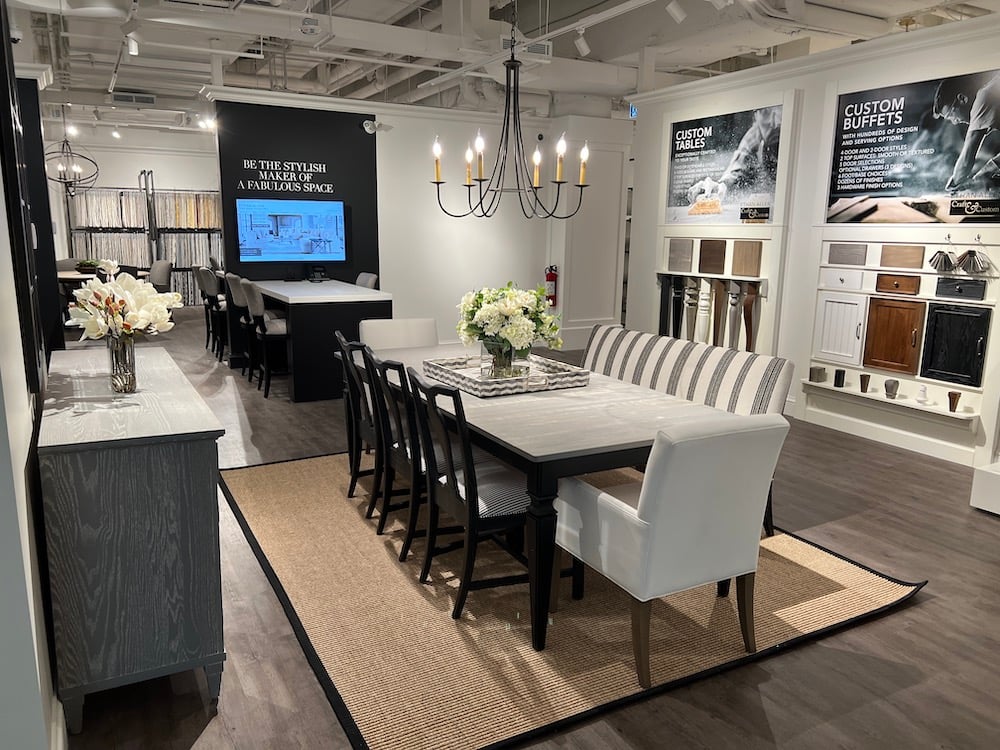
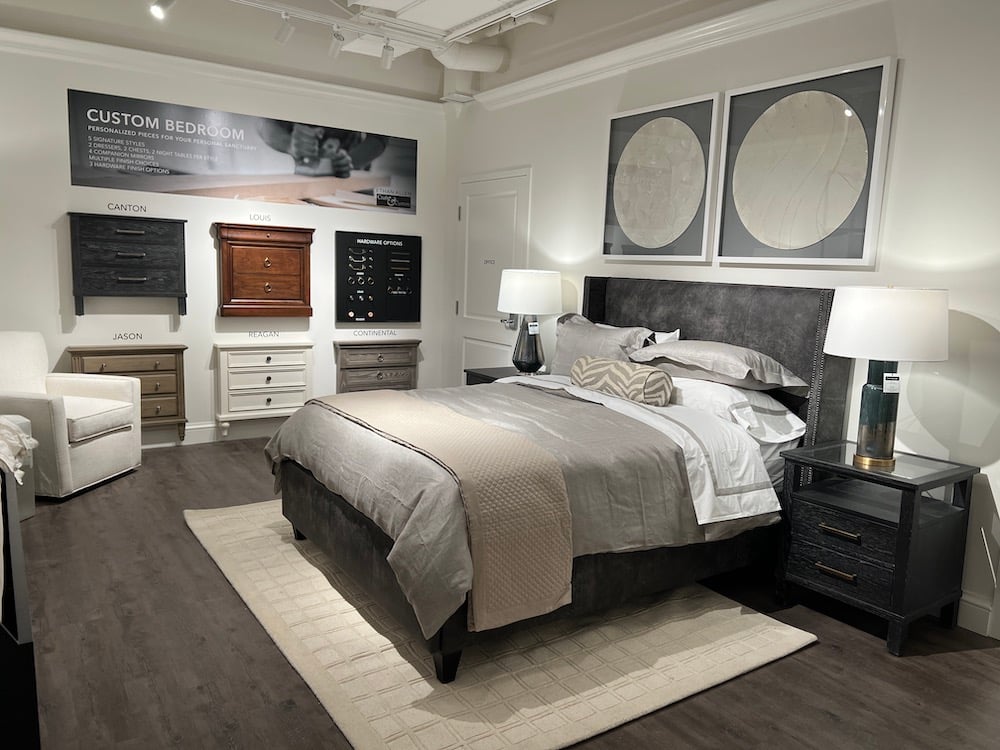
Ethan Allen’s Yorkville Village location has been designed as a Design Studio, placing emphasis on customization and personalized interior design solutions. The space is carefully curated to showcase a range of style projections tailored to Toronto’s diverse clientele. Through interactive technology, customers can visualize custom modifications that best suit their lifestyles and design preferences.
A key feature of the Design Studio is Ethan Allen’s complimentary interior design service. This service allows customers to work closely with in-house designers who provide expert guidance on furniture selection, room layouts, and full-home transformations. The emphasis on personalized service sets Ethan Allen apart from competitors in the luxury furniture space.
Ethan Allen at Yorkville Village in Toronto. Photo: Ethan AllenEthan Allen at Yorkville Village in Toronto. Photo: Ethan Allen
Design and Technology Integration
The store’s layout and aesthetic reflect Ethan Allen’s long-standing commitment to craftsmanship and quality. The space features a curved glass storefront, offering an inviting and open feel that immediately showcases the brand’s design capabilities. Styled room vignettes inside the studio present a curated selection of Ethan Allen’s furniture, lighting, and home accessories.
To enhance the customer experience, the store integrates advanced digital design tools. Six interactive screens placed throughout the studio allow customers to explore Ethan Allen’s extensive collections, visualize design changes, and even create 3D room plans. Virtual design consultations are also available, enabling customers to engage with design experts remotely. This combination of high-touch service and digital innovation is at the core of Ethan Allen’s modernized retail strategy.
Ethan Allen at Yorkville Village in Toronto. Photo: Ethan Allen
Catering to Toronto’s Luxury Market
Ethan Allen has long been recognized for its commitment to high-quality craftsmanship. The brand’s furniture is predominantly made in North America, with about 75% of its products produced in company-owned workshops. This dedication to craftsmanship aligns well with Yorkville’s discerning clientele, who prioritize quality and exclusivity in their home decor choices.
The new Yorkville Village location offers a selection of furniture and home décor items that reflect Toronto’s sophisticated and diverse tastes. The store’s customization options allow customers to personalize every aspect of their furniture, ensuring that each piece is tailored to individual styles and needs.
Ethan Allen at Yorkville Village in Toronto. Photo: Ethan Allen
Future Expansion Plans in Canada
While Ethan Allen has not officially announced additional Canadian locations, the brand says it remains focused on expanding its presence in strategic retail settings. The company typically seeks locations in high-traffic retail environments, such as lifestyle centres and urban shopping malls. The success of the Yorkville Village store will likely influence future expansion plans in Canada.
Ethan Allen currently operates multiple Design Centers across the country, with locations in Thornhill, Mississauga, Richmond (BC), and Calgary. Each of these centres offers a similar mix of customizable furniture and design services, reinforcing the brand’s reputation as a premier interior design destination in Canada.
Founded in 1932, Ethan Allen Interiors Inc. has built a legacy as a leader in the furniture and interior design industry. The company is known for its customization capabilities, high-quality materials, and expert craftsmanship.