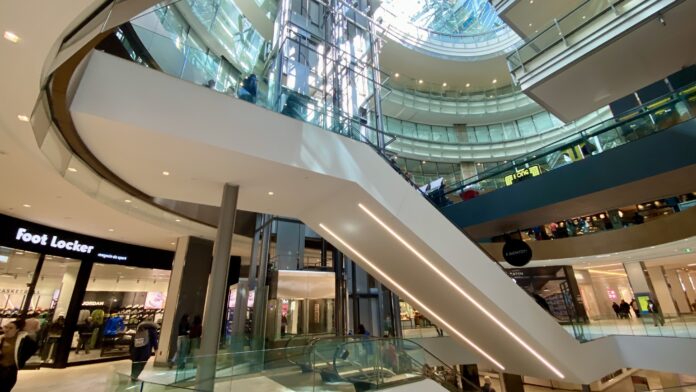
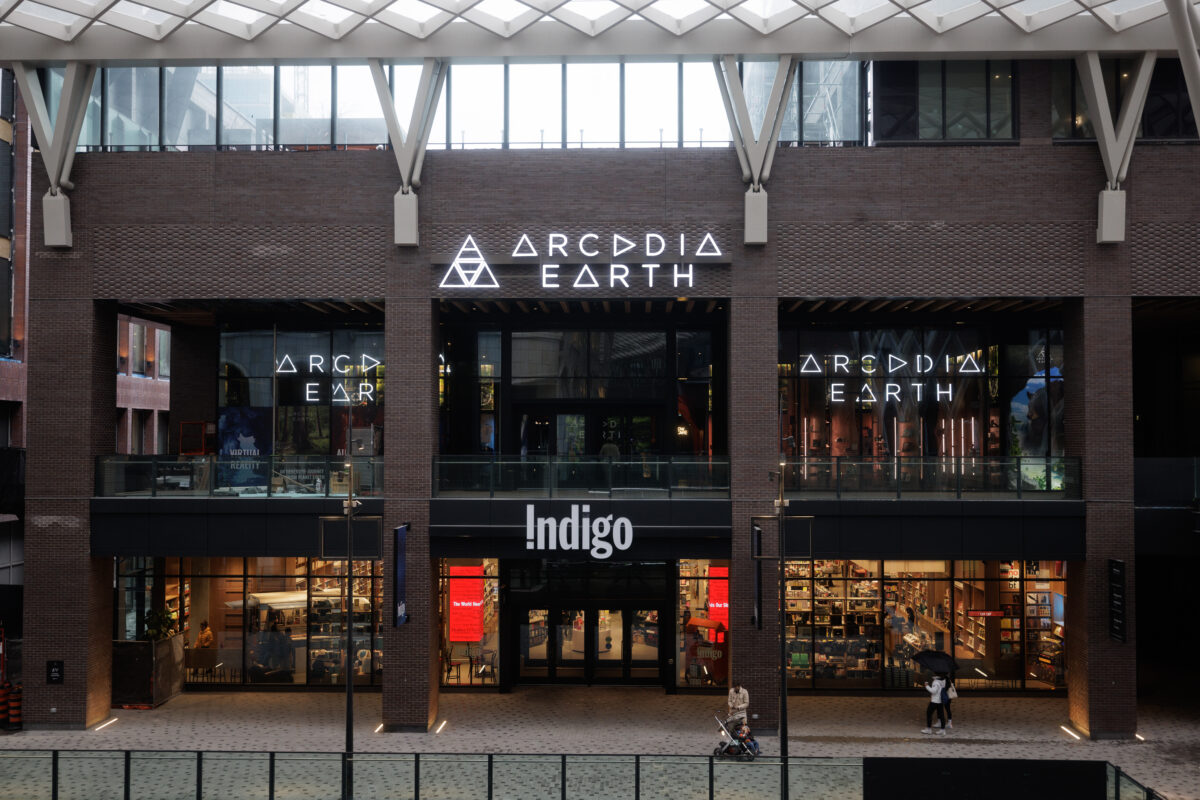
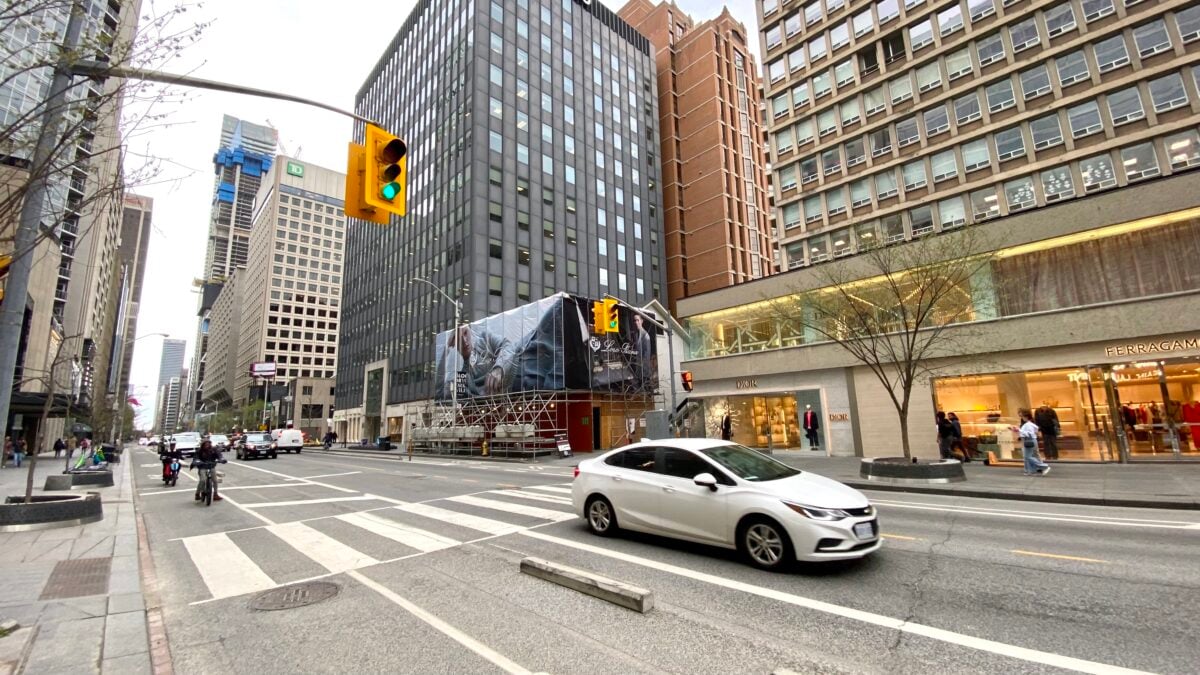
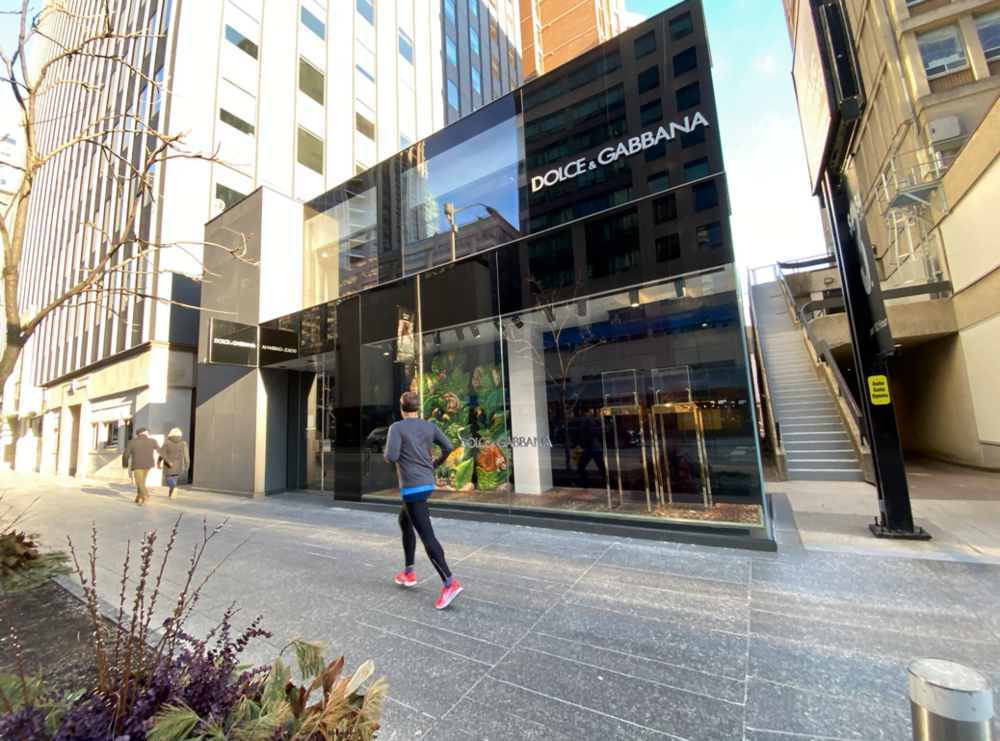
Former H&M at 15 Bloor Street (Image: Craig Patterson)
Retail Insider has learned that retailer Fabricland has secured a lease for the former H&M storefront at 15 Bloor Street West in Toronto’s prestigious Bloor-Yorkville area. The temporary store opens mid-April and will shut when the building demolished for redevelopment — the owner of Fabricland also owns the site.
The new Fabricland store will occupy multiple levels in the 20,000 square foot building which was recently being offered for lease by JLL. The dramatic three-level space is located just off the iconic corner of Yonge and Bloor streets and is next to The One at 1 Bloor Street West, which next year will tentatively be home to an Apple flagship store. Condominium apartment units for sale at The One, which will be finished next year, are currently on the market between about $2 million and $32 million — and an Andaz hotel will also be below it. The door into the luxury building will be next to the new Fabricland as per the photo above.
Each floor at 15 Bloor spans about 5,000 square feet, with 13 foot ceiling heights. H&M opened there in 2004 and was one of the first in Canada at the time. Several years ago, Scotiabank renovated and relocated within the adjacent 19 Bloor Street West and retail space next to it has not yet been leased despite best efforts.
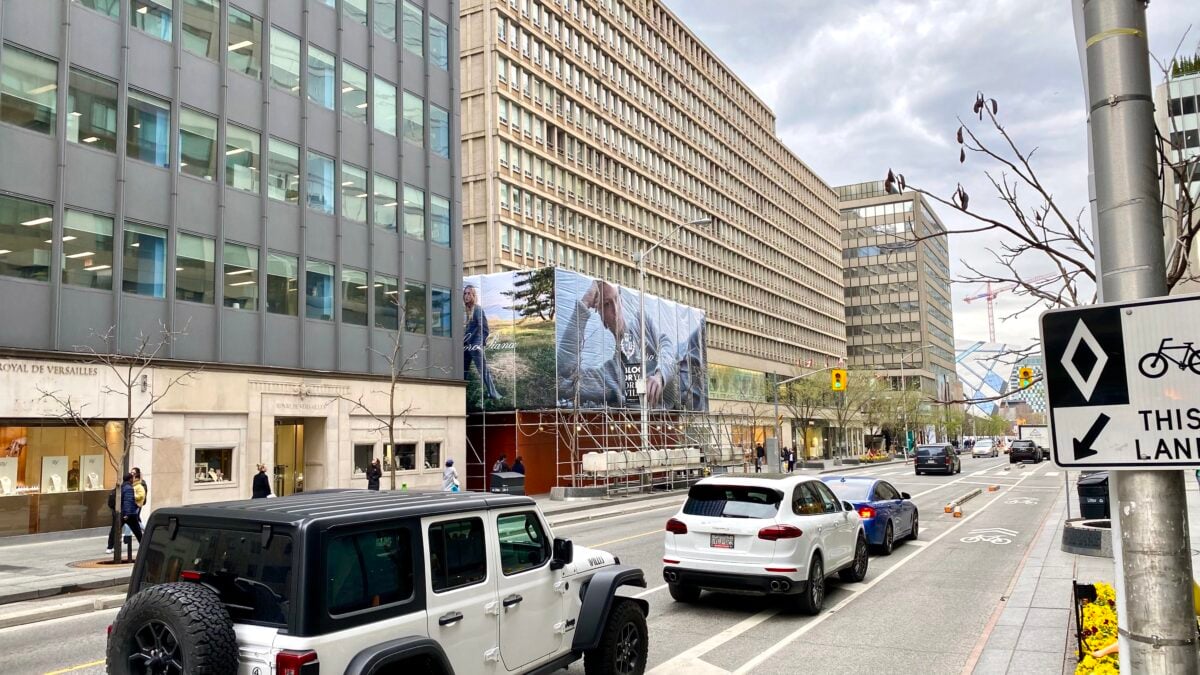
Click image for interactive Google MapFormer H&M at 15 Bloor Street (Image: Dustin Fuhs)
Fabricland is expected to draw traffic to the street, including design students at Toronto Metropolitan University as well as students in other programs.
The terms of the Fabricland lease have not yet been revealed and it’s unknown how long the store will remain, given that 15 Bloor recently saw a tower proposal for the site as well as an adjacent site.
CoStar reported on February 1 of this year that the H&M building as well as the adjacent building at the corner of Balmuto Street, housing a Scotiabank, was under contract to an unnamed buyer for an undisclosed price. Earlier this month, Urban Toronto reported that a development application was being brought by Reserve Properties and Westdale Properties for the combined site with a proposal for a 94-storey mixed use tower housing a whopping 1,262 residential condominium units. The 990 foot tall tower would include less than 3,000 square feet of retail space at its base, a far cry from what’s there now. The proposed density for the site could break a Canadian record if it’s approved as proposed — and many are saying that it won’t be approved with the application requiring revisions, which means Fabricland could be on Bloor Street for several years depending on how things go. Given that the Kimel family owns both Westdale Properties and Fabricland, terms of any lease extensions are expected to be favourable if rent is being paid at all.
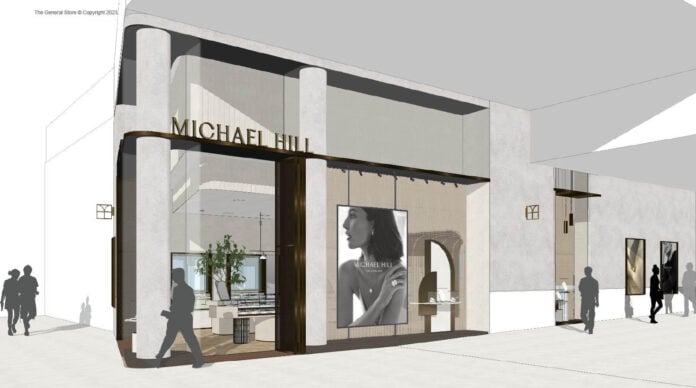
Fabricland will be located directly across the street from the Holt Renfrew Centre, which is home to a large Holt Renfrew flagship store as well as other retailers including a large Aritzia store facing Bloor Street. A large Lululemon flagship store is under construction at the northwest corner of Bloor and Yonge Streets and a Nordstrom Rack store diagonally across from it will eventually see a new tenant following Nordstrom’s exit from Canada. Across Balmuto Street is the Manulife Centre which is home to Eataly and numerous retailers such as Birks. A few hundred feet west is the main luxury run of Bloor Street which includes big-name retailers such as Louis Vuitton, Dior, Prada, Cartier, Gucci, Tiffany & Co. and others. Several luxury brands are currently building new stores nearby, including Saint Laurent, Ferragamo, Rolex, Van Cleef & Arpels, and Alexander Wang.
Former Fabricland at Honest Ed’s (Image: Carol Gleason-Rechner via Pinterest)
This won’t be the first time that Fabricland has had a store on Bloor Street. Until about 12 years ago, the retailer operated in a basement space at the Hudson’s Bay Centre which is now occupied by a Dollarama store. The Hudson’s Bay store at the centre shut in May of 2022. Fabricland also had a presence in the former Honest Ed’s store at Bloor and Bathurst Streets which shut in 2016.
Fabricland was founded in 1968 as Fabricland Distributors, and its first store was at Queen and Roncesvalles. The retailer carries a large selection of fabrics as well as sewing notions and accessories, patterns, broadcloth, flannelette, suitings, utility and cleaning cloths, arctic fleece, cottons and blends, home goods such as curtains, as well as bridal and party wear and coordinated fashion collections. It has over 130 stores in Canada and is the largest fashion fabric distributor in the country.
We’ll follow up on this story next month when Fabricland opens its Bloor Street location.
Zellers at Hudson's Bay in Sunridge Mall, Calgary, AB (Image: Mario Toneguzzi)
The timing for the re-introduction of retailer Zellers in the Canadian retail landscape couldn’t be better, says Madeleine Nicholls, Senior Managing Director, Vancouver Brokerage and National Retail Brokerage Lead for Canada for Colliers.
Madeleine Nicholls
As Zellers opened a number of its first locations within Hudson’s Bay in Ontario and Alberta on Thursday, there was a buzz in the air about something new, albeit an old brand, opening for business at a time when other retailers such as Nordstrom are closing their doors in Canada.
“I’m pretty excited about it,” said Nicholls. “I think it makes sense on a number of levels. There was so much goodwill I think associated with that brand – nostalgia, recognition. I love that the Hudson’s Bay is the oldest retailer in Canada from 1670. I just love that and the fact they’re bringing back a concept that resonates with so many Canadians.
“I think the timing is excellent. I don’t know that they could have necessarily foreseen last year when they made the announcement exactly what would be happening in the spring of this year but their timing is excellent.
“It’s the combination of a few things. We’ve still got high inflation. Consumers are still feeling the brunt of all those interest rate hikes if they have mortgages. So people are feeling the pinch in the pocketbook all over the place. And this is a brand (Zellers) that they have said is going to lead with design and value. So that’s a wonderful thing. That’s exactly what Canadians are looking for. Canadians are a middling bunch. Some will buy the luxury. For sure, there is a market and a demand for that. But by and large if you look across Canada or at Canadians, and you look at that sweet spot of consumer, call it 25 to 55 years old with families and kids, they are looking for value buy especially now.”
Zellers at Hudson’s Bay in Sunridge Mall, Calgary, AB (Image: Mario Toneguzzi)
Nicholls said she loves the idea that Zellers is being reintroduced as a store-in-store concept. It could be a test run for the brand for something bigger in the future.
“I think it makes a lot of sense because they can execute very quickly on it. The other thing that’s great is they’re launching zellers.ca, an ecommerce platform at the same time, and they’ve already got the Bay ecommerce and all that so probably a very natural kind of extension or add on. I think they’ll be very successful at that,” she said, adding that Zellers is a recession-proof brand.
“And there’s this other nod. They’re going to be able to supply all Canadians in all markets. I love that that’s also a nod to the nostalgia. The original Hudson’s Bay fur trappers have been around since 1670 that were trading in the most remote areas of Canada and I hope Zellers can also provide great products, design-led value priced to the northern regions of Canada. I think it’s a great story.”
Zellers at Hudson’s Bay White Oaks Mall (Image: White Oaks Mall)
In a LinkedIn post, Bruce Winder, author of RETAIL Before, During & After COVID-19 and President of Bruce Winder Retail, said: “Checked out the new Zellers store format Thursday at 7am . . . I was impressed with the vibe as the store reminds me of a combo of IKEA , Miniso and Joe Fresh. Biggest challenge will be getting enough traffic post launch to add material sales and earnings to Hudson’s Bay Company.”
The Ontario and Alberta Zellers within Hudson’s Bay locations are:
Ontario
Erin Mills Town Centre, Mississauga
Burlington Mall, Burlington
White Oaks Mall, London
Scarborough Town Centre, Scarborough
Pen Centre Shopping Plaza, St. Catharines
Cambridge Centre, Cambridge
Rideau Centre, Ottawa
St. Laurent Centre, Ottawa
Cataraqui Town Centre, Kingston
Alberta
Kingsway Garden Mall, Edmonton
Medicine Hat Mall, Medicine Hat
Sunridge Mall, Calgary
Over the first opening days, the Zellers Diner on Wheels will visit different store locations.
Zellers Diner Food Truck at Hudson’s Bay in Sunridge Mall, Calgary, AB (Image: Mario Toneguzzi)Zellers at Hudson’s Bay in Sunridge Mall, Calgary, AB (Image: Mario Toneguzzi)
The retailer has plans to open 25 stores within existing Hudson’s Bay locations. Zellers as Canadians knew it ceased to exist in March of 2013 after the Hudson’s Bay Company sold most of the store leases to Target and shuttered a majority of the stores — the remaining two Zellers-branded stores shut in 2020.
The retail sector in Canada has been hit hard with bad news recently with the shuttering of stores such as Nordstrom, Nordstrom Rack, Bed Bath & Beyond and Buy Buy Baby. But at the same time, new concepts have entered the marketplace as well as companies expanding.
Nicholls has looked at how many retailers have opened recently versus how many have closed. And the results are surprising.
“It’s astonishing because it’s about three times more opening than closures yet the mind seems to gravitate towards these closures and these closures stick in the mind and they become the talking point. But people forget, hang on a second, there’s this whole new wave of retailers that have survived and thrived,” she said.
Nordstrom Clearance at CF Toronto Eaton Centre (Image provided)
“We tracked 624 news articles since March 2020. 94 retailers said they were closing, 22 said they were at risk, 501 said they were growing, and seven said they were keeping their spaces closed.
“It tells you that people’s minds stick on the negative and not on the positive. The good is completely lost. There’s been a period of change of course – necessity-driven change because retailers did have to adapt to e-commerce when the physical stores had to close. But that has really done well for them because now that the physical stores are open, you have the e-commerce platform, omnichannel. That’s a winning formula.”
Nicholls said she took a walk to the flagship Nordstrom store in Vancouver the other day when the retailer’s liquidation sale began. The place was packed. She counted close to 400 people on the ground floor.
“And you know why? Because Canadians being a value-loving bunch, could smell blood in the water and they’re looking for the deals,” she said. “I just thought how interesting. They announced they’re leaving and they’re the busiest they’ve ever been.”
Benkei Hime at CF Markville Mall (Image: Cadillac Fairview)
The unique fashion, youth culture and bubble tea concept, Benkei Hime, which launched its first location in Toronto about a year ago, has aggressive plans to build the brand to other markets in the country.
The brand has about 30 stores in Asia with two in Canada – at the CF Toronto Eaton Centre and CF Markville Mall in Markham, Ontario.
Aurora describes Benkei Hime as a fashion label founded in Seoul, Shanghai and Toronto. “The first of its kind that pushes the boundaries between tea, fashion and youth culture. The BH brand includes Bubble tea, youth culture, streetwear apparel, accessories and sports equipment.”
Benkei Hime at CF Toronto Eaton Centre (Image: Benkei Hime)Benkei Hime at CF Toronto Eaton Centre (Image: Benkei Hime)
Berkowitz said stores can be anywhere from 800 to 1,400 square feet. Ideally, the brand is looking for a high traffic location that is in the vicinity of other tenants with a similar customer base.
“They’re looking primarily in major enclosed shopping centres,” he said. “Definitely I would say that they are appealing to a younger shopper in their teens to late 20s. It’s a primary customer.
“It is really a mix of an urban lifestyle brand. It includes a beverage counter with various teas and bubble teas but also has all kinds of branded items from hoodies to key chains to surf boards.
“The primary immediate need would be to add about another four locations in the GTA (Greater Toronto Area) and from there we are looking Canada wide and also have interest in the United States for future growth as well.”
Benkei Hime at CF Toronto Eaton Centre (Image: Dustin Fuhs)Image: Benkei HimeImage: Benkei Hime
Berkowitz said the brand would like to see another four to five locations open this year and then to continue to roll out across Canada at least another five to 10 for next year.
“I think what’s really interesting from a landlord perspective is that they put a tremendous effort into the store design. Each store has a consistent theme but it is customized for the mall and the market that it’s in. The whole way that they see the store is an extension of the brand and so they try to make the experience of visiting the store something worthwhile that will help drive the traffic so that they’re more than just the product they sell. It’s the experience a customer walks into.”
Jason Wang, Owner of Benkei Hime, said the key is providing a place where customers can have a one-of-a-kind experience.
With a lot of the restructuring that is taking place in the retail landscape these days, Benkei Hime sees some great real estate opportunities to expand in the market at decent prices.
“I think our model works in Canada and we want to look for more opportunities,” said Wang.
Benkei Hime at CF Toronto Eaton Centre (Image: Dustin Fuhs)Benkei Hime at CF Toronto Eaton Centre (Image: Dustin Fuhs)
“It’s about lifestyle. It’s really a lifestyle brand and not just a traditional beverage place. And it’s focusing on a young demographic. In the summer we’ll have about 40 to 50 per cent of revenue coming from retail – from streetwear and merchandise. We use beverages to get their attention and when they come to the store they see all these (items) – things that young people use in their daily lives – that makes us a unique place in the mall.”
In a previous Retail Insider story, Wang said: “We consider ourselves as a fashion label, not really a bubble tea store. The idea is to push the boundary between art as well as beverage. The beverage is more tea, but some coffee, fashion and youth culture. It’s a brand for young people.”
In Asia, the brand is known for trendy clothes, Instagram-worthy beverage pictures and it’s a platform for young people to enjoy life and to express themselves.
Warby Parker at CF Toronto Eaton Centre (Image: Dustin Fuhs)
NYC-based eyewear brand Warby Parker continues to expand its footprint in the Canadian market with the recent opening of a new location at the CF Toronto Eaton Centre in the downtown and more openings coming.
Sandy Gilsenan, Warby Parker Senior Vice President of Retail, said the brand has opened over 40 new stores in the past year, “hitting an exciting 200th store milestone.”
Sandy Gilsenan
“Two of those stores are located in Ontario – our Square One and Eaton Centre locations, which opened last September and November,” she said.
“We opened our first store on Queen Street West back in 2016 and now have five locations throughout Canada. When we opened, we received warm welcomes and excitement from the Toronto community. We’re thrilled to have expanded our stores across Canada, throughout Ontario and British Columbia.
“In each of our locations, the store’s design and space have been tailored to reflect its surroundings and community. We’ve worked with local artists such as Micah Lexier, Maggie Groat, Mark Laliberte, and Adrian Forrow to create unique decorative items and murals throughout each store.”
Warby Parker at CF Toronto Eaton Centre including 22 illustrations by Toronto-based artist Rachel Joanis (Image: Warby Parker)Warby Parker at Square One with Toronto-based artist Holly Stapleton’s solvable crossword puzzle within the store’s custom mural. (Image: Warby Parker)
Currently, Warby Parker has 205 stores across the U.S. and Canada and plan to open 40 stores total this year. The locations in Canada include Queen Street West (Toronto), Yorkdale (Toronto), Eaton Centre (Toronto), Square One (Mississauga), and West 4th Ave. (Vancouver).
She said the goal is always to meet its customers where they are and its growing retail footprint is a key part of how the brand does this.
“We aim to open 40 new stores this year. With this, we’re excited to continue expanding our reach and making it even more convenient for our customers to access affordable, holistic vision care,” said Gilsenan.
“It’s been so exciting to grow our retail footprint in Canada over the years. Our drive to provide accessible vision care has led to scaling our eye exam availability (offered in two current Canadian locations), piloting new technologies to streamline the exam process, and continuing to offer high-quality frames at an affordable rate.
“As with everything we do, we want to make sure our customers have the best experience possible for all of their vision care needs, and we’re looking forward to continuing to expand our presence and connect with even more of our Canadian customers.”
Warby Parker West 4th Ave – original mural by Sebastian Curi (Image: Warby Parker)
She said Warby Parker was founded with a mission – to inspire and impact the world with vision, purpose, and style.
“Since the day we launched in 2010, we’ve pioneered ideas, designed products, and developed technologies that help people see. We offer everything you need at a price that leaves you with money in your pocket, from designer-quality glasses and contacts to eye exams and vision tests, and you can meet us online, at our stores, or even in your home,” she said.
“Ultimately, we believe in vision for all, which is why for every pair of glasses or sunglasses we sell, a pair of glasses is distributed to someone in need through our Buy a Pair, Give a Pair program. Over 10 million pairs have been distributed so far—and we’re only just getting started.
“We opened our first store in 2013 in Soho, a few blocks from our headquarters in New York City. Since then, we’ve opened more than 200 stores across the U.S. and Canada. We plan to continue expanding our retail presence to make holistic vision care more accessible and convenient for all.”
Retail Insider is streamlining its Canadian retail news from around the web to include a handful of top news stories that can be viewed quickly during the day. Here are the top stories from the past 24 hours.
The future Aquarium de Montréal will lead by innovation, combining spectacular habitats and unique immersive experiences for guests of all ages and abilities. Image rendering provided by Aquarium de Montréal. (CNW Group/Groupe Écorécréo Inc.)
Montreal-based Groupe Écorécréo plans to develop and open in 2024 a world-class Montreal Aquarium at the massive mixed-use Royalmount development.
Écorécréo operates six brands in 16 winter and summer tourist sites in Quebec.
“We really want to build an immersive experience,” said Jean-Philippe Duchesneau, co-owner of the Groupe Écorécréo. “We want people to be able to really live the Aquarium. So we’re going to have adventures. People are going to be able to learn, observe and play.
Jean-Philippe Duchesneau
“We want to have a narrative so it’s going to be combined with some elements of storytelling as well. We want to showcase really the amazing animals that we’re going to have. We’re going to have an amazing habitat. We want people to fall in love with the animals and also to understand why it’s important to protect them. That’s what we have in mind. That’s our vision.
“We’ve announced our commitment to the well-being of the animals. Our goal really is to inspire a new generation to care about the animals and encourage them to preserve them. So we think we’re on the right track to do that.”
Écorécréo has been operating for more than 25 years. It runs family-friendly activities around Montreal and has 380 employees. It operates a variety of experiences such as an adventure park in the Old Port of Montreal with a ziplines and obstacle courses.
Duchesneau said Écorécréo embraced the vision that Carbonleo, the developer, has for the $7-billion Royalmount project, which the developer describes as an eco-friendly, innovative living environment.
“We like what they are developing as well in terms of mixed-use. We’re going to have restaurants close by, other activities and the shops as well. It’s also about the location. It’s truly central in Montreal. You have direct access to the subway so it’s good for the local people but also the people from out of town that are visiting the city and it’s easily accessible from anywhere around Montreal,” he said.
Royalmount (Rendering: Carbonleo)
Royalmount is at the intersection of highways 15 and 40. The mission of Royalmount village is to repair the crumbling infrastructure that has for decades geographically divided the cities and neighbourhoods on the western part of the island from the rest of the city, said Carbonleo.
“Rooted in today’s realities while answering the needs of tomorrow, Royalmount will have their residents’ well-being at the heart of its mission.
Challenging convention, it will be an inspiring urban cultural hub designed on a human scale. Royalmount will offer the quintessential Montreal experience: a dynamic, diverse culture with restaurants, boutiques, green spaces, hotels, lounge areas and offices, while at the same time embracing the best technological practices for the environment, sustainable development, and green mobility,” it said.
The first phase will consist of an 824,000-square-foot, two-level retail and lifestyle complex. Included will be a mix of foodservice businesses, major retail brands, and an area dedicated to luxury brands with flagship stores. Some confirmed tenants include Louis Vuitton, Tiffany & Co., Gucci, and RH, with others said to be signed but yet to be announced.
The district will also be home to a three-kilometre linear park called Le Champ Libre and an outdoor public piazza.
Michael Stroll
“To create a world class shopping and leisure destination, you need the right environment and multiple attractions that leave customers with lasting memorable experiences and positive emotions. The unveiling of the Aquarium of Montreal at Royalmount marks yet another milestone in our commitment to delighting future Royalmount visitors from Montreal and beyond,” said Michael Stroll, Vice President of Leasing for Carbonleo.
“Our vision for the Montreal Aquarium is to create an unforgettable journey that promotes the health of marine and freshwater environments, while highlighting the importance of providing high quality animal care and carrying out conservation,” said Nicolas Gosselin, General Manager of the Montreal Aquarium. “Our team strives to create an adventure that will transform the way our guests view their relationship with nature. We want to educate the community about aquatic conservation every step of the way, while inspiring future generations to become stewards of our wildlife and wild spaces.”
Yves Lalumière
“The Montreal Aquarium will be an asset for the city, not only as a tourist attraction, but also as a place to learn and meet,” added Yves Lalumière, President and CEO of Tourisme Montréal.
Nordstrom at CF Toronto Eaton Centre (Image: Dustin Fuhs)
Craig sits down with Mark Cohen, Director of Retail Studies at Columbia Business School and CEO of Sears Canada between 2001 and 2004. They discuss why Nordstrom failed in Canada, what might happen with the spaces as well as a revelation that HBC attempted to get Sears to acquire it twice during Cohen’s tenure, among other things.
A transcript of the conversation can be found below.
If you prefer to listen to the audio version, it is available below:
The Interview Series audio podcasts by Retail Insider Canada are available on Apple Podcasts, Stitcher, TuneIn, Google Play, or through our dedicated RSS feed for Overcast and other podcast players. Also check out our The Weekly audio podcast where Craig and Lee discuss popular content published on Retail Insider which is part of the The Retail Insider Podcast Network.
Craig Patterson 0:03 Welcome to the Retail Insider Video Interview Series. I’m your host here today, Craig Patterson, and we’re joined with a special guest. This is Mark Cohen. He’s the director of Retail Studies at Columbia Business School. And he was also the CEO of Sears Canada from 2001 and 2004. Welcome, Mark.
Mark Cohen 0:21 Thanks for having me.
Craig Patterson 0:23 Let’s talk a little bit about Nordstrom and its exit from the Canadian market. This did surprise me a little bit. I was aware of it a few weeks before it was going to happen. And we had kept it quiet. I was still in a state of disbelief. But tell me about why Nordstrom left Canada? And was it a surprise for you when you found out the news?
Mark Cohen 0:43 Well, I was not surprised at all.
Mark Cohen 0:46 Their business in the United States has been flagging, if not downright struggling. And having done business at Sears Canada in the six Nordstrom locations that they opened. Having some familiarity with those boxes, those neighborhoods, those markets, the competition, albiet some years ago, but I think my impression of the circumstances they put themselves in are certainly valid today as they might have been, when I was there. They opened six doors, I thought three of them had potential viability and three were absolutely not going to be successful. I was leery of their ability at the outset to jump into Canada. And I must say that this isn’t an American-Canadian or Canadian-American phenomenon, because in my view most retailers whether they’re North American, Asian or European, who have jumped a national border have failed. They’ve either failed outright, or they’ve eventually succeeded at some in some sub-optimal way. Because there’s an insidiousness, about the complications that you face that you’re seemingly never fully prepared for. When you do jump that border and, and so Nordstrom got sucked into a real estate deal and involving six high profile Sears Canada stores, that at face value had them all jazzed about the opportunity. Having failed to realize that Canada is a real challenge. It’s it’s landmass is the same as the US plus or minus a few 100,000 square feet. But there are only 38 million Canadians. That’s not to diminish the importance of Canada and Canadians but that’s in contrast to 325 million Americans. So the market size is fundamentally different. And then of course, they’re the vagaries of currency equivalence. When I was in Canada, at one point, the US and Canadian dollar were pretty much at parity for a while. Now, of course, there’s a tremendous differential. Then there is the the logistics of servicing a business across this enormous landmass without an enormous number of customers. Like it or not, your success or failure is based on your productivity. And the uberus that the Nordstroms exhibited in presuming that Canadians would be forced to walk around without clothes, until they arrived is just foolishness personified. Sophisticated and affluent Canadians certainly have a variety of very successful Canadian based retailers with which to shop, notably Holt Renfrew on the specialty store side and Harry Rosen. And so what does Nordstrom bring to the table? You know, what do they really offer? I’m sure they opened with much fanfare, a tremendous grand opening surged with lots of enthusiasm that petered out and has disappeared. Certainly COVID was not helpful, but that is what it is.
Craig Patterson 4:23 There are three locations that had potential for success and three didn’t and I can probably guess which ones you’re going to say but tell me about some of the individual store locations that Nordstrom had chosen in Canada for its full line larger store locations. We don’t really have to go into Nordstrom Rack that’s a bit of a different type of retail model.
Mark Cohen 4:50 Well, Vancouver is a sister city to Seattle. And so I know there are lots of Canadians who regularly crush shop into the US into the Seattle marketplace. And so the idea that Nordstrom brand equity at brand equity be would be well known in British Columbia, specifically in the Vancouver market, is kind of obvious. But but did Canadians in the rest of Canada have tremendous insight and sensitivity to Nordstrom? I’m sure lots of folks were aware of them as a brand, but not intimately enough to support them as maybe they would have done in Vancouver. The next location that I think would be a potential success would be the Yorkdale Mall in suburban Toronto, which is the upmarket bull’s eye for affluence and fashion in the Toronto marketplace in a suburban setting. The third, which I cited in some things that I’ve written about, would be Ottawa. Nordstrom does extraordinarily well in the Washington DC metro area, which is obviously the capital of the US and it’s an enormous government hub. Ottawa is an enormous government hub, little different than Washington in that it has a wrench flavor to it by way of population and culture. But nonetheless, a government center has lots of career folks who tend to be more focused on their apparel, then they would in an otherwise suburban location. So I thought if any location was going to be successful, it would be those three. As far as the three that I thought were off the mark; one was Sherway Gardens (another suburban location west of Toronto. A nice looking mall and a nice community, but certainly not distinctive enough), the CF Toronto Eatons Center (as beautiful as it is, it’s a dud as a retail centre because the Eaton Center is a transit hub with folks moving through the center, but you don’t see a lot of folks shopping. Nor does it have a residential core that surrounds it of any consequence, unlike, for example, Yorkdale or even Sherway), and Calgary (the energy capital of Canada like Houston is in the US and the Chinook Centre is a nice looking mall doesn’t have the kind of population density that would suggest that Nordstrom could be successful).
Mark Cohen 8:26 And oh, by the way, I shared this view with Pete Nordstrom some years ago, after he had complained that I was critical. He complained about some things I had written that were critical of his West 57th Street store in New York, and the Nordstrom Rack strategy. So we got into an email exchange, gentlemanly and upfront, but we definitely were on different sides of the issues. And I said, “Oh, by the way, Pete, I think these three you might make a go of it. And the other three, not so much.” and he didn’t give me any numbers. He did acknowledge that I was right on in the experience that Nordstrom was seeing and those first year or two of operation. I say it’s it’s it’s it’s not a surprise that they folded their tent and packed up and left.
Craig Patterson 9:23 No, I actually do agree. Now, the New York City store you mentioned Nordstrom built a large flagship store, not just south of Central Park. Basically, I’ve been told I don’t have the exact sales numbers, but that sales had have seen a reduction to the point that that stores volume might be somewhat similar now to say a suburban Nordstrom unit, as opposed to being the top unit that had been predicted originally when that store opened.
Mark Cohen 9:48 Well, when I criticize the selection of that location and Pete Nordstrom reached out to explain to me how wrong I was. He cited the fact that it’s in close proximity to Central Park, which has 10 million unique visitors a year. To which I said, Pete, I’m a lifelong New Yorker, I grew up in New York City, and I’ve lived off and on my entire life in New York City. And I’m here to tell you the two blocks, as the crow flies between the southern border of Central Park and West 57th Street, might as well be two miles. It’s not, it’s not a path that people will traverse, if at all. And Central Park has an enormous footprint, which has literally well over a dozen portals from north-to-south and east-to-west. Central Park South the southern boundary which he was touting as this portal into Nordstrom is not the primary entry or exit point for visitors to Central Park. So right out of the gate, I politely said, I think you’ve been misled. I think you’ve parked yourself in a place that’s not going to see the kind of traffic that you expect or will need to make sense of the store. And then I went on to criticize the men’s store across the street, and I went on and on and on.
Mark Cohen 11:19 So to make a very long story short, this is a business that has been remarkably successful. But not so much. For quite a few years before COVID, The Rack was keeping the lights on at Nordstrom in terms of growth and profitability. Curiously coming out of COVID, The Rack is now acting as an albatross and holding them down. What I said at the time was, The Rack was a brilliant idea 30-some years ago when it was conceived as a place to put markdowns that were unsightly, that had run the table in terms of their appeal from the store into someplace else and it was very successful. Like all of the outlet stores, whether they’re US and Canada, they can’t live on markdowns and the leavings of a season they need fresh goods. So of course, Nordstrom started to feed The Rack with purpose built merchandise, or opportunistic merchandise. That’s a big business and for others like Mar Maxx, TJ Maxx, Marshalls, Winners… very successful but Nordstrom started to move these Racks closer and closer to the store betting a young, less than affluent customer would fall in love with Nordstrom through The Rack. As they got a little older, a little more sophisticated and a little more capable financially, they would graduate into Nordstrom, except that when I visit a Rack in the United States, I see very sophisticated, seemingly well-heeled customers feasting on the values at The Rack. When I asked my students (who are all late 20s to early 30s, masters/mistresses of the universe, their graduates/students at Columbia), “How many of you have shopped the rack?”, then they all raise their hands. “How many of you have shopped in Nordstrom store?”, then they all raise their hands. “Well, how do you feel about one versus the other?”, they always say something like, “Well, the store is beautiful and it’s elegant and it’s really marvelous. But The Rack is 40% off. So I really don’t need the ambiance and the atmosphere if I can get a much better deal, which is why I shop at The Rack”. End of story. They opened in Canada with six department stores and seven Racks, as if whatever they felt was the basis of their success below the 49th parallel would translate and clearly did not.
Craig Patterson 14:09 Do you think now Nordstrom has twice a year sales these anniversary sales. Whereas you go into a Hudson’s Bay store and it seems like you can always get a clearance rack. Do you think that the way that Nordstrom holds sales – now I am thinking, remember Eton’s in Canada years ago with its ‘Everyday Pricing’, do you have any perspective into the Canadian consumer and whether or not Nordstroms discounting in its full line stores helped lead to the demise specifically of those full price locations versus people maybe not going to a rack location?
Mark Cohen 14:38 Well, they’re practicing old style retail, not unlike what Harrods practices in the UK where they have that fortnight where at the end of each season, they run a two-week event where they sweep all of their seasonal goods in and lots of other values as well. But the world of retail has become ruthlessly value-oriented. And so the customer does expect a deal all the time, which Nordstrom’s format does not support. Now, Hudson Bay is the other end of the spectrum where nothing is on sale is sold at regular price. Or almost nothing. You know, the ubiquitous ‘scratch off’ back in the day when I was in Canada was an every two week event to the point where a customer wouldn’t think of shopping without having one of those coupons in hand. So that’s that’s not sustainable in its own right. You have to have a differentiated offer, which in Nordstroms case has always been very well crafted assortments with tremendous with consistency and taste level and pricing, a hand in glove with enormously consistent customer service. And that’s their watchword. Well, there are other retailers who practice high levels of customer service. And of course, they’ve lost their ability to have truly differentiated somewhat unique assortments. And the customer doesn’t have to shop at Nordstrom to find goods they’re looking for, they can go online, and they can shop from anywhere in the world. Whether they’re living in the US or Canada or anywhere else, for that matter. So the uniqueness that Nordstrom has arrived on, has lost quite a bit of its luster. And I’ll say one of the thing, in the US pre-COVID, Nordstrom was doing almost 40% of its business through its online portal, which had rendered some of their biggest stores nothing more than very fancy distribution centers. Lots of excess square footage being devoted to customer fulfillment and customer pickup, which is not a winning formula because you’re paying rent and occupancy costs on all that space. So they’ve been on a slippery slope for quite a few years. And how could they ever have made a go in Canada, unless they could be something that Canadians couldn’t live without? Or find elsewhere? And speaking of customer service, I mean, Nordstroms customer service is legendary. But then so is Harry Rosen’s customer service. You couldn’t ask for a more customer-centric culture. And I would say that’s pretty much the case for Holt Renfrew. And for some other specialists or luxury retailers in Canada. So what did they come to the table with? “Hey, where’d Nordstrom! Come to shop!” and what did Canadians do? They ignored it.
Craig Patterson 18:01 I found I found as a customer myself living in Toronto and visiting all the stores in Canada. I didn’t always have positive customer service experience with Nordstrom. I know that there was a lot of turnover in terms of staff. I know this firsthand, working with the University of Alberta. We went down to the Calgary store, this is before oil prices had tanked in around 2015, was struggling to hire people. I know that I think there was an 88% turnover the first year that the CF Toronto Eaton Centre opened to 88% turnover in terms of staff. I had an experience in the store where, and this did surprise me quite a bit, a young gentleman working in the store, don’t think he’s there recently, I pointed out as a bit of a bit of a joke, I said, “Oh, there’s a Harry Rosen poster that’s looking into the menswear department of Nordstrom at CF Toronto Eaton Centre”. And he says, “Oh, don’t go there. Harry Rosen sucks”. And I just thought, oh my god, I can’t believe you said that about a competitor. Anyways, I didn’t find that we had the same customer service experience here at Nordstrom, at least me being a man of my age, compared to what I’ve seen in the in the United States where no one would ever say anything like that, as far as my experiences south of the border.
Mark Cohen 19:16 Well, transplanting that culture and that practice is not something you can do overnight. It takes years to build that legacy. And to presume you can transplant it literally overnight and sustained it is a fool’s effort. So I always thought from day one, it would take years for them to establish themselves with any kind of a long range platform for success. At the end of the day, I’ve heard the same kind of experience that you just recounted. I forgive them for the fact that they’re new and it’s a struggle to build in a workforce that’s got some staying power. But you see, it’s unacceptable. Especially if your point of differentiation is your customer centricity. It’s unacceptable. And I must tell you, I say that with with quite alacrity because Sears Canada had an enormously powerful customer service point of view. It certainly was there before I got there and I did everything I could to enhance and enable it to continue. When Sears Canada was scorecarded against this competition, which is something that company paid for all the time, we were always head-and-shoulders above virtually everyone else, certainly The Bay and Canadian Tire. We pay a price for that. You don’t provide excellent customer service just because you say you do. So I forgive Nordstrom for the fact that they struggled. But at the end of the day, I don’t think they had anything to sell that Canadians had to buy from them that they could find somewhere else. Customers revert to the brands they’re most familiar with. And the uberous to think that they didn’t have alternatives that were local and firmly established as kind of stupid and silly. When you break into a marketplace, you have to earn your stripes from day one for quite a while before you’re given the momentum necessary to continue to carry on. And they just didn’t have it. Which is, by the way, one of the reasons why Target failed and failed fast.
Craig Patterson 21:59 Oh, we’ll be talking about that.
Mark Cohen 22:00 Target thought, “Hey, we’re Target” and they bought a portfolio of stores. Half of which were terrible. They were the old Zeller stores. Half of which were the original Zellers locations which 30-40 years ago were on the right side of the tracks. Opposite a crappy Kmart Canada, which Walmart acquired. At some point, Walmart moved from one side of a suburban community to another and built a new Walmart superstore. Zellers stayed in the shadow of their original location and became a place customers really didn’t find appealing to say nothing of the fact that their assortments were nothing to speak of. So Target moved in and half of the locations they acquired were dead on arrival, but they felt “Because we’re Target, we’re going to be so powerful that customers will still seek us out.” and of course, not only did they not, they made a whole host of terrible mistakes, shocking that they made those mistakes. And of course, they folded up their tent almost immediately. Was there something about Canada? Well, Canada is a tough place to do business because of its size and complexity. At least Nordstrom didn’t try to open a store in Quebec.
Craig Patterson 23:31 It was going to.
Mark Cohen 23:33 I know. I don’t say this in any kind of a pejorative way because Sears Canada did almost a third of its business in Quebec which was very profitable and successful in Quebec. Quebec is another country. Like it or not, there’s a little more going on than just the language requirements of doing business in Quebec. It’s got a different customer profile, with different taste level and different points of view. At least they didn’t have seven store in Quebec.
Craig Patterson 24:07 Let’s get back to Nordstrom in terms of its real estate. Do you have any insight into what could be done with the full size boxes in terms of the full price stores for Nordstrom, those six locations in Canada? What could you see coming in? Could we see another international retailer like say Galleries Lafayette come in from Paris? Or do you think that could be subdivided? Or do you have any sort of guesses what could happen there? And at this point, they’re just going to be guesses, of course, because we don’t have anything confirmed yet from any of the landlords.
Mark Cohen 24:32 Some years ago, Galleries Lafayette opened up a store in New York on East 57th Street, and it was a dud. Much fanfare much publicity. After the first six months, no business. So what would appeal to a Galleries Lafayette or a Pron Tom, or Harrods to jump the ocean in light of historic failure? I can’t imagine, even if someone were to give them the space. There’s nothing but failure. With regard to retailers who’ve attempted to cross an ocean across the border, the probability of success is de minimis, even where some very, very powerful global players have eventually succeeded. So for example, Zara opened several dozen stores in the US and immediately failed. And they close them all. And they took a year to figure out why they failed. And then they reopened and now they’re wildly successful. Why did they fail, they hadn’t figured out the logistics of doing business in the United States. It’s a landmass that’s substantially bigger than Europe. And so the time to distance, the cost per unit from a node to a customer’s shopping bag was entirely different than what they had expected. And so they they packed up their tent and then they restarted the clock, and they eventually had become really successful, but it cost them a lot of money. Uniqlo had delusional views of 100+ stores in the US, they now have after years of doing business something like 50 in they struggle because the dynamic of the extraordinarily successful Asian fashion retailer doesn’t work in North America the way they assumed it would, on every level, you can imagine from color preference to sizing.
Mark Cohen 26:44 To your original question, what happens to these boxes? Well, there’s some investment analysts, at least in the United States, yapping about experiential retail and maybe someone will open a sporting goods organization with driving ranges and basketball courts and a way to utilize the space to which I say yeah, right, in your dreams. These are large boxes. I don’t think there’s any likelihood that someone will take them out. Because I can’t imagine anyone having a strategy which would be productive enough, even if the real estate was given to them. Can the spaces be broken up? Yeah, that’s usually available to the landlords, but it’s always very expensive. There’s been a variety of reconfigurations that have taken place at the Eaton Centre. When Eton’s opened in the Eaton Centre, it occupied something like nine floors and then eventually it gave up two floors which Sears Canada took over. Ae their specialty tenants who would consume new specialty space? Maybe in Yorkdale. I can’t imagine. I think there’s a world of hurt out there in terms of what to do with this space. It really is a blight on the mall because it’s a parking field if it’s Sherway or Chinook that’s vacant and empty and it’s a blight on downtown Vancouver and the Rideau Centre in Ottawa. I don’t know what they’re going to do there. So what can I say the real estate business is as ruthlessly challenging as retail, because it is retail, and I’m anxiously awaiting what kind of ideas surfaced as to what to do next.
Craig Patterson 29:01 Now three of the six malls were Nordstrom is located in Canada also have Saks Fifth Avenue stores which is owned by the Hudson Bay Company. It’s no secret that these stores are struggling here in Canada, the Saks Fifth Avenue stores, do you have any insight into the future save those malls of Saks Fifth Avenue was to exit the Canadian market and just how Saks is doing generally in its entry into Canada?
Mark Cohen 29:24 Well, Richard Baker had delusions of grandeur when he decided to move Saks into Canada. The most egregious decision they made was to move Saks into The Bay on Queen Street in Toronto, which happens to be across the street from the Eaton Centre, which is completely wrong from a location point of view. You could probably plant a Saks Fifth Avenue on Bloor Street and possibly be successful. Queen Street? Forget about it. These other locations which are struggling; I think there’s no future. Saks, by the way, you should know has historically been wildly successful in their flagship store in New York on Fifth Avenue. And half of their suburban stores throughout the United States have eventually failed after their original lease agreements, which were basically free, expired. So there’s all sorts of Saks Fifth Avenue in the United States that existed because a developer paid for Saks’ presence. And when those leases ran out, Saks couldn’t make sense of re-upping the lease because they never made any money in those locations. How could they possibly insinuate they would make money in Canada? Once again? Do they have anything to sell that Canadians can’t find somewhere else? I don’t think so.
Craig Patterson 31:03 Makes sense. Now, let’s talk about American brands. Generally, in Canada, we’ve seen a few fail any insights into why I’d say some American retailers have failed when they come into Canada? And is the Canadian consumer that much different than Americans? Do you think?
Mark Cohen 31:17 Well, the biggest issue, of course, is there’s much fewer Canadian consumers. I mean, the numbers are strikingly different. So the population density, the available disposable income by virtue of population size is fundamentally different. The cities across the 49th parallel optically look just like American cities. But the population densities are far less, the distance between cities is far greater. So the logistics of servicing Canadians across the 49th parallel, let alone moving north into the country are fundamentally more challenging than in the US. And that’s not because there’s anything wrong with Canada, that just because it’s all about the cost of diesel and the number of miles you have to travel from point to point. There is also a tremendous amount of cross border duty and other expense involving the movement of goods, which is expensive. No matter how you look at it, it’s expensive. And of course, Canadians don’t have any tolerance, understandably, for differential pricing. So, I can remember Canadians sharing with me how irritating they found dual pricing on things like magazines. Time Magazine was $6.99 in the US and $7.99 in Canada. It pissed them off even though they knew damn well there was a difference in the currency value. They’re sophisticated shoppers and they don’t like it. When Sears Canada had to provide opening price appliances, refrigerators, washing machines, dishwashers, we had to offer those things at pretty much the same price as they were offered in the US because there was visibility into US pricing, even though there were a whole lot of reasons why those goods should be more expensive. We just had to fight harder to be able to provide them at comparable retail prices. A lot of US retailers have just tacked on that added expense to the retail price thinking “Well, it is what it is.” and the Canadian consumer rejects the idea of it. That was a big issue that Target never saw the memo with regard to differential pricing. So you know, is there something about Canadians that’s different? Well, their incomes are a little different, their tax burdens are higher. They they pay more income tax, but then they have nationalized health care – good for Canada. The sales taxes are less in some respects. At the end of the day, there is no doubt more value-oriented to some degree than their American counterpart because they have to be. It’s not because their sensibility is any different. My view is their their their sensitivity to fashion is identical, depending on where you’re talking about in Canada. Vancouver and Montreal are a whole lot more fashion sensitive than Winnipeg. Just like San Francisco, Los Angeles and New York is a whole lot more fashion sensitive than Memphis, Tennessee, or Dallas, Texas. There are vagaries that exist from market to market to market. Canada has a whole lot of weather that speaks to adjustments in assortment. So, I mean Canada has a real honest to God, no fooling winter. There are markets as you know better than I in Canada where it starts snowing in September and the snow is still there in June. And so, you got to be thoughtful about how you adjust your assortments from a seasonal point of view. And yeah, the US has cold weather places like Minneapolis, but it’s not like Winnipeg, I’m telling you. So there you are.
Craig Patterson 35:37 Having been to both cities, I completely agree. Do you have any suggestions for American brands? Or if they’re looking to come to Canada how to be successful? Or what do American brands need to do to be successful in Canada?
Mark Cohen 35:48 Well, you have to understand your your your your gun sight has to be pointed at a an outcome, that’s reasonable. You can’t use American math in Canada. You have to adjust it for market size and logistics complications. Certainly with regard to Quebec, the enormous burden of language, there’s a lot of American retailers who have said, “Hey, they do business in French. So we’ll hire some French speakers to provide us with guidance as to how to proceed.” and what they do is they hire a bunch of people who speak Parisian French, and immediately discover that that is not acceptable in Quebec. Because Quebecois language is a little different and it’s nuanced, and it’s pronounced. And so my Sears Canada team, based in and heavily involved in doing business in Quebec were perfectly compliant with the province’s rules, never had an issue because we were an original enterprise. When all these rules were struck years and years and years ago, we had call centers with bilingual voices. In Ottawa, we had a call center and half the call center was English and the other half was French. Depending on the customer engagement, they were speaking to someone in their language and it wasn’t someone in the Philippines or someone in India. It was someone who was completely conversed comfortable and familiar. Because in Canada, language is a point of sensitivity. Like it or not, it is what it is. And so there’s a lot of American retailers who’ve lost or never known the sensitivity you have to bring to the to the table. And and the allure is, “Hey, it’s right across the border. It’s you know, bingo. 50 miles north or 25 miles north. What’s the big deal? We’ve got a lot of customers who buy goods from us from Canada. It’s a slam dunk.” except it’s not.
Craig Patterson 38:09 This is fascinating stuff. One more question for you here. It’s back to a Canadian retailer. Nordstrom obviously is announced is leaving the Canadian market. I feel like my foundations have been shaken a bit. Do you have any predictions on the future, say of Hudson’s Bay stores in Canada?

Mark Cohen 38:27 Well, Hudson Bay, I’m a tremendous critic of Hudson Bay. And I go back to my four years in Canada, where Hudson’s Bay before Richard Baker essentially took control of the business, there was an American who bought the business and then died suddenly and Richard Baker was a minority shareholder who took over the whole thing. But pre “all of that”, while I was at Sears Canada, Hudson Bay tried to convince us to buy them on two occasions. They had actually been in conversation with Sears Canada before I arrived. So there were three attempts to sell themselves or merge in some way with Sears Canada. While I was there, we spent a lot of time standing on their throat. Because in apparel and accessories, they were our principal competitor. We had to deal with a whole array of competition. Everybody under the sun, including Canadian Tire, etc, etc. but we were standing on Hudson’s Bay’s throat and being very successful doing so I might add because they were looking to throw the towel into our ring, if you will. Baker is an extraordinarily aggressive real estate deal maker who has been manipulating the daylights out of the brand and the equity in the enterprise since the day he took over. And most of the decisions that he’s made, if not all of them from my vantage point, have failed. Maybe not so much for him personally, but certainly for the organization. So he moved The Bay into the Netherlands and Belgium, which was a catastrophically stupid idea. It was part of a real estate deal that he did with Karstadt in Germany. He screwed around with an extraordinarily aggressive expansion of Saks Off Fifth, which is now retrenched. He’s moved Saks into Canada, he was gonna move sacks into Europe, but that didn’t play out. He’s hived off the .com business in the US in the form of Saks.com and HBC.com in Canada, which is counterintuitive to the way customers want to shop and expect to shop. But he’s managed to suck an investor into the mix who’s put money into these new equities. And I suspect he’ll try to do that with Zellers. What do I think the future of The Bay is? I don’t think there’s a future I think Richard Baker will fritter away whatever equity is left which enables him to monetize the asset as best he can. And there’s not going to be much left when all is said and done. That’s a very hostile critical view that I have, but it is what it is.
Craig Patterson 41:25 I’m not sure if anything would surprise me at this point after the Nordstrom announcement and whatever else is to come. I’ve got some insights as well. So hopefully, we see that Hudson Bay stores around here in in Canada. So I want to say thank you so much. Mark Cohen, you’re the director of Retail Studies at the Columbia Business School at Columbia University in New York City. You were also the CEO of Sears Canada from 2001 to 2004, thank you so much for joining us here today with your wonderful insights. I hope to have you back again soon.
Mark Cohen 41:52 You bet. Thanks for welcoming me.
Craig Patterson 41:56 Thank you for being here. I’m Craig Patterson. I’m the founder and publisher of Retail Insider Media Ltd. This is the Retail Insider Interview Series on video. Thank you so much everyone for joining us here today. Whether or not you’re watching this or listening to this as a podcast as we also have that as a channel. Take care and bye for now.

Subscribe, Rate, and Review our Retail Insider Podcast!
Drop us a line at Craig@Retail-Insider.com. You can also rate us in Apple Podcasts or recommend us in Overcast to help more people discover the show!
Background Music Credit: Hard Boiled Kevin MacLeod (incompetech.com). Licensed under Creative Commons: By Attribution 3.0 License. http://creativecommons.org/licenses/by/3.0/
Zellers at Scarborough Town Centre in Toronto, March 21, 2023. Photo: Craig Patterson
The Zellers brand officially launches Thursday, and Retail Insider had the opportunity to visit and shop one of the stores earlier this week. The new Zellers shop-in-stores at Hudson’s Bay reference the interior design of the original chain while showcasing a range of brands that includes the exclusive distribution rights to Anko, a commercially successful line developed by Kmart Australia which is now expanding globally with Canada being its first international market.
The Zellers chain as we knew it shut in March of 2013 after US-based Target acquired many of the leases. Zellers stores at the time lacked investment and the product assortment for many was considered to be less than desirable — that included in-house brand ‘Truly’ which launched in 1999. The new Zellers concept stores, which generally span between 8,000 and 10,000 square feet within Hudson’s Bay stores, is quite different particularly given the design of its core exclusive brand Anko which offers reasonable prices for well-designed, modern and attractive goods across a range of categories.
That includes a selection of clothing for men and women as well as clothing and toys for kids and babies, pet items, an extensive assortment of home goods, wellness, and Zellers-branded merchandise such as hoodies and t-shirts with variations of the Zellers logo.
Zellers inside of Hudson’s Bay at Scarborough Town Centre in Toronto, March 21, 2023. Photo: Craig PattersonZellers inside of Hudson’s Bay at Scarborough Town Centre in Toronto, March 21, 2023. Photo: Craig Patterson
The new Zellers stores are bright and fresh, also housing a range of other brands such as Disney, Mattel, Polly Pocket, Mega Bloks, Crayola, Hoover, and others. The core Anko brand was designed to be simple and modern, with a product assortment that will likely be more attractive particularly to a younger urban consumer than what was in Zellers stores of the past.
If Canadians are receptive to the newly introduced Anko brand in particular, the Zellers 2.0 relaunch could be a success. Zellers representatives told Retail Insider that more Hudson’s Bay stores could see Zellers shop-in-stores if the concept is initially successful. On Thursday, 12 of the 25 announced Zellers locations inside of Hudson’s Bay will open in Ontario and Alberta, and several food trucks will be in parking lots of Bay stores to help augment the buzz.
Zellers will need to continue with its marketing efforts to get Canadians into its stores after the initial launch. The Zellers spaces could help prop up the overall sales per square foot in Hudson’s Bay stores if consumers come back repeatedly to shop. Zellers is being positioned as a destination within Bay stores — for example at Scarborough Town Centre in Toronto and at Erin Mills Town Centre in Mississauga, the Zellers shop-in-stores are located in second-floor spaces that might not otherwise be frequented by visitors.
The Anko line in particular, if it takes off, could take market share from other retailers selling the same categories of goods. That includes home goods and kitchen items in particular — Anko’s designs are simple, modern and affordable, which means retailers such as Kitchen Stuff Plus in Ontario and even TJX brands and IKEA should take note. That also goes for retailers selling other categories such as pet goods and even Saje Natural Wellness — 100% essential oils at Zellers (by Anko) are priced at just five dollars.
Zellers inside of Hudson’s Bay at Scarborough Town Centre in Toronto, March 21, 2023. Photo: Craig PattersonZellers inside of Hudson’s Bay at Scarborough Town Centre in Toronto, March 21, 2023. Photo: Craig Patterson
Nostalgia may bring consumers into the new Zellers stores, and the success of the Anko line as well as other offerings will determine if consumers return. Given that there are plans to expand the assortment within Zellers, including Anko, new products could warrant repeat visits from shoppers when new things are added. Zellers could also bring younger shoppers into Hudson’s Bay stores, in theory, given the modern design of Anko products and the price point — so marketing to a younger demographic will be key. And at the same time, older shoppers familiar with Zellers, including those with higher incomes or why may have had an upscale past, may see a stigma with the Zellers name. Discovering the Anko line and its offerings could change that, however, if they look into the new Zellers further.
Anko launched in 2018 by Kmart Australia as its in-house private-label brand. Some may already be familiar with the Anko brand which had also a handful of stores in Washington State from 2018 to 2020. That included an 18,000 square foot flagship store in the Seattle suburb of Lynwood. All stores shut after the pandemic disrupted operations.
An Anko store manager told Seattle Magazine in 2018 that Anko wanted to “make shopping easy and affordable by providing products that are simply designed and easy to style.” To control costs, products are designed in-house and manufactured without a middleman, according to the article.
Zellers inside of Hudson’s Bay at Scarborough Town Centre in Toronto, March 21, 2022. Photo: Craig PattersonZellers inside of Hudson’s Bay at Scarborough Town Centre in Toronto, March 21, 2023. Photo: Craig Patterson
Anko’s brand name references Kmart itself. Prior to 2018, Kmart Australia had a range of items under several @Co brands — that included names such as ‘Clothing&Co’, ‘Home&Co’, ‘Kids&Co’ and ‘Active&Co’, for example. To simplify things, Kmart Australia modified the ‘&Co’ to Anko about five years ago by replacing the letter ‘c’ with ‘k’ (for Kmart). Until last week, Kmart Australia’s website explained what the brand was about but now that website page has vanished.
As part of a global expansion for the Anko brand, Kmart Australia chose Canada as its first market for wholesale distribution. Kmart Group managing director Ian Bailey told the Sydney Morning Herald earlier this month that wholesale partnerships were the best way for the retailer to get Anko products out in the global market, rather than it setting up bricks-and-mortar stores as it had done in the US before the pandemic.
“Our product has got to a level where we think it’s now globally competitive,” Bailey told the Sydney Morning Herald, going on to say that Kmart was also talking to retailers in Europe, Africa, Asia and the US about selling Anko products in their stores.
“The quality, the style, and the price we think is globally competitive. If you look at our toys, you would say that’s the same,” Bailey said in an interview with the publication.
Zellers inside of Hudson’s Bay at Scarborough Town Centre in Toronto, March 21, 2023. Photo: Craig PattersonZellers inside of Hudson’s Bay at Scarborough Town Centre in Toronto, March 21, 2023. Photo: Craig PattersonZellers inside of Hudson’s Bay at Scarborough Town Centre in Toronto, March 21, 2023. Photo: Craig Patterson
Social media helped propel the Anko brand in Australia, with enthusiastic shoppers routinely sharing their favourite pics on social media channels such as Instagram and TikTok. The same is likely to start happening in Canada this week as Canadians discover the brand.
Retail Insider had the opportunity to speak to decision makers involved with the Zellers rollout this week, and they said that more locations are expected within Hudson’s Bay stores. No further locations were specifically confirmed. The Bay president Sophia Hwang-Judiesch told the Globe & Mail earlier this month that standalone Zellers stores could eventually be part of the plan.
Shake Shack in Madison Square Park (Image: Shake Shack)
NYC-based burger chain Shake Shack has announced plans to open a flagship location in Toronto in 2024, with an additional 35 locations to open across Canada by 2035. It’s a highly anticipated entry into the Canadian market that has been in the works for years.
Michael Kark
“We have been eyeing this incredible opportunity in Canada for quite some time and are elated to have found exceptional partners to serve Shack classics and bespoke Canada-exclusive items to our sophisticated neighbors to the north,” says Michael Kark, Chief Global Licensing Officer of Shake Shack.
“Together with Osmington Inc. and Harlo Entertainment, we plan to open 35 Shacks in Canada by 2035 starting with the flagship location in Toronto in 2024. We can’t wait to be a part of the city’s bustling energy and innovative food scene.”
“Shake Shack has long been a brand that we admire. Their emphasis on community building, enlightened hospitality and exceptional food quality aligns with our values and we are thrilled to be bringing them to Canada,” says Lawrence Zucker, CEO of Osmington.

“Our experience in creating leading culinary destinations, scaling concepts and driving memorable guest experiences has allowed us to build successful hospitality venues across North America. We are extremely proud to be partnering with Shake Shack and excited to bring their brand to Canadians,” says Michael Kimel, Co-Founder and Chairman of Harlo Entertainment.
Since the original Shack opened in 2004 in NYC’s Madison Square Park, the Company has expanded to over 440 locations systemwide, including over 290 in 32 U.S. States and the District of Columbia, and over 150 international locations across London, Hong Kong, Shanghai, Singapore, Mexico City, Istanbul, Dubai, Tokyo, Seoul and more.

As Nordstrom begins its exit from Canada with liquidating sales, many are wondering what is going to happen to some of the big box real estate in choice locations that the giant retailer is going to leave behind.
Are there companies and organizations waiting to jump in and take over that space or will that huge chunk of real estate follow what happened in much of the former Sears space in Canada where landlords broke it up into smaller units to accommodate more than one use?
Martin Moriarty, Senior Vice President, Investments & Leasing with Marcus & Millichap in Vancouver, said he doubts one large-scale user will come in and swoop up the spaces, nor does he think the landlords may want that simple answer.
Martin Moriarty
“For their landlords, Cadillac Fairview and Oxford Properties, two of the best in the business, they now have a generational opportunity to reprogramme, reimagine and reposition key central blocks of space in super-prime locations. This could involve creating a community of smaller retailers, food and beverage offerings and entertainment uses. Nationally, each unit will be different but in terms of Vancouver’s impact, this may prove to be the opening needed for several new market entrants to land. I know there will be a lineup of notable groups looking to take this chance,” he said.
“I may be remarkably wrong but it feels inevitable that the spaces will be subdivided to some degree. Each location, I’m sure, will be strategically attacked differently depending upon location, size and configuration but I’d say subdividing will naturally occur to allow for a wider variety of uses, tenancies and consumer experiences. It feels right and I think, in today’s age, there is also something to be said for “de-risking” an asset by taking such an approach.
“Nordstrom selects great locations and there’s a reason their real estate is revered by most retailers. Whilst hard for me to comment specifically across a national portfolio, I feel confident their landlords will not have a tough time filling these highly-coveted spaces but they will likely take their time to ensure they achieve the right mix of users to bolster their consumer experience. In short, great things do take some time.”
Nordstrom at CF Pacific Centre (Image: Lee Rivett)
Mary Mowbray, Senior Vice President, Retail Group, Colliers, said Canada has relatively few players that could lease Nordstrom department stores which range from 138,000 square feet to 220,000 square feet – maybe Simon’s or Holt Renfrew – so, it’s unlikely, but not impossible, that the stores would be released in their existing sizes.
Mary Mowbray
“It’s more likely that Nordstrom department stores will be broken up into medium sized units of 10,000 square feet to 30,000 square feet and re-leased,” she said. “The mall owners could target lifestyle retailers, large format retailers, larger food and beverage concepts, and entertainment concepts. No owner wants to see an anchor retailer like Nordstrom close but it also creates huge opportunities to introduce new uses and concepts.
“Owners need to bring in new concepts – new retailers but also food and beverage and entertainment uses – to keep attracting people to shopping centres, especially younger customers. And, Nordstrom department stores are in the absolute best shopping centres in the country. They are the calibre of malls that new retailers and concepts are looking to be in. The Nordstrom Rack stores are more likely to be leased to single tenants given their size and locations.”
She said as shopping centres look at big boxes today and in the future more of them will follow what happened with the former Sears space as landlords broke up the space to accommodate more tenants.
“The excitement in retail is in newer concepts. This includes newer retailers, which often start small to test products and the marketAnd, it includes newer uses, such as entertainment uses; these are generally larger than retail uses but often top out at 40,000 square feet, still much smaller than a department store,” said Mowbray. “More, smaller tenants also provide the opportunity to introduce more new concepts over time and reduce an owner’s risk.”
She said she didn’t believe it will be tough for shopping centres to fill these Nordstrom spaces given the quality of the shopping centres and their owners’ experience.
“Nordstrom stores are in the best centres in the country and are remarkably resilient. And, the centre owners have the experience and the depth of knowledge to create exciting opportunities out of the vacancies,” she said.
“Both Nordstrom and Nordstrom Rack occupy different real estate locations to start with. Nordstrom Racks are at power centres and outlet malls, they will be a different animal to deal with given the target audience and offers. And Nordstrom itself is mostly within first tier malls,” he said.
“The majority of spaces will be filled whether the same size or divided up. Malls like Eaton Centre, Pacific Centre and Yorkdale will have some interesting offers. Keeping in mind these locations are all about branding with the right merchants. So they can afford to be very selective and tactical.”
Minakakis said if he was leading retail chains he would be asking why they should enter Canada, a market that clearly is so different. It’s not easy today to pull it off.
“As for demographics, with the exception of Toronto, Montreal and Vancouver, most of our other cities are more like middle America than they are like New York or San Francisco. Getting creative with a retail space is more logical than generating no revenue from it,” he said.
The strategy by landlords to cut and divide space is inevitable for all shopping centres that have little opportunity to attract any big names to Canada, he said. Suburban malls do have an interesting opportunity for smaller chains that are doing well and want more visibility and traffic. More traffic is a challenge these days.
“Ten years ago most shopping centres had a long list of retailers who wanted to lease these spaces. Not as easy today to find large anchors, especially one that stands out as prominently an attraction as Nordstrom. If anything, Nordstrom’s failure means bread and butter for some Canadian department stores, because US and likely international brands not here today, will think twice about making the big move to Canada. If anyone was hoping for a Neiman Marcus or Bloomingdales to enter Canada that’s not in the cards,” said Minakakis.
Nordstrom at CF Toronto Eaton Centre (Image: Dustin Fuhs)
“So, who would take these locations? One retailer that comes to mind is La Maison Simons however they have 15 locations and opening more stores may be attractive provided they aren’t cannibalizing existing stores. There would also have to be very attractive terms to enter some of these prime locations. It all depends on a retailer’s risk appetite.
“What I am also trying to convey to many about Nordstrom’s departure is that the luxury market in Canada is a little overstated by many who focus primarily on luxury brands and sometimes make it sound like everyone in Canada is buying these goods. This is a high income class driven retail culture. In our own research we found consumers who can buy luxury goods are about 10-12 per cent of the population, and the top three per cent can do it everyday. As a matter of fact, I also happen to know high net worth people who drive 15-year old trucks and don’t buy these brands. For this reason, it will be tough to fill Nordstrom’s shoes with new anchors that are as attractive.
“It will take time to fill these spaces in this economy. We should expect that developers will have secured leases before they begin to split up an anchor location, it’s just smart to ride out the storm.”
Nordstrom at CF Sherway Gardens (Image: Nordstrom)
Clearance sales at Nordstrom stores in Canada have begun as part of the winding down of Nordstrom Canada under the Companies’ Creditors Arrangement Act. Nordstrom has six full-sized stores in Canada including three in Toronto (CF Toronto Eaton Centre, Yorkdale and CF Sherway Gardens) as well as in Ottawa at CF Rideau Centre, Calgary at CF Chinook Centre, and at CF Pacific Centre in Vancouver. Nordstrom also operates seven Nordstrom Rack stores in Canada in the metropolitan Vancouver, Edmonton, Calgary, Toronto and Ottawa markets.
On its website the retailer said: “Nordstrom Canada entered the Canadian market in 2014 with a plan to build and sustain a long-term business in the country. Against the backdrop of a challenging operating environment, Nordstrom Canada’s parent company, Nordstrom, Inc., has determined, after careful consideration of all reasonably available options, that it is in the best interests of its stakeholders to discontinue further financial and operational support for the Canadian business operations. As a result, Nordstrom Canada has determined that it will wind down its operations and close its 13 Nordstrom and Nordstrom Rack stores. Further, Nordstrom.ca has ceased operations, effective immediately.”
The retailer said the liquidation sale process is expected to be completed in late June.
Nordstrom Rack at One Bloor (Image: Dustin Fuhs)
Bruce Winder, author of RETAIL Before, During & After COVID-19 and President of Bruce Winder Retail, said landlords will either look for a big new entertainment draw that brings affluent customers to malls or break up the space and lease it out to other tenants in need of smaller spaces.
Bruce Winder
“Another option could be a luxury auto dealership or spa or something like that. There aren’t many retailers who could fill the space Nordstrom had that fit the demographic of the shopper from these malls. These are massive, anchor locations that leave these centres with a huge eye sore and reminder of Nordstrom’s demise. No doubt they already have some deals in the works. Looking forward to seeing what opens later in 2023 or 2024,” he said.
“I don’t think that (landlords) will have a hard time filling the Nordstrom space, but it may take time and require capital to reconfigure the locations. The Nordstrom spots are prime, anchor locations in malls with traffic from shoppers who have high disposable income so the right tenant could make it work if the space is broken up.
“International luxury brands keep coming to Canada so over time they could take portions of this space, but the malls will need another anchor that draws customers out of their chairs and into the shopping centre. It has to be compelling yet make sense from a customer lifestyle perspective. Nordstrom’s exit may make other international brands think twice about expanding into Canada or at least may teach them a good lesson about starting small and testing and learning before gradually expanding.”
Nordstrom Rack at Vaughan Mills (Image: Nordstrom)
Michael Kehoe, Broker of Record, Fairfield Commercial Real Estate in Calgary, said the Canadian Nordstrom locations will be re-configured, repurposed and re-leased strategically over time as these shopping venues across the country evolve to keep pace with consumer demand.
Michael Kehoe
“In some cases, densification is likely to occur as a long-term, mixed-use development strategy,” he said.
“The gene pool of department store retailers in the Canadian market is limited however, I am expecting to see some innovative solutions from the building owners. Could there be an international player that may enter the market or perhaps a large format Canadian retail brand will be a part of the solution? Excited to see the continuous evolution of the consumer retail industry unfold as shopping patterns continue to change across the country. We can expect that the Nordstrom spaces will be recycled and repurposed over time with other retailers, entertainment and other non-retail uses.
“The Canadian Nordstrom spaces are prime and I expect that Cadillac Fairview, an innovative and successful retail landlord will generate some high-profile solutions with interesting new shopping, entertainment and dining destinations that will add value at their Canadian properties. There are obvious challenges facing the consumer real estate industry and the overall economy in Canada but I am not expecting that the Nordstrom spaces will sit idle for long.”