By Devon Johnson
Cushman & Wakefield has published a study ranking retail areas based on their ‘trend’ factor. The report examined 100 areas across North America, and several Canadian addresses made it on the list.
The study recognizes Millennial’s preferences for urban living, while also recognizing that some retailers are gravitating to trendy high streets to reach them, as opposed to shopping centres and busy commercial streets (such as Robson Street in Vancouver or Bloor Street in Toronto). The Urban Land Institute estimates that about 46% of Millennials would choose an urban setting, compared with 24% for suburban and 30% for rural environments.
In the report, each neighbourhood is assigned a level on a ‘Hip-O-Meter’, which reflects where the neighbourhood is in its development. The study also provides ‘livability’ scores, rates ‘retail flavour’, provides retail lease rate ranges, and provides a summary of demographics that includes population, income, education, percentage of renters, and percentage of Millennials living in the area.
Here’s a discussion of the Canadian component to the study, broken down by city. The study ranked Toronto’s ‘West Queen West’ as being the ‘coolest’ in Canada, with Vancouver’s Main Street/Mount Pleasant ranking second.
Each image below is a screen capture from the Cushman & Wakefield study.
TORONTO, ONTARIO:
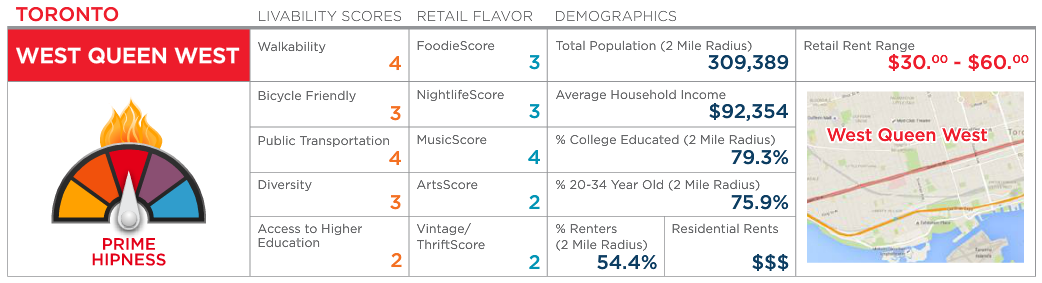
Toronto’s ‘West Queen West‘ came out on top in Canada, referencing a report in Vogue naming West Queen West as Number two on its list of the Top 15 Coolest Neighbourhoods in the World. On the stretch between Bathurst Street and Gladstone Avenue lies “Canada’s largest concentration of independent art galleries, an abundance of independent boutiques, a flourishing restaurant and bar scene, and a couple of new hipster, boutique hotels”. The study goes on to quantify asking rents ranging between $30 and $60 per square foot, compared to top rents of about $120 per square foot on Queen Street West between University Avenue and Spadina Avenue.
An astonishing 75.9% of the area’s population is between the ages of 20 and 34, which is higher than almost every North American area studied.
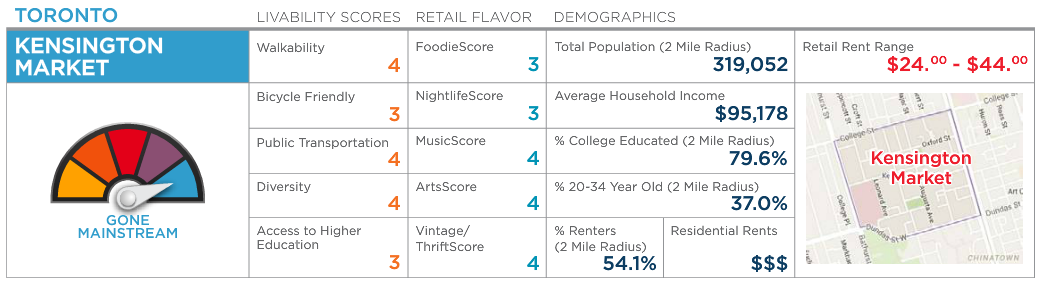
Toronto’s eclectic Kensington Market scored highly, though the study claims that the area has ‘gone mainstream’. Many would debate that this isn’t the case, though a number of chains have recently moved into the area, and redevelopment threatens its outer edges.
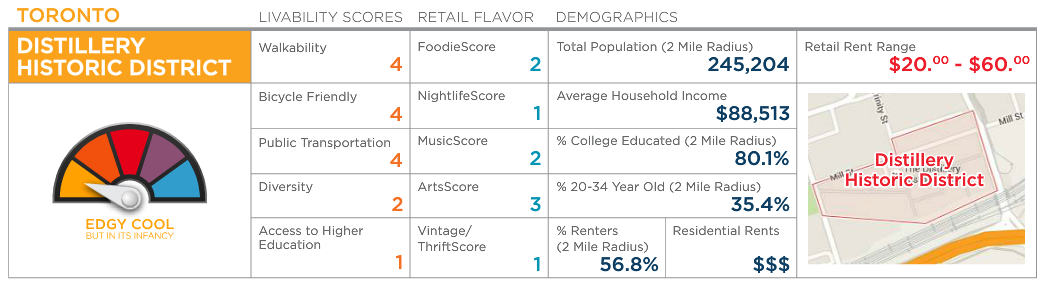
Toronto’s Distillery District is up-and-coming, according to the study, ranking it as ‘edgy cool’. The area will become busier with considerable new residential development nearby, as well as improved public transportation in the area.
VANCOUVER, BRITISH COLUMBIA:
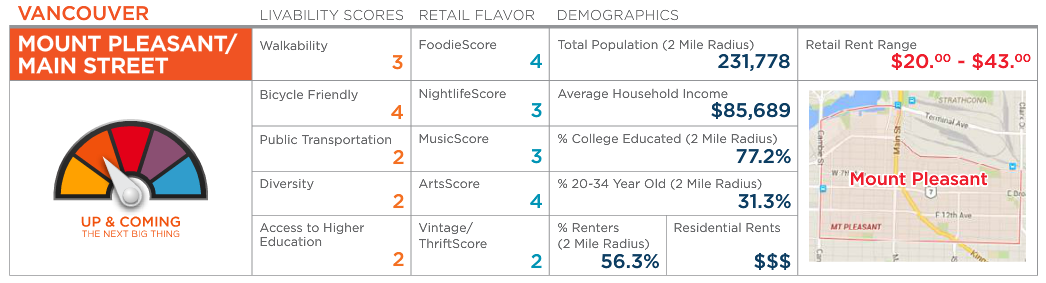
The Cushman & Wakefield study ranked Vancouver’s Main Street/Mount Pleasant as being Canada’s second-trendiest area. The report discusses how the area’s shift from working class to arts district began roughly 20 years ago, and that “this transition has been on steroids over the last five years”. Nowhere have the changes been more profound than near the intersections of Main Street and Broadway, says the report.
Asking rents range between $20 to $43 per square foot according to the study, but those rates “are increasing swiftly,” with Main Street as the epicentre of growth.
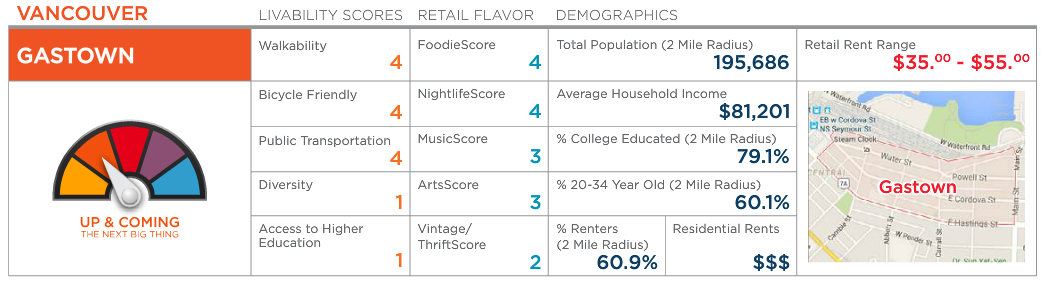
Vancouver’s popular Gastown, also its historic city centre, has a remarkably high number of Millennials living in the immediate area. New stores continue to open in Gastown, including edgy menswear, womenswear and high-priced furniture stores. Gastown is unique in how its north side is flanked by a busy waterfront port, while immediately to the south is Vancouver’s infamous Downtown Eastside, which is also Canada’s ‘poorest postal code‘.
MONTREAL, QUEBEC:
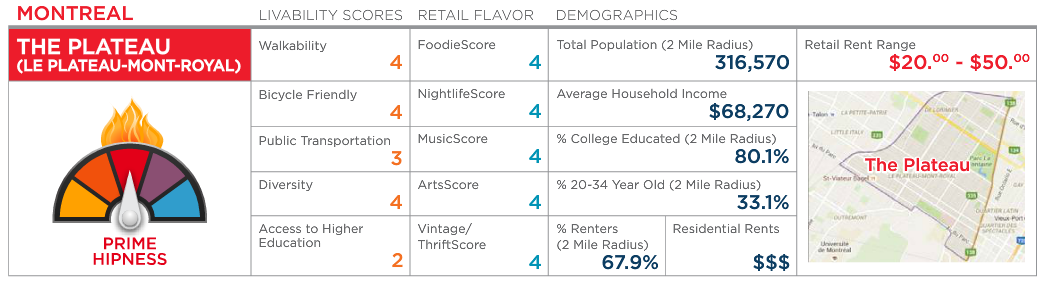
Montreal’s Plateau is consistently ranked as one of the hippest areas anywhere, which makes it surprising that the study saw it rank below areas in Toronto and Vancouver. Regardless, the area is popular with locals and tourists, and is known for its retail innovation and otherwise exceptional ‘cool factor’.
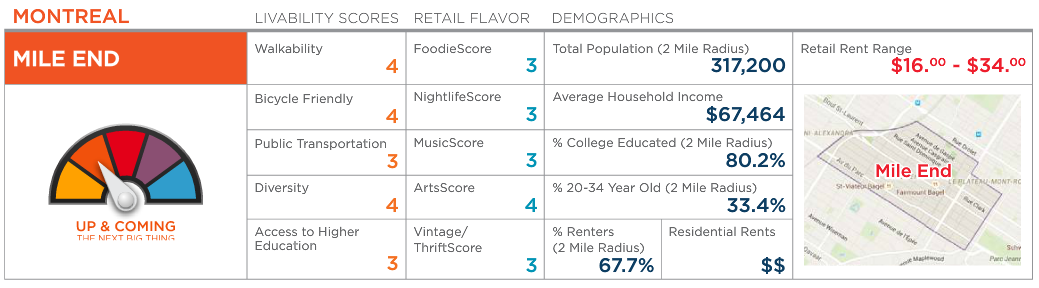
Montreal’s ‘Mile End‘ is also known for being hip, with the study ranking it as being ‘up and coming’. Watch for retail lease rates to rise as new retailers enter.
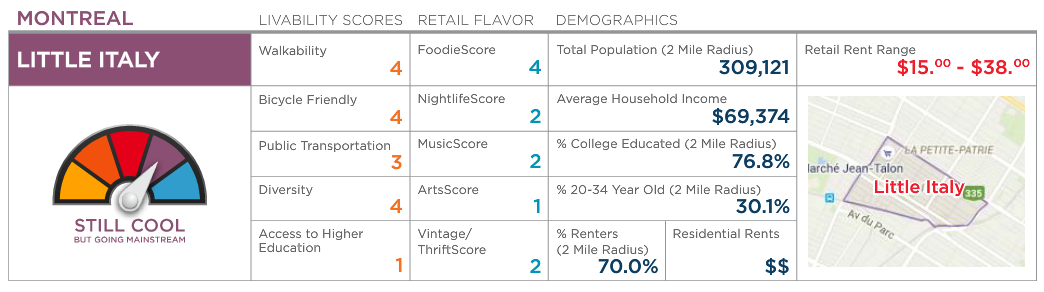
Montreal’s Little Italy area is ‘still cool’, according to the study. There’s a risk, however, that it could go mainstream.
OTTAWA, ONTARIO:
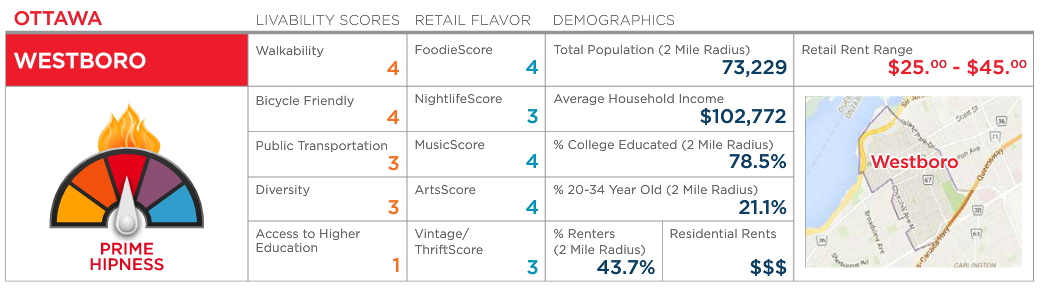
Ottawa’s Westboro area is the undisputed king of cool, in a city generally known for being a stuffy government town. Given its high ranking, its worth noting the rate of high home ownership in Westboro, as well as a population where only 21.1% is between the ages of 20 and 34.
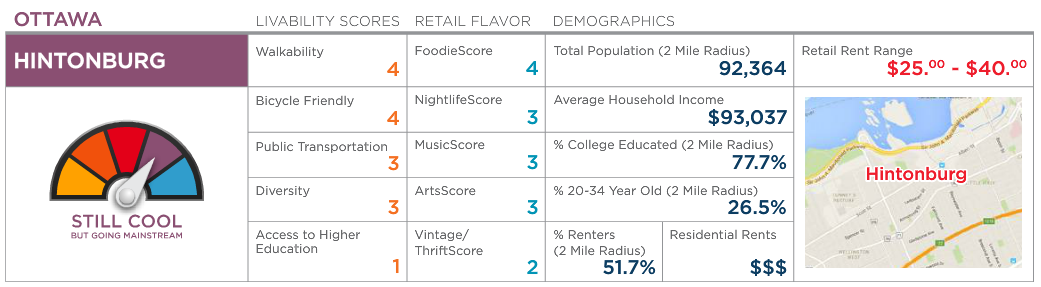
Ottawa’s Hintonburg, west of downtown, is ‘still cool’ according to the study, though it risks losing that status as the area matures.
EDMONTON, ALBERTA:
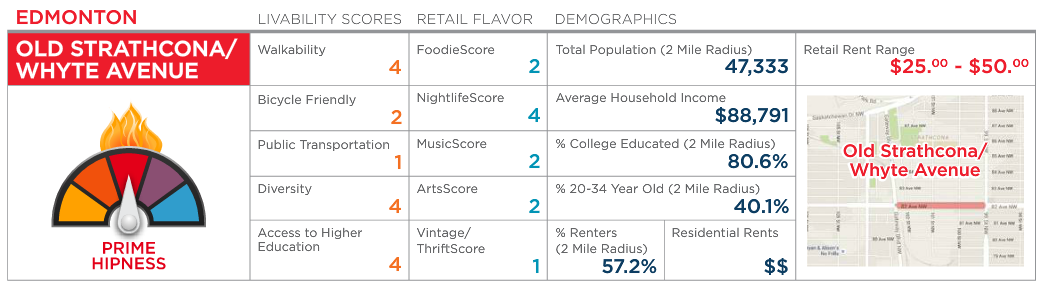
Alberta’s capital city has the provinces ‘coolest’ retail street, according to the Cushman & Wakefield study. Whyte Avenue (82 Avenue) has a variety of stores, restaurants and bars. Renowned fashion and footwear retailer gravitypope began with a single store in the area in the 1990’s, and it continues to operate separate footwear and fashion locations. The area is beginning to see further development that, in the eyes of some, could threaten the historical nature of the area. At least Edmontonians can now boast that their street, and none in Calgary, made Cushman & Wakefield’s top 100 ‘coolest streets’ in 2016.