

In a major development that marks the end of an era in Canadian retail, The Hudson’s Bay Company (HBC) has filed for bankruptcy protection. Beginning Monday, liquidation sales commence at 74 Hudson’s Bay department stores across Canada, with only six locations set to remain open—including three in Ontario and three in Quebec.
The restructuring also impacts HBC’s licensed luxury banners in Canada, with two of the three Saks Fifth Avenue stores—at CF Chinook Centre in Calgary and CF Sherway Gardens in Toronto—also slated for liquidation, alongside all 13 Canadian Saks OFF 5TH stores.

While the news had been rumoured for weeks, the scale of the fallout has shocked observers and devastated staff. Retail employment expert Suzanne Sears, President of Best Retail Careers International, said the human toll of the shutdown is far-reaching.
“Roughly 10,000 people are directly employed by HBC, but when you include contractors and staff from brand shop-in-shops—cosmetics, jewelry, fashion—the number rises closer to 15,000,” said Sears in an interview. “Many of these individuals are career Bay employees. Some have been with the company for 30, 40, even 50 years.”
Devastation on the Sales Floor
Sears visited several stores in Ontario over the past week, including Mapleview in Burlington, Oakville Place, and CF Lime Ridge Mall in Hamilton. She described emotional scenes of employees clinging to hope.
“Staff were hugging each other and crying. They’re devastated,” she said. “These are not just casual jobs—these are people who gave their lives to this company.”
Despite heavy foot traffic amid the sales, she noted an eerie atmosphere in stores.
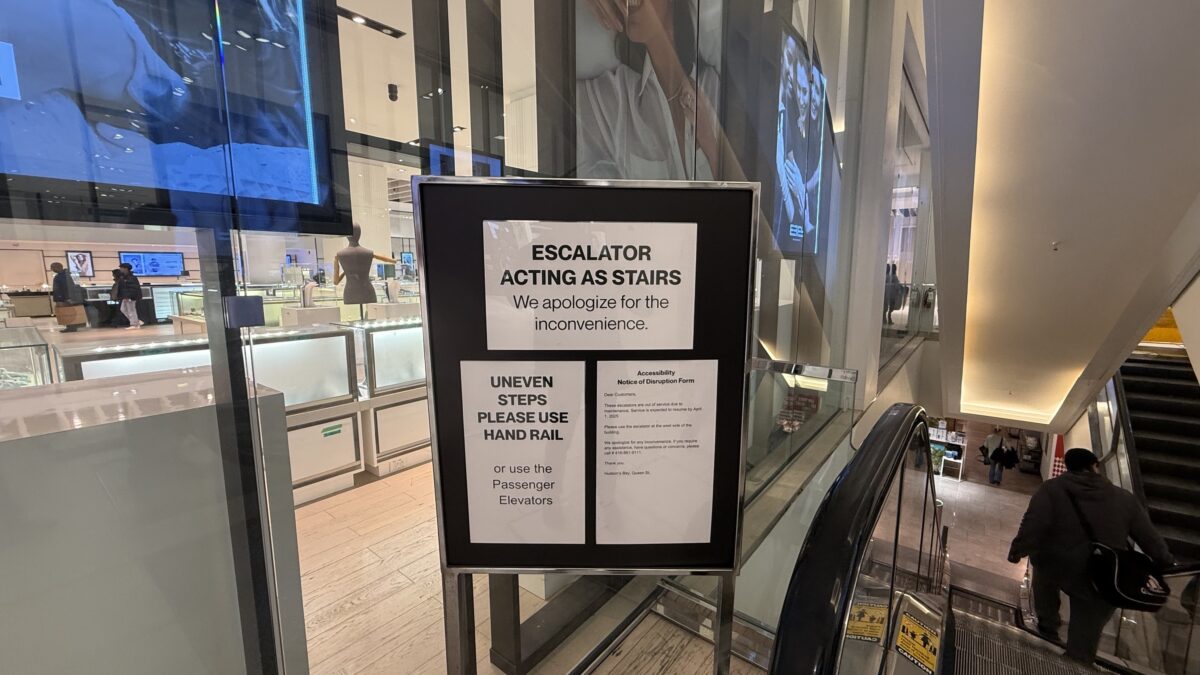
“All the escalators were turned off. Even elevators weren’t working in some locations. You have to leave the store and use the mall escalators just to change floors,” she said.
Sears was also surprised by the quality of certain departments.
“The men’s departments were immaculate, especially at Mapleview. Beautifully merchandised and stocked—it’s ironic to see that just before liquidation.”
Liquidators Move In, Inventory Stripped
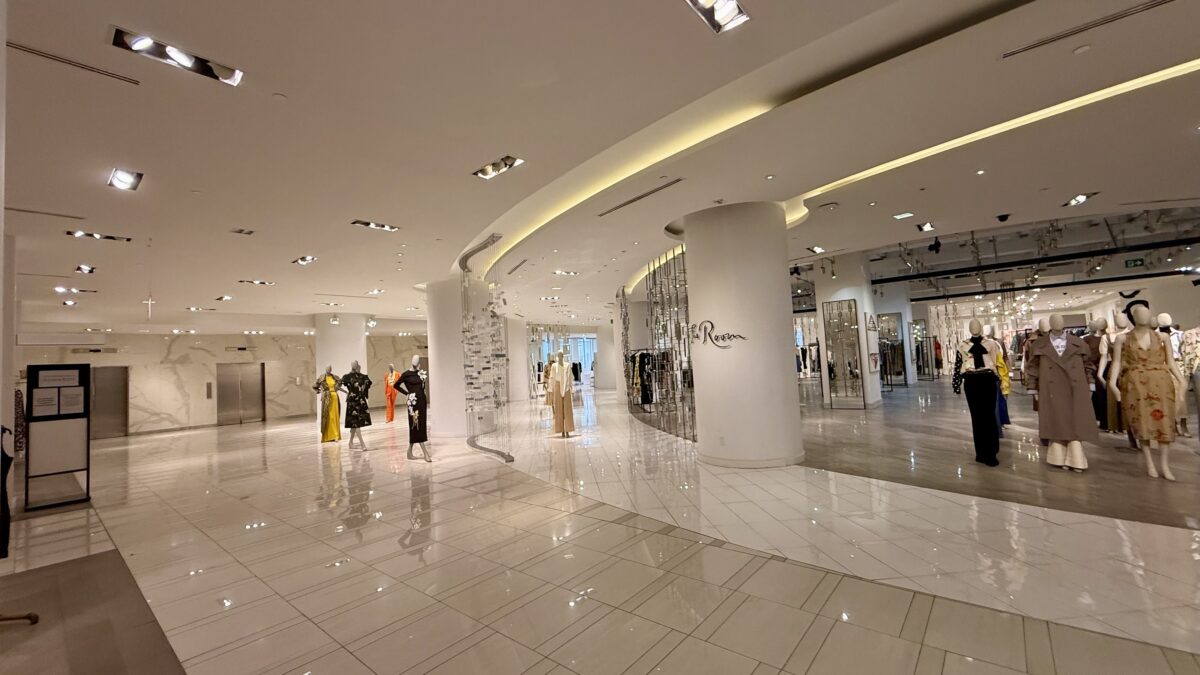
Sears confirmed that external liquidation firms have already taken control, with some cosmetic and perfume counters cleared out and jewelry cases emptied.
“Most luxury beauty brands have pulled their inventory already. You’re seeing empty displays and discount racks resembling Winners stores—chaotic, messy, and picked over,” she explained.
Several international liquidation specialists are reportedly preparing to ship in additional inventory to keep stores stocked throughout the sales.
Employment Fallout and the Bigger Picture
The job losses are not only significant in scale but pose a challenge for the Canadian job market. Sears questioned how the industry would absorb so many displaced professionals.
“There are very few companies left in Canada that can take on full teams of inventory specialists, planners, senior buyers, and regional managers,” said Sears. “These were not just cashiers—these were experts in their fields.”
She warned that older employees in particular will struggle.
“Where do you place someone in their late 50s who’s only ever worked at HBC? Retail was once considered a career. This erodes that notion completely.”
While Sears expects some staff—especially those in luxury sales or specialized departments like men’s tailored clothing—to find work elsewhere, the broader picture is grim.
“People from the Olson shop, men’s suiting, or high-end cosmetics counters will land on their feet. But general merchandise staff? They’re facing limited opportunities,” she said.
Lack of Communication and Support Raises Alarm
Sears was critical of the company’s internal communication with staff, many of whom reportedly had no idea if they were scheduled for shifts beyond this week.
“HBC should have communicated clearly with every employee about their status, exit strategy options, and mental health resources. Leaving people in the dark is unconscionable,” she said.
She also questioned whether employees will receive severance or termination pay.
“In most bankruptcies, staff simply lose out. There’s no union protection for most HBC employees. They’ll be the last to be considered when creditors get paid.”
Retail Careers in Question
Sears didn’t mince words when asked about the long-term prospects for retail workers in Canada.
“This is a death blow to retail as a career. Department stores once offered long-term, well-paid jobs. That era is gone,” she said. “Unless you’re with a luxury European brand—which tend to treat staff better—it’s no longer a viable path.”
She cited La Maison Simons as a Canadian brand that may thrive in the wake of HBC’s collapse.
“Simons is very Canadian, very loyal to its people. They’ll benefit from this, as consumers and workers alike seek alternatives,” she noted.
She also noted the strengths of luxury multi-brand retailer Holt Renfrew, the last of its kind in Canada as Saks prepares to exit the country.
The American Ownership Question
Sears placed much of the blame on HBC Governor Richard Baker and the American private equity model behind the company’s strategy.
“This is Sears Canada all over again. The company was stripped for parts by American interests,” she said. “There needs to be government oversight to prevent these leveraged buyouts from destroying Canadian institutions.”
She pointed to the broader trend of American ownership hollowing out Canadian retail—not just in stores, but also in media and e-commerce infrastructure.
“If we’re going to allow foreign firms to run our largest employers, we need conditions: Canadian head offices, Canadian decision-making, and Canadian employment guarantees,” she insisted.
What Happens Next for Workers?
Sears advised displaced employees to invest in professional resume help and job coaching, especially given the shift toward AI-driven recruitment systems.
“Many of these workers haven’t applied for a job in decades. They were promoted or poached. Now they need to learn to compete in a completely different job market,” she explained.
For those who remain at the six Hudson’s Bay stores still operating, the future remains uncertain. Sears noted that liquidation sales could extend into late spring or early summer, depending on how quickly merchandise sells through.
“Some staff will be rehired on short-term contracts to support these sales, but full-time roles are disappearing fast,” she said.
Final Thoughts: A Canadian Institution in Crisis
The demise of Hudson’s Bay’s full retail footprint is more than a financial collapse—it’s a cultural reckoning.
“This isn’t just about stores closing,” Sears emphasized. “It’s about the loss of a trusted brand, of careers, of stability, and of faith in the system.”
She called on provincial and federal governments, as well as industry organizations like the Retail Council of Canada, to do more.
“Retail is the largest private-sector employer in the country. Yet when crises hit, workers are abandoned. This has to change.”














The irony of the interviewee being named Sears is not lost. its a real shame. I supported HBC as a Bell rep for close to 8 years. Great people now cast astray. Only now there is nowhere else to take their experience.
2/3 Saks stores closing? Does this mean the downtown store is staying open?
“American ownership hollowing out Canadian retail” Ms. Sears is absolutely spot on with her assertions
It’s very sad and it’s too bad a canadian led person didn’t take over. They let it go – it could have reinvented itself!
PRICES ARE WAY TOO HIGH .
The judge said that six stores might be spared, with more spared if sales pick up quickly.
I went to the Quebec city store this weekend, it was FULL of shoppers, everybody was buying, there will hardly be anything to liquidate.
I bought over 1 000$ worth just me. If one million canadians buy 100$, that’s 100$ millions and that would save 10-20 stores.
This place WILL NOT shut down.
We’ve learned nothing from the debacle around Sears Canada’s closing where loyal, long tenured employees were discarded.
Even the Feds used the “It’s a private company, nothing to do with us” to dodge their responsibilities. It has everything to do with the Federal government, who else is going to create a more secure framework for protecting workers during an organisation’s demise?
In the UK, employees are legally preferential creditors.
As it should be!
Why should employees be ahead of other creditors during the demise of a business? The unfortunate reality when a company fails is that there will be a number of parties—-employees, landlords, suppliers, service providers, financial institutions and others—-who will not receive the full value of what is owing to them.
As far as government involvement, corporate leadership in a free market are allowed to operate their business as they see fit, subject to areas such as competition law, taxes, advertising rules and labour legislation. It’s never been a violation of the law for companies to fail to change with consumer preferences or to not adapt to new market realities. The penalty is simply going out of business. It’s never been illegal to run a company poorly and make bad strategic decisions.
I enjoy Craig Patterson’s retail reporting. The scope, the detail … and brief, to the point. That said, the reactions are often compelling. Interesting. Everything from the articulate and well observed to the absolute retarded ( yes, folks, I can use that word ). Annemarie’s commentary is a case in point. For the past quarter century, HBC has positioned themselves as a “bridge” retailer – definition : not bottom of the barrel pricing and not luxury pricing … a.k.a . Giant Tiger vs. Holt Renfrew. They were priced conveniently in the middle strata. The challenge was ( for years ) they didn’t employee experienced staff to explain and promote the product ; moreover, the didn’t hire enough staff given their massive retail acreage. Winnipeg saw this. Epic landmark flagship store. Rotting. St. Vital Shopping Mall. Tumbleweed. Polo Park Shopping Mall. A haven for shop – lifting. I recently mentioned to my fellow friends in Winnipeg : ” I am surprised they lasted as long as they did … ” HBC can resurrect and resurface as long as the new iteration is knowledge of folks current buying habits and to provide a bricks-and – mortar experience that is competitive, vibrant, exciting … we are living amidst most challenging times, bombarded by so much negativity … an exciting retail experience can manifest positivity … and hope …
With all due respect Robert the bay cannot come back. Brick and Mortar is finished and any attempts to revive it is just a waste of time. Stores like Simone and Holt Renfrew are still around because they adapted to the changes years ago and so customers have a better experience going there. Also helps that they’re footprint isn’t massive like the bays was.
Absolutely spot on with the notion that future attempts of foreign takeovers need stringent contingencies protecting Canadian employment, localized incorporation, territory rights, managerial discretion, etc. These retailers have failed Canada, not the other way around. Canadians actually want to shop at the Bay, wanted to shop at Target, Sears, etc. However American owners had other ideas and sabotaged all three companies to the detriment of Canadian consumer choice and retail employee job losses.
Meanwhile I just read on the NYT of Printempts from France opening its first store stateside in NYC. It’s a beautiful store but occupies a much more modest 55K sqft, a far cry from the 150K+ sqft or flagship 600K+ sqft behemoth stores HBC operates. Maybe that is a clue of potential uses for the upcoming HBC store footprints?
Holt Renfrew essentially operates as a mall-within-a-mall, leasing space within its store to third party brands while collecting rent. Why couldn’t the Bay have pivoted to a similar strategy? Rather than buying tons of inventory to scatter across its huge stores, why not lease huge chucks to brands directly? This happened to a degree with certain brands like Levis operating a full boutique within the Vancouver flagship. There are certainly brands looking to secure space that would likely save money operating from within a Bay store vs renting their own dedicated space in a CRU. This allows HBC to abstain the responsibility of selling merchandise directly to the consumer and puts the onus on the vendor. Brands can build their own space, hire their own associates and create a compelling shopping environment on their own dime while driving foot traffic to the Bay. Sounds like a win-win and Holts certainly enjoys this arraignment.
I am very saddened by the closure of our Hudsons Bay store i have been an employee for 10 years and have a close bond with our staff. It is a shame this is our canadian heritage and it should have been protected better.
I owned two retail stores for 34 years . Companies like HBC needed to learn how to change with the times and stay current . Unfortunately they never did and that was their demise. Every time I walked into HBC the escalators didn’t work and they seemed to be running with a skeleton staff on every floor . I was always wondering to myself how HBC stayed in business as long as they did .Today people require great customer service more than ever , and that comes from the top . It was almost as if they gave up and lost interest when taking a stroll through the store . I blame all this on the president and executives who never really stayed current and allowed the Bay to fall from grace . I feel bad for all the employees who were doing there job but never got the proper support they needed . I truly hope all the staff find new employment.