Canadian-born designer Cody Aker is making his mark on the international fashion stage with his London-based label ARSENY. Born in Calgary, Alberta, far from fashion’s traditional centres, Aker has built a brand that questions identity and reshapes ideas of masculinity. His journey reflects a broader trend of Canadian creatives seeking global platforms while drawing on uniquely personal experiences.
Aker’s path to launching ARSENY began in retail, not design studios. He worked at Louis Vuitton and Prada, where he observed how luxury brands cultivate both craftsmanship and storytelling. These formative years were about more than selling garments. They introduced him to the machinery of global luxury: the codes of service, the balance of exclusivity and accessibility, and the importance of client engagement.
“Working in luxury exposed me to fashion’s systems. With ARSENY, I wanted to turn that insight towards building something values-based, critical and new,” he has said. This philosophy anchors his brand in reflection as much as aesthetics.
The guiding philosophy of ARSENY
ARSENY revolves around the principle of UNMASC — a recognition that masculinity, so often positioned as truth, is in fact a performance. Through this lens, clothing becomes a tool to reveal the constructed nature of identity rather than conceal it.
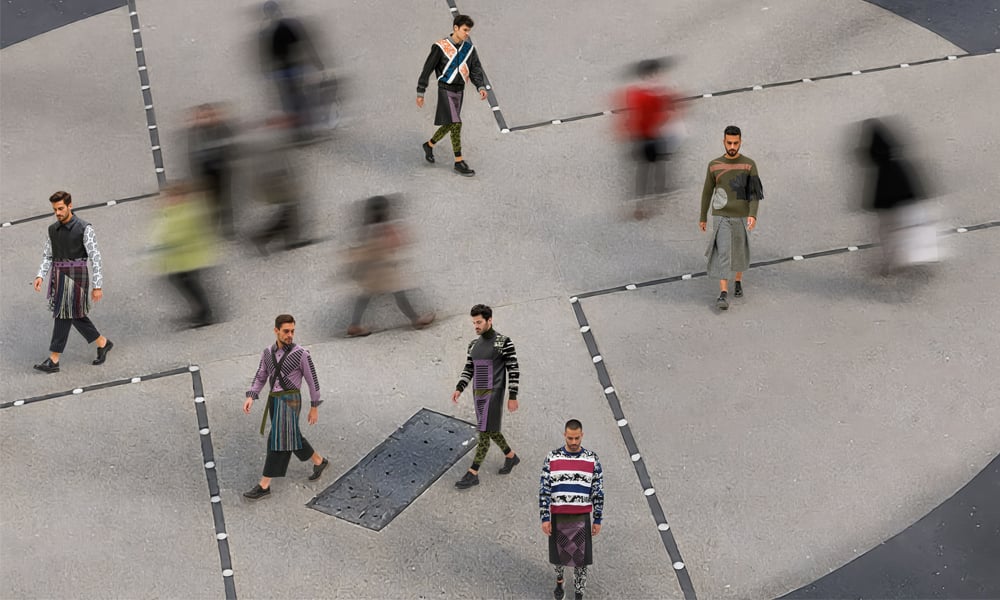
Aker’s garments are built on contrasts. A traditional roll-neck knit is unsettled by a jacquard pattern that appears to glitch between organic textures and digital pixels. Tailoring takes familiar forms but rebalances its lines, subtly shifting proportions off-centre. These are not loud disruptions but quiet interventions, inviting wearers to notice, to question, and to reinterpret.
The clothing remains wearable, resisting the trap of becoming pure concept. Aker insists that ARSENY is not about spectacle for spectacle’s sake but about creating garments that are lived in and thought through. The paradox of ARSENY lies in its ability to be experimental while remaining accessible.
Recognition within London’s fashion ecosystem
Though still an emerging label, ARSENY has already begun to register within London’s highly competitive fashion ecosystem. Aker’s work has appeared on a London Fashion Week runway, garnered support from the British Fashion Council, and earned a feature on SHOWstudio, a digital platform known for spotlighting forward-thinking fashion.
These signals matter. London is a crucible for innovation, often regarded as the most conceptually daring of the four global fashion capitals. Designers such as Alexander McQueen, JW Anderson, and Craig Green built their reputations there by interrogating identity and subverting norms. ARSENY’s arrival aligns with this lineage, situating Aker within a city known for giving young talent room to experiment.
London as a launchpad for Canadian designers
Aker is not alone in choosing London as the place to develop a career. The city has long attracted Canadian designers seeking both training and visibility. Erdem Moralıoğlu, born in Montreal, established his eponymous label in London after studying at the Royal College of Art, and today his brand is stocked globally. Thomas Tait, originally from Montreal, also found early recognition in London, winning the inaugural LVMH Prize in 2014.
This migration reflects both opportunity and necessity. Canada’s domestic market, while sophisticated, is comparatively small and lacks the infrastructure to support young designers at scale. London, by contrast, offers access to industry institutions, media platforms, and global buyers. Aker’s own decision to study at the University of Westminster — a program known for producing forward-looking designers — placed him within this ecosystem.
The broader menswear conversation
Aker’s work arrives at a moment when menswear itself is in flux. Over the past decade, fashion has shifted from rigid tailoring traditions toward an embrace of fluidity, comfort, and cultural commentary. Designers like Kim Jones at Dior Men and the late Virgil Abloh at Louis Vuitton pushed the boundaries of what men’s fashion could signify, blending streetwear codes with luxury craftsmanship.
ARSENY does not directly mimic those approaches but instead asks a different question: what happens when masculinity is treated not as a fixed state but as an ongoing negotiation? In this way, Aker’s brand participates in a global dialogue about identity while offering a uniquely Canadian perspective shaped by distance from fashion’s historic centres.
Balancing contradiction and openness
In interviews and statements, Aker has consistently resisted framing ARSENY as a definitive debut or as the next great disruptor. He sees fashion as “a space for becoming,” a platform where garments function as instruments for exploration rather than conclusions. This stance resists the pressure to codify a new set of rules and instead emphasizes inhabiting contradiction.
The appeal of ARSENY lies in its openness. Aker is not dictating how masculinity should look but rather inviting wearers to dwell in uncertainty. In a fashion industry often driven by trends, declarations, and absolutes, this emphasis on remaining “unfinished” is a radical form of generosity.
Canadian contributions to global fashion
ARSENY also underscores the growing influence of Canadian-born talent in international fashion. Beyond Moralıoğlu and Tait, names such as Aurora James, founder of the New York-based brand Brother Vellies, and Jason Wu, known globally for his womenswear and work with high-profile clients, have carried Canadian sensibilities abroad.
What these designers share is not a single aesthetic but a perspective shaped by Canada’s cultural plurality and geographic remove. Aker’s Calgary upbringing offered distance from fashion capitals, which in turn may have given him the freedom to question assumptions. His London base allows him to translate those questions into a global language.
Looking ahead for ARSENY
As ARSENY evolves, the label is positioning itself not through seasonal hype but through sustained inquiry. For Canadian retail watchers, this trajectory is significant. It highlights how homegrown talent is finding resonance in international arenas while maintaining connections to Canadian identity.
The road ahead will likely see ARSENY build greater visibility through shows, editorial coverage, and retail partnerships. Yet Aker remains clear that growth should not compromise the brand’s guiding principle: fashion as a space for dialogue, not prescription.