

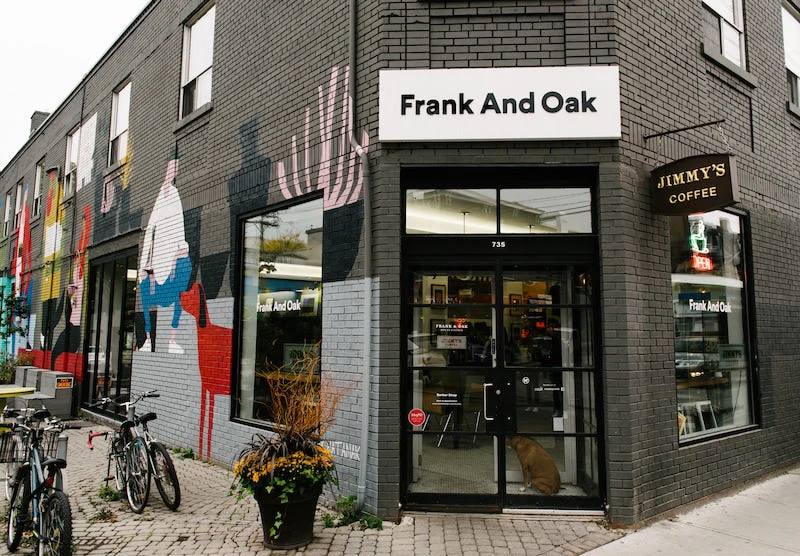
Canadian clothing brand Frank And Oak, long celebrated for its sustainability-driven approach to fashion, is closing the doors to all 14 of its physical stores across Quebec, Ontario, and British Columbia. The announcement comes as part of a broader restructuring effort under court supervision, with ownership of the brand transferring to Montreal-based Lamour Group and Thread Collective Inc.
The decision follows the approval of the sale by the Superior Court of Quebec, effectively ending the retail operations of Frank And Oak’s parent company, UGC Canada Holdings Inc., which is expected to file for bankruptcy in the coming days. While stores will be liquidated, Frank And Oak’s brand will live on through e-commerce, offering a continued online presence for Canadian customers.
A Brand in Flux: From Darling to Distress
Founded in 2012 by Ethan Song and Hicham Ratnani, Frank And Oak quickly rose to prominence by blending stylish design with sustainability. Originally a digital-native brand, its early success was driven by eco-conscious millennials drawn to ethically sourced materials, closed-loop production, and a minimalist aesthetic.
Physical stores followed, opening across major Canadian cities. Flagship locations in Montreal and Toronto featured community-driven experiential retail spaces, further enhancing the brand’s image as an innovator.
Despite its popularity, however, Frank And Oak has struggled to achieve long-term financial viability. Its first bankruptcy filing came in 2020, with over $19 million in debt. It was then acquired by Unified Commerce Group (UCG), a New York-based firm specializing in retail turnarounds. UCG’s goal was to help Frank And Oak scale while retaining its values. But the revival has not gone as planned.
Mounting Debt and Financial Pressures
In January 2025, Frank And Oak filed once again for creditor protection under Canada’s Bankruptcy and Insolvency Act. The filing revealed staggering debts totalling $71 million. Secured creditors were owed $55.5 million—including UCG itself and financial institution Desjardins. Unsecured creditors were owed another $14.6 million.
Among the largest unsecured creditors were:
- Canada Border Services Agency (CBSA): $3.5 million
- Canada Revenue Agency (CRA): $1.7 million
- Shopify: $529,000
- Prepaid card customers: Approx. $504,000
- Global manufacturers and logistics providers
A December 16 letter from UCG CEO Dustin Jones acknowledged the gravity of the situation.
“Despite significant growth over the past few years, the company has struggled to recover from losses incurred as a result of the COVID-19 pandemic,” Jones wrote, citing the lasting impacts of operational disruptions and a shift in consumer habits.
Earlier this month, the company announced it would close 10 stores. The number has since expanded to all 14, marking the end of Frank And Oak’s brick-and-mortar era—for now.
Pandemic Fallout and Global Pressures
The pandemic’s effects were far-reaching. Supply chain disruptions and border delays impacted inventory flow. U.S. operations shuttered amid tariff uncertainty, and increased shipping costs only added to the strain.
But external pressures also played a key role. Damien Siles of the Quebec Retail Council pointed to macroeconomic challenges:
“Inflation, rising operational costs, and weakening consumer confidence have left many Canadian retailers struggling. Frank And Oak is not alone.”
Siles also criticized the federal government for failing to provide protections against international e-commerce giants.
“Companies like Shein and Temu introduce thousands of SKUs daily and ship directly to consumers with little oversight. That makes it incredibly hard for Canadian brands to compete.”
Transition to New Ownership
Despite the collapse of UGC Canada Holdings Inc., the Frank And Oak brand will continue under new ownership. Lamour Group, headquartered in Montreal, specializes in manufacturing and distributing apparel globally. The group is acquiring Frank And Oak’s intellectual property, while existing inventory is expected to be sold off through liquidation.
Thread Collective Inc., also involved in the purchase, is expected to help guide the brand’s next chapter.
In a statement, the companies emphasized that Frank And Oak’s digital storefront will remain active, and they are currently evaluating future strategies that may include relaunching the brand in select markets or through new retail channels.
While few operational details were provided, some industry watchers suggest a “digitally native vertical brand” (DNVB) strategy could be used to relaunch Frank And Oak with tighter inventory, direct-to-consumer margins, and leaner operations.
A Warning for Canadian Fashion Retailers
The story of Frank And Oak is one of inspiration and caution. What began as one of Canada’s most promising sustainable fashion ventures has now entered its second major restructuring within five years.
The rise and fall of the brand highlights not only the challenges of growing in a competitive, cost-sensitive retail environment but also the structural disadvantages many Canadian retailers face. Domestic fashion brands continue to grapple with higher costs, slower logistics, and limited support against aggressive international entrants.
Still, Frank And Oak’s strong brand equity and devoted following give it a fighting chance under Lamour’s stewardship—especially if it leans into its online capabilities.
Whether Frank And Oak’s next iteration can recapture its early success remains to be seen. But for now, the chapter closes on its physical retail footprint as another Canadian fashion brand finds itself navigating turbulent waters.














Alas, the news is mixed, with another Canadian enterprise collapsing and more empty storefronts. I suppose the consolation is that ownership of the brand has been repatriated and the business could continue digitally. I hope Lamour Group can engineer a successful revival.