Food Inflation in Canada Has Become a Structural Crisis

Date:

Share post:

Canada’s Food Price Report 2026 projects that food prices will rise by another 4% to 6% next year. For the average family of four, that means spending roughly $17,571 on groceries in 2026 — close to $1,000 more than this year. Food is now 27% more expensive than it was just five years ago. This latest forecast simply confirms what many Canadians already experience every time they walk into a grocery store: the squeeze is no longer cyclical. It is structural.

To understand where we are headed, we need to be clear about how we arrived here. A long-term review of seasonally adjusted Canadian CPI data, from 1993 to today, reveals a telling pattern. Food inflation did not begin to outpace general inflation during the pandemic, nor did it start with the global disruptions of the past four years. The divergence — this gradual decoupling of food inflation from overall inflation — began earlier, under the Harper government, around 2008 to 2010.
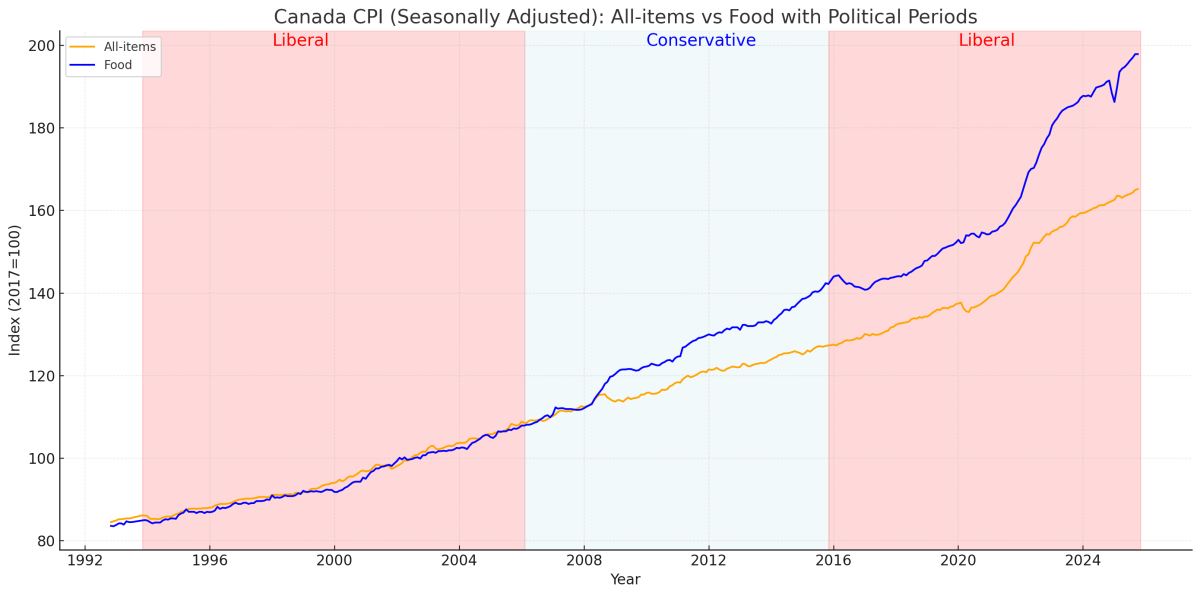
That timing matters not because it points to any single domestic policy choice, but because it underscores how global the shift truly was. The late 2000s marked the first major global food commodity crisis of the modern era. Energy prices spiked, extreme weather events disrupted harvests, and supply chains strained under growing complexity. Canada, deeply integrated into global agricultural markets and reliant on imported inputs for food manufacturing, was inevitably pulled into these forces. The decoupling that began then has persisted ever since, through governments of all political stripes — widening further over the last four years.

Today’s food price pressures reflect accumulated, long-standing structural weaknesses: chronic underinvestment in food processing capacity, high transportation and energy costs, labour scarcity across every segment of the agri-food sector, and a retail landscape in which a small number of players exert disproportionate influence. Add to that climate volatility, geopolitical uncertainty, and the fragility of global supply chains, and the outcome is sustained food inflation that no rebate, tax credit, or political announcement can easily correct.

A critical insight comes from Michael Graydon, CEO of Food, Health & Consumer Products of Canada. He argues that Canada does not suffer from a lack of productivity because its firms are unproductive; we suffer because our manufacturing ecosystem lacks depth.

He’s right.

Canada has world-class multinational plants operating at peak efficiency within their global networks. We also have thousands of small firms with talent, ingenuity, and ambition. What we lack is a strong, scaled “middle” — firms large enough to invest in automation, advanced processing, AI, and modernization. This missing middle is where productivity gains typically emerge. Without it, fewer companies can scale, innovate, or compete. And without it, multinational firms have less incentive to assign new global mandates to Canada. When both ends of the ecosystem — the large and the small — cannot grow together, competitiveness erodes. That erosion eventually shows up in consumer prices.

This same conclusion is reinforced in the latest Global Agri-Food Most Influential Nations Ranking prepared by Dalhousie University’s Agri-Food Analytics Lab and developed in partnership with MNP, which highlights Canada’s shrinking competitiveness in critical parts of the value chain.

The latest Food Price Report makes one thing clear: the affordability crisis is not an aberration. It is a defining characteristic of today’s food economy. Governments often respond with temporary rebates, targeted tax measures, or calls for grocers to stabilize prices, but these measures do not address the underlying issues. They are patches on a system that has been drifting for well over a decade.

If Canada is serious about improving food affordability, it must face these structural issues directly. That means reducing dependence on foreign processing, rebuilding the missing middle in manufacturing, investing in resilient regional supply chains, modernizing our transportation infrastructure, supporting innovation in food production, and strengthening competition within the retail sector. It also requires acknowledging the limits of domestic policy in a world where food is traded globally and increasingly influenced by climate disruptions and geopolitical tensions.

The 2026 forecast is a reminder that the trend lines are all pointing in the same direction. Food inflation separated from general inflation more than fifteen years ago and has not converged since. The pandemic exposed the vulnerability of our supply chains, but it did not create it. Rather, it revealed the cost of ignoring long-term warning signs.

Canada now faces a choice. We can continue to treat food inflation as a temporary irritant, hoping it will fade as global conditions stabilize. Or we can confront it as the structural challenge it has become. The data — spanning decades and multiple governments — is unequivocal: unless Canada commits to a deliberate national strategy that rebuilds depth and competitiveness in its food, health, and consumer products ecosystem, the gap between food prices and household incomes will only continue to widen.


More from Retail Insider:

Sylvain Charlebois
Sylvain Charlebois
Dr. Sylvain Charlebois is Senior Director of the Agri-Foods Analytics Lab at Dalhousie University in Halifax. Also at Dalhousie, he is Professor in food distribution and policy in the Faculty of Agriculture. His current research interest lies in the broad area of food distribution, security and safety, and has published four books and many peer-reviewed journal articles in several publications. His research has been featured in a number of newspapers, including The Economist, the New York Times, the Boston Globe, the Wall Street Journal, Foreign Affairs, the Globe & Mail, the National Post and the Toronto Star.

Subscribe to the Newsletter

Subscribe

* indicates required

LEAVE A REPLY

Please enter your comment!
Please enter your name here

Recent articles

Dollarama sees more than 21% year-over-year sales growth in Q1, surpassing $1.8 billion

Net earnings increased by 10.4% to $302.3 million, resulting in a 13.3% increase in diluted net earnings per common share to $1.11, compared to $0.98.

Advertising influencing people to place a bet: CPA Canada

“You can’t hide from it; gambling ads are everywhere."

lululemon Returns to Oakridge Park with New Store Concept

lululemon has returned to Oakridge Park with one of its newest Canadian store concepts, featuring Pacific Northwest-inspired design, local programming and community engagement.

Pinterest sports trend report shows surge in women’s sports fashion and beauty trends

The La Roche Posay activation will run until July 22. 

German outerwear brand Wellensteyn targets 2nd Canadian store after strong Niagara debut

The success of the 2,350-square-foot store at Outlet Collection at Niagara demonstrates that Canada is a promising market for the international company and the goal is to open another in 2027.

Jersey Mike’s Subs to open 3rd downtown Toronto location

Redberry will open the third downtown Toronto Jersey Mike’s Subs at 160 Bloor St. E. on Wednesday June 17, with a fundraiser for Make-A-Wish Canada.

Honestly Good Chicken Fingers opens 4th location at Stock Yards Village in West Toronto 

With locations in Etobicoke, The Well and Vaughan Mills, the Stock Yards Village opening marks the fourth location in the Toronto area and sets the stage for broader growth across Canada and the United States.

CFIB urges Ottawa to protect supply chains in Canada Labour Code reforms

"Cancelled orders, delayed shipments, lost income: small businesses pay the price every time federally regulated supply chains grind to a halt."

Financial anxiety surges across Canada with six-month spike as more people struggle to keep up with basic costs

The number of those gripped by anxiety when thinking about personal finances has surged to 60%.

Chanel Opens Largest Store in Canada at Oakridge Park in Vancouver

Chanel has opened its largest store in Canada at Oakridge Park in Vancouver. The 13,000-square-foot location is the brand's first full-concept store in Canada and a key addition to the development's luxury retail lineup.

What Happened to Canada’s Women’s Fashion Chains?

Many of Canada’s iconic women’s fashion chains have disappeared. Retail expert Antony Karabus explains how fast fashion, casualization and economic shifts changed the industry.

Daily Synopsis: Jun 10, 2026

FIFA store opens in downtown Vancouver without price tags, Calgary's European Bakery marks 20 years, Montreal Dunkin' operators bank on nostalgia, Bulgari unveils Oakridge Park store, vagrancy concerns on Spring Garden Road in Halifax, and other news.

Licensed establishments in Alberta now able to serve alcohol as early as 6 a.m.

This change gives licensees the option to open earlier to meet business needs and customer demand, including during occasions such as international sporting events and cultural celebrations.

How small businesses are leveraging social media and AI to capture consumer attention: Constant Contact

Globally, 73% of small business owners identify as "Creators" in some capacity.

A&W launching major Canadian airport expansion of Pret A Manger

The first Canadian Pret airport location is expected to open in the international terminal at YVR in early June, with additional airport openings anticipated to continue through the second half of 2026.

VIDEO: Calgary Downtown Revitalization gains momentum

Addressing safety remains a priority, with the city advancing a community-based strategy alongside increased enforcement and services.

Canadian Tire Positioned to Gain Market Share as Retail Consolidation Continues: Report

A new analyst report suggests Canadian Tire is well positioned to benefit from retail consolidation in Canada through its banners, loyalty program, owned brands and True North strategy.

Cineplex partners with Too Good To Go to tackle food waste

Since its launch in 2015, Too Good To Go has helped save more than 600 million meals, avoiding emissions of 1.6M tonnes of CO2 equivalent.

IKEA introduces meatball-flavoured lollipops

The meatball-flavoured lollipop is not an IKEA product but the result of a creative collaboration with Chupa Chups. It will be available for tasting only and will not be sold.

Daily Synopsis: Jun 9, 2026

Ikea bringing meatball-flavoured lollipops to stores, Birks secures loan for store renos, Lego opening store at CF Toronto Eaton Centre, T&T Supermarket to begin construction in Burnaby's Brentwood, and other news.

UNIQLO announces 5 new Canadian store openings for Fall 2026

With these five new stores, UNIQLO's Canadian network will grow to 42 locations.

Royal de Versailles Builds Multi-Brand Luxury Hub on Bloor Street

Royal de Versailles unveils a major Bloor Street renovation including new Tudor and Omega boutiques in Toronto.

Stockouts push shoppers to competitors as loyalty erodes, DOSS study finds

Out-of-stock products are costing brands more than a single sale.

Canadian Franchise Association to Mark World Franchise Day

The franchise industry in Canada contributed over $143 billion to the national GDP in 2025—far exceeding the previous projection of $133 billion.

VIDEO: Canada’s economic uncertainty driving entrepreneurs toward franchising: TD explains why

A recent TD survey found that 27% of Canadians say the economy is too uncertain to start a business and 24% are not comfortable with the financial risk involved.