Advertisement
Advertisement

Storytelling Doesn’t Fail. It Just Rarely Makes It to the Consumer (Opinion)

Date:

Share post:

By Anthony Coppers, Founder & Head of Innovation at GRADIENT

The dominant advice to CMOs right now is to own the narrative.

That framing is already outdated.

What is actually happening across the industry is not a fight for narrative control, but a recognition that narratives only survive if they are tested, interpreted, and lived by consumers. And that realization has quietly moved the conversation from marketing departments to the C-suite.

When Ralph Lauren brings Cesar Conde, Chairman of NBCUniversal News Group, onto its board, it is not a branding gesture. It is an acknowledgment that media, editorial, and cultural fluency are now strategic infrastructure. 

Anthony Coppers
Anthony Coppers

This is not about better campaigns. It is about understanding how stories travel, gain trust, and collapse when they fail to connect with real life.

The same shift is visible at Gap, which appointed Pam Kaufman, formerly of Disney and NBCUniversal, as Chief Entertainment Officer. GAP is not trying to become a studio. It is trying to relearn how to participate in culture, how to collaborate with creators, and how to rebuild emotional relevance with consumers who no longer respond to traditional brand narration.

At LVMH, the creation of 22 Montaigne Entertainment formalizes the same belief.

Entertainment and editorial are no longer treated as marketing outputs, but as long-term narrative assets that sit alongside product and retail strategy.

These are not isolated moves. They are signals that storytelling is being reclassified as a leadership concern.

But here is where many analyses stop short.

Long-form content, entertainment, and editorial are necessary, but they are not sufficient. They still assume a passive consumer. They still ask people to watch.

Today’s consumer wants to participate.

As content becomes more cinematic and staged, audiences are gravitating toward what feels imperfect, analog, and real. Physical experiences they can enter. Moments they can live, even if they later capture and share them digitally. Meaning that feels discovered, not imposed.

This is why experiential is not a tactic. It is the missing completion layer.

The brands ahead already operate this way.
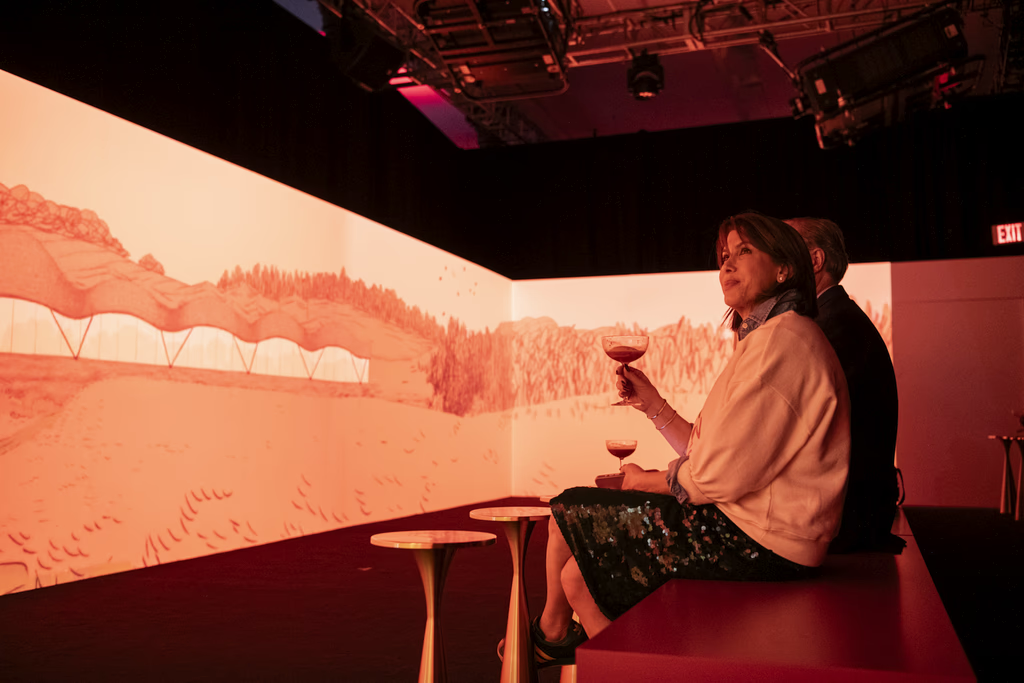
Photo: GRADIENT
Photo: GRADIENT

Barbie did not succeed because Mattel made a film. It succeeded because the narrative escaped the screen and became an environment. 

Installations, fashion collaborations, creator reinterpretation, retail moments. The story lived in culture, and culture wrote the next chapter.

Red Bull has long understood that belief is built through lived proof, not messaging. Content amplifies experience, not the other way around.

In beauty, Sephora has turned retail into an educational and communal environment. What remains underleveraged is the opportunity this creates. 

Stores are not only points of sale. They are content engines, community hubs, and feedback systems where brand meaning is shaped in real time and can be amplified far beyond the physical space.

Across categories, the pattern is the same.

Narrative sets intent.

Experience tests truth.

This is also why influencers matter differently than most brands still treat them.

Influencers are not channels. They are cultural representatives. Scaled consumers who interpret brand stories through lived context. The smartest brands do not brief them to repeat messages. They invite them into environments where inspiration happens and then observe what creators choose to capture, share, and amplify.

That is how trends are actually found. By listening, not declaring.

The consequence of all this is structural.

Photo: GRADIENT
Photo: GRADIENT

If storytelling, entertainment, and culture now sit at the C-level, then experiential expertise belongs there too.

Not as event production. As system design.

Boards and executive teams need a measurable, repeatable way to translate narrative into lived consumer journeys. Environments that are designed once, deployed consistently, and scaled across markets.  Experiences that connect content, creators, retail, and data into a single loop.

This is how storytelling finally reaches the consumer. This is how brands move from messaging to belief.

And this is why experiential thinking is no longer optional at the boardroom level.

Storytelling does not fail. It just needs the right system to survive contact with reality.

More from Retail Insider:

LEAVE A REPLY

Please enter your comment!
Please enter your name here

More From Retail Insider

RECENT RETAIL INSIDER VIDEOS

Advertisment

Subscribe to the Newsletter

Subscribe

* indicates required

RECENT articles

VIDEO: 87% of Canadians feel financially trapped by rising living costs: Harris & Partners

85% report their overall monthly expenses have increased in the past 12 months

Butterly Trust Index Maps AI-Era Product Reviews

Butterly is making a clear argument that will resonate with any retailer or brand watching consumer discovery change...

Abercrombie & Fitch Expands Canadian Store Network

Abercrombie & Fitch expands in Canada with new stores planned in Winnipeg and Ottawa and a reopened location at West Edmonton Mall.

Daily Synopsis: Mar 11, 2026

What might be next for Roots, Pokemon cards hot for theft, downtown Sudbury mall wins legal battle over 2004 Zellers exit, and other news.

Women Entrepreneurs Reshape Canada’s Franchise Industry

Women entrepreneurs are gaining momentum in Canada’s franchise sector, with leaders expanding into construction, automotive, and skilled trades.

Future of Calgary’s Hudson’s Bay Building Discussed

Experts will discuss the history, current status, and potential future of Calgary’s historic Hudson’s Bay building at a public event on March 26.

MUJI opening its newest Canadian store in British Columbia

MUJI has steadily grown as the go-to brand for millions of loyal customers in 30+ countries and 7,000+ products.

Dr. Phone Fix reports over 50% same-store growth and productivity improvements following Geebo acquisition

Dr. Phone Fix said it has begun transitioning the Geebo locations from repair-focused service centres into a broader retail platform.

Sleep Country CEO sees growth amid consumer uncertainty, expands U.S. and UK operations: Stewart Schaefer interview

“I'm bullish for the second half of 2026. And I'm even more bullish into 2027."

More than 1.3 million temporary work permits set to expire by the end of 2026, leaving small businesses scrambling: CFIB

According to CFIB’s Monthly Business Barometer, skilled labour shortages remain the second highest constraint on sales and growth for 39% of small businesses.

Specsavers appoints Jane Hoban as Managing Director to lead next phase of Canadian expansion

Since entering the Canadian market in 2021, Specsavers said it has rapidly expanded to become one of the country's leading optical providers.

Loblaw notifies customers of low-level data breach

Loblaw Companies Limited is Canada’s food and pharmacy leader, as well as its largest retailer and private sector employer with more than 220,000 colleagues across the country.

Grocery Shoppers Embrace Pajama Wear Amid Economic Shift

Quick grocery trips and convenience-driven shopping habits are reshaping how consumers interact with food retailers.

Pharmacy Brands Canada partners with Horizon Healthcare on integrated care pharmacy in Edmonton

Pharmacy Brands Canada operates a national pharmacy banner program representing more than 280 independently owned pharmacies across the country.

Daily Synopsis: Mar 10, 2026

Loblaw investigates data breach after hack, Cellcosmet beauty launches at Holt Renfrew, former RCC director joins CFIG, downtown safety efforts, and other news.

Leyad Acquires Lloyd Mall in Lloydminster

Leyad acquires Lloyd Mall in Lloydminster, strengthening its strategy of investing in necessity-anchored regional retail centres.

AI-Driven Fraud Scams Impact Canadian Retail: Interac

Interac survey finds AI-driven fraud scams rising in Canada, influencing consumer trust and retail shopping behaviour across the country.

Home Improvement Spending Shifts in Canada

New Environics Analytics data links online mass merch shoppers to renovation growth, aging-in-place trends, and shifting population dynamics.

Kettlemans Bagel eyes franchising push as sandwich sales drive growth: Amer Wahab interview

The company operates four locations in Ottawa, two in Toronto and one in Montreal. The original store opened about 32 years ago at 912 Bank St. in Ottawa.

Beavertails eyes growth through retail expansion and strategic store openings: Pino Di Ioia interview

The company’s brick-and-mortar operations are experiencing double-digit growth.